Best AI Animation Video Generator (Game-Trailer Tested)

By Arron R.10 min read
The best AI animation video generator for game trailers in 2026 depends on the shot: Wan 2.7 wins on open-weights cost ($0.10/sec, Apache 2.0), Kling 3.0 wins o

The phrase “best AI animation video generator” gets typed into Google by indie game devs who need a trailer, not a research benchmark. The honest answer in 2026 is that no single video model wins every shot in a game trailer — establishing flyovers, hero close-ups with synced dialogue, fast action B-roll, and stylized title-card animations all have a different model in the lead. This is a shot-by-shot test of the best AI animation video generator for indie game trailers, verified against vendor documentation on June 6, 2026 and run inside the actual Sorceress AI Video Gen panel where all four leading models live behind one credit pool.
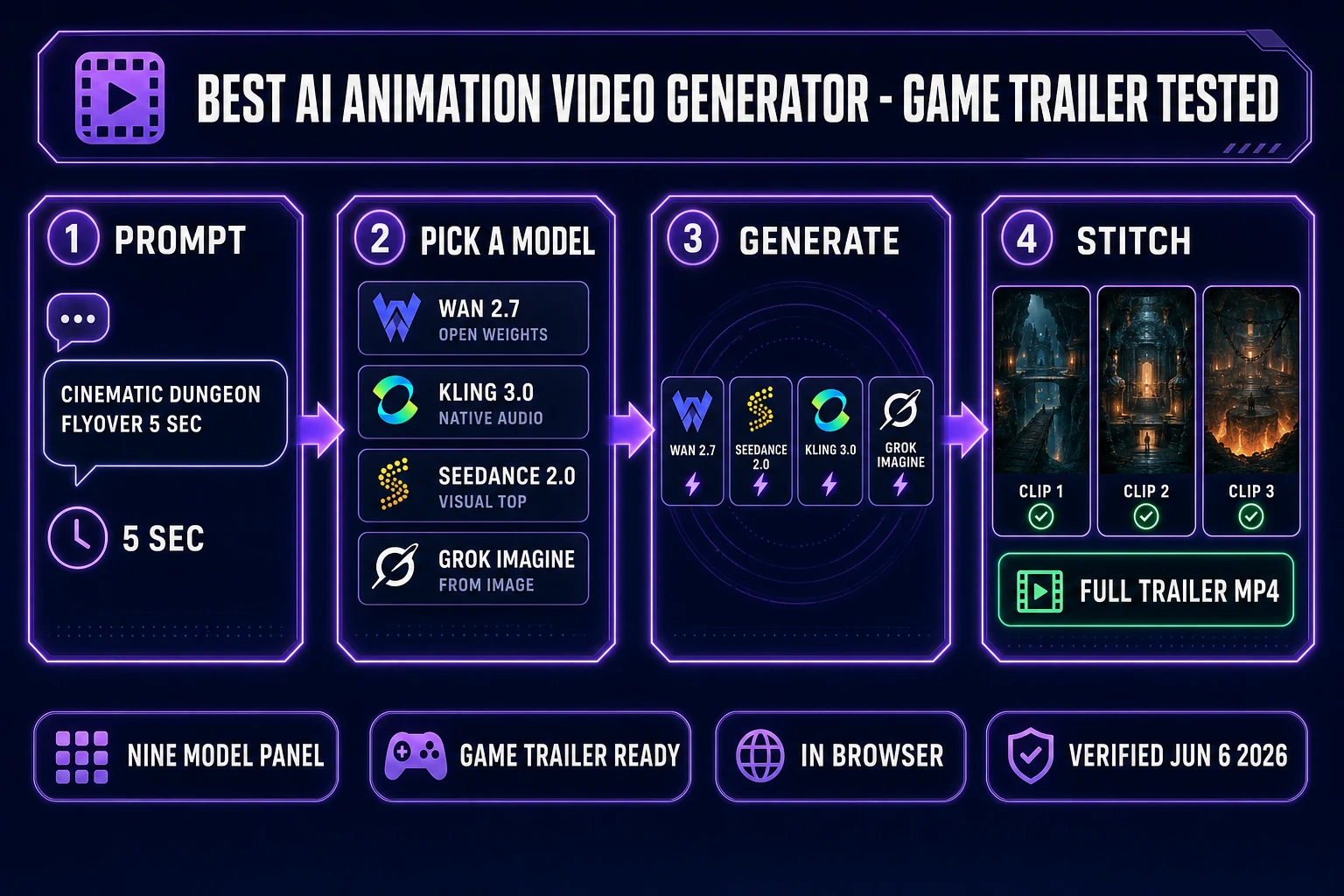
Pipeline diagram of the best AI animation video generator workflow for game trailers: prompt, pick a model (Wan 2.7, Kling 3.0, Seedance 2.0, or Grok Imagine), generate, then stitch into a finished trailer MP4, verified June 6, 2026.
The four-step game-trailer pipeline: prompt the shot, pick the model that leads that shot kind, generate, stitch into a finished trailer. Nine models live in one Sorceress panel.

What “best AI animation video generator” actually means for a game trailer

A game trailer is not one animation; it is a stitched sequence of three to twelve short clips, each with a different job. The opening establishing shot needs scale and camera-movement consistency. The hero close-up needs lip-synced dialogue or at least synced ambient audio. The action B-roll needs frame-level coherence at speed. The title-card sequence wants stylized motion, not photorealism. Asking “which is the best AI animation video generator?” without naming the shot kind is the wrong question, and it’s why every vendor’s benchmark scoreboard reads differently depending on what their team optimised for.

The four model families that lead the 2026 AI video generation space — Wan 2.7 (Alibaba Tongyi Lab), Kling 3.0 (Kuaishou), Seedance 2.0 (ByteDance), and Grok Imagine Video (xAI) — each win a different shot kind. All four live behind the same Sorceress AI Video Gen panel on a single credit pool, which is the trick that makes “pick the best AI animation video generator per shot” a one-tab workflow instead of four-account juggling. Pair each generated clip with AI Image Gen for source stills, Music Gen for the trailer score, and Sound Studio for SFX and voiceover.

Wan 2.7: the open-weights best AI animation video generator on cost

Wan 2.7 is the four-model video suite from Alibaba’s Tongyi Lab released in March and April 2026 under the Apache License 2.0. Verified June 6, 2026 against Together AI’s April 3, 2026 launch post and the Wan 2.7 quickstart docs: the suite ships four endpoints — text-to-video (Wan-AI/wan2.7-t2v), image-to-video with keyframe control (Wan-AI/wan2.7-i2v), reference-to-video for character consistency (Wan-AI/wan2.7-r2v), and instruction-based video editing (Wan-AI/wan2.7-videoedit) — all built on a shared 27-billion-parameter Mixture-of-Experts transformer backbone. T2V and I2V cap at 15 seconds per clip; R2V and Video Edit cap at 10 seconds. Output is 720p or 1080p at 30fps in MP4.

Together AI Serverless Inference runs Wan 2.7 at $0.10 per second of generated video. Apache 2.0 means the weights are downloadable from Hugging Face and ModelScope, so a 24 GB GPU runs the inference pipeline free after hardware cost — useful when a trailer needs forty short B-roll clips and per-second pricing stops penciling out. For a five-second establishing shot at 1080p, Wan 2.7 lands the price at $0.50 on Together AI, which is the cheapest entry point in the 2026 cinematic-quality tier. The Sorceress AI Video Gen panel exposes Wan 2.7 with first-and-last-frame control via the Kie.ai integration, so you can lock the start frame of one clip to the end frame of the previous one for visual continuity across a multi-clip trailer.

Kling 3.0: the cinematic best AI animation video generator at 1080p with audio

Kling 3.0 from Kuaishou is the cinematic-leaning closed-source pick and the only one of the four with native synced audio generation. Verified June 6, 2026 against the official Kling VIDEO 3.0 Model User Guide published February 6, 2026: generation costs 6 credits per second at 720p without audio, 8 credits per second at 1080p without audio, 9 credits per second at 720p with native audio, and 12 credits per second at 1080p with native audio. A voice-control add-on for character-bound voices runs an extra 2 credits per second on top. Single-shot clips run 3-15 seconds; the 3.0 release added a multi-shot mode that chains 2-6 connected scenes in one call, plus a 4K output tier above 720p and 1080p.

Native audio is the differentiator for hero-close-up trailer shots where dialogue lipsync matters. A five-second 1080p clip with a wizard speaking a single line of dialogue costs 60 credits on Kling 3.0 native audio; the same shot from Wan 2.7 needs a separate text-to-speech pass and a manual lipsync alignment step. The Sorceress panel exposes Kling 3.0 with the no-audio single-shot mode and Kling 3.0 Motion Control as separate sub-models, plus Kling 2.5 Turbo Pro for cheaper 5-second drafts at 40 credits and 10-second drafts at 80 credits per the lineup verified against src/lib/video-models.ts on June 6, 2026.
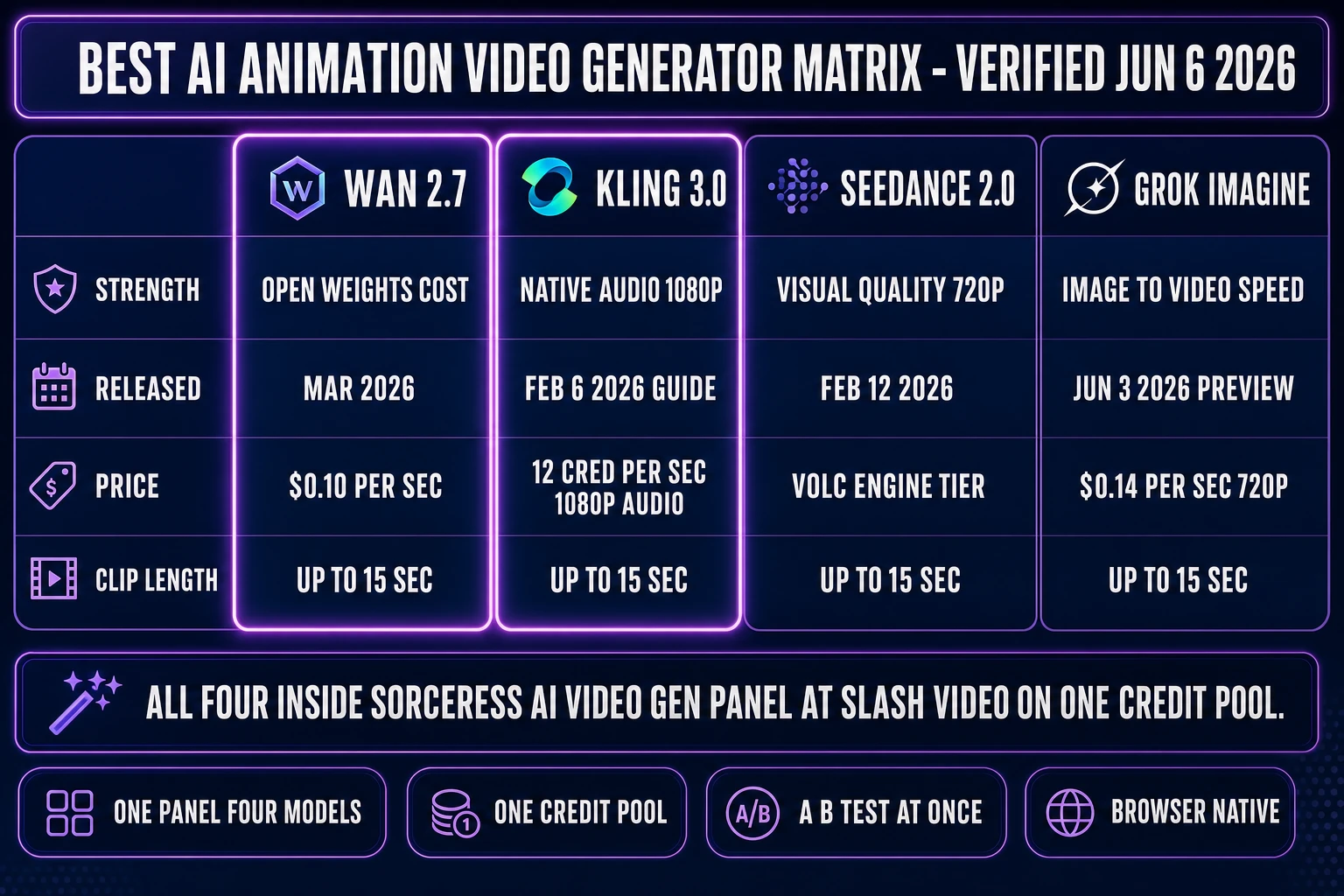
Comparison matrix of the best AI animation video generator options for game trailers: Wan 2.7, Kling 3.0, Seedance 2.0, and Grok Imagine, with strengths, release dates, price per second, and clip length per column, verified June 6, 2026.
The four-column matrix: Wan 2.7 wins on cost, Kling 3.0 wins on native audio, Seedance 2.0 wins on visual quality, Grok Imagine wins on image-to-video speed. All four live in one Sorceress panel.

Seedance 2.0: the visual-quality best AI animation video generator at 720p

Seedance 2.0 from ByteDance launched on Doubao and Jimeng on February 12, 2026 with a unified multimodal audio-video joint generation architecture supporting text, image, audio, and video inputs (verified against the Seedance 2.0 Wikipedia entry). The originally planned global API launch on February 24, 2026 was postponed indefinitely after cease-and-desist letters from Disney, Warner Bros., Paramount, Sony, Netflix, and the Motion Picture Association; ByteDance officially confirmed the overseas API suspension on March 15, 2026 and the model later resurfaced on the Volcano Engine console with stricter compliance gating in April 2026.

For trailer work specifically, Seedance 2.0 is the visual-quality leader at 720p with stylized hero shots: golden-hour profile shots of a character, magic-effect cast animations, slow-motion impact frames. The Sorceress AI Video Gen panel exposes Seedance 2.0 Fast as the recommended ByteDance variant (4-15 second clips, 480p/720p/1080p, with the generate_audio parameter on by default), Seedance 2.0 standard, and Seedance 1.5 Pro as a fallback. Pricing inside the Sorceress credit pool runs 15 credits per second at 720p and 8 credits per second at 480p for Seedance 2.0 Fast per the schedule verified against src/lib/video-models.ts on June 6, 2026, so a 5-second 720p clip is 75 credits, or roughly $0.75 on the $10 / 1,000 credit pack.
Grok Imagine Video: the image-to-video best AI animation video generator from a still

Grok Imagine Video from xAI is the image-to-video specialist in the lineup. Verified June 6, 2026: xAI announced Grok Imagine 1.5 Preview on June 3, 2026 with the API model name grok-imagine-video-1.5-preview, which turns a single still image into a fluid cinematic clip at up to 720p, with prompt-driven camera moves, atmosphere, and physics that keep the original image’s lighting and detail intact. The xAI API charges $0.08 per second at 480p and $0.14 per second at 720p, plus a one-time $0.01 image-input fee per generation. Duration runs 1-15 seconds. The free xAI consumer tier gives 5 generations per day.

Inside the Sorceress AI Video Gen panel, Grok Imagine Video is wired through the xAI provider path with both image-to-video and text-to-video modes, 1-15 second duration, 480p or 720p resolution, and seven aspect ratios from 16:9 to 2:3. The shot-kind it wins is “concept art animated for the trailer’s opening frame” — when the asset is a static key-art still and the trailer needs that exact image to start moving without reinterpretation. For game trailers built from existing concept art, Grok Imagine Video is the cleanest path because the model holds detail and lighting from the input frame instead of regenerating the scene.

The game-trailer test: which shot kind goes to which best AI animation video generator

The honest game-trailer test is shot-by-shot, not model-by-model. Here is how a typical 30-second indie game trailer maps to the four model winners as of June 6, 2026.

Shot 1, opening 5-second dungeon flyover (scale + camera move): Wan 2.7 T2V on Together AI at $0.50 for the 1080p clip, or 50 credits inside the Sorceress credit pool. The Apache 2.0 open-weights status keeps the price honest for the longest shot in the trailer. Reference frame lock via the Kie.ai first-frame parameter keeps the dungeon’s torch placement consistent if you regenerate.

Shot 2, 5-second hero close-up with single dialogue line (lipsync matters): Kling 3.0 1080p native audio at 12 credits per second, total 60 credits. No second text-to-speech pass, no manual lipsync alignment. For a Steam-page hero video where the dialogue is the hook, this is the only one of the four models that ships it in one generation.

Shot 3, 5-second action B-roll (magic spell cast, golden hour, stylized): Seedance 2.0 Fast at 720p, 15 credits per second, total 75 credits. The visual-quality lead at 720p makes the difference on highly stylized particle and lighting work where Wan 2.7 sometimes goes flat.

Shot 4, 5-second concept-art-to-motion title card (key art animated): Grok Imagine Video at 720p, $0.14 per second on the xAI API, total $0.70. The image-to-video subject-stability lead means the key art ends up moving without losing the studio’s house style.

Total cost for the four-shot 20-second trailer core inside the Sorceress credit pool: roughly 250 credits, or $2.50 on the $10 / 1,000 credit pack. Stitch the four clips with end-frame conditioning on Wan 2.7 and Seedance 2.0 for visual continuity. Add Music Gen for the score and Sound Studio for SFX, both in the same browser tab.

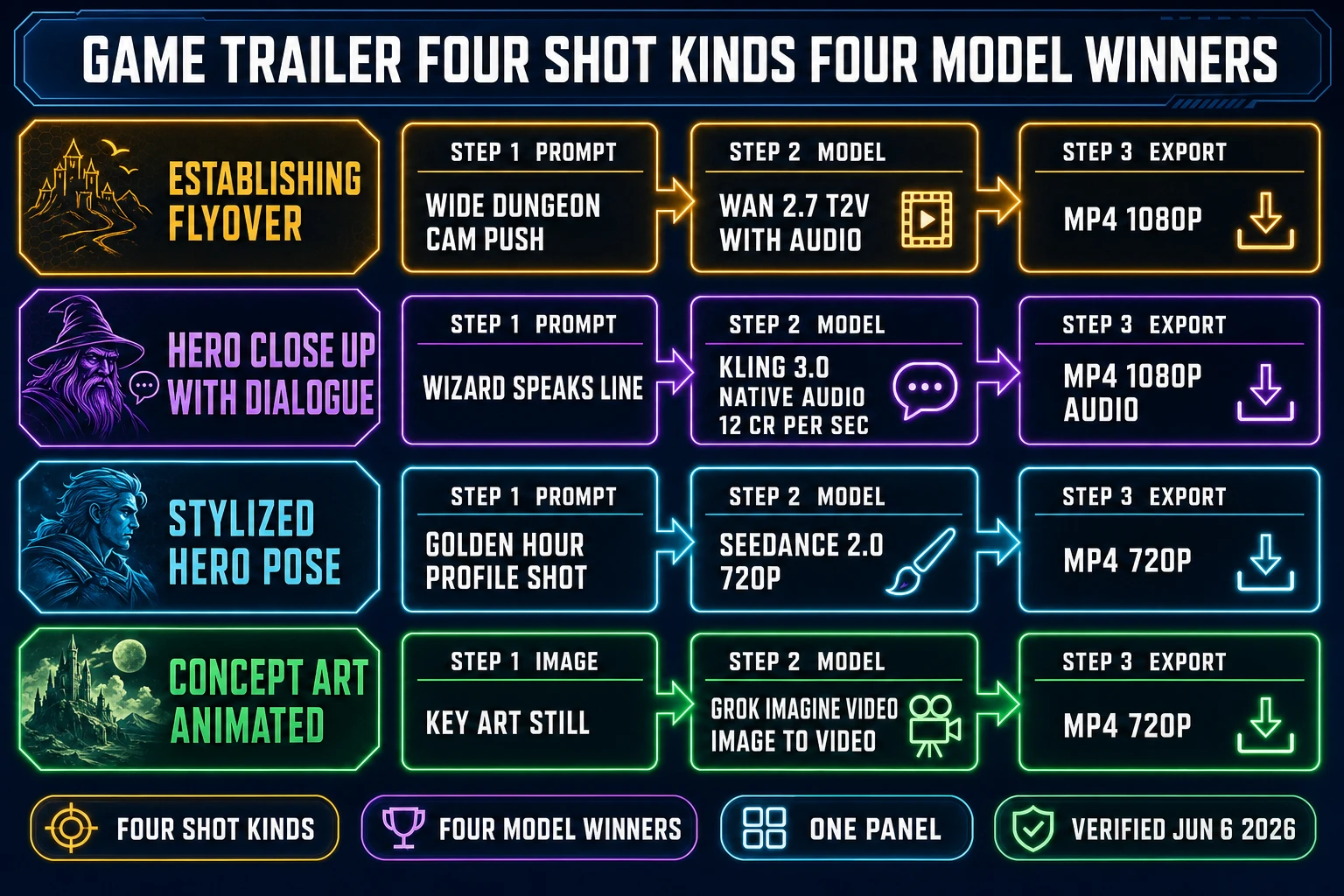
Four-lane pipeline diagram for the best AI animation video generator by trailer shot kind: establishing flyover with Wan 2.7, hero close-up with Kling 3.0 native audio, stylized hero pose with Seedance 2.0 720p, and concept art animated with Grok Imagine image-to-video, verified June 6, 2026.
Four shot kinds, four different model winners. Picking per-shot removes 90 percent of the “which is the best” indecision and gives the trailer a sharper edit.

The unified panel: why Sorceress runs every best AI animation video generator candidate in one tab

The Sorceress AI Video Gen panel at /video runs nine video models in one place, verified against src/lib/video-models.ts on June 6, 2026: Grok Imagine Video (xAI provider), Wan 2.7 with first-and-last-frame control via Kie.ai (uncensored I2V and T2V), Seedance 2.0 Fast (recommended ByteDance variant), Seedance 2.0 standard, Seedance 1.5 Pro, Wan 2.2 Fast (uncensored I2V with interpolation), Kling 3.0 with no-audio single-shot mode, Kling 2.5 Turbo Pro, and Kling 3.0 Motion Control with motion transfer from a reference video at 9 credits per second standard or 14 credits per second pro.

The pragmatic value of the unified panel is the A/B test: queue the same prompt across Wan 2.7, Kling 3.0, and Seedance 2.0 in parallel, then pick the clip that interpreted the shot best. Vendor benchmarks always tell a story; an empirical three-way comparison on your actual prompt tells the truth. The credit pool removes the friction of three separate accounts and three separate billing cycles. For an indie team building a game trailer over a weekend, “the best AI animation video generator” stops being one product and starts being three or four picked per shot, generated in parallel, stitched into the timeline by Sunday night.

The non-video tools in the Sorceress stack carry the rest of the trailer: AI Image Gen for source key-art and concept stills that feed image-to-video, 3D Studio for rigged character animation that no video model can produce (per the Khronos glTF 2.0 specification for the cross-engine runtime format), Auto-Sprite v2 for trailer-ready sprite sheets if the trailer is for a 2D game, Music Gen for the orchestral or chiptune score, and Sound Studio for the SFX layer.

The verdict: how to pick the best AI animation video generator for your trailer

The verdict on the best AI animation video generator for game trailers in 2026 is that the question is the wrong shape. The right shape is “which model leads the kind of shot I am cutting next?” and the answer rotates four ways: Wan 2.7 for cost-controlled cinematic clips and the longest shots, Kling 3.0 for hero close-ups with native dialogue audio, Seedance 2.0 for stylized 720p hero work, and Grok Imagine Video for animating existing concept art without losing the studio’s look.

For a brand-new indie project picking one model to start with, the practical default is Wan 2.7 — Apache 2.0 open weights mean it never gets pulled from under you, the $0.10 per second on Together AI is the cleanest price in the tier, and the 15-second clip ceiling matches the longest shot most trailers ever need. Layer Kling 3.0 in for the one or two close-ups that need synced dialogue, Seedance 2.0 Fast for the most stylized hero shot, and Grok Imagine Video for the title-card animation. Generate all four inside Sorceress AI Video Gen on the same credit pool, stitch the clips with the end-frame conditioning Sorceress exposes on Wan 2.7 and Seedance 2.0, and finish the trailer with Music Gen and Sound Studio — all without opening a fifth browser tab.

The 100 starter credits new Sorceress accounts receive are enough to test all four models on a single trailer shot before committing to a credit pack. The plans page covers the no-expiry credit math; the Sorceress tool guide maps every tool to the trailer step it owns; the Sorceress home page ties the whole stack together. For deeper reading on the underlying animation primitives: the Animation Wikipedia entry covers the medium’s first-principles history, Computer animation covers the digital pipeline, and the Khronos glTF 2.0 specification covers the runtime format every engine reads.

For sibling deep-dives on the broader animation cluster: the best AI animation generator (honest 2026 test) covers the parent category beyond just video; the cinematic AI animation generator piece goes deeper on the trailer-cutscene split; the Renderforest AI animation generator game test compares the legacy template-based path; the Canva AI animation generator piece reviews the marketing-tool angle for game motion; and the Perchance AI animation generator review covers the strictly-free tier. Each addresses a sibling sub-vertical of the broader animation-tool stack.

Frequently Asked Questions

What is the best AI animation video generator for game trailers in 2026?

There is no single best AI animation video generator that wins every game-trailer shot, because trailers need at least four shot kinds (establishing flyovers, character close-ups with synced audio, fast action B-roll, and stylized title cards) and no one model leads all four. Verified June 6, 2026 against vendor documentation: Wan 2.7 (Alibaba Tongyi Lab, Apache 2.0 open weights, launched March 2026 on cloud platforms) is the cost winner at $0.10 per second on Together AI Serverless Inference, ideal for high-volume B-roll. Kling 3.0 (Kuaishou) is the cinematic winner at 12 credits per second for 1080p with native audio per the official Kling VIDEO 3.0 Model User Guide published February 6, 2026, ideal for character close-ups with synced dialogue. Seedance 2.0 (ByteDance, launched February 12, 2026 on Doubao and Jimeng) is the visual-quality winner at 720p, ideal for stylized hero shots. Grok Imagine Video (xAI) is the image-to-video speed winner, ideal for animating still concept art into motion. All four sit behind the same Sorceress AI Video Gen panel at /video on one credit pool, so the right answer to 'which is best' is 'pick per shot, generate in one tab.'

How does the best AI animation video generator compare on price per second of generated video?

Verified June 6, 2026 against vendor documentation, the best AI animation video generator on raw price-per-second is Wan 2.7 at $0.10 per second on Together AI Serverless Inference per their April 3, 2026 launch post, with the open-weights Apache 2.0 license letting you self-host on a 24 GB GPU at zero per-generation cost after hardware. The xAI API for Grok Imagine Video 1.5 Preview (released June 3, 2026 per x.ai's announcement page) lists $0.08 per second of 480p output and $0.14 per second of 720p output. Kling 3.0 charges 6 credits per second at 720p without audio and 12 credits per second at 1080p with native audio per the official Kling VIDEO 3.0 Model User Guide; on Kling's Standard consumer plan that works out to roughly $0.13 per second at 720p and $0.24 per second at 1080p with audio. Seedance 2.0 on the Volcano Engine API tier starts higher because the global commercial launch originally planned for February 24, 2026 was indefinitely postponed after cease-and-desist letters from Disney, Warner Bros., Paramount, Sony, Netflix, and the MPA. The Sorceress AI Video Gen panel abstracts all four into one credit pool at $10 for 1,000 credits with no expiry.

Is there a best AI animation video generator with native audio synced to the visuals?

The best AI animation video generator with native audio is Kling 3.0 (Kuaishou) as of June 6, 2026. Per the official Kling VIDEO 3.0 Model User Guide published February 6, 2026, native-audio generation costs 9 credits per second at 720p and 12 credits per second at 1080p, on top of the standard 6 and 8 credits per second for no-audio variants. The native-audio mode generates synchronized dialogue, sound effects, and background music in a single pass without a separate text-to-speech step. Voice control as a character-bound voice add-on costs an extra 2 credits per second. Seedance 2.0 also supports multimodal audio-video joint generation per the Seedance 2.0 Wikipedia entry but the global API for native-audio synthesis is suspended pending the IP-rights resolution. Wan 2.7's audio-conditioned generation runs through the reference-to-video endpoint (Wan-AI/wan2.7-r2v on Together AI) rather than as a native joint mode. For game trailers where dialogue lipsync matters, Kling 3.0 is currently the practical pick.

What is the best free AI animation video generator for indie game projects?

The best free AI animation video generator in 2026 is the one with enough free generation to ship a real trailer prototype, not the largest watermark-locked free tier. Verified June 6, 2026 against the Sorceress source at src/app/_home-v2/_components/HomeHero.tsx and src/app/plans/page.tsx: Sorceress hands new accounts 100 starter credits with no expiry; that funds a few seconds of Wan 2.7 image-to-video, a Kling 3.0 short clip at 720p, and a Seedance 2.0 Fast generation on day one with no watermark. The credit packs are $10 for 1,000 credits, $20 for 2,000, $50 for 5,000, and $100 for 10,000 credits, all with no expiry. The alternative free options have tighter ceilings: Wan 2.7 is Apache 2.0 open-weights so a 24 GB GPU runs it free after hardware cost, but the 80 GB checkpoint download and inference time make it slow for trailer iteration. Kling 3.0's free consumer tier ladders at 66 daily credits with watermark and 720p cap, enough for one or two short clips per day. Grok Imagine Video's free xAI consumer tier gives 5 generations per day.

Can the best AI animation video generator output longer than 15 seconds in one clip?

As of June 6, 2026, the best AI animation video generator caps clip length around 15 seconds per single generation: Wan 2.7 T2V and I2V both ceiling at 15 seconds per the Together AI Wan 2.7 quickstart documentation, Grok Imagine Video runs 1-15 seconds per the xAI docs, Seedance 2.0 caps at 15 seconds, and Kling 3.0 caps at 15 seconds for single-shot mode. Trailers longer than 15 seconds get assembled by stitching multiple clips with consistent reference frames. Kling 3.0 added a multi-shot mode that chains 2-6 connected scenes in one call. Wan 2.7 supports video continuation through its image-to-video endpoint, where the last frame of clip N becomes the first frame of clip N+1, which keeps the visual style consistent across a longer trailer. Sorceress AI Video Gen exposes end-frame control on Wan 2.7 (the Kie.ai integration with first and last frame parameters) and Seedance 2.0 (last_frame_image parameter), both verified against src/lib/video-models.ts on June 6, 2026, which makes the multi-clip stitch a one-panel workflow.

What is the best AI animation video generator from a still image input for trailer shots?

For the image-to-video use case (animating a still concept art frame, a hero pose, or a key shot) the best AI animation video generator depends on the look you need. Verified June 6, 2026 against vendor docs: Wan 2.7 I2V (the Wan-AI/wan2.7-i2v endpoint on Together AI) supports image-to-video with keyframe control at $0.10 per second of generated 720p or 1080p video, with optional last-frame conditioning for continuation, ideal for trailers where the start and end frame both matter. Kling 3.0 image-to-video runs at 6-12 credits per second depending on resolution and audio, with a Motion Control mode that transfers motion from a reference video onto your static character image. Grok Imagine Video 1.5 Preview (xAI, released June 3, 2026, model name grok-imagine-video-1.5-preview) is purely image-to-video and animates a single still into a fluid clip at up to 720p with strong subject stability per xAI's announcement. Seedance 2.0 Fast (the recommended ByteDance variant inside Sorceress) supports both i2v and t2v and is wired into the same Sorceress AI Video Gen panel.

How does the best AI animation video generator panel inside Sorceress unify multiple models?

The Sorceress AI Video Gen panel at /video runs nine video models in one panel verified against src/lib/video-models.ts on June 6, 2026: Grok Imagine Video (xAI, image-to-video and text-to-video), Wan 2.7 with first-and-last-frame control via Kie.ai (uncensored I2V and T2V), Seedance 2.0 Fast (recommended ByteDance variant), Seedance 2.0 standard, Seedance 1.5 Pro, Wan 2.2 Fast (uncensored I2V with interpolation), Kling 3.0 with no-audio single-shot mode, Kling 2.5 Turbo Pro, and Kling 3.0 Motion Control with motion transfer from a reference video at 9 credits per second standard or 14 credits per second pro. Switch between models without re-uploading your reference image; queue three clips side-by-side at the same prompt across three models to A/B which model interpreted the brief best. The unified panel removes the tool-juggling tax that kills most indie game-trailer pipelines. Pair with AI Image Gen at /generate for the source still frames, Music Gen at /music-gen for the trailer score, and Sound Studio at /sound-creator for SFX and voiceover.

Sources

  1. Animation (Wikipedia)
  2. Computer animation (Wikipedia)
  3. Apache License 2.0 (Wikipedia)
  4. Mixture of experts (Wikipedia)
  5. Seedance 2.0 (Wikipedia)
  6. glTF 2.0 specification (Khronos Group)
  7. Wan 2.7 video model suite on Together AI (April 3, 2026)
  8. Wan 2.7 quickstart (Together AI docs)
Written by Arron R.·2,308 words·10 min read

Related posts