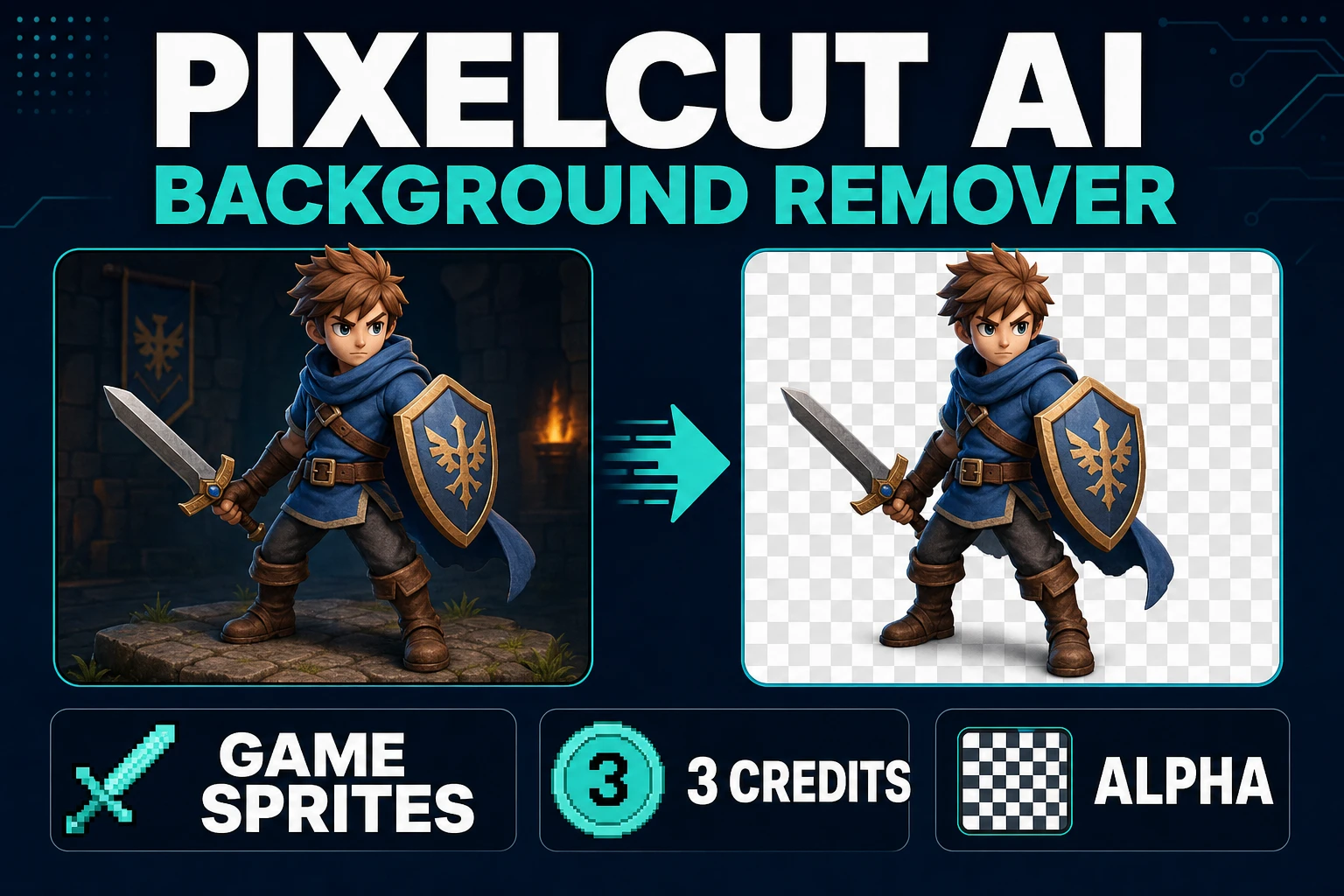
Clip Pixelcut AI Background Remover (Game Sprite Path)

By Arron R.7 min read
Pixelcut AI background remover shines at free ecommerce cutouts. Game sprites need clean alpha, integer edges, and a path into sheets: Sorceress BG Remover (3 c

Ecommerce cutouts and game sprites share one verb — remove the background — and almost nothing else about the finish. A pixelcut ai background remover search usually lands on a free product-photo tool: soft hair edges, white studio swaps, marketplace-ready PNGs. Indie games need hard silhouettes, zero color fringe, and frames that stay put when a camera zooms with nearest-neighbor scaling. This comparison maps where Pixelcut wins, where sprite pipelines diverge, and how Sorceress BG Remover feeds True Pixel and Quick Sprites. Pixelcut product claims below were verified July 20, 2026 against the official Pixelcut background-remover page; Sorceress credit costs were verified the same day in src/app/bg-remover/page.tsx.
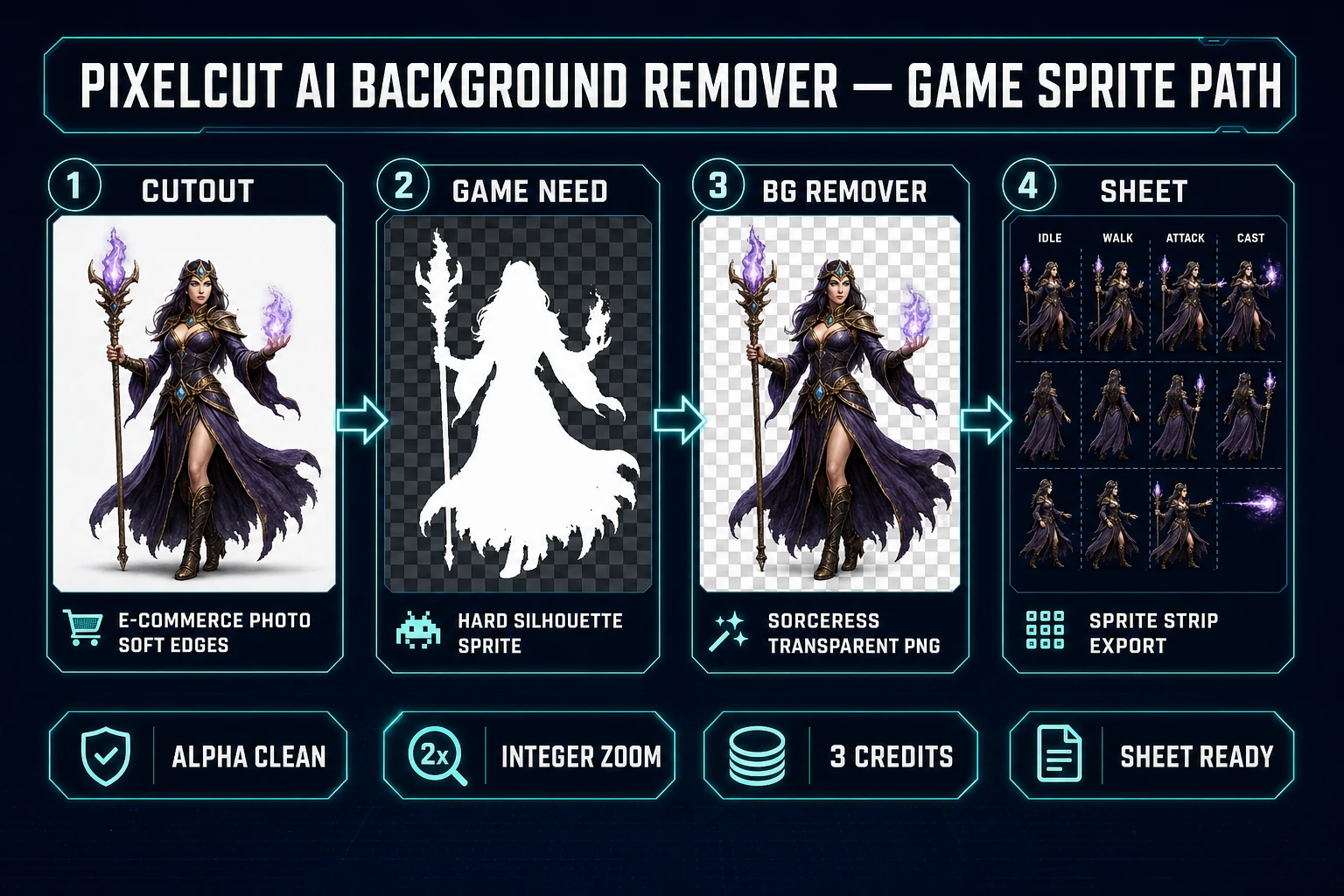
Pixelcut AI background remover versus game sprite path through Sorceress BG Remover
Product cutouts optimize for soft composites; game sprites optimize for hard alpha, integer zoom, and sheet-stable crops.

What pixelcut ai background remover optimizes for

DataForSEO lists pixelcut ai background remover at 320 monthly searches with KD 13 in research-supplement.md, verified July 20, 2026, sitting beside the spaced sibling pixel cut ai background remover at the same volume. The intent is transactional: people want a one-click cutout, often from a phone, often for a listing photo.

Pixelcut's own background-remover page (verified July 20, 2026) positions the tool as free with no sign-up, accepting JPG, PNG, and HEIC up to 100 MB / 8000x8000, with automatic subject detection in seconds, Refine brushes for edge cleanup, transparent or white exports, batch catalog removal, AI background replacement, and a separate video remover. That is a serious ecommerce and social stack. It is not automatically a game-asset stack.

Name Pixelcut in plain text when you compare — do not treat its marketing site as an internal link target. The job of this article is to answer the search, then show the Sorceress path that continues after the cutout into sprites engines can load. For adjacent vendor tests already on the blog, see Photoroom for game sprites and Canva AI background remover for sprite packs — different primaries, same sprite-finish question.

Where ecommerce cutouts diverge from game sprites

A product cutout succeeds when hair looks natural on a lifestyle backdrop. A sprite succeeds when the silhouette reads at 16x16 or 32x32, the alpha channel is binary enough to avoid glow, and every frame of a walk cycle shares a crop box. Soft alpha compositing that flatters a portrait becomes a halo when the engine samples with nearest-neighbor interpolation.

  • Edge policy: ecommerce tolerates feathered edges; sprites prefer crisp, inspectable borders on a checkerboard.
  • Color fringe: leftover backdrop hues on edge pixels scream when upscaled. Games reject them; marketplaces often hide them behind drop shadows.
  • Crop stability: listing photos are single frames. Walk cycles punish any bounce in the bounding box between idle and run.
  • Downstream tools: after a product cutout you design a poster. After a sprite cutout you quantize, sheet, and load into Phaser or Godot.

If your only deliverable is a shop thumbnail, Pixelcut AI background remover is a fair free stop. If the deliverable is a player atlas, plan the cutout as step one of a pipeline, not the finish line.
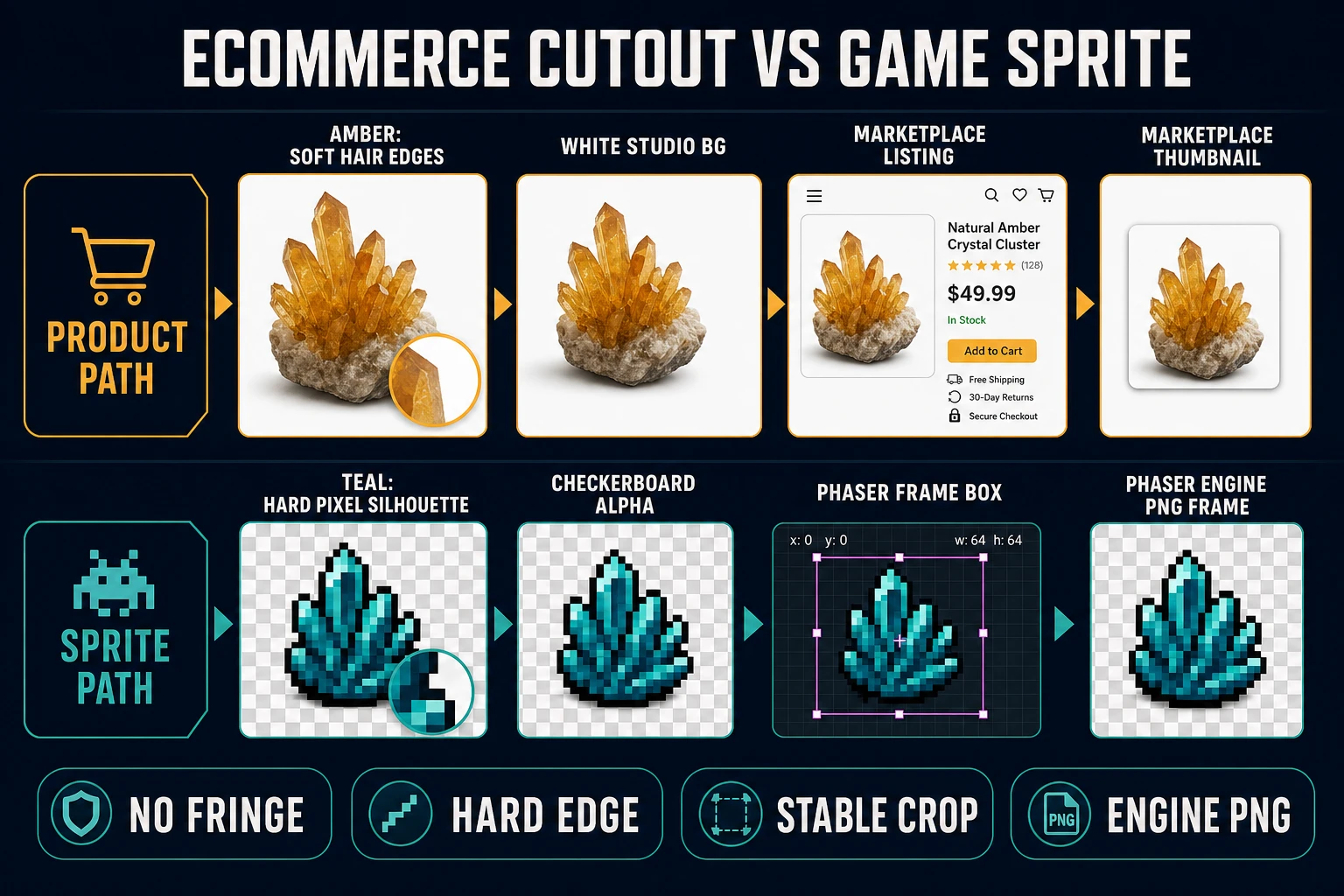
Ecommerce cutout path versus game sprite hard-edge alpha path
Soft product edges and hard sprite silhouettes fail different QA tests — do not reuse the same acceptance bar.

Run the Sorceress sprite cutout path

Open BG Remover. Upload a PNG or JPG under the 5 MB cap verified in src/app/bg-remover/page.tsx on July 20, 2026. Each successful removal costs 3 credits (BG_REMOVER_CREDITS = 3). Batch mode multiplies that cost by file count — useful when you drop eight directional poses at once.

  1. Upload the source (AI concept, photo, or flat illustration with a readable subject).
  2. Run removal and wait for the transparent PNG preview.
  3. Inspect at integer zoom on the checkerboard. Reject any pink/green fringe or semi-transparent mush along the outline.
  4. Download keepers into your sprite folder with stable names (hero_idle_01.png, not final_final2.png).

Starter credits on new accounts cover early experiments. Lifetime Access remains $49 one-time (LIFETIME_PRICE in src/app/plans/page.tsx, verified July 20, 2026); AI removals stay on the credit pool. The Sorceress tools guide maps the adjacent 2D tools once cutouts exist.

You can still run a Pixelcut AI background remover pass on a stubborn photo, then re-import the PNG into BG Remover only if you need the asset inside the Sorceress library — but for most jam casts, starting in BG Remover avoids a dual-tool shuffle.
Edge cases that break gameplay sheets

Three failure modes show up the moment you press play:

  • Fringe: backdrop color stuck in edge texels. Fix by re-cutting with a cleaner source or painting the rim in Canvas after a True Pixel pass — never "fix it with a darker clear color" in the engine.
  • Fat alpha: soft anti-alias that looks fine at 1x and becomes a glow at 4x. Prefer harder mattes for pixel games; keep soft mattes only for hi-res portrait UI.
  • Crop drift: idle framed tighter than walk. Normalize cell size before packing. A one-pixel vertical hop reads as the character vibrating.

Hair and fur are where Pixelcut marketing shines and where pixel games often need a different answer: redesign the silhouette for readability instead of preserving every strand. A three-pixel hair spike that looks stylish in a listing will sparkle noise on a SNES-scale actor.

Cost and batch math for an indie roster

Pixelcut advertises free single cutouts and Pro features (batch, HD, design tools) on paid tiers — third-party 2026 reviews commonly cite Pro around $9.99/month, but treat storefront prices as moving targets and re-check the vendor pricing page the day you subscribe. Sorceress math is source-verified and stable for this article date:

  • 1 cutout: 3 credits on BG Remover.
  • 8 directional idles: 24 credits.
  • 32-frame cast test (4 characters x 8 poses): 96 credits.

At the standard top-up mapping of 1 credit ≈ $0.01, that 32-frame pass is about a dollar before you touch animation tools. Compare that to a month of a design-suite Pro seat when your only need is alpha — for sprite-heavy jams, credit batches usually win. Keep Pixelcut AI background remover in the toolkit when you also need marketplace templates and mobile editing; switch the billing conversation when the asset next home is a texture atlas.

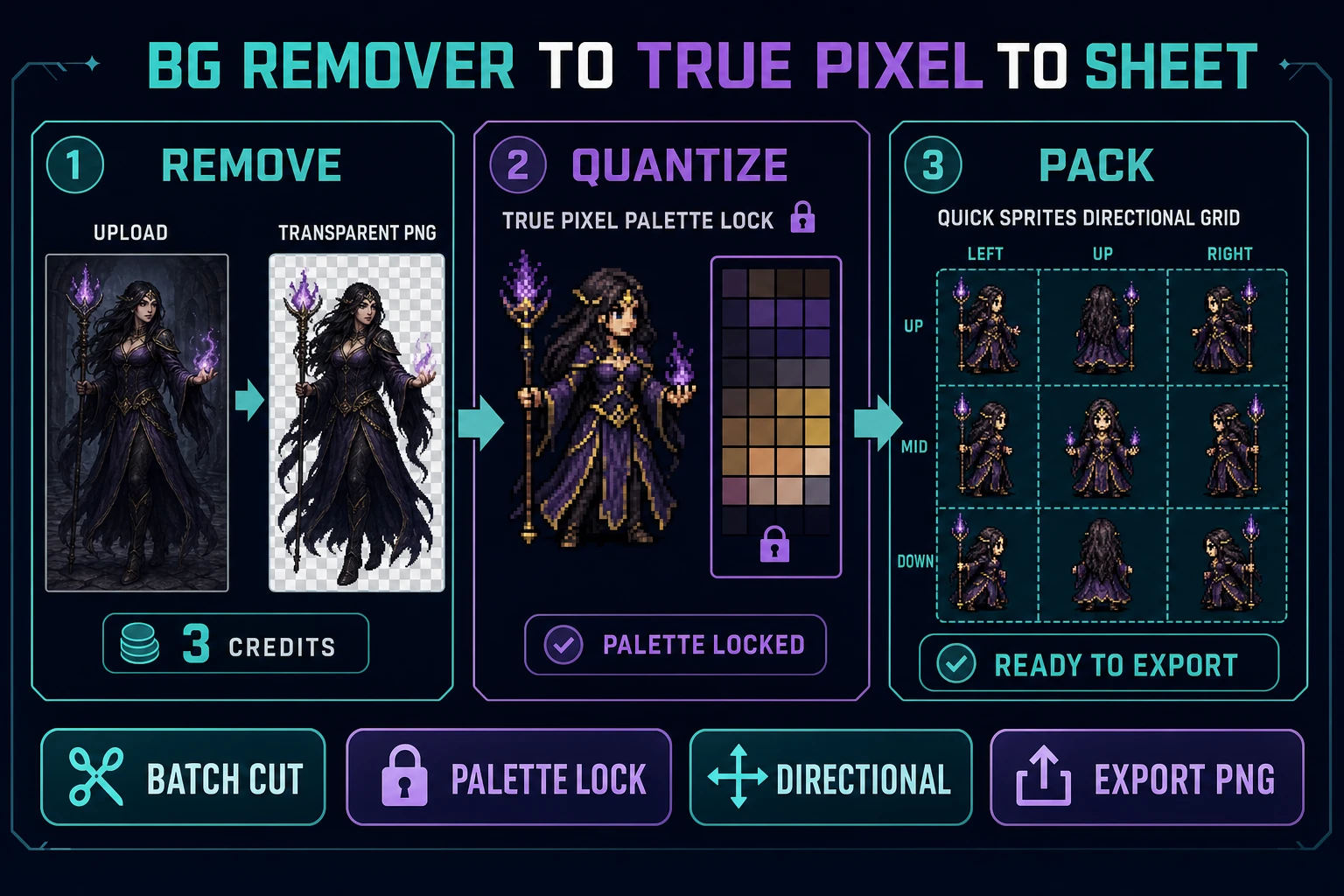
BG Remover to True Pixel to Quick Sprites pipeline for transparent game sprites
Cut alpha, lock palette, then pack directions — the sprite path continues after the remover.

Pair cutouts with True Pixel and Quick Sprites

Transparent PNGs are not finished game art. Send clean cutouts into True Pixel when you need a fixed palette, target resolution, and dither control for a pixel game. Use Quick Sprites when you would rather generate a directional sheet from a text prompt than clean dozens of stills. BG Remover still matters in that second path: any composite frames or photo references you feed into a sheet workflow need the same fringe QA.

A practical jam loop:

  1. Generate or collect reference poses.
  2. Cut them in BG Remover; reject fringe at integer zoom.
  3. Quantize hero frames in True Pixel at the final cell size.
  4. Build or regenerate the full directional set in Quick Sprites when motion matters more than photo fidelity.
  5. Preview loops in Sprite Analyzer before engine import.

That loop is why the pixelcut ai background remover query deserves a game-specific answer. The remover is necessary; it is not sufficient.

When you evaluate a pixelcut ai background remover result for games, flip three viewer modes before you keep the file: checkerboard at 100 percent, nearest-neighbor at 200 percent, and the destination clear color (often a flat sky or dungeon fill). Fringe that disappears on checkerboard often reappears against saturated fills. That three-mode check takes under a minute and saves hours of atlas repair later.

Batch discipline matters as much as edge quality. Process one character identity per batch so lighting and contrast stay comparable across poses. Mixing a bright outdoor photo with a dark indoor concept in the same remover pass creates a roster that never sits on one value range — Quick Sprites and True Pixel then fight the inconsistency instead of polishing a coherent cast.

Export a transparent sprite pack that engines load

Export PNG with a real alpha channel — not a flattened white matte. Keep filenames and folder layout boring:

sprites/
  hero/
    idle_0.png
    idle_1.png
    walk_0.png
    walk_1.png
  manifest.txt

Record cell width/height, anchor points, and whether frames are pre-trimmed. Engines care less about which remover you used and more about whether the atlas indices stay stable across builds. If you flattened to white for a temporary preview, do not ship that file — white mattes become visible boxes the moment the clear color changes.

Final QA checklist before you call the pack done: integer zoom pass, no fringe, matching crop boxes, correct alpha, and a one-screen in-engine smoke test at the camera scale you ship. When those five pass, the debate between Pixelcut AI background remover and Sorceress BG Remover is settled for that asset: use whichever cut the cleanest matte, then finish the sprite path on Sorceress tools built for games.

Frequently Asked Questions

What is Pixelcut AI background remover best at?

Pixelcut AI background remover is a free, no-sign-up cutout tool aimed at product photos, portraits, and marketplace listings. Official Pixelcut pages (verified July 20, 2026) advertise JPG/PNG/HEIC uploads, automatic subject detection in seconds, transparent or white exports, Refine brushes, batch catalog work, and a separate video remover. That stack is excellent for ecommerce. Game sprites still need integer-scale alpha, sheet alignment, and a handoff into pixel tools.

How is a game sprite cutout different from a product cutout?

Product cutouts optimize for soft hair and lifestyle composites. Game sprites optimize for hard silhouette edges, zero color fringe, and stable bounding boxes across frames. A soft alpha halo that looks fine on a Shopify card becomes a glowing outline when nearest-neighbor scaled in Phaser or Godot. Sorceress BG Remover outputs a transparent PNG you can inspect at integer zoom before you quantize or sheet it.

How much does Sorceress BG Remover cost?

Verified July 20, 2026 in src/app/bg-remover/page.tsx: BG_REMOVER_CREDITS = 3 per successful removal. Max upload size is 5 MB. Batch uploads charge 3 credits times the file count. New accounts receive starter credits; Lifetime Access is \ one-time (src/app/plans/page.tsx LIFETIME_PRICE) and AI removals stay pay-as-you-go on the credit pool.

Should I use Pixelcut AI background remover for walk-cycle frames?

You can cut frames there, then import into Sorceress. The faster jam path is to cut in BG Remover so every frame stays in the same library, then send keepers to True Pixel for palette lock and Quick Sprites when you need a fresh directional sheet instead of cleaning AI video frames by hand.

What edge failures break sprite sheets?

Three failures: (1) colored fringe from the old background bleeding into edge pixels, (2) semi-transparent anti-alias that fattens the silhouette at 2x/4x camera zoom, (3) inconsistent crop boxes so idle and walk frames bounce. Inspect every cut at integer zoom on a checkerboard, reject fringe, and normalize cell size before packing a sheet.

Sources

  1. Alpha compositing — Wikipedia
  2. Sprite (computer graphics) — Wikipedia
  3. Portable Network Graphics — Wikipedia
  4. Nearest-neighbor interpolation — Wikipedia
Written by Arron R.·1,484 words·7 min read

Related posts