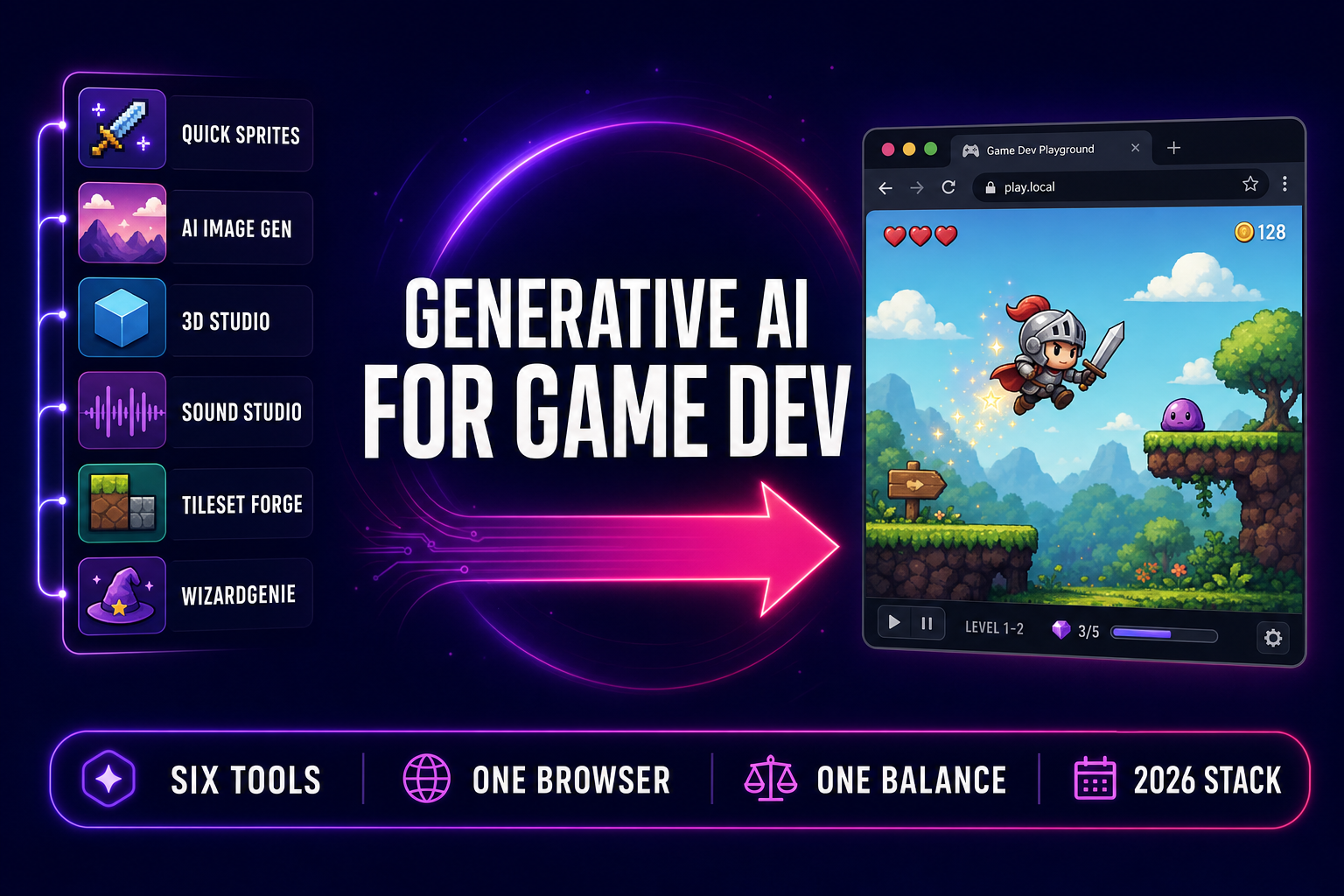
The phrase "generative ai for game development" gets searched a few hundred times a month in 2026, but the answer behind that query has changed every quarter for two years. The 2024 version was "use one tool per asset type and stitch the results in Photoshop." The 2025 version was "the model picker is too crowded; stop and pick three." The 2026 version is something else: a small stack of browser tools that interoperate cleanly enough that a single developer can take a prompt to a playable build in an afternoon. This piece walks the honest 2026 stack for generative AI for game development — six tools that each solve one slice of the pipeline — with credit costs, model versions, and export formats verified against the live source on May 26, 2026.
What generative ai for game development actually means in 2026
Generative AI for game development in 2026 is the practice of using neural-network models trained on game art, audio, and code to produce the assets and scripts a real game needs to ship. The shift from earlier eras is not the existence of the models — image diffusion has been usable since 2022, music models since 2023, frontier coding models since late 2024 — but the fact that the tools have started to interoperate. A 2D sprite generated in one browser tab now imports cleanly into a Three.js scene running in another. A 3D mesh exported from a generator now lands in Phaser without a re-export through Blender. The pipeline that used to cost a week of glue work now costs an afternoon.
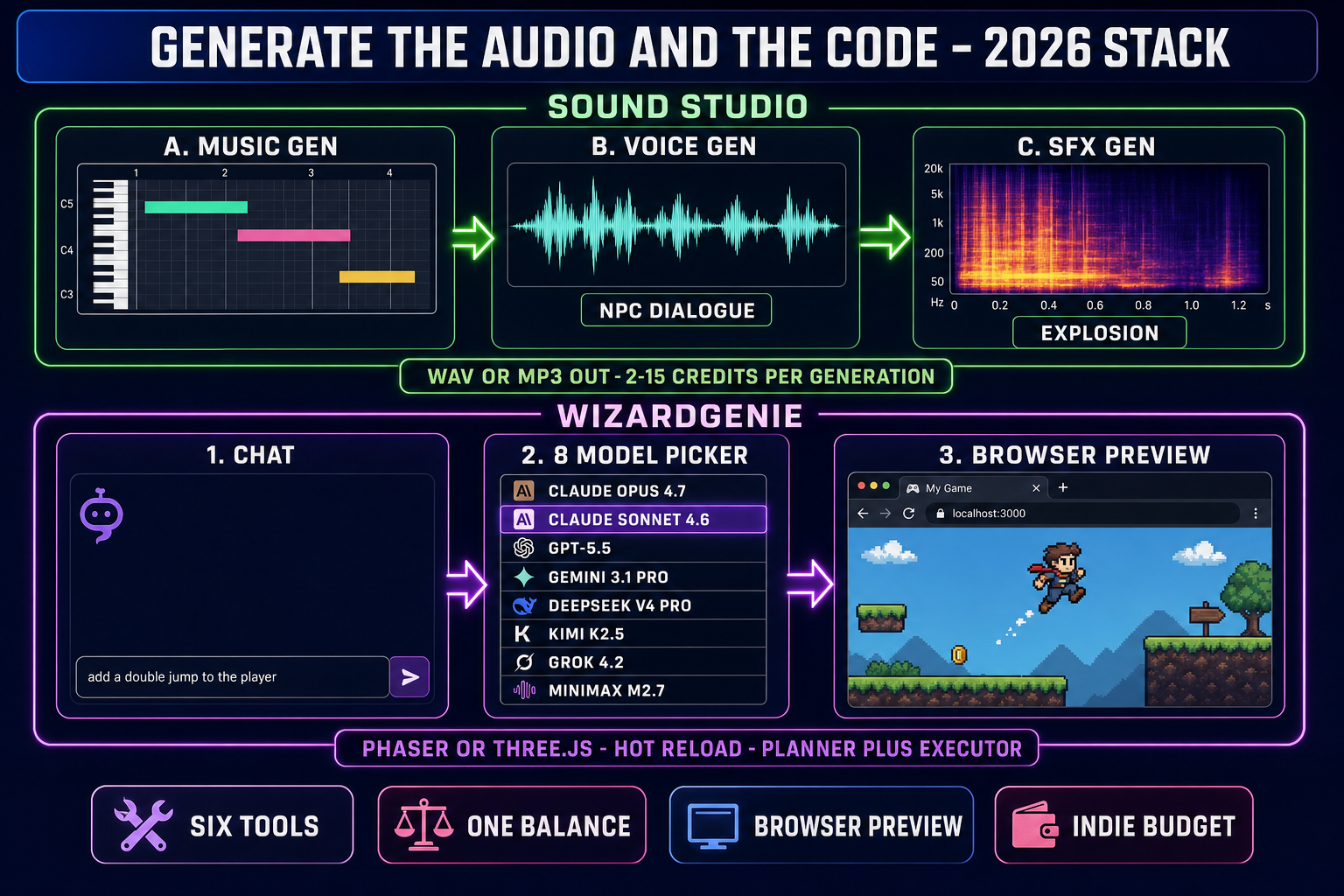
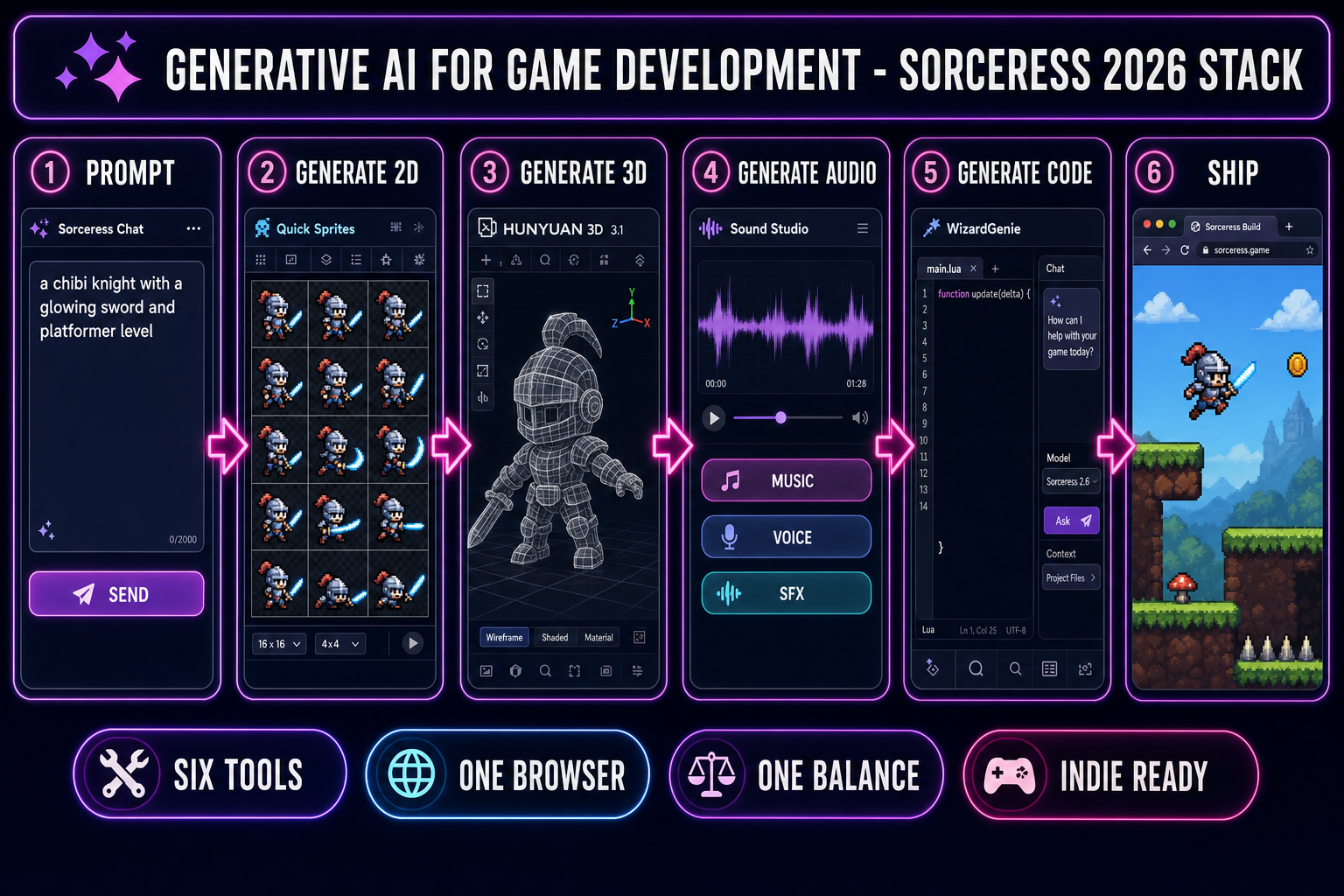
The Sorceress Game Creation Suite is one expression of that interoperability story. Six tools, all browser-native, all sharing a single credit balance — Quick Sprites for 2D sprite sheets, AI Image Gen for static art, 3D Studio for image-to-3D meshing and rigging, Sound Studio for music, voice, and SFX, Tileset Forge for level tilesets, and WizardGenie for the gameplay code. The piece below walks each tool, what it generates, what it costs, and how the export feeds the next step.
The framing matters because "generative ai for game development" gets used loosely. It is not the same as procedural generation (which uses hand-written algorithms; see Procedural generation on Wikipedia). It is not the same as full-game generation (which does not exist; the runtime still runs on a game engine). It is the asset-and-code production layer, not the design layer. Reading the rest of this piece with that distinction in mind keeps the expectations honest.
Generate the 2D art — sprites, images, and tilesets
The 2D path is the most mature of the 2026 generative AI for game development branches because still-image diffusion is the most mature class of generative models. The Sorceress 2D path runs through three tools and produces every 2D asset a typical indie game needs: characters, props, backgrounds, sprite sheets, and tilesets.
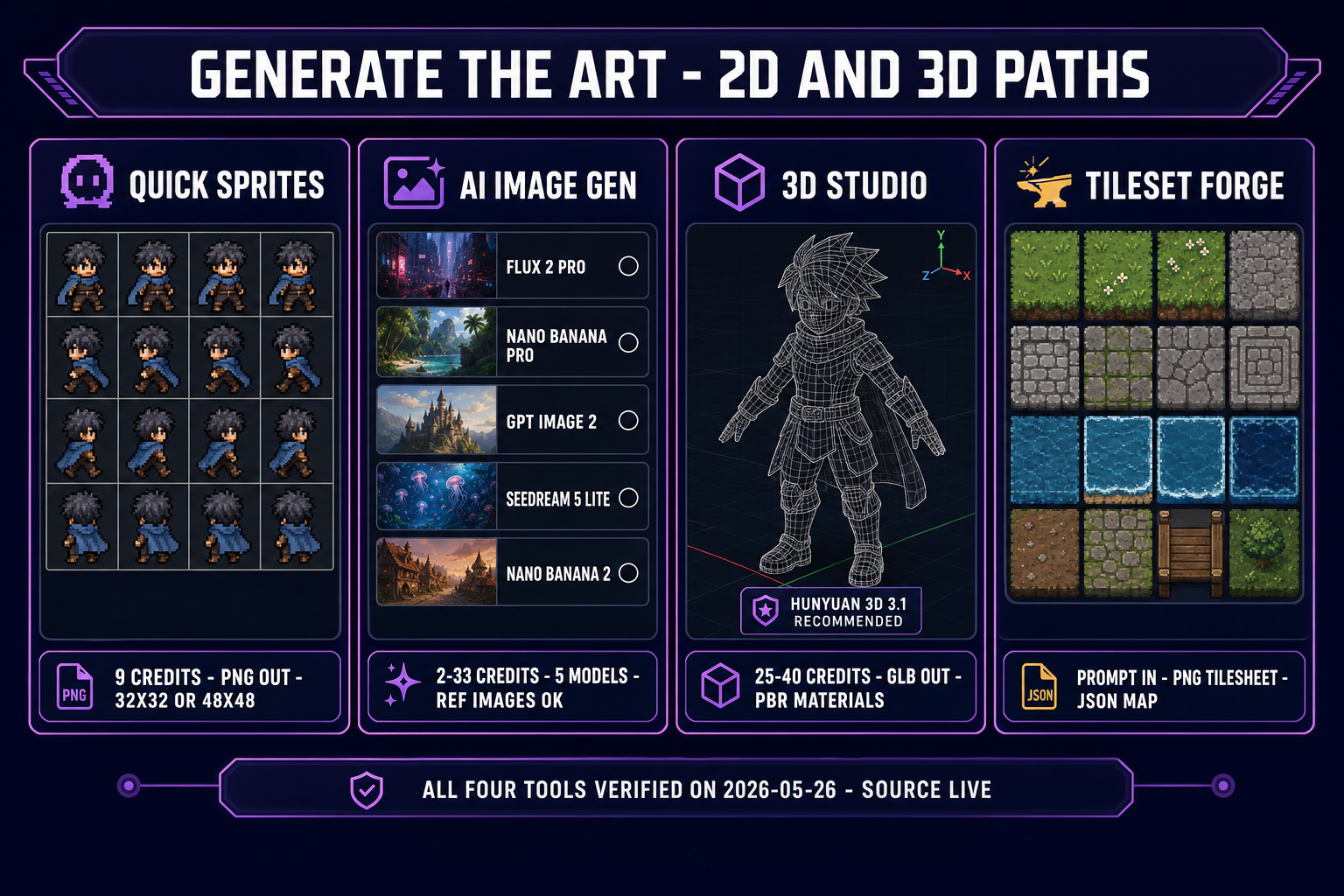
Quick Sprites generates animated sprite sheets directly. The tool runs the Retro Diffusion retro-diffusion/rd-animation model at 9 credits per generation, verified against the live source at src/app/quick-sprites/page.tsx on May 26, 2026. Three style presets ship in the picker: Four Angle Walking (48×48 four-direction four-frame walk cycles), Small Sprites (32×32 with six rows for walk, arms, look, surprise, and lay-down), and VFX Effects (24-to-96 pixel square animations for fire, explosions, and lightning). Each output is a PNG sprite sheet that imports directly into Phaser, Godot, Unity, or any other 2D engine. The default workflow: prompt a character, generate, accept or re-roll, drop the PNG into the asset folder.
AI Image Gen is the still-image generator behind every static piece of 2D art the project needs — character portraits, item icons, background plates, UI illustrations. The picker ships ten image models in 2026, verified against src/lib/models.ts on May 26, 2026: Z-Image at 2 credits, Flux 2 Pro at 6 base credits plus 3 per reference image, Seedream 4.5 at 6 credits, Seedream 5 Lite at 6 to 8 credits, GPT Image 1.5 at 3 to 17 credits by quality, GPT Image 2 at 3 to 17 credits by quality, Nano Banana at 6 credits, Nano Banana Pro at 18 credits 2K or 33 credits 4K, Nano Banana 2 at 9 to 17 credits by resolution, and Grok Imagine at 6 credits. Reference image support is the differentiator for game work — Flux 2 Pro accepts up to 8 references, Nano Banana Pro 8, Nano Banana 2 14, GPT Image 2 10, Seedream 5 Lite 14 — because keeping a character on-model across a hundred generations is the actual production constraint, not initial generation quality.
Tileset Forge sits at the boundary between generative AI and procedural generation. The tool generates tile artwork from a prompt (grass, stone, water, dungeon walls, etc.) and outputs a tilesheet PNG plus a JSON map describing tile indices and adjacency rules. A procedural world-builder like Wave Function Collapse or a hand-rolled cellular-automata level generator then arranges the tiles into rooms. The combination is the right one for indie scope: AI handles the art, an algorithm handles the layout, and the developer keeps full control of the level rules.
Generate the 3D art — image-to-3D, rigging, animation
The 3D branch of generative AI for game development moved from "interesting demo" to "production usable" between mid-2025 and early 2026, because three things happened in parallel: image-to-3D models started outputting clean topology instead of melted blobs, automatic rigging matured to the point where a humanoid mesh could be skeleton-attached without manual marker placement, and the GLB format (the industry-standard glTF 2.0 spec from the Khronos Group) became the universal target every engine reads.
3D Studio handles all three steps in one tool. The model picker ships six image-to-3D options, verified against src/lib/threed-models.ts lines 198-221 on May 26, 2026: Hunyuan 3D 3.1 (the recommended default at 25 credits per generation, with PBR materials, configurable face count from 40K to 1.5M, and text-to-3D plus image-to-3D modes), Meshy 6, TRELLIS 2 (Microsoft Research, 4B parameters, the highest-quality option at 40 credits per generation at 1024-cubed resolution), TRELLIS v1 (the budget option), Hyper3D Rodin, and Tripo v3.1. The default rail order surfaces Hunyuan first because it lands the cleanest topology-plus-texture combination at the lowest cost for typical character work; TRELLIS 2 is the upgrade path when the project needs the highest geometry detail.
The rigging step inside 3D Studio uses a marker-driven workflow that places skeleton joints on the mesh based on a small number of user-clicked anatomical points (head, shoulders, hips, knees), then runs auto-weighting to bind the mesh to the skeleton. The output is a fully rigged GLB with a humanoid skeleton ready for animation. The animation step then either applies pre-built motion clips (idle, walk, run, jump) or generates novel animations from text prompts via an AI animation backend. The whole pipeline — image to mesh to rig to animated GLB — runs in the same browser tab without an export-import cycle.
The reason this matters for generative AI for game development specifically: a 2026 indie 3D project no longer needs a Blender seat, an Adobe ID, or a Maya license to ship a rigged hero character. The whole pipeline runs in the browser. The exported GLB drops directly into a Three.js scene, a Godot 4.x scene, a Phaser 3D scene, or any external engine that reads glTF — which is every major engine in 2026. The integration overhead is one file copy.