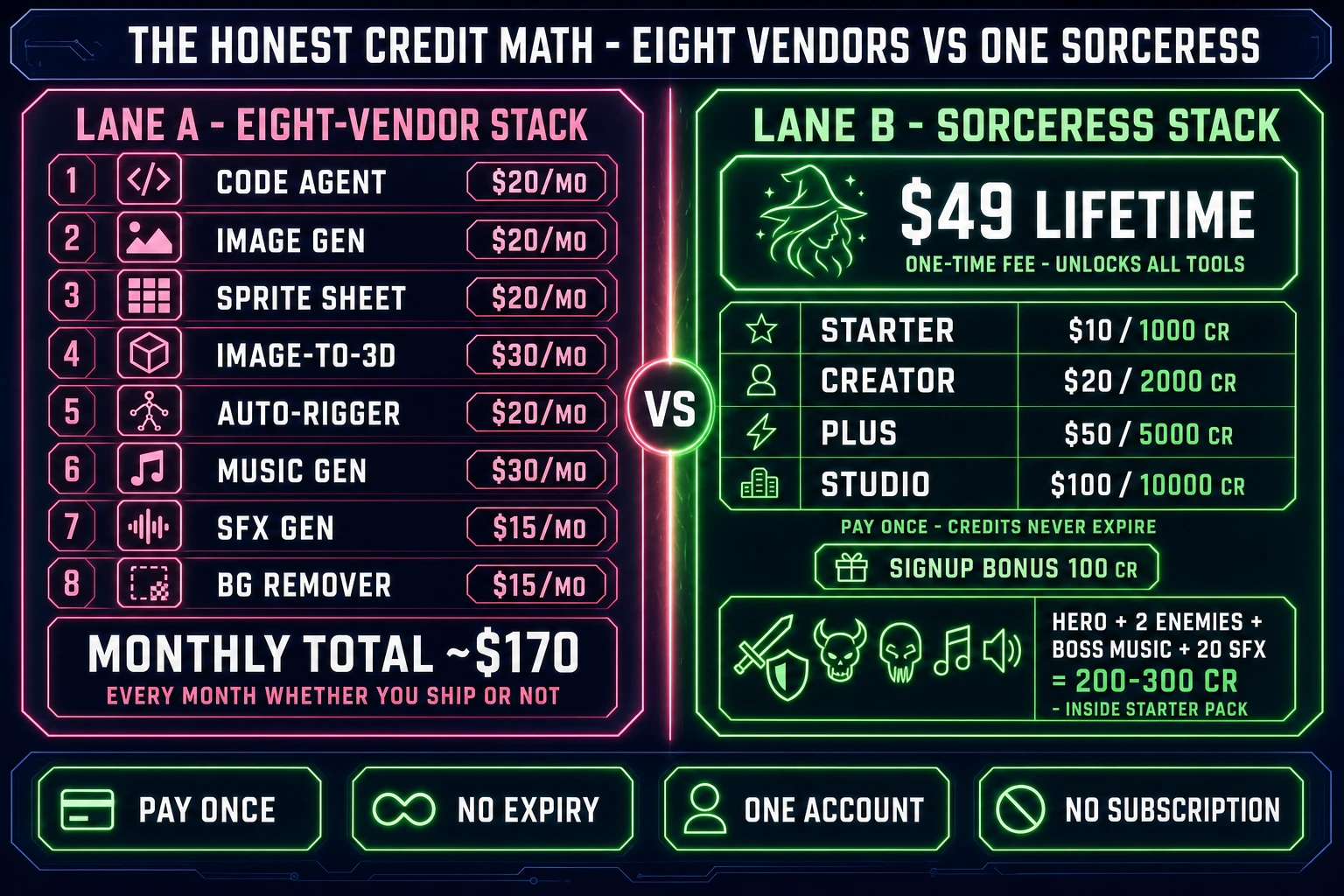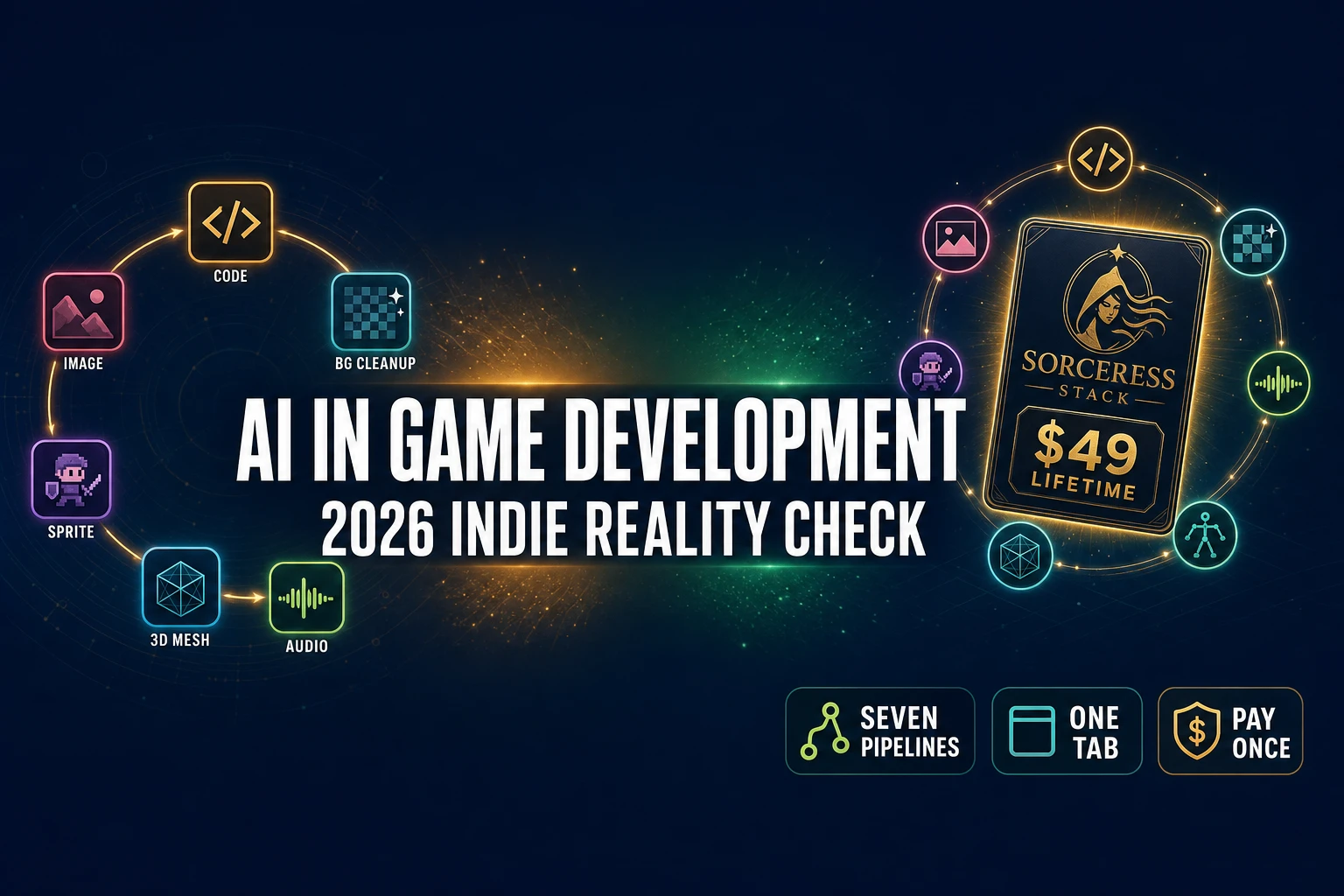
Type AI in game development into Google in 2026 and the first page is half a wall of think-pieces about whether AI is coming for the job and half a wall of breathless tool listicles ranked by who paid for the ad slot. The honest middle answer — what AI actually does for an indie game dev today, where it ships, where it stalls, and what the credit math looks like at the end of the month — is harder to find. This piece walks the seven concrete pipelines where AI now genuinely produces shippable game assets in the browser, the four places it still falls short, and the cost math of the full Sorceress stack against eight separate vendors. All Sorceress tool specs and prices verified June 13, 2026 against the source repo.
What “AI in game development” really means in 2026
The phrase “AI in game development” has been around since the first ghost AI in Pac-Man in 1980, but the meaning quietly forked sometime around 2023. The classical reading — finite-state machines, behavior trees, pathfinding, decision-making for non-player characters — never went away; it is still how every shipped game makes enemies act like enemies. The newer reading is generative AI used at development time: large language models writing GDScript and JavaScript, diffusion models painting sprite sheets, image-to-3D models inflating concept art into rigged meshes, text-to-music models scoring level loops, neural cutouts replacing the Photoshop pen tool.
These two threads almost never overlap inside a single tool today. The behavior-tree AI that decides whether the goblin attacks or flees is plain old imperative code shipped with the game build. The generative AI that produced the goblin’s portrait, walk cycle, hit-grunt vocal, and ambient cave loop ran before the build at the asset-pipeline stage and shipped nothing but the resulting bytes. When this post says “AI in game development” it means the second category: AI as a teammate on the asset and code side, not AI as gameplay behavior.
That distinction matters because most of the hype in 2026 is about the second category and most of the headlines treat the two interchangeably. An indie dev evaluating AI in game development for their next jam is not deciding whether to put a neural network inside the boss enemy; they are deciding which slice of their content pipeline a prompt can collapse from three days to thirty minutes. The honest map below covers exactly that decision.
The seven concrete pipelines where AI now ships indie games
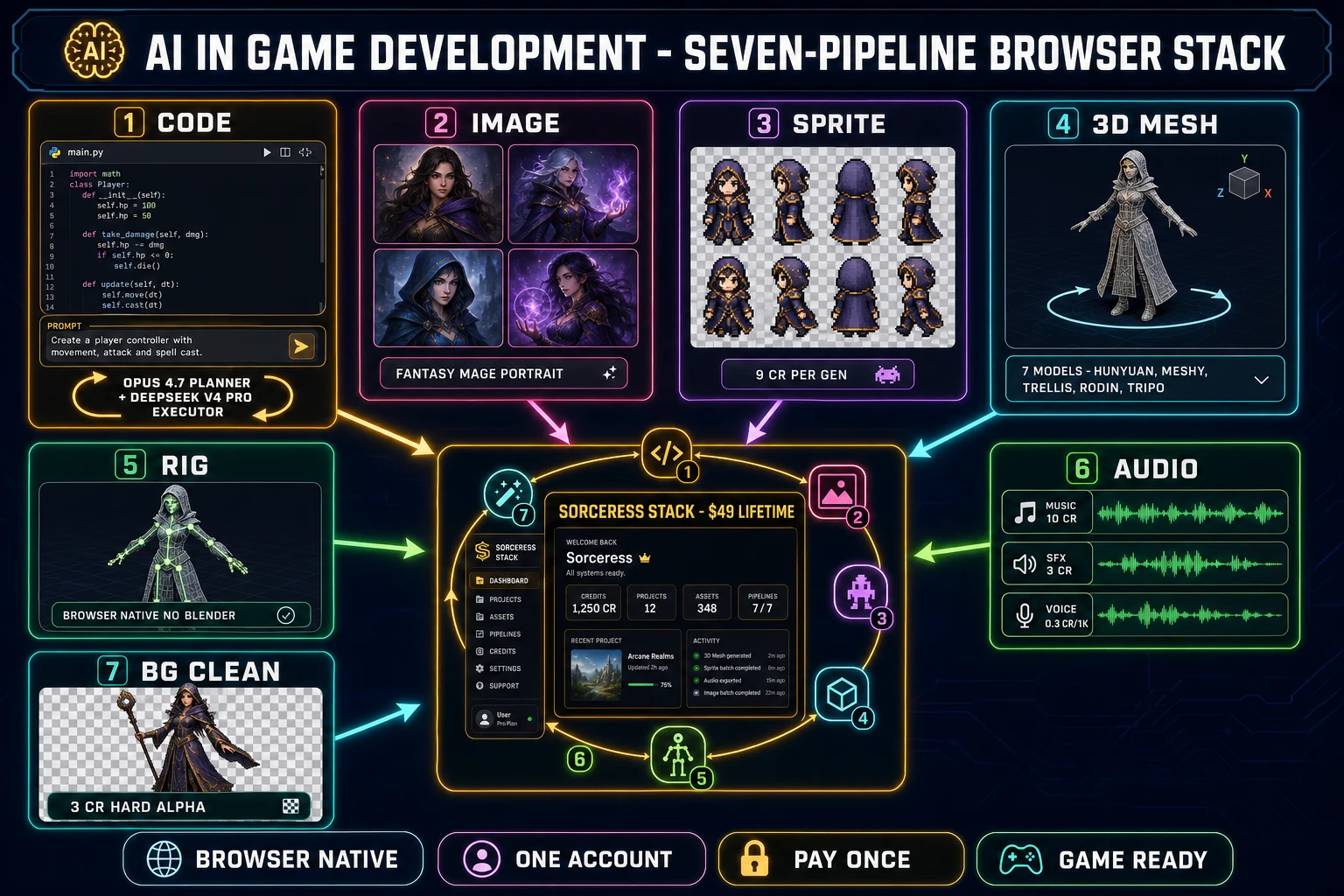
Strip away the marketing and there are exactly seven places generative AI now reliably produces a shippable game asset in 2026. Each is a separate ML problem with a separate model family, and each lives in a different Sorceress tab so the workflow stays browser-native end to end. The pipelines, in roughly the order an indie dev hits them:
- Code generation. Prompt-to-Phaser, prompt-to-Three.js, prompt-to-GDScript via frontier LLMs in a dual-agent loop.
- Concept art and character portraits. Text-to-image diffusion for in-engine sprites, splash screens, item icons, marketing keys.
- Sprite sheets and walk cycles. Image-to-animation models that turn a single character portrait into a 48×48 four-angle walk in seconds.
- Image-to-3D meshes. Multi-view reconstruction that lifts a single PNG into a textured GLB that drops into a browser 3D scene.
- Auto-rigging. Skeleton fitting on the imported mesh so the new character can ride existing animation libraries.
- Music, SFX, and voice. Three separate audio model families — score, foley, dialogue — each at a credit cost that beats the per-hour rate of a freelance composer by two orders of magnitude.
- Background removal and cleanup. Hard-alpha cutouts that take a referenced photograph, a generated character, or a pixel sprite and produce a transparent PNG the engine actually composites cleanly.
The rest of this piece walks each pipeline against the real Sorceress source code — credit costs, model versions, tier gates, the live behavior the dev will see when they open the tab today — then closes on what AI still doesn’t do, and what the eight-vendor subscription stack costs against the unified Sorceress alternative.
Pipeline 1 — Code generation (WizardGenie + Sorceress Code, eight frontier models)
Code generation is the loudest slice of AI in game development right now and also the easiest place to waste a month on a stack that can’t actually ship a playable. The honest test of a code agent for game dev is whether it can take a prompt like “build a Phaser 4 platformer with double-jump, coyote time, and a parallax background” and return a runnable HTML5 project on the first try, not whether it tops a generic large-language-model benchmark.
The Sorceress code stack ships two entry points that share the same model lineup. WizardGenie runs in the browser tab (or as the Windows desktop client for longer agent sessions); Sorceress Code is the lower-level chat-and-diff interface for surgical edits. Both route to eight verified frontier coding models in 2026 — pulled from src/app/_home-v2/_data/tools.ts CODING_MODELS on June 13, 2026:
- Claude Opus 4.7 (Anthropic, top tier) — the heavy reasoner for big agentic refactors and one-shot game scaffolds.
- Claude Sonnet 4.6 (Anthropic, fast and smart) — the everyday workhorse; cheaper than Opus, fast enough to keep flow.
- GPT-5.5 (OpenAI, frontier) — the cross-check brain; tends to catch logic mistakes the Anthropic models hand-wave through.
- Gemini 3.1 Pro (Google, one-million-context) — the “feed it the whole repo” model when context length matters more than peak reasoning.
- DeepSeek V4 Pro (DeepSeek, budget) — the cheap executor; this is the model that should type when an expensive planner thinks.
- Kimi K2.5 (Moonshot, 256K coding context) — the long-file executor; cheap, fast, holds an entire game project in context.
- Grok 4.2 (xAI, two-million context) — the experimental brain; reads enormous codebases in one shot.
- MiniMax M2.7 (MiniMax, agent-ready) — the tool-calling specialist; the model to pair with a long agentic loop.
The pattern that actually ships games in 2026 is the Planner + Executor dual-agent loop: an expensive reasoner (Opus 4.7, GPT-5.5, Gemini 3.1 Pro, or Grok 4.2) writes the plan and reviews the diffs; a cheap fast model (DeepSeek V4 Pro, Kimi K2.5, MiniMax M2.7, or Gemini 3.1 Flash) types out the code. The cost ratio lands at roughly one-fifth of single-frontier cost when the executor is genuinely cheap. Putting Sonnet, Opus, GPT-5.5, or Gemini Pro on the typing side burns the entire cost advantage; the cheap executor is the whole point.
WizardGenie wires this loop together inside one tab. Sorceress Code exposes the model picker per chat for devs who prefer to drive each turn manually. Either way, the actual agent runs against your bring-your-own-key endpoint or against the trial keys baked into the Sorceress account, so there is no separate Anthropic, OpenAI, Google, or DeepSeek subscription to manage.
Pipeline 2 — Visual assets (AI Image Gen + Quick Sprites + True Pixel + 3D Studio + Auto-Rigging)
Visual assets is the place AI in game development genuinely changed the math for indies in the last eighteen months. A solo dev who could draw nothing now ships a hero portrait, a four-angle walk cycle, a tile-set, and a rigged 3D model in an afternoon for fewer credits than a single hour of contracted concept art.
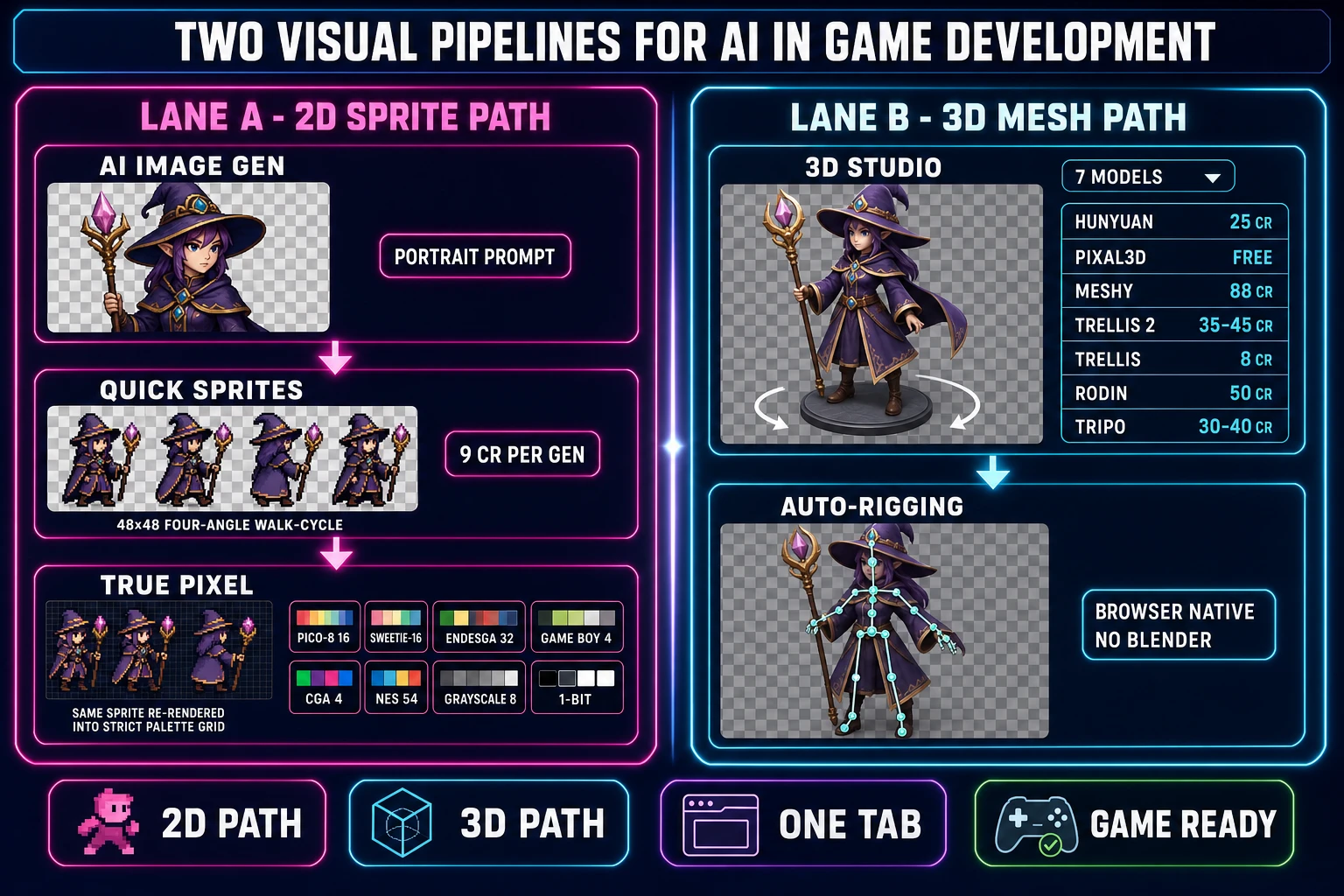
The Sorceress visual stack has five tabs that compose into either a 2D or 3D pipeline depending on the project shape. The 2D path:
- AI Image Gen — concept art, character portraits, splash screens, item icons. Multiple diffusion-model backbones; pick the one that matches the project art direction.
- Quick Sprites — the generated portrait drops in and Retro Diffusion’s
rd-animationmodel returns a 32×32 small-sprite sheet or a 48×48 four-angle walking sheet atCREDITS_PER_GEN = 9per generation (verifiedsrc/app/quick-sprites/page.tsxJune 13, 2026). - True Pixel — the same sprite re-rendered into a strict palette: PICO-8 16, SWEETIE-16, Endesga 32, Game Boy 4, CGA 4, NES 54, Grayscale 8, or 1-Bit. Palette consistency across an entire sprite sheet is the difference between a project that looks like a game and one that looks like a moodboard.
The 3D path adds two more tabs:
- 3D Studio — image-to-3D mesh generation via a seven-model pipeline (Hunyuan 3D 3.1 at 25 credits, Pixal3D Free during beta, Meshy 6 at 50 credits base plus 25 for texture plus 13 for remesh, TRELLIS 2 at 35–45 credits by resolution, TRELLIS at 8 credits, Rodin 2.0 at 50 credits, Tripo v3.1 at 30–40 credits by texture mode plus 5 for quad-faced output). Output is a textured GLB the browser scene reads natively.
- Auto-Rigging — the imported mesh gets a fitted skeleton in the browser so it can ride existing animation libraries without a Blender round-trip. Bipeds and quadrupeds both supported.
The point of having all five tabs under one account is that the output of step n is automatically the input of step n+1 — no re-uploading, no re-encoding, no leaving the browser. The cleaned PNG from step 1 lives at a Backblaze B2 URL the next tab reads natively, and the GLB from 3D Studio drops directly into a Three.js scene wired up by WizardGenie.