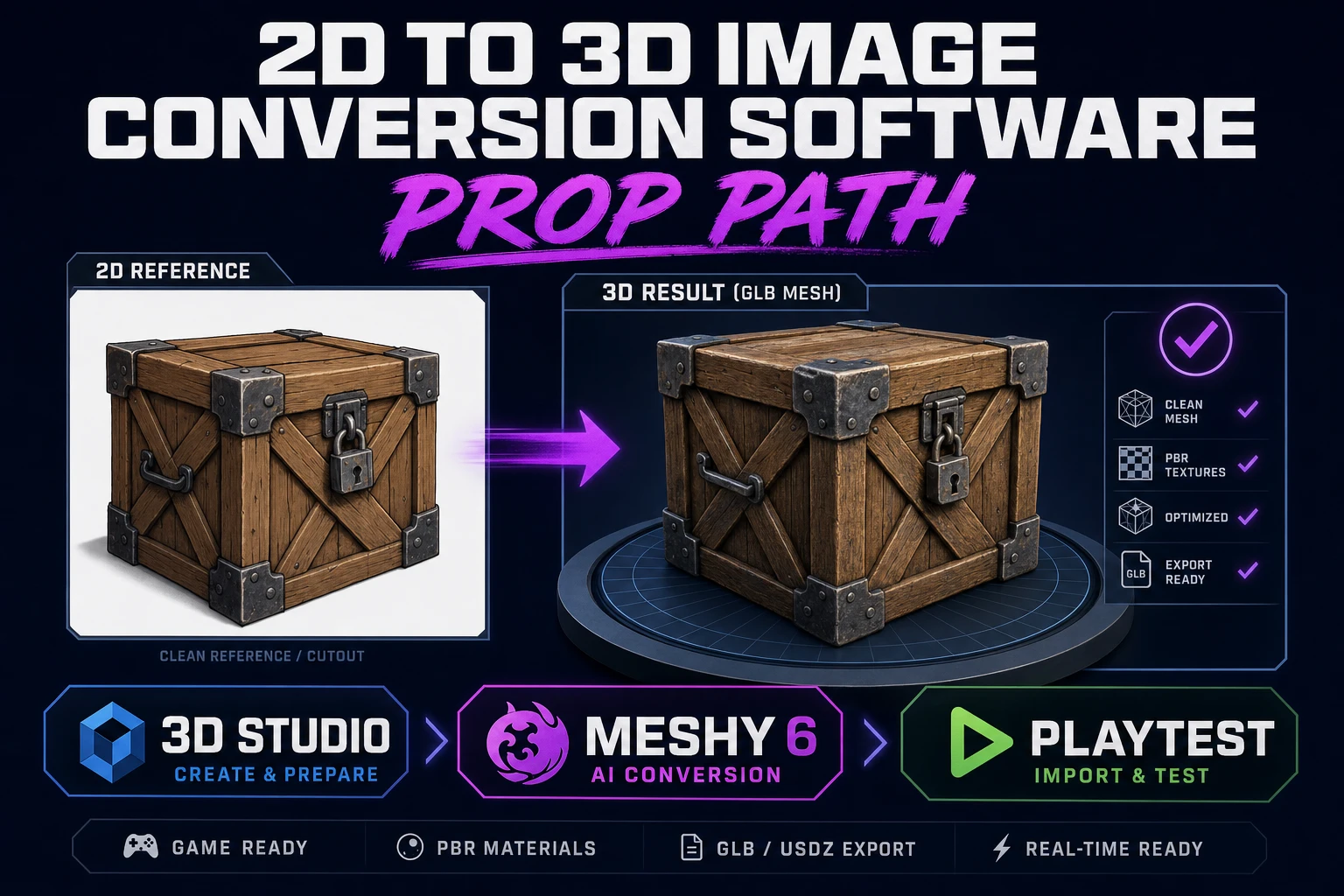
Route 2D to 3D Image Conversion Software (Prop Path)

By Arron R.7 min read
Treat 2d to 3d image conversion software as a checklist, not a lottery: clean the plate, run one textured Meshy 6 pass in 3D Studio (50 cr default), orbit-check

People searching for 2d to 3d image conversion software are not hunting a gallery toy. They want a repeatable path: clean plate in, textured mesh out, GLB in a playtest scene. This guide routes that software checklist through 3D Studio with Meshy 6 credits and model versions verified July 28, 2026.
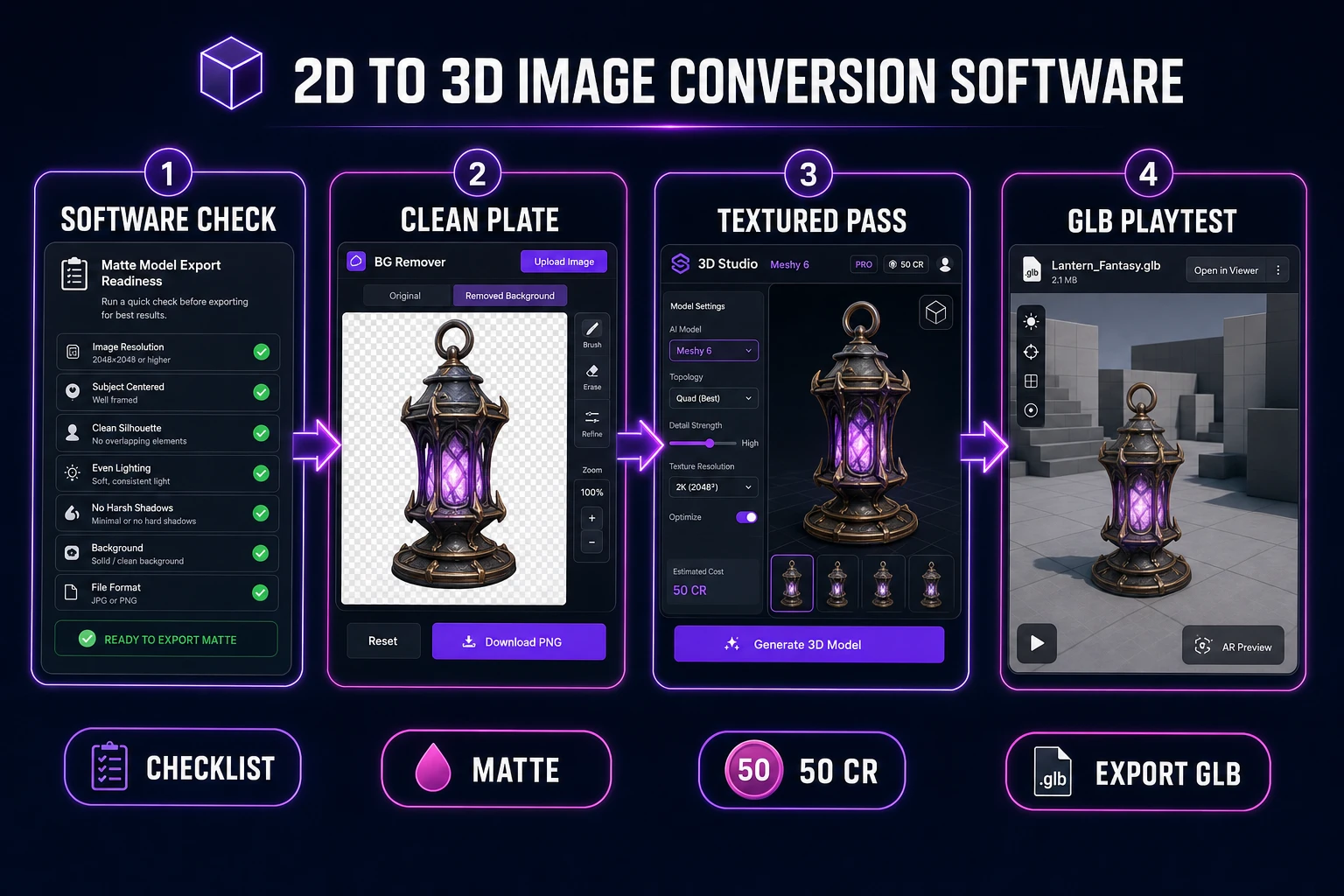
2d to 3d image conversion software pipeline checklist from clean plate to GLB playtest
Software checklist to clean plate to textured pass to GLB playtest. One measured route beats three blind re-rolls.

What 2d to 3d image conversion software must deliver

DataForSEO lists 2d to 3d image conversion software at 880 monthly searches with KD 18 in research-supplement.md, verified July 26, 2026 and still the citation backing this brief. Sibling phrases like 2d to 3d image converter (880/mo, KD 0) and 2d to 3d image conversion (880/mo) share the job: turn a 2D plate into a mesh you can load. True 2d to 3d image conversion software finishes only when the mesh survives a playtest camera, not when the turntable looks pretty.

Write five lines in a text file named prop_software_brief_v1.txt before you open any picker:

  1. Prop job — pickup, weapon, crate, or landmark (pick one).
  2. Input rule — single-subject plate, matte cleaned, subject ≥512×512 after crop.
  3. Model + tier — which generator and texture/remesh flags you will pay for.
  4. Pass/fail gate — front/side/back/top silhouette checklist before export.
  5. Export rule — GLB must drop into a graybox scene without manual retopo on pass one.

That brief is what separates 2d to 3d image conversion software from a folder of pretty meshes that never leave the viewer. For a converter-shaped sibling walkthrough, see Clamp 2D to 3D Image Converter (Prop Mesh). This article stays on the software checklist: gates, stop rules, and cost math.

Decide what is out of scope on day one. Full characters that need auto-rig belong in a later pass on Auto-Rigging. Trailer cinematics belong elsewhere. Day-one conversion software work should prove one prop reads at game scale.
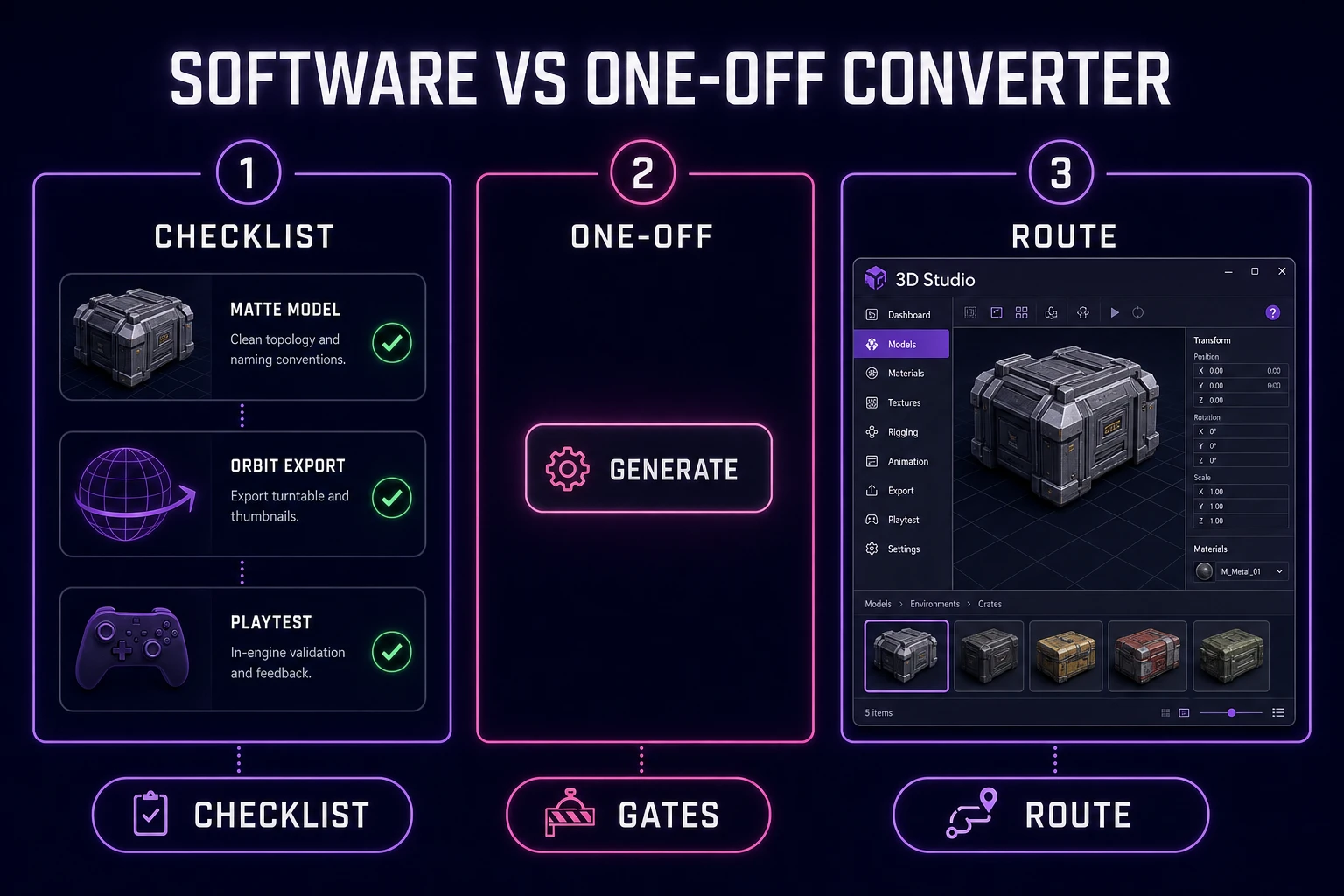
Software checklist versus one-off converter for 2d to 3d image conversion software
Checklist with matte, model, orbit, export, and playtest gates — not a lone Generate button.

Software checklist vs one-off converters

A one-off converter is a single Generate click with no playtest gate. 2d to 3d image conversion software implies a re-runnable loop:

  • Matte gate — background cleaned; fringe fixed once, not paid for three times.
  • Model gate — named model + texture/remesh flags written down before spend.
  • Orbit gate — front/side/back/top verdict logged before export.
  • Export gate — GLB only after silhouette passes.
  • Playtest gate — graybox drop before remesh, PBR, or multi-image spend.

If any gate fails, you stop and fix the plate or change the input set. You do not unlock every add-on on the first click. That stop-first behavior is the whole point of calling it software instead of a lottery.

Browse the wider stack in the Tools Guide when you need art or code tools beside the mesh path. For this prop route, keep the checklist tight: matte → 3D Studio → orbit → GLB → playtest.

Clean the plate first

Start from a photo you trust or generate a concept in AI Image Gen. The plate must be:

  • Single subject — one prop, no cluttered shelves, no hands holding the object unless the hand is the prop.
  • Even lighting — hard shadows bake into albedo and read as fake geometry.
  • Readable silhouette — if you squint and lose the outline, the mesh will too.
  • Resolution that survives crop — clear subject at least 512×512 after you cut the matte; larger is better when detail matters.

Run the plate through BG Remover before 3D Studio. Busy backgrounds invent table edges, wall seams, and phantom limbs. Keep a flat or transparent matte. BG Remover costs 3 credits per image with a 5 MB file cap (src/app/bg-remover/page.tsx, verified July 28, 2026). If the cut leaves hairline fringe, fix the plate once — do not pay for three conversion runs that all inherit the same fringe.

Name the file with intent: crate_front_clean_v1.png, not final_final2.png. Matching stems matter when you later add side and back plates for multi-image.
Run a textured browser pass

Open 3D Studio and select Meshy 6. Live-checked against Meshy Docs on July 28, 2026, Meshy 6 remains the current Image to 3D model for production-quality meshes (Meshy 5 stays available for faster iteration). In Sorceress the visible picker order places Tripo v3.1 first and Meshy 6 second (src/lib/threed-models.ts THREED_MODEL_ORDER, verified July 28, 2026). For this 2d to 3d image conversion software path we stay on Meshy 6 so texture and remesh costs stay honest and comparable to the Clamp converter sibling.

Sorceress credit schedule for Meshy 6 image-to-3D (same source file, verified July 28, 2026):

  • Base (no texture) — 35 credits for a single-image geometry pass.
  • Default textured — 35 + 15 texture = 50 credits (the usual game-prop run).
  • Remesh add-on — +15 credits when you need cleaner topology for later animation.
  • Multi-image base — 45 credits before texture/remesh when you feed front/side/back plates.

Leave remesh off on pass one unless the prop is a humanoid you already plan to rig. Leave PBR maps for a second pass only after the silhouette passes playtest. Default texture on, image enhancement on, remove lighting on — those defaults match how Meshy Docs recommend starting Image to 3D for clear single subjects (plain-text verification July 28, 2026; no outbound competitor link).

Budget one measured pass, not a credit fountain. If the brief says crate pickup for a browser jam, spend 50 credits once, then playtest. Do not unlock remesh, PBR, and multi-image on the first click.

Orbit-check and export GLB

Upload the cleaned plate, confirm Meshy 6, confirm texture, generate once. When the mesh lands, do not export yet. Orbit with a deliberate checklist:

  1. Front — does the prop still match the brief silhouette?
  2. Side — is the volume flat, inflated, or fused to a ghost limb?
  3. Back — did the model invent a second face, a melted handle, or a wall stub?
  4. Top — would a top-down jam camera still read the object?

Fail any one of those and stop. Fix the plate (framing, lighting, matte) or switch to multi-image. Re-rolling the same dirty plate with the same settings is how 2d to 3d image conversion software sessions burn 150 credits and still look wrong in-game.

Record a one-line verdict in prop_software_brief_v1.txt: PASS silhouette / FAIL back handle fused. That line decides the next spend.

When the orbit gate passes, export GLB — the binary glTF 2.0 container defined by the Khronos Group. One file embeds mesh, materials, and textures, which is why browser loaders and quick engine drops prefer it. Verified against the Khronos glTF overview on July 28, 2026; glTF 2.0 is also published as ISO/IEC 12113:2022. The Library of Congress format description for GLB/glTF remains a solid neutral citation for why a single binary container matters in pipelines.

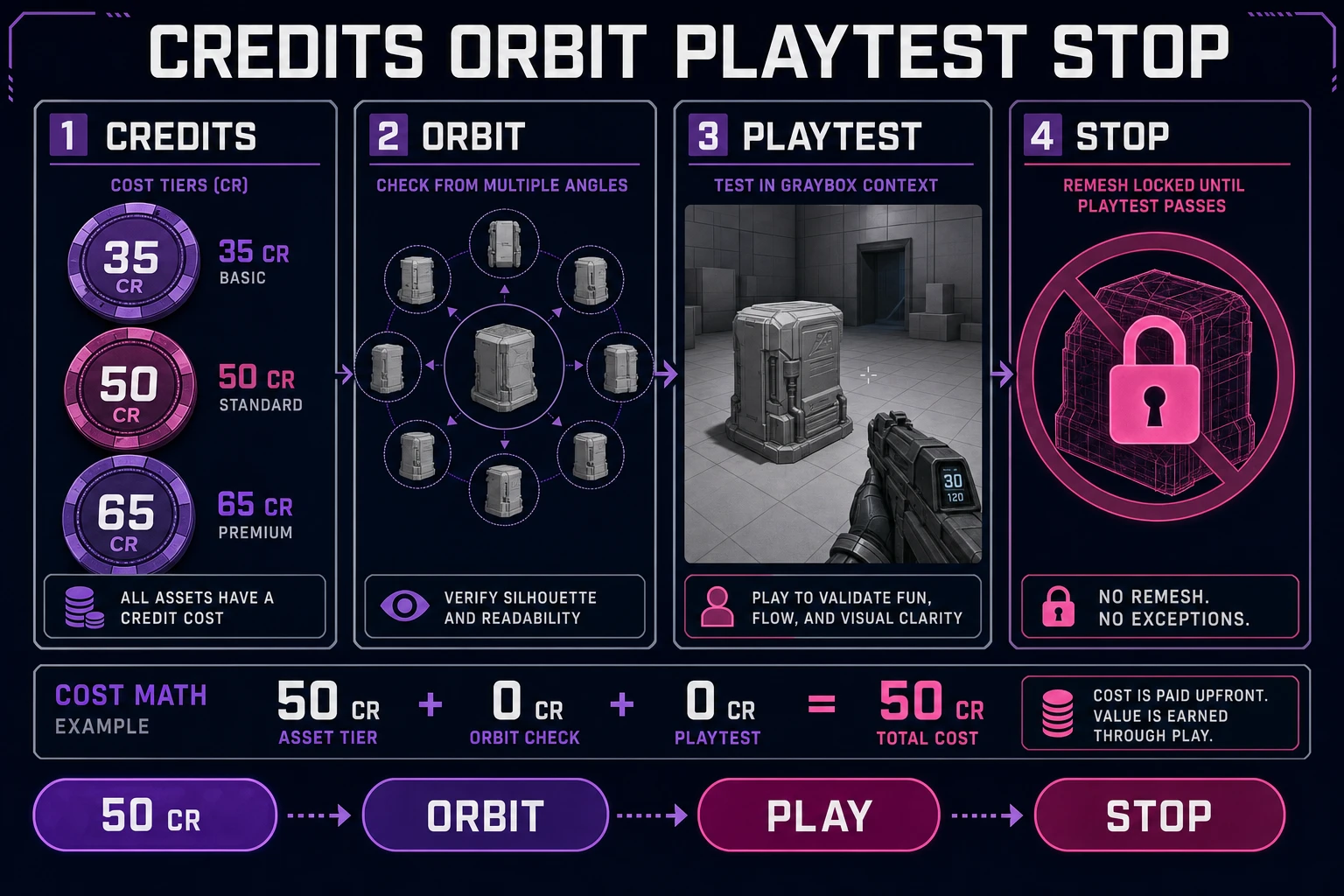
Credit tiers, orbit check, playtest, and stop rules for 2d to 3d image conversion software
50 cr default textured pass, orbit gates, playtest, then stop before remesh. Fix the plate before you buy another generation.

Playtest before remesh

Drop the GLB into a one-screen graybox: floor, player capsule, pickup trigger, and the prop at game scale. You are not art-directing a trailer. You are asking:

  • Is the silhouette readable at the jam camera distance?
  • Does the mesh clip the floor or float?
  • Does the texture scream photo lighting under your scene lights?
  • Is the file heavy enough to stutter a web build?

If you load assets with three.js, follow the official Loading 3D models guidance and keep the playtest scene tiny. Conversion software that never leaves the 3D Studio viewer is unfinished work.

Only after playtest passes should you consider remesh (+15 cr on Meshy 6) or a multi-image set (45 cr base before texture). Remesh is for cleaner topology ahead of animation — not a magic fix for a bad silhouette. Multi-image helps when the back or side fails and you can supply real alternate plates. Neither tool forgives a dirty matte.

When thin props (swords, staffs, antennae) fuse into the body on single-image, prefer multi-image over three identical textured re-rolls. Front/side/back plates beat burning 150 credits on the same bad three-quarter.

Cost math and stop rules

Honest math for one prop with 2d to 3d image conversion software on the Sorceress path (verified July 28, 2026):

  • Matte — 3 credits in BG Remover (skip if the plate is already clean).
  • Default textured Meshy 6 — 50 credits.
  • Optional remesh after playtest — +15 credits.
  • Optional multi-image rescue — 45 base + texture (typically 60 if textured) when silhouette fails and you have plates.

Stop rules that keep the software honest:

  1. No second generation until the orbit verdict is written down.
  2. No remesh until GLB survives a one-screen playtest.
  3. No multi-image until you have distinct front/side/back plates — not three copies of the same angle.
  4. No PBR unlock on pass one for a jam pickup prop.
  5. If the brief changes mid-session (crate becomes character), open a new brief file — do not mutate flags on a failed mesh.

That is the route: treat 2d to 3d image conversion software as a checklist with gates, run one textured Meshy 6 pass in 3D Studio, export GLB, playtest, then decide. Credits, Meshy 6 status, BG Remover costs, and glTF facts were re-verified July 28, 2026 against Sorceress source and Khronos documentation.

Frequently Asked Questions

What must 2d to 3d image conversion software deliver for a game prop?

A repeatable software path: clean input plate, one textured mesh, orbit inspection, GLB export, and a one-screen playtest. Gallery turntables do not count. Sorceress routes that through BG Remover, 3D Studio (Meshy 6), and a graybox drop.

How is conversion software different from a one-off converter click?

Software implies a checklist you can re-run: matte rules, model plus credit tier, silhouette gates, export format, and a stop rule before remesh. A one-off converter is a single generate button with no playtest gate. Use the checklist so credit burn stays measured.

Which model and credits does Sorceress 3D Studio use for this path?

Meshy 6 is the current Image to 3D model (Meshy Docs, verified July 28, 2026). In Sorceress, Tripo v3.1 is first in the picker and Meshy 6 is second (src/lib/threed-models.ts, same day). Meshy 6 image-to-3D: base 35 cr, +15 texture (default textured = 50 cr), +15 remesh; multi-image base 45 cr before texture/remesh.

Should I clean the background before running conversion software?

Yes for most props. Busy backgrounds invent table edges and fused silhouettes. Run BG Remover (3 credits, 5 MB cap, verified July 28, 2026 in src/app/bg-remover/page.tsx), keep a flat or transparent matte, then open 3D Studio.

Why export GLB after conversion software finishes?

GLB is the binary glTF 2.0 container from the Khronos Group (ISO/IEC 12113:2022). One file embeds mesh, materials, and textures for browser loaders and quick engine drops. Export, playtest at game scale, then decide on remesh or multi-image.

Sources

  1. glTF Overview - Khronos Group
  2. glTF 2.0 Specification - Khronos Registry
  3. Loading 3D models - three.js docs
  4. GLB / glTF Format Description - Library of Congress FDD
Written by Arron R.·1,548 words·7 min read

Related posts