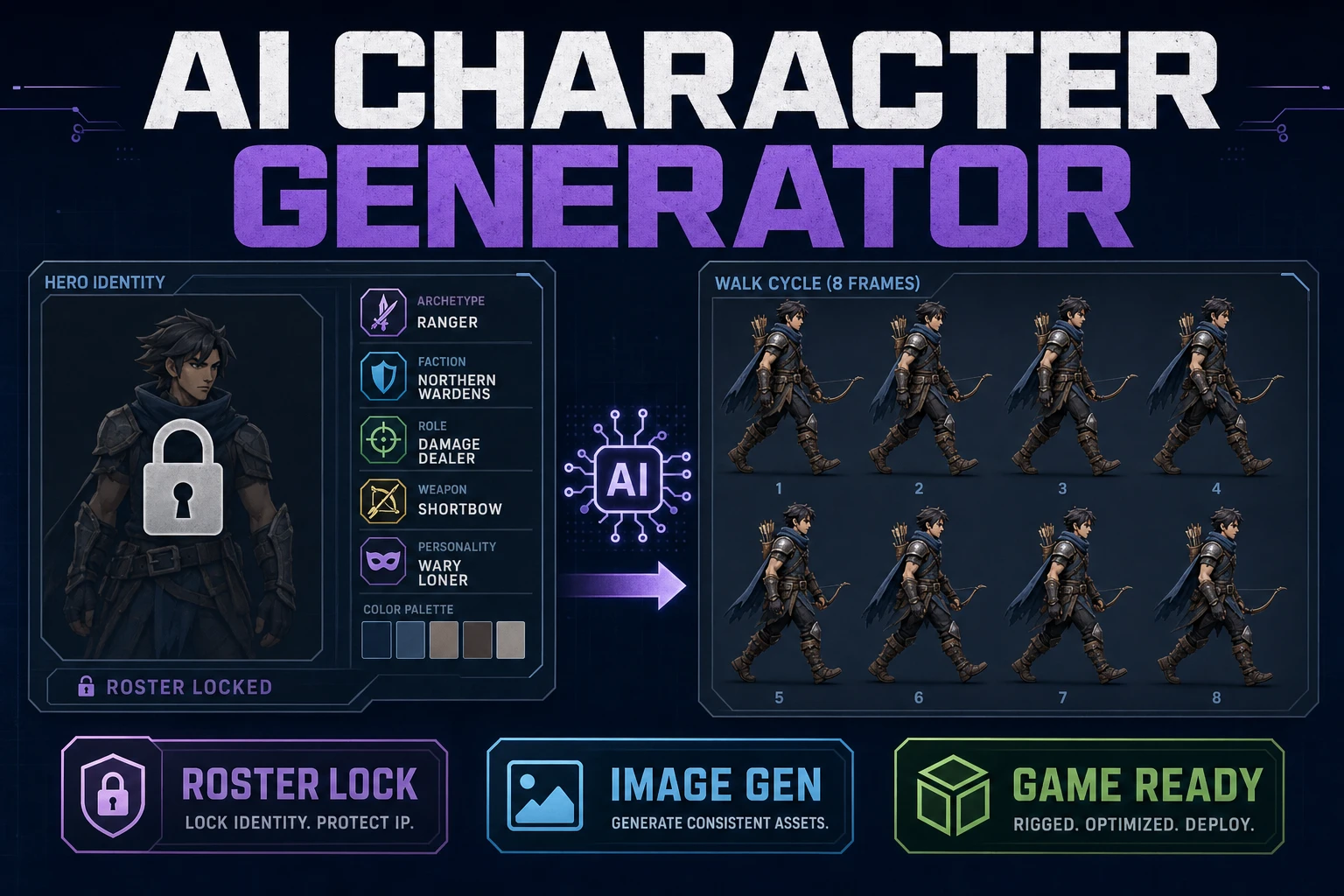
Dial an AI Character Generator (Roster Lock)

By Arron R.7 min read
An ai character generator for games must lock identity before you spend credits. Dial one hero plate in AI Image Gen, cut alpha in BG Remover (3 credits), then

Most jam casts fall apart when every NPC looks like a different game. An ai character generator only helps when you dial one locked identity—silhouette, palette, costume tokens—then cut a hard alpha and prove motion, not when you regenerate a new “hero vibe” every five minutes.
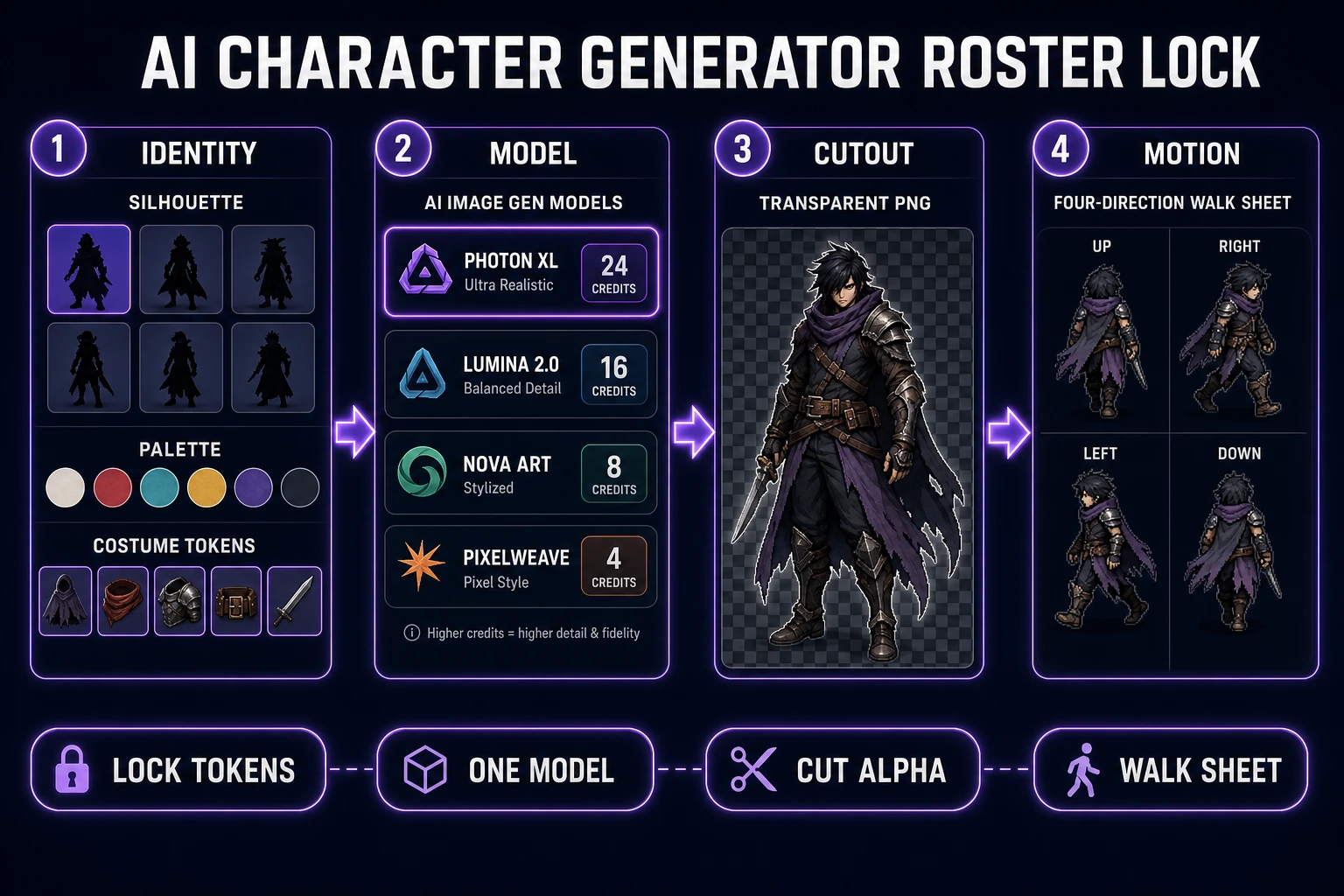
AI character generator roster lock pipeline from identity tokens through image gen cutout to walk sheet
Lock tokens, pick one model, cut alpha, then ship a walk pack before you invent a second identity.

What an ai character generator search wants

DataForSEO lists ai character generator at 18,100 monthly searches with KD 29 in research-supplement.md (verified July 28, 2026). Related phrases include already-shipped siblings such as ai character generator free, character generator ai, and branded long-tails. Readers typing the head query still want the same deliverable: a coherent cast plate an engine can load—portraits, full-body concepts, or sprite-ready cutouts—without hiring a full character pipeline.

Character design for games is a contract, not a mood board. Silhouette must read at thumbnail size. Palette must survive your lighting. Costume tokens must stay nameable so the next prompt does not invent a third cloak. A sprite cast inherits that contract: if the concept plate wobbles, the walk sheet will wobble harder.

Write the contract before you open any generator:

  • Silhouette: one readable outline (hooded mage, round slime, square knight). No dual-weapon clutter on pass one.
  • Palette: three to five named colors. Hex optional; words required (“cyan cloak, charcoal armor, brass trim”).
  • Costume tokens: the nouns you will reuse verbatim across the roster.
  • Camera: full-body three-quarter for concepts, or straight-on for sprite handoff—pick one and stick to it.

That contract is what an ai character generator must obey. Sibling posts cover free-tier framing and branded tools; this roster lock stays on one Sorceress path—AI Image Gen, then BG Remover, then Quick Sprites—so you can ship a consistent cast without opening a desktop paint stack.

Lock identity before the first prompt

Identity drift is the silent killer. Teams “fix” it by regenerating until something looks cool, then discover the shopkeeper, the boss, and the player no longer share a world. Dial the identity first:

  1. Name the subject once (“mushroom knight”, “cyan slime elder”) and refuse mid-batch renames.
  2. Name the costume once. If the cloak is “ragged cyan”, every prompt uses those words.
  3. Name the camera once. Mixing portrait crops with full-body plates breaks sprite pivots later.
  4. Name the negative list once: no second weapons, no random pets, no cinematic rim-light essays on pass one.

Optional but strong: keep a one-line “sacred constants” card next to the prompt box. Treat it like a Phaser constant—change it deliberately, never casually. If you need a villain that rhymes with the hero, change one token (palette or helmet) and leave the rest alone. That is roster design. Spam-generating twelve unrelated faces is not.

Reference images amplify the lock when the model supports them. AI Image Gen exposes per-model reference caps in src/lib/models.ts (verified July 28, 2026): Nano Banana Pro and Seedream 5 Lite accept large reference arrays; Flux 2 Pro charges extra per reference. Attach a clean plate, not a collage of six conflicting outfits. Soft, busy refs teach the model to average—exactly what breaks roster consistency.
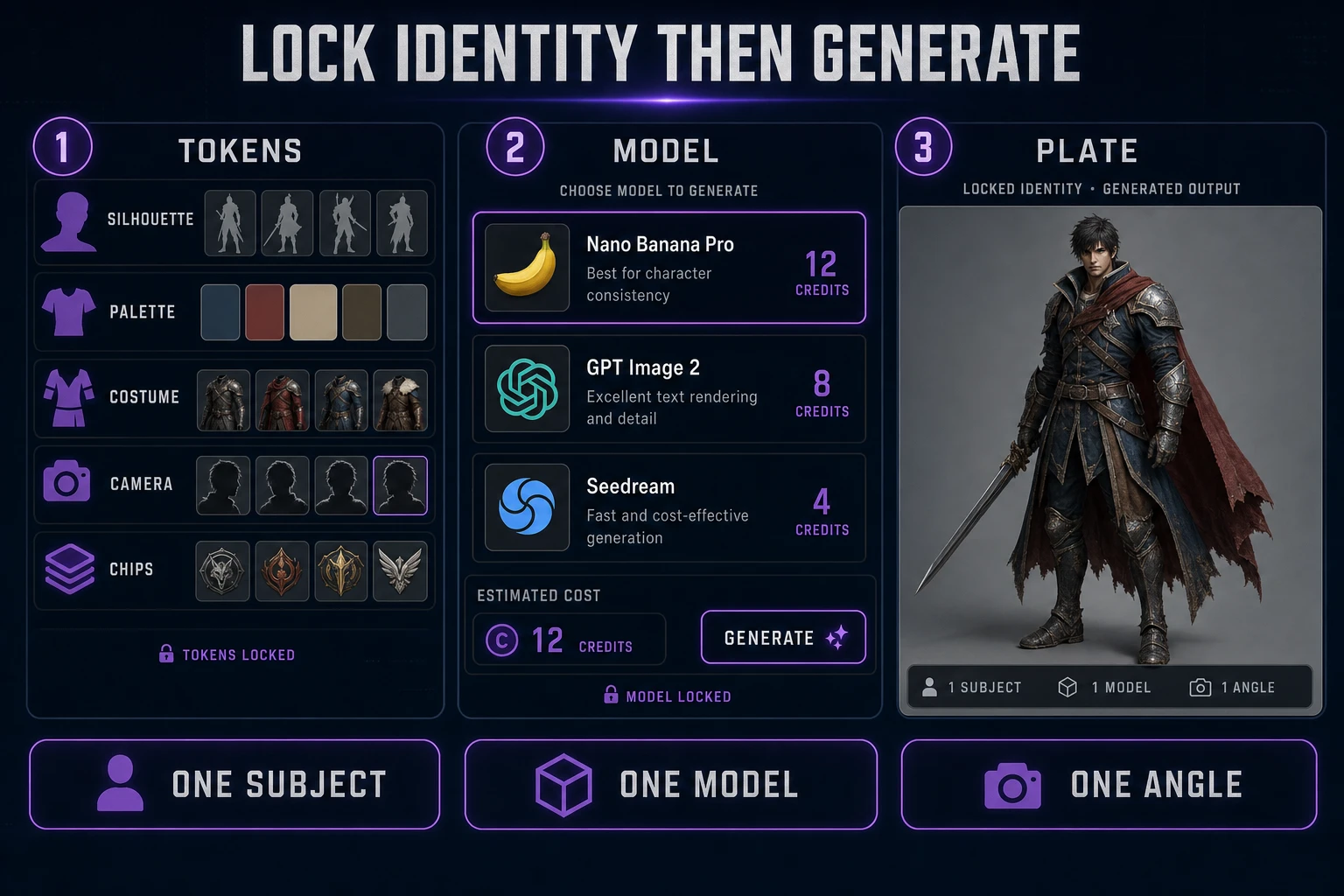
Scorecard for locking identity tokens, choosing one image model, and generating a single hero plate
One subject, one model, one camera. The ai character generator inherits your sticky-note contract.

Pick a model and credit budget

Open AI Image Gen and pick one model for the cast. Mixing Nano Banana Pro lighting with a soft Flux look mid-roster reads as two art directors. Credit costs from src/lib/models.ts (verified July 28, 2026):

  • Nano Banana Pro — 18 credits (default 1K/2K tier). Strong for readable costume detail and text-in-image work when you need labels on concept sheets.
  • Nano Banana 2 — 9 credits. Faster sibling when you are iterating silhouettes, not final key art.
  • GPT Image 2 — 5 credits. Useful when you want a cleaner photoreal plate before you stylize downstream.
  • Seedream 5 Lite — 6 credits. Uncensored path when horror or mature costume language matters for the jam.
  • Flux 2 Pro — 6 credits base, +3 per reference image.
  • Z-Image — 3 credits. Cheap sketching budget for silhouette tests.
  • Grok Imagine — 6 credits.

The Replicate model card for Nano Banana Pro describes it as Google DeepMind’s Gemini 3 Pro Image generation and editing model, with multi-image blending and resolutions up to 4K (card re-fetched July 28, 2026). Use that power for the hero plate—not for twelve disposable randoms.

Budget rule for a weekend cast: spend the expensive model on the hero lock, then reuse cheaper passes only if they inherit the same tokens and refs. Do not “save credits” by switching models every generation; lighting grammar drift costs more redraws than the credit delta.
Generate the hero plate in AI Image Gen

Sign in, confirm credits, set aspect ratio for the job. Full-body concept plates often want 2:3 or 3:4; sprite handoff plates often want 1:1 so the subject fills the frame without cinematic empty sky. Prompt shape that survives engines:

  1. Subject + role (“mushroom knight, player hero”).
  2. Costume tokens from the sticky note.
  3. Palette words.
  4. Camera and background simplicity (“full body, plain mid-gray backdrop, game concept art”).
  5. Stop. No novel-length lore paragraphs.

Generate once. Wait. Inspect on mid-gray, pure black, and pure white. Ask only roster questions:

  • Does the silhouette read at thumbnail size?
  • Do costume tokens match the sticky note?
  • Would a second NPC wearing the same cloak still look like the same world?
  • Is the plate clean enough to cut alpha without hair-frizz soup?

If the plate fails silhouette or token fidelity, regenerate with a tighter prompt or a fixed seed—do not invent a second palette. Most “the ai character generator is broken” reports are identity drift, soft backgrounds, or camera chaos—not a missing art director.

When the hero plate passes, freeze it as the cast bible. Save the PNG and the exact prompt string. Every NPC prompt should start from that bible with one deliberate token change. Free-tier and branded sibling posts cover other entry points; this path stays on the unified AI Image Gen panel so model choice and credit math stay honest.

Cut alpha and check silhouette

Game engines want hard edges more often than soft product-shot mattes. After you have one plate you would actually ship, open BG Remover. BG_REMOVER_CREDITS is 3 and MAX_FILE_SIZE_MB is 5 in src/app/bg-remover/page.tsx (verified July 28, 2026). Upload the hero plate, run once, then inspect the result on a checkerboard:

  • Hair and cloak edges should not glow white.
  • Feet should not float on a gray matte wedge.
  • Internal holes (under arms, between legs) should be true holes, not muddy gray.

If the cut fails, fix the plate (cleaner backdrop, sharper limbs) before spending another three credits. Do not paint fake transparency in a paint app and call it done—engines and atlas tools punish soft mattes. Sibling posts walk Pixelcut and inverted “remover background” phrasing; this roster lock only needs one clean cutout for the handoff.

Optional: if you need a pixel modulus for a retro jam, run the cutout through True Pixel after alpha is honest. Quantize after cutout, not before—quantizing a busy photo background invents junk colors you will fight forever.

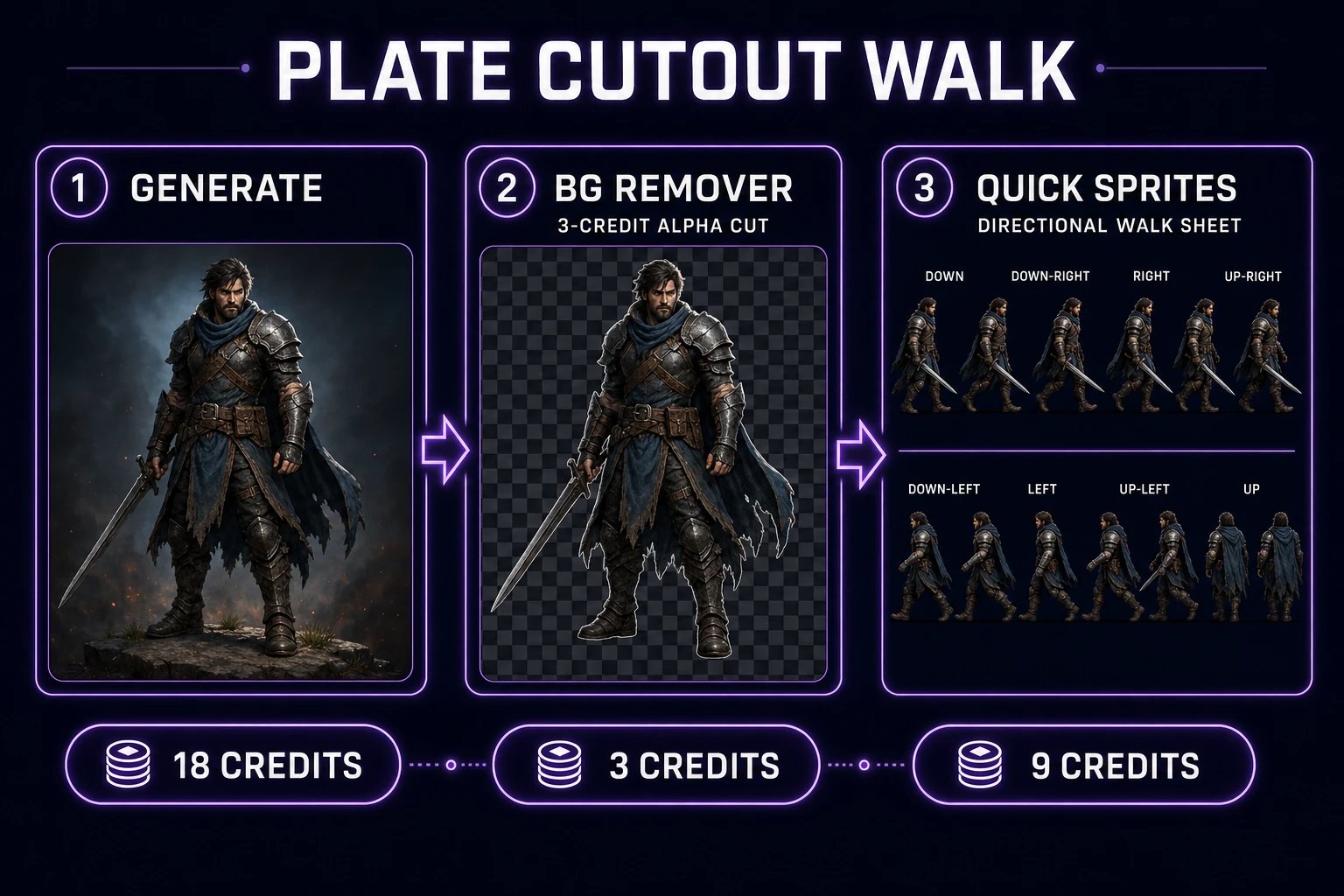
AI Image Gen hero plate flowing into BG Remover cutout and Quick Sprites walk sheet
Spend the image model on identity. Spend three credits on alpha. Spend nine credits on a walk pack only after the cutout survives checkerboard review.

Hand off to Quick Sprites for motion

A static plate is not a cast. Motion proves the silhouette. Open Quick Sprites with the cutout as your mental reference (and as an image reference when the style supports it). CREDITS_PER_GEN is 9 and the model id is retro-diffusion/rd-animation in src/app/quick-sprites/page.tsx (verified July 28, 2026).

Style-to-size pairs that keep the roster honest:

  • Four Angle Walking — 48×48 only. Classic ↑ → ↓ ← humanoid walks.
  • Small Sprites — 32×32 only. Denser packs with extra gesture rows.

Prompt the same subject tokens you locked in AI Image Gen. One action loop on pass one—walk only. Leave return-as-spritesheet enabled. Preview at game camera zoom, not editor zoom. Phaser texture concepts expect consistent frame dimensions; a 49-pixel-wide cell inside a 48×48 row will hitch. Use Sprite Analyzer when you want a scrub before import.

If feet slide or the cloak flips between directions, fix the Quick Sprites prompt—do not return to AI Image Gen and invent a third hero. The ai character generator already did its job when the plate locked. Motion is a separate budget.

Cost math and stop rules

Honest weekend math (verified July 28, 2026 against source constants):

  • Hero plate on Nano Banana Pro: 18 credits (or GPT Image 2 at 5 if you are iterating).
  • One BG Remover cut: 3 credits.
  • One Quick Sprites walk pack: 9 credits.
  • Optional second NPC plate on Nano Banana 2: 9 credits, same tokens + one deliberate change.

Lifetime Access is listed at $49 via LIFETIME_PRICE on the plans page (verified July 28, 2026). Credits still meter generation—lifetime does not mean infinite silent retries. Stop rules that protect the roster:

  1. No second model until the first plate’s silhouette and costume tokens survive mid-gray and checkerboard checks.
  2. No second costume theme until walk frames survive a two-minute playtest.
  3. No “final final v7” filenames—store the prompt string next to the PNG.
  4. No competitor tab-hopping mid-pipeline. Stay on the Sorceress tools guide path so credit math stays comparable run to run.

When you need free-tier framing or a branded long-tail, read the sibling posts that already target those queries. When you need the head-term ai character generator workflow for a shippable jam cast, dial the lock here: identity first, one model, hard alpha, then motion. That is how a roster holds together under a deadline.

Frequently Asked Questions

What should an ai character generator lock before the first prompt?

Identity tokens: silhouette, palette, costume keywords, and camera framing. Write those four on a sticky note and refuse to rename them mid-batch. A roster only holds if every NPC inherits the same grammar.

Which AI Image Gen models and credit costs apply for character plates?

As of July 28, 2026 in src/lib/models.ts: Nano Banana Pro 18 credits, Nano Banana 2 9, GPT Image 2 5, Seedream 5 Lite 6, Flux 2 Pro 6 (+3 per reference), Z-Image 3, Grok Imagine 6. Pick one model for the whole cast so lighting grammar stays coherent.

How do I keep an ai character generator on-model across NPCs?

Reuse the same subject tokens and attach 1–3 reference images when the model supports refs. Nano Banana Pro and Seedream 5 Lite accept large reference arrays in code. Do not invent a new hair color for every shopkeeper.

When should I run BG Remover after character generation?

After you have one plate you would actually ship. BG_REMOVER_CREDITS is 3 with a 5 MB upload cap (src/app/bg-remover/page.tsx, verified July 28, 2026). Inspect alpha on a checkerboard before you feed the cutout into Quick Sprites.

How do I stop burning credits on bad cast art?

One hero plate, one model, one aspect ratio until silhouette and costume survive a mid-gray check. Then cut alpha once. Then generate walk rows. Do not queue five costume variants while the first identity is still soft.

Sources

  1. Character design — Wikipedia
  2. Sprite (computer graphics) — Wikipedia
  3. Nano Banana Pro — Replicate model card
  4. Textures — Phaser Concepts
  5. HTML canvas — MDN Web Docs
Written by Arron R.·1,596 words·7 min read

Related posts