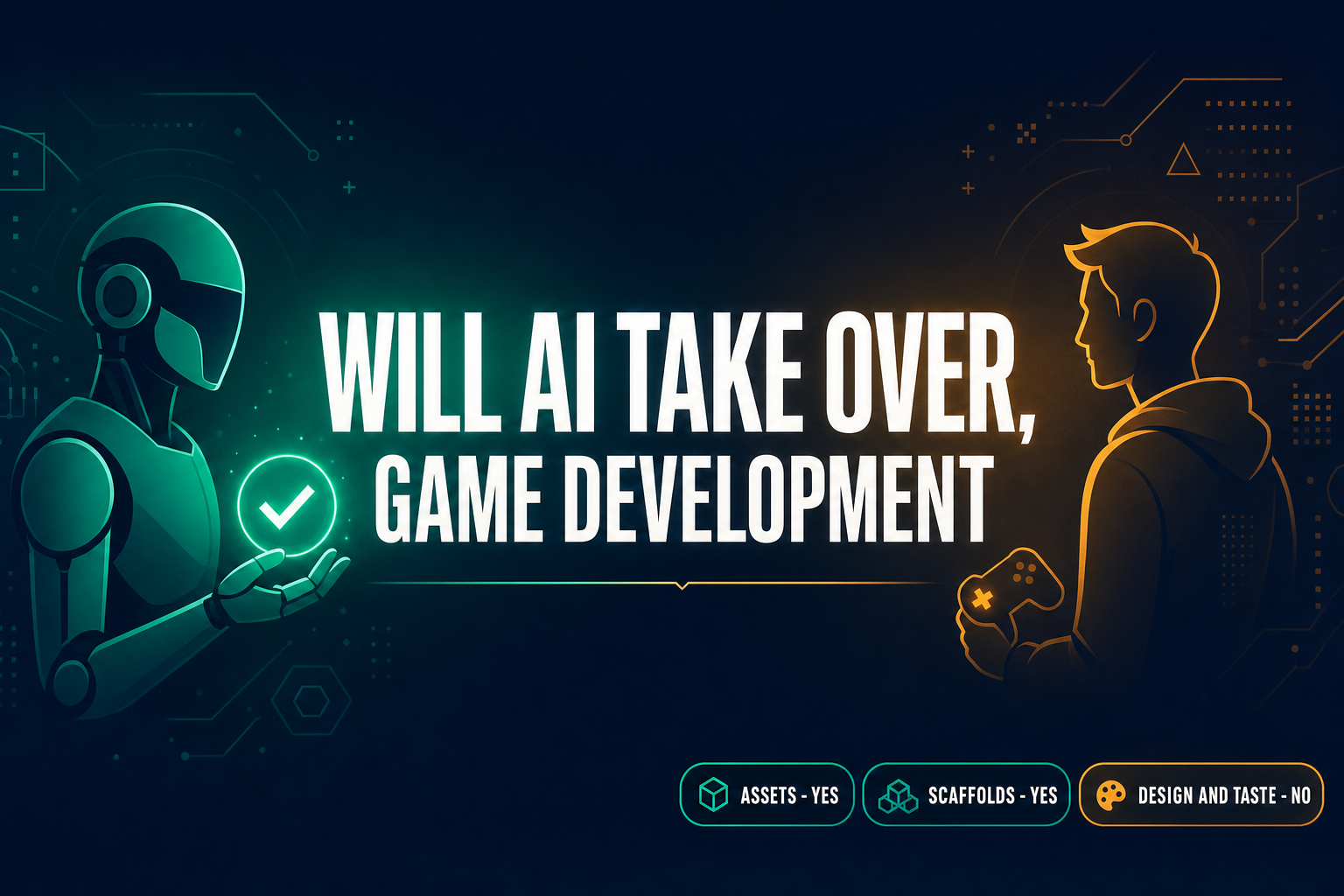
Will AI Take Over Game Development? (An Honest 2026 Read)

By Arron R.13 min read
Will AI take over game development? In 2026 the honest answer is: AI already runs the asset and code-scaffolding layer (sprites, 3D meshes, music, SFX, gameplay

Search “will AI take over game development” in May 2026 and the first page of results splits in two: panic pieces about a profession on the way out, and breathless pieces about a finished game shipped by one person over a weekend. Neither matches the working day of the actual game devs shipping in 2026. The honest read is layered. AI has already taken over the asset and code-scaffolding layer of the pipeline; it has clearly not taken over level design, encounter pacing, narrative voice, or the polish-and-taste week that decides whether a prototype becomes a release. The Activision disclosure on Call of Duty: Black Ops 6 in February 2025 (first reported by The Verge) and Steam’s January 2026 clarification of its AI disclosure form together paint the official picture. The indie corner of vibe coding platforms paints the unofficial one. This post pulls them together. Verified May 16, 2026 against the Verge and Game Developer reports, the GDC 2026 State of the Industry survey, the Steam disclosure form changes, and the Sorceress tool catalog in src/app/_home-v2/_data/tools.ts.
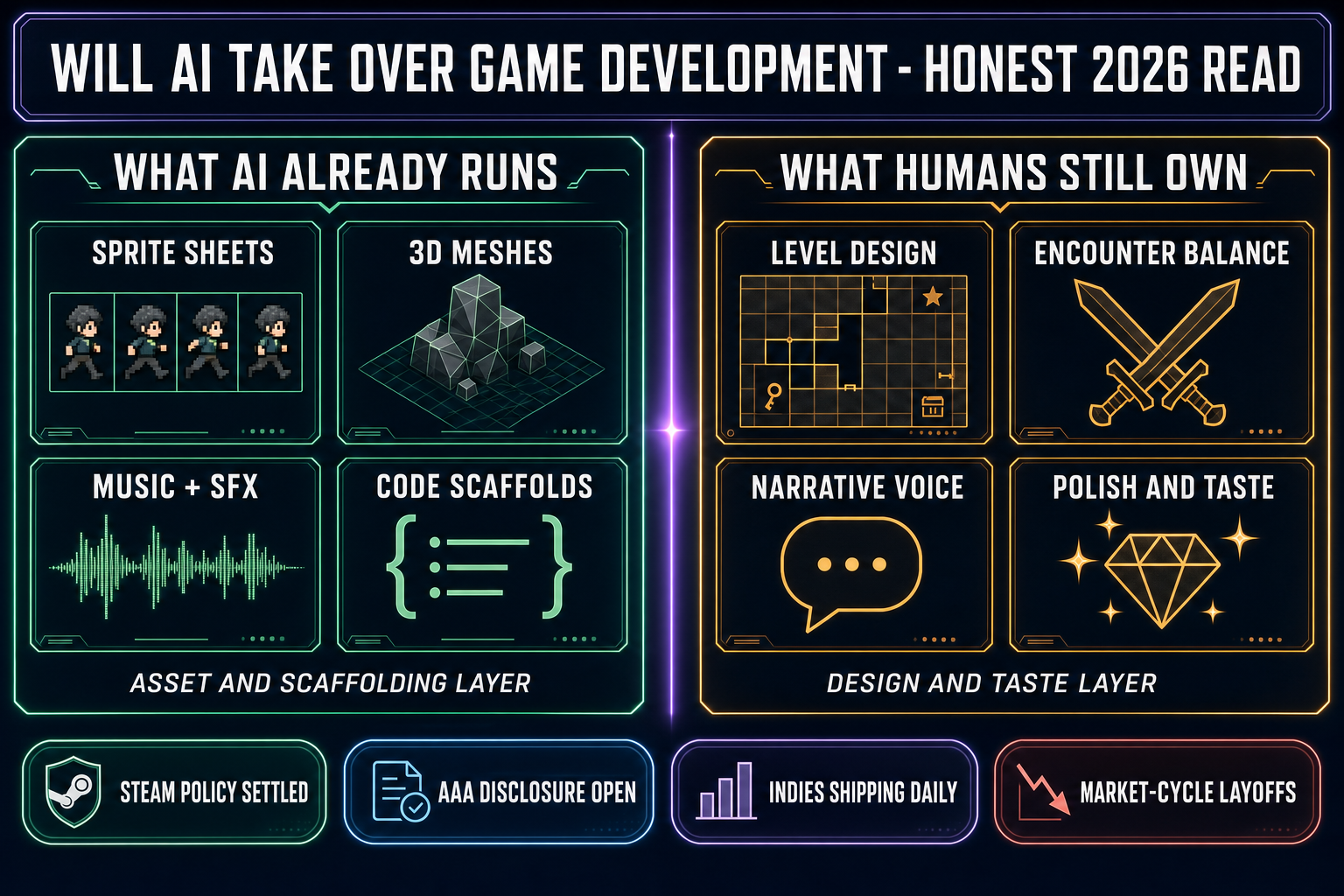
Will AI take over game development diagram showing what AI already runs (sprite sheets, 3D meshes, music plus SFX, code scaffolds) on one side and what humans still own (level design, encounter balance, narrative voice, polish and taste) on the other
Will AI take over game development? In 2026 it has cleanly taken over the asset and scaffolding layer and just as cleanly has not taken over the design and taste layer. Verified against the GDC 2026 State of the Industry survey and the Steam disclosure rules on May 16, 2026.

What “will AI take over game development” actually asks

The query is doing two jobs at once. The first job is the existential one — the new dev wondering whether to start a five-year game-dev career path right as the technology that automates parts of it is going vertical. The second job is the operational one — the current dev wondering which parts of their day are about to change shape. Both jobs are legitimate. The answer that helps both of them is the same answer: AI has not taken over game development as a whole, but it has taken over specific layers of the pipeline. Knowing which layers tells you which career bets to make in 2026 and which parts of the day to spend learning a new tool instead of doing it the old way. The shape of the takeover is layer-by-layer, not job-by-job.

The empirical proof that AI is not running the show is on the storefronts. Open the Steam new-release sidebar on any week in 2026 and the standout releases are still games whose teams used AI for parts of the production, not games whose teams replaced themselves with AI. Itch.io’s top weekly grossing slot in any 7-day window is a mix of hand-crafted pixel-art titles and AI-assisted prototypes; no slot is held by a fully automated game. That pattern matters because storefronts are the place where the takeover would show up first if it were happening — users buy what they like and that selection process is brutally honest. The other place it would show up is in studio org charts, and the GDC 2026 State of the Industry survey gives a clear read there too: layoffs are widespread (one in four developers in the last two years, 33% in the US) but respondents themselves attributed them primarily to restructuring (43%), budget cuts (38%), and project cancellations (32%), not AI replacement. AI shows up in the survey as a topic, not as the cause.

Where AI has already taken over — assets first, code second

Four layers are now meaningfully AI-run for any team that wants them to be. The asset layer is the cleanest sweep. Images — characters, environments, props, UI elements — come out of AI Image Gen at /generate with reference-image conditioning so the same wizard stays on-model across eight poses, eight outfits, or eight expressions without each render drifting. Sprite sheets — the packed grids of frames that drive 2D animation — come out of Quick Sprites at /quick-sprites with frame count, FPS, palette quantization, and transparent-background controls, in less time than it takes to find the right pixel-art tutorial. 3D meshes come out of 3D Studio at /3d-studio using one of seven image-to-3D models (Meshy 6, Meshy 5, Rodin 2.0, TRELLIS, TRELLIS 2, Tripo v3.1, Hunyuan 3D 3.1) with PBR materials and an auto-rigging path that exports to glTF 2.0 or FBX. Audio — music loops, sound effects, sometimes voice when the licensing is clean — comes out of Music Gen and SFX Gen with the dev never leaving the browser tab.

The fifth layer is gameplay code, and the answer is “mostly yes, with caveats.” A vibe-coding session on WizardGenie — the surface where the asset stack and the code editor share a browser tab — turns a one-paragraph brief into a runnable prototype in the time it takes the model to draft the diff. The lift from prompt to playable shape is real, and at the indie scale it is the difference between shipping a jam game and not. The caveats are also real and worth naming honestly: the resulting code needs human review of the architectural decisions, the data model, and the long-tail edge cases. Save state, multiplayer netcode, accessibility, and crash-recovery paths are where AI-scaffolded code reliably underestimates the work that remains. The post on cursor vibe coding and the replit vibe coding breakdown both unpack the same gap from different vendor angles.
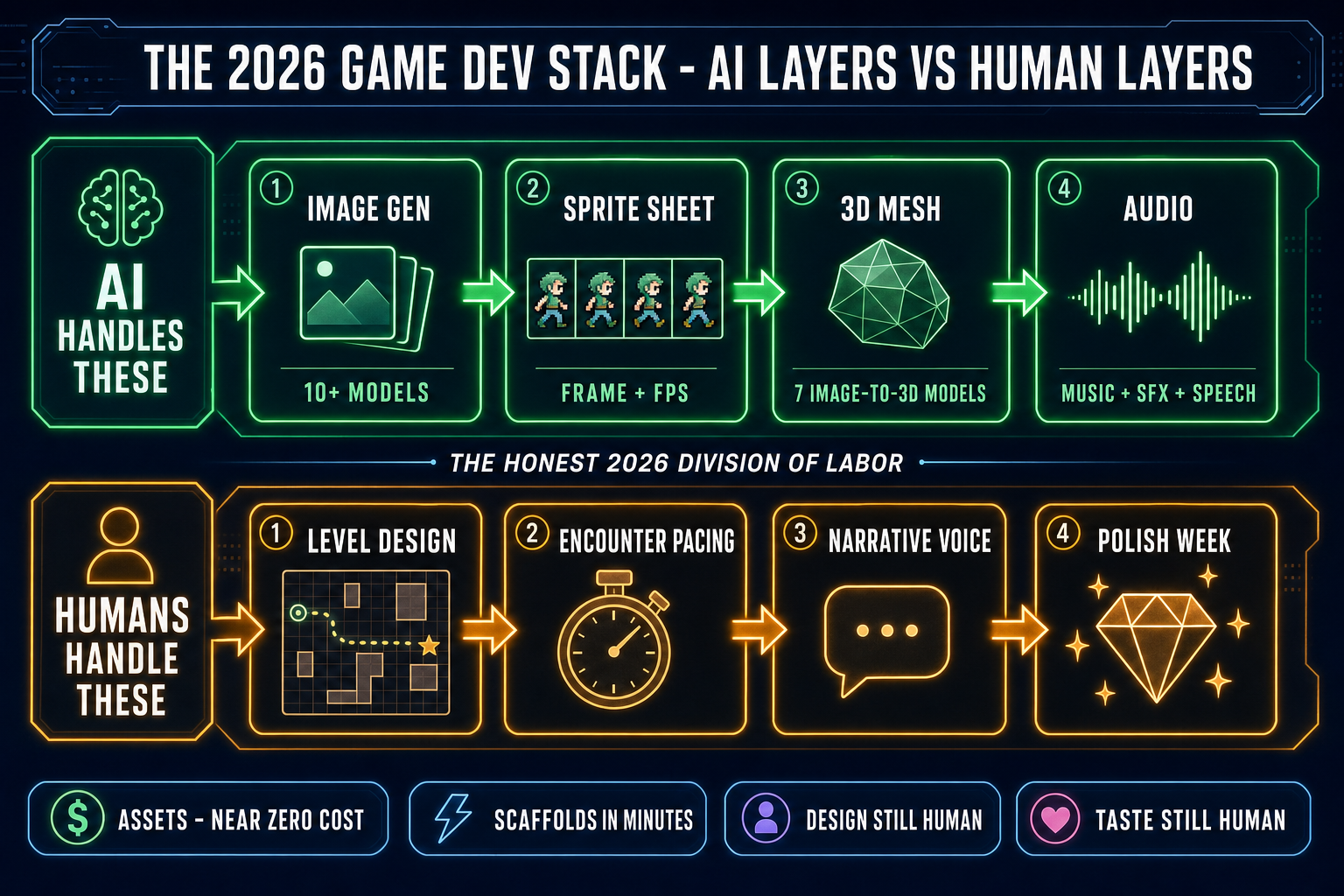
The 2026 game dev stack showing AI layers (image gen, sprite sheet, 3D mesh, audio) on top and human layers (level design, encounter pacing, narrative voice, polish week) on bottom, with a divider labeled the honest 2026 division of labor
The honest 2026 division of labor: AI handles the asset and scaffolding layers; humans still own design, encounter pacing, narrative voice, and the polish week. Tool URLs and image-to-3D model lineup verified against the Sorceress source on May 16, 2026.

Where AI has clearly not taken over game development

Level design is the cleanest example. The AI scaffolds the loop — player controller, camera, collision, basic enemy — but the moment-to-moment shape of a good level (rhythm of empty space and pressure, the timing of an unlock, the placement of a hidden path, the sightline that lets a player feel smart) is still built on hours of human playtest data and a designer who has internalized what fun feels like in that genre. Encounter pacing is the same. An AI can populate an arena with reasonable enemy compositions; it cannot tell you which fifth encounter in the third dungeon is the one that breaks the difficulty curve, because the answer depends on what the actual human player will do at that point in the run. Narrative voice is the third. AI dialogue at the line level is workable in 2026; AI narrative voice consistent across an entire 30-hour RPG is not, and the gap is large enough that the small teams shipping AI-heavy RPGs in 2026 keep the writers on payroll.

The fourth gap is the polish week. The week (or six) that turns a prototype into a release candidate — cleaning up jank, tuning hit feedback, removing dialog dead-ends, balancing the late-game economy, adding the dozen small affordances that ship-ready games have and prototypes don’t — is where the “built in a weekend” demos consistently stop. Polish is the place where game devs earn their reputation and AI consistently produces a 6/10. The fifth gap is taste, which is harder to define and easier to feel. Players know the difference between a game whose creator cared about every screen and a game that was assembled. The taste-driven calls (cut the entire third act because it does not earn its weight, redesign the boss because the silhouette is unreadable at low resolution, swap the color palette because the wrong color reads as poison in this region) are still human work in 2026 and will be for a while.

Big-studio AI in 2026: Activision and the disclosure norm

The high-profile data point is Activision. In February 2025 Activision added a Steam disclosure to Call of Duty: Black Ops 6 reading “Our team uses generative AI tools to help develop some in game assets.” The disclosure was forced by months of player observation — the now-infamous six-fingered zombie Santa loading screen, weapon decals and prestige emblems with telltale artifacts, calling cards and a Zombies map logo that AI-detector tools flagged. The disclosure was a marker that the workflow had reached AAA, not that the franchise had been replaced by AI. The game is still designed by humans, balanced by humans, voice-acted by humans (the prior controversy over the SAG-AFTRA strike notwithstanding), and shipped by humans. AI assisted the asset pipeline; AI did not write the game.

The platform-level response settled in January 2026. Valve clarified the Steam AI disclosure form to draw a clean line: developers no longer need to disclose use of AI-powered tools for workflow efficiency (code helpers, asset-pipeline assistants, development environments with AI built in), because that category is “not the focus of this section.” The disclosure rules still apply to two player-facing categories: (1) generative AI used to produce content shipped in the game — artwork, sound, narrative, localization — and (2) generative AI that produces content live during gameplay (runtime AI text or images). Marketing assets and Steam store pages also fall under disclosure. Game Developer covered the same disclosure tweak the same week. The net effect: the industry norm in 2026 is “workflow AI is fine, content AI must be disclosed.”
The layoff conversation: AI is cited, not the cause

The GDC 2026 State of the Industry survey, the closest thing the field has to an annual ground-truth check, reported one in four developers (28%, rising to 33% for US-based pros) experienced layoffs over the past two years — 17% in the past 12 months alone, with another 11% in the prior 12. Two-thirds of respondents at AAA studios said their companies conducted layoffs; one-third of indie respondents said the same. Among those laid off, 48% are still seeking reemployment, including 36% of those laid off over a year ago. Among surveyed students, 74% said they are concerned about future job prospects, citing the lack of entry-level positions, competition from laid-off senior staff, and AI-related displacement — in that order.

The story behind the numbers is the one the survey respondents themselves told. The post-2021 correction has many causes: the COVID-boom over-hiring, the end of zero-interest money, multiple over-leveraged acquisitions made when capital was cheap, and yes, productivity gains from AI tools that let smaller teams produce what bigger teams used to. The chain that goes “studio adopts AI, studio fires its team” is real in some cases and is not the dominant story. The dominant story is “studio was over-staffed for a market that contracted, studio cut to match the new headcount.” That distinction matters for the new dev deciding whether to enter the field. The honest read for a 2026 entrant is that the entry-level squeeze is real, the path through it is portfolio work that demonstrates the things AI is not good at (level design, polish, taste, a finished playable demo with a coherent point of view), and the asset-and-scaffolding tools that scared off some hiring managers are the same tools that let a one-person team ship the demo that gets you hired.

The indie ground truth: vibe-coded prototypes, hand-tuned releases

The most interesting category in 2026 is not the big-studio AI controversy or the big-studio layoff — it’s the indie demo on Steam Next Fest or the Itch.io page that quietly grew a wishlist count. The pattern in those demos is consistent. The dev used vibe coding for the gameplay scaffolding, sourced character art from an image model with reference conditioning to stay on-model, packed sprite sheets in Quick Sprites, generated environment props in 3D Studio, scored the prototype with Music Gen and SFX Gen, and then spent six honest weeks doing the things AI could not do: level design, playtesting, balance, dialog polish, the marketing screenshots that actually sell the page. The build that landed on the storefront is not an “AI game.” It is a small-team game with the asset and scaffolding cost collapsed to near zero. That collapse is the actual takeover. It is the reason the indie shelf in 2026 has more shipped games on it than at any prior moment in the medium’s history.

The flip side of that abundance is the discoverability problem. With the cost of shipping a prototype near zero, the cost of standing out in a feed of prototypes has gone up. The dev work that gets a small team noticed in 2026 is the work that has always gotten teams noticed: a strong art direction, a clear point of view, a hook the screenshot can carry, a vertical slice that delivers on the hook. AI shortens the path to having a vertical slice to show; it does not shorten the path to having a slice worth showing. Our best vibe coding tools for games piece and the full Sorceress stack walkthrough map out which tool covers which step for the part AI is good at.

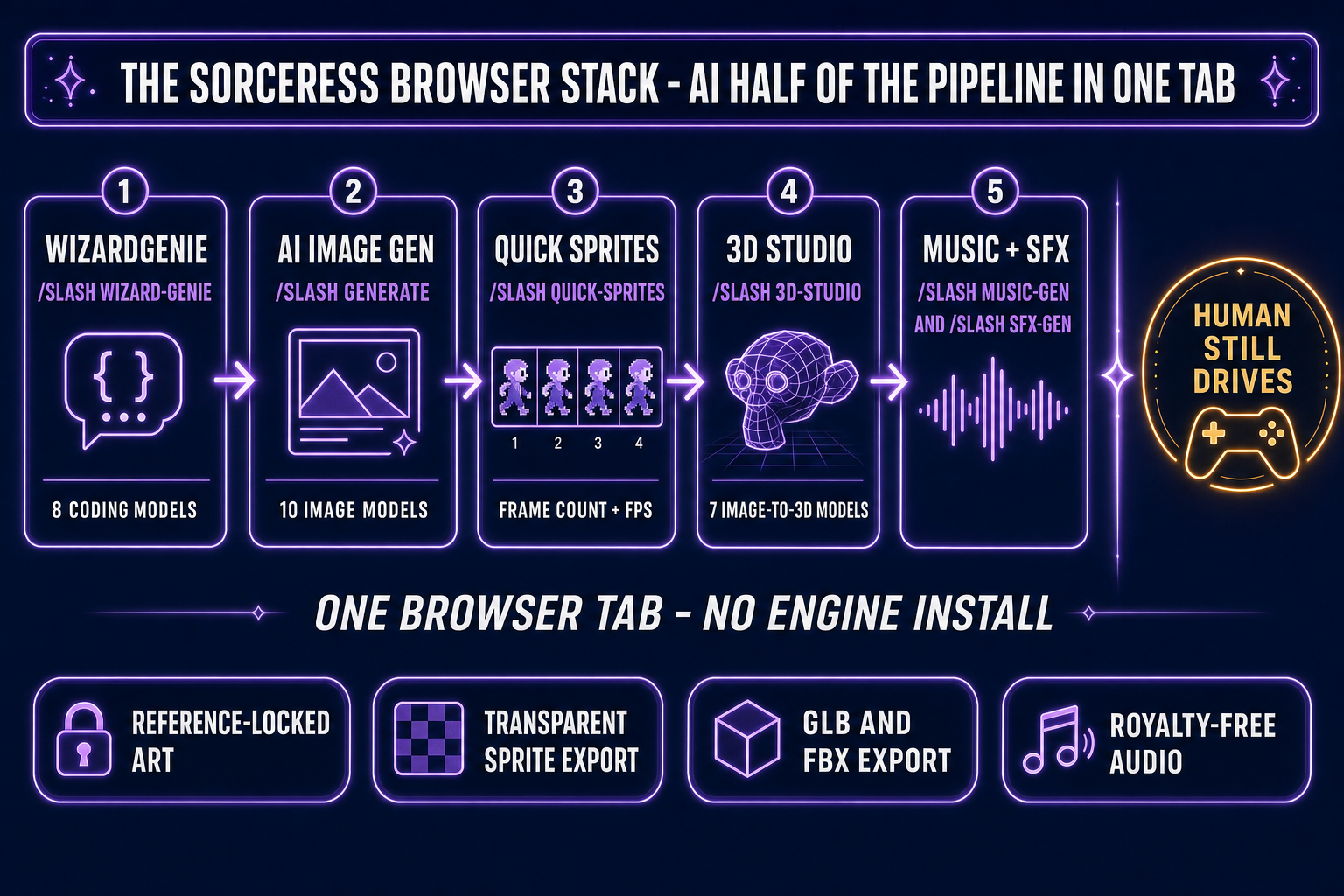
The Sorceress browser stack pipeline showing five tools (WizardGenie, AI Image Gen, Quick Sprites, 3D Studio, Music plus SFX) running in one browser tab, with a separate human-still-drives badge to the right
The Sorceress stack handles the AI half of the pipeline in one browser tab; the human still drives the design and taste half. Model counts and tool URLs verified against the Sorceress source on May 16, 2026.

The 2026 stack: what a real AI-assisted game-dev day looks like

A typical 2026 indie day inside the Sorceress browser tab looks like five tools in sequence. WizardGenie at /wizard-genie/app opens with a model picker listing eight options verified against src/app/_home-v2/_data/tools.ts: Claude Opus 4.7 (top-tier reasoning), Claude Sonnet 4.6 (fast and smart, the default for most vibe sessions), GPT-5.5 (frontier), Gemini 3.1 Pro (1M context), DeepSeek V4 Pro (the cheap executor for the Planner-Executor split), Kimi K2.5 (256K coding-tuned), Grok 4.2 (2M context), and MiniMax M2.7 (agent-tuned). The dev picks Sonnet 4.6 for iteration speed and describes the game in a paragraph. The scaffolding lands in a few minutes. AI Image Gen at /generate runs ten image models with reference-image conditioning to lock the character; the same wizard render works across eight poses without drifting. Quick Sprites at /quick-sprites packs the frames. 3D Studio at /3d-studio handles any 3D props with one of the seven image-to-3D models. Music Gen and SFX Gen handle the audio. The exported assets land in the project that WizardGenie’s agent is editing, which collapses the context-switch tax to near zero.

The cost picture has settled into a Planner-Executor pattern that is worth naming explicitly because it is the part that goes wrong most often. The acceptable Planners (expensive, top-tier reasoning) are Opus 4.7, GPT-5.5, Gemini 3.1 Pro, and Grok 4.2. The acceptable Executors (cheap, fast, big-context) are DeepSeek V4 Pro, Kimi K2.5, MiniMax M2.7, Gemini 3.1 Flash, GPT-5.5 Mini, and Claude Haiku 4.5 when it ships. Pairing two frontier-priced models on the same loop erases the cost advantage the pattern exists to capture. The 2026 AI coding API pricing breakdown goes line by line on the per-token math. The short version: Opus 4.7 plans, DeepSeek V4 Pro types, and the total spend lands at roughly one-fifth of running Opus on both sides of the loop.

The verdict: AI is a co-author of the asset layer, not the designer

So — will AI take over game development? In May 2026 the precise, defensible answer is: AI has already taken over the layers of game development where the work is generative and repeatable (assets, scaffolding) and it has not taken over the layers where the work is selective and taste-driven (level design, pacing, narrative coherence, polish, the calls about what to cut). Storefronts confirm it: the games that move on Steam and Itch.io are still made by humans who used AI for parts of the production, not by AI that used humans for parts of the QA. The big-studio disclosure norm settled into “workflow AI is fine, content AI must be disclosed.” The layoff numbers are real and are mostly the post-COVID market correction, with AI as one of several causes rather than the cause. The indie ground truth is the most interesting category: the bar to ship has fallen, the bar to stand out has risen, and the new dev who builds toward the things AI is not good at (level design, polish, taste, a finished playable demo) is the dev who will be employed five years from now.
The practical move for a 2026 dev who wants to actually do the work is to use the AI half of the pipeline (assets and scaffolding) in one browser tab and spend the saved time on the human half (design and polish). The fastest way to feel that shape is to open WizardGenie, type the game in a paragraph, let the agent stub out the project, and then walk one floor down the asset stack — AI Image Gen for the character, Quick Sprites for the animations, 3D Studio for any 3D props, Music Gen and SFX Gen for the audio — without leaving the browser. Then spend the next six honest weeks designing the levels, balancing the encounters, tuning the dialog, and writing the marketing copy that makes the screenshot land. That is the 2026 day. The full Sorceress stack walkthrough shows the tool order, the prompt-to-game pipelines piece shows the asset hand-offs, and the original what is vibe coding explainer — building on Karpathy’s February 2 2025 origin tweet and Simon Willison’s February 6 follow-up — sets up the why.

Frequently Asked Questions

Will AI take over game development entirely in 2026?

No. The honest 2026 read is that AI has already taken over specific layers of the pipeline (the asset layer - sprite sheets, 3D meshes, music, SFX - and the code-scaffolding layer) and just as clearly has not taken over the layers that decide whether a game is fun. That means level design, encounter pacing, narrative voice, art direction, playtest-driven polish, the taste calls about what to cut, the long-tail balance work that turns a prototype into a shippable game. The shape of the takeover is layer-by-layer, not job-by-job. A solo indie in 2026 can ship a working prototype that would have needed a small team in 2022 because the asset and scaffolding cost dropped to near zero - but the things that make people actually buy and finish the game are still the things humans do best. The empirical proof that AI is not running the show is on Steam: search the new-release sidebar on any given week and the standout releases are not AI-generated games, they are games whose teams used AI behind the scenes for parts of the production. The Activision disclosure on Call of Duty: Black Ops 6 in February 2025 (acknowledged to The Verge and to Steam's disclosure form) is the high-profile example - generative AI was used for some in-game assets (the now-infamous six-fingered zombie Santa loading screen being the giveaway), but the game itself is still designed, balanced, and shipped by humans.

Will AI replace game developers and put indie devs out of work?

It is replacing some specific tasks within the game-developer job and not the job itself. The GDC 2026 State of the Industry survey reported one in four developers (28%, rising to 33% for US-based pros) experienced layoffs over the past two years, and 74% of game-dev students said they are concerned about future job prospects, with AI-related displacement cited as one of three top concerns alongside the entry-level squeeze and competition from laid-off senior staff. But the surveys also note that respondents themselves attributed the layoffs primarily to restructuring (43%), budget cuts and market conditions (38%), and project cancellations (32%) rather than AI replacement. The post-2021 correction in game industry headcount has many causes - the COVID-boom over-hiring, the end of zero-interest money, multiple over-leveraged acquisitions, and yes, productivity gains from AI tools - but the chain that goes 'studio adopts AI - studio fires its team' is rarely the actual story. The story that is true is that the bar to ship is now lower for solo and small-team indie devs because the asset and scaffolding cost has collapsed - which is what fills the indie-on-Steam side of the new-release feed in 2026.

What are platforms like Steam, Itch.io, and Epic doing about AI-generated games?

Steam updated its AI disclosure form in January 2026 to draw a clear line: developers no longer need to disclose use of AI-powered tools for workflow efficiency (code helpers, asset-pipeline assistants, development environments with AI built in), because that category is 'not the focus of this section.' The disclosure rules still apply to two categories that are about player-visible content: (1) generative AI used to produce content shipped in the game (artwork, sound, narrative, localization) and (2) generative AI that produces content live during gameplay (runtime AI text, runtime AI images). Marketing assets and Steam store pages also fall under disclosure. Valve was explicit that failure to implement safeguards against infringing AI content will get the app removed. Itch.io has community-level tags but no platform-wide AI ban as of May 2026. Epic Games Store's CEO Tim Sweeney commented publicly on the Valve disclosure shift in January 2026 but Epic has not introduced a parallel disclosure form. The honest read across the three storefronts in 2026 is 'workflow AI is fine, content AI must be disclosed' - the industry-wide norm has settled there for now.

What parts of game development can AI actually handle in 2026?

Four layers cleanly and one layer partially. The four clean wins are (1) image generation - characters, environments, props, UI elements, with reference-image conditioning to keep characters on-model; (2) sprite-sheet production - frame extraction, alpha handling, animation loops; (3) 3D mesh generation - image-to-3D models like Meshy 6, Rodin 2.0, TRELLIS 2, Tripo v3.1, and Hunyuan 3D 3.1 turn a concept image into a posed mesh with PBR materials, and auto-rigging closes the loop to a skeleton-ready FBX or glTF; (4) audio - music loops, sound effects, sometimes voice when SAG-AFTRA-style concerns are addressed. The partial win is gameplay code. Vibe-coding tools ship a runnable prototype from a one-paragraph brief, but the resulting code needs human review of the architectural decisions, the data model, and the long-tail edge cases - especially anything involving save state, multiplayer netcode, or accessibility. The layers AI is not yet running are level design (good levels still require human playtest data), encounter balance, narrative voice that lands across an entire campaign, the polish week that turns a prototype into a release candidate, and the marketing and community work after launch. Sorceress (sorceress.games) bundles the four-layer asset stack plus a multi-model code editor in one browser tab so the AI half of the pipeline is one workflow, not five tools.

How are big studios actually using AI in shipped games in 2026?

Two visible patterns. The first is asset assistance disclosed under Steam's content rules. The flagship example is Activision's February 2025 disclosure on Call of Duty: Black Ops 6 - 'Our team uses generative AI tools to help develop some in game assets' - which followed months of player complaints about telltale AI artifacts (the six-fingered zombie Santa loading screen, weapon decals, prestige emblems and calling cards, and a Zombies map logo that AI-detector tools flagged). The disclosure itself is a marker that the workflow has reached AAA, not that the franchise is suddenly AI-built. The second pattern is workflow AI inside the studio - code completion in the engine IDE, copilots in art tools, AI-assisted localization passes, AI-summarized playtest feedback - which under the January 2026 Steam clarification does not require disclosure because it is dev-side efficiency, not player-facing content. Talking to indie devs in 2026 the third pattern is the most interesting: the asset stack outside the studio. A solo dev sources character art from an image model, runs a sprite sheet through a packer, generates a music loop, and ships a build that two years ago would have needed a four-person team. Whether the player even notices the asset is AI-sourced depends mostly on whether the dev cared enough to take the AI output as a starting point and not the finished asset.

Sources

  1. Vibe coding - Wikipedia
  2. GDC 2026 State of the Game Industry - layoffs and generative AI
  3. Activision confirms Call of Duty has AI-generated content (The Verge, Feb 2025)
  4. Valve's new Steam AI disclosure rules clarified (PC Games N, Jan 2026)
  5. Valve tweaks and clarifies AI disclosure rules for Steam (Game Developer, Jan 2026)
  6. Sprite (computer graphics) - Wikipedia
  7. glTF 2.0 specification (Khronos Group)
  8. Andrej Karpathy on vibe coding (Simon Willison, Feb 6 2025)
Written by Arron R.·2,875 words·13 min read

Related posts