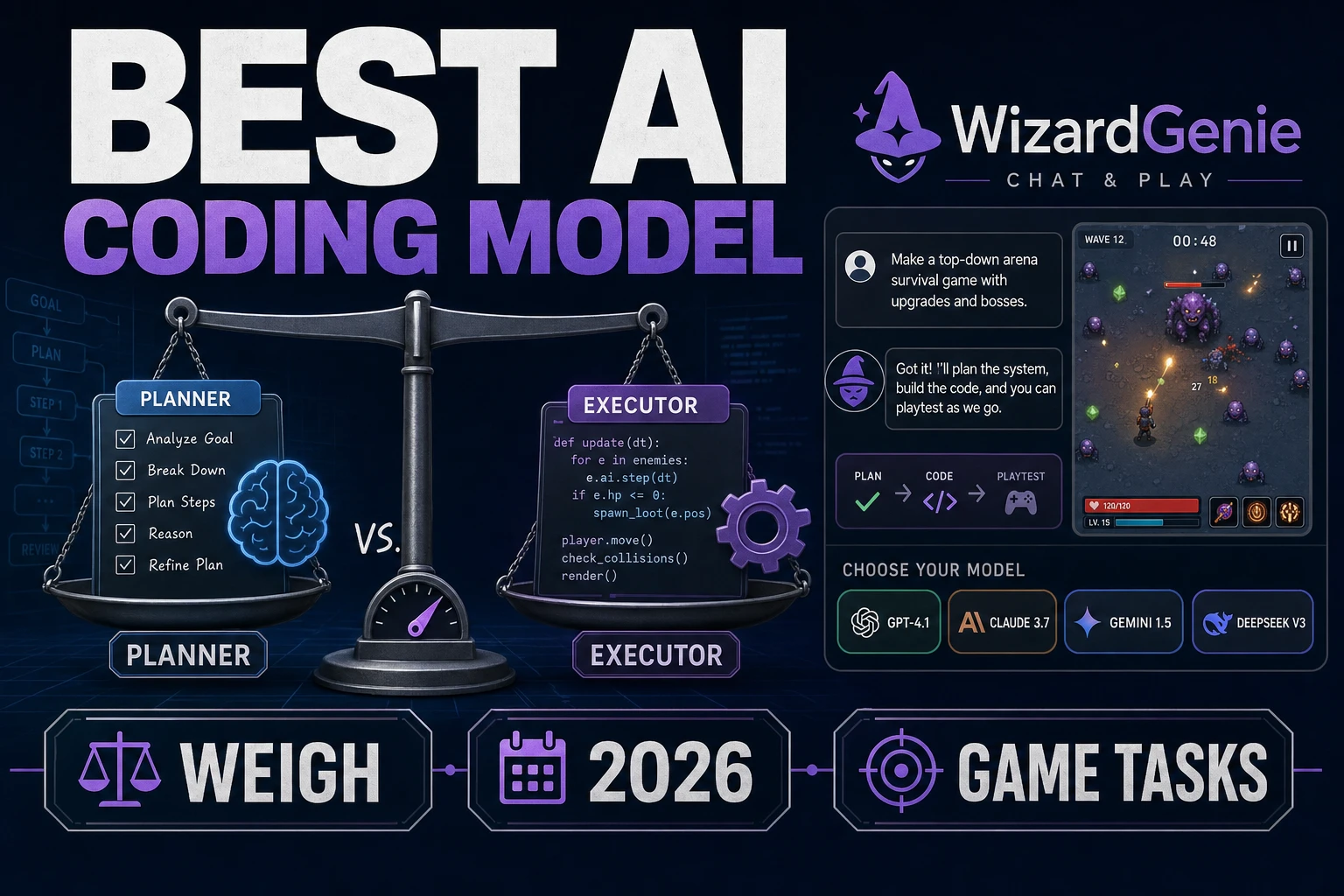
Weigh the Best AI Coding Model (Game Tasks 2026)

By Arron R.7 min read
The best AI coding model for games is a pairing: a frontier planner for scaffolds and hard bugs, plus a cheap executor for feel tweaks. Weigh them on playable t

Leaderboards crown a single "winner." Game jams punish that mindset. The best AI coding model for a playable weekend is almost always a pairing: a frontier planner for scaffolds and hard bugs, plus a cheap executor for feel tweaks. This comparison weighs that split on real game tasks inside WizardGenie, using the Sorceress CODING_MODELS catalog in src/app/_home-v2/_data/tools.ts (verified July 27, 2026). Claude Opus 4.7 API pricing was live-checked the same day on Anthropic's official announcement. Phaser v4.2.1 "Giedi" was confirmed against the GitHub release notes.
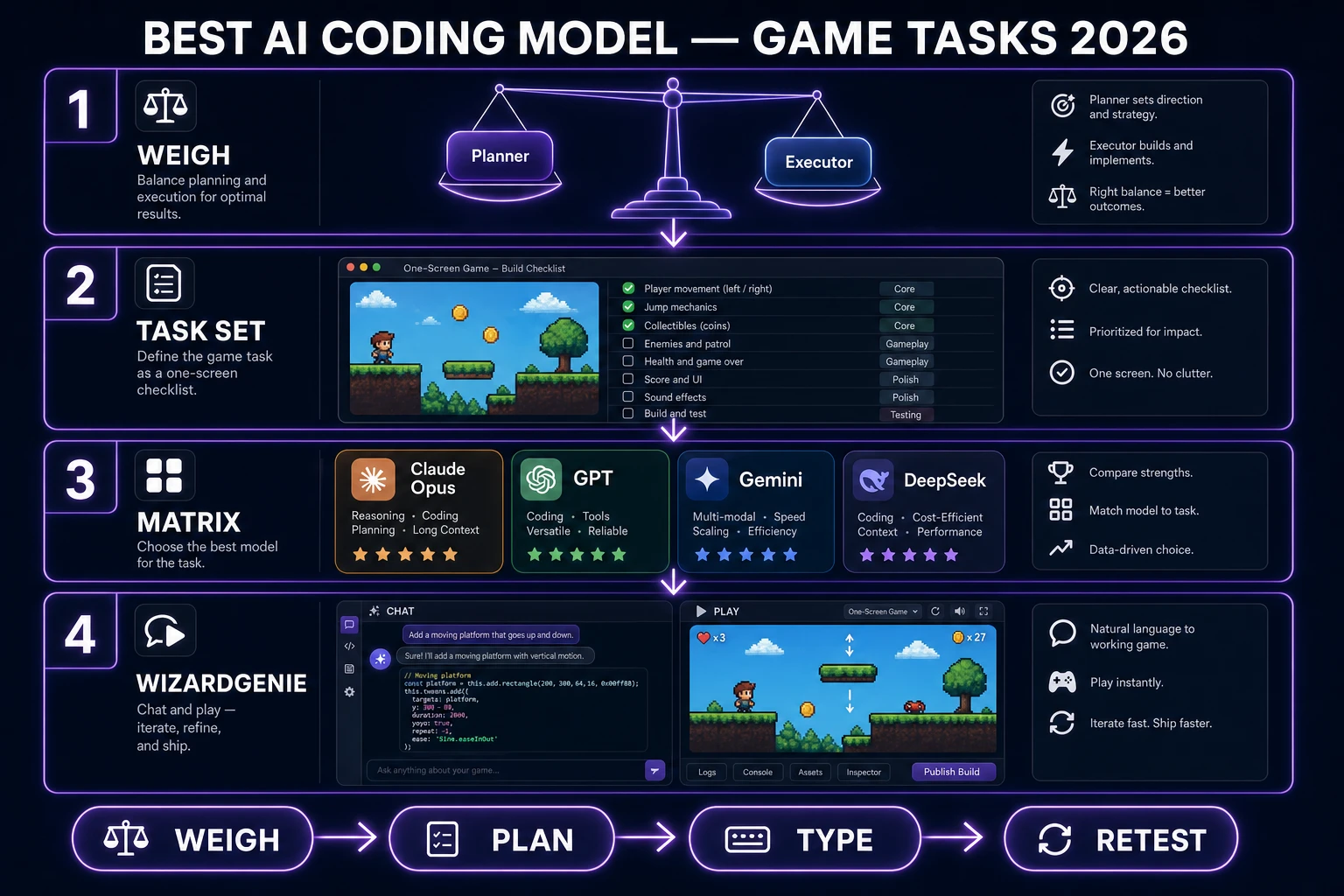
Best AI coding model weigh-in path from task set through model matrix to WizardGenie dual-agent loop
Weigh the best AI coding model on playable game tasks—not on a chat demo that never reopens on day two.

What best ai coding model means for games

DataForSEO lists best ai coding model at 210 monthly searches with KD 30 in research-output.md (verified July 26, 2026). Sibling phrases carry more head volume: best ai model for coding at 1,300/mo (KD 18) and best coding ai model at 590/mo (KD 19). Those siblings already have honest-test posts on this blog; this page targets the exact best ai coding model phrasing and reframes the weigh-in around game systems instead of generic SWE benches.

Wikipedia's vibe coding entry (checked July 27, 2026) traces the phrase to Andrej Karpathy in February 2025. Martin Fowler separates pure "forget the code exists" prompting from agentic work where structure still matters. Game tasks live in the second camp: gravity, hitboxes, score rules, and asset hooks must survive the next prompt.

So for games, the best AI coding model is not the one that hallucinates a trailer script. It is the one that:

  • Scaffolds a one-screen loop without inventing inventory systems you did not ask for.
  • Accepts "enemy speed 90 to 70" without regenerating the scene graph.
  • Keeps sacred constants named and editable across sessions.
  • Leaves room for a cheaper model to type the micro-fixes.

If your ranking only measures "first pretty render," you are weighing demos, not games. For tool-level ranking of the agent shell around those models, see rank best vibe coding tool.

The 2026 task set

Ignore the reel. Score five rows on paper before you trust any candidate as the best AI coding model for a jam.

Task Pass looks like Fail looks like
Playable slice Move, collide, score, restart in one screen Pretty menu with no loop
Single-variable fix One constant changes; rest stays Whole scene regenerates
Asset add One PNG + one SFX drop in cleanly Rebuild the game with art
Reopen continuity Day-two folder still runs Disposable sandbox evaporates
Cost split Frontier plans; cheap model types Frontier model on every gravity tweak

MDN's overview of web games still centers on a running loop, input, and assets. Your weigh-in should center on the same surfaces. Time the loop too: if a tiny feel fix takes longer than playing the screen twice, the model is optimizing for spectacle.

Pin a real runtime when physics behavior matters. As of July 27, 2026, Phaser v4.2.1 "Giedi" (released July 9, 2026) remains the stable tag on the official GitHub release notes. Naming that version in the scaffold prompt reduces silent API drift when you rotate models mid-weekend.
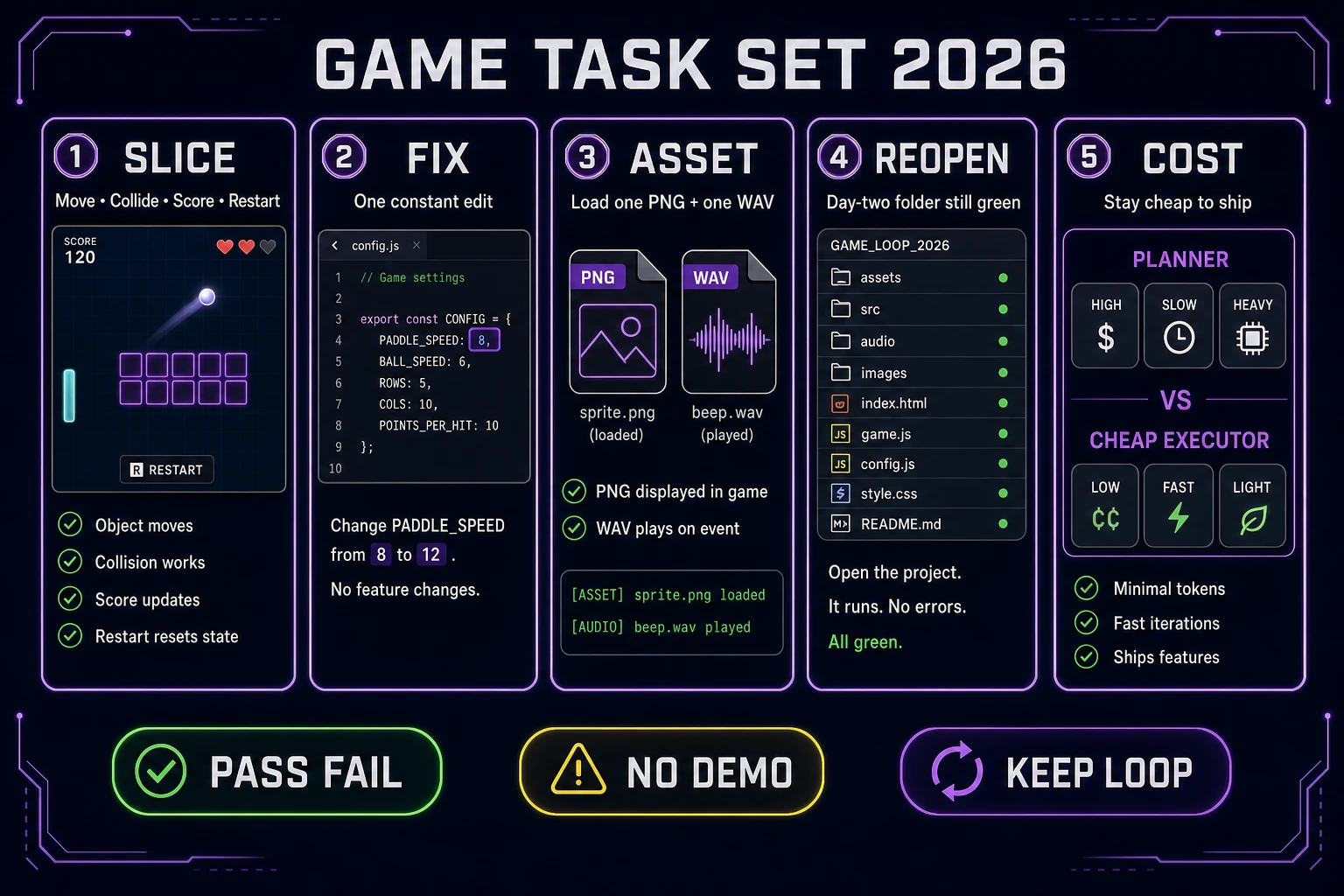
Game task set scorecard for best AI coding model weigh-in
Five pass/fail rows beat a leaderboard screenshot: slice, fix, assets, reopen, and planner/executor cost.

The verified model matrix

WizardGenie drives the current Sorceress coding lineup. Names below are taken verbatim from CODING_MODELS on July 27, 2026—not from memory of last month's marketing slides.

Model Provider tag in catalog Default weigh-in role Best game-task fit
Claude Opus 4.7 Anthropic · Top tier Planner Hard scaffolds, long agent runs, strict instruction follow
Claude Sonnet 4.6 Anthropic · Fast + smart Planner / mid Faster architecture passes when Opus is overkill
GPT-5.5 OpenAI · Frontier Planner Alternate frontier scaffold when you want a second opinion
Gemini 3.1 Pro Google · 1M context Planner Large context dumps (design docs + prior session notes)
Grok 4.2 xAI · 2M context Planner Huge context windows for lore-heavy prototypes
DeepSeek V4 Pro DeepSeek · Budget Executor Cheap typing for gravity, speed, and score tweaks
Kimi K2.5 Moonshot · 256K coding Executor Budget coding passes with a wide context cushion
MiniMax M2.7 MiniMax · Agent-ready Executor Agent-friendly micro-fixes without frontier spend

Anthropic's Introducing Claude Opus 4.7 post (Apr 16, 2026; re-fetched July 27, 2026) prices Opus 4.7 at $5 per million input tokens and $25 per million output tokens—same as Opus 4.6—with API id claude-opus-4-7. That number is why Opus belongs on the planner seat, not on every coyote-time nudge. Vendor pages for the other families move weekly; treat the Sorceress catalog as the names you can actually select in WizardGenie today, and re-check pricing on publish day whenever you quote dollars.
Where the leader wins

Frontier planners win the weigh-in when the failure mode is architecture, not polish. Put Claude Opus 4.7, GPT-5.5, Gemini 3.1 Pro, or Grok 4.2 on the first pass when you need:

  • A clean Phaser scene graph with named constants from the first prompt.
  • Collision layers that do not invent a second player controller.
  • Honest refusal of out-of-scope features ("no inventory") instead of silent scope creep.
  • Recovery from a broken playtest without rewriting the whole project folder.

A practical scaffold any best AI coding model should survive as planner:

Build a one-screen browser action prototype on Phaser v4.2.1. Side-view. Player moves and collides with platforms. Collect three pickups to raise score. Touching an enemy restarts the run. Colored rectangles only. No inventory, no dialogue. Expose moveSpeed and enemySpeed as named constants. Do not invent extra systems.

Anthropic's Opus 4.7 notes emphasize stricter instruction following than Opus 4.6—useful when earlier models "helpfully" added menus you never asked for. In a jam, that literalism is a feature: your sacred constants stay sacred. Use the planner again when a bug is structural (wrong physics body ownership, broken restart state, score never resetting). Do not burn planner tokens on "make the jump feel floatier by 8%."

Browse the wider catalog when the weigh-in leaves the code pane: the tools guide maps image, audio, and 3D surfaces on the same account. Hook art through AI Image Gen without asking the planner to regenerate systems.

Where a cheap executor still wins

Budget executors win most of the weekend hours. After the slice boots, switch to DeepSeek V4 Pro, Kimi K2.5, or MiniMax M2.7 for:

  1. Single-variable feel fixes. Enemy speed 90 feels unfair; set to 70; keep player speed fixed.
  2. HUD copy and score formatting. Tiny string edits should not cost frontier rates.
  3. Asset wiring. Point an existing sprite path at a new PNG without rewriting collision.
  4. Retest scripts. Ask the executor to list the five scorecard rows and mark pass/fail after each play.

Honest caveat: a cheap executor can still smash a careful scaffold if you prompt it like a greenfield build ("rebuild the game with better art"). Keep prompts surgical. If the executor starts inventing systems, stop and return to the planner with a failure log—not with "make it cooler."

This is also where sibling rankings diverge. Posts that ask what is the best AI model for coding often chase a single champion. Game tasks reward a roster. Calling DeepSeek "worse" because it loses a hard SWE bench misses the point: on micro-fixes it can be the best AI coding model for your credit balance.

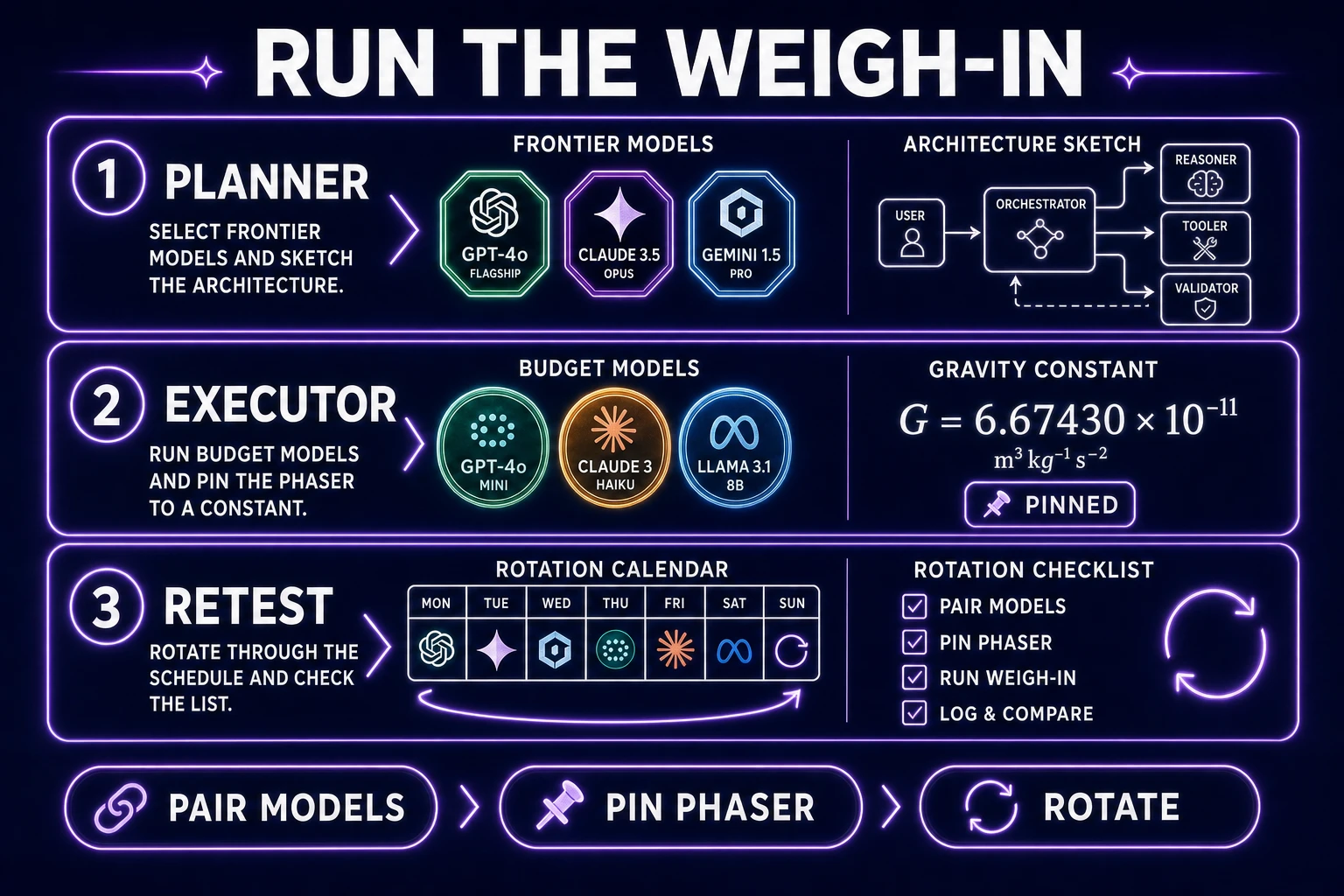
WizardGenie planner versus executor weigh-in with Phaser pin and retest rotation
Run the weigh-in inside WizardGenie: frontier plans, budget types, then retest after each model rotation.

Run the weigh-in inside WizardGenie

WizardGenie is the Sorceress AI-native game engine: describe the game, watch it run, iterate in real time. It ships as a Windows desktop app and as a web entry at /wizard-genie/app. Web wins for zero install; desktop wins for native filesystem depth and longer agent sessions.

Weigh-in procedure that fits a Saturday morning:

  1. Open WizardGenie and pin Phaser v4.2.1 in the first prompt.
  2. Select a frontier planner from the matrix. Run the one-screen scaffold. Play until you hit a real fail.
  3. Feed the fail back as the next planner prompt. Stop when move/collide/score/restart all pass.
  4. Switch to a budget executor. Run ten single-variable feel prompts. Score how many preserve the scene.
  5. Drop one sprite via AI Image Gen and one cue via SFX Gen. Fail the model if it rebuilds systems to accept the files.
  6. Close the project. Reopen. If the loop is dead, the candidate failed reopen continuity—regardless of how pretty the first render looked.

Write the five scorecard rows on paper. Do not trust vibes. The best AI coding model for your jam is the pairing with the most passes at the lowest spend, not the model with the loudest launch blog.

Retest after each rotation

Model lineups rotate. Catalog tags drift. Pricing changes. Treat the weigh-in as a living checklist:

  • Re-open CODING_MODELS whenever WizardGenie shows a new chip—do not assume last month's "top tier" is still the planner you want.
  • Re-fetch vendor pricing the day you quote dollars. Opus 4.7's $5 / $25 figure was true on Anthropic's page on July 27, 2026; it is not a permanent law.
  • Re-pin the Phaser stable tag after each engine upgrade so physics regressions are not blamed on the wrong model.
  • Retest the five rows whenever you change planner or executor. A new "best" on a public bench can still fail single-variable feel fixes in your project.

Verdict for 2026 jam work: there is no lone best AI coding model. Weigh Claude Opus 4.7 / GPT-5.5 / Gemini 3.1 Pro / Grok 4.2 as planners, keep DeepSeek V4 Pro / Kimi K2.5 / MiniMax M2.7 as executors, and run the scorecard inside WizardGenie until the loop survives day two. That pairing is the ranking that ships a playable slice.

Frequently Asked Questions

What is the best AI coding model for a weekend game jam?

There is no single winner. Use a frontier planner (Claude Opus 4.7, GPT-5.5, Gemini 3.1 Pro, or Grok 4.2) for the first playable scaffold and hard architecture bugs, then switch to DeepSeek V4 Pro, Kimi K2.5, or MiniMax M2.7 for micro feel fixes so the weekend stays affordable.

How should I weigh the best AI coding model against leaderboard hype?

Run a fixed game task set: one-screen slice, single-variable feel fix, asset add without rewrite, reopen continuity, and cost per successful fix. Models that win chat demos but regenerate your scene on every gravity tweak lose the weigh-in.

Which coding models does WizardGenie expose today?

Verified against src/app/_home-v2/_data/tools.ts CODING_MODELS on July 27, 2026: Claude Opus 4.7, Claude Sonnet 4.6, GPT-5.5, Gemini 3.1 Pro, DeepSeek V4 Pro, Kimi K2.5, Grok 4.2, and MiniMax M2.7.

What does Claude Opus 4.7 cost on the Anthropic API?

Anthropic’s Introducing Claude Opus 4.7 post (Apr 16, 2026), re-checked July 27, 2026, lists $5 per million input tokens and $25 per million output tokens—same as Opus 4.6—with API id claude-opus-4-7.

Which Phaser version should I pin when testing coding models?

Phaser v4.2.1 Giedi (released July 9, 2026) was live on the official GitHub release notes when checked on July 27, 2026. Name that version in scaffold prompts so physics APIs do not drift between model rotations.

Sources

  1. Introducing Claude Opus 4.7 — Anthropic
  2. Phaser v4.2.1 release notes — GitHub
  3. Vibe coding — Wikipedia
  4. Vibe Coding — Martin Fowler Bliki
  5. Games — MDN Web Docs
Written by Arron R.·1,599 words·7 min read

Related posts