Pulse Vibe Coding With Claude (Planner Split 2026)

By Arron R.7 min read
Vibe coding with Claude works when Claude plans and a budget model types. WizardGenie Dual-agent Planner+Executor on desktop and web keeps that split honest. Ve

Searchers who type vibe coding with Claude already picked a Planner brand. They are not asking whether large language models can write code — Wikipedia’s Large language model page (checked 2026-09-24) covers that primitive. They want a workable chair assignment: Claude plans the next change, something cheaper types the files, and a playable build decides if the plan was right. This article locks that split for indie browser games on WizardGenie. Procedure without the brand lives on how to vibe coding. Definitions live on what is vibe coding and vibe coding meaning. Facts below were verified 2026-09-24 against Wikipedia, MDN’s game anatomy guide, Phaser’s stable download page, and the Sorceress source for WizardGenie plus CODING_MODELS.
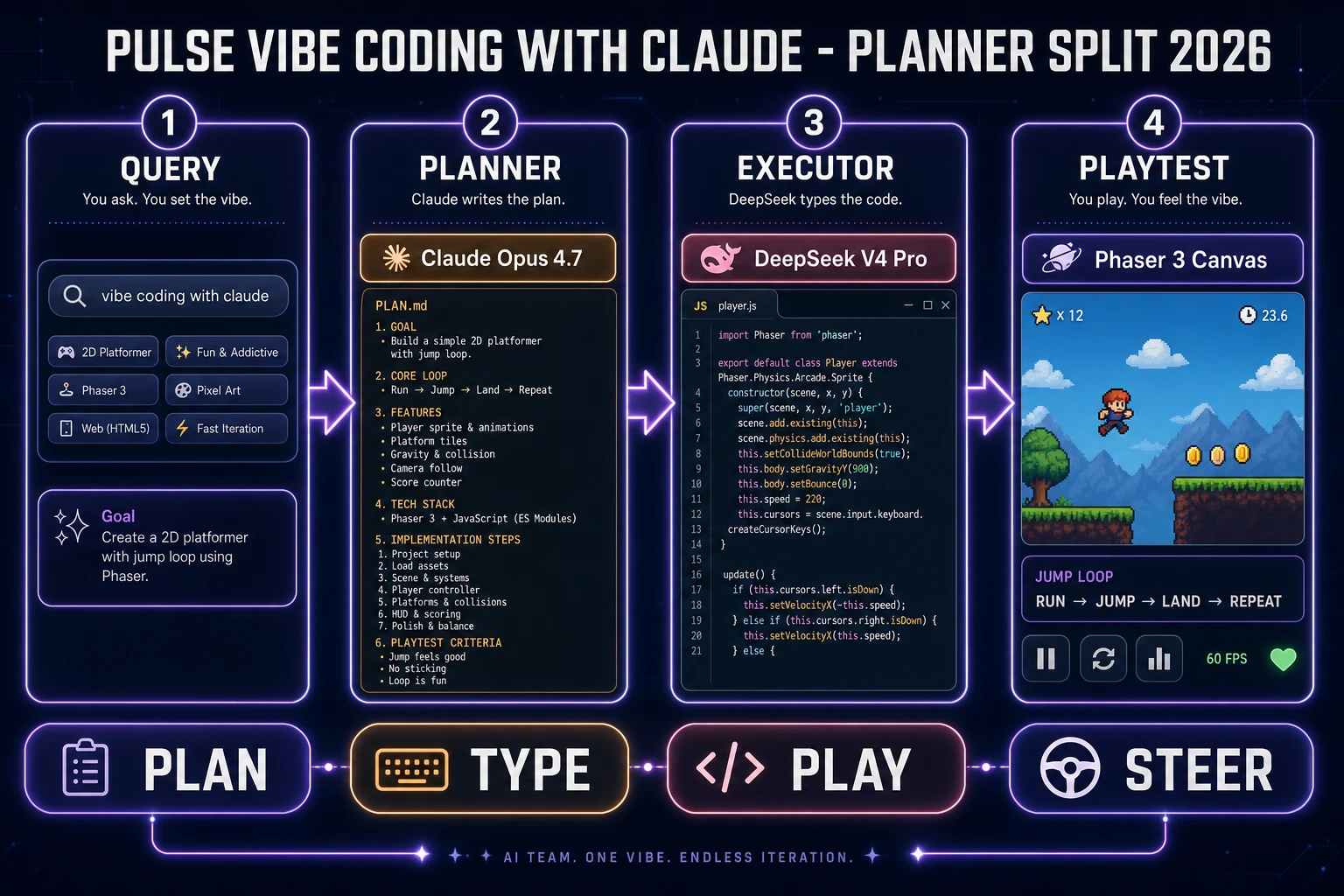
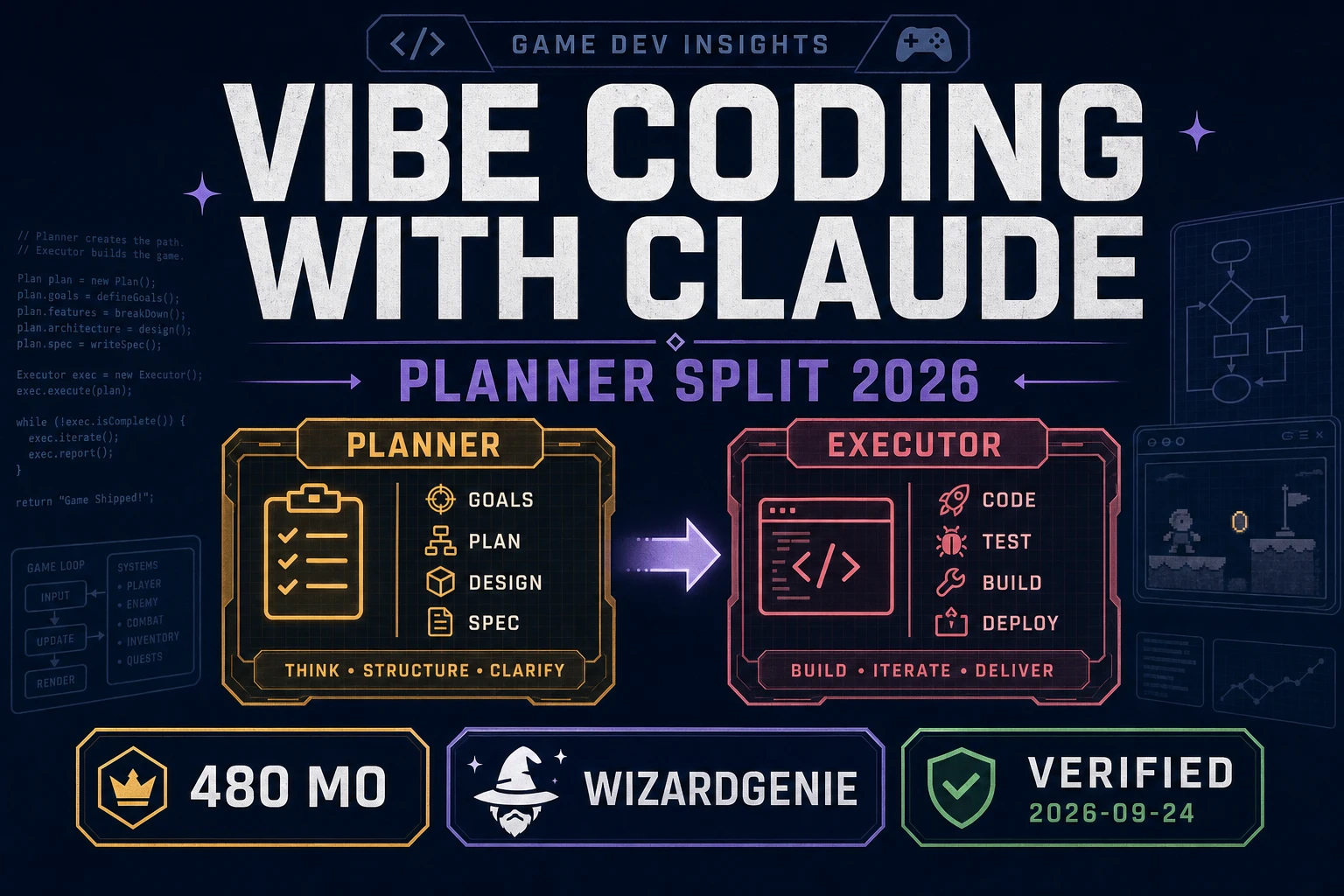
Vibe coding with Claude planner split pipeline from query to playtest
Claude on the Planner seat, a budget model on the keys, playtest before the next plan.

What vibe coding with Claude searchers actually want

DataForSEO lists vibe coding with claude at 480 searches a month, KD 0 (confirmed 2026-09-22 in tools/research-supplement.md). Neighboring rows include vibe coding claude (260/mo, KD 7), claude code vibe coding (210/mo, KD 7), claude code for vibe coding (260/mo, KD 12), and how to vibe coding (1,600/mo, KD 20). The brand-tagged rows want a model placement. The how-to row wants a checklist. This page answers the brand row without pretending Claude must own every keystroke.

Wikipedia’s Vibe coding page (checked 2026-09-24) still defines the practice as describing a project in natural language to a large language model that generates source code, then guiding changes with results and follow-up prompts. Andrej Karpathy coined the phrase in February 2025. Critics on the same page flag accountability, maintainability, and security when code is accepted without review. That critique is why the Planner split matters: the expensive model should understand the change; the cheap model should apply it; you should still run the build.

Claude as Planner, not as the typer

The honest reading of vibe coding with Claude is chair assignment, not brand loyalty on every token. Put Claude Opus 4.7 on the plan. Give the Executor a short brief: which file, which behavior, which playtest proves success. Let DeepSeek V4 Pro, Kimi K2.5, or MiniMax M2.7 write the diff. Read the diff. Run the page.

Why not let Claude type everything? Because the Dual-agent economic logic collapses when the typing chair costs frontier rates. Claude Sonnet 4.6 appears on the Sorceress home roster as Fast + smart. It is still the wrong chair for bulk typing in a Planner+Executor setup. Opus and GPT-5.5 are planners. Frontier-priced models on the Executor seat erase roughly four-fifths of the reason to split the work.

A Planner brief that works for a jam platformer:

Goal: player jump peak feels too low in playtest.
Files allowed: src/player.js only.
Change: increase jump impulse 20%, keep gravity unchanged.
Done when: hold jump clears the first spike row without clipping the ceiling.
Do not refactor unrelated systems.

Hand that brief to the Executor. Do not paste “make it better” into Claude and hope. The Planner’s job is to shrink the blast radius before anyone types.
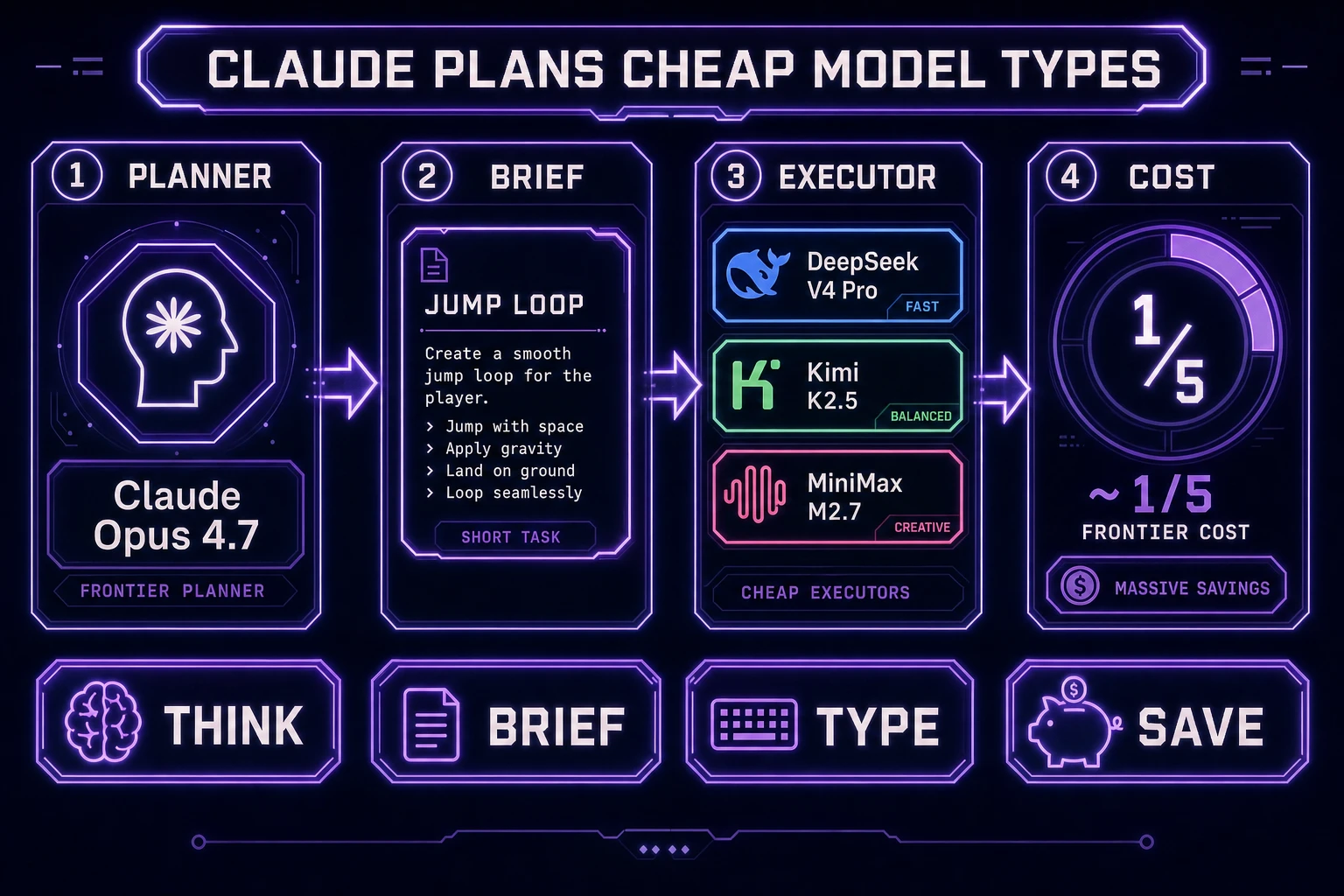
Claude plans and cheap model types for vibe coding with Claude
Think on Opus; type on a budget model; save tokens for the next plan.

WizardGenie dual-agent for vibe coding with Claude

WizardGenie is the Sorceress coding lane built for this pattern. The marketing page (read 2026-09-24) lists Dual-agent Planner + Executor as an engine-level power: a smart Planner thinks; a cheap Executor codes. The same page ships the engine as two builds. Desktop is the cutting-edge release with a native filesystem. The web build is free to try and receives the same features after they stabilize on desktop. Calling WizardGenie browser-only would misstate that page. Sibling surface: Sorceress Code for file-aware chat in the same suite.

Beyond the split, the page documents Mem Palace + Graphify long-term memory (project conventions survive across sessions) and agentic web browsing (agents can pull docs into the project). Those features support vibe coding with Claude because the Planner can remember your collision rules without re-pasting the whole architecture every morning.

WizardGenie does not auto-publish finished games to an arcade. Export the build and host it where you choose. Skipping a fake publish step keeps the article honest.
Cheap executors that keep the split honest

Roster verified 2026-09-24 in src/app/_home-v2/_data/tools.ts CODING_MODELS:

Model Home roster tag Sensible chair for vibe coding with Claude
Claude Opus 4.7Top tierPlanner (default Claude seat)
Claude Sonnet 4.6Fast + smartNeither for bulk typing
GPT-5.5FrontierPlanner alternative
Gemini 3.1 Pro1M contextPlanner alternative
DeepSeek V4 ProBudgetExecutor
Kimi K2.5256K codingExecutor
Grok 4.22M contextPlanner alternative
MiniMax M2.7Agent-readyExecutor

With a true cheap executor, the token bill lands nearer to roughly one-fifth of a single-frontier session than to a full frontier stack. That is the ratio this blog uses for Planner+Executor math. The WizardGenie marketing line says roughly a quarter; the operational rule for articles stays one-fifth when the typer is genuinely budget-tier.

Three pairings that stay inside the roster:

  • Claude Opus 4.7 + DeepSeek V4 Pro — default for vibe coding with Claude.
  • Claude Opus 4.7 + Kimi K2.5 — when the Executor needs a wide coding context.
  • Claude Opus 4.7 + MiniMax M2.7 — when the Executor tag Agent-ready matches your tool-calling style.

Never put Opus, Sonnet, GPT-5.5, Gemini 3.1 Pro, or Grok 4.2 on the Executor chair. Name them in plain text when you compare; do not send readers to vendor product pages.

Game loop first when vibe coding with Claude

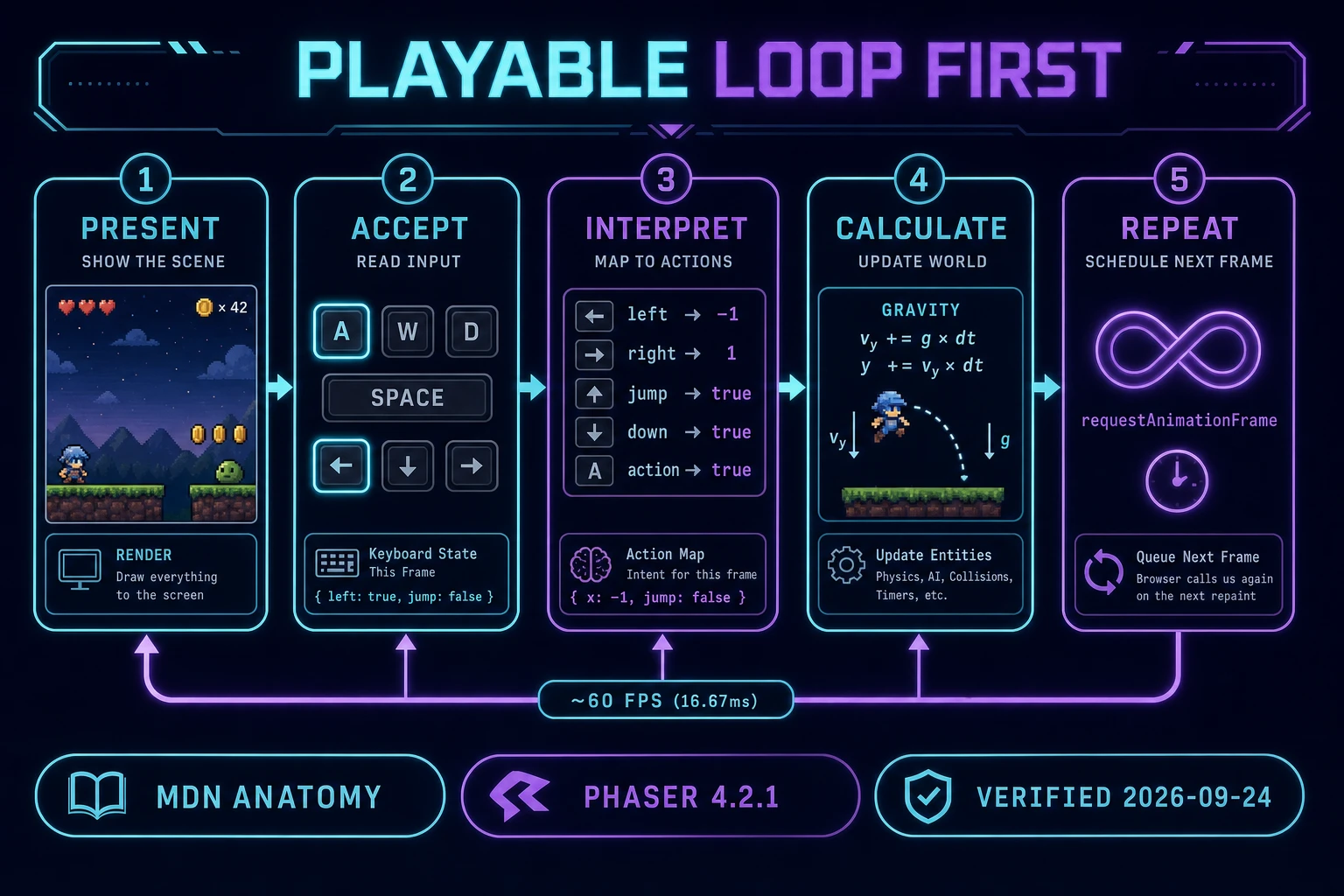
MDN’s Anatomy of a video game (checked 2026-09-24) reduces every game to a cycle: present a situation, accept input, interpret those signals, calculate a new situation, repeat until an end condition. If the first Claude plan asks for an open-world RPG with crafting, the Planner failed. If the first plan asks for a character that jumps over spikes and restarts on hit, the Planner named the cycle.

Playable loop first diagram for vibe coding with Claude
MDN’s present–accept–interpret–calculate–repeat cycle is the object of the first plan.

A first prompt the Planner can shrink into Executor tasks:

Build a single browser scene. Present a ground and a player square.
Accept left/right and jump. Interpret jump as an upward velocity while grounded.
Calculate gravity and spike collisions. Repeat with requestAnimationFrame.
Restart on spike hit. Show a score that increases while alive.

Phaser v4.2.1 “Giedi” (released 9 July 2026, stable download page checked 2026-09-24) is a common runtime for that scene. Plain HTML Canvas works too. The library is secondary. The loop you can feel in under a minute is primary. MDN’s broader Game development hub (checked 2026-09-24) is the neutral technical spine for browser games — cite it when you need engine-agnostic language.

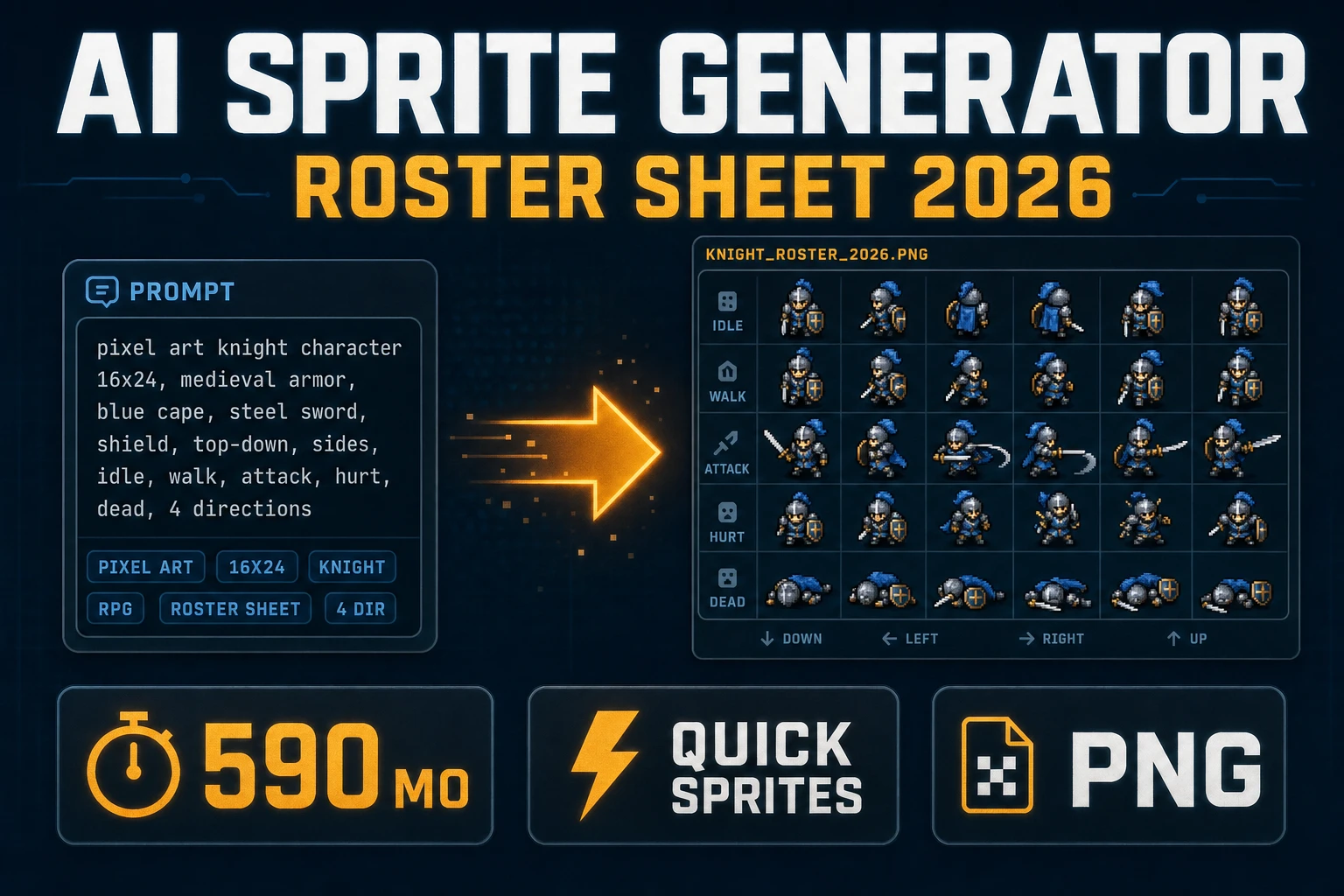
After the square-on-spikes loop is fun, pull assets from the same suite without derailing the plan:

Tell the Executor the file names and sizes. Do not ask Claude to invent a full art bible while collision code is still wrong. Tool comparisons for platforms live on best vibe coding tools.

Guardrails that keep vibe coding with Claude honest

Karpathy’s February 2025 coinage, quoted on Wikipedia (checked 2026-09-24), describes giving in to the vibes and forgetting that the code even exists on a throwaway weekend project. A jam you might show someone on Monday is already past that license. Wikipedia also notes critics flag accountability and security when unread AI code ships. For vibe coding with Claude on a jam:

  • Keep the project folder. Desktop WizardGenie helps here; web still needs an export habit.
  • Run the page yourself after every Executor pass. A chat screenshot is not a playtest.
  • Ask the Planner for one visible change per cycle: higher jump, slower enemy, restart on death.
  • Reject Executor diffs that touch files outside the brief.
  • Treat production merges without a human read as out of scope.

Playtest checklist after each generation:

  1. Open the build yourself.
  2. Move for ten seconds. Die on purpose. Restart.
  3. Write one sentence about what felt wrong.
  4. Paste that sentence to Claude as the next Planner input.
  5. Only then spawn the Executor.

Examples that work: jump peak is too low; spikes kill on touch but the hitbox is taller than the art; score should reset on death. Examples that stall: make it better; add polish; build the whole campaign. Claude cannot feel the jump. You can. Vibe coding with Claude stays honest only while that feedback loop stays closed.

When the Planner brief is vague, the Executor invents scope. When the brief names one file and one playtest, the diff stays reviewable. That is the operational difference between vibe coding with Claude as a serious jam method and vibe coding with Claude as unread paste.

If you need a wider stack map after the loop works, read AI in game development for asset lanes beside the coding agent. Keep those links as secondary paths. The primary job on this page remains the Planner split.

The verdict on vibe coding with Claude

Vibe coding with Claude is a Planner brand query, not a license to burn frontier tokens on every keystroke. Keep Claude Opus 4.7 on the thinking seat. Put DeepSeek V4 Pro, Kimi K2.5, or MiniMax M2.7 on the typing seat. Run Dual-agent on WizardGenie (desktop or web). Start from MDN’s five-verb loop. Playtest before the next plan. That is the whole pattern at jam scale — verified 2026-09-24 against Wikipedia, MDN, Phaser v4.2.1, and the Sorceress coding roster.

Frequently Asked Questions

What does vibe coding with Claude actually mean in 2026?

Vibe coding with Claude means describing a game task in natural language to a large language model in the Claude family, then steering the generated source with playtests and follow-up prompts. Wikipedia’s Vibe coding page (checked 2026-09-24) defines the practice that way for any LLM. On Sorceress, the honest split is Claude Opus 4.7 as Planner and a budget model as Executor — not Claude typing every line.

Should Claude be the Planner or the Executor for vibe coding with Claude?

Planner. The Dual-agent pattern on WizardGenie (marketing page read 2026-09-24) pairs a smart Planner that thinks with a cheap Executor that codes. Acceptable planners in CODING_MODELS (src/app/_home-v2/_data/tools.ts, verified 2026-09-24) include Claude Opus 4.7, GPT-5.5, Gemini 3.1 Pro, and Grok 4.2. Acceptable executors are DeepSeek V4 Pro, Kimi K2.5, and MiniMax M2.7. Putting Claude Sonnet 4.6 or Opus on the typing chair erases the cost win.

Is WizardGenie only a web tool for vibe coding with Claude?

No. The WizardGenie page (read 2026-09-24) ships the same engine as two builds: desktop is the cutting-edge release with a native filesystem; the web build at /wizard-genie/app is free to try and receives the same features after desktop stabilizes them. Dual-agent Planner+Executor, Mem Palace + Graphify memory, and agentic web browsing are part of that engine on both builds.

How do I start a game loop when vibe coding with Claude?

Name MDN’s present–accept–interpret–calculate–repeat cycle in the first prompt (Anatomy of a video game, checked 2026-09-24). Ask for one browser scene, not a genre bible. Phaser v4.2.1 “Giedi” (released 9 July 2026, phaser.io/download/stable checked 2026-09-24) is a common runtime. Playtest yourself before the next plan.

How is vibe coding with Claude different from how to vibe coding?

How to vibe coding (1,600/mo) is the generic procedure query. Vibe coding with Claude (480/mo, KD 0; research-supplement.md verified 2026-09-22) pins the Planner brand. The five moves stay the same; the chair assignment changes. Sibling posts cover what is vibe coding and vibe coding meaning for definition intent.

Sources

  1. Vibe coding - Wikipedia
  2. Large language model - Wikipedia
  3. Anatomy of a video game - MDN
  4. Phaser v4.2.1 Giedi stable download
  5. Game development - MDN
Written by Arron R.·1,576 words·7 min read

Related posts