Prop Tripo AI Image to 3D Model (Game GLB 2026)

By Arron R.10 min read
A tripo ai image to 3d model job is a game GLB pipeline: prep a clean photo, open Sorceress 3D Studio, pick Tripo v3.1 at 40 credits or a cheaper Meshy 6 or Hun

People who type tripo ai image to 3d model into a search box in 2026 are rarely shopping for another product tour. They already have a reference photo — a character concept, a prop sketch, a scanned figurine — and they want a textured 3D mesh they can drop into Unity, Godot, or Unreal in one session. This page treats the query as a shipping problem: what the search actually wants, how Sorceress 3D Studio puts Tripo v3.1 in a picker beside Meshy, Hunyuan 3D, TRELLIS, and Rodin, how to prep the input, when Material Forge and Auto-Rigging earn their credits, and the wallet math verified against source today.
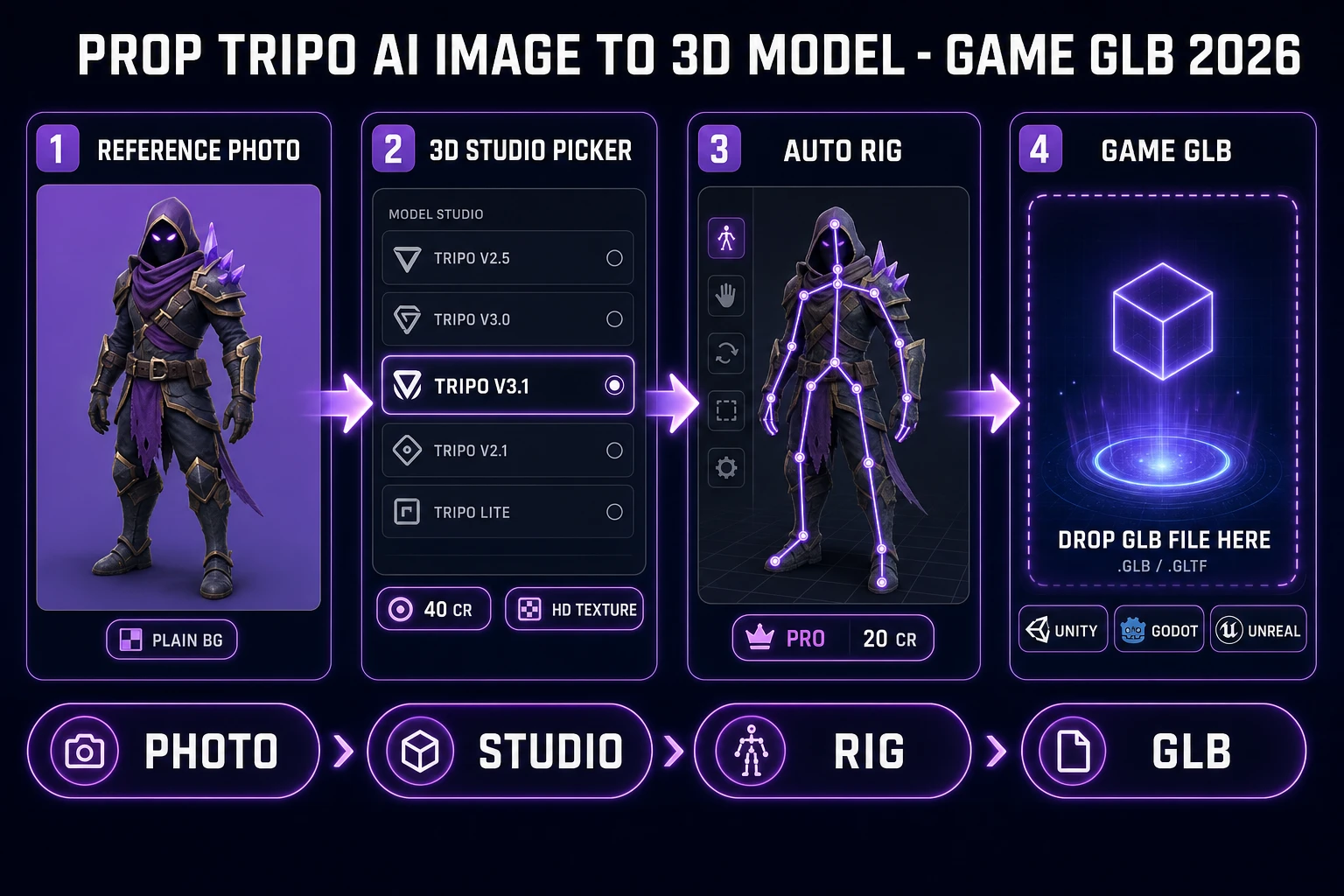
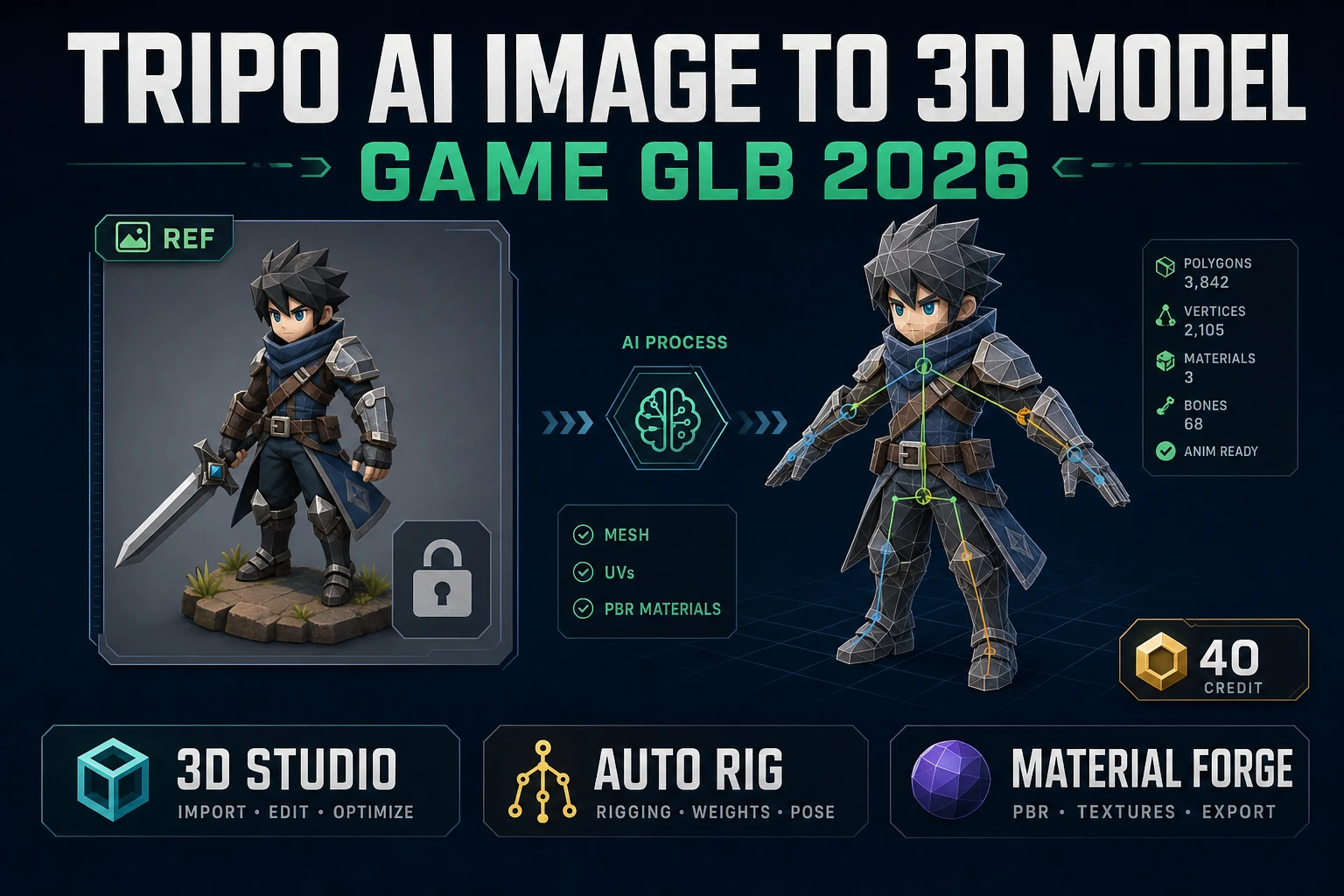
Tripo AI image to 3D model pipeline: reference photo, 3D Studio picker, Auto-Rigging, game GLB export
A tripo ai image to 3d model job as a game GLB loop: photo in, Sorceress 3D Studio picks the mesh model, Auto-Rigging on Pro, export to any engine.

What a tripo ai image to 3d model search actually wants

DataForSEO lists tripo ai image to 3d model at 1,000 searches a month with KD 6 and competition 0.03 (confirmed in tools/research-supplement.md, verified 2026-09-29 pull). Neighbor phrases sit higher — image to 3d model at 8,100/mo and meshy ai image to 3d at 1,600/mo — but the head terms are already covered by other posts on this blog. This page stays on the branded long-tail because the intent is unusually clean: the searcher named a vendor, which means they are past the tire-kicking stage and want a mesh.

Wikipedia’s 3D modeling page (verified 2026-09-29) still defines a 3D model as a mathematical description of an object’s surface — a description that game engines then rasterize per frame. The glTF reference (verified 2026-09-29) names the format that dominates handoff in 2026: a JSON scene graph with binary buffers, wrapped as a single .glb file. When a searcher types "tripo ai image to 3d model", they are asking for one of two files: a GLB that opens in any engine, or an FBX for a Unity or Unreal pipeline. Everything upstream of that — vendor loyalty, model version, credit tier — is negotiable.

Adjacent 3D angles already on the blog: see Meshy image to 3D game GLB for the Meshy-branded long-tail, how to turn an image into a 3D model for the head query, AI 3D model generator free for the free-tier lane, and Mixamo alternative for the rigging half of the same pipeline. This page stays on the Tripo-branded search.

3D Studio is the featured surface. The home card (verified 2026-09-29 in src/app/_home-v2/_data/tools.ts) frames it as a complete 3D character pipeline: AI image generation, single-image to textured 3D, automatic humanoid auto-rigging with weight-paint refinement, and AI-powered text-to-animation, all exported to FBX, GLB, or GLTF for any engine. That is the whole shape of a tripo ai image to 3d model job on Sorceress — a picker for the mesh step, then rig and export on the same page.

The picker order (verified 2026-09-29 in src/lib/threed-models.ts, constant THREED_MODEL_ORDER) is Meshy family first, then Tripo family, then the single-option brands: Meshy 7, Meshy 6, Tripo P2, Tripo v3.1, Tripo Smart Mesh, Hunyuan 3D 3.1, Pixal3D, TRELLIS 2, Rodin 2.0. Tripo v3.1 is the middle-of-list workhorse when the input is a still image and the target is a textured GLB. It supports image-to-3D, text-to-3D, and multi-image-to-3D in the same model — swap input modes without changing panels.

The Studio tabs go left-to-right in the order you actually work: Generate (upload image and pick model), Uploads (drop in a mesh you already own), Refine, Rig, Animate, Export. Nothing else on the page — no separate app for each provider, no per-vendor sign-in. A searcher who lands on the page after typing "tripo ai image to 3d model" clicks Generate, selects Tripo v3.1 in the picker, uploads the reference, and starts a job.

Photo prep before you hit generate

The single largest cost of a bad tripo ai image to 3d model run is the credits you burn on a clean generation of a bad photo. Prep the input first. A usable reference has one subject, flat lighting, plain background, and shows enough silhouette for the mesh to guess volume on hidden sides.

If your reference is a busy scene, crop to the subject and open BG Remover at BG_REMOVER_CREDITS = 3 per image (verified 2026-09-29 in src/app/bg-remover/page.tsx). A transparent PNG on flat background is what the mesh models expect. If your reference is a hand sketch, run one round through AI Image Gen with a "clean product shot, plain background, 3/4 view" prompt to give Tripo v3.1 a photograph to work from — that costs 3 credits on Z-Image or 9 on Nano Banana 2 (verified 2026-09-29 in src/lib/models.ts).

Pose matters. Tripo v3.1 accepts natural poses; Meshy 6 has a pose_mode flag for A-pose or T-pose specifically because rigging on top of a hero pose is a mess. If the character will be rigged in the same session, pick a photo in a neutral pose or use the Meshy T-pose lane. If the character stays static (a statue, a prop, a piece of furniture), the pose is whatever the reference shows.

Multi-image is optional. Tripo v3.1 supports multi-image-to-3D — front, side, back — and Meshy 6 supports multi-view too. Both improve reconstruction accuracy on complex silhouettes but double the credit cost. Start single-image; escalate to multi-view only when the first run misses a hidden side.
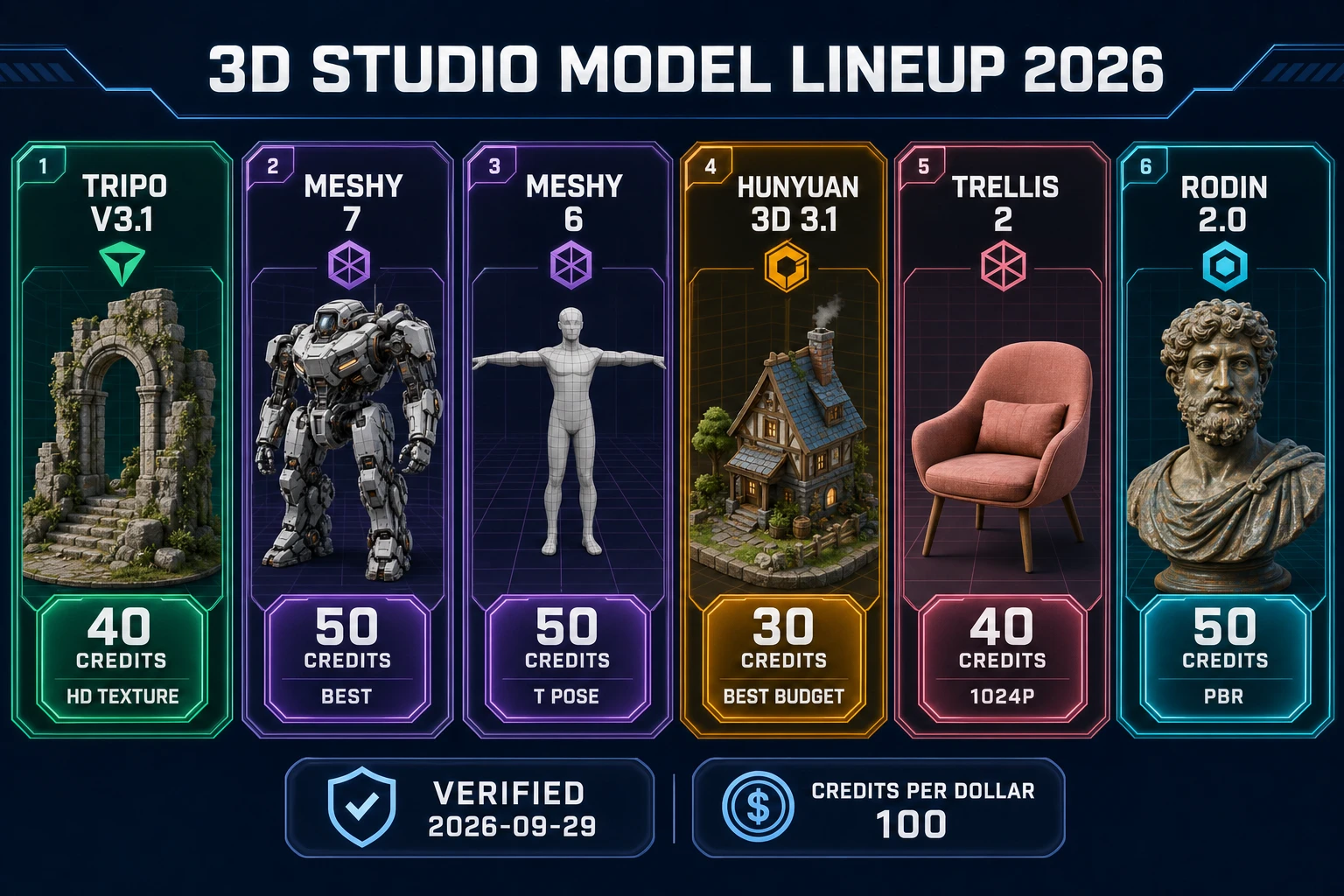
3D Studio model picker chart for tripo ai image to 3d model brief with credit chips
3D Studio picker lineup for a tripo ai image to 3d model job: Tripo v3.1 at 40 credits, Meshy 7 and 6 at 50, Hunyuan 3D 3.1 at 30, TRELLIS 2 at 40, Rodin 2.0 at 50. Verified 2026-09-29.

Tripo v3.1 in context: the Sorceress mesh roster

Tripo v3.1 is one model in a picker of nine. Naming it in a search does not lock the workflow to it — the whole point of the 3D Studio picker is that a searcher can compare in one panel. Credit costs verified 2026-09-29 in src/lib/threed-models.ts:

Model Base credits Best fit for a tripo ai image to 3d model brief
Tripo v3.140 (image, HD texture)Default lane when the query named Tripo
Tripo Smart Mesh (P1)65 (image, standard)Low-poly / clean-topology output up to 20k faces
Tripo P2125 (base)Native quad topology, artist-grade edge flow
Meshy 750 (image, texture)Best-in-class fidelity, Ultra Mode available
Meshy 650 (image, texture)T-pose / A-pose for rigging; multi-view supported
Hunyuan 3D 3.130Best-budget lane for a rough draft
TRELLIS 240 (1024p)Open-source path; 35 at 512p, 45 at 1536p
Rodin 2.050PBR out of the box, five export formats
Pixal3DFree unlimitedVIP members only; not for pixel-art references

Tripo is named in plain text on this page. Sorceress does not deep-link to competing product pages, and readers who already have a Tripo account can bring their photo here instead — same result, one panel, no extra sign-in. The picker’s brand-neutral behavior is the point: pick by shape of your input, not vendor loyalty.

Rule of thumb: Tripo v3.1 for a props-and-prototypes lane at 40 credits, Meshy 6 for a rigging-ready humanoid at 50 credits, Hunyuan 3D 3.1 for a 30-credit draft, TRELLIS 2 for an open-source pass. Escalate to Tripo P2 or Meshy 7 Ultra Mode when the first pass misses geometry on a critical prop.
Textures and PBR with Material Forge

A Tripo v3.1 job returns a textured mesh, but the texture is baked. If the game needs the material to react to light — a metal chestplate, a wet stone floor, a glass shield — open Material Forge. The home card (verified 2026-09-29 in src/app/_home-v2/_data/tools.ts) frames it as image-to-full-PBR: albedo, roughness, metallic, normal, AO, live 3D preview, ready to drop into Unity, Unreal, or Godot.

Wikipedia’s physically based rendering page (verified 2026-09-29) frames PBR as a family of shading models that simulate light-matter interaction based on measured material properties. In practice that means five textures instead of one: the base color, a roughness map that tells the shader how blurry the reflection is, a metallic map that switches between conductor and dielectric behavior, a normal map that fakes surface detail, and an ambient-occlusion map that darkens crevices. Every modern engine reads that set the same way; the file names change but the channels do not.

The workflow after a tripo ai image to 3d model job: bring the mesh back into 3D Studio, open the material or texture tab, and either accept the baked albedo or send a swatch of the intended material into Material Forge for a full PBR set. Tripo v3.1 also has a pbr flag on its own generation — turning it on tells the model to output roughness and normal maps directly. Both paths land in the same place; the choice is whether you want the material generated with the mesh or as a separate PBR pass you can re-use across props.

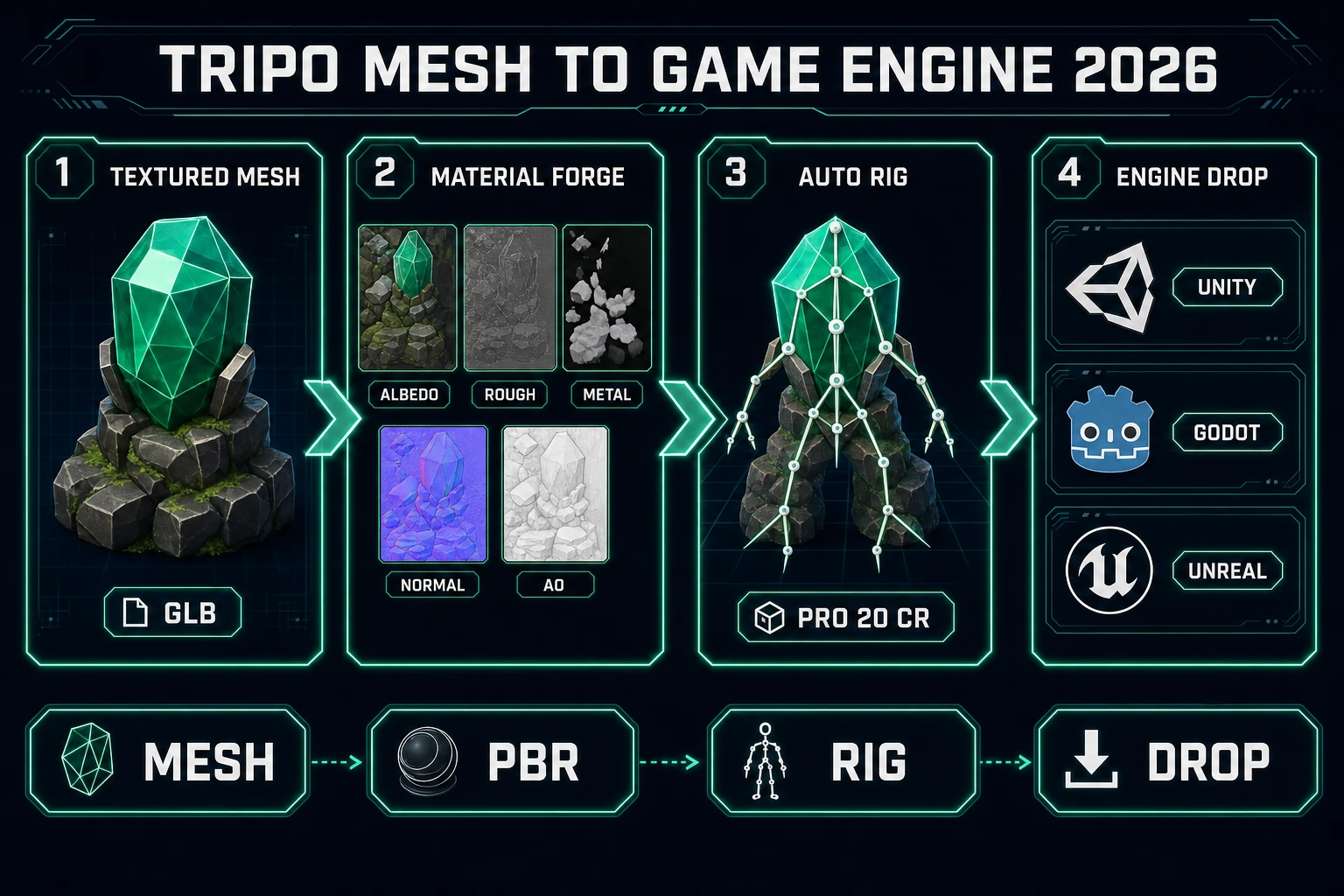
Tripo mesh to game engine loop with Material Forge PBR maps, Auto-Rigging, and engine drop targets
The handoff after a tripo ai image to 3d model job: textured mesh, PBR maps in Material Forge, Unreal-style skeleton from Auto-Rigging on Pro, then GLB or FBX into Unity, Godot, or Unreal.

Rig, animate, and export to Unity, Godot, or Unreal

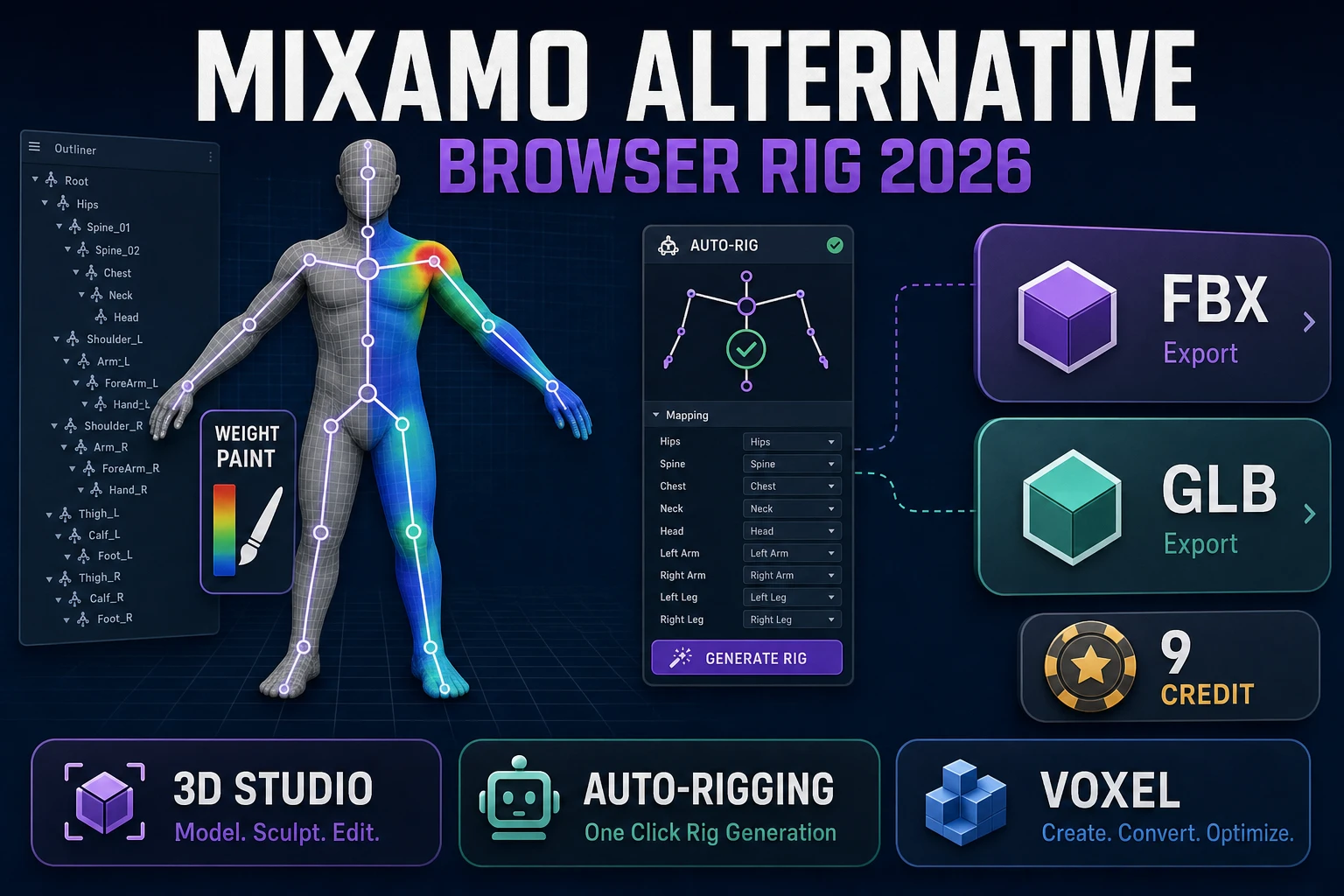
A static prop can ship straight from the Tripo v3.1 output. A character needs a skeleton. Auto-Rigging is the featured lane — the home more-tools card (verified 2026-09-29 in src/app/_home-v2/_data/tools.ts) badges it Pro and describes it as auto-rig humanoid 3D models plus weight-paint refinement. Never call it free in a post: the badge is Pro, and misleading a reader on tier is a Hard Rule #12 violation for this blog.

Provider math checked today in src/lib/rigging/external-rig/autoRigPricing.ts: AUTO_RIG_CREDITS.meshy = 20, AUTO_RIG_CREDITS.tripo = 40. The UI stays vendor-neutral — the button says "AI auto-rig" — but the numbers a Pro user pays are fixed there. Auto-Rigging writes an Unreal-style skeleton with weight-paint refinement, and the weight-paint tab exists specifically because auto-detection is not perfect on stylized meshes.

Wikipedia’s skeletal animation page (verified 2026-09-29) still defines the technique as a mesh deformed by a hierarchical bone rig, with each vertex weighted to one or more bones. That is exactly what Auto-Rigging produces. The rig is Unreal-style because that skeleton reads cleanly in Unity and Godot too — the joint names align with humanoid retargeting tables in both engines.

For non-humanoid props, skip Auto-Rigging entirely and export the GLB straight from 3D Studio. For multi-legged creatures, use the Procedural Walk lane instead — that path handles spiders, crabs, quadrupeds, and centipedes with real-time IK. Wikipedia’s FBX page (verified 2026-09-29) still frames the format as Autodesk’s exchange container, well-supported in Unreal and Unity. Pick GLB when in doubt; pick FBX when the target pipeline expects it.

Credit math for a tripo ai image to 3d model session

Quote wallet numbers from source, not marketing memory. CREDITS_PER_DOLLAR = 100 in src/lib/models.ts. SIGNUP_GRANT = 100 in src/app/api/admin/credits/route.ts. Both verified 2026-09-29.

Session plan Photo prep Mesh Rig / materials Total USD at 100 cr/$
1 Tripo v3.1 prop, no rig3 (BG cut)40043$0.43
1 Meshy 6 hero, T-pose + rig35020 (Meshy rig)73$0.73
Draft on Hunyuan 3D 3.1030030$0.30
Tripo v3.1 + PBR pass340+ Material Forge (model-priced)43+$0.43+
Tripo v3.1 multi-image + rig0402060$0.60

Signup stress test: the 100-credit grant covers two Tripo v3.1 props (80 credits) with a plain-background BG cut on each, or one Meshy 6 hero with a rig (73 credits) plus a small BG cut. That is enough to prove the tripo ai image to 3d model loop before you top up. Escalate to Tripo P2 at 125 credits only for the hero prop that will appear in every trailer shot — the artist-grade quad topology earns its cost when the mesh will be edited by hand later.

A practical checklist before you click Generate: prep a single-subject reference on a plain background, pick the model by input shape (Tripo v3.1 for props, Meshy 6 for humanoids to rig, Hunyuan 3D 3.1 for a cheap draft), start single-image and escalate to multi-view only if a hidden side breaks, layer PBR through Material Forge only when the material actually reflects light in the scene, and rig only characters that will move. Bad meshes are usually a photo problem; bad rigs are usually a pose problem; bad materials are usually a fidelity-vs-cost problem. Fix the right layer instead of burning another 40 credits on the same broken input.

Verdict: ship a game GLB, not another tour

A clean tripo ai image to 3d model session on Sorceress in 2026 looks like this:

  1. Prep a single-subject reference photo on a plain background. Cut with BG Remover at 3 credits if the original scene is busy, or regenerate with AI Image Gen for a sketch.
  2. Open 3D Studio, pick Tripo v3.1 in the model picker for the default 40-credit lane, or swap to Meshy 6 for a T-pose humanoid, or Hunyuan 3D 3.1 for a 30-credit draft. Run single-image first.
  3. If the material needs to react to light, add a PBR pass with Material Forge. If the character will animate, open Auto-Rigging on Pro for an Unreal-style skeleton at 20 credits.
  4. Export as GLB for a browser or a quick engine drop, or FBX for Unity or Unreal with extra animation channels. Same rigged character, same page.

That is the whole job a tripo ai image to 3d model search is buying: not another product tour, but a textured mesh that opens in any engine and, if it is a character, a rig underneath it. Prep the photo, pick the lane, rig only what moves, and ship the GLB. The picker in Sorceress 3D Studio lets you compare Tripo v3.1 against Meshy 6, Hunyuan 3D 3.1, TRELLIS 2, and Rodin 2.0 in one panel — decide by input shape, not by which brand landed in the search query.

Frequently Asked Questions

What does a tripo ai image to 3d model search actually want?

A game GLB, not another tour. DataForSEO lists tripo ai image to 3d model at 1000/mo with KD 6 and competition 0.03 (tools/research-supplement.md, verified 2026-09-29). That is transactional intent: the searcher already has a reference photo and wants a textured mesh they can drop into Unity, Godot, or Unreal in one session. Sorceress 3D Studio ships Tripo v3.1 alongside Meshy 6, Meshy 7, Hunyuan 3D 3.1, TRELLIS 2, and Rodin 2.0 in one panel so the lane is a picker, not a vendor lock.

How much does one Tripo v3.1 image-to-3D run cost on Sorceress?

40 credits for a single-image run with the default HD texture, verified 2026-09-29 in src/lib/threed-models.ts. Multi-image also lands at 40; text-to-3D is 35 with HD or 20 with no texture. Quad Mesh adds +5 credits and Detailed Geometry adds +30. At CREDITS_PER_DOLLAR = 100 in src/lib/models.ts, a 40-credit Tripo v3.1 job is 40 US cents. A new account starts with SIGNUP_GRANT = 100 free credits.

Is Tripo v3.1 always the right lane for a tripo ai image to 3d model brief?

No, and that is the point of a picker. Meshy 6 at 50 credits with texture is the workhorse for humanoid characters that need a T-pose or A-pose for rigging. Hunyuan 3D 3.1 at 30 credits is the best-budget lane for a rough draft. Pixal3D is free unlimited for VIP members. TRELLIS 2 at 40 credits is a solid open-source path. All figures verified 2026-09-29 in src/lib/threed-models.ts; pick by shape of your input, not vendor loyalty.

Do Tripo v3.1 meshes rig cleanly in Sorceress Auto-Rigging?

Yes when the input is a clean humanoid in a T-pose or A-pose. Auto-Rigging is Pro tier (verified 2026-09-29 in src/app/_home-v2/_data/tools.ts, badge Pro) and bills 20 credits per external AI auto-rig at the current provider rate in src/lib/rigging/external-rig/autoRigPricing.ts. It writes an Unreal-style skeleton with weight-paint refinement. Non-humanoid props skip Auto-Rigging; multi-legged creatures belong on the Procedural Walk lane at /rigging-multileg.

Which export format should I pick after a tripo ai image to 3d model job?

GLB for browser and quick engine drops, FBX when the target is Unity or Unreal and you need extra animation channels. Wikipedia glTF page (verified 2026-09-29) frames GLB as the single-file binary variant of glTF, designed for efficient transmission. Sorceress 3D Studio exports GLB, GLTF, or FBX from the same rigged character (verified 2026-09-29 in src/app/_home-v2/_data/tools.ts). Pick GLB if you are unsure - it is smaller, self-contained, and every modern engine reads it.

Sources

  1. 3D modeling - Wikipedia
  2. glTF - Wikipedia
  3. Physically based rendering - Wikipedia
  4. Skeletal animation - Wikipedia
  5. FBX - Wikipedia
Written by Arron R.·2,333 words·10 min read

Related posts