Swap Mixamo Alternative (Browser Rig 2026)

By Arron R.12 min read
The honest Mixamo alternative on Sorceress is a three-tool stack: 3D Studio pipes an image to a rigged humanoid, Auto-Rigging (Pro) refines weights on any GLB o

People who type Mixamo alternative into a search box in 2026 are not researching rigging in the abstract. They already know Mixamo exists, they have already run into one of its limits — the Adobe ID prompt, the humanoid-only auto-rigger, the vanishing character history, the country block — and they want a swap they can open in a browser tab today. This page treats the query as a shipping problem: what searchers actually need, what Mixamo still does well and still refuses to do, and how the 3D Studio plus Auto-Rigging plus Voxel Studio stack on Sorceress covers the same job in one browser session with different tradeoffs.
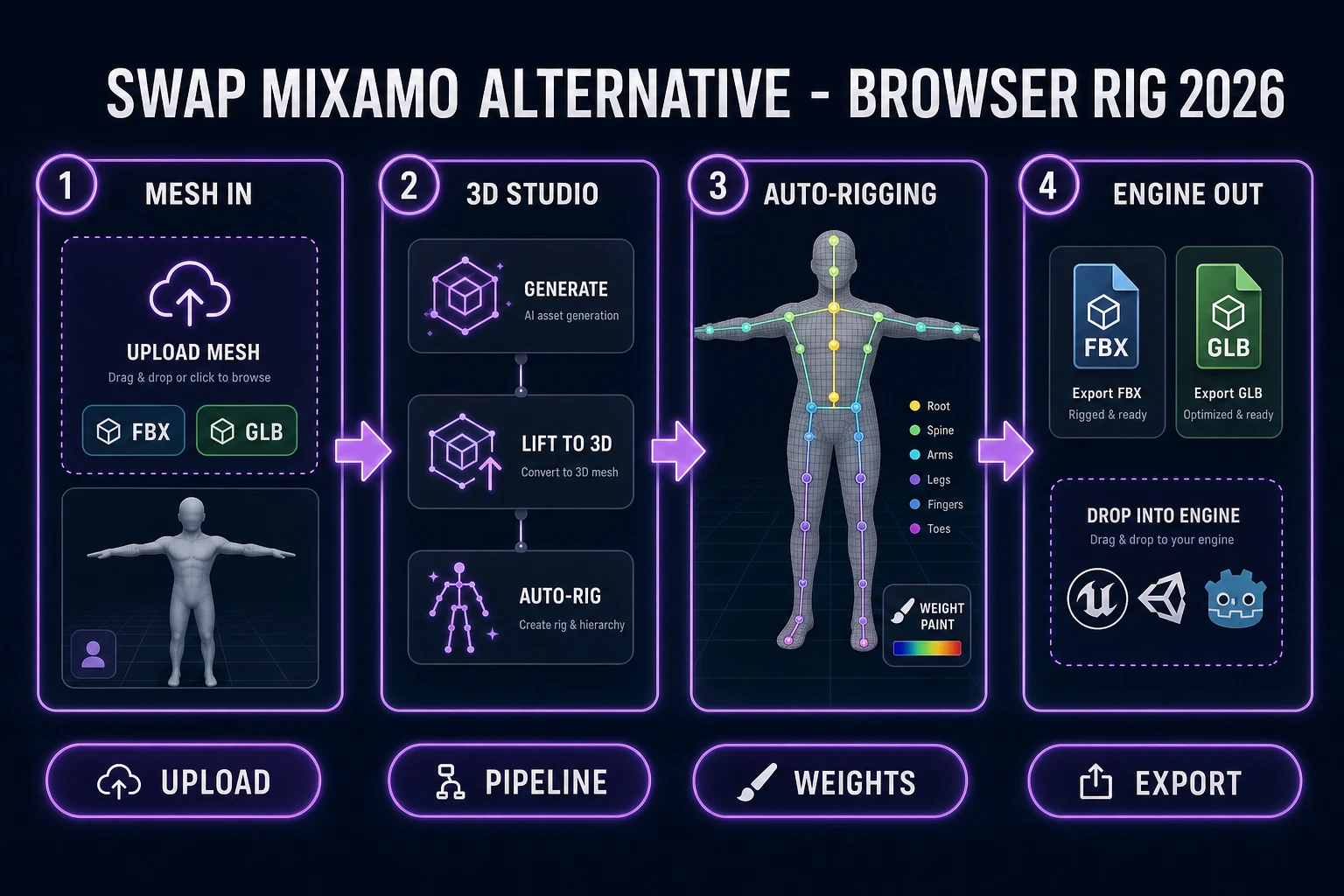
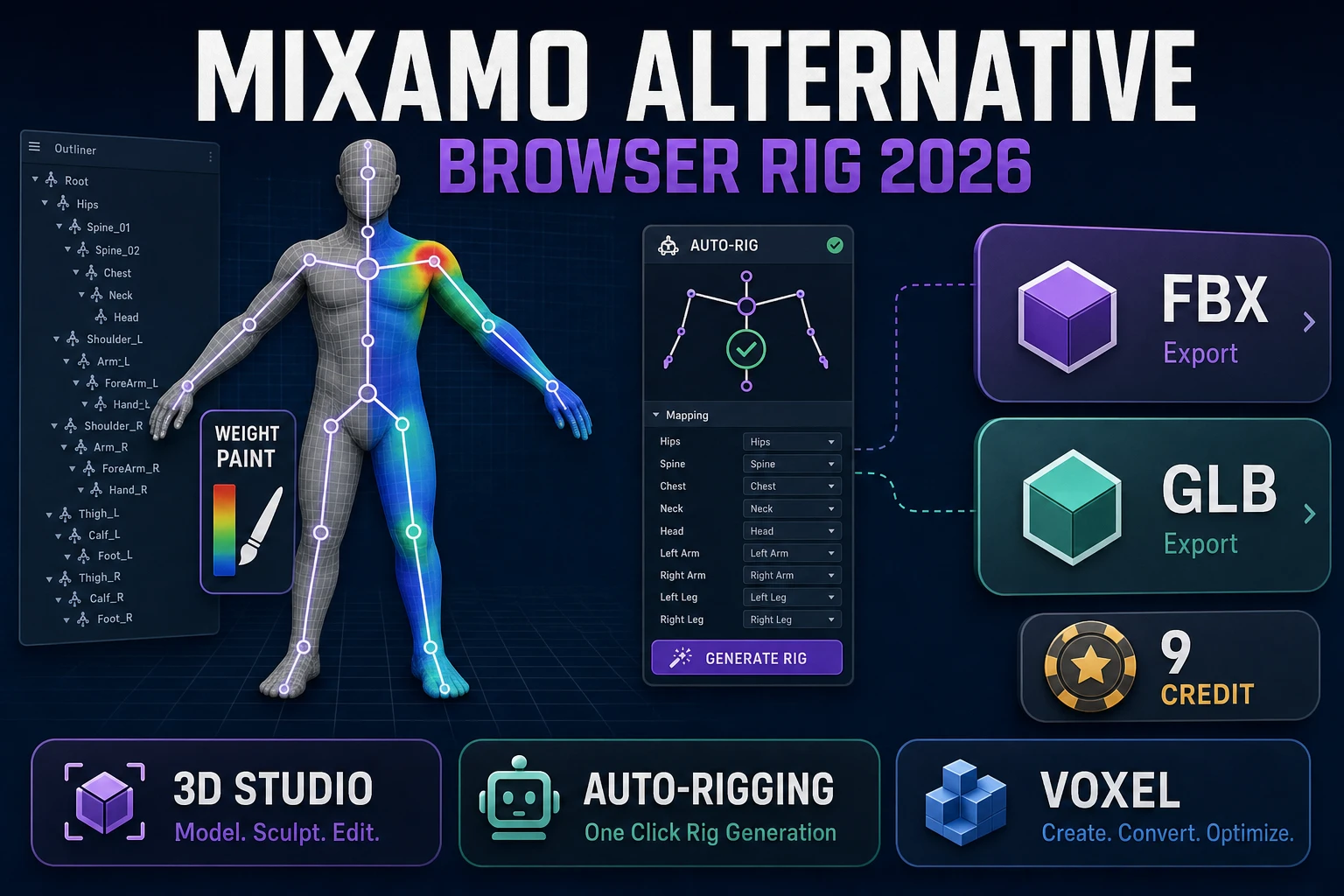
Mixamo alternative browser rig pipeline: mesh upload, 3D Studio pipeline, Auto-Rigging weight paint, engine export
Mixamo alternative reframed as a browser rig pipeline: bring your own GLB or FBX, run the 3D Studio image-to-rig chain, refine weights in Auto-Rigging, and export straight into any modern engine.

What a Mixamo alternative search actually wants in 2026

DataForSEO lists mixamo alternative at 210 searches a month with KD 5 and low competition (verified 2026-09-29 in tools/research-supplement.md). The related long-tails — mixamo alternative free, mixamo auto rigger alternative, mixamo animation alternative, mixamo rigging alternative — all cluster around the same shipping need: a working browser tool that either replaces Mixamo entirely or fills in a specific gap Mixamo cannot cover. The Auto-Rigging tool inside Sorceress explicitly names Mixamo alternative as a long-tail candidate in its own catalog entry, which is what surfaced this page in the first place.

Two audiences share this query. The first has a specific technical block: Enterprise or Federated Adobe IDs cannot use Mixamo, and the current release of Adobe Creative Cloud in China does not include Mixamo (adobe.com FAQ, verified 2026-09-29). The second audience has a modeling block: their character is not a bipedal humanoid, so Mixamo's auto-rigger simply refuses. Both audiences want a browser tool with a real skeleton on the other side of the upload button. Neither is interested in installing Blender for a one-off rig.

Adjacent Sorceress angles already on the blog: see Bind Auto-Rig character skin for the head auto-rig query, AI character rigging browser skeleton for the AI-side framing, Auto Rig Pro free browser skeleton for the Blender plugin comparison, and AI 3D character generator for the end-to-end prompt-to-model brief. This page stays on the plain mixamo alternative long-tail and on the browser-first swap intent.

What Mixamo actually does (and still refuses to do) today

Before picking an alternative, quote the source honestly. Facts below are from the Adobe Mixamo FAQ page (helpx.adobe.com/creative-cloud/faq/mixamo-faq.html, verified 2026-09-29):

  • Free with an Adobe ID. No Creative Cloud subscription required. Royalty-free for personal, commercial, and non-profit use, including video games.
  • Blocked for Enterprise and Federated IDs. Studios that only issue Federated Adobe IDs to their staff cannot open Mixamo at all.
  • Not available in China. The current Creative Cloud release in China does not include Mixamo.
  • Bipedal humanoids only. The auto-rigger and animation library are restricted to biped humanoids with a distinguishable head, body, arms, and legs. Extra limbs, wings, tails, large hair, or large clothing may not work.
  • Only the last used character is stored. Replace the character and the previous rig is gone. Adobe explicitly recommends saving rigged characters locally.
  • Character must be centered at origin and in a neutral pose, with no other scene objects, no floating parts, no gaps between body parts, and a clean error-free mesh.

Mixamo's animation library is also a real asset — decades of curated motion capture that many indie devs still use in their first Unity or Unreal project. Any honest Mixamo alternative conversation acknowledges that library exists. The failure modes worth swapping around are the rigging restrictions (biped only, humanoid only, character history discarded, third-party account required) rather than the motion library itself.

3D Studio: image to rigged humanoid in one browser tab

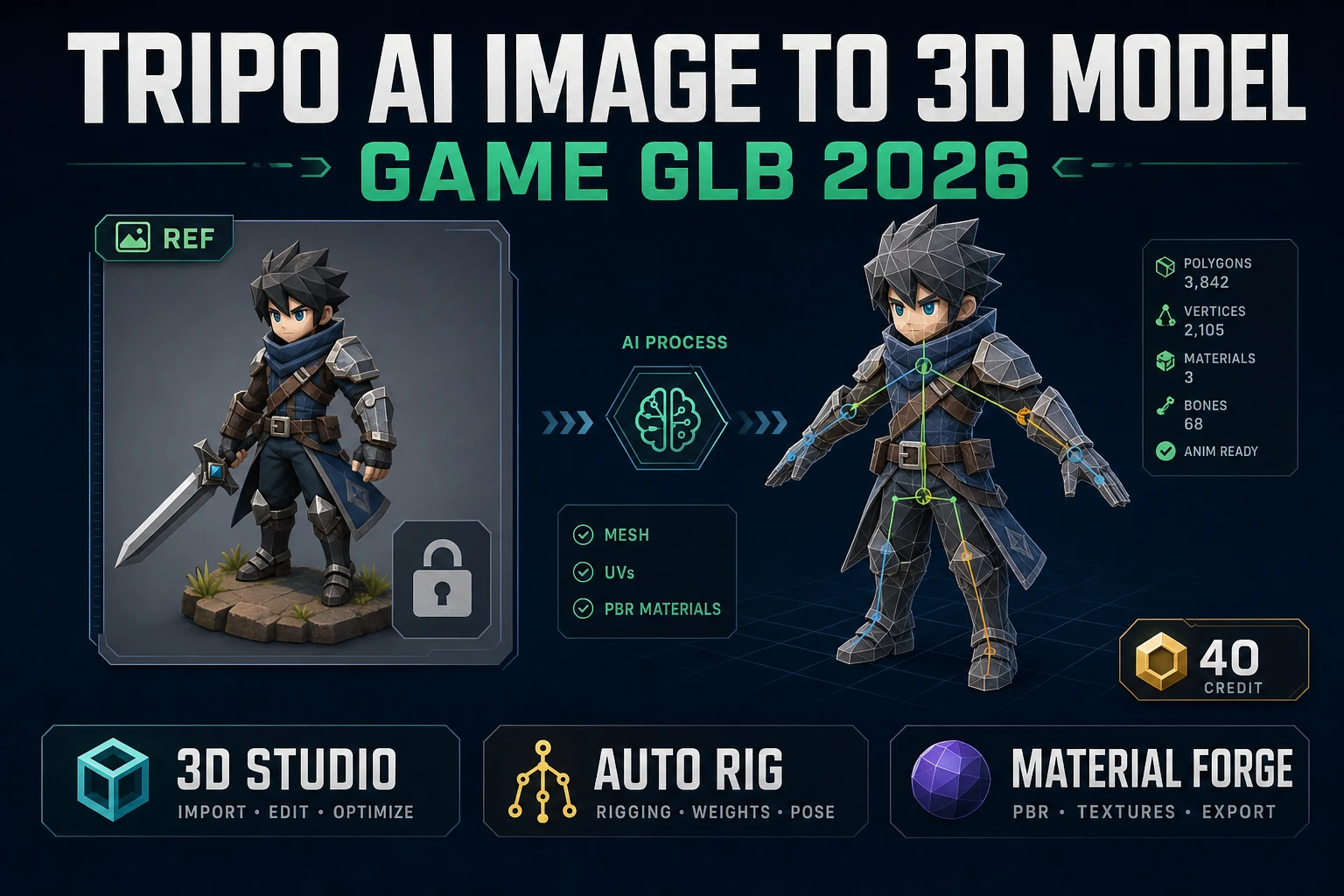
The most direct Mixamo alternative on Sorceress is 3D Studio. Its card description (verified 2026-09-29 in src/app/_home-v2/_data/tools.ts) reads: type an idea, get a fully rigged, fully animated, game-ready 3D character; the pipeline chains AI image generation, single-image to textured 3D, automatic humanoid auto-rigging with weight-paint refinement, and AI-powered text-to-animation, all exported to FBX, GLB, or GLTF for any engine. That is the four-step chain a Mixamo user would otherwise have to stitch across a modeling app, an FBX exporter, Mixamo itself, and a re-import.

The published four steps in the card data (verified 2026-09-29): (01) Generate — AI image gen turns your prompt into a concept character; (02) Lift to 3D — one-click image-to-3D produces a fully textured model; (03) Auto-rig & weight paint — humanoid skeleton attached automatically, weights refined; (04) Export — FBX, GLB, or GLTF for any engine. Mixamo lets you skip steps 01 and 02 by uploading your own mesh; 3D Studio lets you do the same by dropping a GLB or FBX directly into the pipeline.

Wikipedia's skeletal animation article (verified 2026-09-29) still defines the technique as a mesh (skin) bound to a hierarchical set of interconnected bones, with each bone influencing a weighted set of vertices. That definition is the same on Mixamo and on 3D Studio; what differs is the fidelity of the weight assignment and how much of the pipeline runs before or after the auto-rig call. On Sorceress, the humanoid skeleton is attached automatically and then the weight paint is refined — that refinement pass is the part of the pipeline Mixamo does not expose to the user.

Practical habits when you use 3D Studio as a Mixamo alternative: model or generate the character in the same T-pose or A-pose Mixamo expects (arms out, palms down, feet parallel), keep the mesh symmetric and centered on the world origin, avoid baked props or hairpieces that break the humanoid outline, and export to GLB when you plan to iterate inside the browser or to FBX when the target engine's pipeline still prefers it.
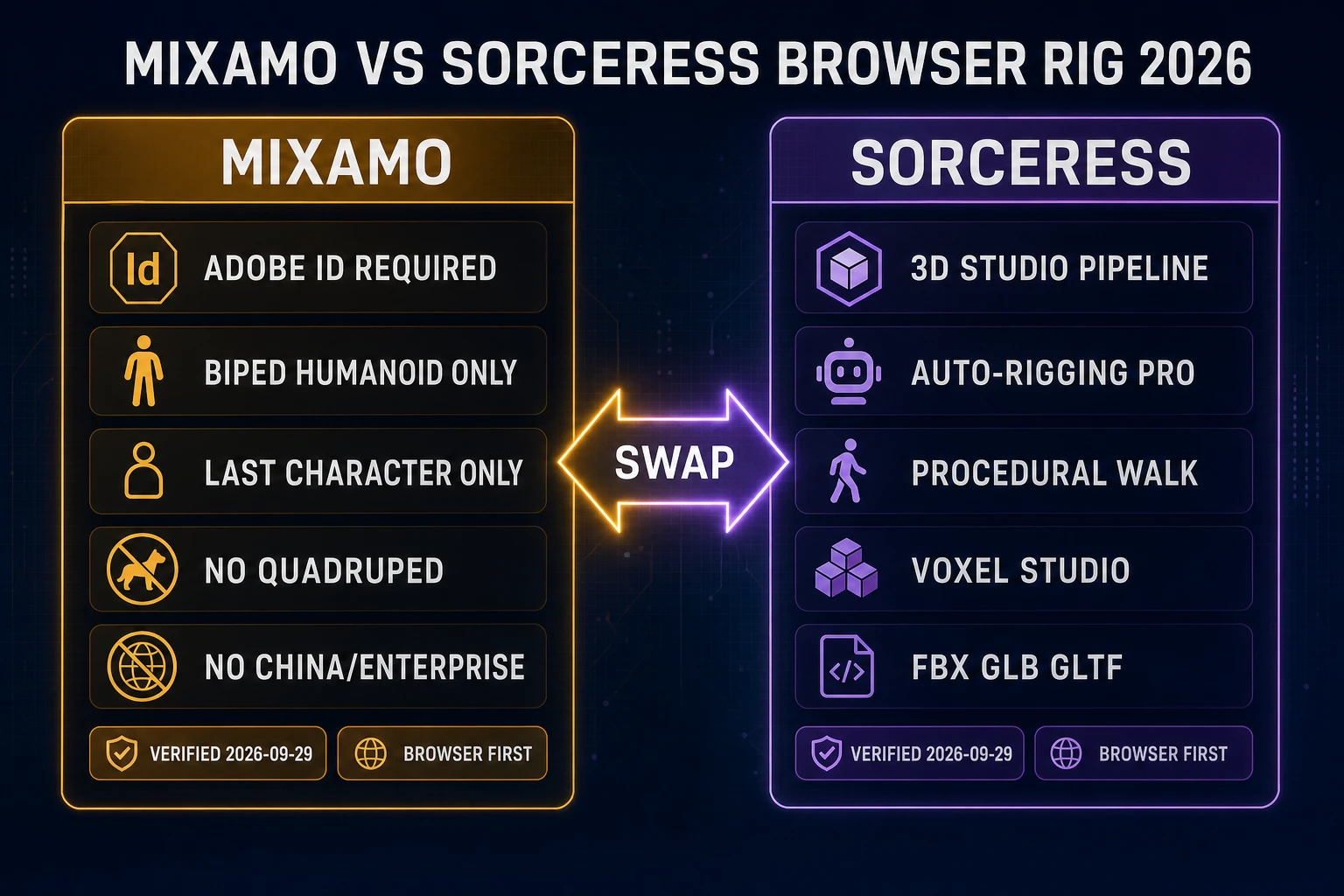
Mixamo vs Sorceress browser rig comparison chart with feature chips for each side
Honest Mixamo alternative comparison, verified 2026-09-29: Mixamo is free but bounded (biped humanoid, Adobe ID, no history); Sorceress is Pro-badged but broader (3D Studio pipeline, Voxel, Procedural Walk).

Auto-Rigging on Sorceress: the standalone Mixamo alternative

When you already own the mesh — bought on a marketplace, sculpted in Blender, exported from a legacy Mixamo session before an account change — the direct Mixamo alternative is the standalone Auto-Rigging tool. The more-tools card (verified 2026-09-29 in src/app/_home-v2/_data/tools.ts) describes it as: auto-rig humanoid 3D models plus weight-paint refinement, badge Pro, href /rigging, group 3D & Animation.

Pro tier is the honest tradeoff here. Mixamo is free with an Adobe ID; Sorceress Auto-Rigging is a paid tool inside the Pro subscription. In exchange, you get a browser session that does not depend on an Adobe account, does not vanish the last uploaded character when you upload a new one, and pairs natively with the rest of the Sorceress stack — AI Image Gen for the concept, Material Forge for PBR maps, and Procedural Walk for creatures Mixamo cannot rig at any price.

Weight paint is the piece both tools claim and only one exposes to the user. Mixamo's rigger is a closed pipeline: upload, place markers, download a skinned FBX. Auto-Rigging on Sorceress runs the humanoid auto-rig in the same one-click fashion, then keeps the weight-paint refinement step visible so you can adjust the influence of a bone before you commit the export. That single step is often the difference between a Mixamo mesh that deforms cleanly at the shoulder and one that pinches; on Sorceress you can see the weights instead of guessing at them.

The upload contract is the same shape on both sides: bring an FBX or GLB in a neutral pose, centered on origin, symmetric, no extra scene objects. Sorceress's rigging page accepts both FBX and GLB (verified 2026-09-29 by grepping src/app/rigging/page.tsx for parseFBX and parseGLB). If your Mixamo rejection was a strict humanoid-only refusal — a character with tails, wings, or extra limbs — you are not in Auto-Rigging territory either. Skip to the Voxel Studio and Procedural Walk sections below.
Voxel Studio and Procedural Walk: the Mixamo gaps

Mixamo does not rig quadrupeds, spiders, drakes, insects, or anything with more or fewer than two legs. Adobe's FAQ is explicit: the auto-rigger and animation libraries are for bipedal humanoids only (verified 2026-09-29). That gap is what Procedural Walk exists to fill. Its card (verified 2026-09-29 in src/app/_home-v2/_data/tools.ts) advertises 3D procedural rigging and animation for any creature: spiders, ants, drakes, four-legged beasts, anything with more or fewer than two legs, auto-rigged and driven with real-time inverse kinematics so feet plant on uneven terrain, stairs, and ramps without baking a single keyframe. Badge Pro, href /rigging-multileg, group 3D & Animation.

The inverse kinematics article on Wikipedia (verified 2026-09-29) frames IK as the mathematical process of calculating joint parameters that provide a desired position for the end effector — in a rigging context, the foot or the hand. Procedural Walk uses that math at runtime so the same rigged spider walks over a staircase and over flat ground without a separate stair animation. Mixamo has no equivalent at any tier.

The second gap Mixamo cannot fill is voxel casts. Voxel Studio and its adjacent tools (AI Voxel Generation, Voxel Text-to-Animation, both badged AI Credits; verified 2026-09-29 in src/app/_home-v2/_data/tools.ts) build blocky characters from text, image, or 3D input, rig the resulting voxel humanoid, and drive it with text-to-animation. That path is a natural swap when the target aesthetic is Minecraft-adjacent, when the polygon count needs to stay tiny for mobile web, or when the character brief involves creatures Mixamo's humanoid-only rigger refuses. Voxel Studio's rigging step is included in the AI Credits lane rather than gated behind the Pro badge for the generation itself.

Rule of thumb for the Mixamo alternative decision tree: humanoid biped in FBX or GLB → Auto-Rigging (Pro) is the swap. Prompt-to-humanoid from scratch → 3D Studio full pipeline is the swap. Multi-legged creature → Procedural Walk (Pro) is the swap. Blocky voxel cast → Voxel Studio (AI Credits) is the swap. Mixamo's motion library — the part that many devs actually stay for — is still fine to keep in a separate lane; the FBX Mixamo hands back can be re-imported into 3D Studio for further edits without a re-rig.

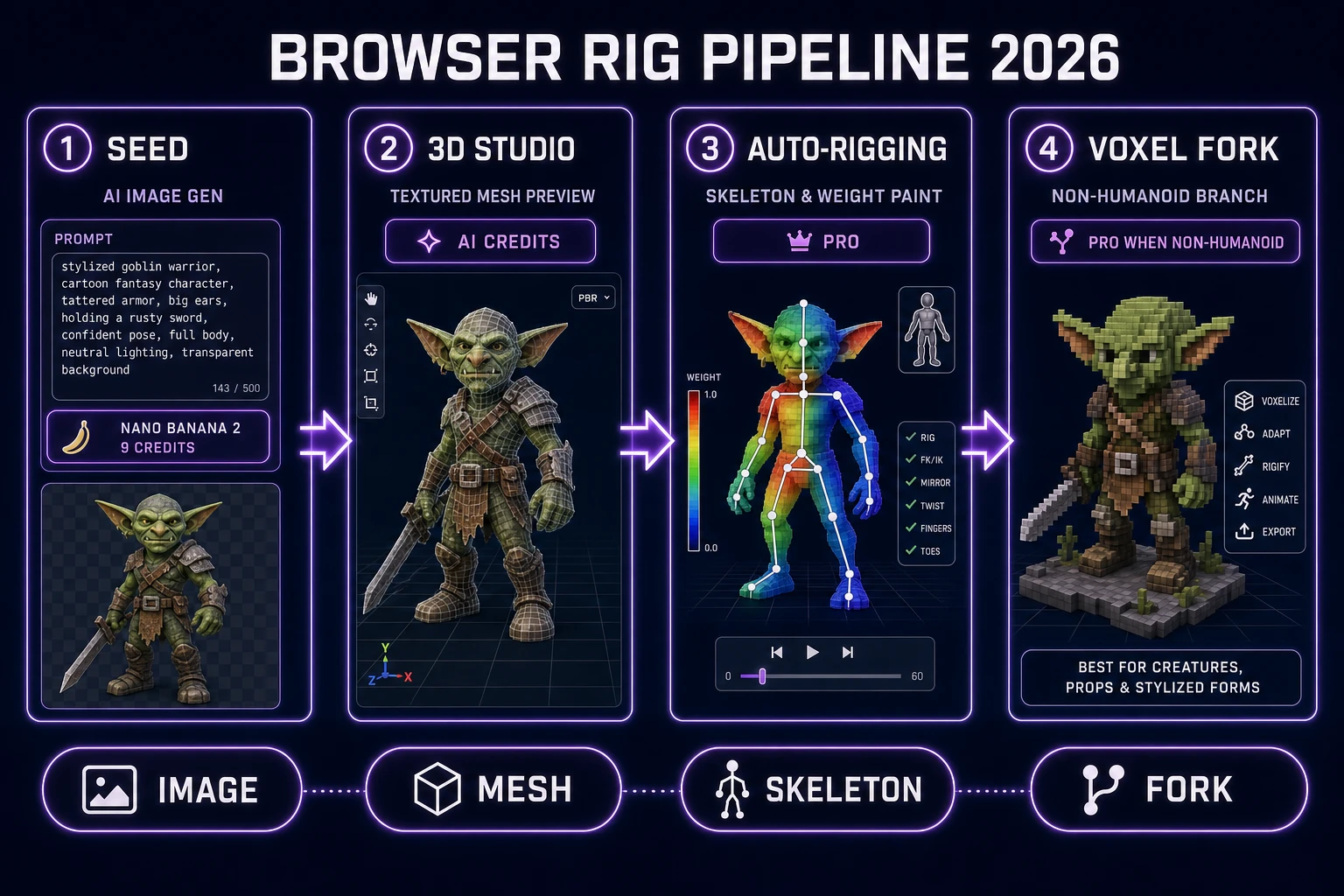
Mixamo alternative pipeline: image seed, 3D Studio, Auto-Rigging Pro, Voxel Studio fork
Honest browser rig pipeline verified 2026-09-29: seed in AI Image Gen, mesh in 3D Studio, Pro rig in Auto-Rigging, voxel fork for the cast Mixamo cannot touch.

Engine handoff: FBX, GLB, and GLTF

Mixamo hands back an FBX with the skeleton, skin weights, and optionally a baked animation clip. A Mixamo alternative that only exports OBJ is not actually an alternative; it forces the developer back into Blender to rebind the skin, which defeats the point. The 3D Studio card description explicitly lists FBX, GLB, and GLTF as the export formats (verified 2026-09-29). All three carry the skeleton and skin weights; the choice is about which engine or runtime consumes the file.

Wikipedia's glTF article (verified 2026-09-29) still describes glTF 2.0 as an open royalty-free 3D transmission format optimized for run-time delivery, with GLB as the binary container that packs meshes, textures, and animation into a single file. The FBX article (verified 2026-09-29) still describes FBX as Autodesk's proprietary interchange format widely used across DCC apps and game engines. Practical picking rule: GLB for web-first engines and any browser preview, FBX for engines whose importers still prefer it, GLTF as the loose sibling of GLB when you want the textures and .bin data as separate files.

For the engine step itself, the two friendliest browser-first paths are Phaser (2D only, does not matter here) and any glTF-capable 3D engine. Sorceress does not link out to competing engines from body copy, but the file shape is a standard — a GLB with a humanoid skeleton and PBR-friendly materials is understood by any modern 3D pipeline. If the target is a web build, use the GLB; if the target is a legacy FBX-first importer, use the FBX; do not re-encode in the browser between the two.

Credit math for a browser rig session

Quote wallet numbers from source, not marketing memory. CREDITS_PER_DOLLAR = 100 in src/lib/models.ts. SIGNUP_GRANT = 100 in src/app/api/admin/credits/route.ts. Both verified 2026-09-29. Auto-Rigging and Procedural Walk are gated behind the Pro badge rather than a per-run credit line, so the cost model is subscription-plus-generation-credits, not per-rig.

Mixamo alternative session Image seed Mesh step Rig step Total credits USD at 100 cr/$
Existing GLB or FBX, rig only00Pro (subscription)0 gen creditsPro plan only
Prompt to rigged humanoid (3D Studio full)9 (Nano Banana 2)3D Studio AI Credits lanePro (subscription)9 + mesh gen$0.09 image + mesh
Voxel humanoid from prompt (Voxel Studio)0 or 3 (Z-Image draft)Voxel Studio AI CreditsAI Credits lane3 + voxel gen$0.03 draft + voxel
Multi-legged creature (Procedural Walk)0 (bring your mesh)0Pro (subscription)0 gen creditsPro plan only
Hero pass with Nano Banana Pro seed183D Studio AI CreditsPro (subscription)18 + mesh gen$0.18 image + mesh

The 100-credit signup grant covers the image seed and initial voxel generations on the free tier before you decide whether the Pro subscription is worth it for the rigging pass. Mixamo has no signup grant because it has no credit model — the tradeoff is that Mixamo's compute is subsidized by Adobe and its output surface is smaller. On Sorceress, generation credits and Pro tier are the two ledgers and both are visible in the account page (verified 2026-09-29).

A practical checklist before you swap: confirm the mesh is a T-pose or A-pose humanoid centered on origin (or a multi-leg creature if you are heading to Procedural Walk); pick the export format the target engine actually prefers (GLB for web, FBX for legacy Unity or Unreal importers); keep a copy of the source mesh outside the browser session (Sorceress keeps your files but a local backup is still good hygiene, exactly like Adobe's own recommendation for Mixamo); and do not expect a Mixamo-style motion library on the Sorceress side — the motion story lives in 3D Studio's AI Text-to-Animation and in Procedural Walk's real-time IK, not in a preset library.

Verdict: pick the Mixamo alternative that matches the gap

A clean Mixamo alternative in 2026 is not a single URL. Mixamo itself is still the free, humanoid-only baseline for developers who have an Adobe ID and can live inside its shape; there is no shame in staying on it for the specific job it was designed for. The Sorceress swap is the answer when Mixamo's shape does not fit your job:

  1. Enterprise or Federated Adobe ID, or a China-based account: Mixamo is unavailable; open 3D Studio or standalone Auto-Rigging in the browser.
  2. Humanoid mesh you already own: upload the GLB or FBX into Auto-Rigging (Pro), refine weights, export.
  3. Prompt-to-rigged humanoid from scratch: run the full 3D Studio chain — image, lift to 3D, humanoid rig, text-to-animation, export.
  4. Quadruped, spider, drake, or anything non-humanoid: Mixamo will refuse; open Procedural Walk (Pro) and let real-time IK handle the terrain problem too.
  5. Voxel or Minecraft-adjacent cast: Voxel Studio (AI Credits) rigs voxel humanoids and hands you a game-ready character in the same browser session.

The searcher who typed Mixamo alternative into Google in 2026 does not want another blog post arguing about rigs in the abstract. They want a browser tool that fits the specific gap Mixamo left. Match the gap to the tool, keep the credit math honest, and swap once — do not build a workflow that depends on a third-party account you cannot actually create.

Frequently Asked Questions

What does a Mixamo alternative search actually want in 2026?

Almost always an in-browser auto-rigger that outputs a game-ready skeleton without an Adobe account. DataForSEO lists mixamo alternative at 210 searches a month with KD 5 and commercial-adjacent intent (tools/research-supplement.md, verified 2026-09-29). The Auto-Rigging tool catalog inside Sorceress explicitly names 'Mixamo alternative' as its long-tail candidate. The searcher already knows Mixamo exists; they want a swap they can run in the browser today, ship an FBX or GLB, and keep working after the tab closes.

Is Auto-Rigging on Sorceress free like Mixamo?

No. Auto-Rigging is Pro-tier (verified 2026-09-29 in src/app/_home-v2/_data/tools.ts: badge "Pro"). Mixamo is free with an Adobe ID (adobe.com FAQ, verified 2026-09-29). The honest tradeoff: Mixamo is free but only rigs bipedal humanoids, only remembers the last uploaded character, and requires an Adobe account (blocked for Enterprise/Federated IDs and in China). Auto-Rigging on Sorceress is paid, runs in the browser without third-party sign-in, keeps your session, and pairs with 3D Studio for the mesh you feed it. Voxel Studio covers the blocky cast Mixamo cannot rig at any price.

Can I rig a quadruped or a spider on Sorceress?

Yes. Mixamo's auto-rigger is bipedal humanoids only (adobe.com FAQ, verified 2026-09-29). Sorceress has Procedural Walk (badge "Pro", href /rigging-multileg, verified 2026-09-29 in src/app/_home-v2/_data/tools.ts) for multi-legged creatures — spiders, ants, drakes, four-legged beasts. It auto-rigs and drives them with real-time inverse kinematics so feet plant on uneven terrain without keyframing. That is a Mixamo gap by design, not a Sorceress bonus.

What files does the Sorceress Mixamo alternative actually output?

The 3D Studio card description (verified 2026-09-29 in src/app/_home-v2/_data/tools.ts) lists FBX, GLB, and GLTF as export targets for any engine. That covers the same handoff Mixamo uses (FBX with skin + animation baked in) plus GLB and GLTF for web-first engines. The Wikipedia glTF article (verified 2026-09-29) still treats GLB as the binary variant of glTF 2.0 designed for efficient transmission and load. Any modern browser or engine that can import glTF can eat the Sorceress output.

How much does a browser rig session cost on Sorceress?

CREDITS_PER_DOLLAR = 100 and SIGNUP_GRANT = 100 in src/lib/models.ts / src/app/api/admin/credits/route.ts (verified 2026-09-29). The image seed on Nano Banana 2 is 9 credits, image-to-3D lives on 3D Studio's AI Credits lane, and the Auto-Rigging step is gated behind the Pro badge — not a per-run credit burn once you are on Pro. A single image-seeded humanoid character costs roughly 9 credits for the portrait plus 3D Studio's image-to-3D credits, then the Pro rigging pass. Existing GLB or FBX uploads skip the image and 3D steps entirely — walk straight into Auto-Rigging.

Sources

  1. Skinning - Wikipedia (skeletal animation)
  2. Skeletal animation - Wikipedia
  3. glTF - Wikipedia
  4. FBX - Wikipedia
  5. Inverse kinematics - Wikipedia
Written by Arron R.·2,600 words·12 min read

Related posts