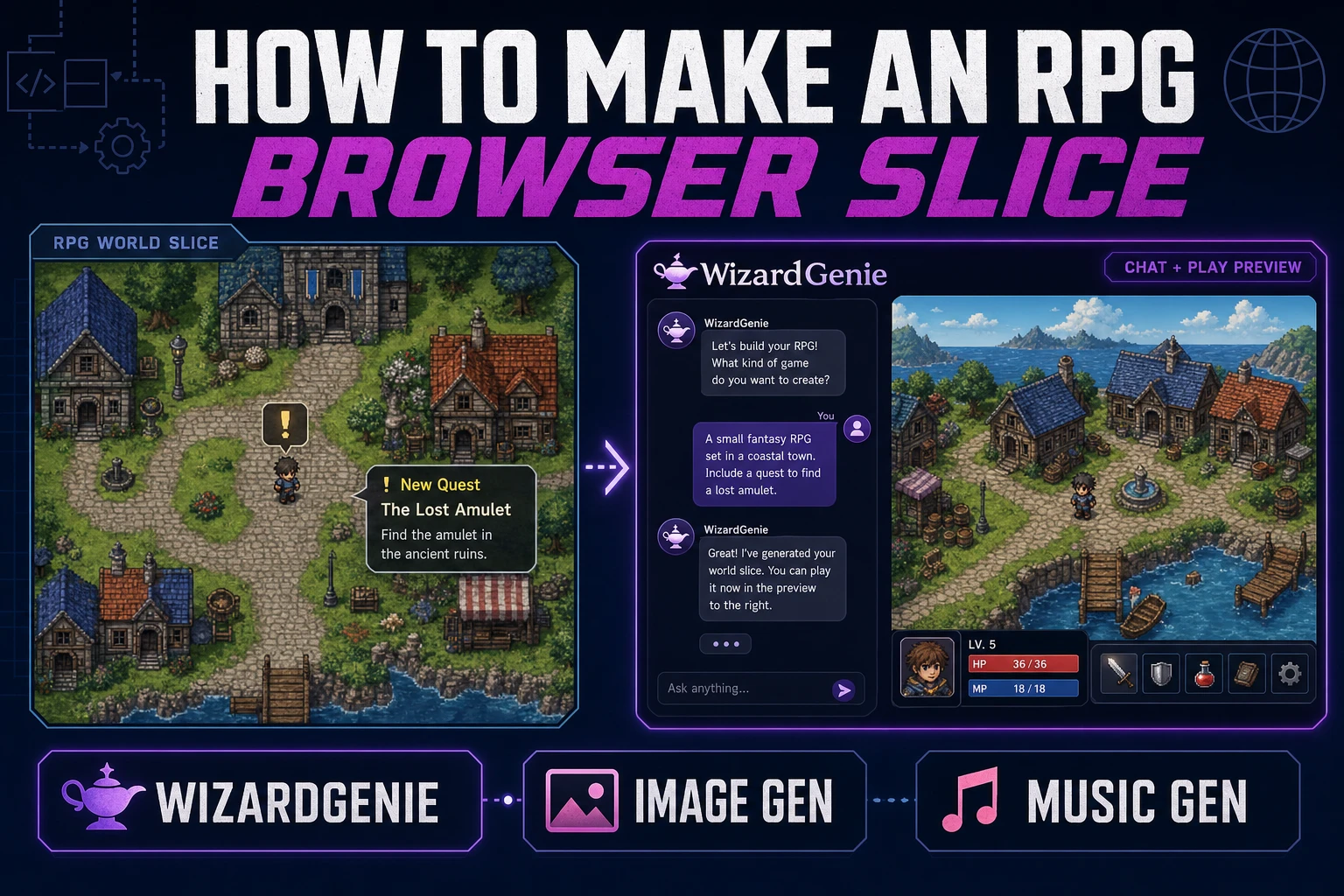
Quest How to Make an RPG (Browser Slice)

By Arron R.7 min read
How to make an RPG starts as a vertical slice, not a full world bible. Lock one town, one combat encounter, and one quest in WizardGenie, generate cast and prop

Most “full RPG” plans die in the world bible. How to make an RPG that actually ships starts smaller: one walkable town, one fight you can win or lose, and one quest with a clear Done state. This guide builds that vertical slice in the browser with WizardGenie, fills the cast in AI Image Gen, and scores a short loop bed in Music Gen. Model lineup and credit costs below were verified against Sorceress source on July 24, 2026; Phaser v4.2.1 “Giedi” was live-checked on the official GitHub release notes the same day.
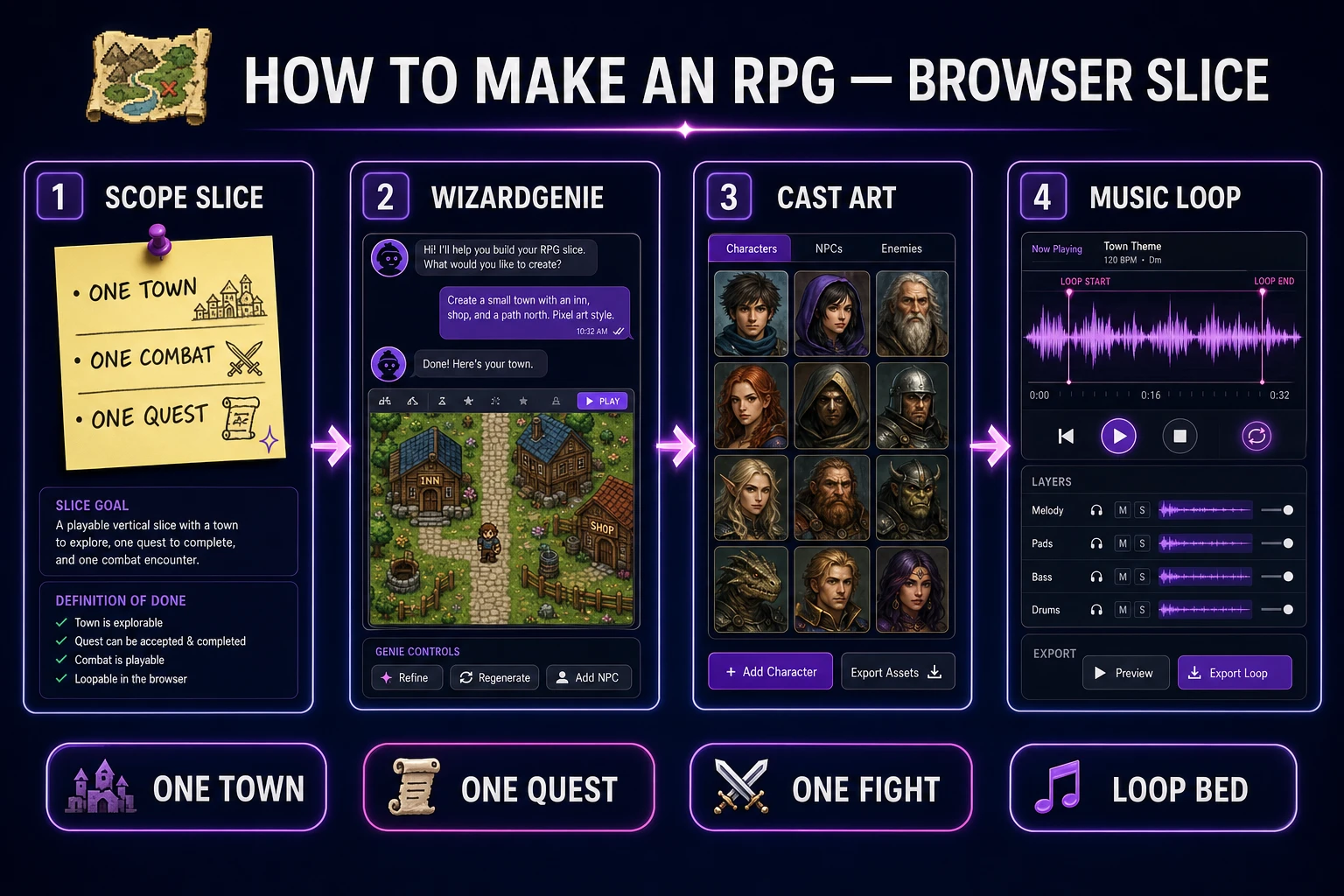
How to make an RPG browser slice pipeline from scope through WizardGenie scaffold to cast art and music loop
Scope the slice first, scaffold systems second, generate cast third, then score a loop bed before expanding the world.

What how to make an rpg must scope first

DataForSEO lists how to make an rpg at 320 monthly searches with KD 5 in research-supplement.md, verified July 22, 2026 (still the citation-grade row for this primary). Sibling tails already own engine-specific posts—Unity, Godot, Scratch—so this page owns the engine-agnostic head term: a portable browser vertical slice.

Wikipedia’s role-playing video game article (live-checked July 24, 2026) centers RPGs on character progression, exploration, and quest structure. The broader RPG page adds the same spine from tabletop roots: players inhabit characters whose capabilities grow through play. Your first build only needs to prove that spine once.

Write three hard limits on a sticky note before you open a coding agent:

  • One town: a hub with 2–4 interactable NPCs and exits that do not lead anywhere yet.
  • One combat: a single encounter recipe (turn-based or real-time) with win, lose, and flee outcomes.
  • One quest: accept → travel or talk → fight or deliver → reward → Done flag that stays Done.

Those three limits are the slice contract. Skip them and you will invent inventory depth, crafting trees, and a second continent before anyone can finish a five-minute playthrough. The redo tax is what kills RPG prototypes—not the first hour of careful systems.

Also decide what you will not build yet. No romance tracks, no crafting, no multiplayer. A how-to-make-an-RPG session that tries to invent a full party, class tree, and open world in one sitting almost always ships muddy compromises. One hero, one quest, one fight is a complete first milestone.

Pick one town, one combat, one quest

Name the fantasy in one sentence a stranger can repeat: “Harbor town, rat cellar, retrieve the dock key.” That sentence becomes the WizardGenie prompt spine and the playtest pass/fail. If you cannot say it in one breath, the slice is still too big.

Map the town as rooms, not continents. Three screens is plenty: plaza, shop or inn, and the combat space. Mark which NPC gives the quest and which object or enemy completes it. Keep dialogue short—two lines to accept, one line on success—so you can replace gray text with voiced lines later without rewriting quest logic.

Design combat as a recipe, not a bestiary. One enemy type, one player attack, one defend or item, clear HP. If you need variety later, duplicate the recipe with new art and numbers. Do not invent status-effect graphs before the first fight is fun.

Write the quest as a state machine on paper before you code it: Locked → Accepted → InProgress → Resolved → Rewarded. Every interactable in the town should only move that machine forward or refuse politely. Side chatter that does not touch the machine can wait for the second quest. If an NPC both sells potions and advances the main quest, split those verbs so you can debug them separately when the Done flag misfires.

Time-box the fantasy. A weekend slice means you can finish the checklist by Sunday evening. If your one-sentence pitch needs a prologue dungeon and a capital city, cut the prologue. Harbor town plus cellar is enough to teach movement, talk, fight, and reward—the four verbs every later system will reuse.
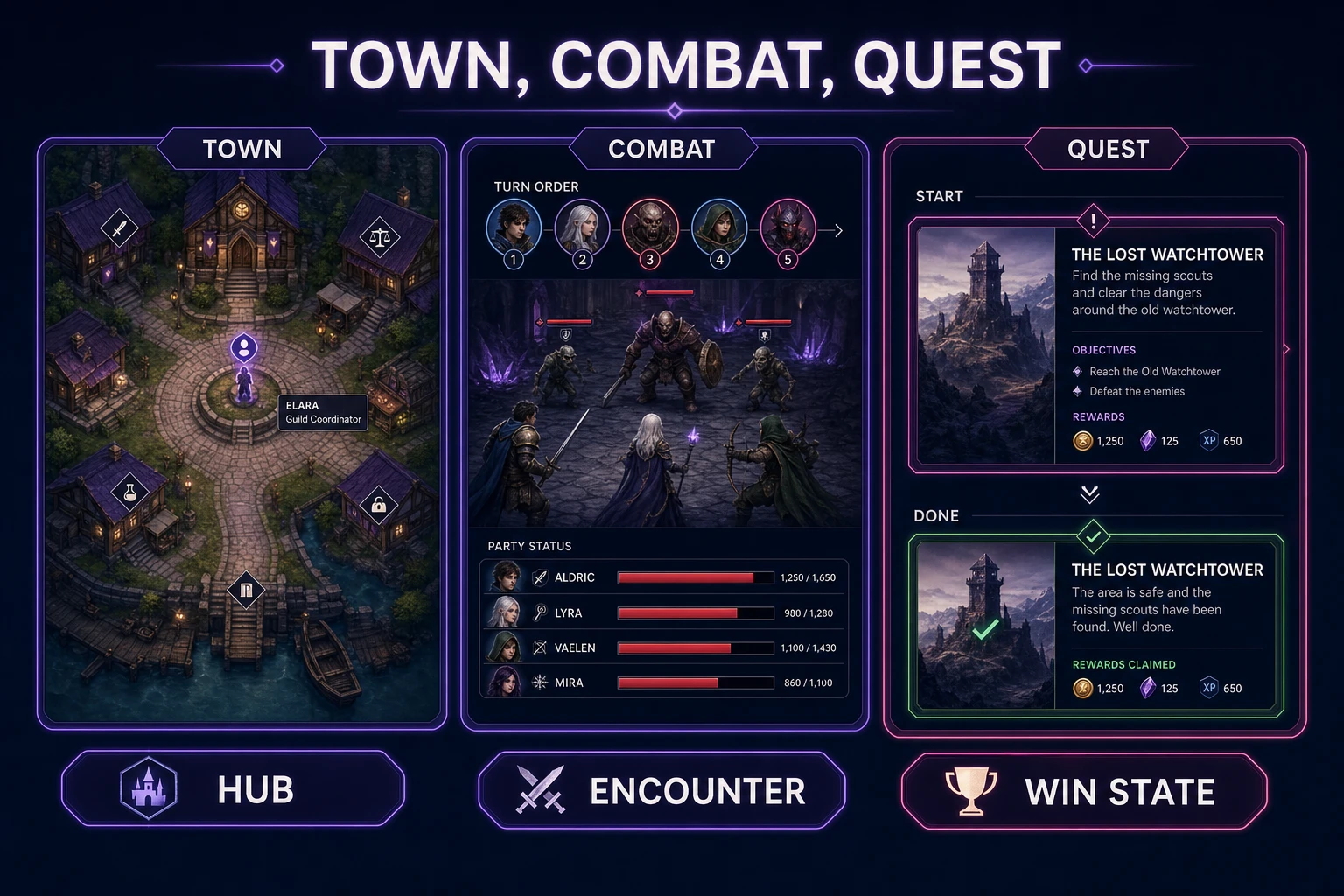
Scorecard showing town hub, single combat encounter, and quest card win state for an RPG vertical slice
Town hub, one encounter, one quest win state—three panels, one slice.

Scaffold systems in WizardGenie

Open WizardGenie on web or desktop and describe the slice contract, not a marketing trailer. WizardGenie is Sorceress’s AI-native game engine: you describe the game; it writes, runs, and iterates in real time. Coding models available (verified July 24, 2026 in CODING_MODELS): Claude Opus 4.7, Claude Sonnet 4.6, GPT-5.5, Gemini 3.1 Pro, DeepSeek V4 Pro, Kimi K2.5, Grok 4.2, and MiniMax M2.7—bring your own API key or use the trial fallback.

Prompt like a producer: “Browser RPG vertical slice. Three screens: plaza, inn, cellar. One quest from the innkeeper to retrieve a dock key from cellar rats. Simple turn combat with attack and defend. Quest Done flag after reward. Graybox art OK.” Iterate on broken doors and missing Done flags before you mention particle polish.

Browser HTML5 remains a first-class game platform—MDN’s web games introduction (live-checked July 24, 2026) still frames reach, update control, and Web Audio / canvas / WebGL as the core stack. Phaser v4.2.1 “Giedi” shipped July 9, 2026 (GitHub release notes live-checked July 24, 2026); if your scaffold targets Phaser, pin that version in the prompt so the agent does not invent APIs from older training cutoffs.

If you use a Planner+Executor pairing, keep the expensive reasoner as Planner and a cheap fast model as Executor (DeepSeek V4 Pro, Kimi K2.5, or MiniMax M2.7). Putting a frontier model on the typing side erases the cost advantage that makes dual-agent work worth running.
Generate cast and props

Grayboxes prove systems; faces sell the quest. Open AI Image Gen once the walk, talk, and fight loop already play. Generate a consistent cast pack: hero bust, innkeeper, one rat or bandit silhouette, and one key or MacGuffin prop. Prompt with the same art direction string on every card—“flat indie RPG, warm lantern light, clean silhouette, no soft photographic bokeh”—so the town does not look like five different games.

Name files with role and size baked in: npc_innkeeper_bust.png, enemy_rat_side.png, prop_dock_key.png. Drop them into the WizardGenie project and ask the agent to swap grayboxes without changing collision or quest IDs. If a silhouette fails at play scale, regenerate that one card—do not repaint the whole cast because one rat looked cute instead of threatening.

Defer tileset perfection. A readable plaza and cellar with solid collision beats a beautiful map that soft-locks the quest marker. When you are ready for floor packs later, route through Tileset Forge; for this slice, keep art budget on faces and the MacGuffin.

Score a short loop bed

Silence makes a town feel unfinished. Open Music Gen and generate one short instrumental loop for the hub—something that can sit under dialogue without fighting it. Music Gen bills 10 credits per track (MUSIC_CREDIT_COST in src/app/music-gen/page.tsx, verified July 24, 2026); optional auto-lyrics add 2 credits you do not need for a bed.

Prompt for loopability: “soft harbor town instrumental, gentle lute and woodwinds, no vocals, seamless loop, 90 seconds.” Keep combat music for a second pass after the fight feels fair. Wire the bed to the town scene only; let the cellar inherit a quieter gain or a second shorter cue once the first bed is approved.

Export, name the file bgm_town_loop.mp3, and ask WizardGenie to fade in on plaza enter and fade out on quest complete. If the loop seam clicks, regenerate once with “seamless loop” emphasized rather than editing in a DAW before the slice is fun.

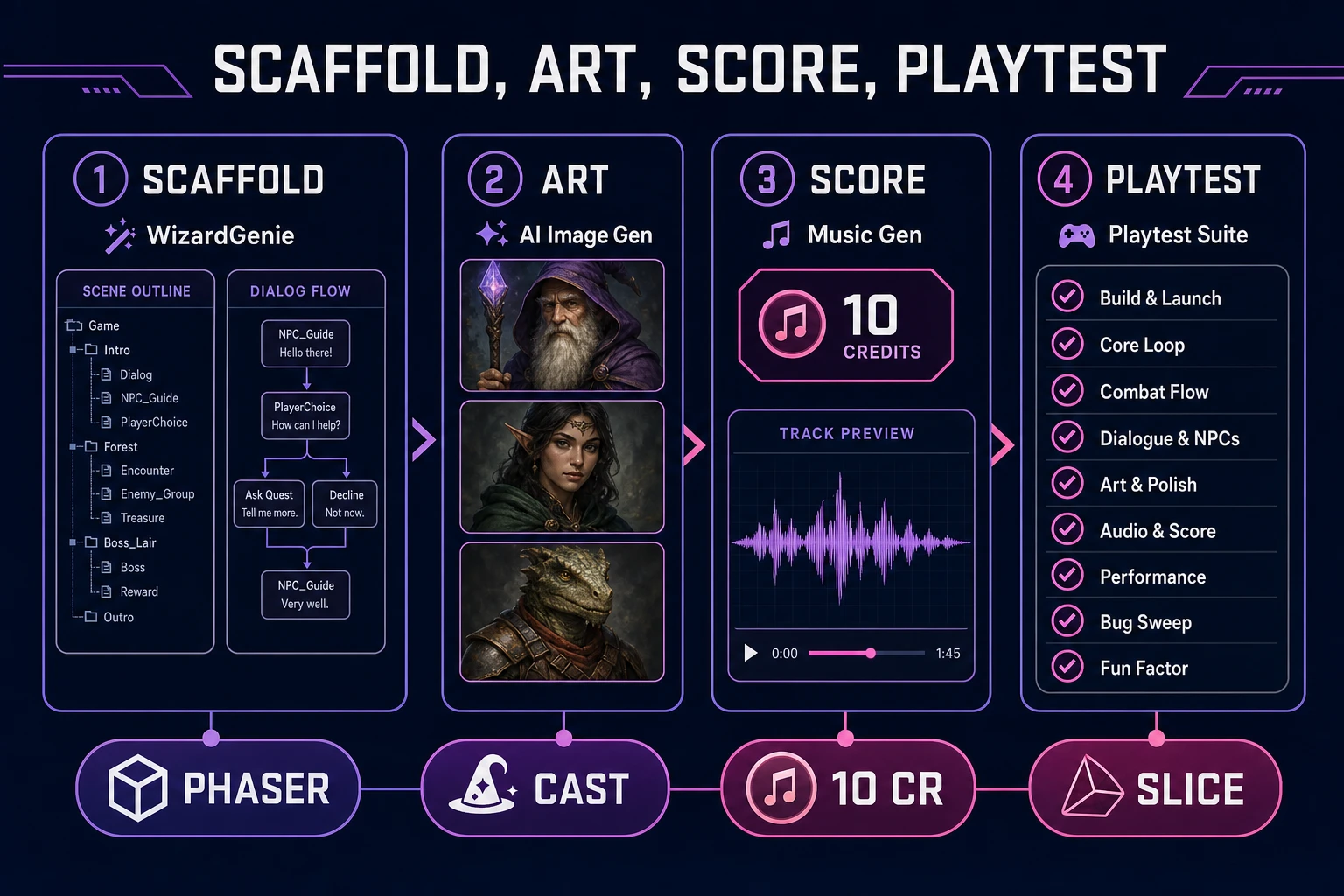
Pipeline from WizardGenie RPG scaffold through AI Image Gen cast and Music Gen loop into a playtest checklist
Scaffold, art, score, playtest—expand systems only after the checklist passes.

Playtest the slice checklist

Play the slice cold, as if you never wrote the prompt. Check these gates before adding systems:

  1. You can walk the town without soft-locking in geometry.
  2. You can accept the quest and see an objective on screen.
  3. You can enter combat, win, lose, and return to a stable hub state.
  4. Completing the quest sets Done and grants the reward once—not twice.
  5. The Music Gen bed plays without clipping dialogue or muting SFX you already have.

Record one take. If any gate fails, fix that gate in WizardGenie before generating more art. Expanding the world while the Done flag double-fires teaches you nothing about RPG design—it only multiplies bugs.

Invite one friend for a five-minute run with no coaching. Watch where they stand still. Confusion at the innkeeper is a UI problem; confusion in the cellar is a navigation or combat-clarity problem. Fix the stillness, not the lore dump.

Keep a reject log: “door blocked,” “quest text unclear,” “rat HP too high,” “music too loud under dialogue.” Fix the top three before you spend another Image Gen batch. The log is how you stop arguing with yourself about lore while the interact button still fails.

When to expand systems

Expand only after the checklist passes on a cold playthrough. Safe second-wave additions, in order: a second quest that reuses the same combat recipe, a second enemy tint with new numbers, then inventory with two items max. Unsafe early additions: crafting, romance, multiplayer, open-world map stitching.

When you do add a second quest, clone the state machine and change only the MacGuffin and the destination room. Reusing collision, combat, and UI code is the point of the slice—you are buying speed, not originality. New systems should plug into verbs you already proved: walk, talk, fight, reward.

When systems outgrow the jam, keep the browser slice as the design source of truth. Porting later is cheaper when the quest graph is already honest. For a fuller catalog view of how Sorceress tools chain after this slice, see the Tools Guide. Sibling engine tutorials on the blog cover Unity/Godot/Scratch phrasings—this page stays on the portable how to make an RPG slice you can finish in a weekend.

Budget feel, not fantasy. A disciplined first pass looks like: graybox scaffold in WizardGenie on your API key, one cast pack in AI Image Gen, one 10-credit Music Gen bed, then playtest until Done is boringly reliable. That is how to make an RPG that exists—before you invent the continent that never ships.

Frequently Asked Questions

What does how to make an RPG mean for a first prototype?

Ship a vertical slice: one town hub, one combat encounter, and one quest with a clear start and finish. Wikipedia’s role-playing video game page (live-checked July 24, 2026) frames RPGs around character progression and quest structure—prove those loops once before you invent a continent.

Do I need Unity or Godot to follow this how to make an RPG guide?

No. This path builds a browser HTML5 slice first with WizardGenie (desktop or web), AI Image Gen for cast art, and Music Gen for a loop bed. Engine-specific tutorials already cover Unity/Godot/Scratch siblings; this page owns the portable browser slice.

Which WizardGenie coding models should I use for an RPG slice?

Verified against src/app/_home-v2/_data/tools.ts CODING_MODELS on July 24, 2026: Claude Opus 4.7, Claude Sonnet 4.6, GPT-5.5, Gemini 3.1 Pro, DeepSeek V4 Pro, Kimi K2.5, Grok 4.2, and MiniMax M2.7. For Planner+Executor work, keep the expensive reasoner as Planner and a cheap model (DeepSeek V4 Pro, Kimi K2.5, MiniMax M2.7) as Executor—never put a frontier model on the typing side.

How much does a Music Gen loop bed cost on Sorceress?

Music Gen charges 10 credits per track generation (MUSIC_CREDIT_COST in src/app/music-gen/page.tsx, verified July 24, 2026). Optional auto-lyrics add 2 credits. Generate one short instrumental town bed first; do not batch five moods before the quest loop plays.

When should I expand beyond the first RPG slice?

After the playtest checklist passes: players can walk the town, finish the quest, win or lose the fight, and hear the loop bed without breaking immersion. Only then add a second quest, inventory depth, or a second combat recipe. Expanding systems before the slice plays is how RPG prototypes die.

Sources

  1. Role-playing video game — Wikipedia
  2. Role-playing game — Wikipedia
  3. Introduction to game development for the Web — MDN
  4. Phaser v4.2.1 release notes — GitHub
Written by Arron R.·1,663 words·7 min read

Related posts