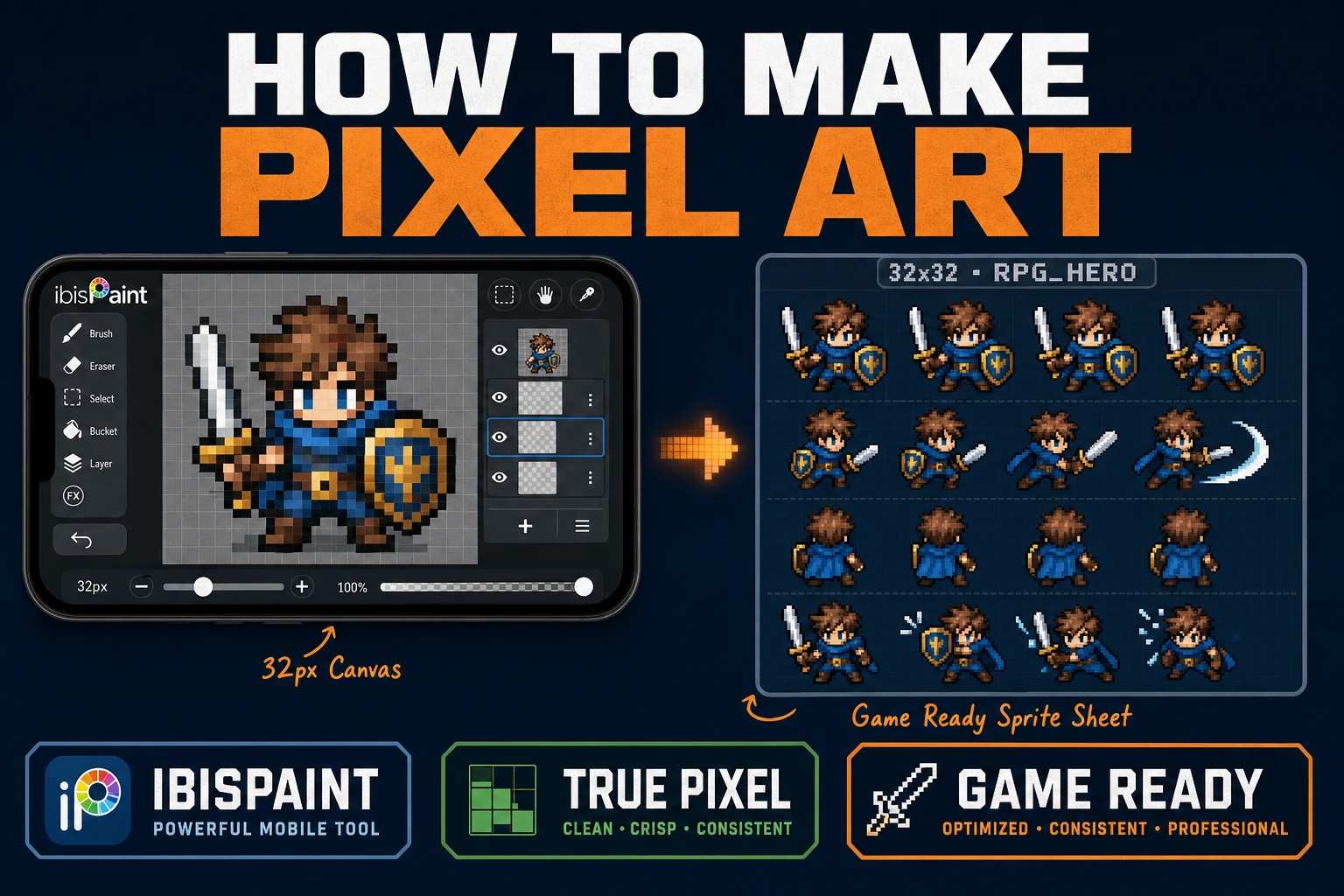
Learn How to Make Pixel Art in IbisPaint for Games

By Arron R.7 min read
How to make pixel art in IbisPaint for games: create a tiny canvas (often 32x32), turn Grid on with Pixelated zoom, draw with a 1.0px Digital Pen, export transp

Phone paint apps tempt you to open a huge canvas and scribble with soft brushes. How to make pixel art in IbisPaint for a playable game is the opposite habit: lock a tiny grid, force Pixelated zoom, draw with a 1px hard pen, then hand the PNG to a browser cleanup loop. This guide follows the official ibisPaint pixel-art settings (re-checked July 28, 2026), then finishes the sprite in True Pixel, Canvas, and Sprite Analyzer.
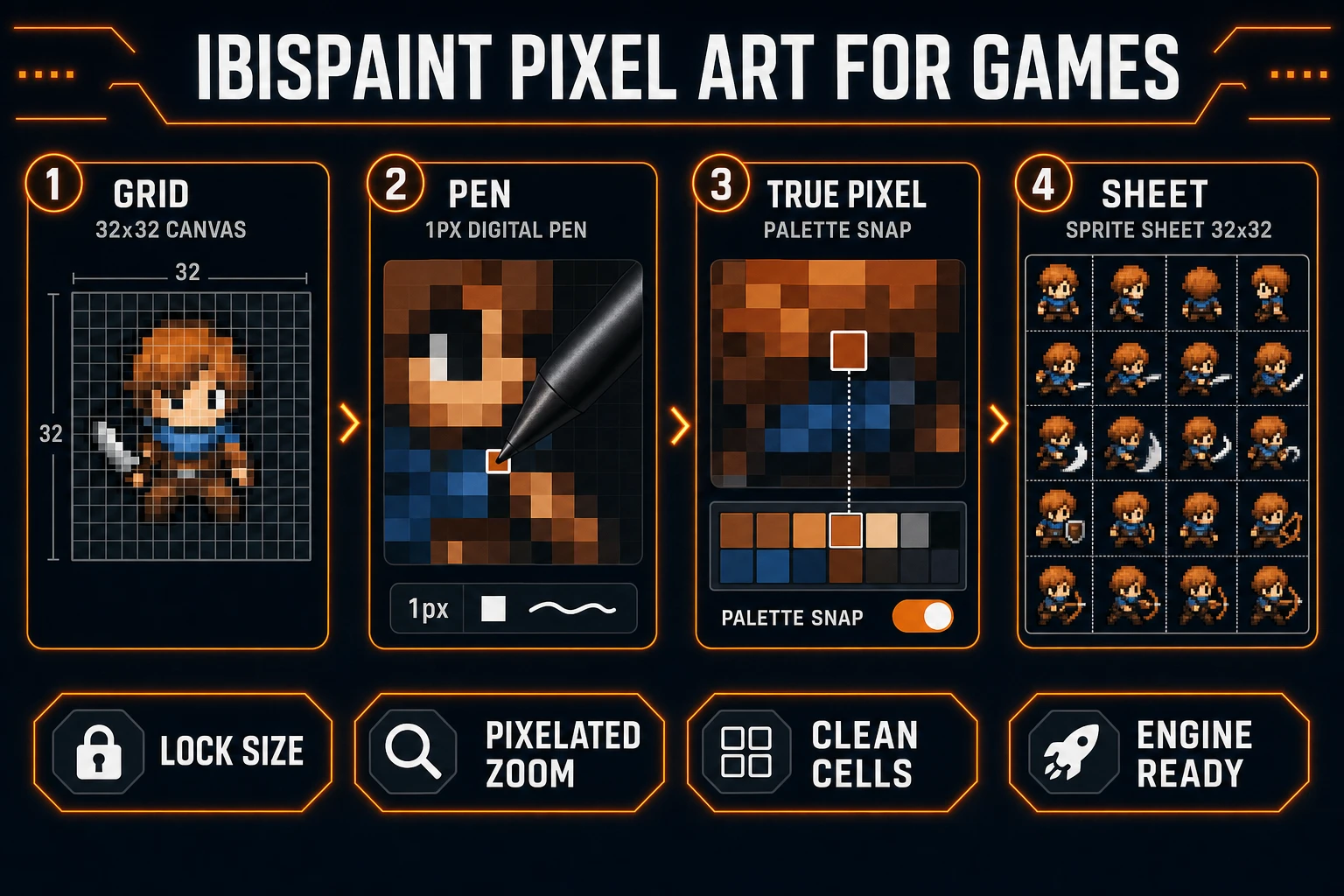
How to make pixel art in IbisPaint workflow from locked grid through True Pixel cleanup to a game sprite sheet
Lock the cell size first, draw hard pixels second, clean and sheet third. Never soft-upsample a master for the engine.

What how to make pixel art in IbisPaint requires

DataForSEO lists how to make pixel art in ibispaint at 110 monthly searches with KD 0 in research-supplement.md (verified July 19, 2026; still the slate citation for this brief). Readers typing that query already own or plan to open IbisPaint; they need a game-safe recipe, not a gallery of painterly portraits.

Wikipedia pixel art page frames the craft as images edited at the pixel level. For games that definition tightens: every frame must share a resolution contract so walk cycles, props, and UI icons sit on the same optical scale. A sprite is still a 2D bitmap composited into a larger scene. If your cells disagree about size, the compositor cannot save the look.

Write three decisions before you tap Create New Canvas:

  • Cell size: 16x16, 32x32, or 48x48 for the hero. Pick one modulus and keep props on it.
  • Palette budget: a short list you will reuse, not a new brown on every layer.
  • Transparency rule: true alpha PNG or one keyed background. Never both mixed on one sheet.

Those three lines are the contract. Soft brushes, Smooth zoom, and accidental resize are how phone drawings turn into mush at playtest scale. Sibling articles cover the broader browser map (how to make pixel art), the Procreate path, and the Photoshop path; this post stays on the IbisPaint to Sorceress handoff.

Set the final sprite size and grid before drawing

ibisPaint official tutorial Display Grid on the Canvas (lecture 53 / page no=171, re-fetched July 28, 2026) walks the pixel-art setup explicitly: open Create New Canvas, enter 32 for width and 32 for height, confirm, then open the View Menu, turn Grid on, and switch Display when zooming to Pixelated. That Pixelated flag is load-bearing. Smooth zoom lies about edges while you draw.

The matching View Menu details tutorial (lecture 184 / no=168, same day) repeats the rule: Smooth is the default when zooming; Pixelated is better when drawing pixel art. Use Grid Settings if you need interval tweaks, but do not trust a soft preview and hope the export stays crisp.

If your game camera wants 16x16 or 48x48 instead of 32x32, change the New Canvas numbers. Do not draw at 512x512 and plan to downsample later. Downsampling after freehand phone strokes invents gray ramps between cells. Match the engine cell size on day one.

Also refuse mid-project size changes. A hero locked at 32x32 who later needs 48x48 usually forces a full redraw of every walk frame. Treat the first locked number as sacred until a playtest proves the camera is wrong.
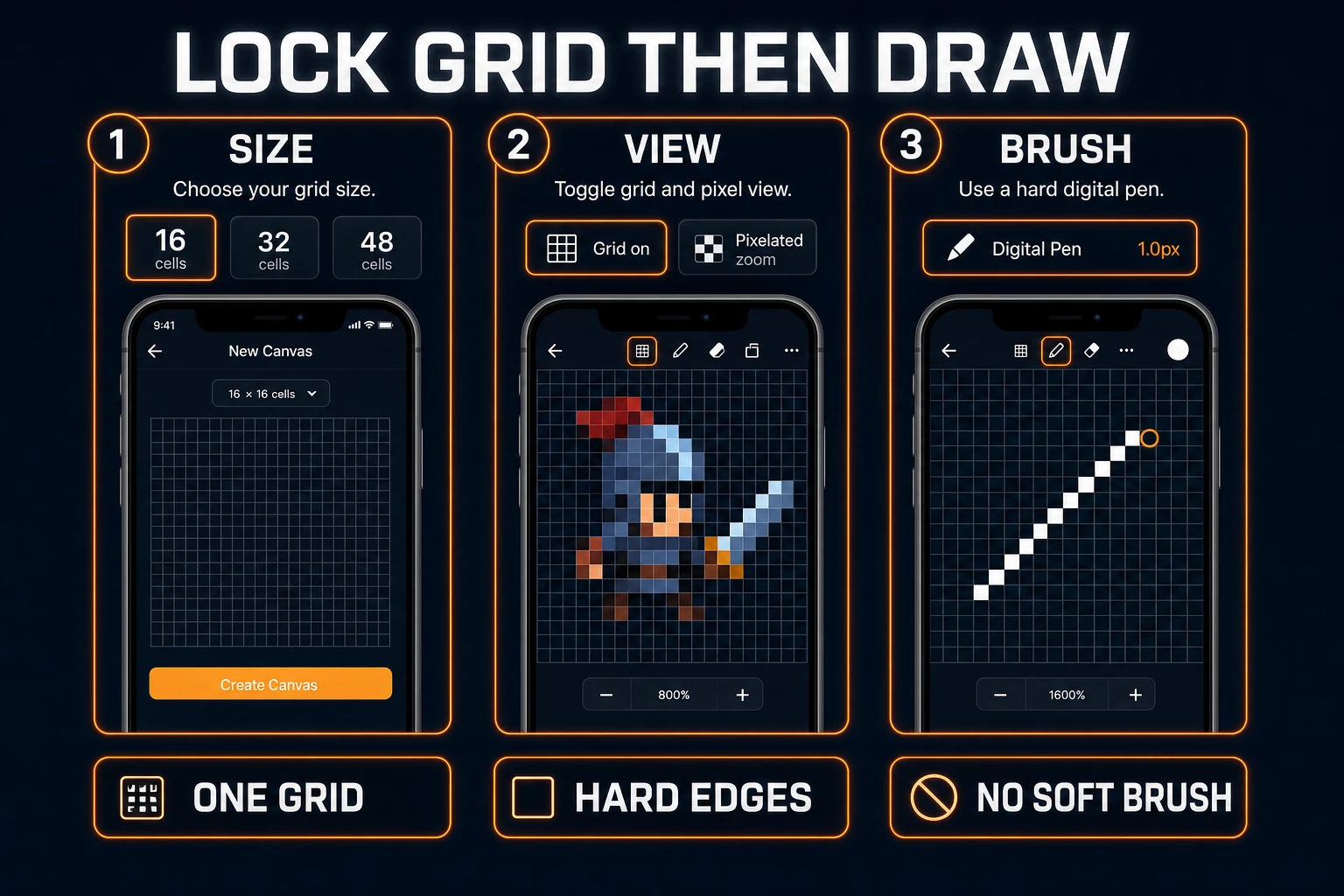
Scorecard for IbisPaint pixel art: locked cell size, Pixelated zoom, and 1px Digital Pen
Official ibisPaint pixel-art settings: tiny canvas, Grid on, Pixelated zoom, Digital Pen at 1.0px.

Block silhouette, clusters, and palette in IbisPaint

Still in the official grid tutorial: open the Brush Window, select Digital Pen, set thickness to 1.0px, then draw so pixels land on the grid. That is the whole brush recipe. Soft airbrushes, textured watercolor pens, and AI enhance filters fight the craft. Save them for concept mood boards, not masters.

Draw in three passes:

  1. Silhouette: flat outer ring only. Squint from arm length. If the hero reads as a rock, fix contrast before eyes.
  2. Clusters: block hat, torso, legs as solid shapes. Avoid one-off speckles.
  3. Palette: fill from a short list. Cap yourself; every new near-duplicate brown makes the cast noisy.

Test the silhouette on pure black, pure white, and a mid-gray floor color. If it disappears on any plate, raise outline contrast. Do not add eyelashes. Internal detail is optional; the outer ring is load-bearing for jam playtests.

Keep one idle pose readable before you animate. How to make pixel art in IbisPaint fails most often when people invent a twelve-frame walk before the standing pose survives a squint test.
Export without smoothing or accidental resampling

When the idle reads, export a transparent PNG at the native grid size. ibisPaint tutorial index lists dedicated paths: Save canvas as Transparent PNG and Save Layer as Transparent PNG, so you can ship alpha without flattening onto a white page. Prefer those over a social-share JPEG.

Hard export rules for games:

  • Keep the 1x master (16, 32, or 48 on a side). Upscale only for store mockups.
  • Never accept a Smooth / bilinear enlarge as the engine texture.
  • If you must Resize later, the official Resize tutorial (lecture 67 / no=77, re-fetched July 28, 2026) lists Nearest Neighbor (Pixel) among interpolation methods and recommends it for pixel art. Use that class of resampling, not Color Average soft blends, when you care about hard cells.
  • Name files boring and searchable: hero_idle_32.png, not FinalFINAL2.png.

Phone galleries often re-encode or pad images. Confirm the downloaded file pixel dimensions in any inspector before you import. A 32x32 that secretly became 128x128 with soft pixels is already broken for nearest-neighbor engines.

Convert and repair the sprite in True Pixel and Canvas

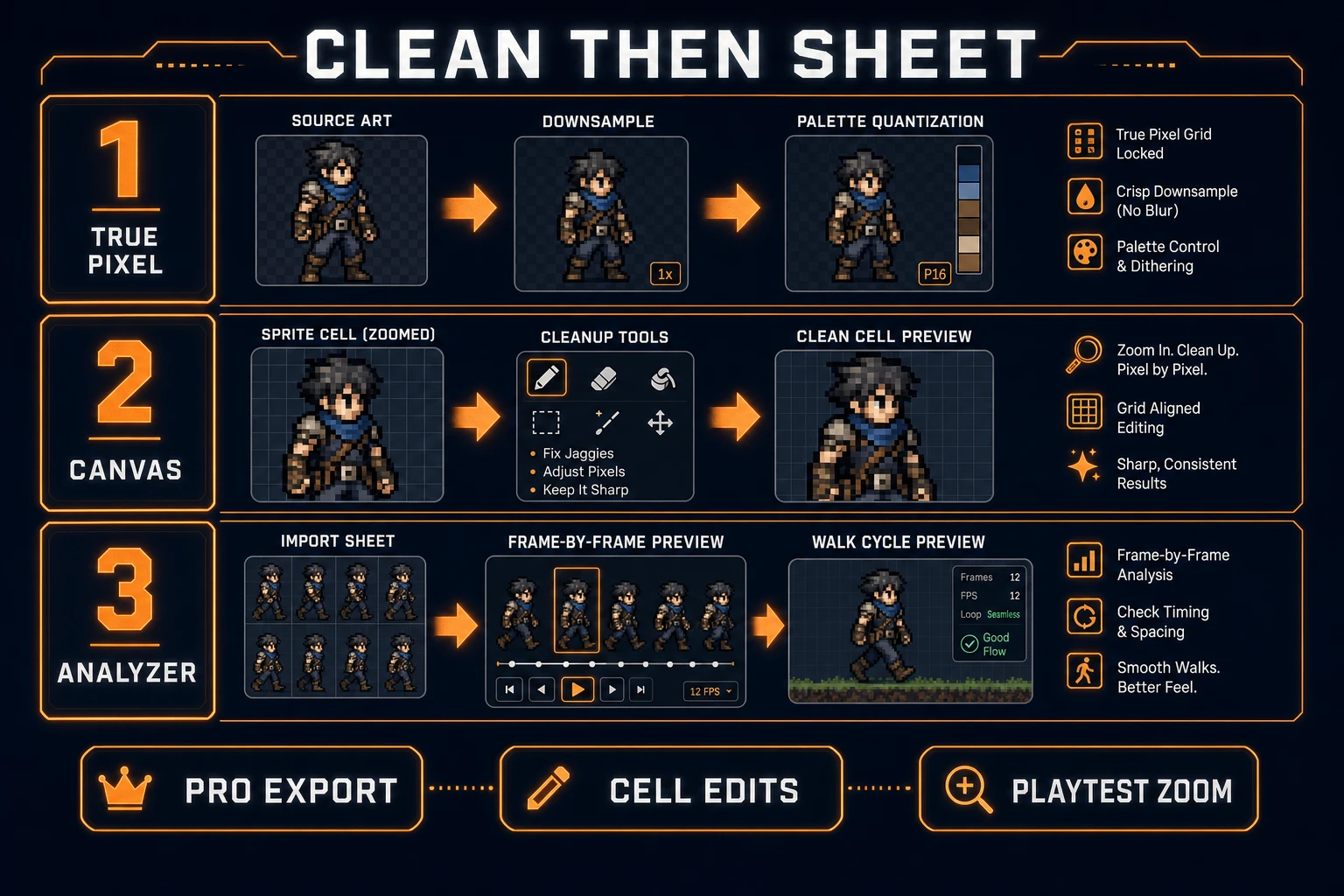
Hand pixel art from a phone still benefits from a browser cleanup pass. Open True Pixel when you want palette snap, outline help, or conversion toward a shared preset. Source presets in src/app/pixel-art/page.tsx include PICO-8 (16), SWEETIE-16, Endesga 32, Game Boy, CGA, NES, Grayscale, and 1-Bit (verified July 28, 2026). Set targetWidth to your locked cell size. The page defaults to 64; change it if your IbisPaint canvas was 32.

True Pixel core path downscales, quantizes, and can apply dither modes (none, ordered, floyd-steinberg), edge enhance, and outline options in the browser. Drag-and-drop upload returns early when isPro is false; export shows Upgrade to Pro to Export for signed-in non-Pro users (same source file, July 28, 2026). Sign in on a Pro-capable account before you batch-clean a cast.

After conversion, open the 1x PNG in Canvas, Sorceress browser editor. Zoom until each cell is a chunky square. Fix stray anti-aliased fringe, palette orphans, silhouette holes, and feet that disappear at game scale. MDN Canvas API is the same primitive under the hood: edit pixels, never paint with a soft brush on the master.

If your starting point was a photo or AI render instead of a phone draw, the sibling pipeline convert image to pixel art goes deeper on downsample math. Here the point is repair: IbisPaint got you intentional cells; True Pixel and Canvas keep the cast on one palette contract.

True Pixel convert, Canvas clean, and Sprite Analyzer preview for IbisPaint game sprites
Snap palette in True Pixel, repair cells on Canvas, then prove the sheet in Sprite Analyzer before engine import.

Inspect animation readability in Sprite Analyzer

Single idles are props. Characters need rows. Arrange cleaned frames on a regular grid, same cell size, no mixed widths, then open Sprite Analyzer to preview frame-by-frame. Confirm:

  • feet stay planted across the walk row
  • outlines do not flicker on and off
  • no frame secretly grew by one pixel
  • hurt or jump poses still read at the playtest camera zoom

Engine import cares about math. Phaser texture and frame APIs expect consistent frame dimensions inside a sheet. See the Phaser textures concepts. If row zero is 32x32 and row one includes a 33-pixel-wide frame, animation hitching is your fault, not the engine.

When you need directional volume faster than hand-drawing every angle, Quick Sprites can generate retro walk or VFX sheets as a parallel path. Use it for cast filler after the hero IbisPaint idle sets the art direction. For the wider sprite and tileset catalog, skim the tools guide.

Package pixel art for a game without scaling blur

Art that never enters a running build is cosplay. Drop the sheet into a one-screen prototype: move, collide, one hazard, restart. Play for two minutes at the real camera zoom, not at 400% editor zoom.

Ask only readability questions on the first pass:

  • Can you track the player against the floor tiles?
  • Does the hurt flash read without a floating number?
  • Do walk frames smear when the character is three tiles tall on screen?

If the answer is no, return to Canvas. Do not invent a new palette. Most my IbisPaint sprite looks bad in-game bugs are contrast, outline, or soft-export bugs.

Packaging checklist:

  1. Ship 1x PNG masters in the repo.
  2. Document cell size and pivot in a one-line note next to the sheet.
  3. Scale in the engine with nearest-neighbor / point filtering only.
  4. Refuse store-page upscales as runtime textures.

How to make pixel art in IbisPaint stops being mysterious once the phone settings match the official recipe and the browser loop finishes the sheet: Grid + Pixelated + 1px Digital Pen, transparent 1x export, True Pixel snap, Canvas repair, Sprite Analyzer proof, playtest zoom. Ship the readable idle first. The fancy blink can wait until the jump already feels fair.

Frequently Asked Questions

What does how to make pixel art in IbisPaint require for games?

A locked sprite size before you draw, View Menu Grid on with Display when zooming set to Pixelated, and a Digital Pen at 1.0px thickness. Those three settings are the official ibisPaint pixel-art recipe (tutorial Display Grid on the Canvas, re-checked July 28, 2026). Soft brushes and huge canvases break game-scale readability.

What canvas size should I use in IbisPaint for a game sprite?

Match the engine cell size, not phone wallpaper. The official ibisPaint pixel-art tutorial creates a 32x32 canvas as the worked example. Common indie targets are also 16x16 and 48x48. Pick one modulus for the whole cast so walk frames, props, and tiles share optical scale.

How do I export IbisPaint pixel art without blur?

Export a transparent PNG at the native grid size. Do not upscale with Smooth interpolation and ship that file as the engine texture. Keep the 1x master; nearest-neighbor scale only for mockups. ibisPaint tutorial index lists Save canvas as Transparent PNG and Save Layer as Transparent PNG paths for alpha exports.

When should I use True Pixel after drawing in IbisPaint?

Open True Pixel at /pixel-art when a hand draw needs palette snap, outline cleanup, or conversion toward a shared preset (PICO-8, Game Boy, NES, and others in src/app/pixel-art/page.tsx). Drag-and-drop upload and export are Pro-gated in the current page (verified July 28, 2026). Then repair stray cells in Canvas.

How do I check animation readability before import?

Arrange equal-size frames into a sheet and preview them in Sprite Analyzer at /spritesheet-analyzer. Confirm feet stay planted, outlines do not flicker, and no frame secretly grew by a pixel. Then drop the sheet into a one-screen playtest at the real camera zoom.

Sources

  1. Display Grid on the Canvas — ibisPaint official tutorial
  2. View Menu details — ibisPaint official tutorial
  3. Changing image resolution with Resize — ibisPaint official tutorial
  4. Pixel art — Wikipedia
  5. Sprite (computer graphics) — Wikipedia
  6. Canvas API — MDN Web Docs
  7. Textures — Phaser Concepts
Written by Arron R.·1,541 words·7 min read

Related posts