Latch How to Make a Pixel Art (Game Sheet 2026)

By Arron R.7 min read
How to make a pixel art game sheet on Sorceress: lock a palette in True Pixel, clean edges in Canvas, animate with Quick Sprites when you need a walk strip, the

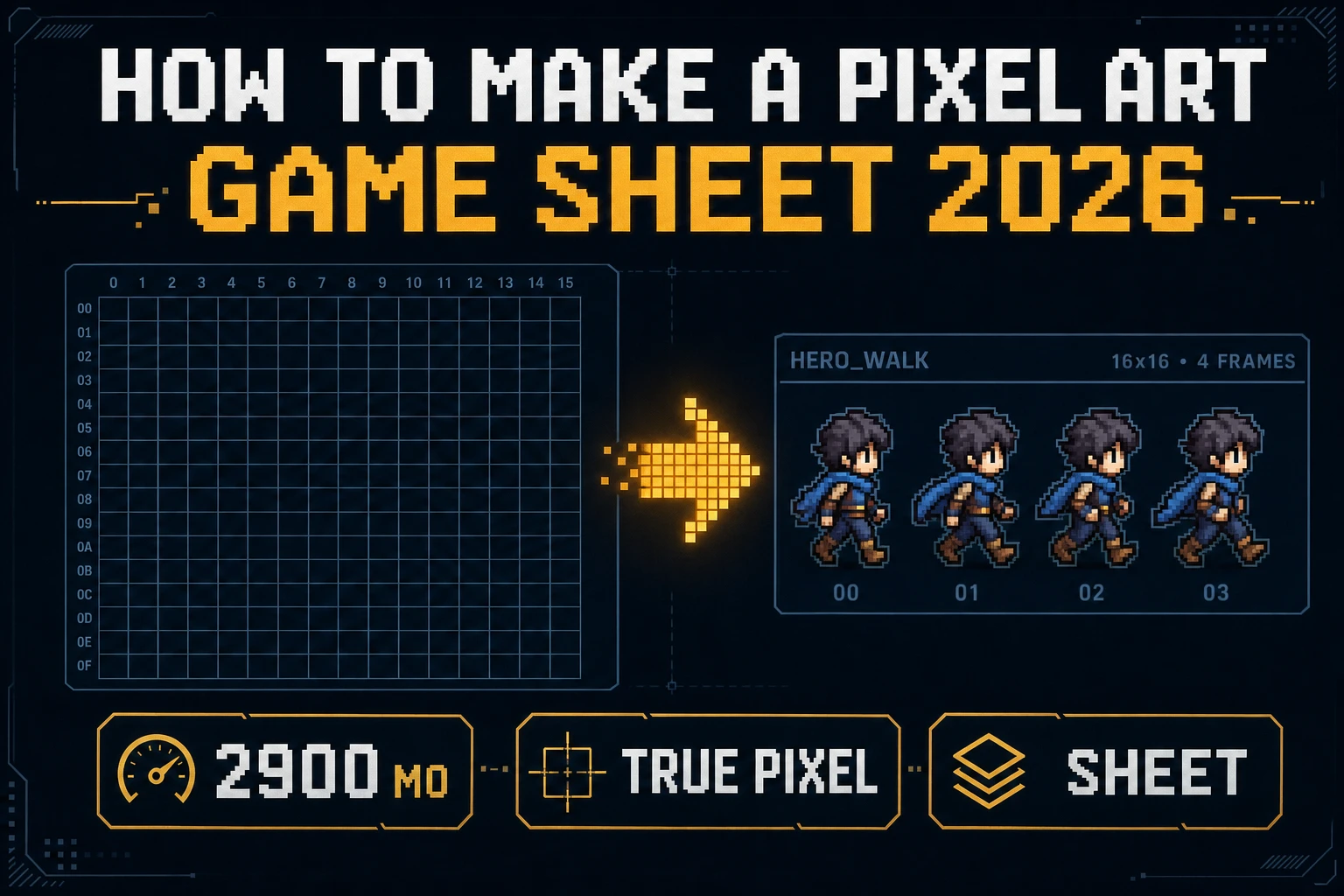
A jam sprite is not a soft illustration scaled down in an image editor. Searchers who type how to make a pixel art want integer cells, a short palette, and a sheet the engine can draw without blur. This guide walks that path on Sorceress: lock the grid in True Pixel, clean edges in Canvas, animate when you need a walk strip, then import with nearest-neighbor scaling.
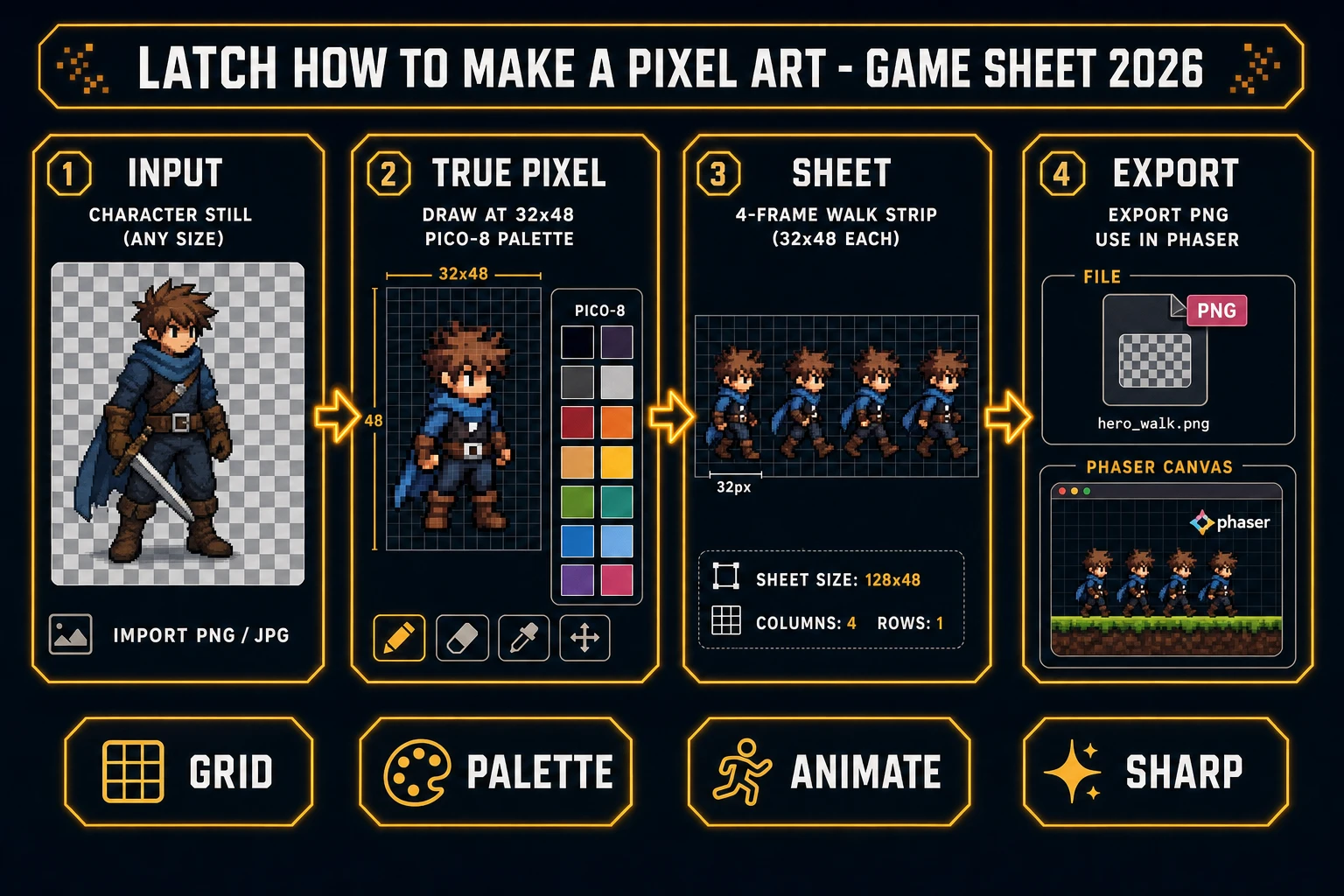
Four-step pipeline for how to make a pixel art game sheet: input still, True Pixel palette lock, walk strip, sharp Phaser export
How to make a pixel art game sheet: lock the grid, pack poses, then export a PNG the engine can scale without blur.

What how to make a pixel art means for games

Pixel art is artwork built at the pixel level. The Wikipedia Pixel art page (verified 2026-09-23) frames it as deliberate placement of individual pixels, not a filtered photo. When you ask how to make a pixel art asset for a game, you are choosing a target width and height, forcing every color onto a limited set, and writing a file whose edges stay hard under nearest-neighbor scale.

That is why how to make a pixel art for games is a different question from painting a concept piece at 4K and hoping the engine will forgive it. Soft gradients and anti-aliased outlines turn to mush the moment a camera zooms. A 48×64 hero with sixteen locked colors reads at walking distance on a phone. A noisy photo crop does not.

People also search pixel art how to make, how to make pixel art games, and how to make pixel art game. Those intents fold into the same pipeline once you decide the cell size: prep the alpha, quantize, pack frames, import with crisp scaling. The sections below stay on that sheet path. If you already have a photographic still and only need a conversion verb, the companion guide on convert an image to pixel art covers that angle. This page is about building a game-ready sheet end to end.

True Pixel: how to make a pixel art sheet from any still

Sorceress True Pixel is the tool that answers how to make a pixel art sprite from an image or video on this site. The Sprites & 2D home card badges it Pro and describes video or image input becoming a pixel-art animated sprite (verified 2026-09-23 in src/app/_home-v2/_data/tools.ts). The live page is /pixel-art.

Facts verified 2026-09-23 in src/app/pixel-art/page.tsx:

  • Eight palette presets: PICO-8 (16), SWEETIE-16, Endesga 32, Game Boy (4), CGA (16), NES (54), Grayscale (8), 1-Bit (2).
  • Three dither modes: none, ordered (Bayer), floyd-steinberg, with an intensity slider when dither is on.
  • Master resolution longest side capped at MASTER_RES_LONGSIDE = 256 before you pick the final export size.
  • Chroma key and Corridor Key background removal sit on the same surface. Cloud Corridor Key costs Math.max(1, Math.ceil(frameCount / 10) * (maxDim > 512 ? 2 : 1)) credits. Local Corridor Key is 0 credits.

A typical how to make a pixel art run for a single pose:

  1. Open True Pixel and drop a PNG or JPG of a single character or prop. Prefer a clear silhouette. Avoid tiny faces buried in a wide landscape crop.
  2. If the backdrop is a flat green or blue plate, enable chroma key and pick the plate color on the preview. If the backdrop is photographic, matte first with BG Remover (3 credits per still, verified 2026-09-23), then upload the transparent PNG.
  3. Pick a palette preset that matches the rest of the game. PICO-8 and SWEETIE-16 read as indie defaults. Game Boy and 1-Bit are for deliberate monochrome. NES is for larger, more colorful sheets.
  4. Set the target width and height to the size you will draw in the engine, not the size of the source. A 48×64 hero is common for side-view jams.
  5. Start with dither none. If gradients band badly, try ordered at a moderate intensity, then floyd-steinberg only if you still need softer steps.
  6. Download the PNG. Open it on a checkerboard. Confirm empty pixels are actually empty before you celebrate.
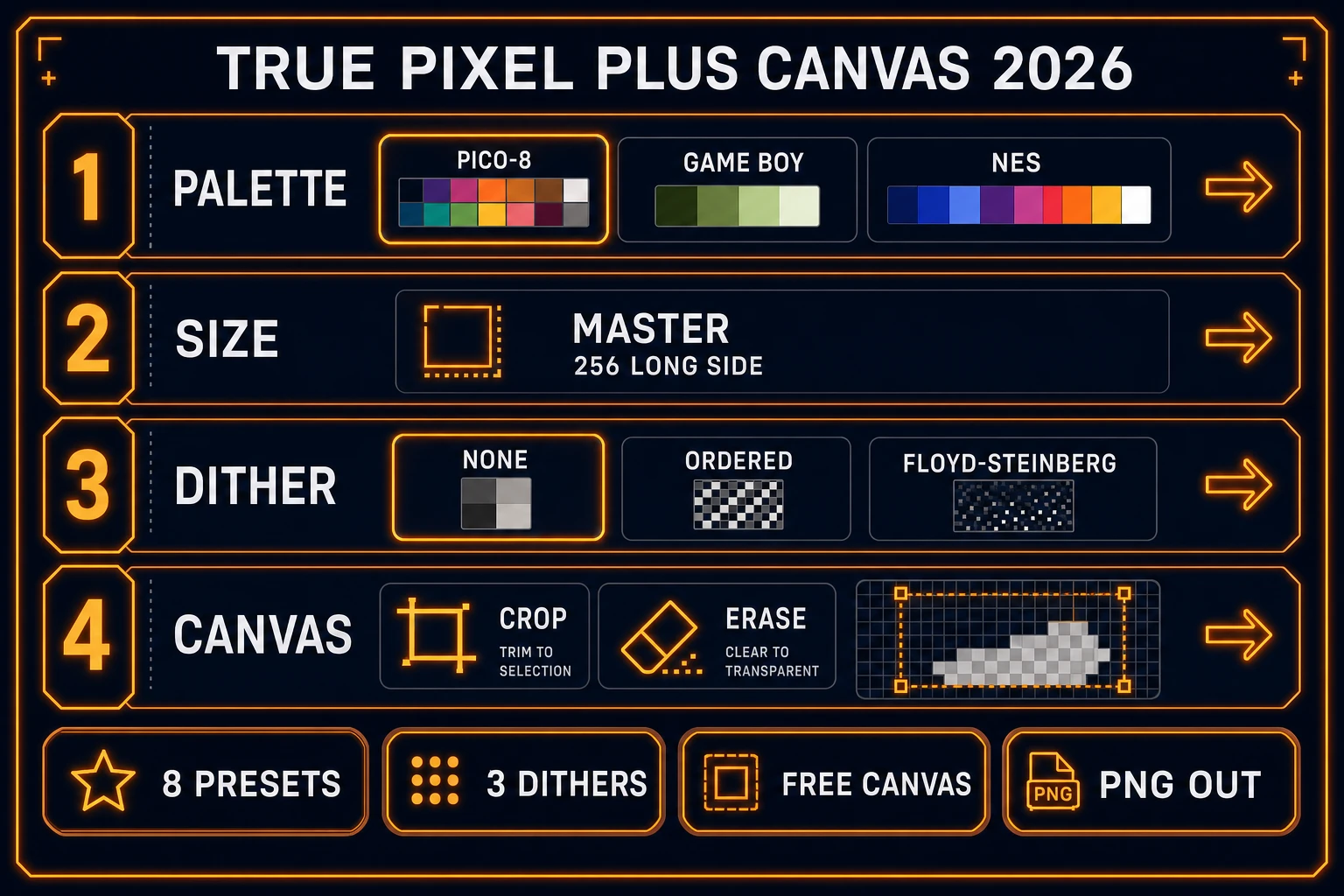
True Pixel and Canvas controls for how to make a pixel art: eight palette presets, three dither modes, master 256 long side, free Canvas crop
Controls that matter when you how to make a pixel art sheet: palette, size, dither, then Canvas cleanup.

Canvas edits before the grid locks

Sorceress Canvas is the Free in-browser editor on the Image Tools row (badge verified 2026-09-23). It is not a second pixel converter. It is where you crop, erase, and fill before True Pixel locks the grid. A noisy margin becomes a ring of junk colors after quantization. A tilted crop becomes a jagged outline you will fight for the rest of the jam.

Use Canvas when:

  • The still has a huge empty margin around a small figure. Crop it so the character fills most of the frame.
  • A matte left a pale halo. Erase the halo. Do not blur it into the hair.
  • A sleeve has a hole. Sample a nearby opaque pixel with the picker and brush it closed.

Then send or re-upload the cleaned still into True Pixel. How to make a pixel art sheet on a messy full-frame screenshot means spending the dither pass fighting the background instead of shaping the character.
Quick Sprites when you need animated frames

One True Pixel pass gives you one pose. A walk cycle needs a strip. Quick Sprites is the AI path for how to make a pixel art animation from a prompt instead of hand-posing every frame. The Sprites & 2D home card badges it AI Credits (verified 2026-09-23). The page bills CREDITS_PER_GEN = 9 credits per generation (verified 2026-09-23 in src/app/quick-sprites/page.tsx).

One built-in style worth knowing for jam heroes: Four Angle Walking — consistent four-direction, four-frame walking animations of humanoid characters at 48×48 only. That size matches a common side-view cell. Prompt for silhouette, outfit, and palette mood. Do not ask the model for soft painterly shading; you want hard edges the sheet can keep.

When to pick which path:

  • True Pixel — you already have a still (AI render, photo, hand draw) and only need palette + size lock.
  • Quick Sprites — you need a multi-frame sheet invented from a prompt and you accept 9 credits per gen.
  • True Pixel video — you have a short clip and want every frame to share the same palette and dither settings.

For atlas layout details beyond this page, see how to make a sprite sheet. For the broader image-to-pixel framing, see Image to Pixel Art in the Browser.

Sheet sizing that survives import

How to make a pixel art sheet that survives an engine import starts with equal cells. Pick one cell size and keep it for every pose in the atlas. Mixing a 32×32 idle with a 48×48 walk forces the loader to stretch one of them. Stretching is where soft edges sneak back in.

Practical rules for jam sheets:

  • Lock cell width and height before you generate the second pose.
  • Leave one or two empty pixels of padding inside the cell so swings do not clip.
  • Keep the feet planted on the same baseline across frames so the walk does not bob.
  • Export PNG with alpha. Do not flatten onto a solid background “for safety.”

If you quantized in True Pixel, re-check that every frame still uses the same palette preset. A mid-jam switch from PICO-8 to NES looks like a lighting bug in playtests even when the silhouette is fine.

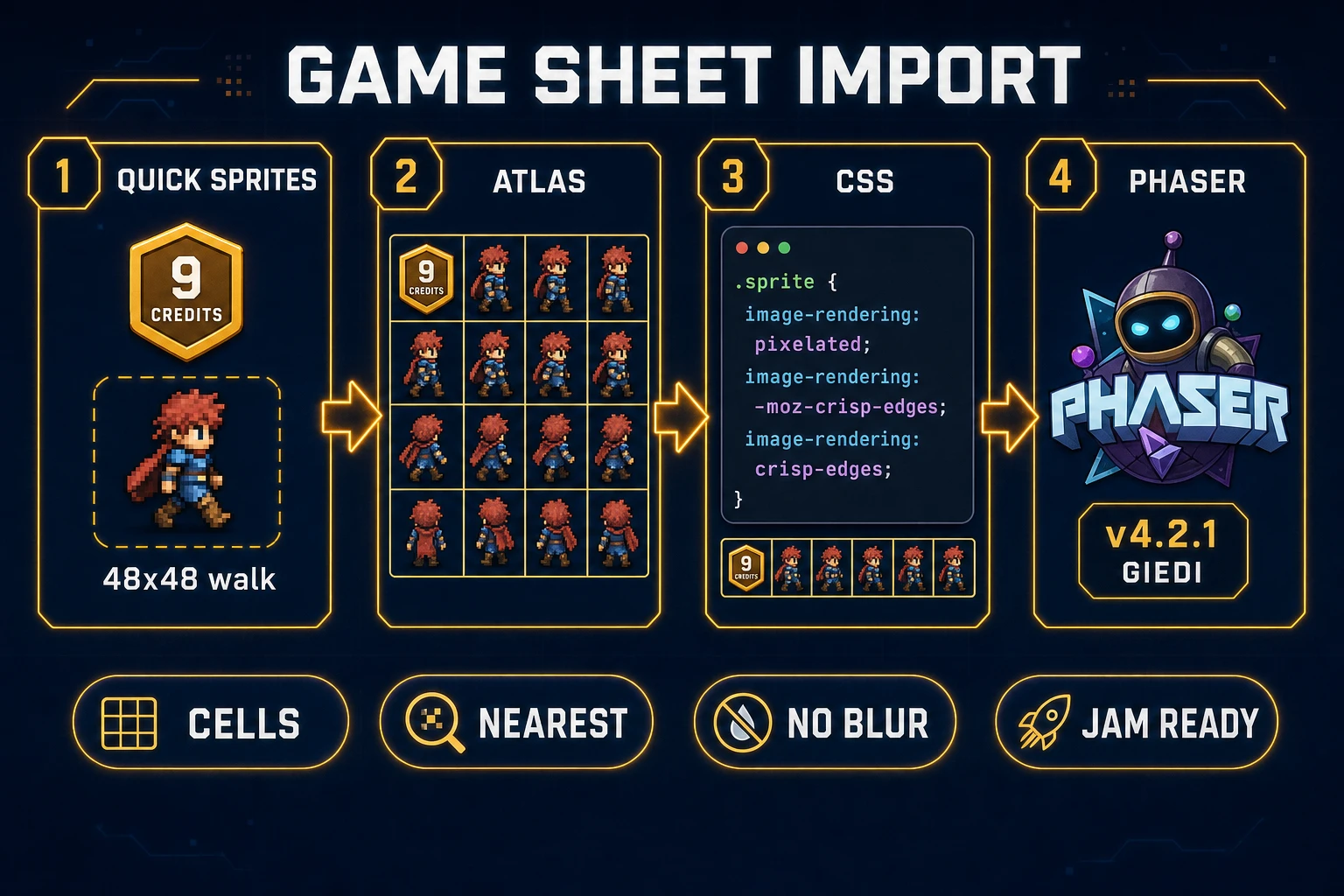
After how to make a pixel art sheet: Quick Sprites walk strip, equal atlas cells, image-rendering pixelated, Phaser 4.2.1 import
After how to make a pixel art sheet: pack equal cells, then keep nearest-neighbor scaling or the grid turns to mush.

Engine import after how to make a pixel art

Export is half the job. Soft scaling undoes a clean how to make a pixel art pass. MDN’s crisp pixel art look article (verified 2026-09-23) shows the CSS fix:

img.sprite,
canvas#game {
  image-rendering: pixelated;
}

The companion image-rendering page (verified 2026-09-23) documents pixelated and crisp-edges. Use integer scale factors when you can. Non-integer device pixel ratios can still look uneven; that is a browser limitation MDN calls out, not a broken PNG.

In canvas code, keep source pixels aligned to canvas pixels. Drawing a 48×64 sprite into a 50×70 destination softens edges even if CSS later says pixelated. Prefer 1:1 draw, then scale the canvas element with CSS.

Browser jam stacks often use Phaser. Phaser v4.2.1 “Giedi” was released 2026-07-09 (verified 2026-09-23 on phaser.io/download/stable). Load the PNG as a texture and disable any texture filtering that bilinear-blurs atlases. If you are vibe-coding the loader, keep the asset path and the pixelated CSS in the same prompt so the agent does not helpfully add smooth scaling.

Verdict: how to make a pixel art sheet in one session

How to make a pixel art game sheet on Sorceress in 2026 is a short loop, not a desktop DCC project:

  1. Decide the cell size first (often 32, 48, or 64 on the long side).
  2. Clean the still in Canvas or matte with BG Remover when the backdrop is photographic.
  3. Quantize in True Pixel with one shared palette and dither setting.
  4. When you need a walk strip from a prompt, run Quick Sprites (9 credits) instead of posing every frame by hand.
  5. Pack equal cells, export PNG with alpha, import with image-rendering: pixelated.

True Pixel stays Pro on the home card; Canvas stays Free; local Corridor Key stays 0 credits; Quick Sprites stays 9 credits per gen — all verified 2026-09-23 against the live source. Open True Pixel, lock the grid, and ship the sheet before the jam clock hits zero.

Frequently Asked Questions

What does how to make a pixel art mean for a game sheet?

How to make a pixel art sheet for a game means building (or remapping) art onto a fixed grid with a short palette, then packing poses into cells the engine can draw. Wikipedia’s Pixel art page (checked 2026-09-23) defines the form as deliberate pixel-level placement. For jams the win is a readable silhouette at 32–64 px, not a filtered photo.

How to make a pixel art sprite without Photoshop?

How to make a pixel art sprite in the browser on Sorceress: open True Pixel at /pixel-art, pick one of eight palette presets (PICO-8, SWEETIE-16, Endesga 32, Game Boy, CGA, NES, Grayscale, 1-Bit), set width and height, choose dither none / ordered / Floyd-Steinberg, and download the PNG. Facts verified 2026-09-23 in src/app/pixel-art/page.tsx.

Is how to make a pixel art free on Sorceress?

The home card badges True Pixel Pro (verified 2026-09-23 in src/app/_home-v2/_data/tools.ts). Palette quantization and dither run in the page. Corridor Key cloud keying bills Math.max(1, Math.ceil(frames/10) * (maxDim > 512 ? 2 : 1)) credits; local Corridor Key is 0 credits. Canvas is Free. Quick Sprites costs 9 credits per generation.

How do I keep pixel art sharp after I how to make a pixel art sheet?

After you how to make a pixel art PNG, scale with nearest-neighbor, not bilinear. MDN’s crisp pixel art guide (verified 2026-09-23) shows image-rendering: pixelated on img and canvas. Phaser v4.2.1 “Giedi” (released 2026-07-09, page checked 2026-09-23) is a common browser engine for that load path.

Should I how to make a pixel art still in True Pixel or use Quick Sprites?

How to make a pixel art still in True Pixel when you already have a pose you want to keep and only need palette + size lock. Use Quick Sprites when you want an AI-generated animated pixel sheet from a prompt (for example Four Angle Walking at 48×48). Quick Sprites is badged AI Credits at 9 credits per gen (verified 2026-09-23).

Sources

  1. Pixel art - Wikipedia
  2. Crisp pixel art look with image-rendering - MDN
  3. CSS image-rendering - MDN
  4. Phaser v4.2.1 Giedi download
Written by Arron R.·1,566 words·7 min read

Related posts