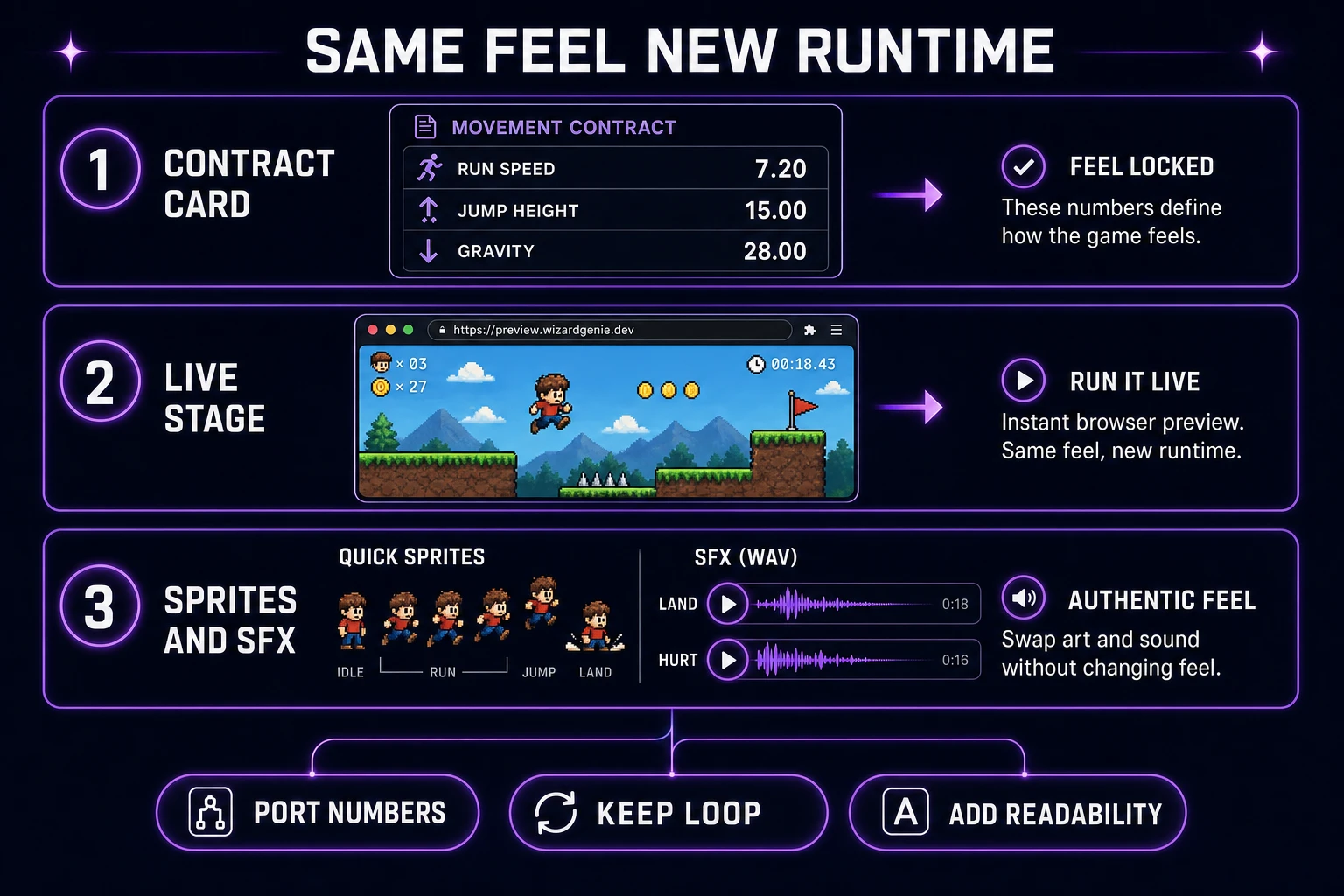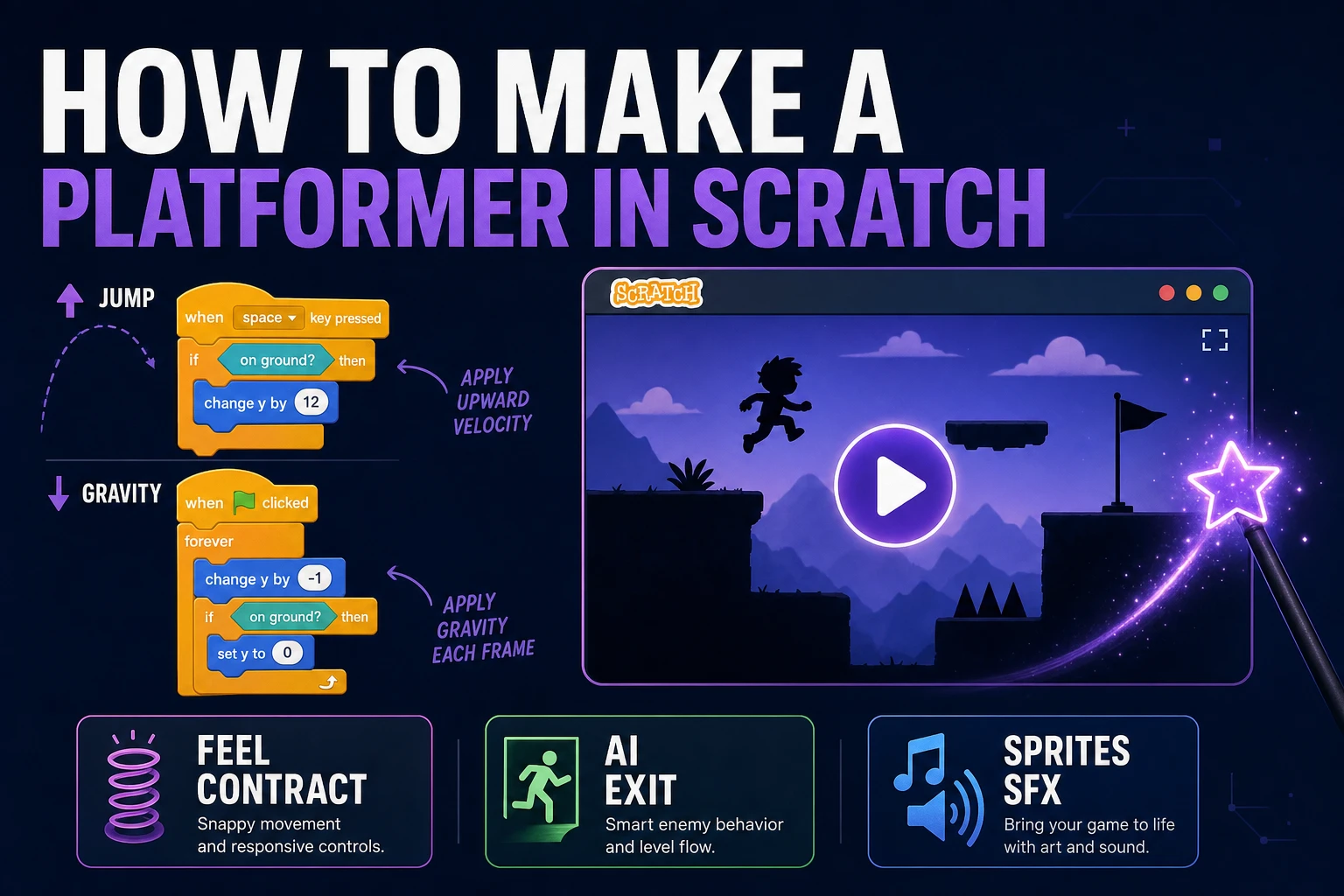
Most Scratch platformers fail on feel, not on missing levels. The jump floats, the ground flag flickers, or death dumps the player into an unclear restart. Start with a smaller contract: fall, stand, jump, die, and respawn on one screen. This guide covers how to make a platformer game in Scratch with separate gravity, ground, and jump scripts, then shows when to port that same contract into a browser build with WizardGenie, Quick Sprites, and SFX Gen. Scratch product facts below were verified against the official About Scratch page on July 21, 2026. Phaser version facts were verified against phaser.io the same day.
What how to make a platformer game in Scratch must teach first
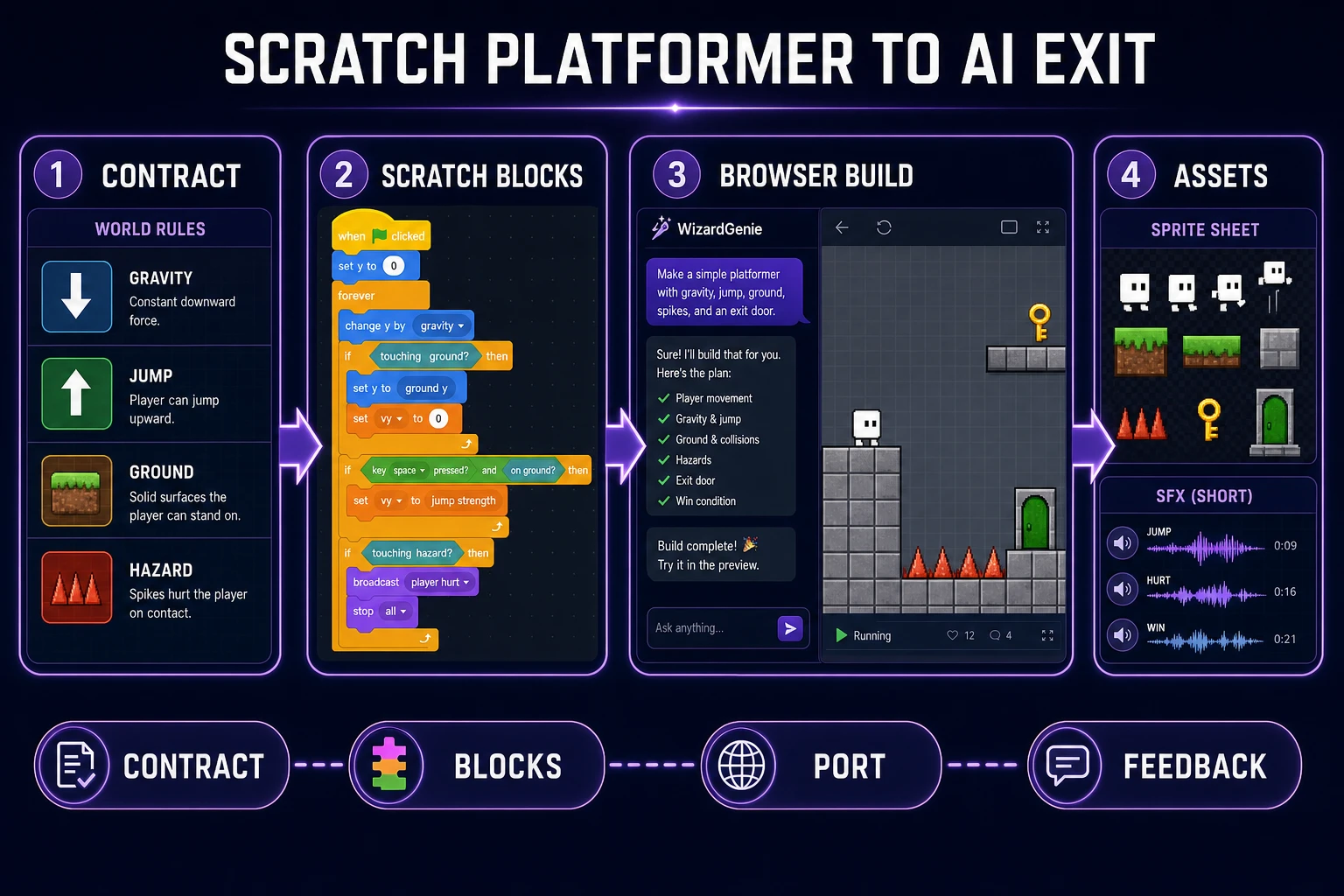
The primary query how to make a platformer game in scratch has 1,900 monthly searches and KD 0 in the DataForSEO-backed research-supplement.md, verified July 21, 2026. Close siblings such as how to make a platformer scratch and how to make a platformer in scratch share the same volume band. Readers typing those phrases usually want block scripts that make a character run and jump on platforms, not a genre essay.
Scratch is a free creative coding environment from the Lifelong Kindergarten Group at the MIT Media Lab, designed especially for ages 8 to 16 and used in more than 150 countries. It is excellent for learning variables, sensing, and forever loops. A platform game is defined by traversal across suspended ground, with jumping as the central skill. For a first Scratch prototype, translate that into six written fields before any fancy costumes:
- Run speed: how many steps per frame while left or right is held.
- Jump impulse: the upward change to the vertical velocity variable when a jump starts.
- Gravity: the downward change applied every frame while airborne.
- Grounded flag: a boolean that becomes true when the feet touch a platform color or sprite.
- Max fall speed: a clamp so long drops stay readable.
- Hazard rule: what kills the player and where respawn restores control.
If you cannot fill that card, keep designing. A project that only says “make a fun platformer” will invent a different jump on every remix.
Build gravity, ground, and jump as separate scripts
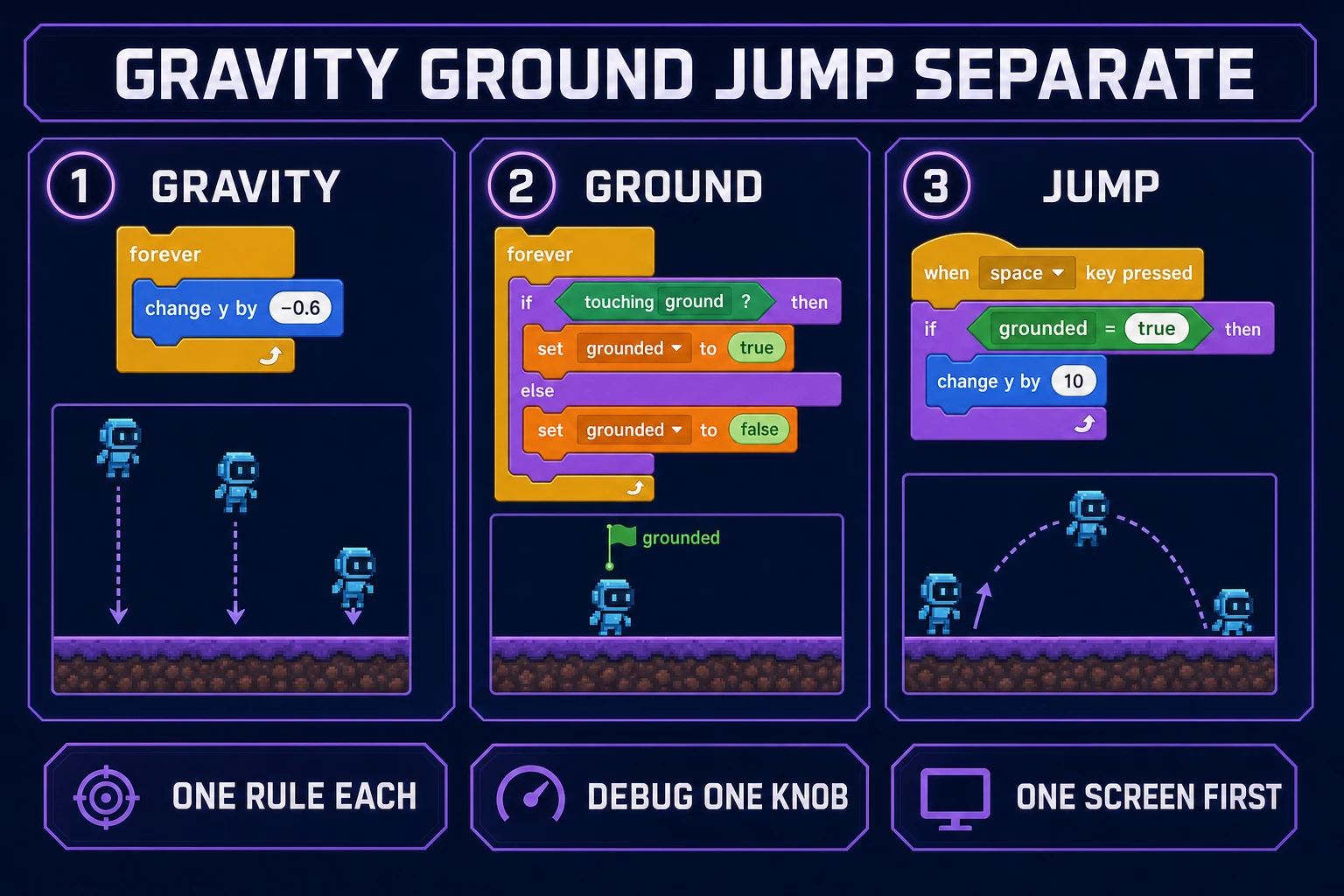
The core mistake in how to make a platformer game in Scratch is stuffing move, fall, and jump into one forever stack. Split them so each forever loop owns one rule.
Gravity script: if not grounded, change vy by a small positive amount (down), clamp to max fall speed, then change y by vy. Do not apply gravity while grounded or the character will vibrate into the floor.
Ground script: sense the platform with color touching or sprite touching under the feet. When contact is true, set grounded to true, set vy to 0, and snap y up a pixel so the costume does not sink. When contact is false, set grounded to false. Keep the sensing hitbox at the feet, not the whole costume, or hair pixels will count as ground.
Jump script: when the jump key is pressed and grounded is true, set vy to a negative impulse. Optional coyote time: keep a short timer after leaving a ledge during which jump still works. Optional jump buffer: remember a premature press for a few frames and fire on the next grounded edge.
Horizontal move stays in a fourth forever loop: if right arrow, change x by run speed; if left, change x by negative run speed. Wall bumps can use the same color sensing as floors, but finish floor feel before wall slides.
Add scrolling and simple hazards
Only after a five-minute playtest on a fixed stage should you add scroll. A practical Scratch pattern is to move the backdrop or platform sprites opposite the player once the player crosses a screen center threshold. Keep the player’s on-stage x mostly stable while the world slides. If both player and world move freely, camera math will fight your ground sensing.
Hazards should be boring and reliable. Spikes or pits set a hurt state, disable controls briefly, play a short sound later, and go to a spawn x/y. Do not rebuild the entire stage on every death unless you are intentionally testing costume load. A respawn that reallocates platforms will hide collision bugs behind loading noise.
Enemy patrols can wait. A moving platform is enough stress for the second lesson: grounded must stay true while riding, and leaving the platform edge must clear grounded cleanly. If the player sticks to the side of a platform, shrink the side hit test or only accept ground when the feet are above the platform top.