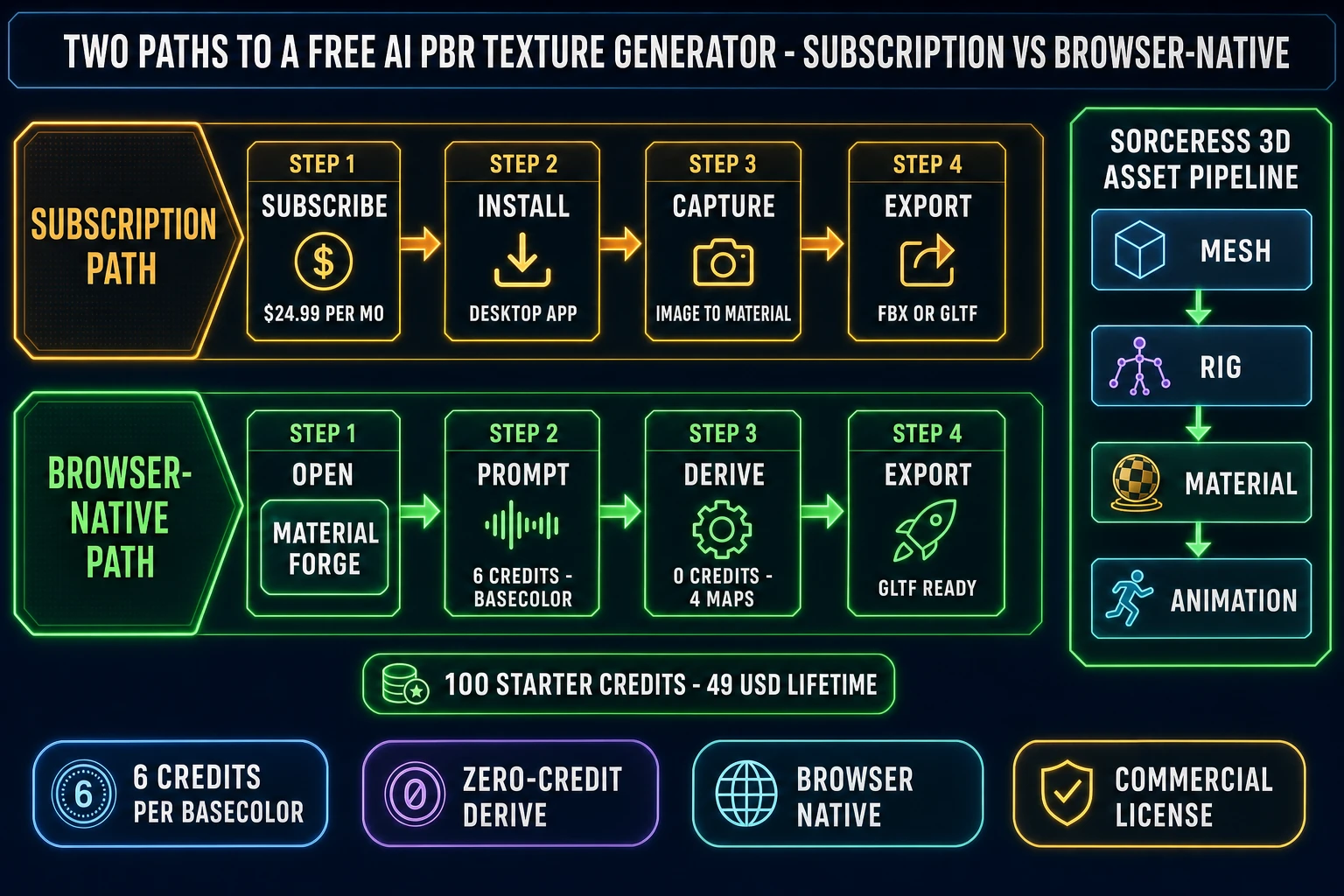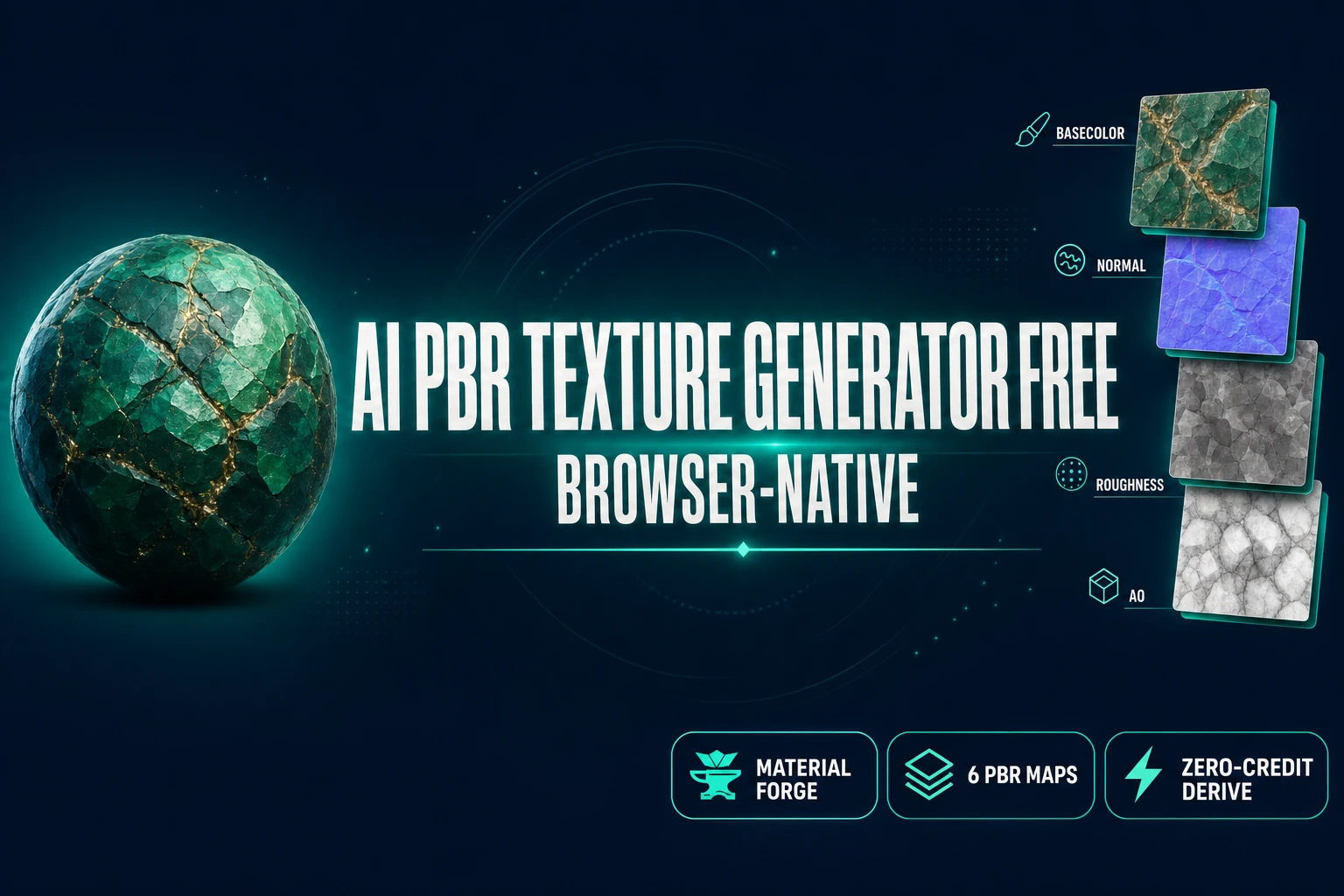
An AI PBR texture generator free of monthly subscriptions has finally landed in 2026 — a browser tab, a text prompt or a reference image, and a complete six-map physically-based-rendering material exits ready for Three.js, Godot, Unity, or Unreal. The category that used to live exclusively inside $59.99-per-month Adobe Substance 3D licenses now runs on three free or near-free rails: Sorceress Material Forge for image-to-material with an algorithmic derive pass, Polycam’s standalone web texture generator for tileable preview maps, and the open-source Material Maker for procedural node-graph authoring. This guide rates the honest 2026 free landscape and walks the Material Forge zero-credit derive path step-by-step, with every credit cost and price verified against the live source on June 15, 2026.
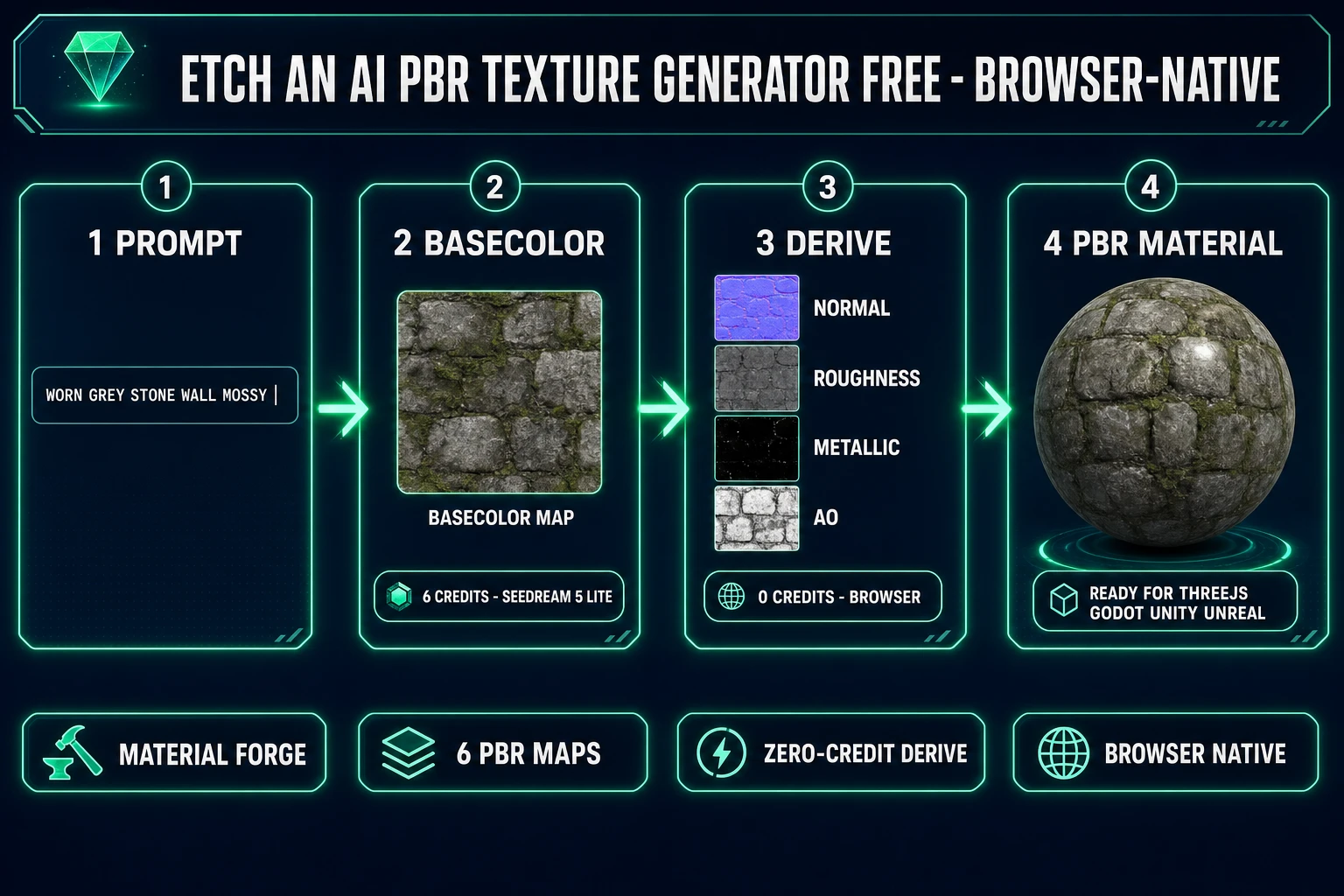
src/lib/material-forge/derive-maps.ts on June 15, 2026.What an AI PBR texture generator free of subscriptions actually delivers in 2026
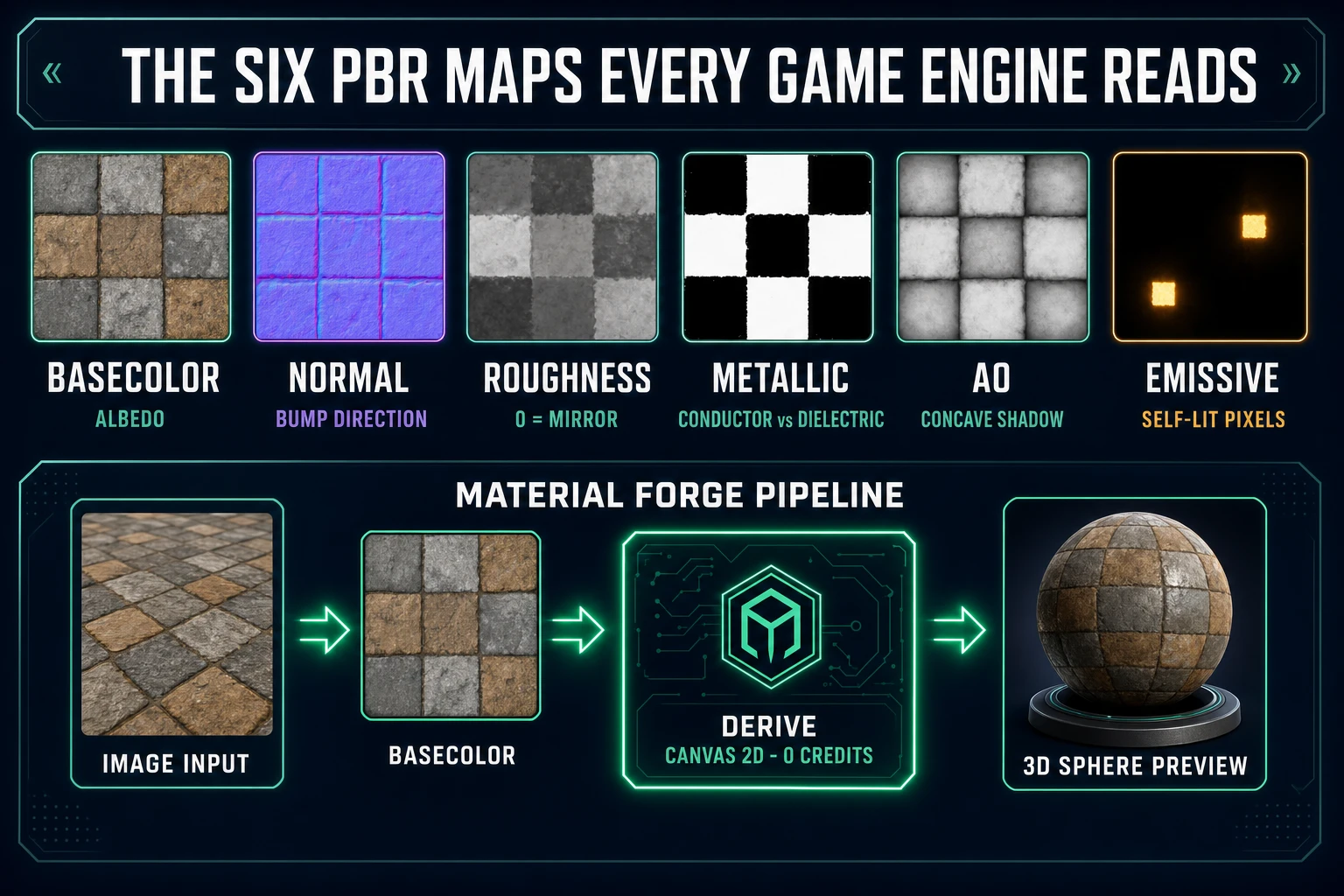
The category covers any tool that takes a text prompt or a single reference image and outputs the multi-map texture stack a modern game engine reads as a physically-based-rendering material. The technical primitive is a five-to-six-channel texture mapping bundle: BaseColor (the surface albedo, or albedo), Normal (the micro-detail bump direction encoded via normal mapping), Roughness (how scattered light reflection is), Metallic (conductor versus dielectric), Ambient Occlusion (the soft self-shadow in concave details), and optionally Emissive (which pixels glow on their own).
For an indie game team, the practical impact is brutal arithmetic. A 40-material PBR pack — the rough minimum for a small first-person or top-down build — previously meant either a $24.99-per-month Adobe Substance 3D Texturing subscription (verified blog.adobe.com June 15, 2026) or four-to-eight hours of manual map authoring per material in Substance Designer’s node graph. The same 40-material pack through an AI PBR texture generator free of subscriptions costs about 240 Sorceress credits on the cheapest Seedream 5 Lite model (about $2.40 on the $10 Starter pack), renders in under an hour of prompt iteration, and the four supporting maps derive in the browser at zero additional cost.
The honest 2026 baseline: Sorceress Material Forge ships 100 starter credits at sign-up (roughly 16 BaseColor generations on the 6-credit Seedream 5 Lite model), runs every texture through any of seven IMAGE_MODELS verified against src/app/_home-v2/_data/tools.ts on June 15, 2026, and ships a zero-credit algorithmic derive pass per src/lib/material-forge/derive-maps.ts that produces Normal, Roughness, AO, Metallic, and Emissive maps from a single BaseColor input. The $49 Lifetime tier at /plans unlocks every non-AI-generative capability permanently.
The six PBR maps every game engine reads (and what each one does)
Before picking an AI PBR texture generator free of subscriptions, decide what kind of maps you need. The PBR material model splits cleanly into six texture channels, and the bidirectional reflectance distribution function that every modern game engine implements reads each one for a specific visual effect:
- BaseColor map (also called Albedo). The actual color of the surface under neutral, flat light. The single map every PBR pipeline absolutely requires — the four-to-five supporting maps can be derived from it, but the BaseColor itself must be authored or generated. Sorceress Material Forge stores this in
MaterialTextures.baseColorMapverified againstsrc/lib/material-forge/types.tson June 15, 2026. - Normal map. The surface micro-detail encoded as RGB normals that fakes geometric depth without polygons. A flat plane with a brick-wall normal map looks like real bricks under in-engine light because the normals tilt the shading at every pixel. Material Forge derives this from luminance gradients with a default strength of 0.8 per
DEFAULT_DERIVE_SETTINGS. - Roughness map. How scattered light reflection is on a per-pixel basis. 0 equals a perfect mirror; 1 equals matte chalk. Most natural surfaces sit between 0.4 and 0.85. Material Forge derives this from luminance contrast inversion with a default bias of 0.5 and contrast of 0.5.
- Metallic map. Whether a pixel is a conductor (true metal like steel, copper, gold) or a dielectric (everything else: wood, stone, plastic, fabric, skin). Near-binary in real PBR — pixels are almost always 0 or 1. Material Forge derives this from threshold detection at default 0.8, with derivation off by default.
- Ambient Occlusion map (AO). The soft self-shadow in concave surface details, baked once at material-author time so the in-engine renderer does not have to compute it per frame. Ambient occlusion is what makes the mortar between bricks look recessed. Material Forge derives this from local luminance averaging at default strength 1.0, radius 4 pixels.
- Emissive map. Which pixels glow on their own — runes, screens, lava, neon signs, fireflies. Off by default in most authoring tools because most materials are non-emissive. Material Forge derives this from bright-pixel thresholding at default 0.85, intensity 1.0, with derivation off by default.
The honest production rule: a complete PBR material for a 2026 game engine needs BaseColor plus at minimum Normal and Roughness. AO and Metallic are strongly recommended. Emissive is optional and material-specific. The glTF 2.0 standard that every modern web and game engine implements packs Roughness and Metallic into a single combined map for shipping efficiency, but the authoring tool can still expose them separately during the design pass.
The 2026 free landscape — an honest read on Polycam, Material Maker, and Substance Sampler
Free is a slippery word in this category, and the three contenders most indie teams compare have three different shapes of free, each with a different catch.
- Polycam AI Texture Generator. Free in-browser tool at
poly.cam/tools/ai-texture-generator, watermark-free, royalty-free commercial license with no required attribution, generates albedo plus normal plus roughness plus displacement maps, up to four seamlessly tileable variants per prompt, verified against the Polycam tool page and third-party listings on June 15, 2026. The catch: per the livepoly.cam/pricingpage verified June 15, 2026, the Free plan only allows AI-texture previews; full-resolution texture downloads require the Basic plan at $12.50 per month billed annually. The standalone AI-texture-generator tool URL has historically allowed direct downloads, but the official pricing page is the source of truth on what the Free tier guarantees today. - Material Maker (open-source). Fully free, MIT-licensed, latest stable release v1.6 from April 18, 2026, built on the Godot engine, 200+ procedural nodes, basic glTF PBR export added in v1.6, verified against the official GitHub release tag on June 14, 2026. The catch: Material Maker is procedural, not AI — you build materials by wiring node graphs (noise, gradient, warp, blend) rather than prompting. The learning curve is real (12-to-20 hours to get fluent), and the output style skews toward stylised, abstract, or geometric materials rather than photoreal organic surfaces. It is a strict superset of free, but it is not an AI PBR texture generator in the prompt-to-pixel sense.
- Adobe Substance 3D Sampler. No longer subscription-free — the perpetual license was discontinued in January 2024 and the cheapest path is the 30-day free trial bundled with the $24.99-per-month Substance 3D Texturing plan or the $59.99-per-month Substance 3D Collection plan (verified blog.adobe.com and adobe.com plan modal on June 15, 2026; March 2025 price increase reflects unmetered access to Substance 3D Assets and is the first Texturing price adjustment since 2015). The Texturing plan includes 25 monthly generative credits and 100GB cloud storage. The Image-to-Texture, Text-to-Texture, and Text-to-Pattern AI features inside Sampler 4.4 remain labeled beta. The catch: real free is 30 days, not forever.
- Sorceress Material Forge. 100 starter credits at sign-up (about 16 BaseColor generations on the 6-credit Seedream 5 Lite model), 6 to 18 credits per BaseColor generation depending on the IMAGE_MODELS pick verified against
src/app/_home-v2/_data/tools.tson June 15, 2026, zero-credit algorithmic derive pass for the four-to-five supporting maps persrc/lib/material-forge/derive-maps.ts, full commercial license on the starter allowance and on every paid tier, output drops directly into 3D Studio for mesh-and-material binding. Verified againstsrc/app/material-forge/page.tsxon June 15, 2026.
The honest 2026 stack for an indie game shipping commercial: start at the Sorceress 100-credit allowance to author roughly 16 BaseColor materials and derive every supporting map for free, supplement with Polycam’s free in-browser tool for stylized tileable level-art backgrounds, and pull in Material Maker only when a material needs the kind of procedural-control surface (parameterised brick offset, controllable noise frequency, ramp-driven color) that a node graph delivers and a prompt cannot. A sister Sorceress walkthrough covers the head Material Forge pipeline in more depth: the photo-to-PBR walkthrough from May 9 documents the original image-to-material flow end to end.
src/lib/material-forge/derive-maps.ts on June 15, 2026.