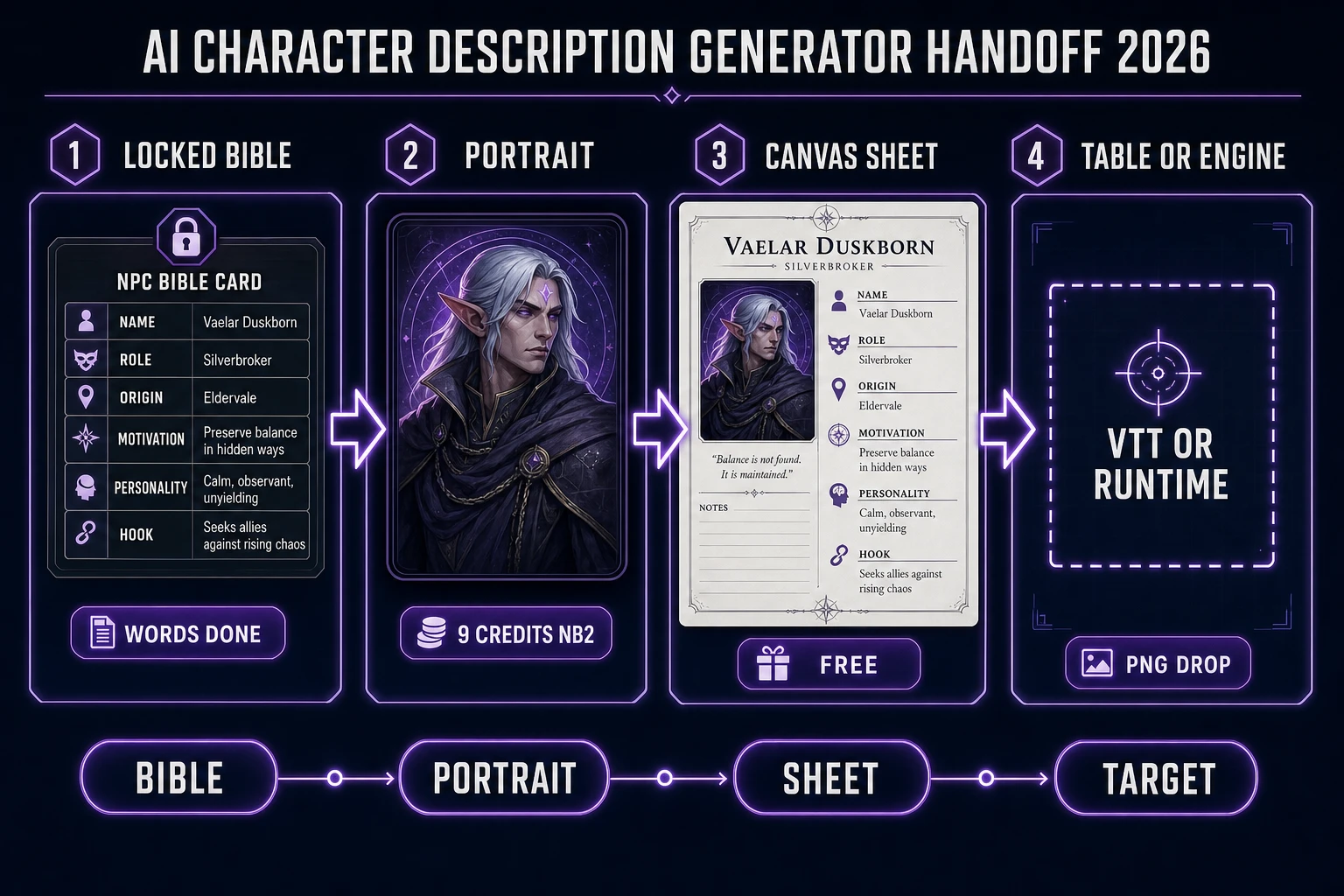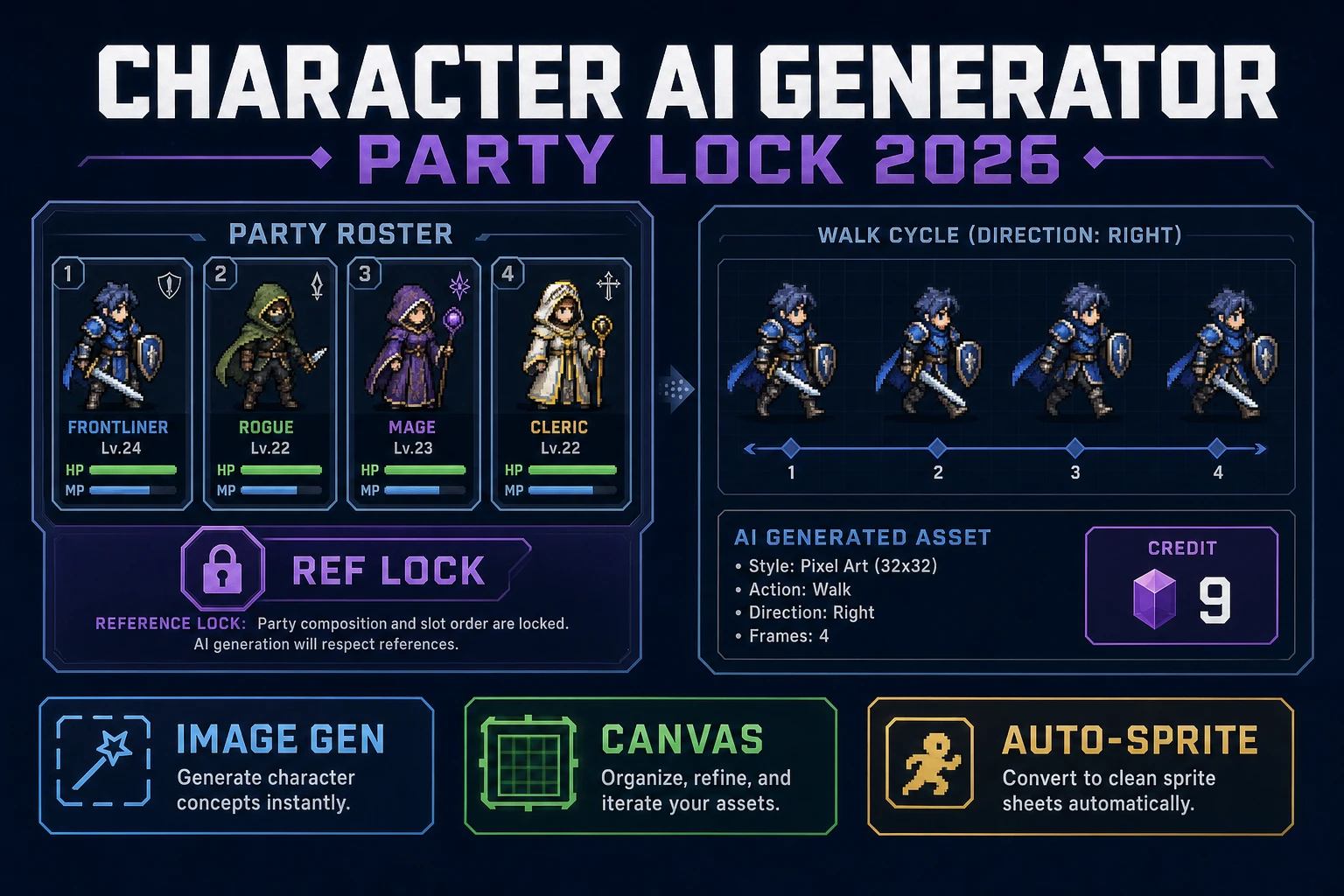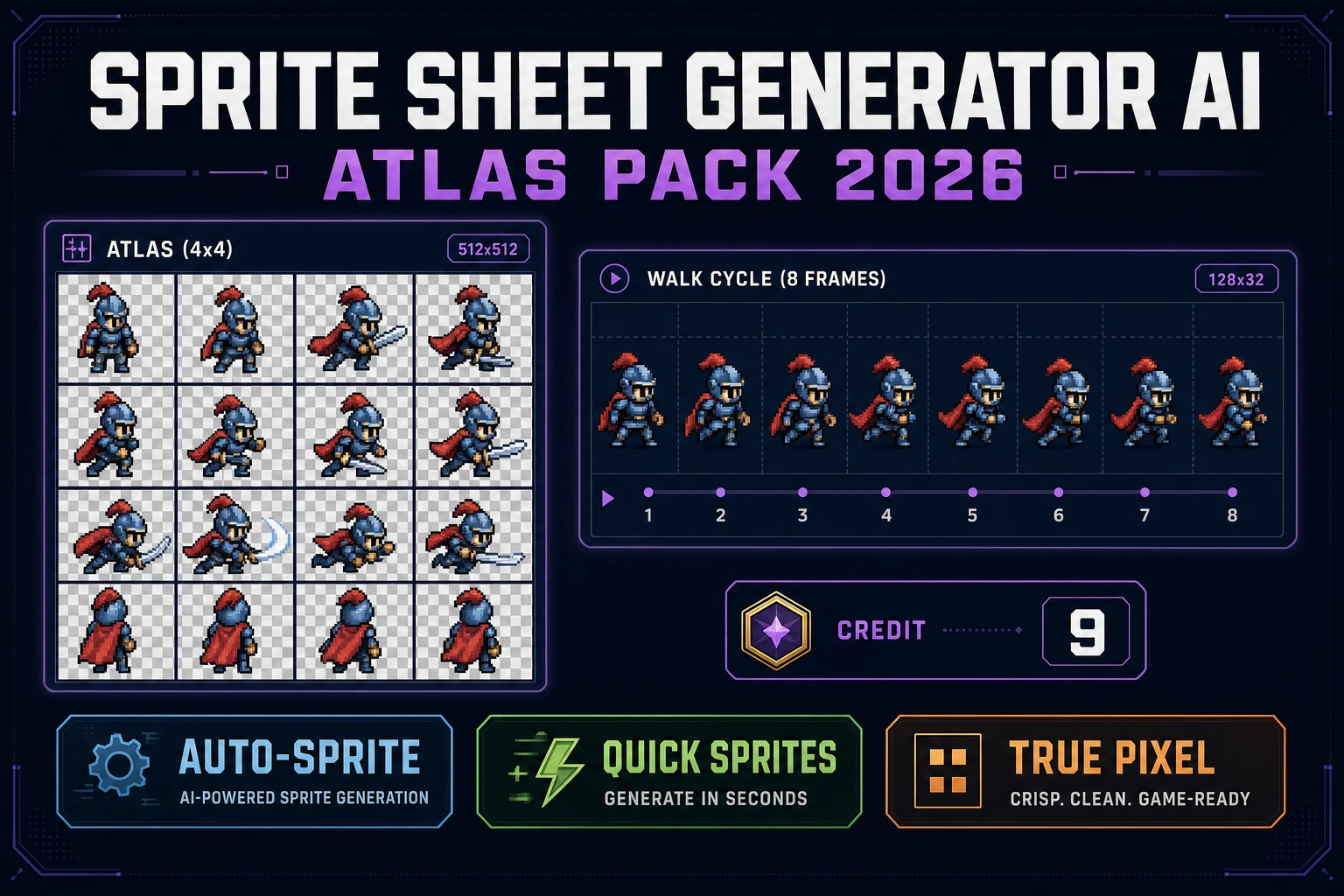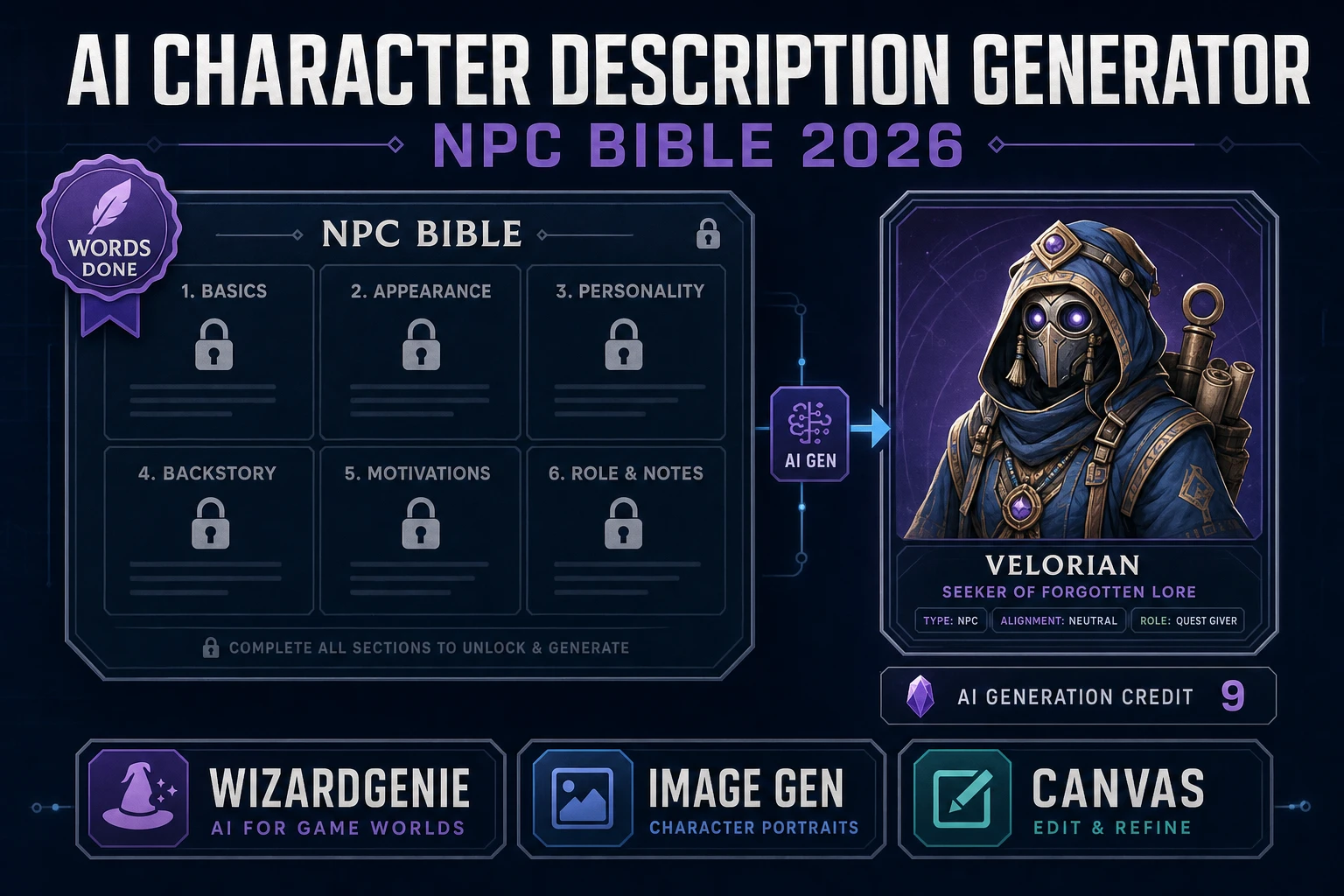
People who type ai character description generator into a search box in 2026 usually already have a face in mind — they need the words behind it. A merchant needs a shop, a temper, a rumor, and a five-line hook a party can push against. A quest-giver needs a wound, a debt, and a lie. That is a bible, not a portrait. This page treats the query as a text-first shipping problem: what the search actually wants, how WizardGenie drafts the party bible in a dual-agent pass, how Sorceress AI Image Gen stamps the portrait after the words are locked, and how free Canvas lands the whole sheet on one page. Every credit and every model claim in this piece was checked against the local source on 2026-09-29.
What an ai character description generator search actually wants
DataForSEO lists ai character description generator at 1,600 searches a month with KD 0 and competition 0.03 (confirmed in tools/research-supplement.md, verified 2026-09-29 pull). Intent is informational, not transactional — the searcher is looking for a workflow that produces usable prose, not a purchase page. The sister phrase character ai generator sits at 880/mo but skews toward the Character.AI chatbot brand and toward portrait-first game queries. This page is aimed at the writer sitting between those two lanes: someone who needs description text, wants it consistent across a whole cast, and would prefer a portrait to stamp on the sheet at the end.
Wikipedia’s non-player character article (verified 2026-09-29) frames the job cleanly: NPCs fill any role not occupied by a player character — allies, bystanders, competitors, quest-givers, shopkeepers, monsters. Some are only a brief description (“You see a man in a corner of the tavern”); others need complete game statistics and backstories. An ai character description generator that only writes one-liners is fine for tavern extras. A generator for named cast — the wizard who has actually lost something, the merchant with a debt — needs full backstories that stay consistent across sessions.
Wikipedia’s backstory entry (verified 2026-09-29) is blunt about the mechanics: a backstory is the set of events leading up to the main plot, often used to lend depth or believability to the main story, and it is revealed through flashbacks, dialogue, direct narration, summary, or recollection. All five reveal-modes are gameplay events. If the description is only a personality adjective and a hair color, the player has nothing to bump into during the session. The generator has to output cause-and-effect the game can actually surface.
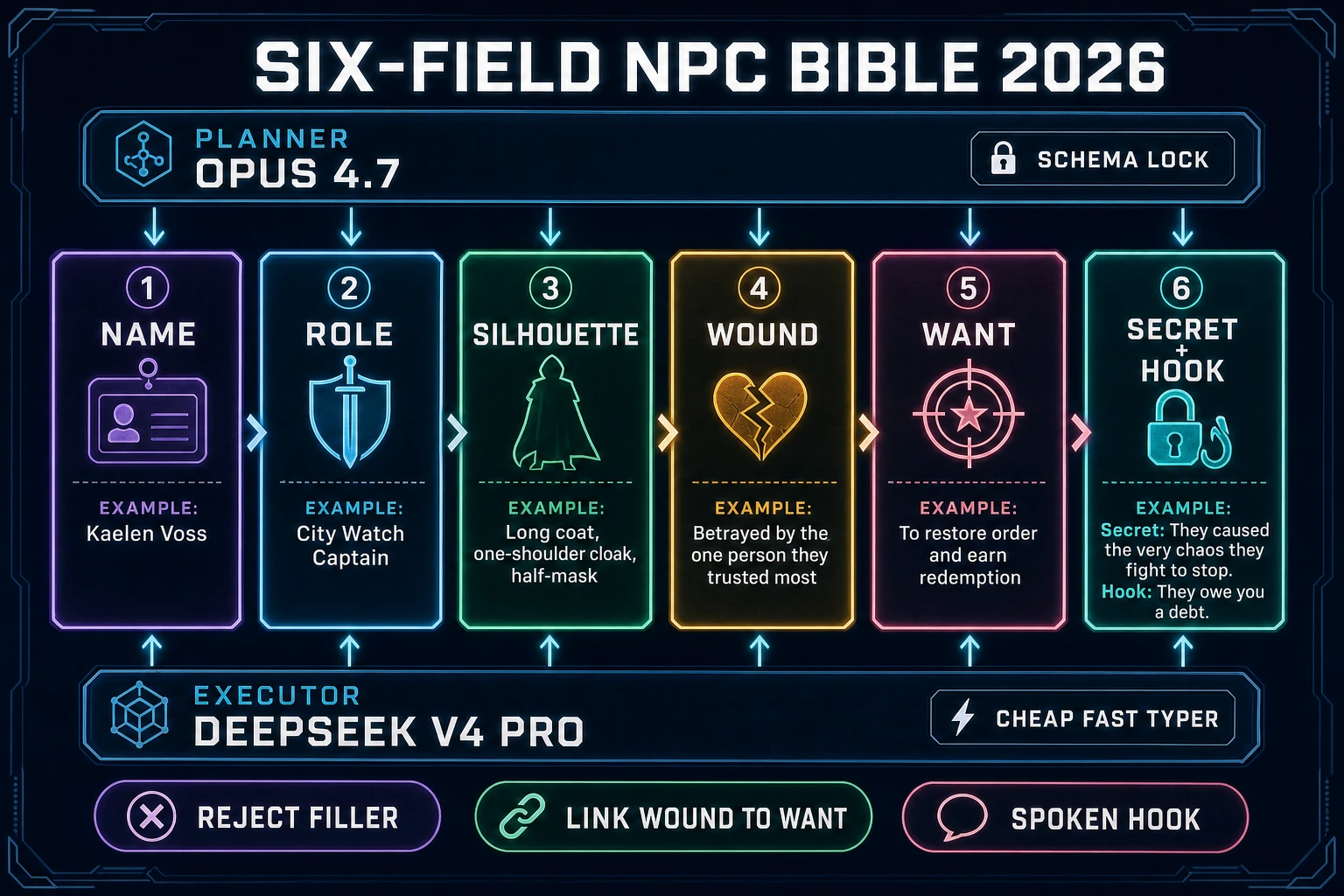
Wikipedia’s character sheet entry (verified 2026-09-29) notes that the gamemaster may keep proper sheets for NPCs, and some rulebooks ship dedicated “NPC sheets” that are smaller than the main player-facing ones. That is the shape we are targeting: not a full stat block, but a repeatable one-page bible per NPC — face, role, wound, want, secret, hook. Small enough to fit on a card. Rich enough to run.
Description first, portrait second
The temptation with any modern generator is to jump straight to the image model, generate twenty faces, and pick a favorite. For NPCs, that is the wrong order. A portrait tells you what a character looks like; a bible tells you what they want. Ship the words first, and the portrait becomes a coloring job. Ship the portrait first, and you spend the next hour retrofitting a personality onto a face that does not have room for it.
Practical shape of a text-first NPC bible for a game or tabletop cast:
- Role — what the party needs this NPC to be in the story (quest-giver, gatekeeper, rival, mentor, foil). Not the vibe; the function.
- Silhouette — one shape word plus one prop word. “Hunched apothecary with a strap of glass vials.” The image model reuses this later; the writer needs it now for tags and voice.
- Wound — one concrete past event that still hurts. Not “trauma”; a specific loss with a date or place.
- Want — one active goal the NPC would pay the party to help with, or would resist the party over.
- Secret — one fact the NPC is currently hiding, with a tell.
- Hook — the exact line the NPC delivers when the party first meets them. Not a summary of the line — the line.
Six fields. No adjectives that could describe anyone. If the generator returns “brave, clever, mysterious,” reject the row and re-prompt. The whole point of an ai character description generator worth using is that its output cannot be swapped between characters without noticing.
WizardGenie as the text engine
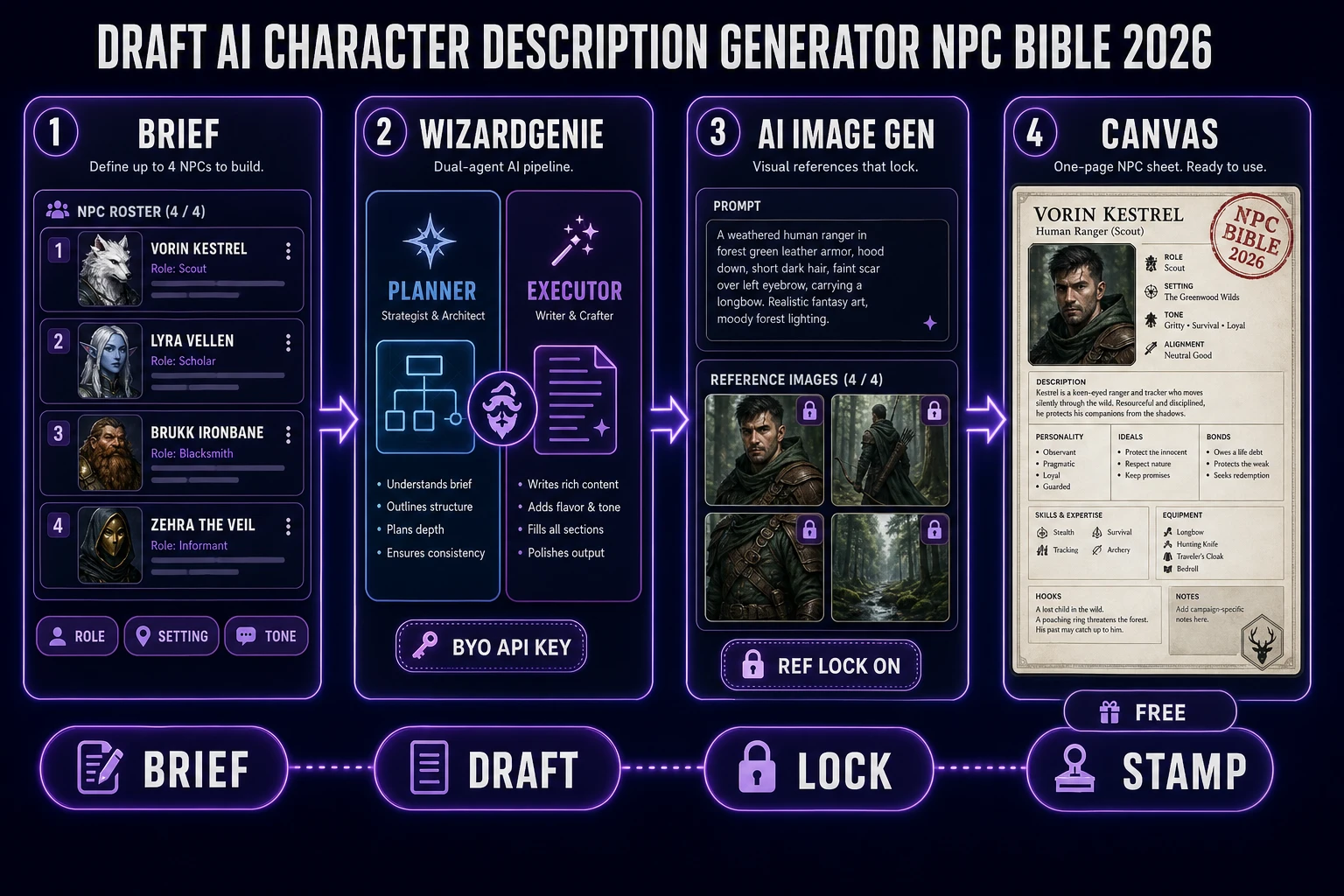
WizardGenie is the featured tool for the description step. The card tagline is “AI-powered game engine” — the tools catalog describes it as a browser-embedded engine that lets you describe a game and iterate on it in real time, and it drives every leading AI coding model (Claude Opus 4.7, GPT-5.5, Gemini 3.1 Pro, DeepSeek V4 Pro, Kimi K2.5, Grok 4.2, MiniMax M2.7) with a bring-your-own-API-key path or a fallback trial key. The property that matters for an ai character description generator brief is that the same agent surface that writes gameplay code will happily write structured NPC bibles when you hand it a template.
The way to get repeatable text from WG is the Planner + Executor pattern: an expensive reasoner writes the bible outline (six fields, one paragraph each), and a cheap fast typer expands each field into prose against the outline. Acceptable Planners are frontier reasoners — Claude Opus 4.7, GPT-5.5, Gemini 3.1 Pro, Grok 4.2. Acceptable Executors are cheap models with real context — DeepSeek V4 Pro, Kimi K2.5, MiniMax M2.7, Gemini 3.1 Flash, GPT-5.5 Mini. The economic logic is “expensive reasoner thinks, cheap fast typer executes.” Never put a frontier-priced model on the typing side — the pattern only earns its cost when the executor is actually cheap.
WG runs on both desktop and web. The web entry point is /wizard-genie/app; the desktop side is a Windows installer with native filesystem access and longer-running sessions. Pick whichever matches your habit — the bible template runs the same on both. Related Sorceress angles already on the blog: vibe coding with Claude for the coding-side of the dual-agent pattern, and character AI generator party lock for the portrait-first sibling of this brief.
A six-field NPC bible template you can paste today
Hand the Planner a system prompt that pins the shape. Keep the exact wording of the six fields — the value of the template is that every NPC comes back on the same schema.
You are drafting an NPC bible for a game party.
Return exactly one NPC per response, on this schema:

NAME:      <proper name, 1-3 words>
ROLE:      <story function, 1 sentence>
SILHOUETTE:<shape + prop, 1 sentence>
WOUND:     <one past loss, with place or date, 1 sentence>
WANT:      <current active goal, 1 sentence>
SECRET:    <hidden fact + tell, 1 sentence>
HOOK:      <first line the NPC actually says>

Rules:
- No adjectives that could describe another NPC.
- No 'brave', 'clever', 'mysterious', 'trauma', 'dark past'.
- The WANT must be something the party can help with or resist.
- The HOOK is a spoken line, in quotes, not a summary.
Then feed the Executor one line per NPC: “Draft one NPC. Setting: pirate free-port. Role: harbormaster who owes money to a cult.” The Planner keeps the schema honest; the Executor writes fast prose. Six-field bibles at that shape take a couple of seconds each on a modern executor and read as if the writer knew the world.
Guardrails to keep the ai character description generator loop honest:
- Reject any NPC whose WOUND and WANT are not causally linked. If the harbormaster’s wound is a lost sister and the want is “better ledgers,” the row is filler. Re-prompt.
- Reject any HOOK that is a paraphrase instead of a spoken line. The party needs the line to react to; a summary is authorial, not diegetic.
- Cap the party at four to six named NPCs per bible pass. Human working memory is small; a cast the writer cannot recall by name will not stay consistent across sessions either.
- Save the raw output as flat markdown or JSON, one file per NPC, named after the SILHOUETTE phrase —
hunched_apothecary_glass_vials.mdbeatsnpc07_final_v2.mdevery time.