Most first platformers fail on feel, not on missing levels. The jump hangs, the ledge forgives nothing, or death dumps the player into an unclear restart. Start with a smaller contract: run, jump, collide, die, and respawn on one screen. This guide turns that contract into a browser build with WizardGenie, then makes the loop readable with Quick Sprites and SFX Gen. Phaser version facts below were verified against the official Phaser download page on July 20, 2026. WizardGenie and asset-tool behavior were checked against the Sorceress source the same day.
What how to make a platformer must define first
The primary query how to make a platformer has 320 monthly searches and KD 0 in the DataForSEO-backed research-supplement.md, verified July 20, 2026. Its natural sibling how to make a platformer game shares the same volume and difficulty. Readers typing those phrases usually want a playable side-view mover with jumps, not a genre essay.
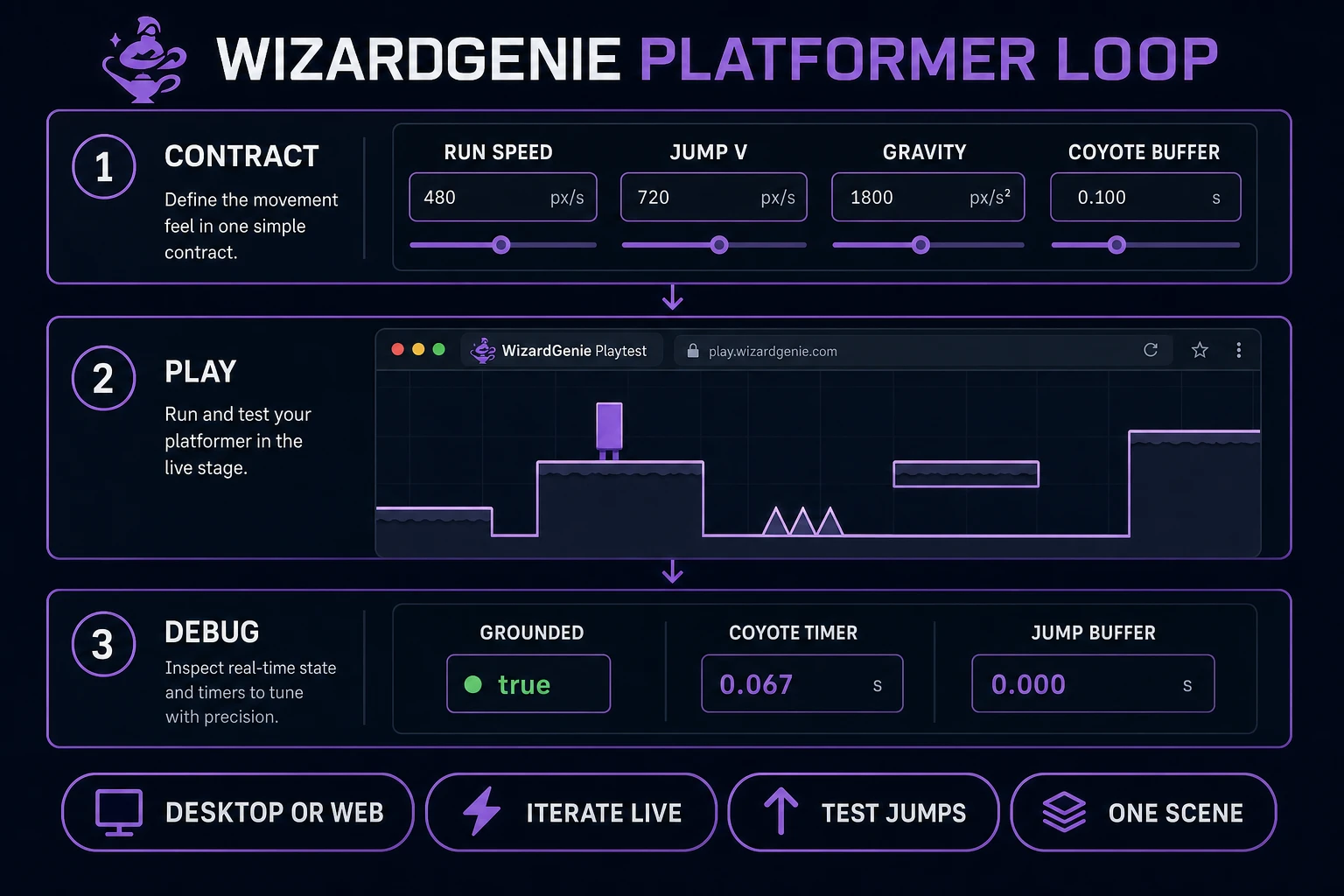
A platform game is defined by traversal across suspended ground, with jumping as the central skill. For a first browser prototype, translate that into six written fields before any art:
- Run speed: horizontal units per second while grounded and airborne.
- Jump velocity: the initial upward impulse on a successful jump.
- Gravity: constant downward acceleration after the jump apex.
- Coyote time: how long after leaving a ledge a jump still counts.
- Jump buffer: how long a premature jump press is remembered.
- Max fall speed: the terminal velocity that keeps long drops readable.
Add three rules beside those numbers: what counts as ground, what kills the player, and where respawn restores control. If you cannot fill that card, keep designing. An agent given only “make a fun platformer” will invent a different contract on every revision.
Lock jump feel before levels or art
Jump feel is the product. Levels are arrangements that stress that product. Art is a readability layer over both. Order them that way or you will polish the wrong failure.
Build a single gray box stage with two platforms, one gap that requires a clean jump, one gap that requires coyote or buffer forgiveness, and one spike or pit. Play it for five minutes with keyboard only. If you routinely clip the near ledge, raise coyote time slightly. If you press jump early and nothing happens on landing, raise the buffer. If the apex feels floaty, increase gravity or reduce jump velocity—change one variable at a time.
Axis-aligned box checks are enough for this stage. MDN’s guide to 2D collision detection covers AABB overlap as the practical default for rectangles that do not rotate. Keep player hitboxes slightly smaller than the visual sprite later so hair and cape pixels do not kill the run. Do not introduce slopes, one-way platforms, or wall jumps until the basic arc is honest.
The Sorceress how to make a platformer workflow
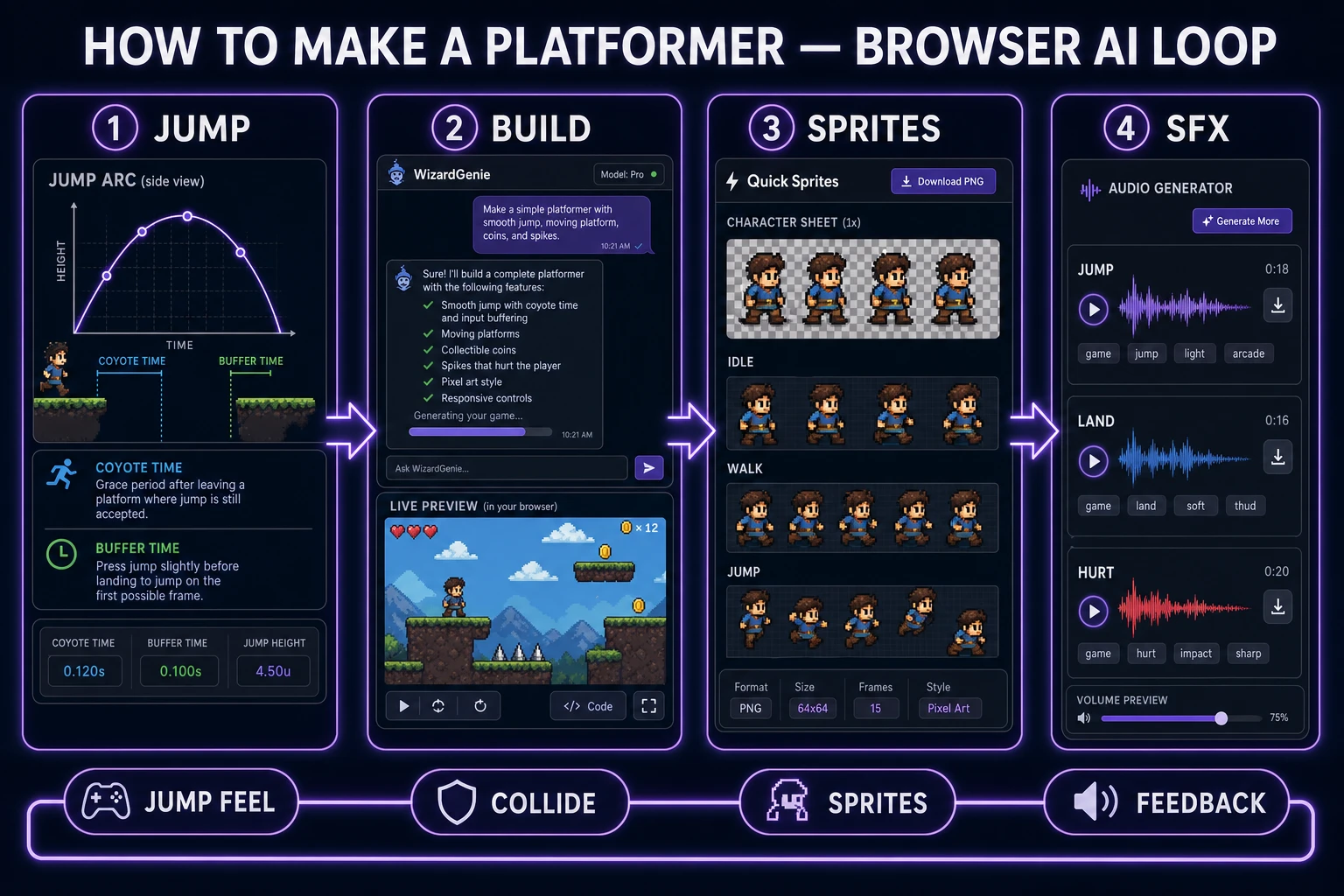
The workflow has four handoffs. Each one produces an artifact you can inspect before moving on:
- Movement card: the six numbers plus ground, hazard, and respawn rules.
- Playable gray box: WizardGenie writes and runs the browser loop with colored shapes.
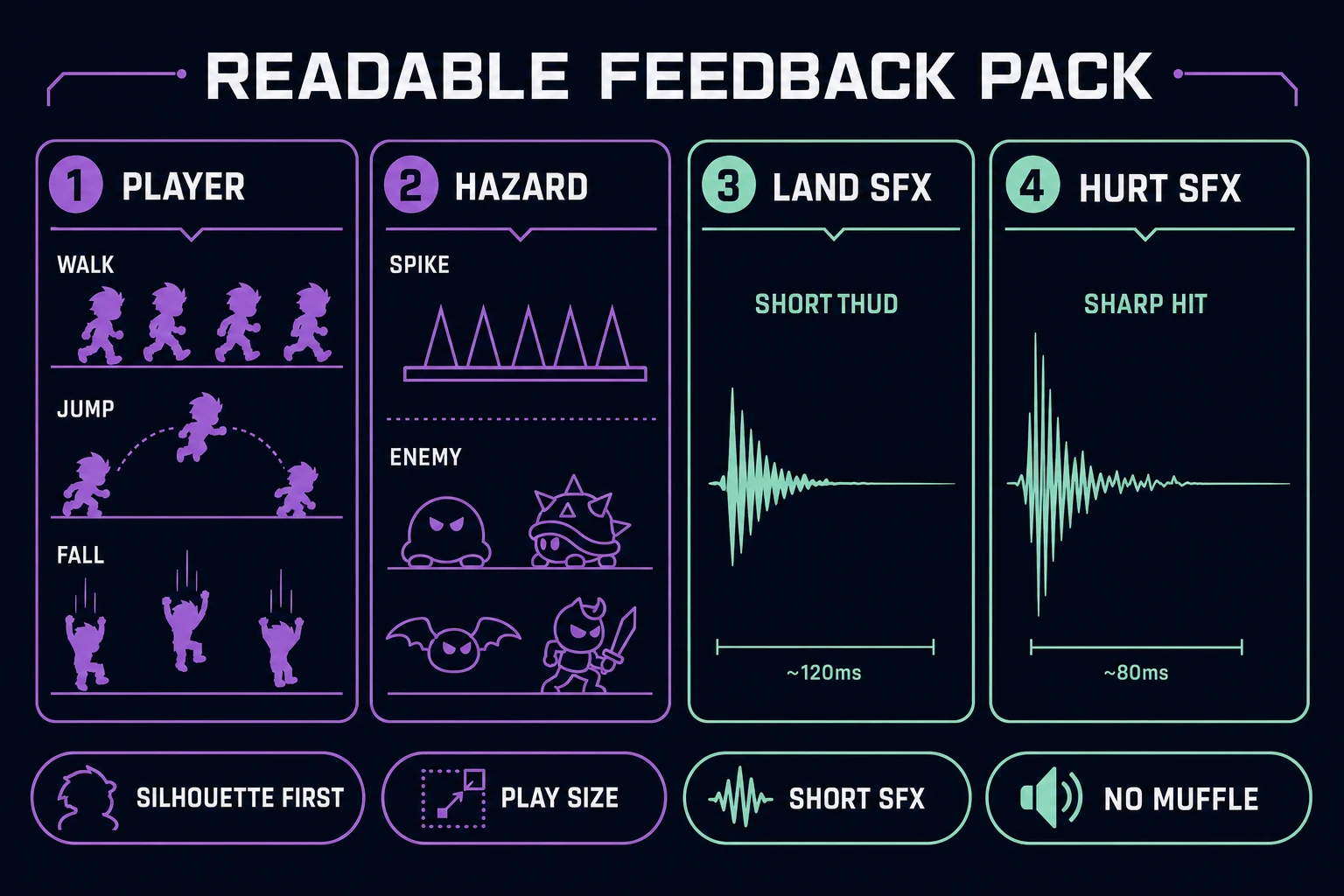
- Readable cast: Quick Sprites supplies player and hazard frames that stay clear at play size.
- Feedback pack: SFX Gen adds short land, jump, and hurt cues that confirm state changes.
WizardGenie is available on desktop and web. On both surfaces the core loop is the same: describe the game, let the agent write and run it, then iterate in real time. Bring your own API key or use the trial path exposed in the product. Model choices in the current Sorceress catalog include Claude Opus 4.7, Claude Sonnet 4.6, GPT-5.5, Gemini 3.1 Pro, DeepSeek V4 Pro, Kimi K2.5, Grok 4.2, and MiniMax M2.7. For platformer prototyping, prefer a strong planner for the first scaffold and a cheaper fast model for tiny feel tweaks so iteration stays cheap.
If you want Phaser specifically, pin a real version. As of July 20, 2026, the stable release on phaser.io/download/stable is Phaser v4.2.1 “Giedi” (released July 9, 2026). Name that version in the prompt when you care about Arcade Physics body behavior. Keep the first scene tiny: one camera, one player body, static platforms, one hazard group.
Optional cleanup tools live in the Sorceress tools guide, but this how to make a platformer path only needs the three featured tools below. A longer Phaser-focused sibling lives at how to make a 2d platformer game if you later want a deeper engine angle.