Claude Vibe Coding (For Games, You Need More Than Code)

By Arron R.11 min read
Claude vibe coding is the default workflow with Sonnet 4.6 ($3/$15 per Mtok) and Opus 4.7 ($5/$25) in 2026 — fast, agentic, 200K context. For games it stops at

Search "claude vibe coding" in May 2026 and the results split into three camps. One camp uses Claude Code, Anthropic’s terminal CLI that hit v2.1.139 on May 11, 2026 with 122,000 stars on GitHub. A second camp uses Claude through a third-party editor that routes prompts to the Anthropic API. A third camp uses Claude inside a multi-model coding tool like WizardGenie, where Claude Opus 4.7 and Claude Sonnet 4.6 sit alongside seven other frontier models in the same picker. All three setups do roughly the same thing for web apps and CLI scripts — describe the change, accept the diff, run, paste the error back, repeat. None of the three, on their own, ship a sprite sheet, a music loop, a textured 3D mesh, or a packaged playable game. That gap is the entire reason this post exists. Verified May 15, 2026 against Anthropic’s May 2026 pricing aggregator listings, the anthropics/claude-code GitHub release tags, and the WizardGenie model lineup in src/app/_home-v2/_data/tools.ts.
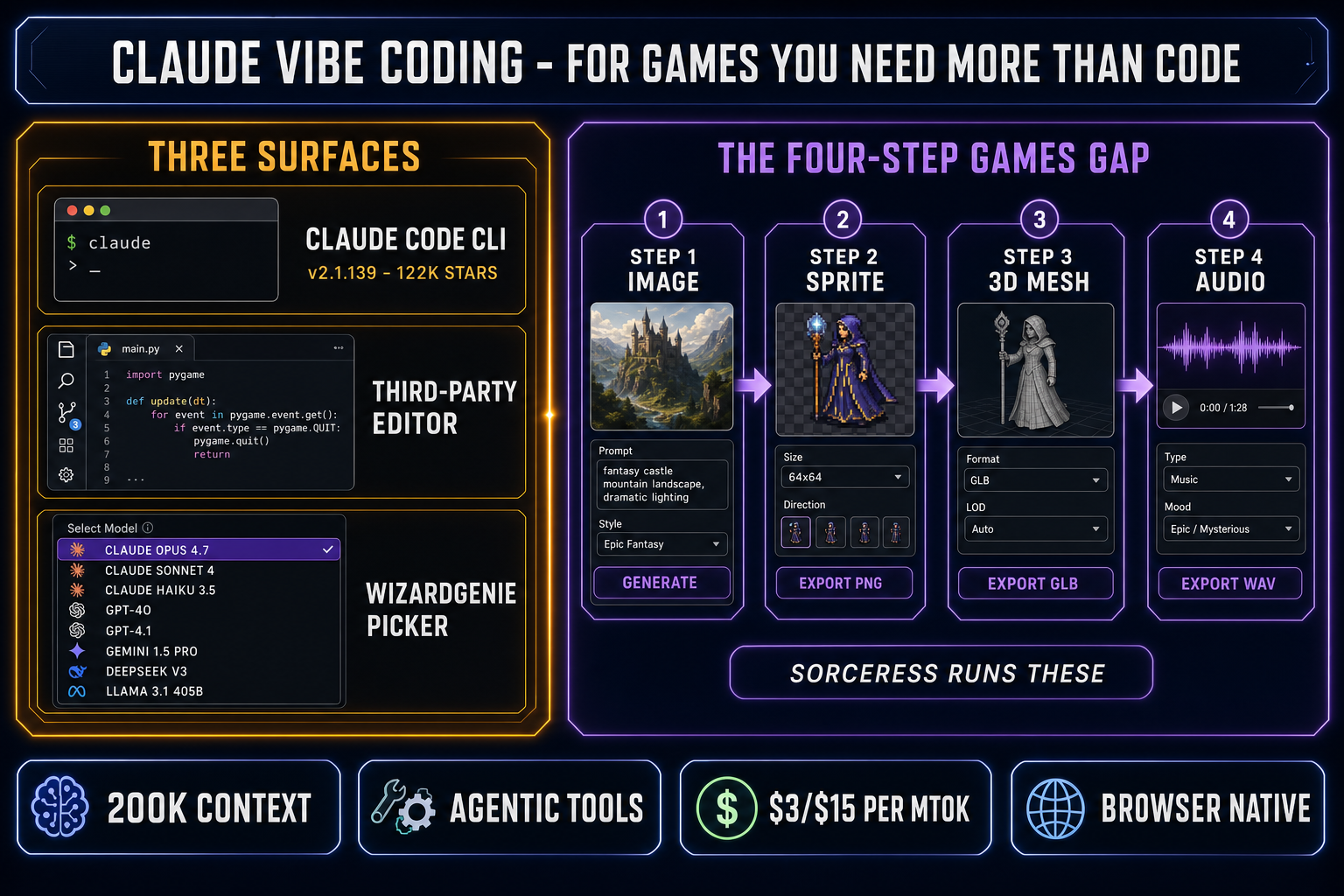
Claude vibe coding workflow diagram showing the three surfaces (Claude Code CLI, third-party editors, WizardGenie multi-model picker) feeding into a four-step games gap (sprite sheet, 3D mesh, music, sound) bridged by the Sorceress asset stack
Claude vibe coding works on three surfaces, but for games each surface stops at the code — the four asset steps after it (sprite sheet, 3D mesh, music, sound) need their own tools. Verified against the Anthropic May 2026 pricing aggregator and the WizardGenie source on May 15, 2026.

What “Claude vibe coding” actually means in 2026

The phrase comes from Andrej Karpathy’s February 2, 2025 post on X, which racked up about 4.5 million views and ended up being named Collins Dictionary’s Word of the Year for 2025. Karpathy described the workflow as “a new kind of coding” where you “fully give in to the vibes, embrace exponentials, and forget that the code even exists.” In his own setup he was using Cursor Composer routed to Anthropic’s Sonnet model, often controlled by voice through SuperWhisper, accepting diffs without reading them, and pasting error messages straight back into the model. Independent analyst Simon Willison picked the term up four days later and noted the same posture — the dev describes intent, the model writes code, the dev steers by feel rather than by line-edit. Twelve months later the term has bled out of dev Twitter into mainstream news, and “Claude vibe coding” specifically refers to that workflow when the model on the other end of the prompt is Claude Sonnet 4.6 or Claude Opus 4.7.

There are three live surfaces today. Claude Code is Anthropic’s own CLI; the GitHub repo at anthropics/claude-code is on its 108th release as of mid-May 2026 (v2.1.139, May 11, 2026), with an “Agent view” preview that shows every running, blocked, and finished session in one list. Third-party editors route the same Claude API behind their own UX. WizardGenie bundles Claude alongside GPT-5.5, Gemini 3.1 Pro, DeepSeek V4 Pro, Kimi K2.5, Grok 4.2, and MiniMax M2.7 in a model picker built specifically for game projects — same Claude underneath, plus everything else. The choice of surface matters less than the underlying model behavior, which is what makes the “Claude vibe coding” query make sense at all.

Why Claude became the default vibe-coding model

Three things, none of them mysterious. The first is agentic tool use. Claude Sonnet 4.6 and Opus 4.7 can decide on their own to read a file, run a shell command, edit a region, run the tests, and react to the output without the dev orchestrating every step. That fits the “forget the code exists” posture; you describe the goal and the model navigates the loop. The second is 200K context, which is enough to hold a small game project (maybe 30–50 source files plus the framework docs) in one prompt without retrieval gymnastics. The third is error-handling reliability. When you paste a stack trace into Sonnet 4.6, it tends to read the trace, locate the file and line, propose the diff, and explain why — instead of guessing. Writers calling this the “default” aren’t making a leaderboard claim; they’re describing the model that consistently completes the inner loop without breaking the dev’s flow.

The economics are also legible. Pricing aggregator Tokencost lists Sonnet 4.6 at $3 input and $15 output per million tokens, with prompt caching at $0.30 per million on cache reads. That is not the cheapest option in the picker — DeepSeek V4 Pro is roughly an order of magnitude lower — but it’s within the “ten dollars buys a productive afternoon” range that vibe coders accept. Opus 4.7, the heavier reasoning model, runs $5 input and $25 output per million tokens; expensive enough to feel for long sessions, cheap enough to be the default thinker on plans. Both numbers are an order of magnitude lower than the deprecated Opus 4.0 list price ($15 / $75), which is part of why the “Claude is too expensive to vibe with” complaint from late 2024 has mostly faded. We covered the full per-token landscape in the 2026 AI coding API pricing breakdown, refreshed on the same May verification cycle as this post.

The Claude vibe coding workflow, end to end

Pulled apart, the loop is simple enough to write on a sticky note:

  1. Describe the change in one or two sentences. Not pseudocode, not function signatures — intent. “Make the player sprite turn red for half a second when it gets hit, then play the hit-sound effect.”
  2. Let Claude propose a diff. If the project is in the model’s context (or if Claude Code is reading the workspace), the diff lands inline.
  3. Accept the diff without line-editing it. This is the controversial step. Vibe coders accept and run; line-by-line review is the prior workflow.
  4. Run the game and watch. Either the sprite turns red on hit, or it doesn’t, or the build breaks.
  5. Paste the result back. If it broke, paste the error or the screenshot. If it worked but feels off, describe the off-ness in plain English. Claude proposes the next diff.

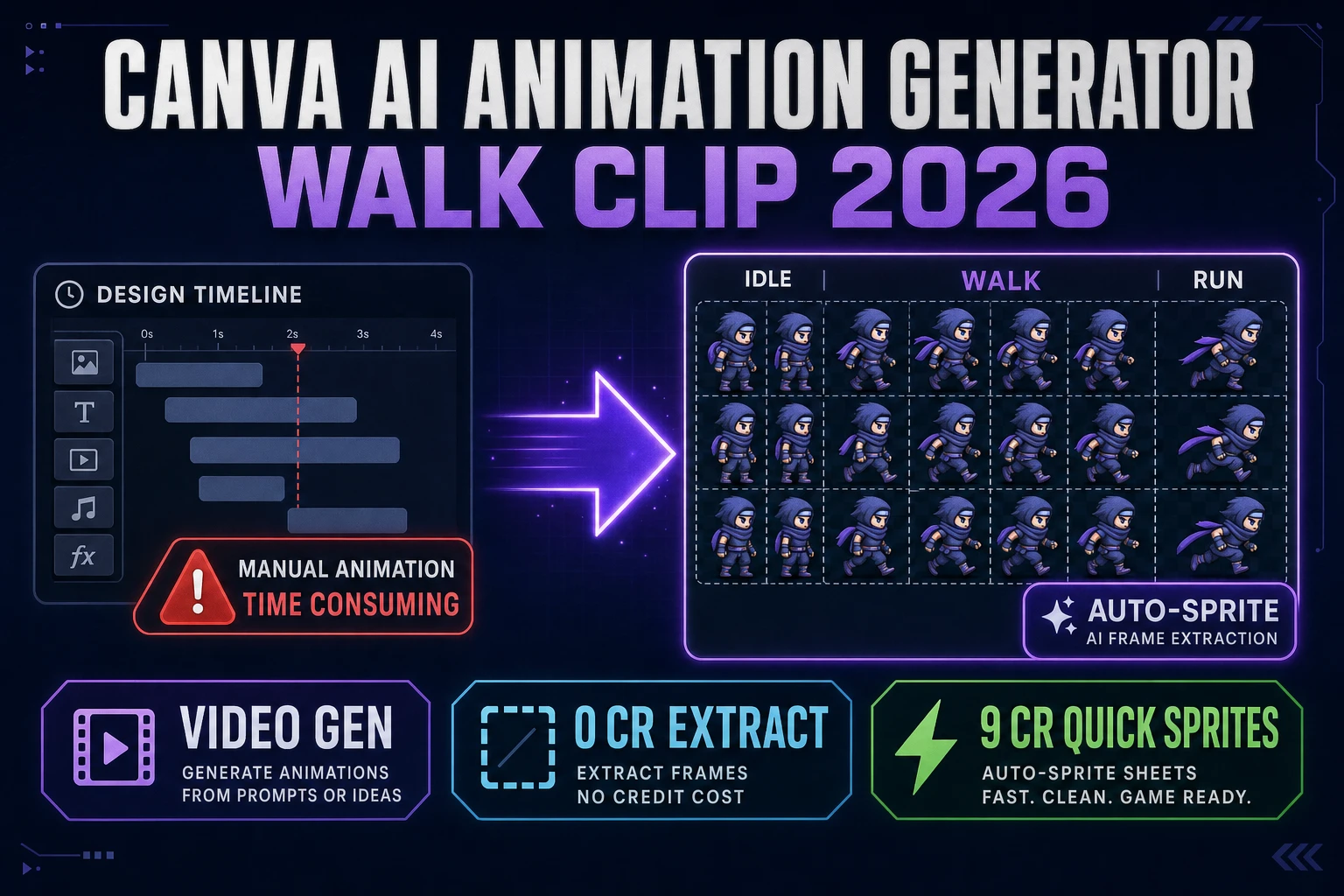
The reason “vibe coding” is a different posture and not just a marketing label is the fourth and fifth steps. Old-school iteration was “write a test, watch it fail, write the fix.” Vibe coding is “run the build, watch the screen, react.” Games are uniquely well-suited to this because every change is testable in one click and the dev’s eyes are a pretty good oracle for “is the punch animation snappy?” or “does the platformer feel right?” The catch is that the loop only covers the code. It does not produce the sprite the player turns red, or the hit sound the player hears, or the music that plays under the fight. Those are different artifacts and Claude alone has no way to render them.
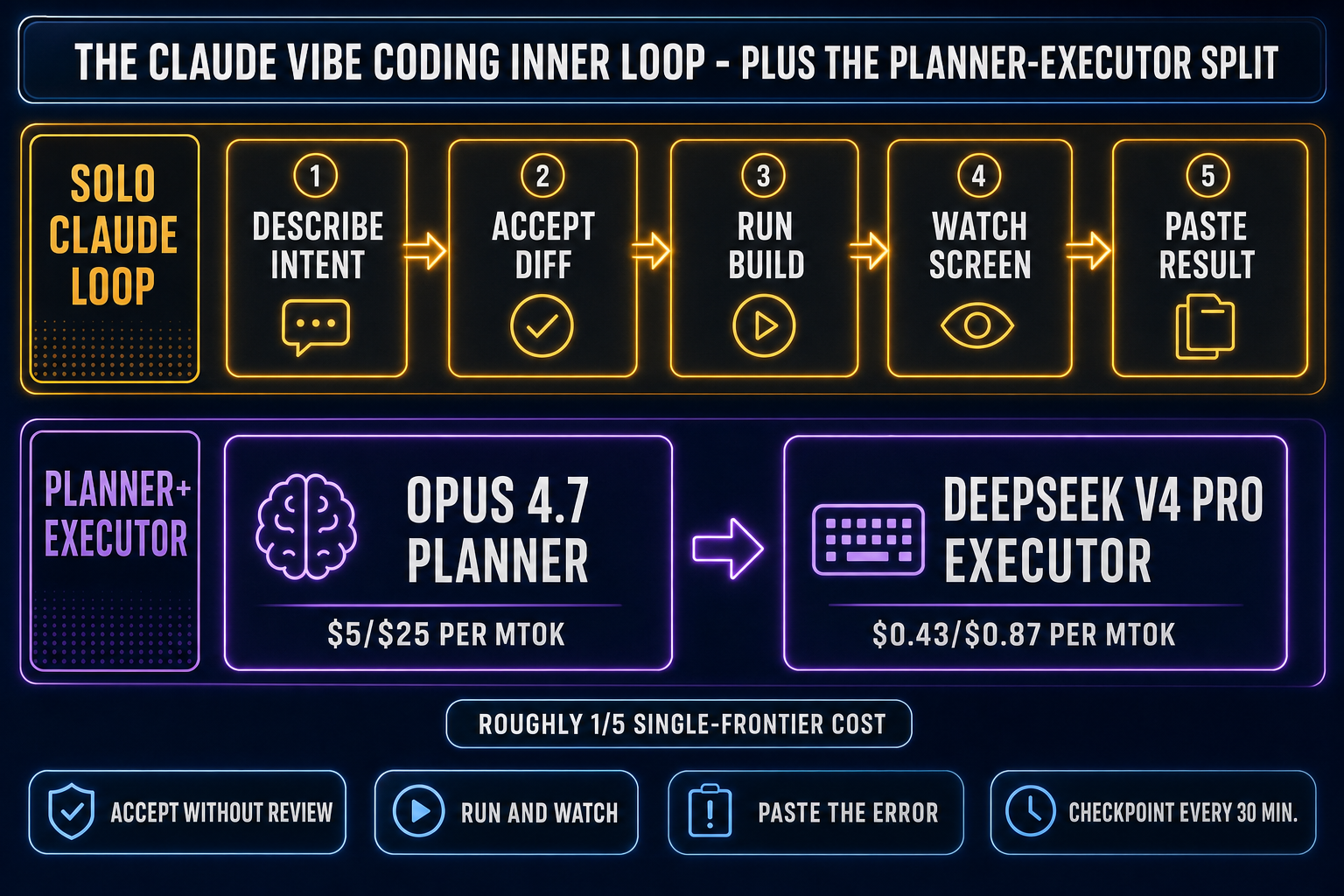
The vibe-coding inner loop with Claude: describe intent, accept diff, run, watch the screen, paste result back. Plus the Planner-Executor variant where Claude Opus 4.7 plans and DeepSeek V4 Pro types, costing roughly one-fifth of single-frontier all-Opus output
The vibe-coding inner loop and the Planner-Executor cost ratio. Pricing verified against the May 2026 pricing-aggregator listings on May 15, 2026.

The Planner-Executor pattern: expensive thinker, cheap typer

The Planner-Executor split is the cost-saver that vibe coders running long agentic sessions reach for once they’ve felt the bill. The pattern: route the planning step (read the codebase, decide what to change, write the spec for the diff) to a top-tier reasoning model like Claude Opus 4.7 or GPT-5.5, and route the actual code-typing (drafting the diff, applying the edits, running the shell command) to a fast cheap model like DeepSeek V4 Pro, Kimi K2.5, MiniMax M2.7, Gemini 3.1 Flash, or GPT-5.5 Mini. The economics are real. Opus 4.7 is $5 input and $25 output per million tokens; DeepSeek V4 Pro is around $0.435 input and $0.87 output at the May 2026 promo (list price $1.74 / $3.48), which expires May 31, 2026. The output side is where the savings stack up — on a long agentic session the executor types the bulk of the tokens, so a 25:1 spread on the output rate translates to roughly a 1/5 single-frontier cost when the planner is Opus and the executor is DeepSeek V4 Pro.

The pattern only works when the executor is genuinely cheap. Pairing two frontier models defeats the purpose. Pairing Sonnet (input/output around $3 / $15) as the executor still saves something but loses most of the headline ratio, which is why the cost-conscious version of Claude vibe coding tends to put Sonnet on the planner side and a true cheap model on the typing side. Inside WizardGenie the model picker exposes both halves explicitly, so a single project can run Opus-as-planner with DeepSeek-as-executor without juggling separate API keys or two terminals. We dug into this in detail in the all-eight-models head-to-head; the short version is that the strongest vibe-coding session today is rarely a single model alone, and Claude is most useful when it’s the one doing the thinking.

Where Claude vibe coding stops short for games

Code, even gameplay code, is one slice of a finished game. The other slices are art, animation, music, sound, voice, and 3D geometry, plus the export and packaging step. Claude can describe what a sprite sheet ought to contain, but it cannot generate the pixels. It can sketch a music brief, but it cannot render the WAV. It can write a JSON list of sound-effect names, but it cannot synthesize the punch and the whoosh. Asking Claude to do those steps anyway produces empty placeholder strings, broken from PIL import Image snippets, or instructions to “import a sound here” without the sound. That isn’t a Claude failure — it’s the wrong tool for the job. Frontier coding LLMs are trained on text, not on pixel-art conventions, palette quantization, mocap retargeting, drum patterns, or game-engine shader graphs.

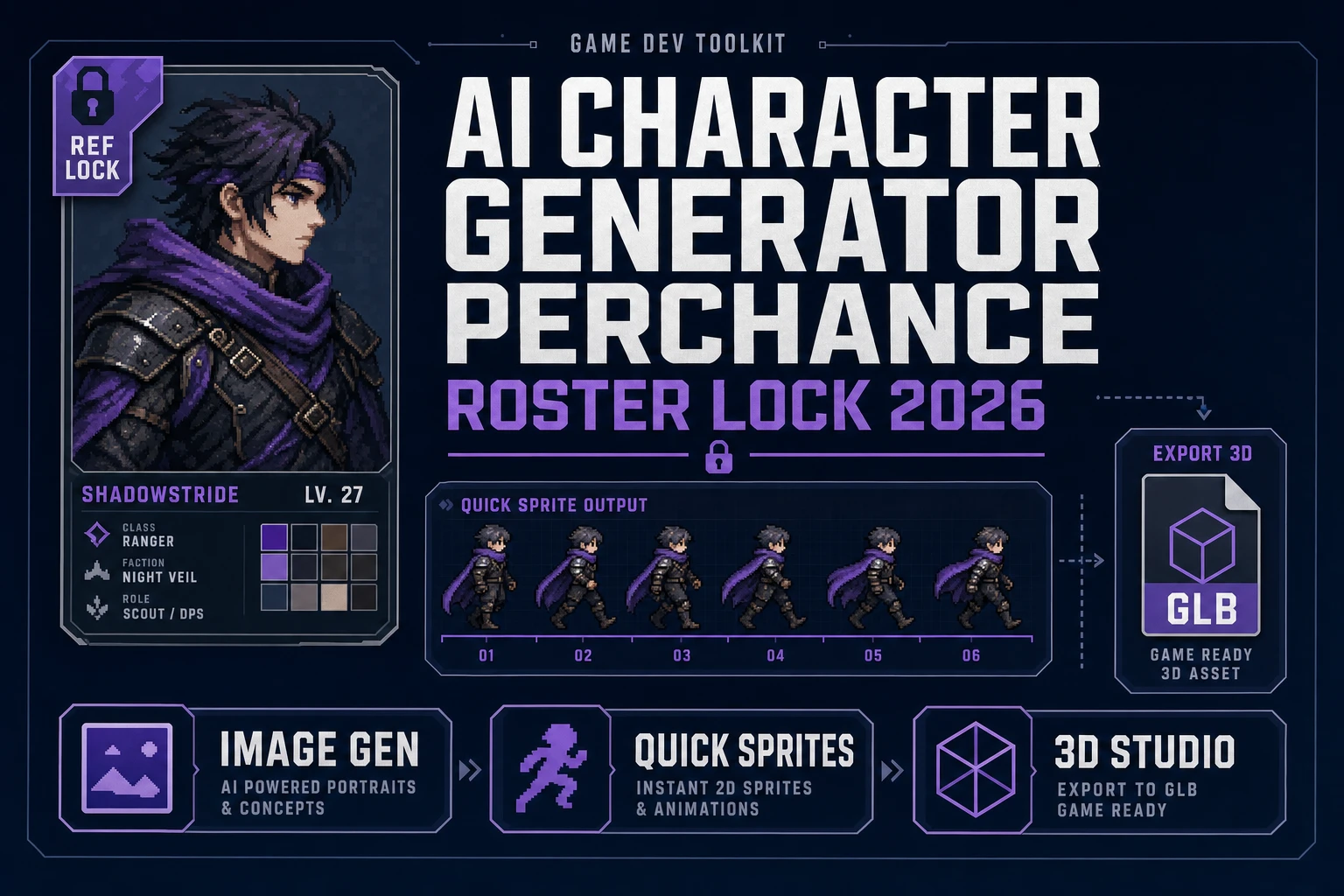
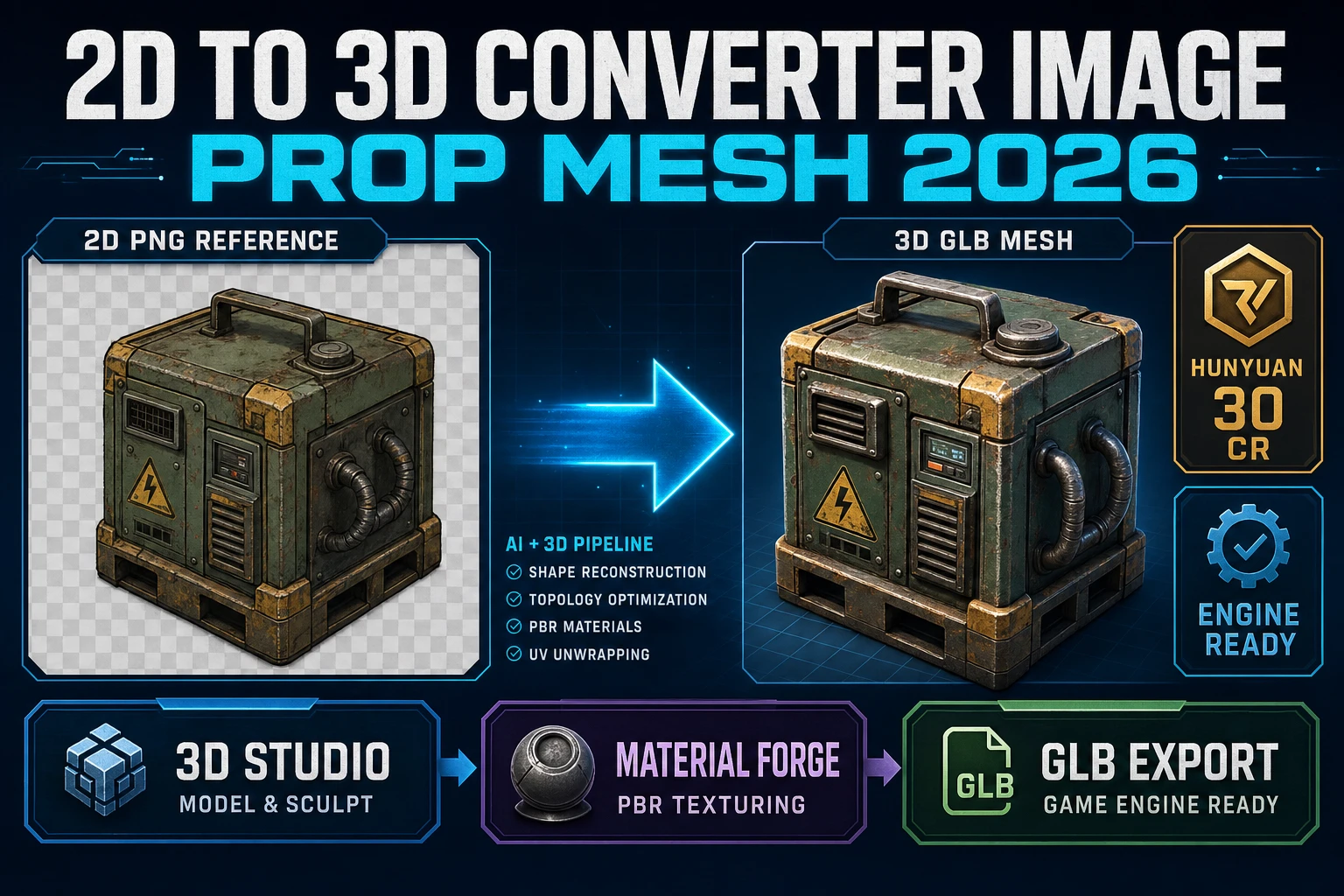
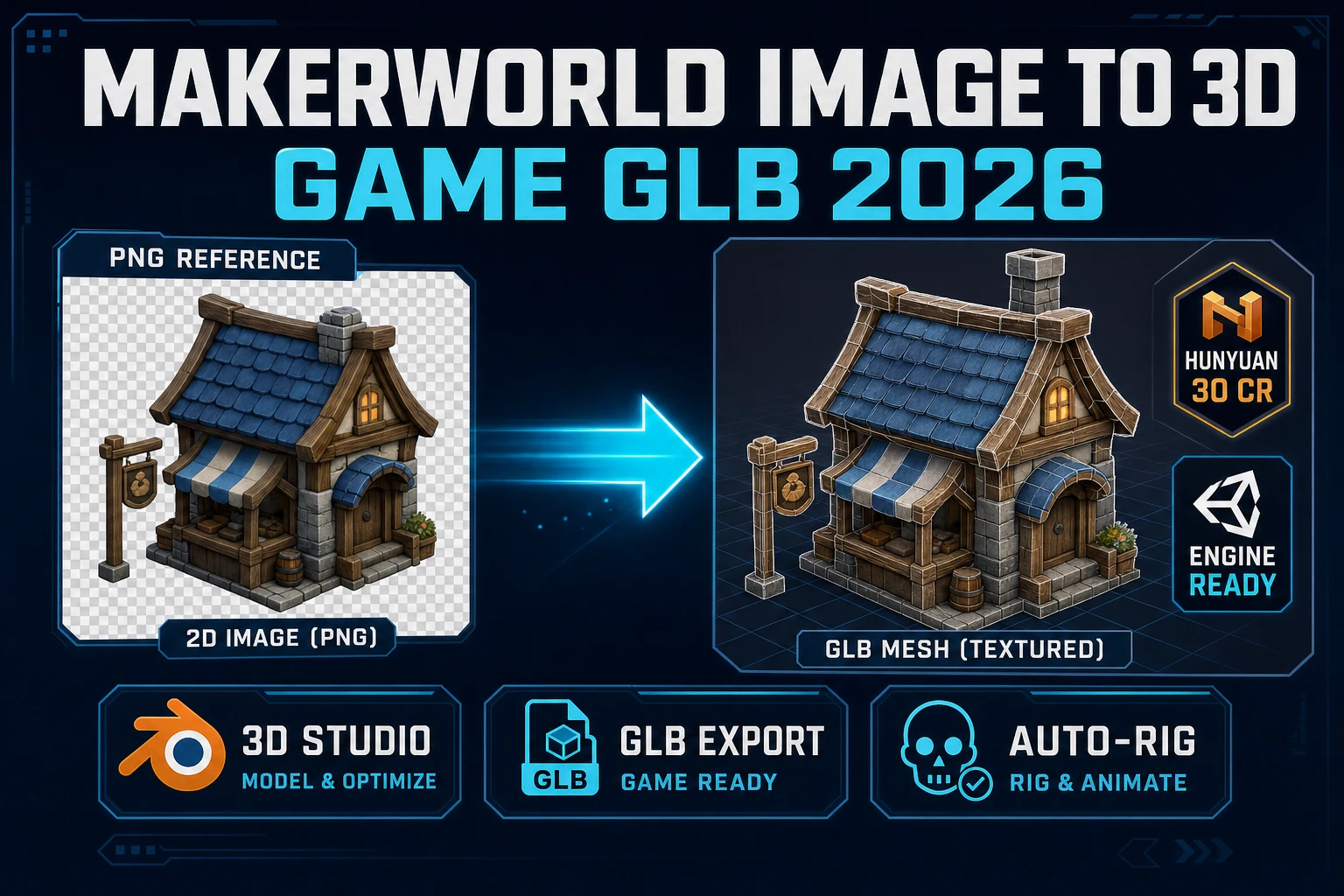
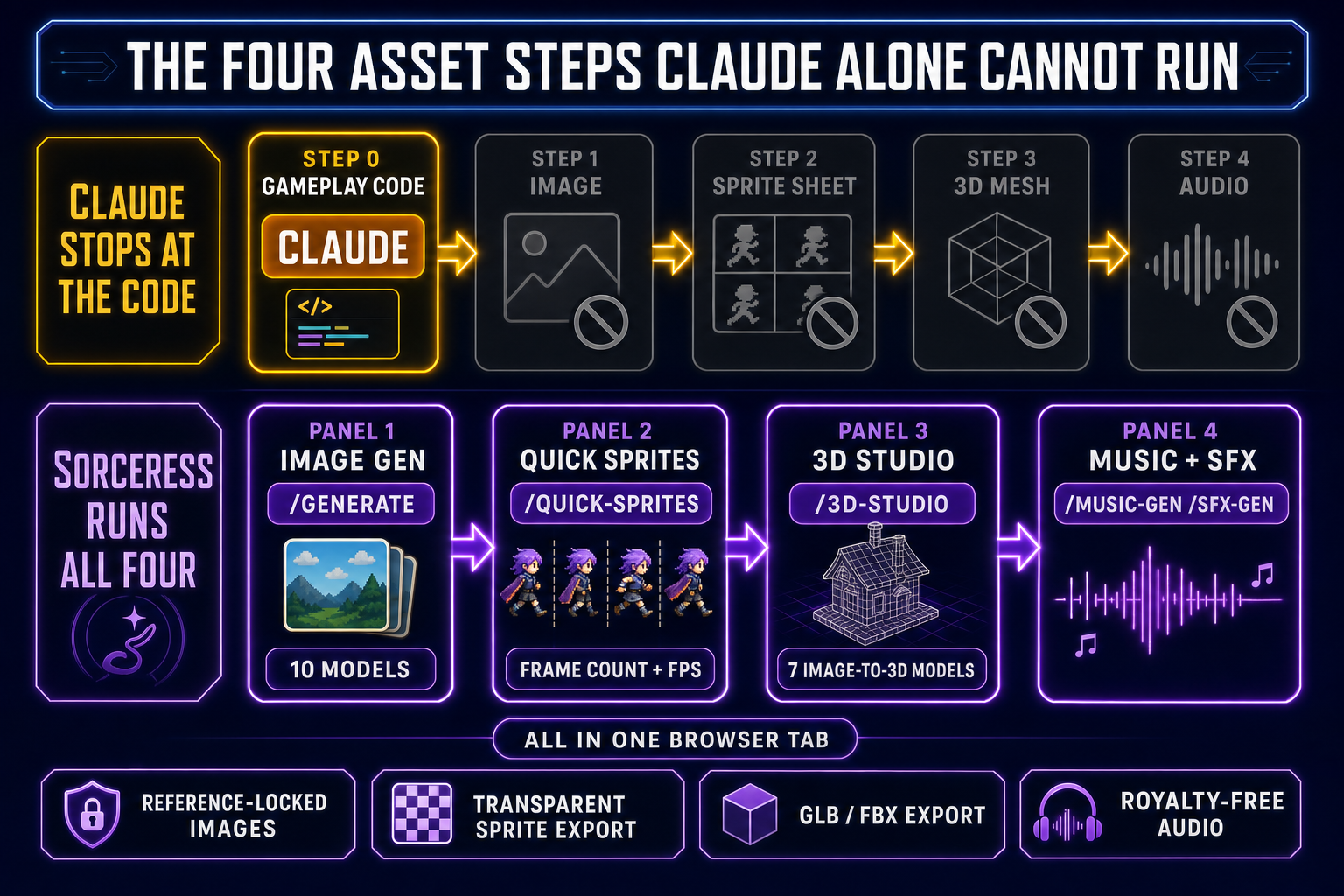
The honest pre-flight for a game project running Claude vibe coding is the four-step asset gap that sits underneath every sprite-driven, mesh-driven, or audio-driven feature. Step one is the character or environment image — one or more reference-locked illustrations the gameplay code will render. Step two is the sprite sheet — multi-frame animation grid at engine-ready dimensions on a transparent background. The sprite sheet primitive is the same one every 2D engine has read since the 1980s. Step three is the 3D mesh and rig if you’re past the 2D plane — textured manifold geometry plus a humanoid skeleton, exported as glTF 2.0. Step four is the audio — music loop, sound effects, voice. Without those four, Claude’s gameplay diff lands in a project full of TODO comments and runs against a black screen. With those four, the same diff lands in a project where the punch sprite turns red, the hit sound fires, and the boss music drops the bass on the next bar.

The four-step asset gap that Claude alone cannot run for games (image generation, sprite sheet, 3D mesh, music and sound) versus the Sorceress tool that handles each step (AI Image Gen, Quick Sprites, 3D Studio, Music Gen and SFX Gen) all available in the same browser tab as WizardGenie’s Claude-powered code editor
The four-step asset gap and the Sorceress tool that runs each step. Tool URLs and model lineups verified against the Sorceress source on May 15, 2026.

The Sorceress + Claude stack: WizardGenie wraps Claude and the asset steps

WizardGenie is the surface where the Claude vibe coding workflow and the four asset steps live in the same browser tab. The model picker lists eight options as of May 15, 2026, verified against src/app/_home-v2/_data/tools.ts: Claude Opus 4.7 (top-tier reasoning), Claude Sonnet 4.6 (fast and smart, the default for most vibe sessions), GPT-5.5 (frontier), Gemini 3.1 Pro (1M context for huge projects), DeepSeek V4 Pro (the cheap executor), Kimi K2.5 (256K coding-tuned), Grok 4.2 (2M context), and MiniMax M2.7 (agent-tuned). The same project can run Claude as the planner, DeepSeek as the executor, and switch to GPT-5.5 for a refactor without leaving the editor. The Claude API key is bring-your-own or covered by the platform credit pool; either way the model is the same Anthropic-served Claude.

The asset steps live one click away in the same browser session. AI Image Gen at /generate runs ten image models with reference-image conditioning — the way you keep a character on-model across eight poses without each render drifting into a different face. Quick Sprites at /quick-sprites turns a character image into a packed sprite sheet with frame count, FPS, palette, and transparent background controls. 3D Studio at /3d-studio runs seven image-to-3D models (Meshy 6, Meshy 5, Rodin 2.0, TRELLIS, TRELLIS 2, Tripo v3.1, Hunyuan 3D 3.1) for the mesh step plus an auto-rigging path for the skeleton. Music Gen and SFX Gen handle the audio. Sonic glue: Claude writes the gameplay code that references these assets, and the assets get generated in the adjacent panel. The dev never has to leave the browser tab. We laid out a longer version of the same pipeline in the prompt-to-game-AI pipelines piece.

Common Claude vibe coding mistakes for game devs

Mistake one: asking Claude for assets it cannot produce. “Generate a 64x64 sprite sheet of a wizard walking” will get you a Python snippet that calls Pillow on a file path that doesn’t exist, or a bullet list of frame indices, or an apology. The fix is to keep Claude on the code side and run the actual sprite generation in Quick Sprites. Mistake two: putting Sonnet (or any frontier model) on the typing side of a Planner-Executor. Sonnet 4.6 is $3 / $15 per Mtok input/output. DeepSeek V4 Pro is $0.435 / $0.87 at the May 2026 promo. Putting Sonnet on the executor side erases roughly four-fifths of the cost advantage that makes the pattern worth running. The Hard Rule: cheap typers only. Mistake three: long sessions without checkpoints. Claude does not have memory across sessions; the “forget the code exists” posture turns into “forget the bug exists” if you don’t commit on green every 30 minutes. Mistake four: confusing Claude Code (the CLI) with Claude vibe coding (the workflow). Claude Code is one surface among three; the workflow runs anywhere a Claude model picker exists, including in editors that aren’t Anthropic’s. Mistake five: running a long agentic session on a single Sonnet 4.6 model when a Planner-Executor split would be both cheaper and faster. If the project is large enough that Claude is reading multiple files per turn, split the work.

Try Claude vibe coding for a real game

The fastest way to feel the gap and the bridge in one sitting is to open WizardGenie, pick Claude Sonnet 4.6 in the model picker, type “a top-down dungeon crawler with a wizard who shoots fireballs,” and let the agent stub out the project. The code lands. The wizard’s sprite is a placeholder. Switch to AI Image Gen, generate a wizard with a reference image, send it to Quick Sprites for the walk and attack animations, and drop the resulting sheet back into the project. Now the wizard moves. Run SFX Gen for “fireball whoosh” and “hit thud,” Music Gen for the dungeon loop, and the playable build is one switch away. The full asset roundup of which Sorceress tool covers which step lives in the best vibe coding tools for games piece, and the deeper definition-of-vibe-coding piece is the what is vibe coding explainer if you’re still backfilling the term.

Frequently Asked Questions

What is Claude vibe coding and how is it different from regular AI coding?

Claude vibe coding is the workflow Andrej Karpathy named on February 2, 2025 — describe intent in plain English, accept the diff Claude proposes without line-editing it, run, paste the result back, repeat — when the model on the other end is Anthropic's Claude Sonnet 4.6 or Claude Opus 4.7. The difference from prior AI-coding workflows is the posture, not the model. Older AI-coding patterns were autocomplete (the model suggests, you approve every line) or pair-programming (the model proposes, you review carefully). Vibe coding flips the loop: the dev describes the goal, accepts the agent's diff sight unseen, runs the build, watches the screen, and reacts to what they see. Games are uniquely good for this because every change is testable in one click and the dev's eyes are a reasonable oracle for whether the punch animation feels snappy or the platformer feels right. The catch is the same one every vibe-coding workflow has — the loop only covers the code. Claude does not generate the sprite the player turns red, the hit sound the player hears, or the music that plays under the fight. Those are different artifacts and Claude alone has no way to render them, which is why the games-specific version of Claude vibe coding pairs Claude with an asset stack that handles the four steps after the code.

Is Claude Code the same thing as Claude vibe coding?

No. Claude Code is one of three live surfaces where Claude vibe coding happens. Claude Code is Anthropic's terminal CLI, hosted at github.com/anthropics/claude-code, currently on its 108th release as of mid-May 2026 (v2.1.139, May 11, 2026). It runs in any terminal, reads the workspace, executes shell commands, and applies edits — it is the surface Anthropic ships. The other two surfaces are third-party editors (which route the same Claude API behind their own UX) and multi-model editors like WizardGenie (which bundle Claude alongside seven other frontier models in a single picker). Claude vibe coding refers to the workflow on any of those surfaces. Claude Code is the workflow on the Anthropic-hosted surface specifically. Confusing the two leads to incorrect setup advice — for example, recommending Claude Code as the only way to vibe-code with Claude when the actual Claude API is reachable from any client that speaks JSON. For game projects, the three-surface choice matters less than which model you point the prompt at. Sonnet 4.6 is the default for fast iteration; Opus 4.7 is the default for the planner role in a Planner-Executor split. Either works on any of the three surfaces.

How much does Claude vibe coding cost per month?

It depends on which Claude model and how long the sessions run. As of May 15, 2026 the relevant per-million-token rates from the Anthropic API documentation indexers are: Sonnet 4.6 at $3 input / $15 output, with prompt caching at $0.30 per million on cache reads; Opus 4.7 at $5 input / $25 output. Both are an order of magnitude lower than the deprecated Opus 4.0 list price ($15 / $75) was last year, which is part of why the 'Claude is too expensive to vibe with' complaint from late 2024 has mostly faded. A typical hour of agentic Claude Sonnet 4.6 vibe coding on a small game project lands around $2 to $8 of API spend, depending on how many files the agent reads per turn. Opus runs roughly 1.7x more for the same workflow because of the higher per-token rate. The cheaper variant is the Planner-Executor pattern: route the planning step to Opus 4.7 and the actual code-typing to a true cheap executor like DeepSeek V4 Pro, which is around $0.435 input and $0.87 output per million tokens at the May 2026 promo (list $1.74 / $3.48). The output-side savings stack to roughly a 1/5 single-frontier cost on a long agentic session because the executor types the bulk of the tokens. Inside WizardGenie the model picker exposes both halves, so a single project can run Opus-as-planner with DeepSeek-as-executor without juggling two API keys.

Why does Claude vibe coding stop short for games specifically?

Because a finished game is not just code. It is gameplay code plus a sprite sheet, plus a 3D mesh, plus a rigged skeleton, plus a music loop, plus sound effects, plus voice, plus the export and packaging step. Claude generates the code. Claude can describe what a sprite sheet ought to contain, but it cannot render the pixels. Claude can sketch a music brief, but it cannot synthesize the WAV. Claude can write a JSON list of sound-effect names, but it cannot produce the punch and the whoosh. Asking Claude to do those steps anyway gets you a Pillow snippet that runs on a file path that does not exist, or a bullet list of frame indices, or an apology. That is not a Claude failure — it is the wrong tool for the asset step. Frontier coding LLMs are trained on text, not on pixel-art conventions, palette quantization, mocap retargeting, drum patterns, or shader graphs. The honest pre-flight for a game project running Claude vibe coding is the four-step asset gap: image generation, sprite sheet, 3D mesh, audio. Without those four, Claude's gameplay diff lands in a project full of TODO comments and runs against a black screen. With those four — handled in adjacent browser tabs at /generate, /quick-sprites, /3d-studio, /music-gen, and /sfx-gen — the same diff lands in a project where the gameplay actually works.

What is the Sorceress alternative or complement to Claude vibe coding?

Sorceress does not replace Claude. WizardGenie at /wizard-genie/app is the surface where the Claude vibe coding workflow and the four asset steps live in the same browser tab. The model picker as of May 15, 2026 lists eight options verified against src/app/_home-v2/_data/tools.ts: Claude Opus 4.7 (top-tier reasoning), Claude Sonnet 4.6 (fast and smart, the default for most vibe sessions), GPT-5.5 (frontier), Gemini 3.1 Pro (1M context), DeepSeek V4 Pro (the cheap executor), Kimi K2.5 (256K coding-tuned), Grok 4.2 (2M context), and MiniMax M2.7 (agent-tuned). The same project runs Claude as the planner, DeepSeek as the executor, and switches to GPT-5.5 for a refactor without leaving the editor. The asset steps live one click away in the same browser session: AI Image Gen at /generate runs ten image models with reference-image conditioning, Quick Sprites at /quick-sprites turns a character image into a packed sprite sheet, 3D Studio at /3d-studio runs seven image-to-3D models (Meshy 6, Meshy 5, Rodin 2.0, TRELLIS, TRELLIS 2, Tripo v3.1, Hunyuan 3D 3.1), Music Gen at /music-gen handles the music loop, and SFX Gen at /sfx-gen handles the sound effects. Claude writes the gameplay code that references these assets; the assets get generated in the adjacent panel. The dev never has to leave the browser tab.

Sources

  1. Vibe coding — Wikipedia
  2. Andrej Karpathy on vibe coding (Simon Willison's Weblog, Feb 6 2025)
  3. anthropics/claude-code — GitHub releases
  4. Claude Sonnet 4.6 — pricing and context (Tokencost)
  5. DeepSeek V4 Pro — pricing and context (Tokencost)
  6. Sprite (computer graphics) — Wikipedia
  7. glTF 2.0 specification (Khronos Group)
Written by Arron R.·2,465 words·11 min read

Related posts