Clarify Vibe Coding Meaning (Indie Games 2026)

By Arron R.9 min read
Vibe coding meaning: you describe software in ordinary language, an AI model writes the source, and you steer by running it. Dictionaries and Karpathy disagree

Vibe coding meaning is the phrase people type when a dictionary, a February 2025 note, and a weekend game jam all claim the same three words. Those three sources do not describe the same amount of review. Collins and IBM describe prompting a model to write code. Andrej Karpathy’s coinage, quoted on Wikipedia, adds that you may stop reading the diffs on a throwaway project. A browser game sits in the gap between those sentences. This page is about that gap. The origin story of the phrase lives on what is vibe coding. Facts below were checked on 2026-09-21 against the Collins Word of the Year post, IBM’s explainer (updated 24 July 2026), the Wikipedia Vibe coding article, MDN’s game development guide, and the Sorceress source for WizardGenie and the coding model roster.
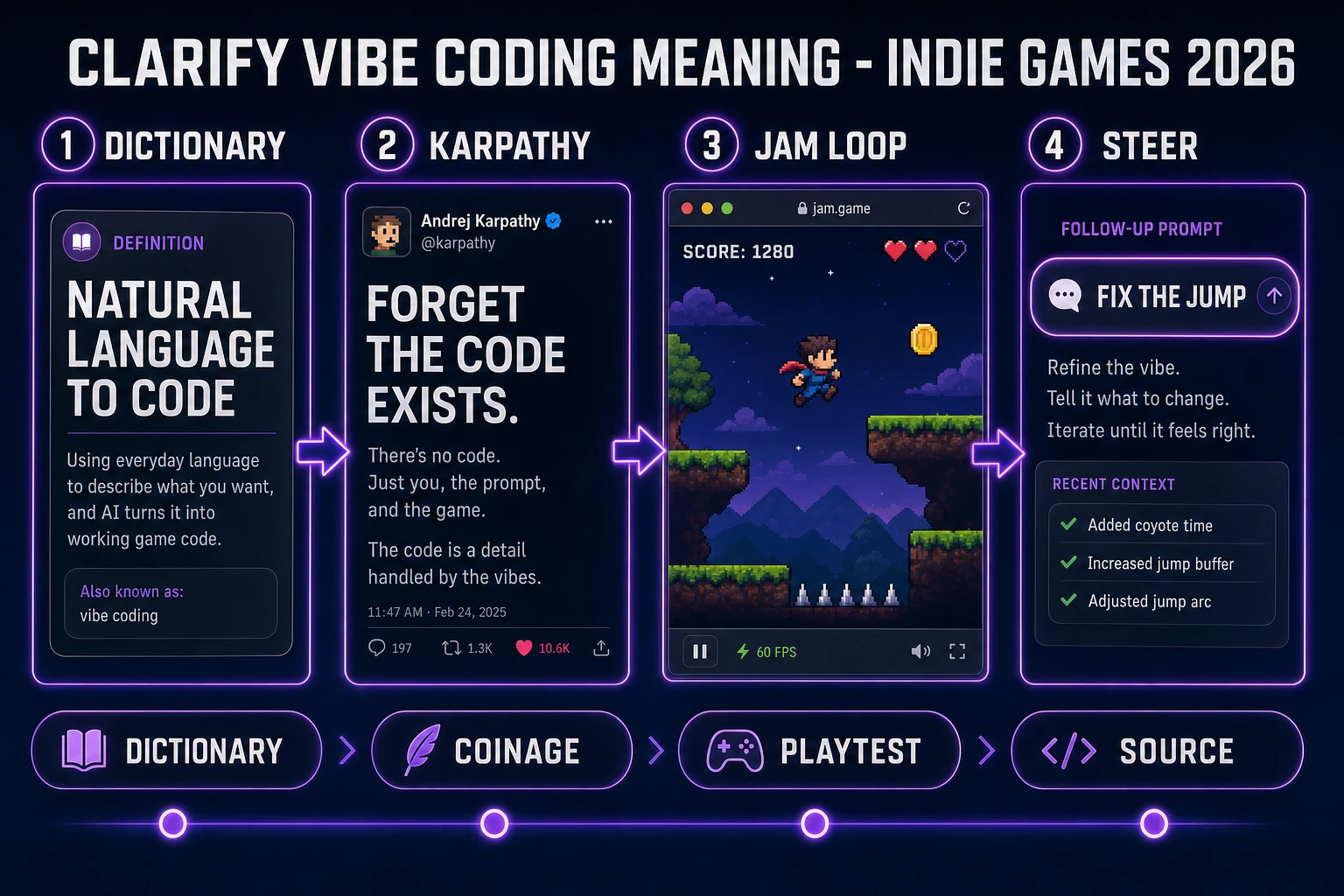
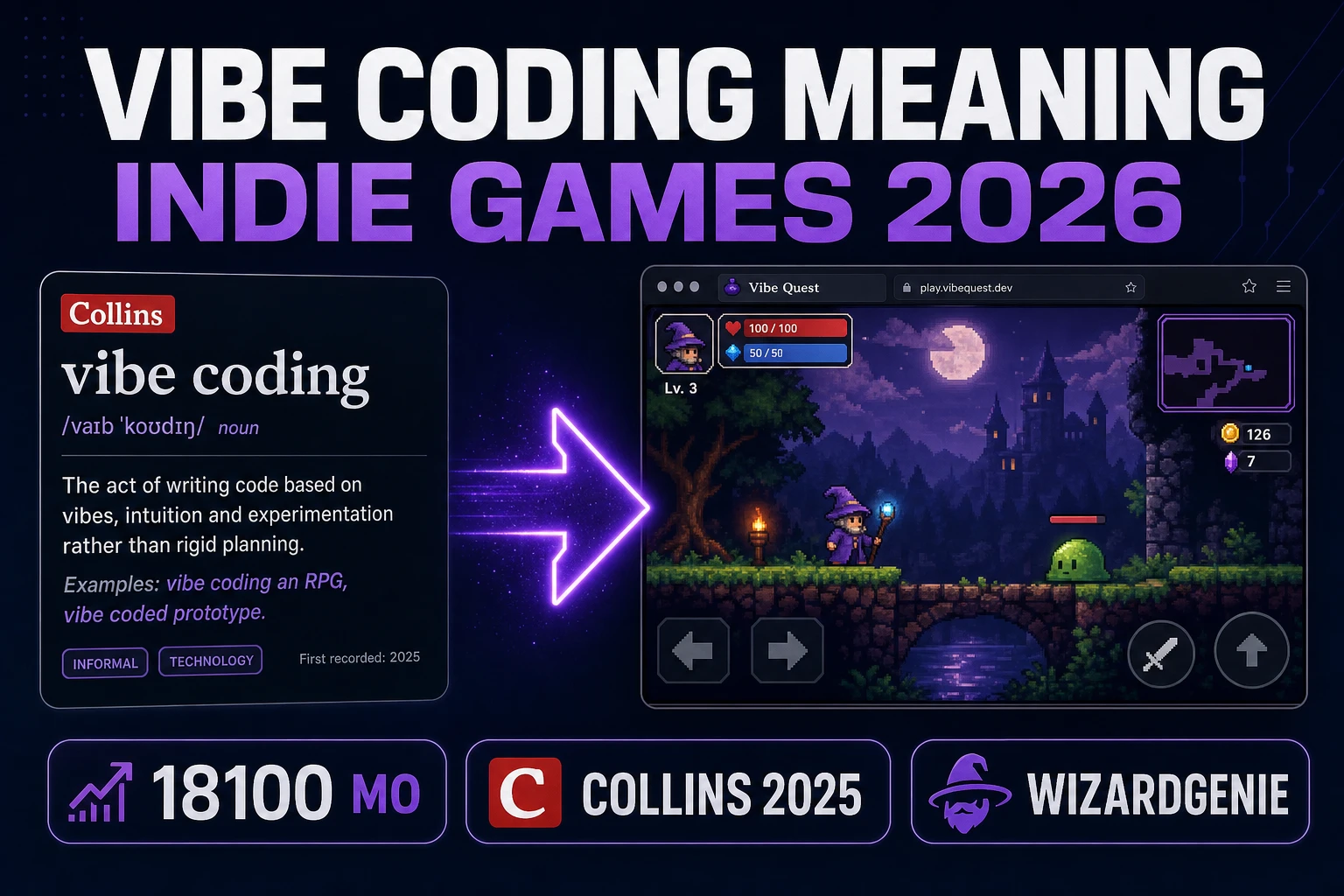
Vibe coding meaning split across a dictionary card, Karpathy’s coinage, a jam loop, and a steer prompt
Four readings of the same phrase: a dictionary line, the original note, a playable loop, and the next prompt.

Vibe coding meaning in one sentence

The shortest honest line, taken from sources checked today, is this: you say what you want in ordinary language, and a large language model writes the source. Collins, in the 6 November 2025 Word of the Year post, calls vibe coding “the use of artificial intelligence prompted by natural language to write computer code,” and glosses it as telling a machine what you want rather than coding it yourself. IBM’s page, published 8 April 2025 and updated 24 July 2026, uses almost the same sentence: the practice of prompting AI tools to generate code rather than writing code manually. IBM also says Karpathy introduced the term in February 2025.

Karpathy’s own note is narrower than the dictionary. The Wikipedia article, checked 2026-09-21, quotes him describing a kind of coding where you “fully give in to the vibes, embrace exponentials, and forget that the code even exists,” accept the diffs, paste errors back in, and treat the result as fine for throwaway weekend projects. That is a usage rule, not a parts-of-speech definition. The dictionary answers what the activity is. The note answers how little of the output its author was reading that weekend.

People also search what is vibe coding (60,500/mo, KD 38), what does vibe coding mean (2,400/mo, KD 42), how to vibe coding (1,600/mo, KD 20), vibe coding application (1,300/mo), and vibe coding with claude (480/mo, KD 0). DataForSEO lists the head phrase vibe coding meaning at 18,100 searches a month, KD 43. Those rows were confirmed 2026-09-21 in tools/research-supplement.md from the 2026-09-18 pull. The neighboring queries want a definition, a procedure, or a product. They are not interchangeable, which is why a second page can answer the meaning split without repeating the origin explainer.

The dictionary trail behind the phrase

Three public wordings are in circulation, and they license different behavior.

Source When What it licenses
Karpathy’s note, via Wikipedia February 2025 Describe, accept, paste errors back, stop reading diffs on a throwaway
Merriam-Webster slang entry, quoted on Wikipedia March 2025 Tell an AI what you want; the coder need not understand how the code works; bugs are expected
Collins Word of the Year 6 November 2025 AI, prompted in natural language, writes computer code

Merriam-Webster’s own page did not load on 2026-09-21 (a bot check blocked the fetch). The wording above is the quotation printed on the Wikipedia Vibe coding article retrieved the same day: vibe coding is telling an AI program what you want and letting it create the product, often without understanding how or why the code works, and often accepting bugs. Collins was fetched directly. Its post does not require ignorance. It requires a prompt in place of hand-typed syntax.

That difference is the whole argument. A Collins-shaped vibe coding meaning still has source code at the end. A Merriam-Webster-shaped reading, as Wikipedia quotes it, treats understanding as optional. Karpathy’s reading treats understanding as something you postpone on a weekend toy. The vibe coding meaning you pick is the one you will have to live with on Monday. Indie games borrow all three and then discover, at hour six, which one they actually meant.
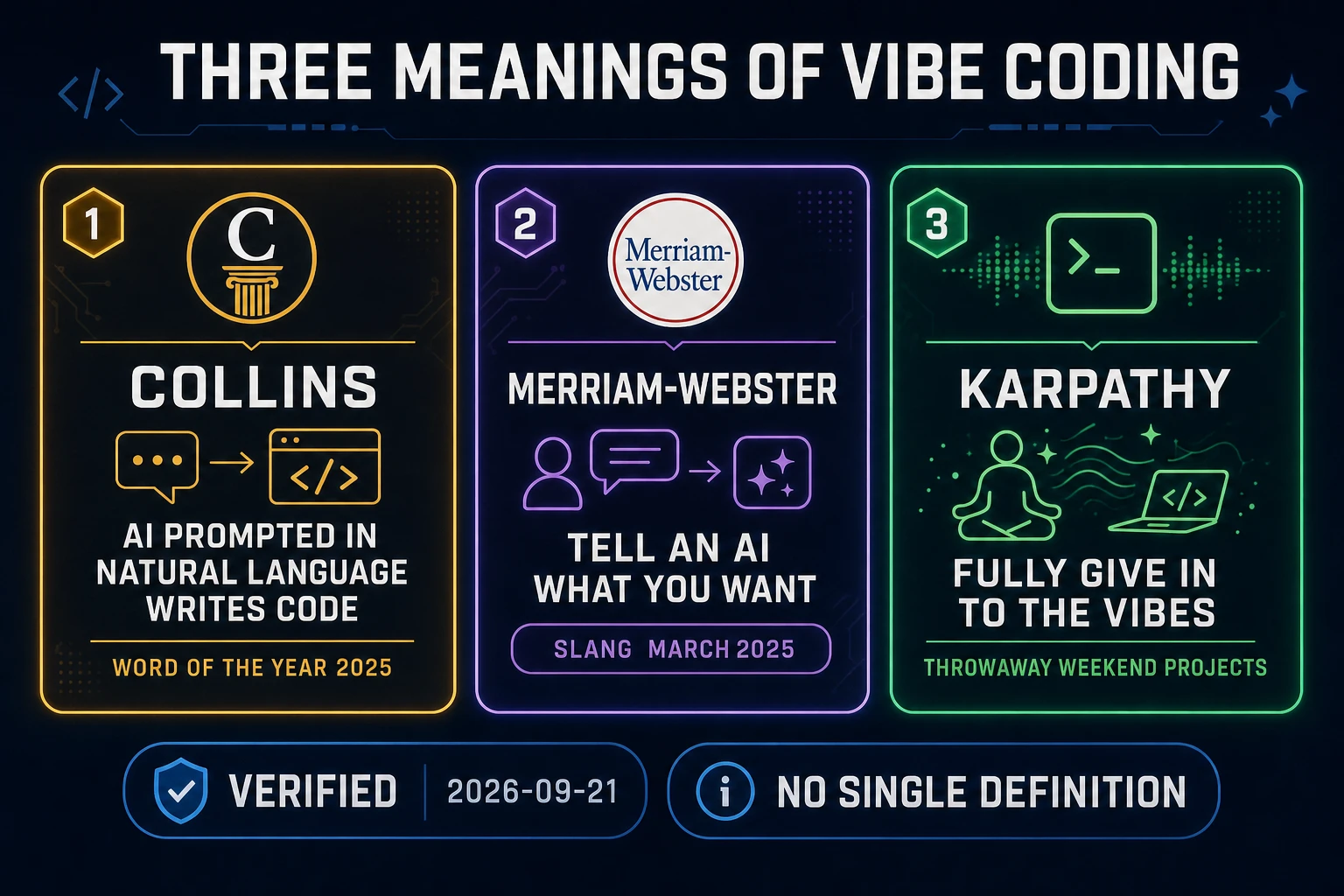
Vibe coding meaning compared across Collins, Merriam-Webster, and Karpathy
Same phrase, three licenses: write code from language, skip understanding, or stop reading diffs on a toy.

Hobbyists and working programmers use different meanings

Wikipedia’s reception section, checked 2026-09-21, says advocates claim amateurs can produce software without the training software engineering usually takes, and critics answer with accountability, maintainability, and security. The same article reports that in June 2025 Andrew Ng objected to the name because it suggests engineers simply go with the vibes when they use AI tools. IBM’s July 2026 update keeps both halves: prototyping gets faster, and production still needs review, tests, and a security pass. IBM lists the failure modes in plain language: novel requirements, weak structure, hard debugging, painful maintenance, and vulnerabilities that skip review.

Both pages still point at the March 2025 report that a quarter of startups in that Y Combinator winter batch had codebases that were almost entirely AI-generated. That number describes a cohort of companies, not a quality score, and not a game. It is evidence that the phrase escaped hobby forums. It is not evidence that unread code ships cleanly.

For a working programmer, vibe coding meaning has collapsed into “I use a coding agent.” The diffs are still the job. For a hobbyist at a jam, the phrase often means “I will not learn the engine this weekend.” Both uses are real. They produce different bugs. That split is the practical vibe coding meaning for a team versus a jam. The professional failure is a confident merge of code nobody on the team can explain. The jam failure is a fun ten minutes and then a wall, because the next change needs a file the author cannot find.
What the phrase means inside a game jam

MDN’s game development guide, checked 2026-09-21, says web games are built with HTML, CSS, and JavaScript in a standards-compliant browser, and points beginners at the anatomy of a game loop. That loop is the object the phrase has to name if the reader is making a game. A vibe coding application, in this setting, is a small playable build: something on screen reacts to input, the state updates, and the frame draws again. A landing page with a button is not that object. A chat transcript is not that object.

The jam reading that survives contact with a playtester looks like this:

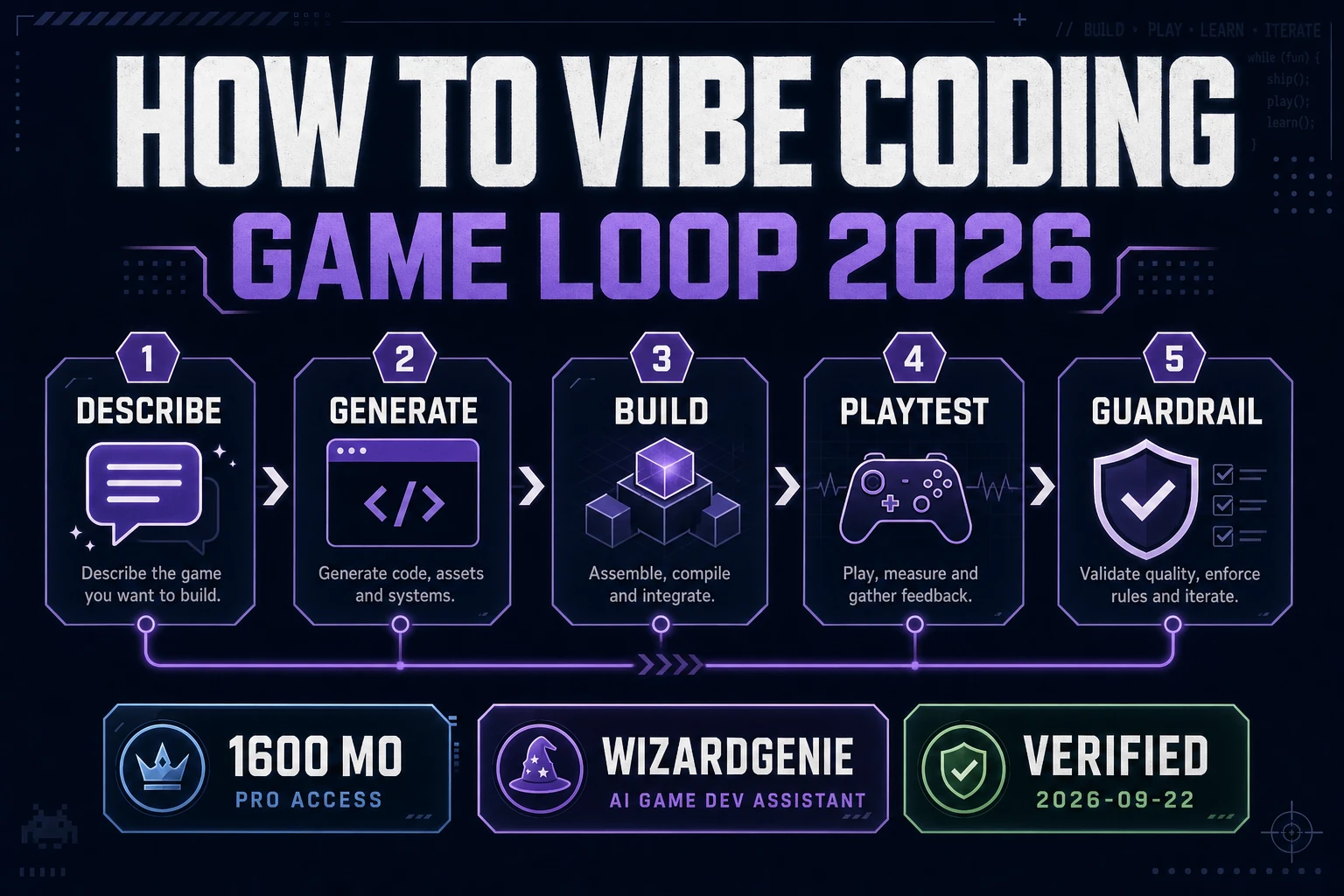
  1. Describe one loop in ordinary language: a character, a hazard, a score, a way to fail.
  2. Let the model write the files.
  3. Run the page from a click, not from a screenshot of the chat.
  4. Ask for one change that you can see: a higher jump, a slower enemy, a restart on death.
  5. Keep the files. The next prompt edits those files.

What does vibe coding mean if step 5 is skipped? It means a demo that cannot be patched. Karpathy’s “forget that the code even exists” is a fair description of a toy he did not plan to maintain. A jam entry you might show someone on Monday is already past that license. You can still talk to the model in English. You cannot treat the project folder as optional.

How to vibe coding that loop is a procedure, and the search volume on that awkward phrase (1,600/mo) shows people want steps, not etymology. The steps above are the whole procedure at jam scale. Wider tool comparisons live on best vibe coding tools. A browser build walkthrough lives on how to make a game with AI.

How Sorceress reads vibe coding meaning

WizardGenie is the Sorceress place where this phrase becomes a project. The marketing page, read 2026-09-21, says the same engine ships as two builds. Desktop is the cutting-edge release, with a native filesystem. The web build is free to try and receives the same features a little later. Describing WizardGenie as a browser-only toy would misstate that page. You pick the build. The agent still takes a plain-language description of the game and writes code against the project.

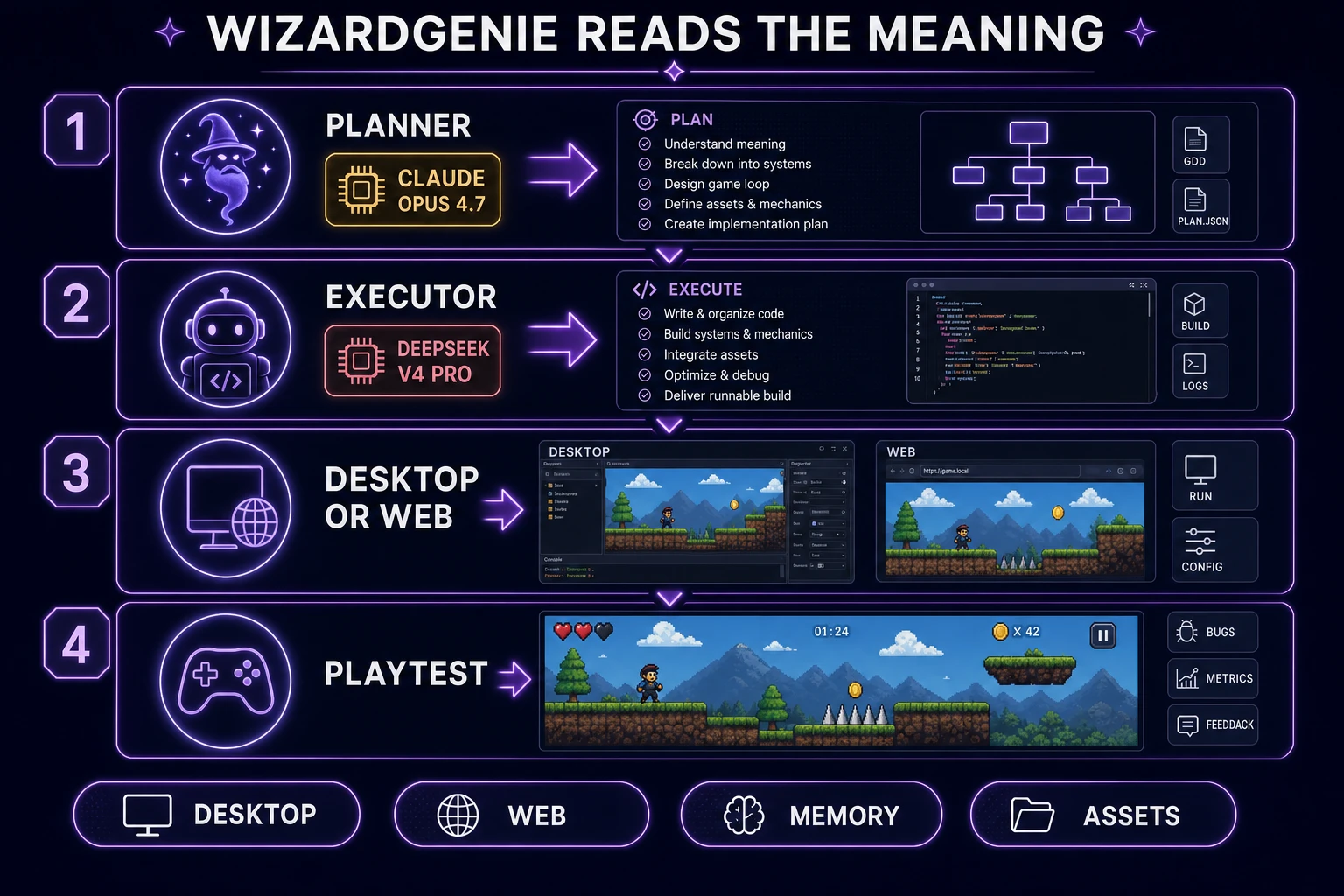
The same page names a dual-agent Planner plus Executor: a smarter model plans, a cheaper model types. The economic point of that split is to keep the typing side cheap. Acceptable planners in the current Sorceress coding roster are Claude Opus 4.7, GPT-5.5, Gemini 3.1 Pro, and Grok 4.2. Acceptable typers are DeepSeek V4 Pro, Kimi K2.5, and MiniMax M2.7. Claude Sonnet 4.6 is in the roster as “Fast + smart.” It is the wrong chair for the typing side, because a frontier-priced model on every keystroke removes the reason to split the work. The roster itself, verified 2026-09-21 in src/app/_home-v2/_data/tools.ts, is:

Model Tag on the home roster Sensible chair
Claude Opus 4.7 Top tier Planner
Claude Sonnet 4.6 Fast + smart Neither the default typer nor a reason to skip a cheap executor
GPT-5.5 Frontier Planner
Gemini 3.1 Pro 1M context Planner, especially when the project is already large
DeepSeek V4 Pro Budget Executor
Kimi K2.5 256K coding Executor
Grok 4.2 2M context Planner when the context itself is the problem
MiniMax M2.7 Agent-ready Executor

Vibe coding with Claude, as a search, usually means “put a Claude model in the planner seat.” That is a pairing, not the definition. Opus 4.7 can plan the jump-feel change. DeepSeek V4 Pro can type it. The page also lists Mem Palace and Graphify for memory across sessions, agentic web browsing for docs, and a voxel world builder plus VFX tools aimed at Three.js and Phaser. Sprites, images, and 3D sit in the same editor, which matters because a meaning that only covers source code still leaves the jam without art. AI Image Gen is the art counter beside the code.

Sorceress Code is the file-aware sibling for people who already have a folder. On 2026-09-21 the page stores API keys in localStorage only, with a comment that they are not sent to Sorceress servers. The saved provider slots are Anthropic, DeepSeek, OpenAI, and NVIDIA. Bring-your-own-key is how the roster above actually runs. WizardGenie is the game-shaped session. Code is the project-shaped session. Both are readings of the same phrase: language in, source out, you still own the files.

Vibe coding meaning on WizardGenie: planner, cheap executor, desktop or web, then a playtest
Planner thinks, a cheap model types, you run the build on desktop or web, then you ask for one visible change.

Misreadings that change the work

Four substitutions show up constantly, and each one swaps the vibe coding meaning for a different job.

  • No-code. Visual builders hide the program. Collins and IBM still name generated source. If you cannot open the file, you are in a different category.
  • Accept-all, forever. Karpathy limited that posture to throwaway weekend projects. IBM’s 2026 update puts review, tests, and security back on the path to anything you would call production. A jam you will patch on Monday is closer to the second sentence.
  • One model does every token. The phrase does not name a vendor. Vibe coding with Claude is a planner choice inside a longer loop. The typer should stay on a budget model from the roster above.
  • The chat is the game. MDN’s stack is still HTML, CSS, and JavaScript running in a browser. Until that loop plays, the conversation is a spec. The vibe coding meaning that matches a shipped jam is the one with a running page.

Wikipedia also records the security argument in general terms: unread generated code ships bugs the author cannot see, and the pattern is a poor fit for systems you must maintain. This page does not repeat third-party incident counts, because those numbers move and each incident report was not re-fetched on 2026-09-21. The durable point is already in the definitions. Optional understanding is a slang gloss. It is a bad operating rule for a game you intend to update.

The verdict

Vibe coding meaning, as of 2026-09-21, is three sentences wearing one label. Collins: natural language prompts an AI model to write code. The Merriam-Webster slang gloss, via Wikipedia: you need not understand the result. Karpathy: on a throwaway, you may stop reading the code. For an indie game, keep the Collins sentence, borrow Karpathy’s English, and decline the invitation to stay ignorant. Describe the loop, run it, and keep the files.

Open WizardGenie on desktop or on the web build, put a frontier model on the plan and DeepSeek V4 Pro, Kimi K2.5, or MiniMax M2.7 on the typing, and ask for one playable loop. If the project already lives in a folder, use Sorceress Code with your own key. Art for that loop starts in image generation. The rest of the suite is on Sorceress. Another essay about vibe coding meaning will not make the character jump. A playtest will.

Frequently Asked Questions

What is the vibe coding meaning in one sentence?

Vibe coding meaning, checked 2026-09-21 on the Collins Word of the Year 2025 post and on IBM’s page (updated 24 July 2026): you tell an AI model what you want in ordinary language, and the model writes the computer code. Andrej Karpathy coined the phrase in February 2025. His own note, quoted on the Wikipedia Vibe coding page the same day, goes further and says you can forget the code exists on a throwaway weekend project.

What does vibe coding mean for a browser game?

For a browser game, what does vibe coding mean is a described playable loop: input, update, and render in HTML, CSS, and JavaScript, which MDN names as the core web game stack (verified 2026-09-21). You judge the build by playing it. The source stays in the project so the next prompt can change a real file.

Is the vibe coding meaning the same as no-code?

No-code hides the program behind visual blocks. The Collins and IBM definitions still name generated source code. A vibe coding application for a jam is a folder of files you can open, not a diagram you cannot export.

How to vibe coding a small game without losing the source?

How to vibe coding a jam build: describe one playable loop, run it, then ask for one change at a time. Keep a frontier model on planning and a cheap model on typing. On Sorceress that split is WizardGenie’s Planner plus Executor, with DeepSeek V4 Pro, Kimi K2.5, or MiniMax M2.7 on the typing side (model list verified 2026-09-21 in the homepage coding roster).

Does vibe coding with Claude mean you only need one model?

Vibe coding with Claude names a planner, not the whole pipeline. The Sorceress coding roster, read 2026-09-21, includes Claude Opus 4.7 as a top-tier model and Claude Sonnet 4.6 as fast and smart. Putting either on every keystroke erases the reason to split planning from typing. Pair Opus 4.7, GPT-5.5, Gemini 3.1 Pro, or Grok 4.2 as the planner with a budget typer.

Sources

  1. Vibe coding - Wikipedia
  2. Collins Word of the Year 2025
  3. What is vibe coding? - IBM
  4. Game development - MDN
Written by Arron R.·2,119 words·9 min read

Related posts