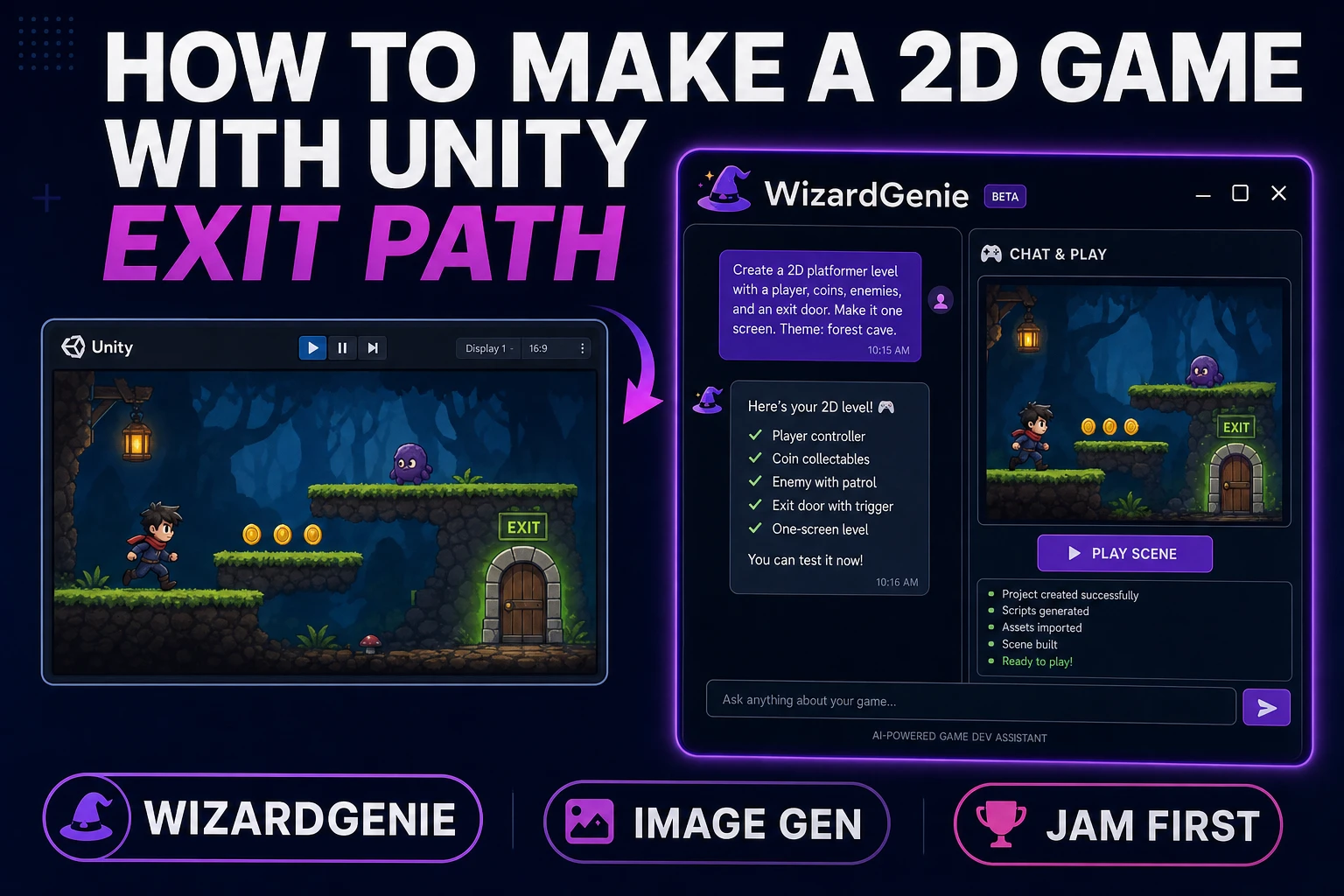
Boot How to Make a 2D Game With Unity (Exit Path)

By Arron R.8 min read
How to make a 2D game with Unity often starts as a weekend jam question. If Hub installs and editor setup are overkill, scaffold a one-screen browser slice in W

Searchers typing how to make a 2D game with Unity often want a playable weekend, not a career in Hub templates. This guide is the exit path: decide when a desktop engine is overkill for a jam, scope a one-screen fantasy, scaffold it in WizardGenie, swap grayboxes in AI Image Gen, and keep a later Unity export honest—without linking out to competitor tooling. Model lineup and Phaser v4.2.1 facts below were verified July 24, 2026.
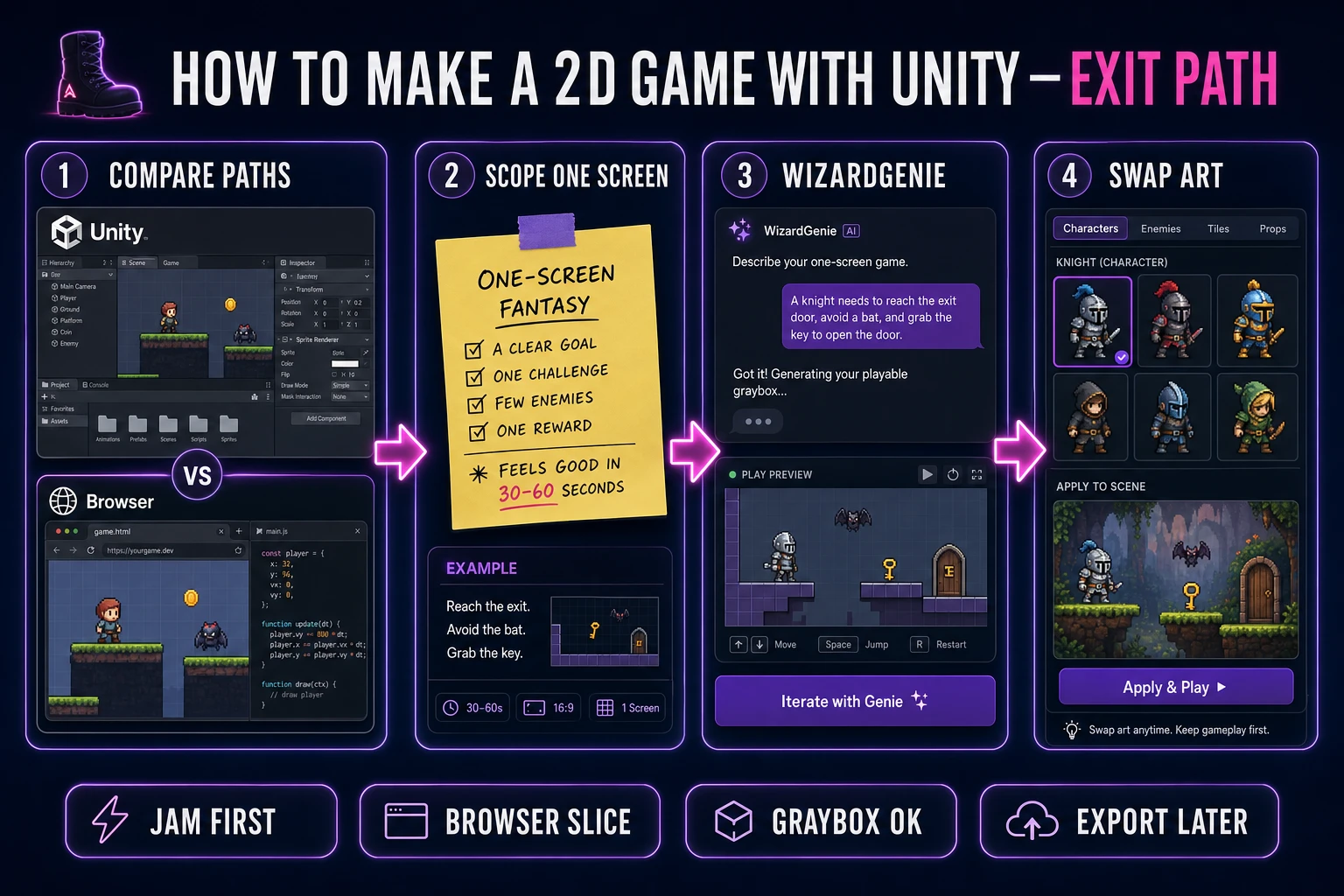
How to make a 2D game with Unity exit path pipeline from path compare through WizardGenie scaffold to art swap
Compare paths first, scope one screen, scaffold in WizardGenie, then swap art—export to a desktop engine only if the slice still needs it.

What how to make a 2d game with unity searchers compare

DataForSEO lists how to make a 2d game with unity at 260 monthly searches with KD 0 in research-supplement.md, verified July 22, 2026 (still the citation-grade row for this primary). Close siblings—how to make a 2d unity game (260/mo, KD 0) and how to make a 2d game unity (260/mo, KD 5)—share the same jam intent. The stricter how to make a 2d game in unity phrasing already has a dedicated in-editor sibling on this blog; this page owns the “with Unity” comparison: desktop setup versus a browser vertical slice.

Wikipedia’s Unity (game engine) article (live-checked July 24, 2026) frames Unity as a cross-platform C# engine popular with indie and mobile teams, with current Unity 6 mainline and LTS builds listed as of March 2026. That is real production software. It is also an install-and-learn tax that can consume a 48-hour jam before your first jump feels good.

Wikipedia’s 2D computer graphics page (live-checked July 24, 2026) reminds you what you are actually shipping: sprites, layers, and transforms—not an editor brand. If the fantasy is “one screen, one verb, one win,” the graphics problem is 2D readability; the tooling problem is whichever stack gets a stranger to that win fastest.

Write the comparison on a sticky note before you open anything:

  • Desktop path: Hub, editor version, 2D template, packages, first scene, first C# compile.
  • Exit path: browser HTML5 slice, linkable demo, graybox OK, art second.

If the sticky note says “I need a link people can click tonight,” you are already on the exit path. How to make a 2D game with Unity searchers who pick the desktop path for a one-screen fantasy usually lose Saturday to setup and Sunday to “why won’t the collider stick.”

When a desktop engine is overkill for a jam

A desktop engine is the right call when you already know you need console targets, a deep 2D package suite, or a team that lives in MonoBehaviours every weekday. It is overkill when your success metric is a five-minute playtest in a browser tab and a tweetable GIF.

MDN’s introduction to web game development (live-checked July 24, 2026) still sells the web as a first-class game platform: reach, update control, Web Audio, canvas/WebGL, and shareable URLs without an app-store middleman. Wikipedia’s HTML5 page (live-checked July 24, 2026) underscores the same canvas/audio stack that browser engines sit on.

Jam overkill signals:

  • You have never opened the editor and the jam ends in under 48 hours.
  • Your fantasy is one screen with one verb (jump, shoot, match, dash).
  • You need strangers to play without installing a build.
  • You are still deciding whether the idea is fun.

If three of those four are true, boot the exit path. You are not “quitting Unity forever”—you are refusing to pay the install tax before the fantasy earns it. Sibling posts on this blog already walk in-editor Unity pipelines for people who truly need that stack on day one.
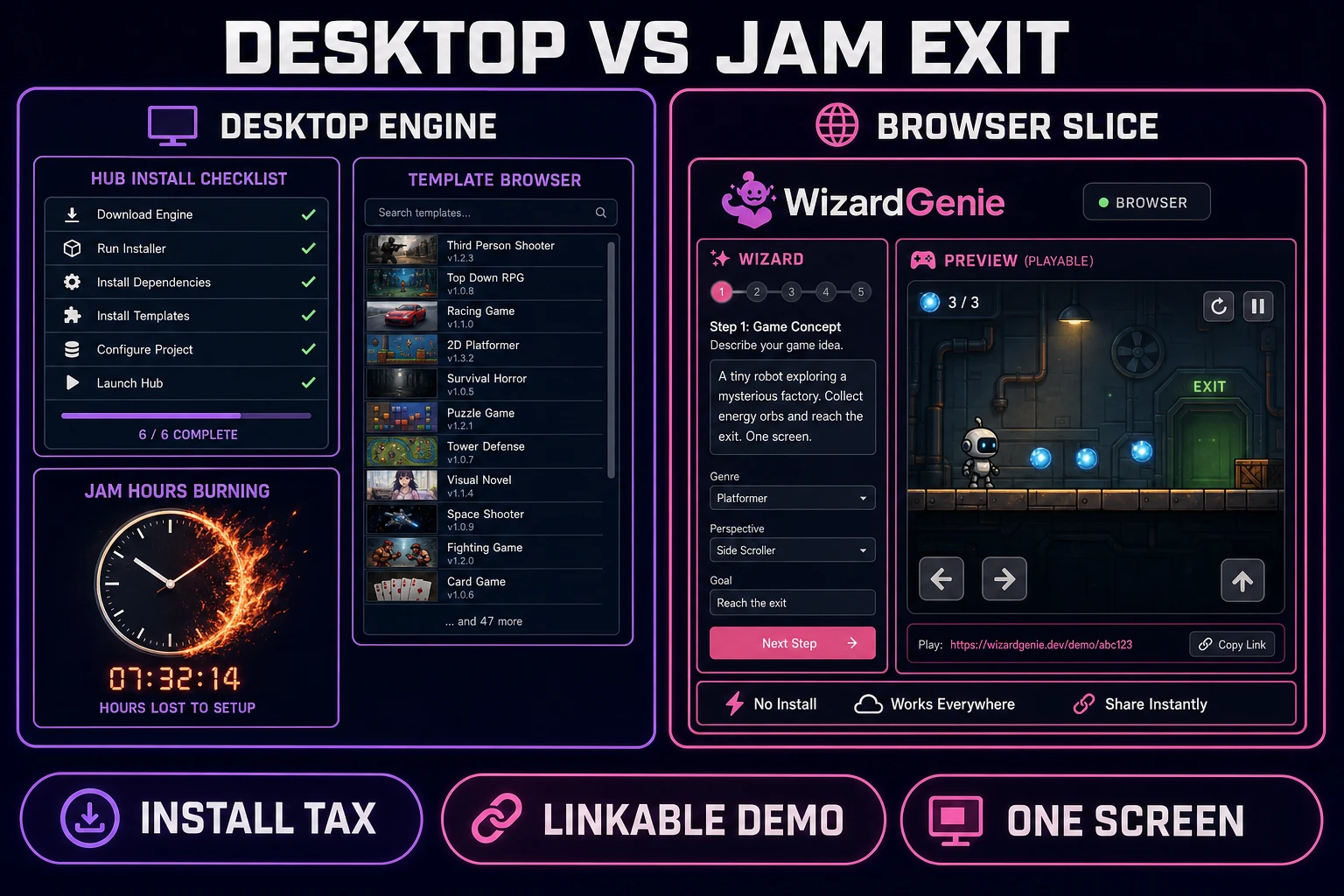
Scorecard comparing desktop engine install tax versus browser jam exit for a 2D vertical slice
Desktop install tax versus browser jam exit—pick the path that matches the weekend clock.

Scope a one-screen fantasy

Name the fantasy in one sentence a stranger can repeat: “Rooftop dash, one gap, land on the neon ledge.” That sentence becomes the WizardGenie prompt spine and the playtest pass/fail. If you cannot say it in one breath, the slice is still too big for how to make a 2D game with Unity as a weekend question.

Lock three hard limits:

  • One screen: no world map, no hub travel, no second biome.
  • One verb: jump, shoot, or match—not all three.
  • One win: reach the flag, clear the wave, or fill the meter once.

Also decide what you will not build: inventory, crafting, multiplayer, dialogue trees, save slots. Those systems are how jam prototypes die while the jump still feels muddy. Time-box the fantasy to a Sunday evening checklist; if the pitch needs a prologue dungeon and a capital city, cut the prologue.

Draw the screen as boxes, not art. Mark spawn, hazard, and win zone. Write collision rules in plain language (“solid platforms, one moving hazard, death resets to spawn”). That paper sketch is cheaper to rewrite than a half-finished editor scene.
Scaffold in WizardGenie instead

Open WizardGenie on web or desktop and describe the slice contract, not a marketing trailer. WizardGenie is Sorceress’s AI-native game engine: you describe the game; it writes, runs, and iterates in real time. Coding models available (verified July 24, 2026 in CODING_MODELS): Claude Opus 4.7, Claude Sonnet 4.6, GPT-5.5, Gemini 3.1 Pro, DeepSeek V4 Pro, Kimi K2.5, Grok 4.2, and MiniMax M2.7—bring your own API key or use the trial fallback.

Prompt like a producer: “Browser 2D vertical slice. One screen rooftop dash. Jump only. One moving hazard. Win on neon ledge. Graybox art OK. Reset on fall.” Iterate on sticky collisions and unfair spawns before you mention particle polish.

If the scaffold targets Phaser, pin Phaser v4.2.1 “Giedi” (released July 9, 2026; GitHub release notes live-checked July 24, 2026) in the prompt so the agent does not invent APIs from older training cutoffs. Browser HTML5 remains a first-class distribution path—MDN’s web games introduction (live-checked July 24, 2026) still frames reach and update control as the core win.

If you use a Planner+Executor pairing, keep the expensive reasoner as Planner and a cheap fast model as Executor (DeepSeek V4 Pro, Kimi K2.5, or MiniMax M2.7). Putting a frontier model on the typing side erases the cost advantage that makes dual-agent work worth running.

Stay inside the slice contract. When the agent offers a second screen, a shop, or a dialogue system, refuse politely and restate the one-sentence fantasy. The redo tax from scope creep is what kills how-to-make-a-2D-game-with-Unity weekends—not the first hour of careful systems.

Swap grayboxes for art

Grayboxes prove systems; silhouettes sell the fantasy. Open AI Image Gen once walk, jump, and win already play. Generate a tight pack: hero idle/run read, one hazard silhouette, one win-flag or ledge prop, and a simple backdrop strip. Prompt with the same art direction string on every card—“flat indie 2D, hard edge silhouettes, no soft photographic bokeh”—so the screen does not look like five different games.

Name files with role baked in: hero_run.png, hazard_spinner.png, prop_neon_ledge.png. Drop them into the WizardGenie project and ask the agent to swap grayboxes without changing collision or win IDs. If a silhouette fails at play scale, regenerate that one card—do not repaint the whole pack because one hazard looked cute instead of threatening.

Defer tileset perfection. Readable platforms with solid collision beat a beautiful map that soft-locks the win zone. When you are ready for floor packs later, route through Tileset Forge; for this slice, keep art budget on the hero and the hazard you actually touch.

If you need a walk cycle sheet instead of stills, sibling sprite-sheet posts on the blog cover that path—do not derail the jam into atlas perfection before the jump feels fair.

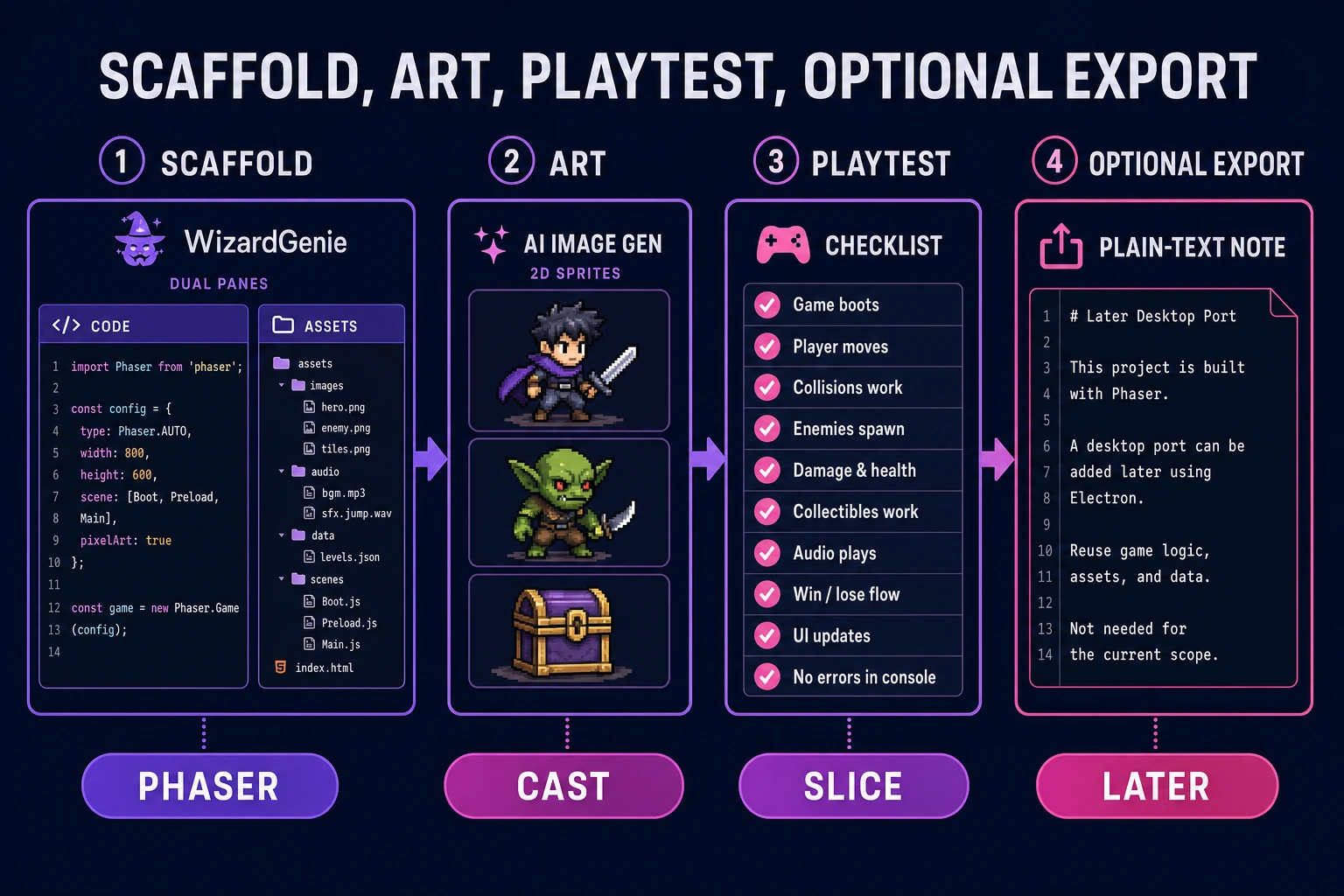
Pipeline from WizardGenie 2D scaffold through AI Image Gen art into playtest checklist and optional later desktop export
Scaffold, art, playtest, optional export—expand systems only after the checklist passes.

Keep an honest Unity export option

The exit path is not “never use Unity.” It is “earn the desktop install.” After the browser slice plays cold, you can still port: keep collision sizes, spawn rules, and win conditions identical, then rebuild the same one-screen fantasy in a desktop project when consoles, deep 2D packages, or a C#-first team require it. Wikipedia’s Unity page (live-checked July 24, 2026) remains the neutral reference for what that engine family is—this article will not deep-link competitor docs or stores.

Honest export rules:

  • Port systems that already feel good—do not invent new verbs during the first port.
  • Carry the same one-sentence fantasy; if the pitch grows, that is a new project.
  • Keep art as PNG sprites so either stack can import them.
  • Schedule the port after the jam ships, not during the jam.

If you already live in Unity daily and only wanted AI help for sprites and C#, use the in-editor sibling guide instead. This page exists for how to make a 2D game with Unity searchers who would rather ship a linkable slice tonight.

Cost math for a weekend slice

Budget feel, not fantasy. A disciplined exit-path weekend looks like:

  1. Graybox scaffold in WizardGenie on your own API key (coding traffic stays on BYOK).
  2. One focused AI Image Gen pack for hero, hazard, and win prop—stop after the silhouettes read at play scale.
  3. Cold playtest until spawn → verb → win is boringly reliable.
  4. Optional desktop export only if the jam result still needs console targets or a C#-first pipeline.

Play the slice cold, as if you never wrote the prompt. Check these gates before adding systems: you can move without soft-locking; the verb works every attempt; the win fires once; falling or failing resets cleanly; art did not break collision. Record one take. If any gate fails, fix that gate in WizardGenie before generating more art.

Invite one friend for a five-minute run with no coaching. Watch where they stand still. Confusion at the spawn is a UI problem; confusion at the hazard is a readability or timing problem. Fix the stillness, not the lore dump.

Keep a reject log: “gap too wide,” “hazard invisible on backdrop,” “win zone soft,” “reset too slow.” Fix the top three before you spend another Image Gen batch. The log is how you stop arguing about themes while the jump still feels sticky.

When systems outgrow the jam, keep the browser slice as the design source of truth. Porting later is cheaper when the one-screen fantasy is already honest. For a fuller catalog of how Sorceress tools chain after this slice, see the Tools Guide. Sibling how-to posts cover platformer, RPG, and in-editor Unity phrasings—this page stays on the how to make a 2D game with Unity exit path you can finish before Monday.

Frequently Asked Questions

What does how to make a 2D game with Unity mean for a weekend jam?

Most searchers want a playable one-screen fantasy this weekend, not a full Hub-plus-editor career setup. If install time and project templates would eat your jam hours, scaffold a browser HTML5 slice in WizardGenie first, prove walk/jump/win, then decide whether a desktop engine export is still worth it.

Is this guide teaching Unity Editor steps?

No. This page is the exit path for how to make a 2D game with Unity search intent when a desktop engine is overkill for the jam. Sibling posts already cover in-editor Unity pipelines. Here Unity is named in plain text only; you build the slice in WizardGenie and AI Image Gen, then keep an honest later-port option.

Which WizardGenie coding models can scaffold a 2D browser slice?

Verified against src/app/_home-v2/_data/tools.ts CODING_MODELS on July 24, 2026: Claude Opus 4.7, Claude Sonnet 4.6, GPT-5.5, Gemini 3.1 Pro, DeepSeek V4 Pro, Kimi K2.5, Grok 4.2, and MiniMax M2.7. For Planner+Executor work, keep the expensive reasoner as Planner and a cheap model (DeepSeek V4 Pro, Kimi K2.5, or MiniMax M2.7) as Executor.

Which Phaser version should I pin if the scaffold targets Phaser?

Phaser v4.2.1 “Giedi” (released July 9, 2026) was live-checked on the official GitHub release notes on July 24, 2026. Pin that version in your WizardGenie prompt so the agent does not invent APIs from older training cutoffs.

When should I still use a desktop Unity project?

When you already need console targets, deep 2D package suites, or a team that lives in C# MonoBehaviours every day. Wikipedia’s Unity (game engine) page (live-checked July 24, 2026) lists current Unity 6 mainline/LTS builds as of March 2026—real production work belongs there. A jam slice that only needs a linkable demo belongs in the browser first.

Sources

  1. Unity (game engine) — Wikipedia
  2. 2D computer graphics — Wikipedia
  3. HTML5 — Wikipedia
  4. Introduction to game development for the Web — MDN
  5. Phaser v4.2.1 release notes — GitHub
Written by Arron R.·1,742 words·8 min read

Related posts