Bank Character AI Generator (Party Lock 2026)

By Arron R.10 min read
A game-side character AI generator job is a party lock: seed one face in Sorceress AI Image Gen, keep it on-model with the reference panel, clean cards in free

People who type character AI generator into a search box in 2026 land on two very different rooms. One room is the Character.AI chatbot brand and its roleplay wiki; the other is a game-dev workshop that needs a locked party roster — four faces that survive a second prompt, a shared palette, and files that can end up on a tabletop or inside an engine. This page belongs to the second room. It treats the query as a shipping problem: what the search actually wants, how Sorceress AI Image Gen holds a face on-model, how free Canvas stamps a card without burning credits, when Auto-Sprite v2 earns a Pro sheet, and the wallet math verified against source today.
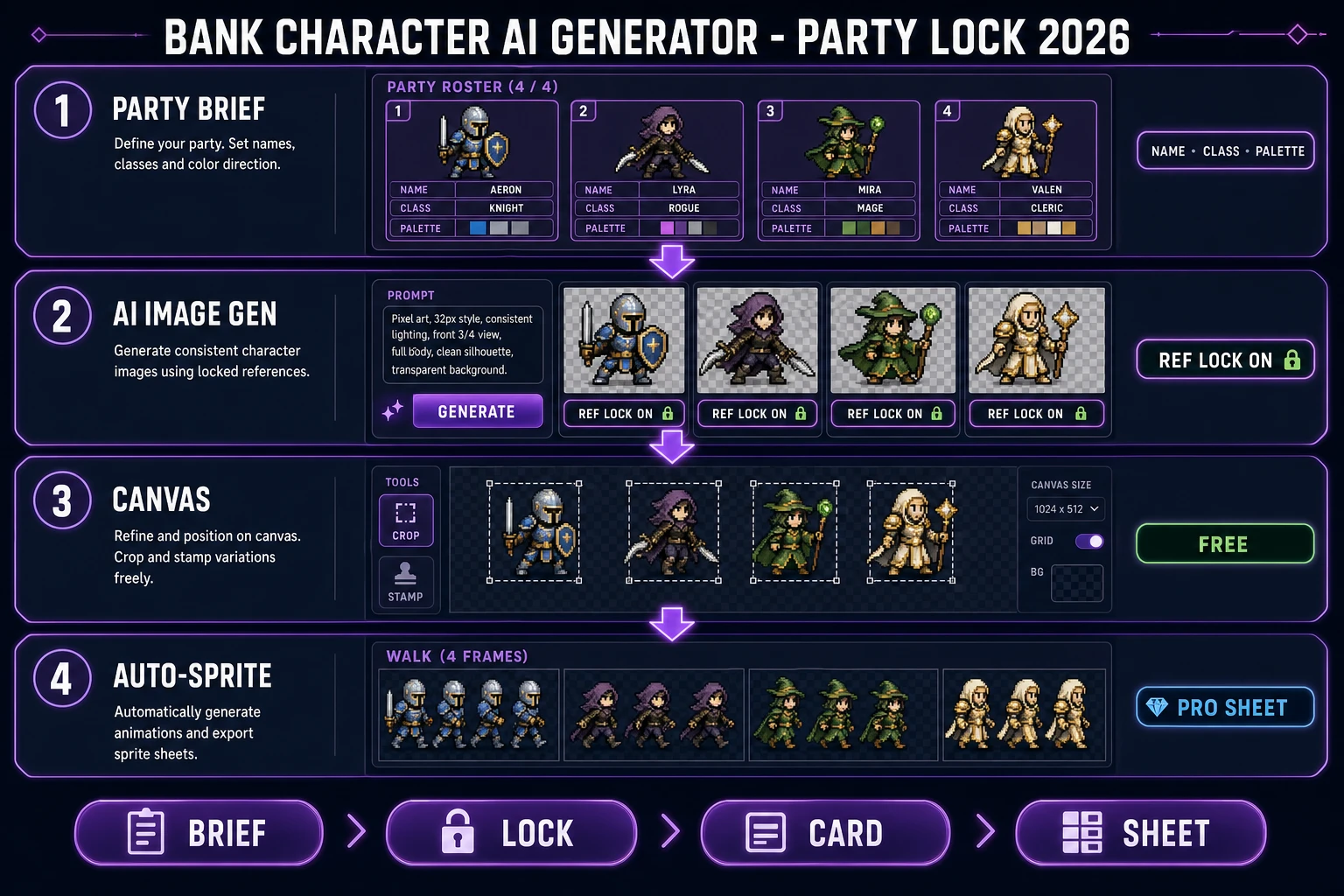
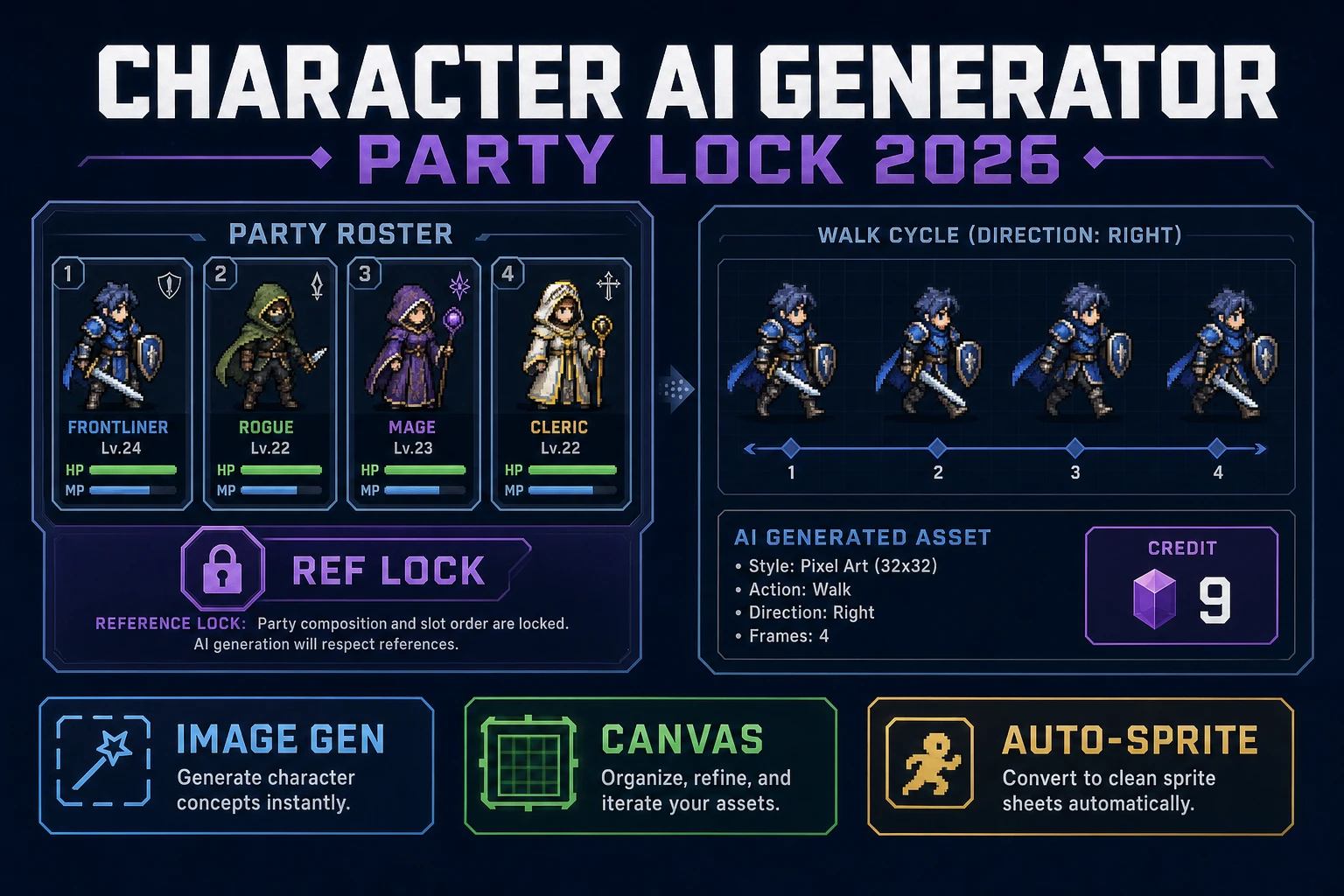
Character AI generator party lock pipeline: brief, AI Image Gen ref lock, Canvas card, Auto-Sprite sheet
Character AI generator reframed as a party lock: brief the roster, seed one face, keep the party on-model, and only cast motion when the game actually needs it.

What a character AI generator search actually wants

DataForSEO lists character ai generator at 880 searches a month with KD 21 (confirmed in tools/research-supplement.md, verified 2026-09-29 pull). The sister phrase ai character generator sits at a much higher head volume — that variant already has its own roster-lock post. This page stays on the reversed word order, because the intent skews harder toward Character.AI-adjacent traffic and toward searchers who want a generator for their game party, not another one-off portrait.

Two audiences share this query. The first is chatbot traffic looking for Character.AI, the roleplay conversation product; we mention it in plain text, do not deep-link out, and let readers who want a bot leave without a fight. The second audience — the one this page is for — is building a game or a tabletop cast and needs consistent art. Wikipedia's non-player character page (verified 2026-09-29) frames NPCs as any character not controlled by a player: quest-givers, shopkeepers, party members, monsters. Every NPC brief has the same production question underneath it — can we redraw this character tomorrow without the face drifting?

Wikipedia's model sheet article (verified 2026-09-29) names the traditional answer: standardize appearance, poses, and gestures so collaborators stay on-model. Indie AI workflows do not skip that need; they relocate it into reference images and a shared prompt prefix. The text-to-image model overview (verified 2026-09-29) notes that modern systems condition on text embeddings and can latch onto a small set of concept images — that is the technical spine under party lock.

Adjacent Sorceress angles already on the blog: see AI character generator roster lock for the head query, AI DnD character generator roster card for the tabletop long-tail, AI character image generator sprite pack for the sprite-first framing, and AI 3D character generator for the 3D fork. This page stays on the plain character ai generator long-tail and on party-lock intent.

Reference lock in AI Image Gen

AI Image Gen is the featured panel for this workflow. The home card (verified 2026-09-29 in src/app/_home-v2/_data/tools.ts) lists Nano Banana Pro, GPT Image 2, Grok Imagine, Seedream 5 (uncensored), Flux 2 Pro, Z-Image Turbo, and more behind one prompt field and one gallery. For a character AI generator session, start with a deterministic seed prompt: class or role, silhouette, palette, one prop, one voice hook, plain background. Do not improvise cloak adjectives between takes; that is how a party stops looking like the same party.

Base credits checked today in src/lib/models.ts (verified 2026-09-29):

Model Base credits Best fit for a character AI generator card
Z-Image3Silhouette drafts and cheap volume before the lock
Nano Banana 2 Lite4Lighter Nano Banana 2 lane for iteration
GPT Image 25Dense in-image text and sharp card art
Flux 2 Pro6 (+3 per ref)Painterly fantasy heroes
Nano Banana / Seedream 5 Lite6Mid-tier party variants
Nano Banana 29Default locked roster workhorse (up to 14 refs)
Nano Banana Pro18Hero card when fidelity beats cost

New accounts start with SIGNUP_GRANT = 100 free credits (src/app/api/admin/credits/route.ts). CREDITS_PER_DOLLAR = 100, so one credit is one US cent on the top-up ledger. Pick the seed model before you invent a second outfit — the cheap lane is for finding a face; the 9- and 18-credit lanes are for keepers you are actually going to lock.

After the first keeper lands, drop that PNG into the reference panel and generate every follow-up pose against it. Reference maxima from src/lib/models.ts today: Nano Banana max 3, Nano Banana Pro max 8, Nano Banana 2 max 14, GPT Image 2 max 16, Flux 2 Pro max 8 with refImageCredits: 3 per extra image. Keep the prompt prefix identical. Change only the pose line. If hair length or cloak color drifts, you loosened the prefix or swapped models mid-roster — reset to the seed reference and rerun.

Name files before the queue finishes: ranger_seed.png, ranger_idle_01.png, merchant_seed.png. A gallery full of untitled thumbnails is how a character AI generator party quietly dies between sessions. The sprite article (verified 2026-09-29) still describes sprites as independently movable 2D bitmaps composited into a scene; a folder of untitled portraits cannot become independently movable anything.
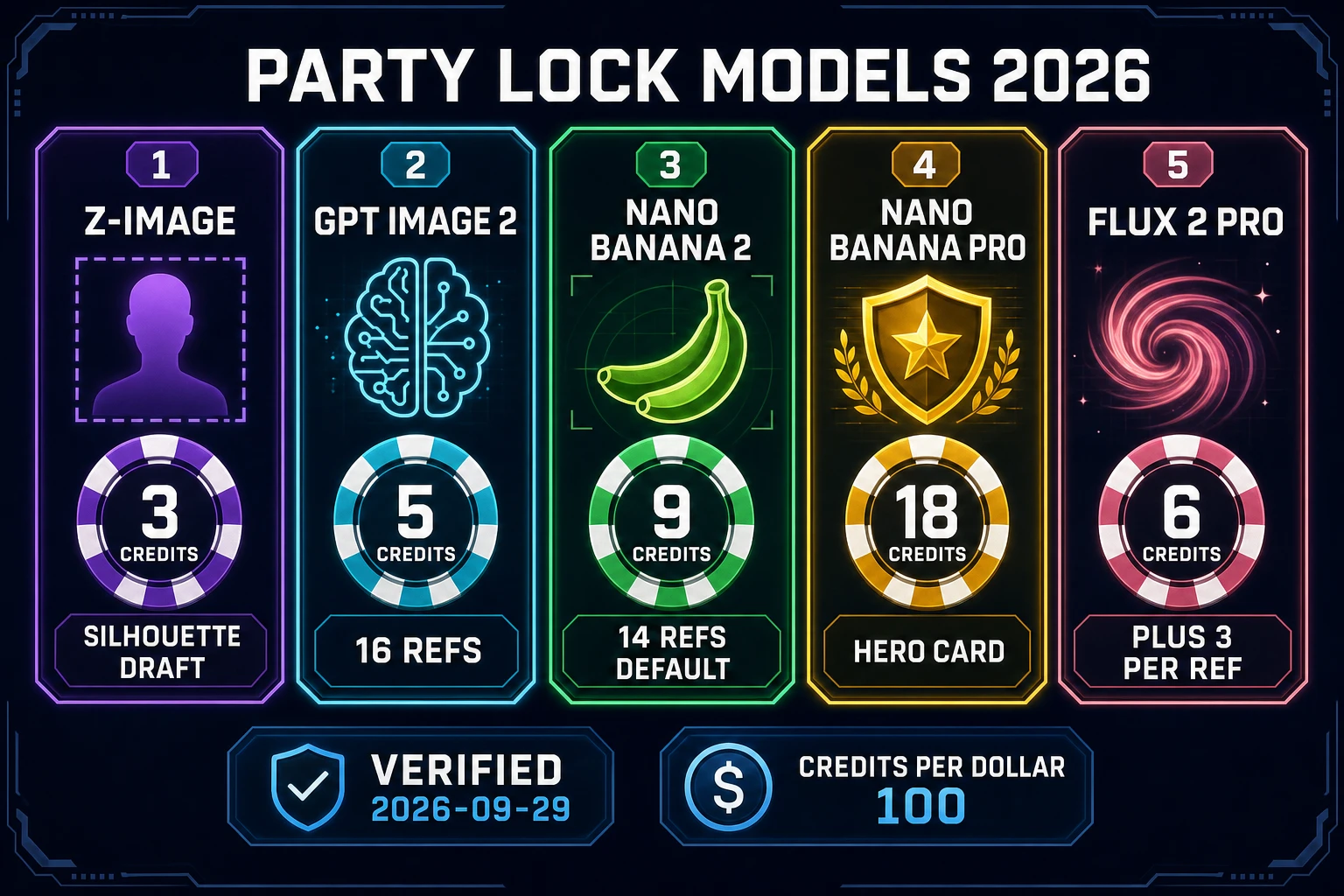
Character AI generator party lock model cards with credit chips from 3 to 18 credits
Character AI generator lanes inside AI Image Gen: Z-Image at 3 credits for silhouettes up to Nano Banana Pro at 18 for hero cards, verified 2026-09-29.

Stamp party cards in Canvas

A diffusion keeper is not yet a card. Open Canvas — the home more-tools card calls it a quick, easy in-browser image editor and badges it Free (verified 2026-09-29 in src/app/_home-v2/_data/tools.ts). Crop to a consistent frame, erase stray background crumbs, and stamp a simple name or role label if the portrait needs to read at token size. Do not ask Canvas to invent a new face; treat it as the production cleanup bench between AI Image Gen takes.

Useful card habits for a character AI generator export: same canvas size for every party member, centered subject, no baked ground shadow that becomes a second silhouette when you stamp tokens, and a flat backdrop you can cut later. MDN's image file type guide (verified 2026-09-29) still treats PNG as the browser-friendly format with optional transparency — keep keepers as PNG before you fork into tokens or sprites.

When you need true alpha for engine import or party UI slots, open BG Remover at a flat BG_REMOVER_CREDITS = 3 per image (verified 2026-09-29 in src/app/bg-remover/page.tsx). Cut once on approved faces, then stop regenerating backgrounds inside the diffusion model. Canvas is free touch-up; BG Remover is the paid alpha pass; Image Gen is the paid generation. Never charge readers for a step Canvas already does for zero credits.

A common trap for character AI generator sessions is stamping party labels inside the diffusion prompt. Do not. Generation models still hallucinate text at any size, and a portrait with garbled letters becomes garbage the second a translator or an engine renders it. Stamp text with real fonts in Canvas after the face is locked. That single habit removes an entire class of retry loops from the pipeline.
Cast walk sheets with Auto-Sprite v2

Portraits do not walk. When the same character AI generator cast needs motion for a jam build or a trailer, open Auto-Sprite v2. The home card (verified 2026-09-29 in src/app/_home-v2/_data/tools.ts) describes the pipeline in order: AI image generation creates the character, AI video brings it to life, then Auto-Sprite converts the clip into a clean, game-ready sprite sheet. The Sprites and 2D tile badges the tool Pro — plan for a Pro-capable account before you promise a whole team that everyone can open the same lane.

Cloud Corridor Key math inside Auto-Sprite (verified 2026-09-29 in src/app/autosprite-v2/page.tsx): 1 credit per 10 frames when the working size is 512 or below, or 2 credits per 10 frames above 512. VIP members get Cloud GPU free on that path; non-VIP math is unchanged. Budget AI image and AI video generations as separate line items when you use the full three-step pipeline, then treat the sprite-ify step as the Pro workflow that turns the clip into a sheet.

Do not ask Auto-Sprite to invent a new face. Feed it a locked, cleaned portrait and treat the sheet as motion, not redesign. Soft silhouettes and melted hands are almost always a seed problem, not a sheet problem — re-lock the 2D reference before you burn another video pass. When a locked variant still drifts, do not jump straight to Nano Banana Pro at 18 credits either. Re-attach the seed, shorten the pose line, and retry Nano Banana 2 at 9 credits. Reserve the expensive hero lane for the face you already trust.

If you need a cheaper still-only pixel row without the video fork, Quick Sprites sits at CREDITS_PER_GEN = 9 (verified 2026-09-29 in src/app/quick-sprites/page.tsx). Keep Auto-Sprite as the featured motion path for the character AI generator brief; use Quick Sprites when the party only needs a short idle or walk strip generated from a still prompt. For a video- or image-in path that outputs a pixel atlas, True Pixel is the other Pro-badged option — its own card lists chroma keying, edge cleanup, and batch processing.

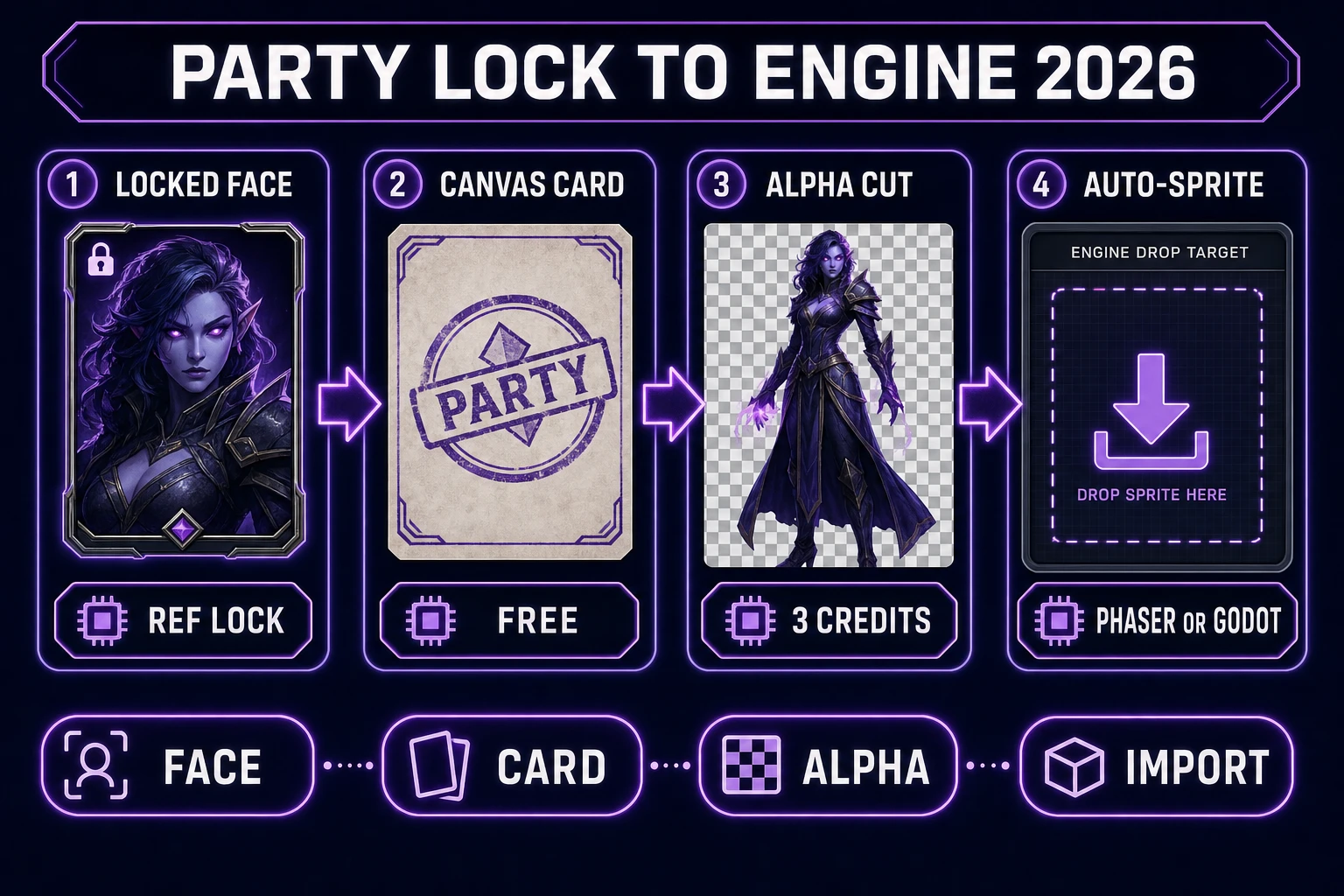
Character AI generator engine handoff: locked face, Canvas card, alpha, Auto-Sprite sheet to engine drop target
Honest engine fork after a character AI generator lock: free Canvas card, alpha at 3 credits, Auto-Sprite Pro when motion is on the critical path.

Engine handoff: from PNG to game

Not every character AI generator search needs a walking sprite. Split the job honestly:

  • Party UI portrait — locked face + Canvas crop, same size across four faces, shared palette. Stop there. You are shipping a readable roster panel, not an atlas.
  • Tabletop token — same lock, square crop, then BG Remover for true alpha. Drop the PNG into your VTT of choice; no motion is needed.
  • Playable 2D cast — locked PNG into Auto-Sprite (or Quick Sprites for a still row) into a transparent PNG sheet. Only now does motion earn its credit burn. Import into your engine with the frame size matched to your tile grid.

For the engine step itself, the two friendliest browser-first paths are Phaser and Godot; both accept a transparent PNG atlas with a fixed grid. Sorceress does not link out to competing engines from body copy, but the file shape is standard — a 4×4 or 4×6 PNG with equal tile size is understood by any modern 2D pipeline. If the target is a web build, MDN's image-type guide is the right factual ground; if the target is an engine importer, the frame size is a shared contract between the atlas and the animation player.

Refuse off-model keepers before they enter the cast folder. If the fighter and the wizard share a folder of untitled final_v7 PNGs, you do not have a roster — you have a regenerate loop. Stamp the card in Canvas, lock the reference in AI Image Gen, and let a scan of the folder tell you at a glance whether the party is on-model.

Credit math for a party-lock session

Quote wallet numbers from source, not marketing memory. CREDITS_PER_DOLLAR = 100 in src/lib/models.ts. SIGNUP_GRANT = 100 in src/app/api/admin/credits/route.ts. Both checked 2026-09-29.

Session plan Image line Cleanup Motion Total USD at 100 cr/$
1 Nano Banana 2 seed only90 (Canvas Free)09$0.09
1 seed + 3 locked party variants360036$0.36
4 faces + BG Remover alpha cuts3612048$0.48
Same + 1 Quick Sprites walk row3612957$0.57
Hero Nano Banana Pro card only180–3018–21$0.18–$0.21

Auto-Sprite v2 sits behind the Pro badge — do not tell readers it is a free credit burn. Budget image and video generations as separate line items, then add Corridor Key math (1 credit per 10 frames SD, 2 per 10 HD) when you key the clip in-cloud. Canvas remains the free cleanup bench between generations. A four-face party with a single walk row lands at 57 credits ($0.57) before any cloud keying, which the 100-credit signup grant covers with room to test.

A practical checklist before you click Generate on a character AI generator run: write the six-field prefix (name, role, silhouette, palette, prop, voice hook), seed one face on Nano Banana 2 or Z-Image, lock the keeper as reference, refuse off-model keepers, clean the card in Canvas, cut alpha only on approved faces, and open Auto-Sprite only when motion is on the critical path. Soft silhouettes are a crop problem; palette drift is a prompt-prefix problem; melted sheet frames are a seed problem. Fix the right layer instead of escalating credits.

Verdict: bank a locked party, not a chatbot session

A clean character AI generator session on Sorceress in 2026 ends with files, not conversations. The finished shape is a locked folder of on-model portraits, a small stack of party cards, optionally a set of alpha tokens, and — only when motion is on the critical path — a transparent PNG sheet ready for an engine.

  1. Capture the party brief in plain notes (name, role, silhouette, palette, prop, voice hook) — treat that as the prompt prefix from now on.
  2. Open AI Image Gen, seed with Nano Banana 2 at 9 credits (or Z-Image at 3 credits for silhouette drafts), then lock the keeper as a reference for every follow-up pose.
  3. Clean cards in free Canvas, cut alpha on keepers in BG Remover at 3 credits each when tokens need transparency.
  4. If the party needs motion, cast sheets in Auto-Sprite v2 (Pro pipeline) or a Quick Sprites row at 9 credits for a still-prompt strip.
  5. Import the transparent PNG sheet into your engine or drop the party card straight into a tabletop stack.

That is the whole job character AI generator searchers on the game-dev side of the query are buying: not another chatbot tab, not another randomizer tour, but a face that survives the next prompt and a folder of party files that can sit on a table or enter a game. Lock once, stamp the roster, and only then decide whether the cast also needs a walk cycle.

Frequently Asked Questions

What does a character AI generator search actually want?

It depends on the searcher, but for game devs a character AI generator query is a party-lock problem, not a chatbot. DataForSEO lists character ai generator at 880/mo with KD 21 (tools/research-supplement.md, verified 2026-09-29). Some of that volume belongs to the Character.AI chatbot brand, which is a different product and does not draw sprites or ship game assets. The game-dev slice needs a face that survives a second prompt, a consistent party palette, and files an engine or tabletop can actually import.

How does a character AI generator stay on-model across a whole party?

Reference lock, not luck. Seed one keeper in Sorceress AI Image Gen at /generate, drop that PNG into the reference panel, then reuse the same deterministic prompt prefix for every follow-up pose. Reference maxima (verified 2026-09-29 in src/lib/models.ts): Nano Banana 2 up to 14 refs, Nano Banana Pro up to 8, GPT Image 2 up to 16, Flux 2 Pro up to 8 with 3 credits per extra reference. Vary only pose or camera. That is the whole party lock.

Is Canvas actually free for character AI generator cleanup?

Yes for the editor surface. The home more-tools card badges Canvas as Free (verified 2026-09-29 in src/app/_home-v2/_data/tools.ts). Crop keepers, erase stray background crumbs, and stamp a simple roster-card layout without burning image credits. Image Gen and Auto-Sprite still bill their own credit or Pro lanes; Canvas does not invent free diffusion generations.

When should I open Auto-Sprite v2 for a character AI generator brief?

When the roster needs motion, not another still. Auto-Sprite v2 is a three-step pipeline: AI image, AI video, then sprite sheet (verified 2026-09-29 in src/app/_home-v2/_data/tools.ts). The card badges it Pro under Sprites and 2D. Cloud Corridor Key math is 1 credit per 10 frames at working size 512 or below, or 2 credits per 10 frames above 512 (src/app/autosprite-v2/page.tsx). For still-only walk strips from a prompt, Quick Sprites at 9 credits per row is the cheaper lane.

How much does a four-face character AI generator party cost on Sorceress?

Verified 2026-09-29 against source: Nano Banana 2 is 9 credits per image, BG Remover is 3 credits per image, CREDITS_PER_DOLLAR = 100, SIGNUP_GRANT = 100. A one-seed plus three locked variants costs 36 image credits. Cutting alpha on four keepers adds 12 credits. Total 48 credits or .48 before any Auto-Sprite video or keying. Canvas touch-ups stay on the Free badge.

Sources

  1. Model sheet - Wikipedia
  2. Non-player character - Wikipedia
  3. Sprite (computer graphics) - Wikipedia
  4. Text-to-image model - Wikipedia
  5. Image file type and format guide - MDN
Written by Arron R.·2,338 words·10 min read

Related posts