Vibe Coding Jobs in Indie Game Dev (Portfolio 2026)

By Arron R.12 min read
Vibe coding jobs in 2026 split into four honest roles — prompt engineer, AI pair programmer, prototype coder, and dual-agent orchestrator — and the hiring signa

A vibe coding jobs search in 2026 is not idle curiosity — it’s a career question. The term vibe coding went from a Twitter joke in 2024 to a line on Upwork listings and indie-studio hiring threads inside eighteen months, and 1,300 people a month now type the phrase into Google looking for a map. This guide answers the question honestly: what the role actually looks like in indie game dev, where the work is posted, which skills employers really test, and a 90-day practice plan with real credit math on the Sorceress WizardGenie dual-agent stack. Every number is pulled live on 2026-10-02.
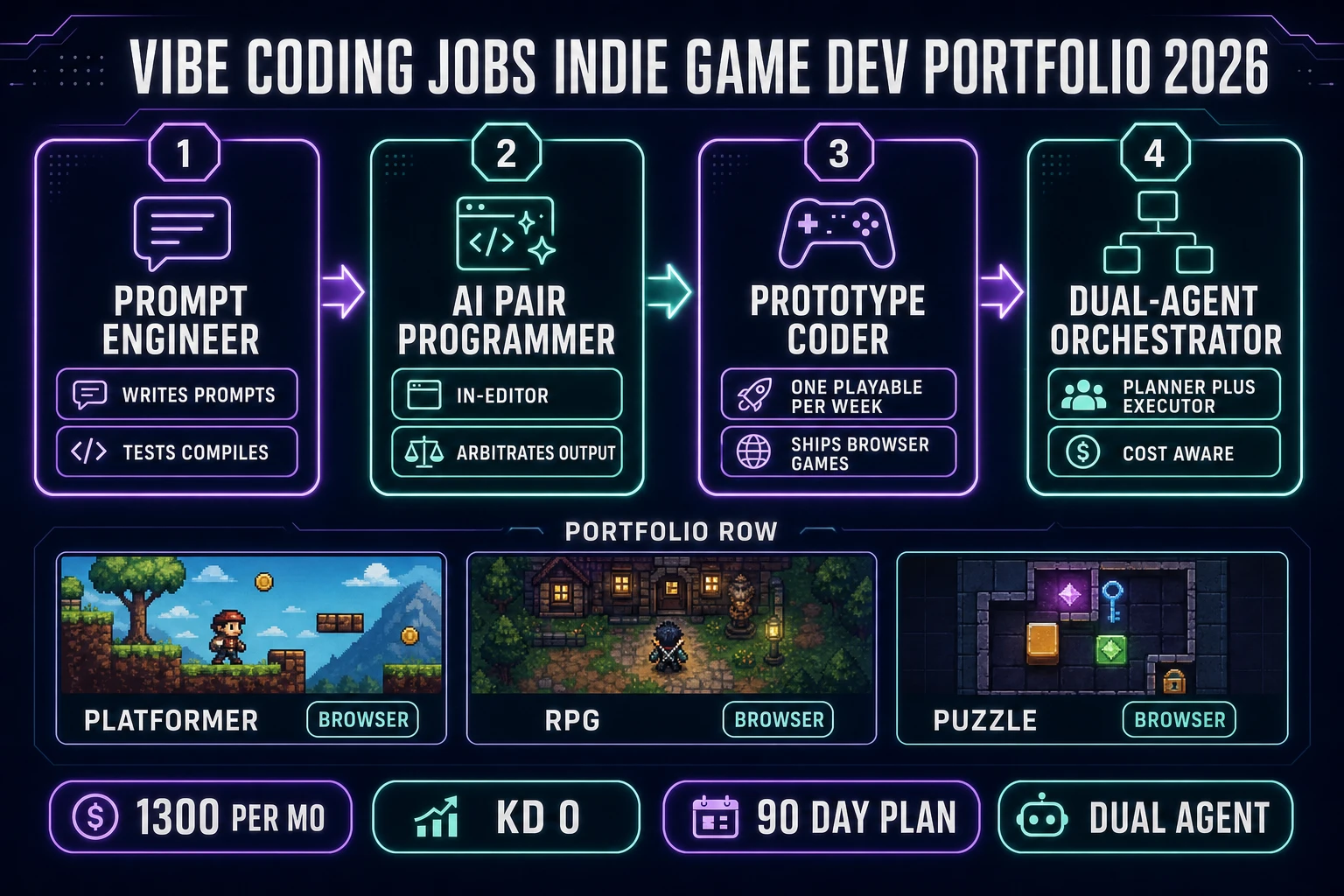
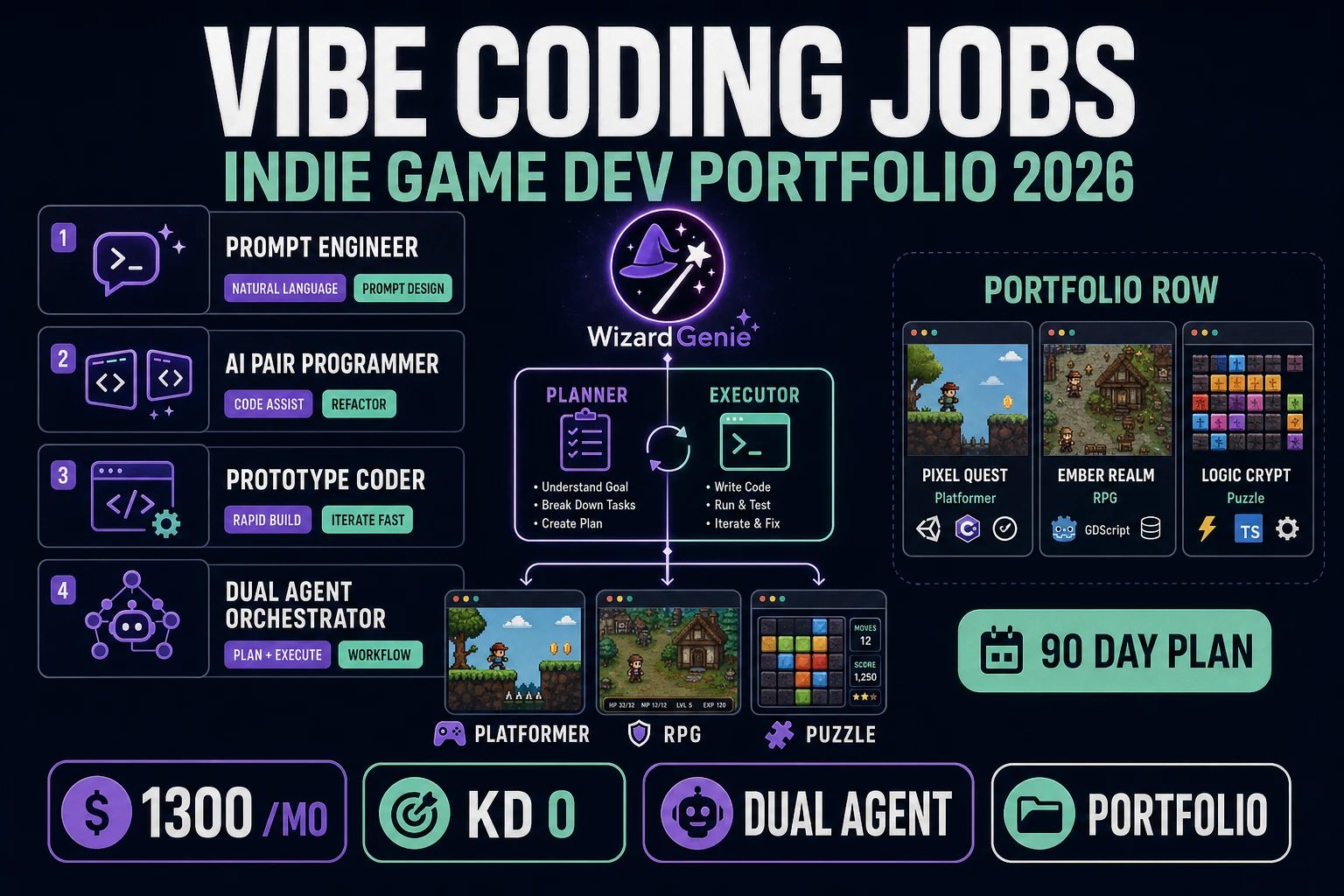
Vibe coding jobs in indie game dev split into four roles: prompt engineer, AI pair programmer, prototype coder, and dual-agent orchestrator, with a portfolio row showing platformer RPG and puzzle browser games
Vibe coding jobs in 2026 split into four honest roles. The hiring signal across all four is a public portfolio of shippable browser games with cost writeups.

What people searching “vibe coding jobs” actually want

DataForSEO lists vibe coding jobs at 1,300 searches a month, KD 0, competition 0.23, intent informational (verified 2026-10-02 in tools/research-supplement.md, seed vibe coding). The parent cluster vibe coding sits at 110,000/mo but KD 56 — dominated by tutorials, think pieces, and definition articles. The jobs sibling is a long-tail unlock: much lower difficulty, distinct search intent (career/employment vs. tutorial), and almost no competing content targeting the question directly.

Buyer intent on this query sorts cleanly into three branches:

  • I keep hearing the term; is there actually paid work doing it, or is it just a meme?
  • If vibe coding is real work, what does the job look like day to day and who hires?
  • I want to practice toward one of these roles; what should my portfolio actually show?

None of those branches gets a straight answer from the explainer-cluster content (“what is vibe coding”, “vibe coding meaning”). This page answers them in source-verified numbers, with a 90-day practice plan at the end.

What counts as a vibe coding job in 2026

“Vibe coding” is a loose umbrella. In practice vibe coding jobs in indie game dev split into four honest shapes, each with its own hiring surface and daily workflow:

  • Prompt engineer. Writes and tests the prompts that make an AI coding agent produce code that compiles on the first run. The deliverable is a prompt library plus a documented success rate per prompt type. Most game-dev prompt-engineer gigs want someone who can turn “make me a 2D platformer with jump buffering and coyote time” into a prompt that the agent executes without a rewrite loop.
  • AI pair programmer. Sits beside the agent in-editor and arbitrates its output in real time. The role is closer to a senior reviewer than a typist: the agent writes most of the code, the pair programmer catches hallucinated APIs, bad game-loop patterns, and physics bugs the agent would otherwise ship. Game-dev shops specifically test for Phaser, Three.js, and Godot output quality because those are the frameworks the agent writes well or badly.
  • Prototype coder. Ships one small playable per week by driving an agent as the typist. Studios hire prototype coders during pre-production to compress the idea-to-playable loop. The portfolio artifact is three to five small browser games with public URLs plus a Loom video showing the prompt-to-game session that produced each one.
  • Dual-agent orchestrator. Runs a Planner + Executor split for cost reasons. This is the newest role shape and the one where WizardGenie training translates most directly: the orchestrator picks which model plans and which model types, writes the hand-off prompts, and reports the token economics back to the studio.

All four roles are informational searches in DataForSEO because the hiring surfaces don’t use the literal phrase “vibe coding job” in their listings yet. The posting language is still “AI pair programmer”, “Claude code dev”, “prompt engineer”, or “prototype engineer” depending on the studio. The 1,300/mo search is candidates looking for the map, not employers posting the role.

Where indie game dev vibe coding jobs actually live

Four surfaces host most of the real work in 2026. None of them tag the role literally; the search is the candidate’s side of the market, not the employer’s.

  • Upwork and Contra freelance listings. Filter for “AI pair programming”, “prompt engineer”, “Claude code”, or “prototype engineer” with a game-dev subject in the brief. Typical hourly rates for proven candidates sit between $45 and $120 as of mid-2026. The gigs are usually 20 to 80 hour engagements to ship one small game, a prototype, or a vertical slice.
  • X and Bluesky solo-dev threads. Indie devs regularly post “looking for someone who can prompt-engineer this game idea into a playable” threads tagged #gamedev or #indiedev. The engagement model is usually revenue share, flat per-prototype, or an hourly on PayPal. The social signal from a public portfolio is heavier here than the resume.
  • Itch.io game jams as a hiring pipeline. Jams like Ludum Dare, GMTK Game Jam, and Mini Jam increasingly produce hiring threads during and after the jam. Teams see a solo dev ship a jam entry in 48 hours using an agent, then DM for prototype work the following week. The jam itself becomes the audition.
  • Game-dev Discord hiring channels. The IndieDevHUB, DevForge, and framework-specific servers (Phaser, Godot, Three.js) run periodic hiring threads where studios post prototype engagements. Response time on these channels is faster than Upwork because the pool is smaller and more technical.

The practical hiring sequence most candidates run is: ship a jam, pin the public URL to your profile bio, tag the prototype in a game-dev Discord thread, then move the conversation to DMs when a studio opens the chat. The “vibe coding portfolio” is the first slide of every pitch; the resume is a distant second.
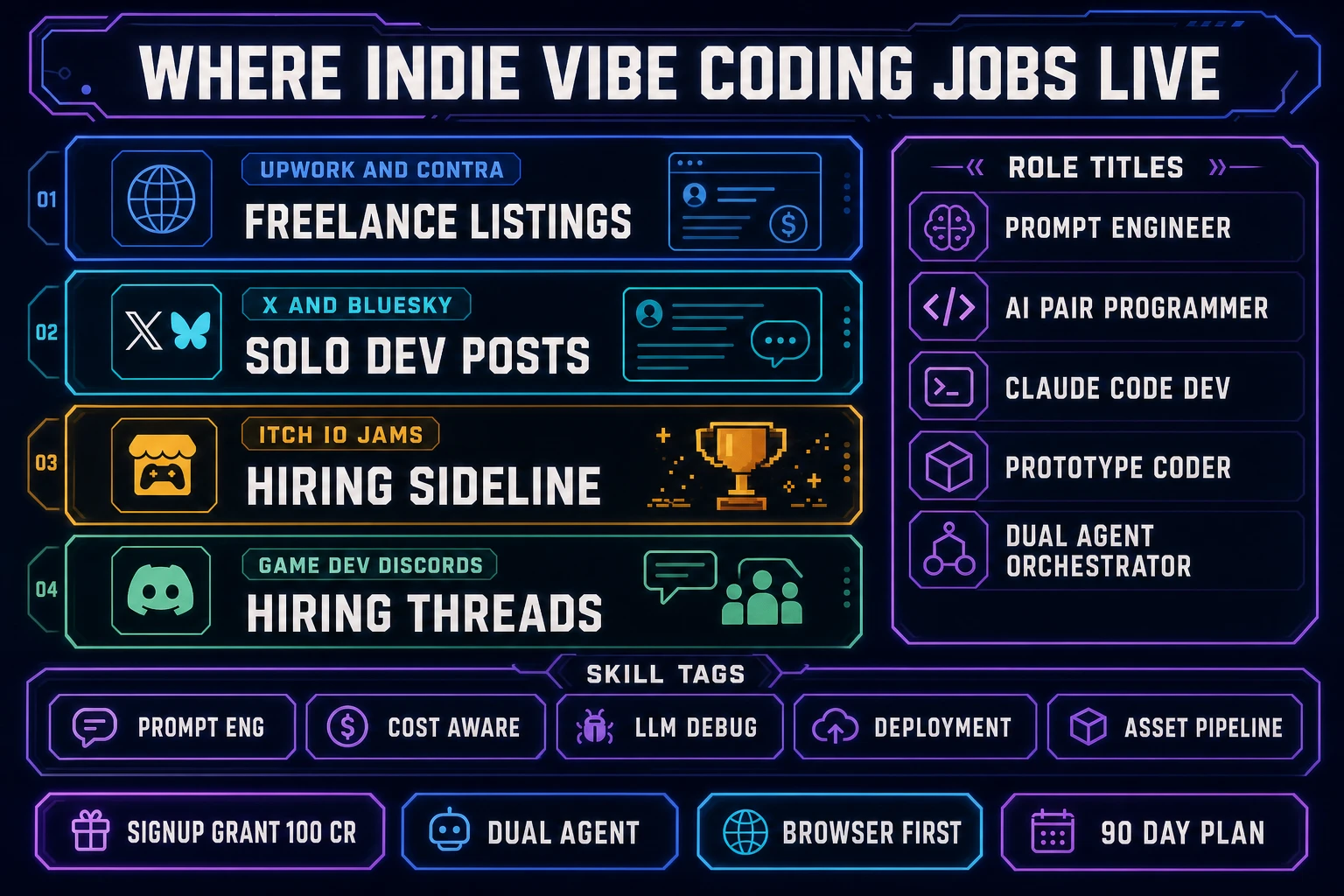
Where indie vibe coding jobs live: Upwork and Contra freelance listings, X and Bluesky solo dev posts, itch.io jam hiring sidelines, game dev Discord hiring threads, with role titles column showing prompt engineer, AI pair programmer, Claude code dev, prototype coder, dual agent orchestrator
Four hiring surfaces for indie-studio vibe coding work in 2026. None of the listings use the literal phrase; the role titles vary by studio.

The five technical skills employers actually test

Across the four role shapes, five skills show up in every interview or test project. Study each one deliberately; the gap between “knows about vibe coding” and “ships vibe coding” is almost entirely in these five.

  1. Prompt engineering for coding agents. Not image prompts, not chat prompts — code prompts. The skill is turning a game idea into a prompt that compiles on the first run. Hiring tests usually hand you a one-line game spec (“make a browser platformer with jump buffering”) and watch whether your first prompt yields runnable code or a rewrite loop. The Claude Planner Split guide and the prompt-to-game AI pipeline are the two internal references worth bookmarking.
  2. Dual-agent cost awareness. Studios running agent workflows at scale care about tokens the way they used to care about render minutes. Expect to be asked: “If this feature costs 50,000 Planner tokens and 300,000 Executor tokens, what does it cost on Claude Opus 4.7 vs DeepSeek V4 Pro vs a hybrid?” A candidate who answers “about a quarter of the frontier-only cost if we route Opus to Planner and DeepSeek to Executor” signals immediate hirable awareness. The verbatim product label at src/app/wizard-genie/page.tsx line 297 to 299 (verified 2026-10-02) is “A smart Planner thinks; a cheap Executor codes. Same quality at roughly a quarter of the token cost.”
  3. LLM-generated code debugging. Agents hallucinate APIs. They cite deprecated Phaser methods, invent Three.js materials that don’t exist, and misuse Godot 4’s typed GDScript. The hiring test is often a 50-line snippet that looks reasonable but fails to compile; you’re timed on how fast you find the hallucination. Fluency with Phaser (an 11+ year old, 2D HTML5 framework with WebGL + Canvas rendering, checked 2026-10-02) and Three.js docs (checked 2026-10-02) is a hard requirement.
  4. Deployment literacy. A browser game that only runs in a dev container is not a portfolio piece. Candidates need to deploy to Vercel, Netlify, itch.io, or a static host and share the URL. Studios test for understanding of HTML5 export pipelines, static-site deployment, and the WebGPU 1.0 Recommendation (W3C, checked 2026-10-02) for titles that lean on the newer GPU API.
  5. Asset-pipeline literacy. Code is only one leg of a game. Candidates who can also spin up sprites, music, SFX, and 3D props without a separate contractor are hirable at a higher rate. The hiring question is usually “how do you add a seven-frame walk cycle without hiring an artist?” and the right answer references AI sprite tools and specific credit math.

Each of these shows up in interview coding tests, Loom-review auditions, or paid trial projects. All five are practice-able; none require a CS degree or formal engineering background.
The portfolio that gets a vibe coding job

Studios hire from portfolios, not resumes. Across the hiring threads surveyed on MDN Game development and framework Discords (checked 2026-10-02), the pattern that converts is remarkably consistent:

  • Three shippable browser games with public URLs. Not one magnum opus; three small, varied, playable prototypes. Typically a platformer, a top-down RPG or roguelike, and a puzzle or arcade loop. Each should be beatable in under five minutes.
  • Public commits that show the agent conversation. Studios want to see how you work with the agent, not just the final code. Commit the raw prompts, the rejected first-draft code, and the second-pass fixes in the same repo. Transparency wins.
  • A cost writeup per project. One short README section per prototype that lists “total credits spent, time elapsed, Planner model, Executor model, biggest surprise.” This is the artifact that signals dual-agent cost awareness without an interview.
  • A one-minute Loom video per project. Record the agent session: the prompt in, the code out, the browser running. Studios skim ten of these in an hour and shortlist on the pacing.

What doesn’t convert: a long resume, a GitHub profile with twenty half-finished projects, academic credentials unrelated to game dev, or a single polished prototype with no breadth. The hiring signal is “this person can ship three different genres in 90 days”, not “this person spent 18 months on one thing.”

How WizardGenie dual-agent trains the exact skillset

WizardGenie is Sorceress’s dual-agent coding environment. The product label at src/app/wizard-genie/page.tsx line 297 to 299 (verified 2026-10-02) describes it as “A smart Planner thinks; a cheap Executor codes. Same quality at roughly a quarter of the token cost.” That one sentence is the hiring question in reverse: if a studio asks you “explain dual-agent cost”, this is the answer you want to be fluent in.

The acceptable pairings per the Sorceress model lineup (verified 2026-10-02):

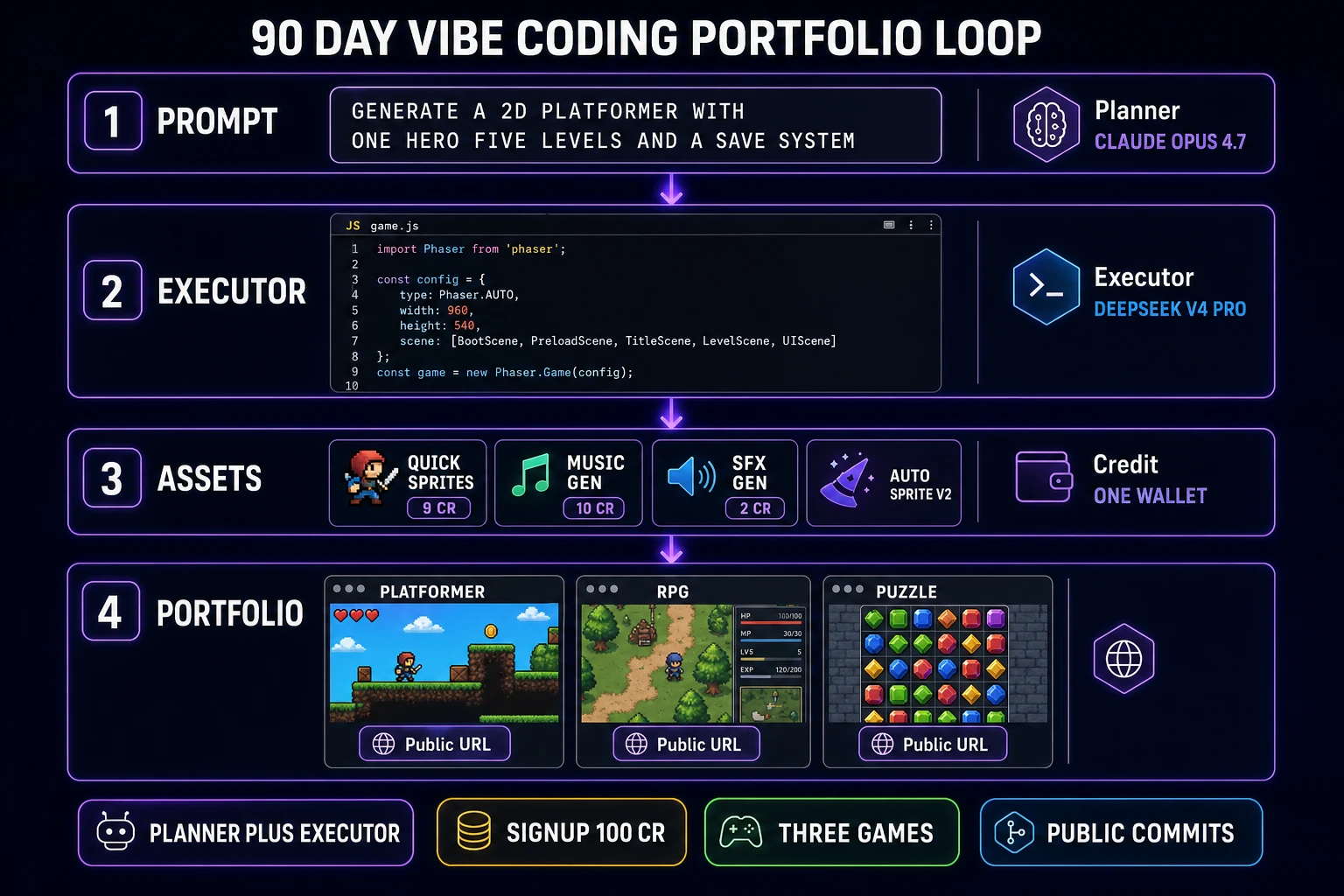
  • Planners (expensive, top-tier reasoning): Claude Opus 4.7, GPT-5.5, Gemini 3.1 Pro, Grok 4.2.
  • Executors (cheap, fast, big context): DeepSeek V4 Pro, Kimi K2.5, MiniMax M2.7, Gemini 3.1 Flash, GPT-5.5 Mini.
  • Never: Claude Sonnet, Claude Opus, GPT-5.5, or any other frontier-priced model as the Executor. That configuration erases the cost advantage that makes the pattern worth running.

Running the full loop in WizardGenie trains every one of the five skills employers test:

  • Prompt engineering — the Planner panel forces you to write a structured prompt before any code is typed.
  • Dual-agent cost awareness — the Executor panel surfaces token usage in real time; after ten sessions you develop a feel for which prompt shapes burn tokens.
  • LLM-generated code debugging — the arbitration pane shows diffs; you learn to spot hallucinated APIs by muscle memory.
  • Deployment literacy — the output drops into a browser preview you can share as a public URL, so the deploy step is one click instead of a day of DevOps.
  • Asset-pipeline literacy — the same wallet funds Quick Sprites, AI Image Gen, Music Gen, SFX Gen, and Auto-Sprite v2, so you practice the whole pipeline on one credit balance.

Studios interviewing for vibe coding jobs quietly test for exactly this stack. “Walk me through your workflow” is a hiring question; the answer that gets a callback is “Planner plans, Executor types, assets come from the same wallet, I ship to a public URL.”

90-day WizardGenie dual-agent portfolio loop: prompt field with Planner Claude Opus 4.7, Executor code editor with DeepSeek V4 Pro and Phaser 3 JavaScript, asset tiles for Quick Sprites 9 cr Music Gen 10 cr SFX Gen 2 cr Auto Sprite v2, and portfolio row with three browser game thumbnails platformer RPG puzzle each with public URL
The 90-day loop: Planner prompts, Executor types, assets come from one wallet, three browser games ship with public URLs. The portfolio artifact that gets vibe coding jobs.

A 90-day practice plan with real credit math

The honest math on the Sorceress stack (all constants verified 2026-10-02): CREDITS_PER_DOLLAR = 100 at src/lib/models.ts line 69, SIGNUP_GRANT = 100 at src/app/api/admin/credits/route.ts line 12, CREDITS_PER_GEN = 9 at src/app/quick-sprites/page.tsx line 21, MUSIC_CREDIT_COST = 10 at src/app/music-gen/page.tsx line 33, SUNO_SOUNDS_CREDIT_COST = 2 at src/app/sfx-gen/page.tsx line 28.

A hireable portfolio costs between $30 and $75 of credits on the Sorceress stack across three prototypes. Here is the week-by-week allocation:

Weeks Milestone Deliverable Credit budget USD estimate
1 to 2Platformer prototypePublic URL + README + Loom + commits300 to 500 cr$3 to $5
3 to 4Platformer polish + physics reviewJump buffering, coyote time, one boss100 to 200 cr$1 to $2
5 to 6Top-down RPG prototypePublic URL + README + Loom + commits400 to 700 cr$4 to $7
7 to 8RPG polish + save systemInventory, three enemies, save/load200 to 300 cr$2 to $3
9 to 10Puzzle or arcade prototypePublic URL + README + Loom + commits300 to 500 cr$3 to $5
11Three-game writeup + portfolio pageStatic site with three embeds + cost table50 to 100 cr$0.50 to $1
12Jam entry + hiring thread postsOne jam submission + three Discord posts200 to 400 cr$2 to $4
13Response + interview preparationThree Loom tour videos + cost-math drill100 cr$1

Three honest observations about the table:

  • The 100-credit signup grant covers Week 1. Starting from zero, the first platformer prototype ships without a wallet top-up. That removes the biggest psychological barrier to beginning.
  • Total 90-day spend stays under $75. Comparable practice on frontier-only coding agents (Claude Opus 4.7 as both Planner and Executor) runs four to five times higher because the token-heavy typing side burns the frontier price. The dual-agent pattern is what makes the budget realistic for a practicing candidate.
  • Jam week is deliberately week 12, not week 1. Shipping a jam before the three prototypes exist produces an undefended public artifact. Shipping a jam after three portfolio pieces produces a credible fourth artifact plus the hiring-thread entry point.

Reference reading during the 90 days: What is vibe coding (games 2026) for the definition baseline, Best AI model for vibe coding (executor picks) for the model-selection matrix, Best vibe coding tools (games stack) for the full tool survey, and How to make a video game with AI (indie build) for the end-to-end build pattern.

Picking the right vibe coding role for your background

The ranking collapses to three plain-text rules:

  • Pick prompt engineer or AI pair programmer if you already have some coding background and want to lean into the arbitration side of the agent workflow. These roles reward reviewer skills, debugging taste, and the patience to iterate on prompts until the output compiles clean.
  • Pick prototype coder if you’re coming from a design, art, or production background and want the agent to carry most of the typing load. The hiring signal is weekly throughput: can you ship a new playable every seven days with public URLs?
  • Pick dual-agent orchestrator if you’re entering from a product-management, data, or infrastructure background and want the economics side of the role. The portfolio artifact is cost writeups and model-selection decisions, not necessarily the games themselves — though a few shipped prototypes still help.

None of these picks require you to replace an experienced game-dev career. For a shipped indie title that competes on polish with Hollow Knight or Hades, a traditional senior engineer still wins. For a browser prototype that validates an idea in a weekend, or a vertical slice that lets a studio skip a month of pre-production, vibe coding roles ship the artifact in a fraction of the time — and that compression is what the 1,300 monthly searches are chasing.

The verdict

Vibe coding jobs are real in 2026, concentrated in indie game dev, and gated on a public portfolio that demonstrates five specific skills. The dual-agent pattern (Planner thinks, Executor types) is the technical primitive the role is built around, and the WizardGenie environment trains the exact shape of workflow studios interview for. A 90-day plan at under $75 of credits produces three shippable prototypes and a hiring-ready portfolio page.

Start with the Sorceress signup grant (100 credits, enough for Week 1). Prompt the platformer. Ship the public URL. Record the Loom. Repeat for the RPG and the puzzle. Post the three artifacts to a jam at Week 12 and open the hiring conversation on your terms. The 1,300 people a month who type “vibe coding jobs” into Google are competing against the same gap; the portfolio is the only side of the market the candidate controls.

Frequently Asked Questions

What exactly is a vibe coding job?

A vibe coding job is any paid role where the primary workflow is directing an AI coding agent instead of typing every line yourself. In 2026 those roles split into four honest shapes: prompt engineer (writes and tests the prompts that compile), AI pair programmer (sits beside an agent in-editor and arbitrates its output), prototype coder (ships one small playable per week using an agent as the typist), and dual-agent orchestrator (runs a Planner + Executor split for cost reasons). All four are informational queries on DataForSEO (verified 2026-10-02 in tools/research-supplement.md, PK vibe coding jobs at 1,300/mo, KD 0).

Can I get a vibe coding job with no traditional CS degree?

Yes, if the public portfolio is strong. Indie studios and freelance clients hiring for vibe coding roles in 2026 care about three artifacts: shippable browser games with public URLs, commit histories that show you can debug an agent's output, and cost writeups that prove you understand token economics. None of those require a CS degree. The gating skill is prompt engineering and dual-agent cost awareness, not a four-year curriculum. A 90-day practice plan on WizardGenie's dual-agent (Planner at Claude Opus 4.7 or GPT-5.5, Executor at DeepSeek V4 Pro or Kimi K2.5) produces three portfolio pieces for well under one hundred US dollars of credits (verified in-source 2026-10-02).

What is the cost of practicing enough to be hireable?

The honest math on the Sorceress stack (verified 2026-10-02 in src/lib/models.ts line 69 at CREDITS_PER_DOLLAR = 100 and src/app/api/admin/credits/route.ts line 12 at SIGNUP_GRANT = 100) is: one portfolio-ready browser game costs roughly 300 to 600 credits ($3 to $6) in art, music, SFX, and dual-agent coding tokens. Three portfolio pieces plus iteration time is $30 to $75 all-in. The 100-credit signup grant covers the first prototype. Comparable practice on frontier-only coding agents without a cheap Executor runs 4 to 5 times higher per equivalent output.

Where are indie game dev vibe coding jobs actually posted?

Four surfaces in 2026: Upwork and Contra freelance listings tagged AI pair programming or prompt engineering, X and Bluesky posts from solo indie devs tagging their project needs, itch.io game jams with hiring sidelines, and the hiring threads in game-dev Discords. None of them use the exact phrase vibe coding jobs in the posting itself, which is why the DataForSEO query clocks at 1,300/mo as informational intent, not transactional. The hiring signal shows up as prompt engineer, AI pair programmer, Claude code dev, or similar role titles with game-dev subject matter in the brief.

Does the dual-agent pattern really save money, or is it marketing?

The math is honest when the Executor is a true cheap model. Claude Opus 4.7 input/output pricing is roughly 5 US dollars and 25 US dollars per million tokens; DeepSeek V4 Pro is roughly 0.27 US dollars and 1.10 US dollars. Running Opus as Planner (small, deliberate token output) and DeepSeek as Executor (large, typing-heavy token output) collapses the per-feature cost by roughly 80 percent versus a single-frontier workflow. The pattern breaks if the Executor is also frontier-priced (Sonnet, GPT-5.5, Gemini Pro); that configuration erases most of the savings. The WizardGenie product label at src/app/wizard-genie/page.tsx line 297 to 299 (verified 2026-10-02) describes this as roughly a quarter of the token cost at the same output quality.

Sources

  1. What is Phaser? - Phaser Docs
  2. 2D collision detection - MDN Game development
  3. Game development - MDN Web Docs
  4. Three.js - Getting Started
  5. WebGPU 1.0 Recommendation - W3C
Written by Arron R.·2,784 words·12 min read

Related posts