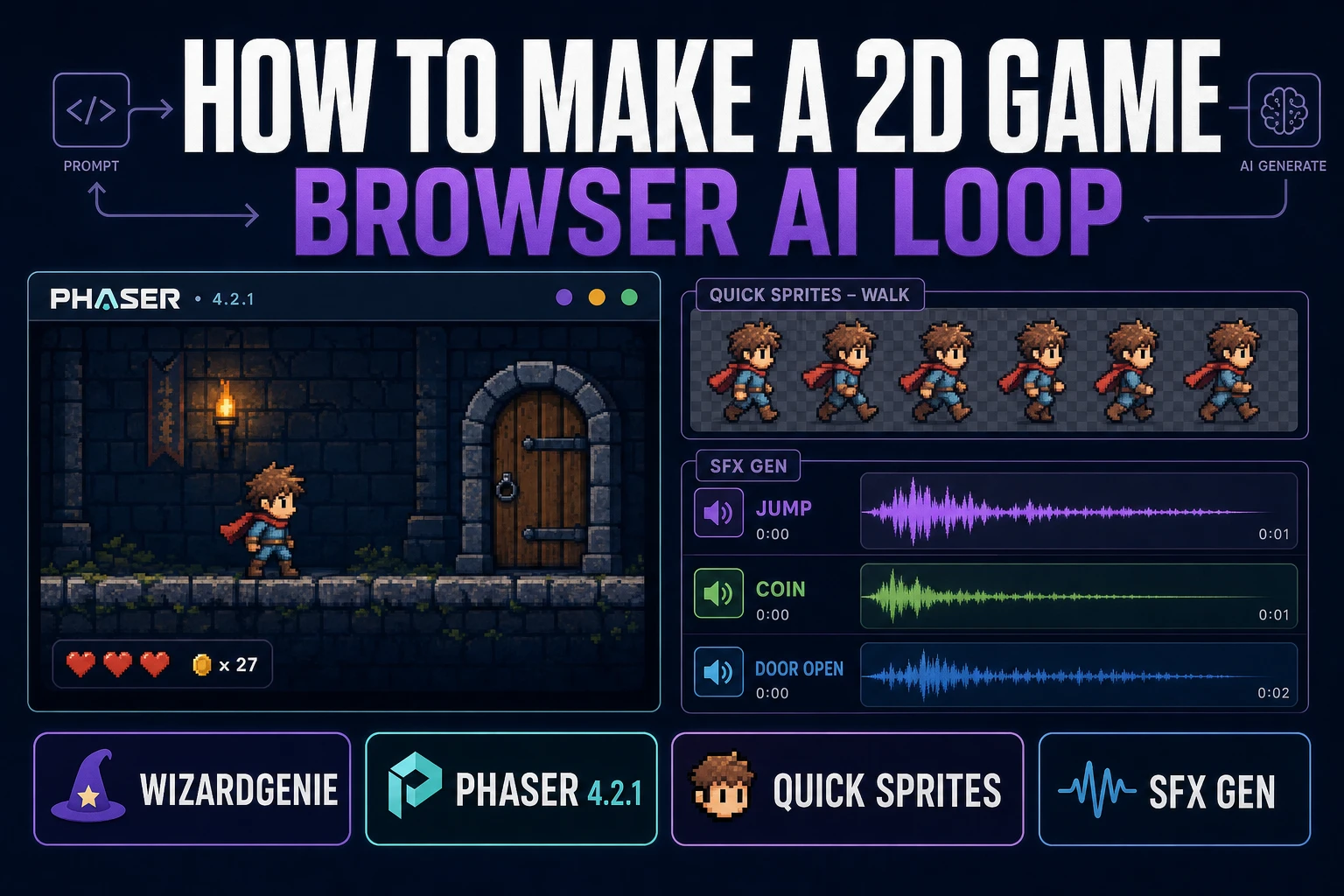
Every “how to make a 2D game” tutorial on the open web starts by asking you to pick an engine — Unity, Godot, Unreal, or Roblox — before you have written a single line of code or drawn a single frame. That order is backwards for a weekend jam. The engine choice locks you into a toolchain that takes hours to install, a rendering pipeline that takes days to learn, and a project structure that outlives whatever prototype you were actually trying to ship. This post walks the honest browser-only path for how to make a 2D game on Sorceress — one WizardGenie session for a Phaser 4 game loop, one Quick Sprites row for the hero, three SFX Gen cues for the audio moment. Every model version and credit constant verified against Sorceress source on August 1, 2026.
What a how to make a 2D game search actually wants in 2026
DataForSEO lists how to make a 2D game at 320 monthly searches with KD 29 as an engine-agnostic head query (verified 2026-08-01 in research-supplement.md). The engine-specific siblings each carry their own volume: how to make a 2D game in Unity at 260/mo (KD 22), how to make a 2D game in Godot at 110/mo (KD 13), how to make a 2D game in Roblox at 30/mo, how to make a 2D platformer game at 50/mo. The pure head phrase — without an engine attached — is where beginners sit before they have committed to a toolchain, and it is by far the most useful search to answer honestly, because the answer changes the reader''s next hour instead of confirming a decision they already made.
Two intents share the query. The first is the true beginner who has never opened a game engine and does not want to install a five-gigabyte editor to learn whether they enjoy the craft. The second is the jam dev who has shipped small games before and wants the shortest possible path from zero to a playable browser link. Both intents share the same actionable next step: lock a one-screen scope, prompt an AI-driven scaffold for the game loop, cast the assets in the same browser tab, ship a link. The scope decision comes before the engine decision, and for a jam-scope build, the browser is honestly the fastest ground.
Why the browser is the honest 2D game jam runtime
Every 2D-game tutorial that starts with “first, download Unity” is asking you to lose a Saturday to setup before you have decided whether the idea is worth building. Unity is a real tool, Godot is a real tool, Unreal is a real tool — but none of them are the right first surface for a jam-scope game, because none of them can render an idea in the first ten minutes.
The browser can. A modern browser tab has an HTML canvas element, an audio graph, a keyboard-event pipeline, and a JavaScript runtime that can drive all three at 60 frames per second. Sorceress''s canonical 2D scaffold is Phaser, an open-source JavaScript framework in the same lineage as traditional 2D game engines but with the entire install surface being “a <script> tag in an HTML file”. Verified on August 1, 2026 against the phaserjs/phaser GitHub Releases page: current stable is Phaser v4.2.1 codename “Giedi”, released 2026-07-09.
Runtime honesty matters. If your game runs in a browser tab, the delivery cost is zero — you upload the build folder to any static host and share a URL. If it runs in Unity, you pick between a WebGL export (which then also runs in a browser, but through a hundred megabytes of transpiled runtime) or a native binary (which asks the player to trust you enough to install an executable). The game jam culture that popularized rapid iteration — Ludum Dare, GMTK, Global Game Jam — runs on browser links, not installer downloads, for a reason. The reason is friction. Zero-friction distribution is what turns a weekend prototype into a playtest.
The Sorceress how to make a 2D game pipeline in five steps
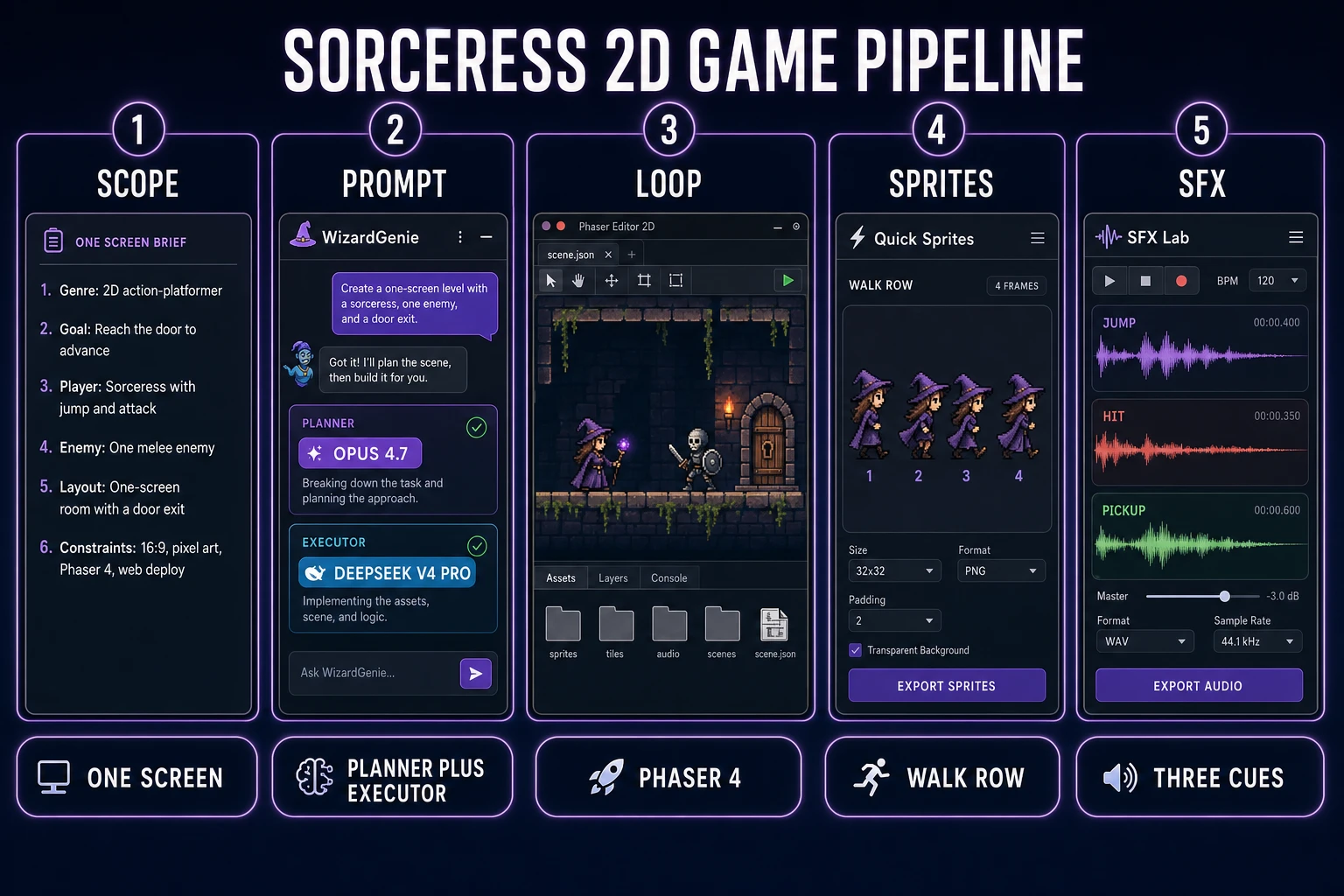
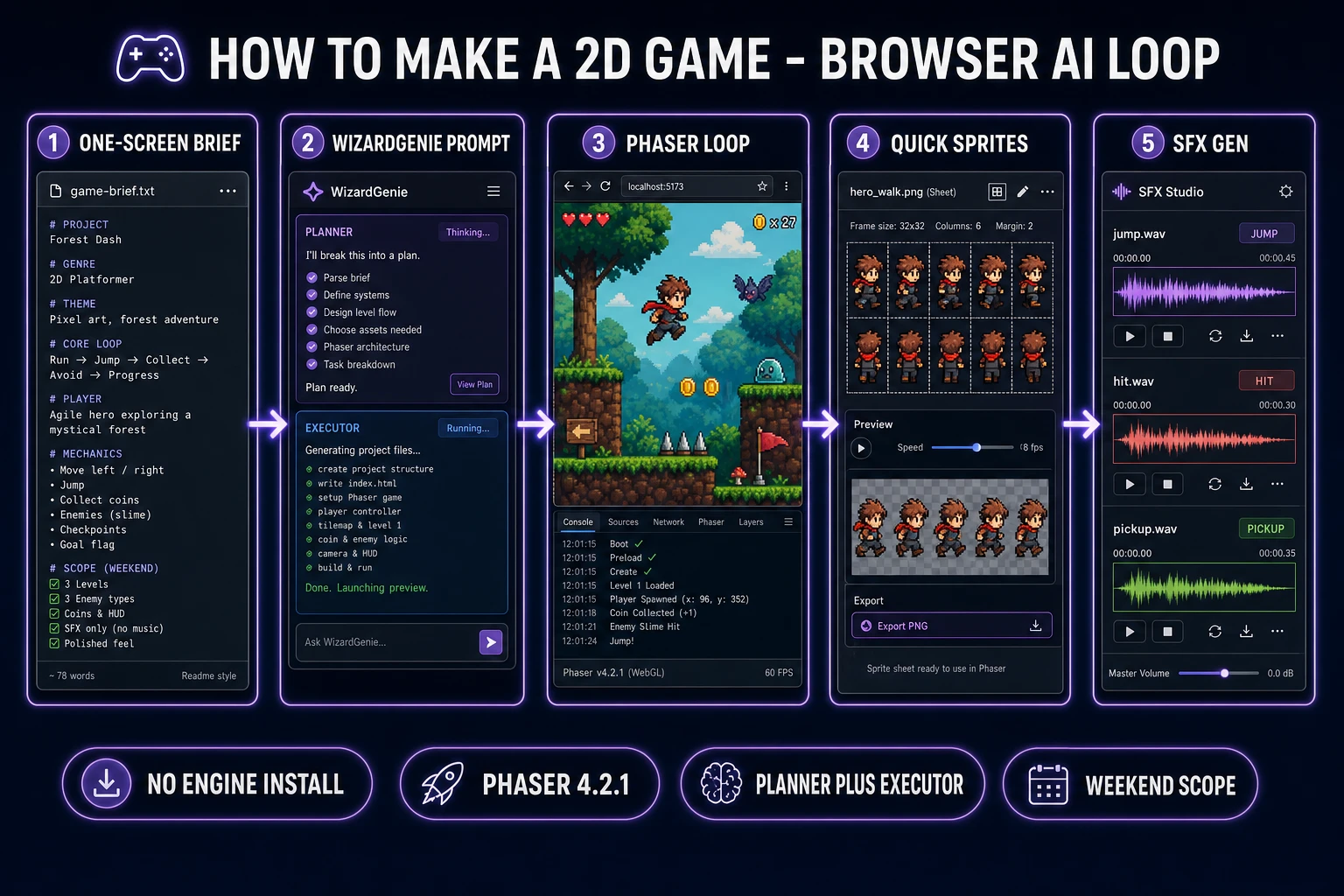
The full workflow on Sorceress fits into one browser session. No engine install, no editor download, no separate audio DAW:
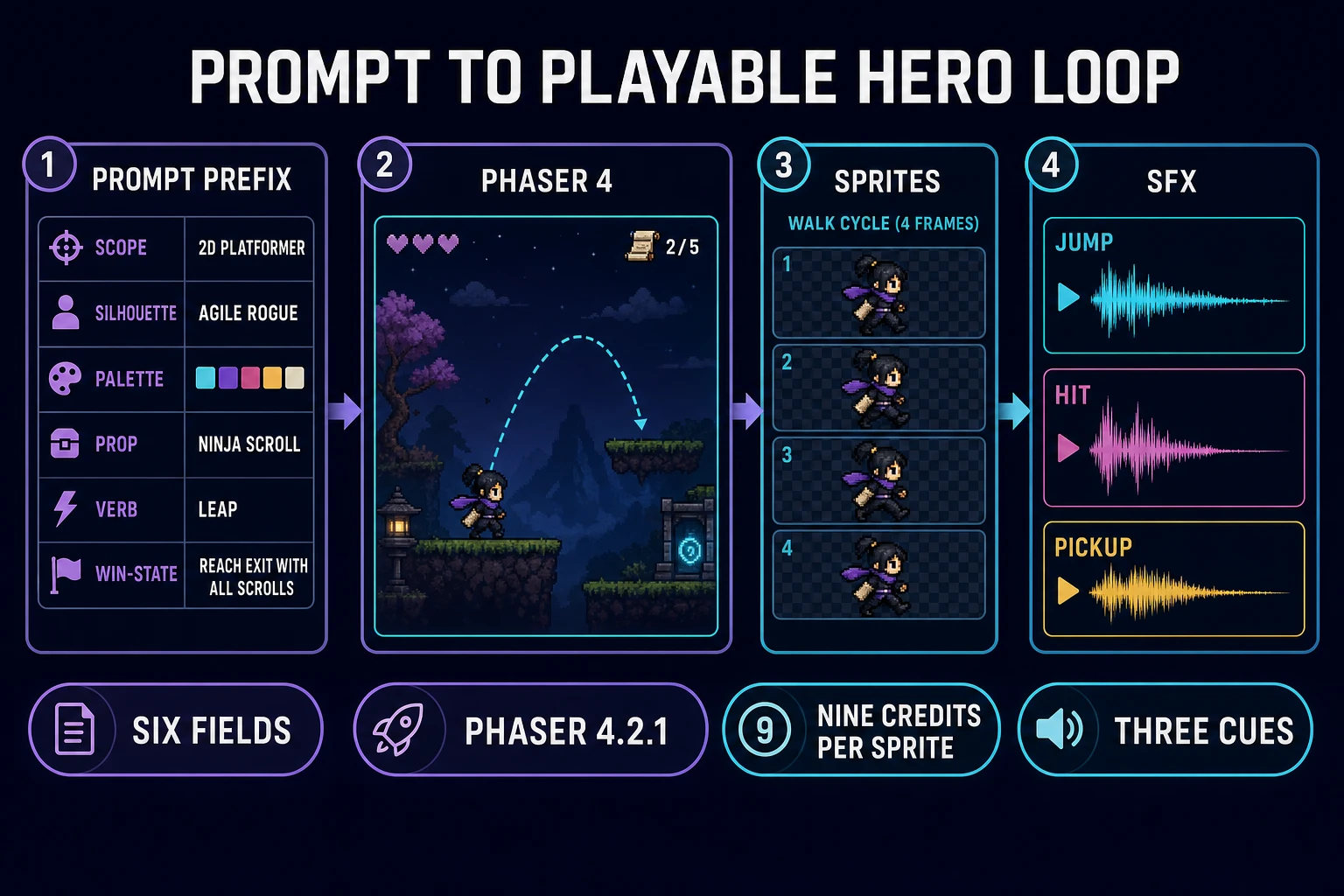
- Lock a one-screen scope. Write six lines in a text file — scope, silhouette, palette, prop, verb, win-state — before you touch any tool.
- Prompt WizardGenie for the game loop. Planner+Executor pair, browser preview, Phaser 4.2.1 target.
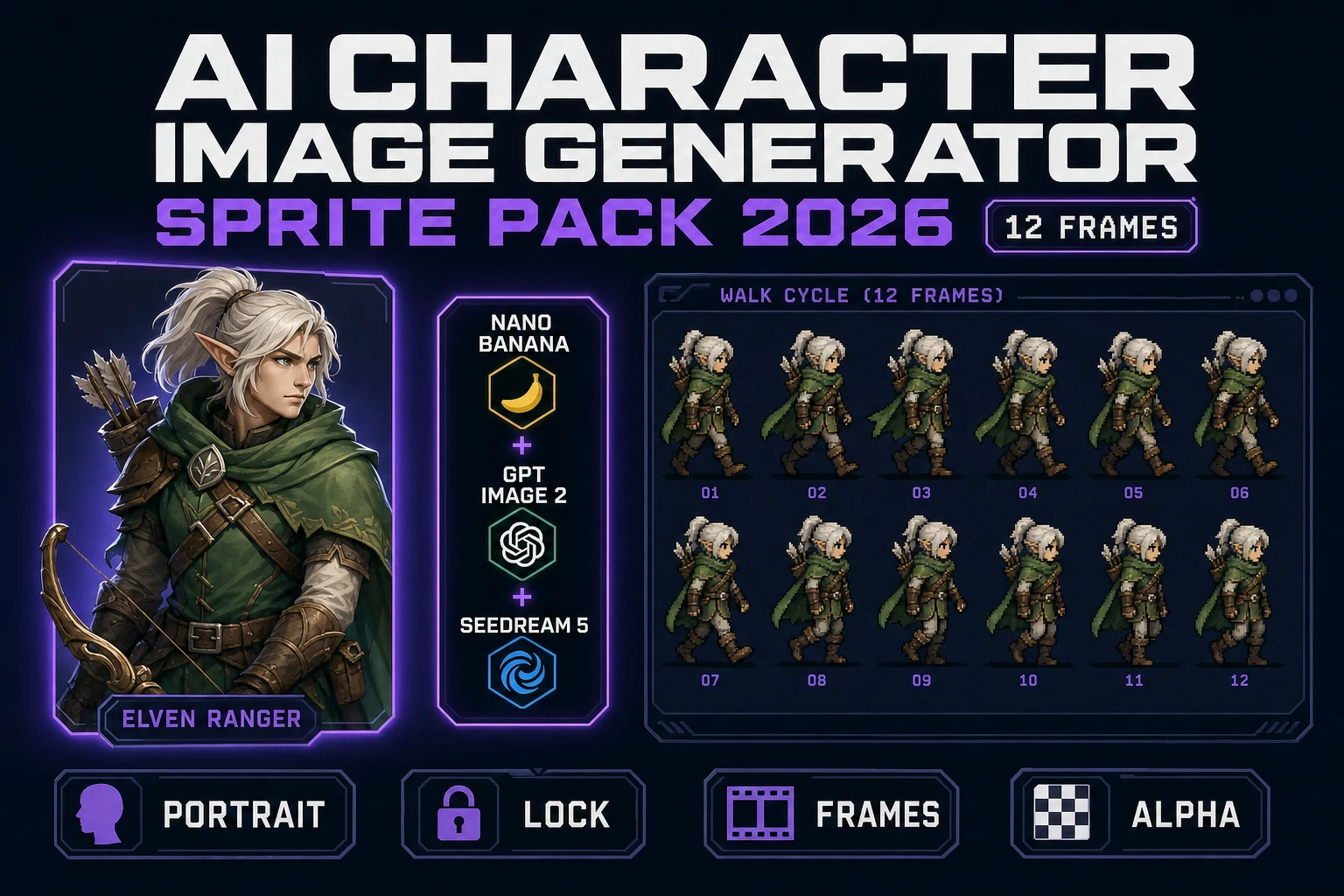
- Cast the hero on Quick Sprites. Four-angle walk row at 9 credits per generation, retro-diffusion/rd-animation model.
- Drop cues from SFX Gen. Three one-second stems for jump, hit, pickup — 1 credit per second on byteplus-seed-audio.
- Playtest, tweak, ship. Preview inside the WizardGenie session, hit share-link, done.
Credit budget for a one-screen jam-scope build: 27 credits for a hero walk row plus about 3 credits for the SFX cues, roughly 30 credits total for the asset side. On the 100-credits-per-dollar rate, that lands under 30 cents in art plus audio. WizardGenie handles the code side under a BYO-key model surface — you plug your own model API key in and pay the provider directly for tokens, which for a jam-scope 2D game runs well under one US dollar on a Planner+Executor split. The Sorceress $49 Lifetime Access tier (LIFETIME_PRICE = 49 in src/app/plans/page.tsx) covers the credit stipend past the first jam if the plan is to keep shipping.
Step 1 — lock the one-screen scope before any code
The most expensive mistake in a 2D-game jam is writing code before writing the scope. A jam-scope 2D game fits in six lines of plain English, and those six lines govern every downstream decision — which sprites you generate, which cues you cut, which Phaser scene classes WizardGenie writes. Open a text file (call it scope.md) and fill in one line per prompt:
- Scope: one screen, one enemy type, one door, one win-state.
- Silhouette: the hero''s shape in seven words (“small green frog in a red bandana”).
- Palette: four hex colors max, one background, one hero, one enemy, one prop.
- Prop: the one collectible or interactable that changes state (a key, a coin, a health pack).
- Verb: the one player input beyond movement (jump, dash, shoot, throw).
- Win-state: the exact condition that ends the level (reach the door, defeat the enemy, collect the key).
Those six lines are enough for WizardGenie to write the entire game skeleton. They are also enough for Quick Sprites to know what the hero looks like and for SFX Gen to know what cue verbs it needs to produce. Without the scope file, every tool needs the same background prompt re-typed three times, and the tools drift — the hero''s bandana disappears from the sprite row, the “jump” cue lands on the wrong verb, the Phaser scene draws a door that never gets touched. Fifteen minutes on the scope saves two hours downstream.
Scope traps to avoid: multiple enemy types, procedurally generated levels, a save system, a menu screen with settings. Every one of those doubles the code volume and does not raise the ceiling on whether the loop reads as fun. A one-screen jam-scope game with a locked scope ships. A four-scene game with three enemies and a title menu does not.