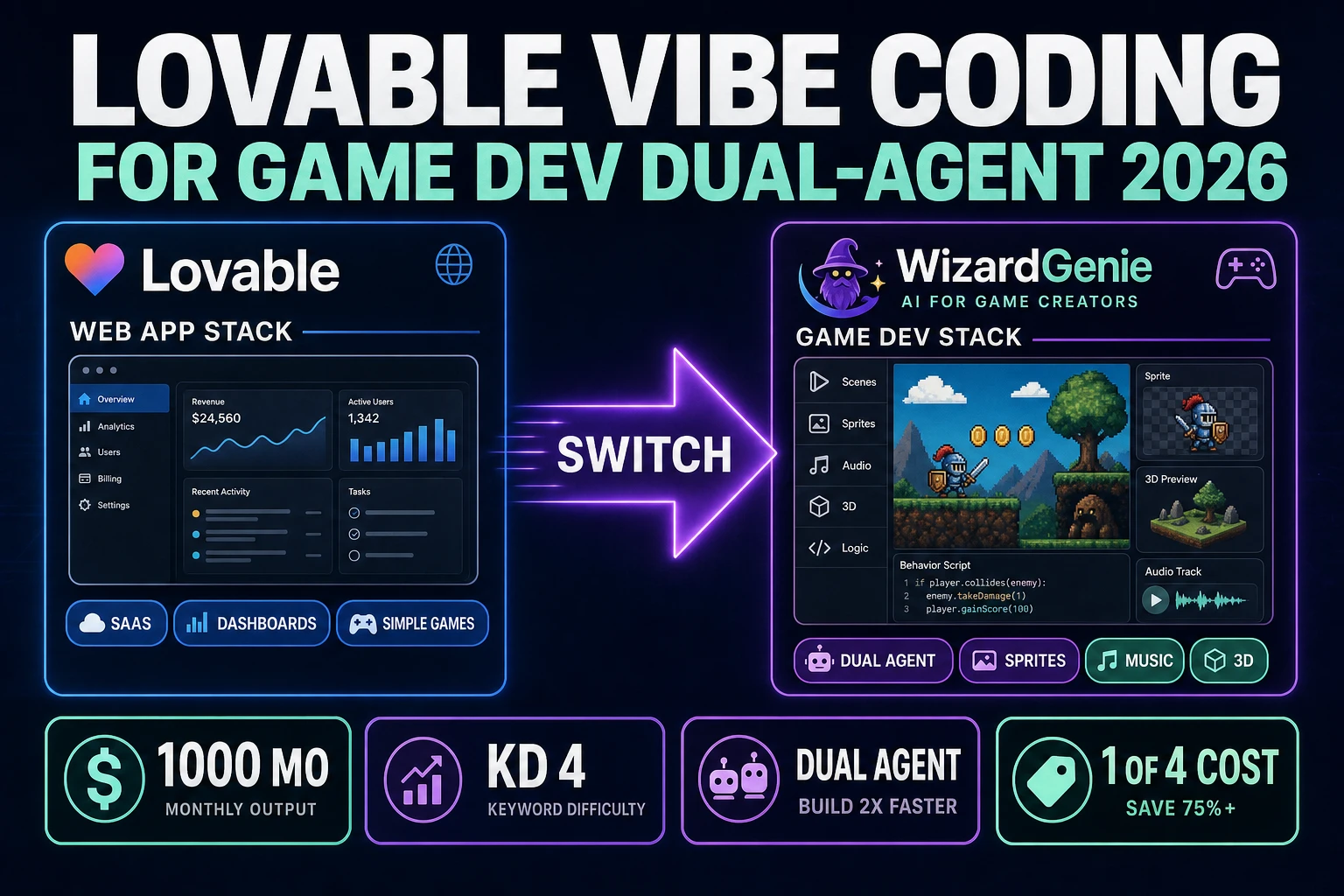
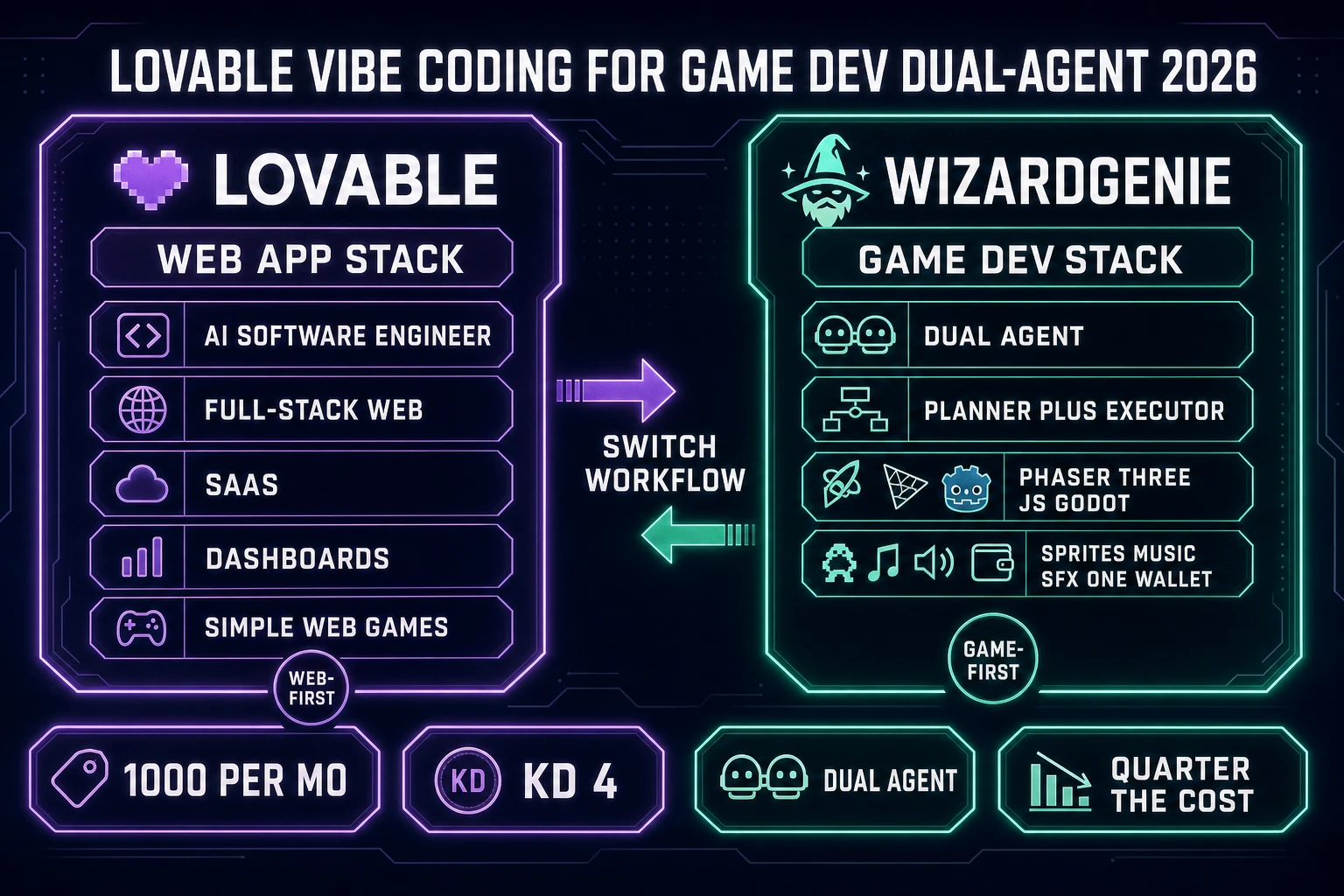
Searchers who type lovable vibe coding into Google in 2026 are not asking whether Lovable can describe a React component. They want to know whether Lovable can ship a game. The honest answer, straight from Lovable's own pricing page (verified 2026-10-03), is that Lovable positions itself as "an AI software engineer, which enables anyone to build for the web" — and that word, web, is doing most of the work. Lovable's own introduction page (verified 2026-10-03) lists what you can build; under "Games and interactive content" the two words it uses are "simple" and "web-based." For a quiz or a browser clicker, that is enough. For a 2D platformer with physics, a sprite sheet, a music bed, and three levels, it is not. This article maps where Lovable's web-app DNA hits a wall for game dev, then sets up a Planner-plus-Executor dual-agent workflow that is actually built for games. All numbers below were verified against lovable.dev/pricing, docs.lovable.dev/introduction, Wikipedia's Vibe coding page, MDN's Game development hub, Phaser's What is Phaser? page, Three.js documentation, and the Sorceress source for WizardGenie, CODING_MODELS, and the credit constants on 2026-10-03.
What searchers typing lovable vibe coding actually want
DataForSEO lists lovable vibe coding at 1,000 searches a month, KD 4, competition 0.42, intent informational (verified 2026-10-03 in tools/research-supplement.md, vibe coding cluster). Four is a low keyword difficulty — the SERP is not locked yet, which means the current top results are mostly Lovable's own marketing surfaces and generic "what is Lovable" explainers. Nothing on the first page honestly answers the game-dev follow-up. That is the gap this post is written to fill.
Wikipedia's Vibe coding page (verified 2026-10-03) names the practice as describing a project in natural language to a large language model that then generates source code, with Andrej Karpathy coining the term in February 2025 and Collins English Dictionary naming it Word of the Year for 2025. The same page catalogues the critics: accountability, maintainability, and security vulnerabilities when AI-generated code ships without review. The same page also records that in May 2025, Lovable — identified as a Swedish vibe coding app — was reported to have security vulnerabilities in generated code, with 170 of 1,645 Lovable-created web applications having an issue that would allow personal information to be accessed. That is not a reason to avoid Lovable; it is a reason to read every diff, which is a universal vibe-coding rule, not a vendor-specific one.
The upshot: a reader who types lovable vibe coding into Google in 2026 wants a plain-text, verified answer to two questions. Question one: what is Lovable really built for? Question two: if I want a game instead of a web app, what do I switch to and how? Both questions get answered below.
What Lovable actually is in 2026 (verified today)
Lovable's own pricing page positioning (lovable.dev/pricing, verified 2026-10-03): "Lovable is an AI software engineer, which enables anyone to build for the web. Simply chat to instantly build websites and web apps, with no technical knowledge needed." The introduction page (docs.lovable.dev/introduction, verified 2026-10-03) expands this: "Lovable is a full-stack AI development platform for building, iterating on, and deploying web applications using natural language, with real code, security, and enterprise governance." Both quotes are on the record. Both say web.
Credits run the whole platform. The pricing page lists a free plan with a daily grant of 5 build credits (capped at 30 a month), plus monthly grants of 20 Cloud credits, plus 4 AI-feature credits for apps the user builds. Paid plans add a monthly credit balance on top of the daily grant and the Cloud grant. Default Mode pricing varies by task complexity — Lovable's own examples (verified 2026-10-03) show "make the button gray" at 0.50 credits, "remove the footer" at 0.90, "add authentication with sign up and login" at 1.20, and "build me a landing page, use images" at 1.70. Plan Mode is a flat 1 credit per message. Monthly plan credits expire two months after they are issued, annual plan credits expire one month after the period ends, top-up credits last twelve months, and the daily 5-credit grant does not roll over.
Three concrete observations fall out of those numbers:
- Credit cost is correlated with the scope of the task, not with the vertical. Building a game feature costs the same as building a dashboard feature — the engine does not know which one you asked for.
- The free plan's 5-credits-a-day ceiling is enough to iterate on a landing page. It is not enough for a game-loop sprint, where you typically re-run the generator ten to twenty times before the physics feels right.
- Credit expiry is aggressive. Game-dev work tends to be stop-start (prototype on Saturday, playtest on Monday, revise on Tuesday night); a two-month expiry is fine for weekend sprints and a problem for seasonal projects.
For the record on security posture: docs.lovable.dev lists SOC 2 Type II, ISO 27001:2022, AIUC-1, and GDPR compliance (verified 2026-10-03). That is a strong SaaS baseline. It does not change the Hard Rule for any vibe-coded output: read your diffs. Veracode's October 2025 study (cited on the Wikipedia Vibe coding page, verified 2026-10-03) found LLM-generated code security has not improved in step with its functional capability, and that result holds across vendors.
Where lovable vibe coding hits a wall for game dev
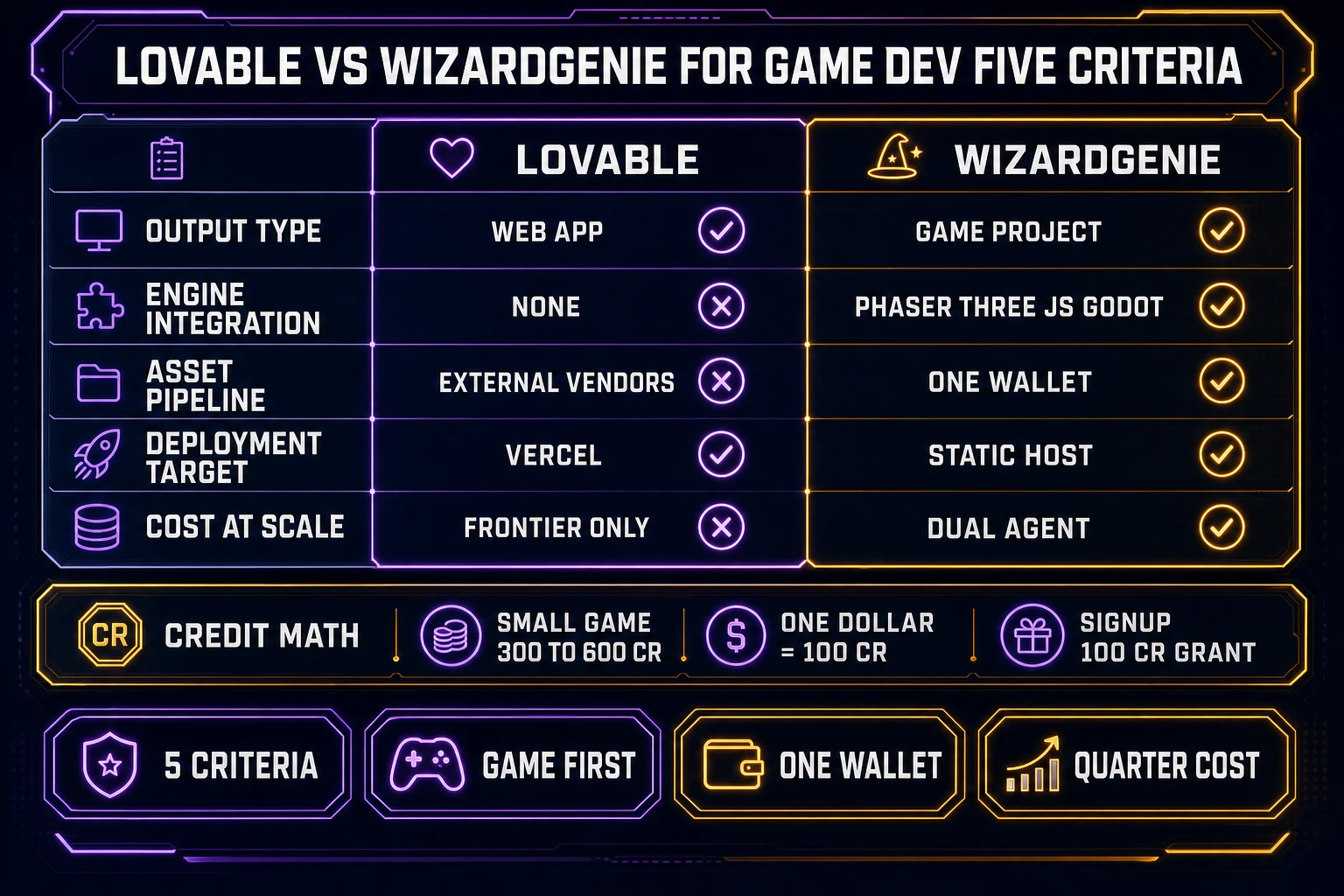
Everything in the previous section is accurate and true of any web-first vibe-coding platform. The game-dev wall shows up at five specific places. These are not opinions — they fall straight out of what Lovable's own docs say the product is built to produce.
- Output type. Lovable generates full-stack web applications. Those are React or Vite frontends with a backend, auth, database, and integrations. A game is a loop (MDN's Anatomy of a video game, verified 2026-10-03, reduces it to present → accept input → interpret → calculate → repeat). A web app is a request-response surface. The two shapes do not overlap much.
- Engine integration. Lovable has no engine-aware templates for Phaser (docs.phaser.io, verified 2026-10-03: 2D HTML5 framework, WebGL + Canvas), Three.js (threejs.org/docs, verified 2026-10-03), Godot, Unity, or Unreal. Asking Lovable for "a Phaser 3 platformer" realistically returns a React scaffold with Phaser installed as an npm dependency — not an engine-aware project with scenes, physics, and a published build pipeline.
- Asset pipeline. Lovable's "Images, video, and design assets" line covers social graphics and marketing images. There is no sprite-sheet generator, no music generator, no SFX generator, no 3D model generator in the stack. For a game you have to leave Lovable, pay three separate vendors for sprites, music, and SFX, and glue the outputs back by hand.
- Deployment target. Lovable publishes to its own hosting (Cloud credits). That is correct for a SaaS product. A game is usually a static build dropped on itch.io, GitHub Pages, Netlify, or a jam host — different mental model, different pricing.
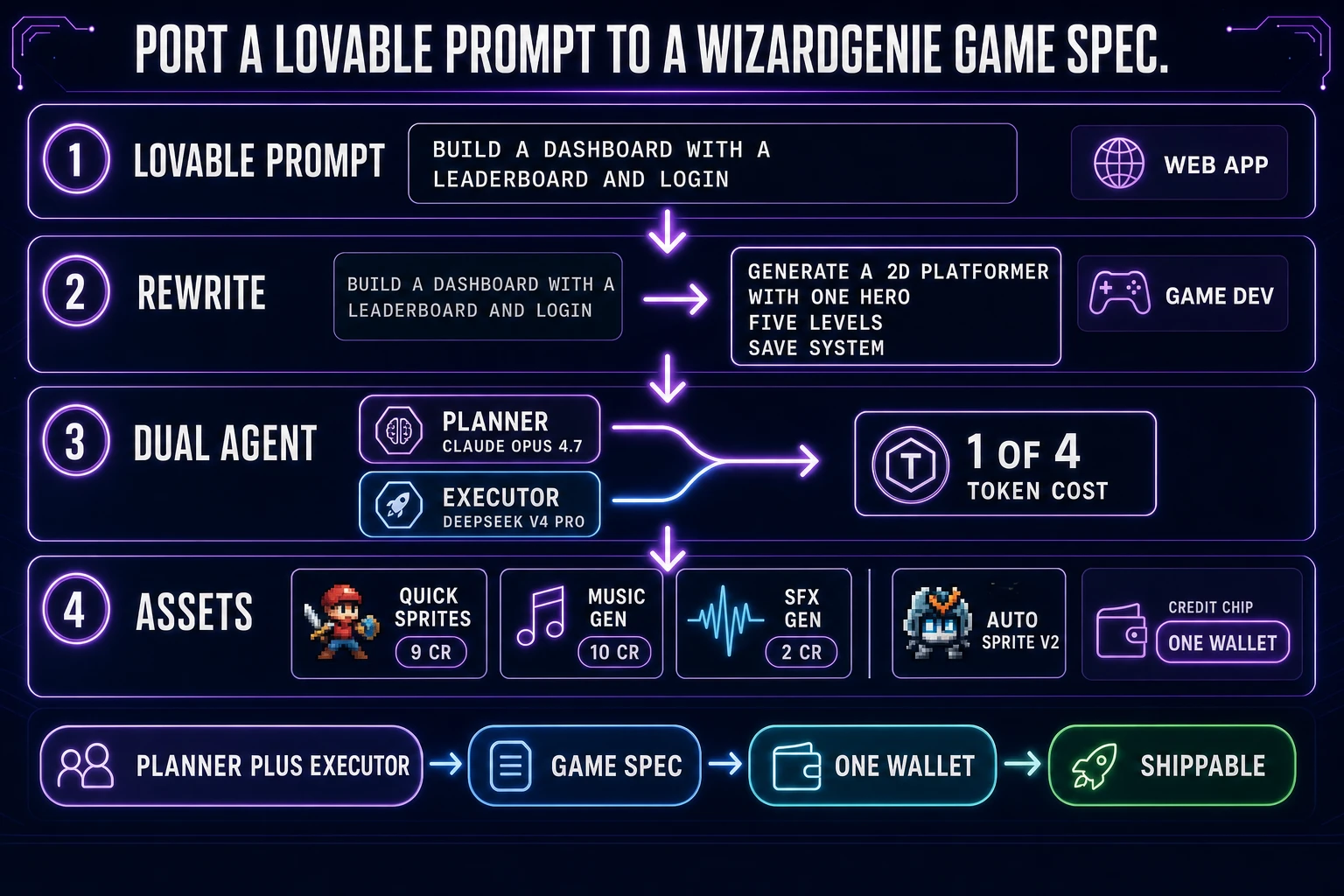
- Cost at scale with no cheap executor seat. Lovable charges per prompt by task complexity. There is no Planner-plus-Executor split; one model handles the whole chat. For a game-dev sprint where you want ten quick typing passes against one careful planning pass, that pricing shape costs more than it needs to.