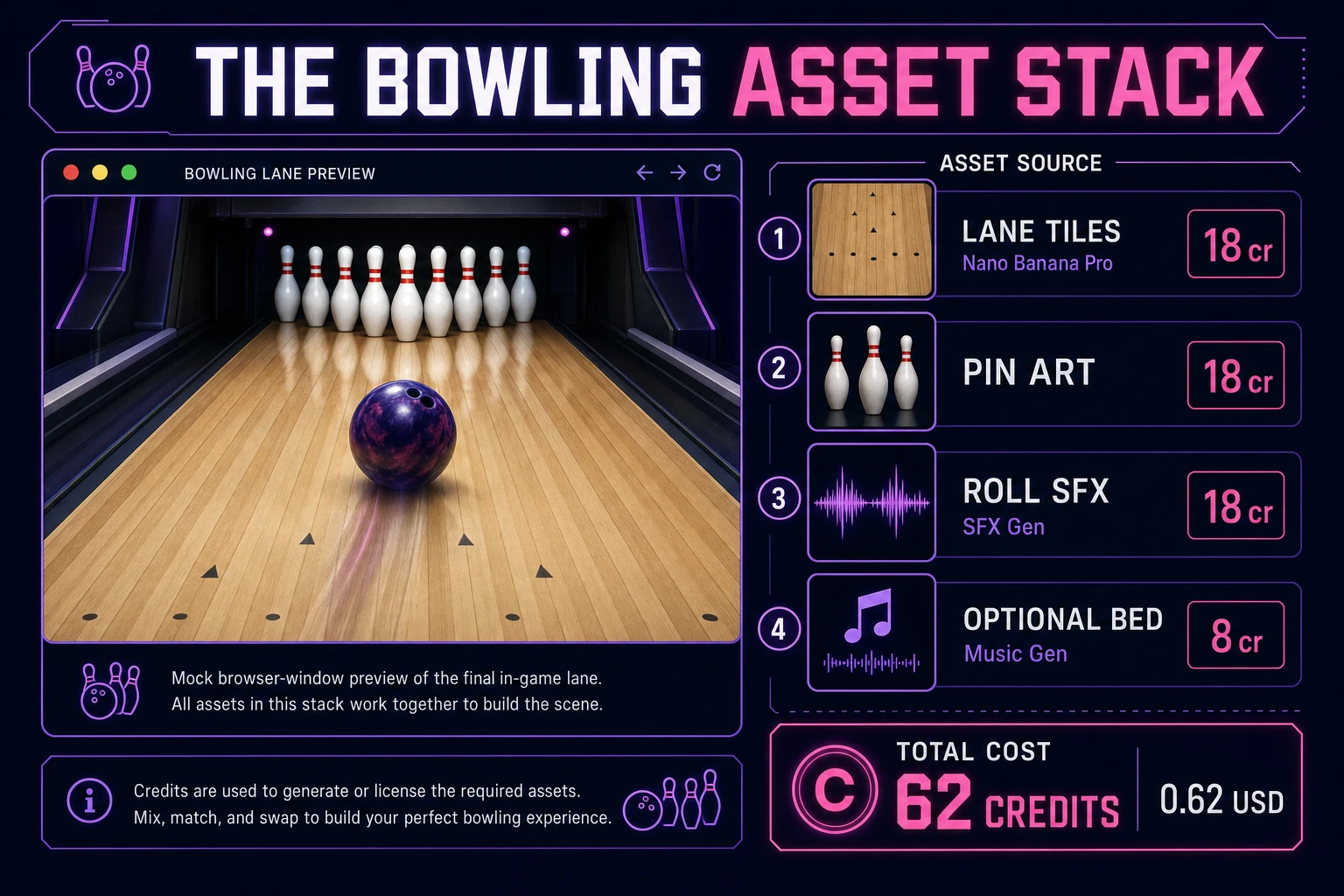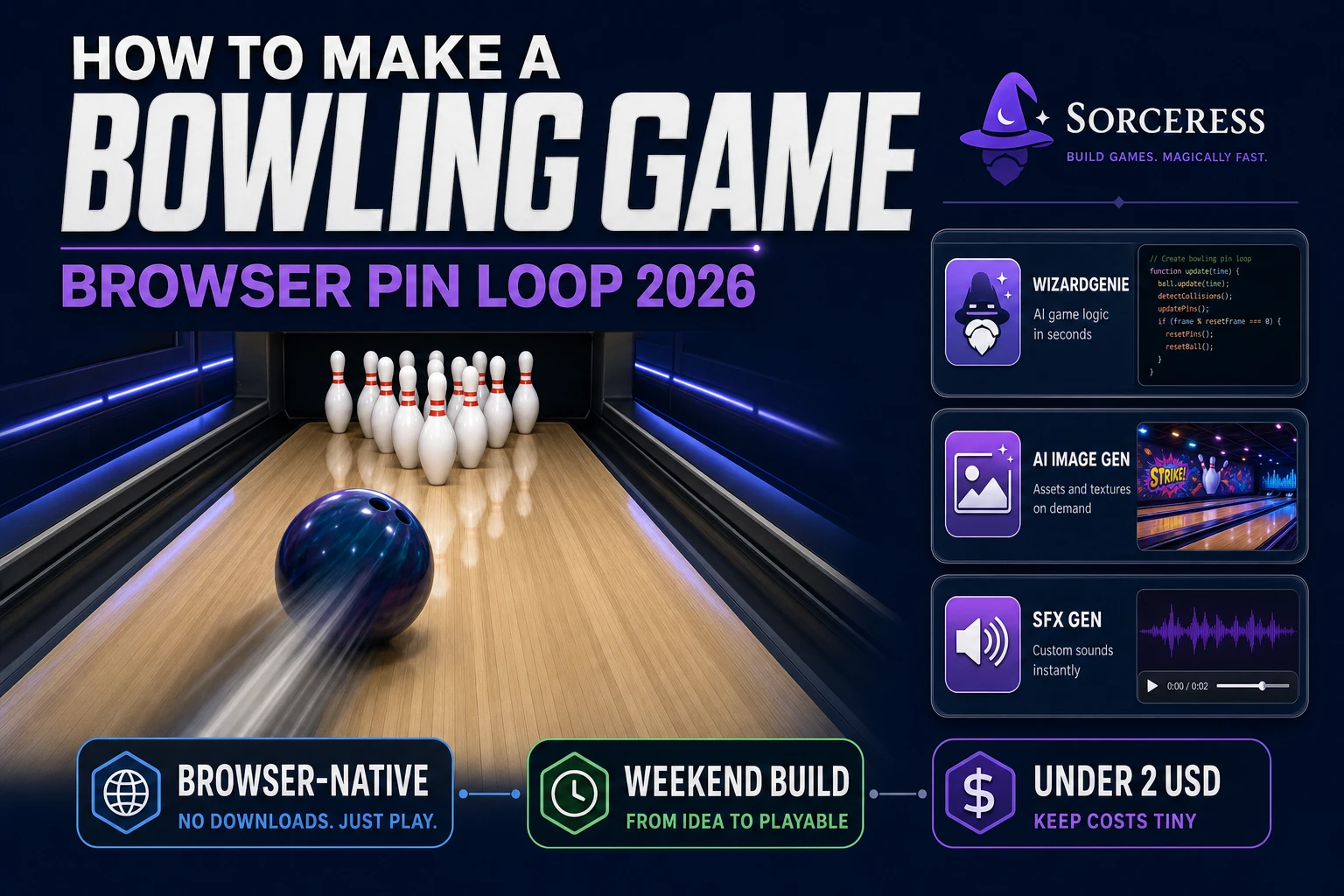
Most beginners who search “how to make a bowling game” want a lane you can see, a ball you drag to aim across the wood, a power meter that fills on pull-back, and pins that scatter when the ball hits the triangle. A broadcast bowling sim with oil-pattern physics, league brackets, and networked tournaments is a studio project. A browser ten-pin loop is different. A coding agent scaffolds aim vectors, lane friction, and pin collision from one prompt, and AI generation covers lane tiles and roll audio. On desktop or web, that means WizardGenie for the aim-throw-roll loop, AI Image Gen for lane art, SFX Gen for roll and crash audio, and optional Music Gen for an arcade bed. This guide is the honest end-to-end for how to make a bowling game in 2026, as a weekend build you can finish once.
What how to make a bowling game actually means in 2026
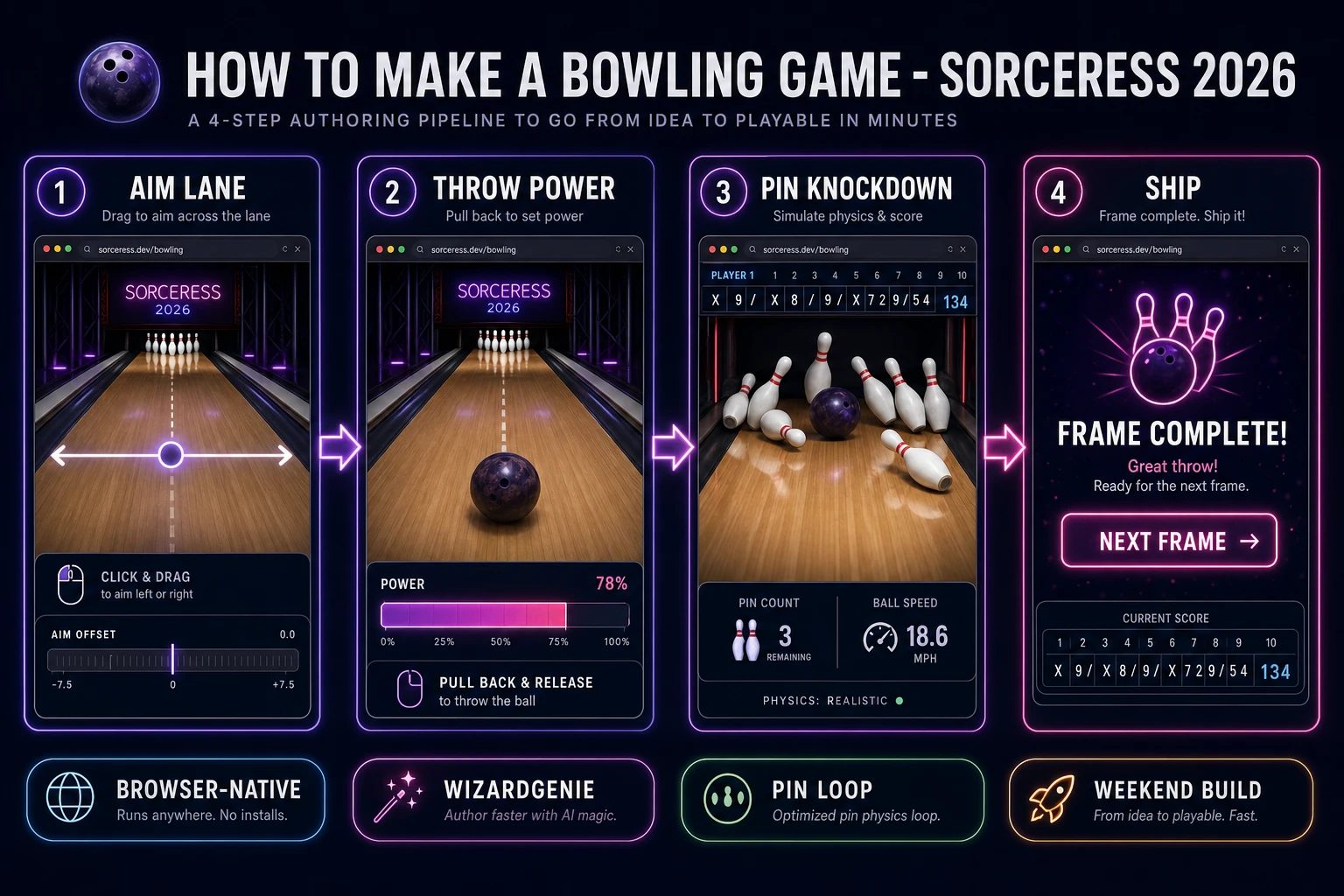
The query “how to make a bowling game” hides three intents. Some searchers want a Unity asset pack with pre-modeled alleys and licensed bowler avatars — that is engine shopping, not a minimal playable loop. A second intent is a realistic bowling sim with oil lanes, hook spin, and ESPN camera cuts — a product team, not a solo jam. The third intent, and the one this guide targets, is a browser ten-pin frame: one lane from bowler to pit, ten pins in standard triangle formation, drag-to-aim input across lane width, a power bar on pull-back, ball roll that decelerates on wood, and a knockdown counter that ticks up each pin collision. That is a weekend build, it demos the Sorceress toolset, and it is the format most bowling game tutorial and javascript bowling game searchers actually want.
The presentation contract is small and strict. A title screen shows the alley name, frame number, and Play. The play screen shows the lane from a top-down or slight behind-the-bowler angle, the ball at the start line, ten pins at the far end, a throw counter (first or second throw), and a power meter that appears only while the player drags. On release, hide the meter, apply velocity from aim direction times power, and let friction slow the ball each frame until speed drops below a rest threshold or the ball enters the gutter or pit. When the ball rests, count standing versus knocked pins, update frame score, and either offer a second throw or reset pins for the next frame. The Bowling overview on Wikipedia (verified 2026-08-25) still separates ten-pin from other bowling variants cleanly — cite it when you write your itch.io blurb so players know you shipped a pin loop, not a full league roster. If you already shipped a drag-and-roll sports game, the sibling guide on how to make a golf game covers cup friction and stroke counting; this post owns lane aim, pin scatter, and frame reset instead.
The bowling loop in one minute (aim, throw, roll, knockdown)
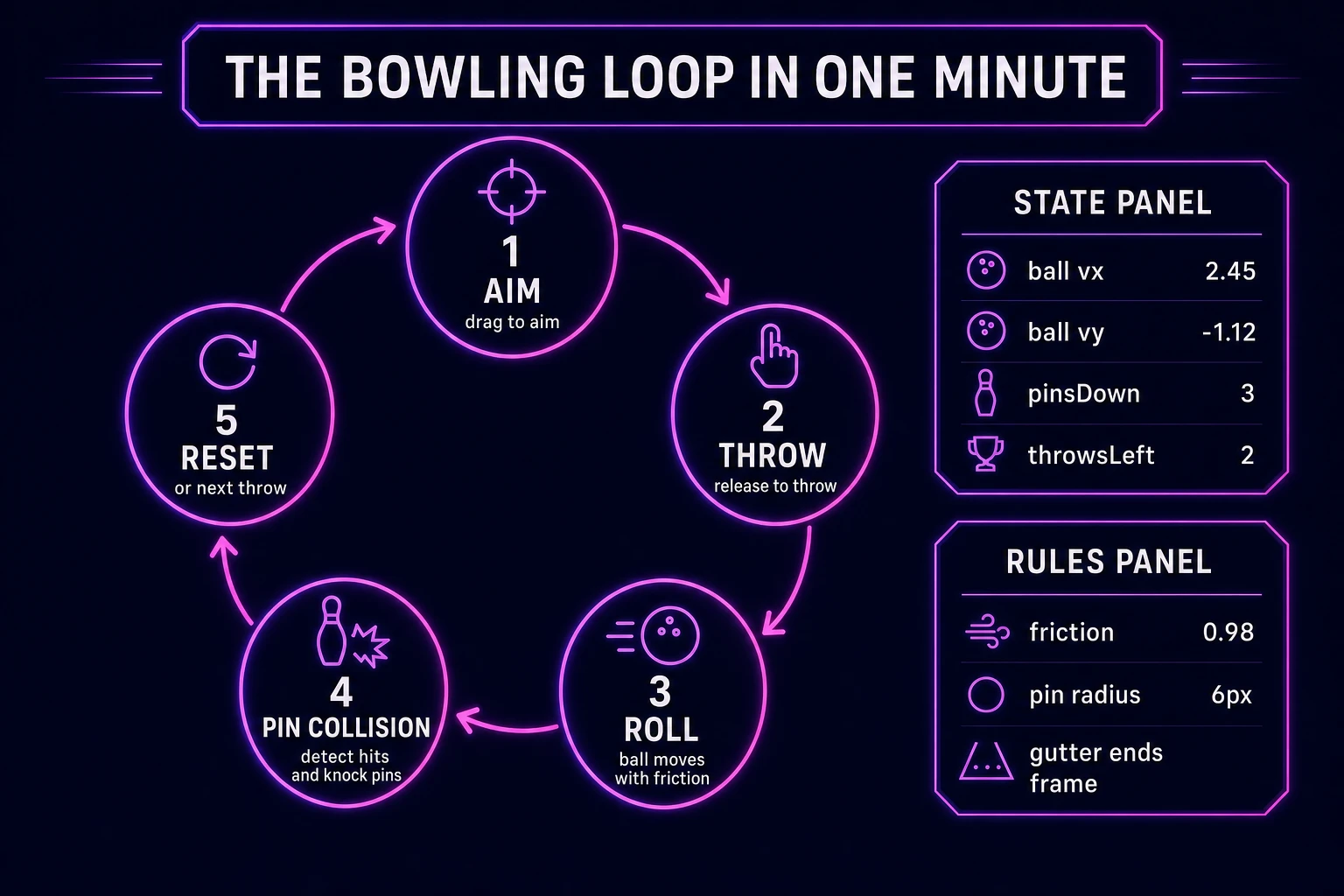
Five moving parts, repeated until the frame resolves. First, aim — on pointerdown at the ball, record the start point and show a direction arrow across lane width. Horizontal aim matters more than vertical; clamp release angle so the ball cannot leave the lane except through gutters. Second, throw — on pointerup, compute power as clamped distance between start and release, convert aim angle to a unit vector aimed down-lane, and set ball velocity to direction times power times a scale factor. Third, roll — each frame while speed exceeds the rest threshold, move the ball forward, multiply velocity by a friction constant, and check gutter bounds: if ball center crosses left or right gutter line, mark gutter and end the throw. Fourth, pin collision — for each standing pin, if ball circle overlaps pin circle, mark pin knocked, apply a small scatter impulse to neighbors, and play crash audio. Fifth, reset or next throw — when the ball rests in the pit or gutter, increment throw count, compare knocked pins to ten, show frame score, reset pins if two throws used or strike achieved, and advance frame. That is the entire bowling loop. Hook spin, oil patterns, and ten-frame league brackets are polish layered after one honest throw knocks the head pin without the ball sliding forever.
Pick your engine for how to make a bowling game: canvas, Phaser, or WizardGenie
Three good targets in 2026, each with a different trade-off. Vanilla JavaScript on canvas is the honest default and the pick this guide recommends for a first build. Draw the lane rectangle, gutter strips, pin triangles, and ball each frame with fillRect, arc, and lineTo, integrate position with friction each tick, and run circle-vs-circle collision for pins. Total code footprint for a working html5 bowling game is under 450 lines including throw counter, pin reset, and a simple power meter. No engine to install, ships as a static HTML file, deploys anywhere. The MDN Canvas API docs cover drawing and animation frames, and Pointer events cover mouse and touch on the same drag-to-aim gesture.
DOM with CSS transforms becomes the right pick only for a static mockup — a rolling ball at sixty frames per second through dozens of div elements janks on mobile. Stick with canvas for any ten pin bowling javascript tutorial you expect strangers to play.
Phaser 4.1.0 (verified 2026-08-25 on the official Phaser API documentation page) becomes the right pick if you want Matter Physics restitution on pin scatter, tweened camera follow as the ball approaches the triangle, or Scene transitions between title and play. Phaser does not invent your friction curve — you still need the same velocity decay and pin overlap helpers. Use Phaser when pin tumble chains and animated lane reveals are the product; use raw canvas when the product is a browser bowling game walkthrough people can read in one sitting.
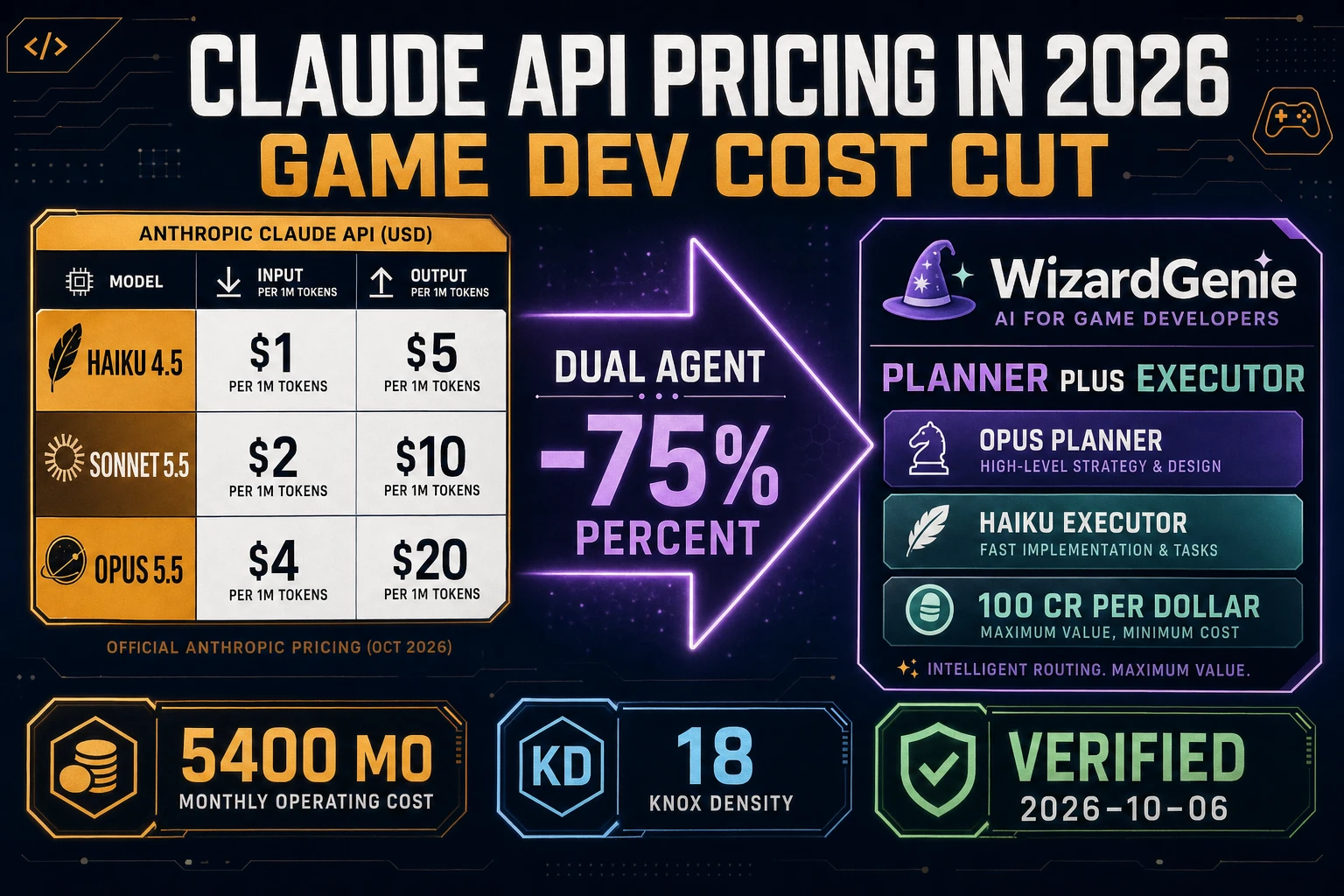
WizardGenie is not a separate rendering engine — it scaffolds whichever of the two you pick from a single natural-language prompt. WizardGenie ships as both a desktop app (Windows installer with auto-update, available to Early Access supporters and above) and a no-install web build. Its coding-model lineup covers Claude Opus 4.7, GPT-5.5, Gemini 3.1 Pro, DeepSeek V4 Pro, Kimi K2.5, Grok 4.2, and MiniMax M2.7 (verified 2026-08-25 in src/app/_home-v2/_data/tools.ts). For ten-pin bowling, any frontier model scaffolds aim drag, lane friction, and pin overlap in one prompt. Pair a frontier planner with a budget executor like DeepSeek V4 Pro or Kimi K2.5 for the typing pass — the Dual-agent pattern lands most projects at roughly one-fifth the single-frontier cost.