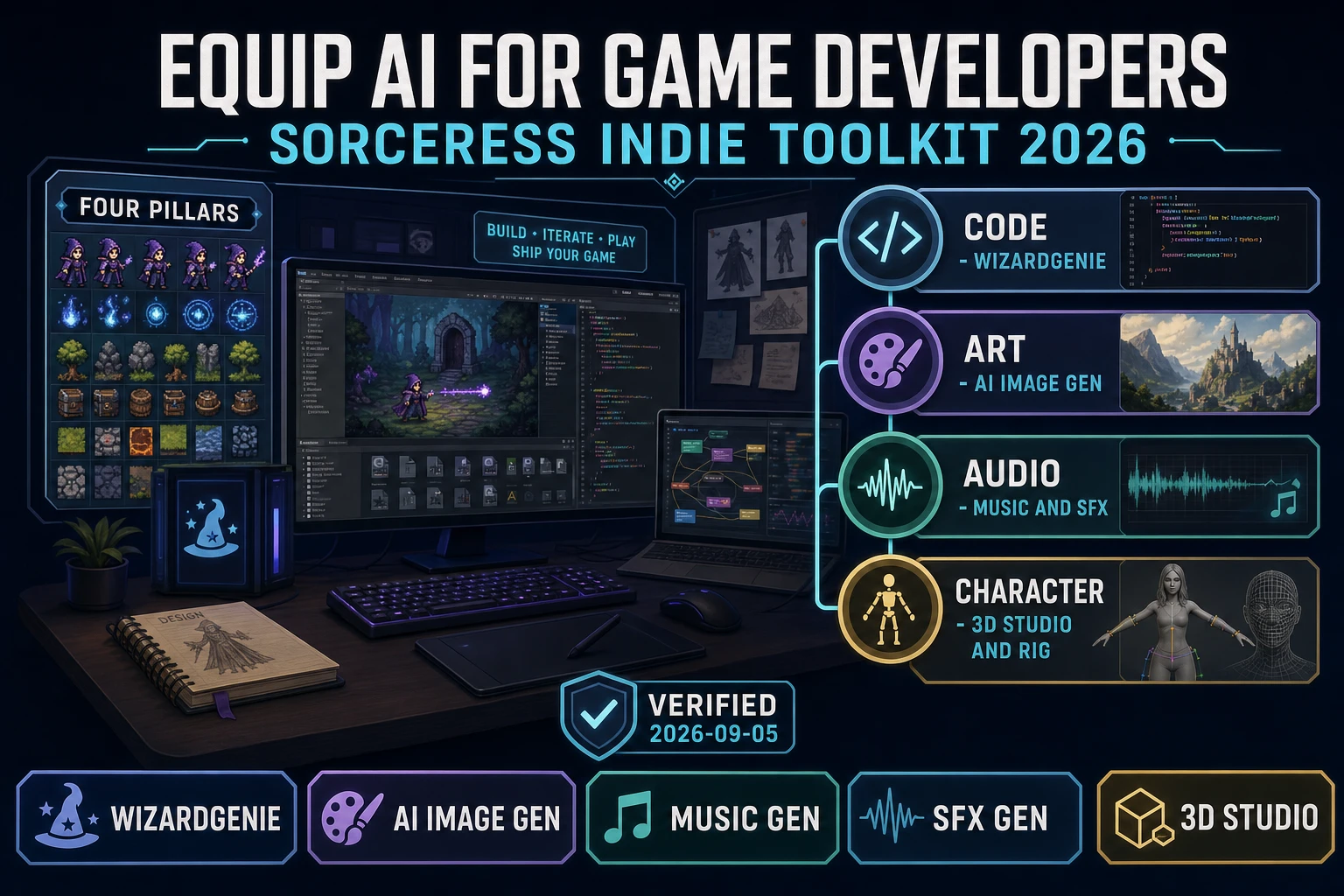
Equip AI for Game Developers (Indie Toolkit 2026)

By Arron R.9 min read
The ai for game developers stack in 2026 is four jobs, not one prompt: an agent that codes, an image gen for art, an audio model for music and sfx, and a rig pi

Type ai for game developers into Google in 2026 and half the results are vendor decks selling "prompt-to-game" magic, the other half are Reddit threads asking whether any of it actually works for a real indie project. The honest answer is that the AI part of game development is not one product - it is four boring specialized jobs: an agent that writes the game loop, an image model that produces sprites and tilesets, an audio model that scores the bed and cuts sound effects, and a character pipeline that turns a portrait into a rigged 3D mesh. Sorceress ships all four of those jobs as separate panels in a browser tab, at published credit prices, verified 2026-09-05 against the source in src/app/_home-v2/_data/tools.ts and the per-tool credit constants in src/lib/. This piece walks through what ai for game developers actually delivers today, what each pillar of the stack costs, and where the human still has to be in the loop.
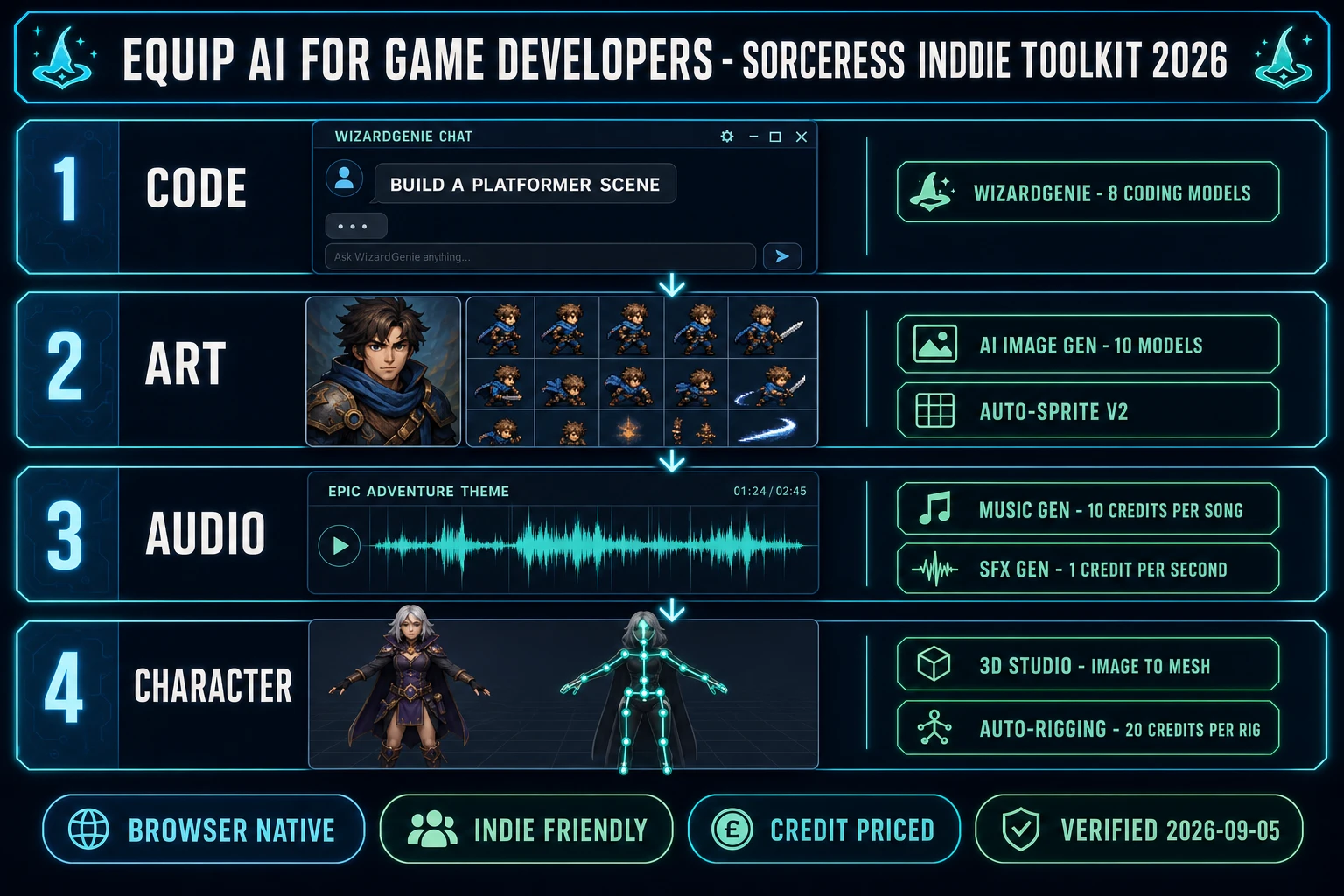
Equip AI for game developers indie toolkit 2026: four-panel Sorceress diagram showing WizardGenie for code with 8 coding models, AI Image Gen and Auto-Sprite v2 for art, Music Gen at 10 credits per song and SFX Gen at 1 credit per second, plus 3D Studio image-to-mesh and Auto-Rigging at 20 credits per rig
An ai for game developers stack is a set of four specialized tools, not a single prompt-to-game button.

What ai for game developers actually means in 2026

The phrase ai for game developers now covers three different things in the same sentence, which is why the search results are so noisy. The first meaning is procedural in-game AI - pathfinding, behavior trees, the enemy that flanks the player. That is a separate field with its own textbooks, and it is not what this piece is about. The second meaning is generative production tools - AI that writes code, produces art, composes music, and rigs characters. That is what a solo dev or a small jam team actually hires when they say the word. The third meaning is the marketing collage that stitches both together and promises "make a game with one prompt" - which is not a real product category yet, no matter what the vendor deck says.

The generative production toolchain is the one that shipped in 2026. Frontier coding models learned to hold a game codebase in context and patch it across turns instead of one-shotting a single file. Image models learned to keep a character silhouette consistent across a walk cycle when they are given a reference frame. Music models learned to compose a two-minute loop that stays in tempo and key. Image-to-3D models learned to produce a mesh clean enough to auto-rig without a manual weight-paint pass. Each of those four capabilities crossed the "good enough for a jam game" line in the last twelve months. Put them in one browser tab with a shared credit system and one auth session, and you have what a small team actually calls an ai for game developers stack.

The four jobs an indie dev actually hires AI to do

Sit next to a solo dev during a game jam and the tool tabs cluster into the same four groups every time. Job one is coding - the actual loop, the collision, the input handler, the save system. Job two is art - character sprites, tileset frames, UI icons, key art. Job three is audio - a loop that sits under the game and a small pack of sound effects for jumps, hits, pickups, menu clicks. Job four is character - if there is a 3D character at all, it needs a mesh, a skin, and a skeleton before it can walk. Those four jobs used to require four separate humans (a programmer, a pixel artist, a composer, a 3D artist) or one very stretched dev doing all of them at half speed.

The AI stack in 2026 does not remove any of the four jobs. It shifts them from "type every line and paint every pixel" to "describe the outcome and playtest the result". The programmer still owns the design, but the agent types the boilerplate. The artist still owns the style, but the image model produces the frames. The composer still owns the mood, but the music model prints the stems. The character artist still owns the silhouette, but the image-to-3D model produces the mesh and the rigger attaches the skeleton. What used to take a jam week of four people can now be handled by one dev in a weekend if the stack is honest about which model does which job.
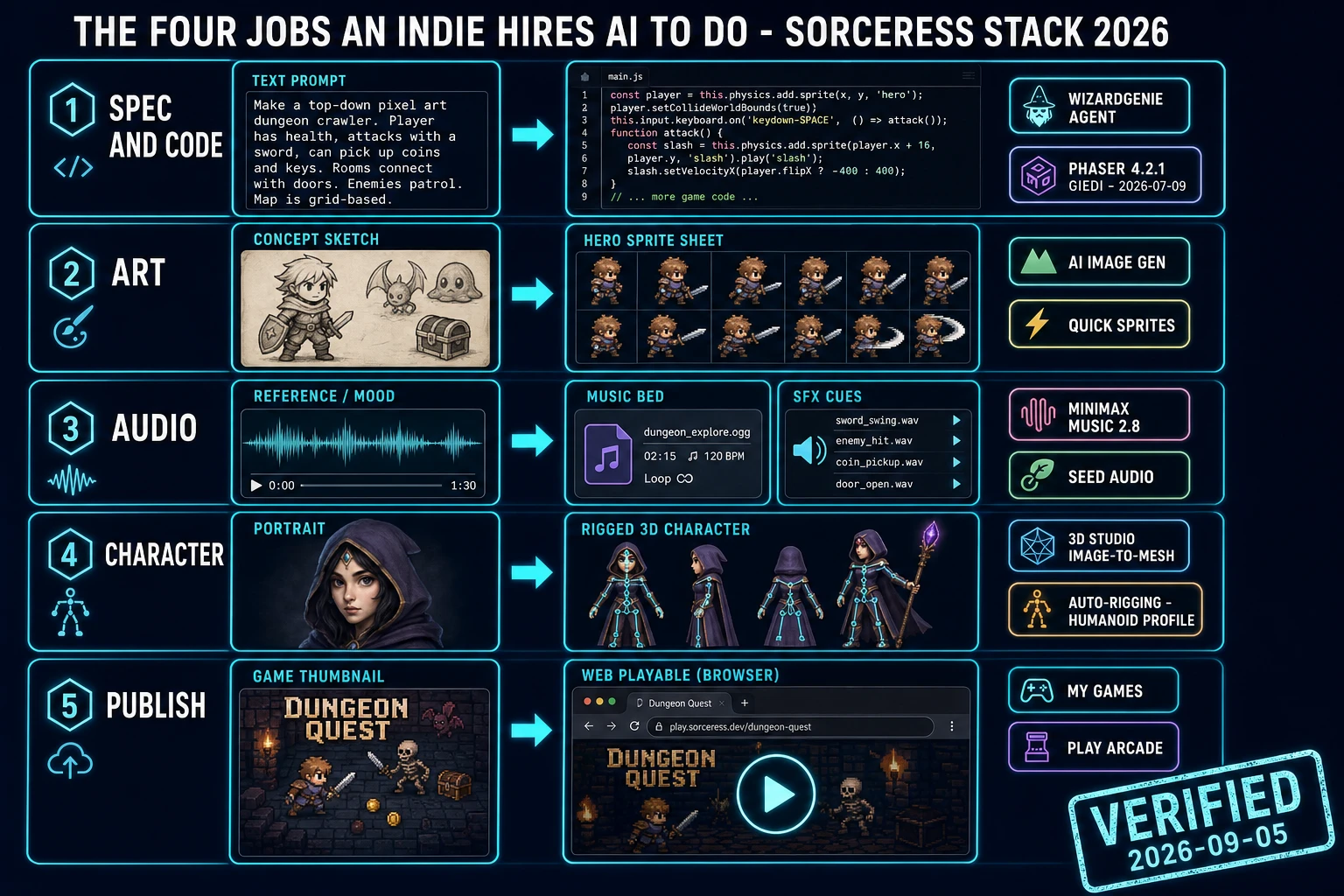
The four jobs an indie hires AI to do in the Sorceress ai for game developers stack: spec-to-code with WizardGenie writing Phaser 4.2.1 Giedi, concept-to-sprite with AI Image Gen and Quick Sprites, waveform-to-music with MiniMax Music 2.8 and sound with Seed Audio, portrait-to-rigged-character with 3D Studio image-to-mesh and Auto-Rigging humanoid profile, plus publishing to My Games and Play Arcade
The Sorceress ai for game developers stack maps four jobs to four panels: code, art, audio, character.

Pick your ai for game developers stack: browser-first, agent-driven, credit-priced

Not every AI toolchain is a good match for a game dev, and the shortlist gets shorter once the real constraints get named. Constraint one is that the dev is almost always sitting in a browser - installing yet another desktop DCC package to try one tool is a friction wall. Constraint two is that the agent has to actually understand a game codebase across turns, not just one file at a time. Constraint three is that the price has to be predictable - a jam week cannot end with a surprise thousand-dollar API bill. Constraint four is that the assets have to be game-ready: sprites with a real transparent alpha, meshes with clean topology, audio with the right loop points, models with a rig attached.

Sorceress was built around those four constraints. The WizardGenie agent runs in a browser tab and holds the game codebase across turns. The AI Image Gen panel exposes ten image models with a shared reference-image system so a character stays on-model across a walk cycle. The Music Gen and SFX Gen panels use a shared credit balance so the audio and code sessions do not need two separate billing accounts. The 3D Studio and Auto-Rigging panels wire image-to-mesh into an auto-rigger that outputs a GLB the game engine reads directly. The whole stack is priced per credit, published on the plans page, and works with the same browser tab a dev already has open. That is what "browser-first, agent-driven, credit-priced" means in practice.
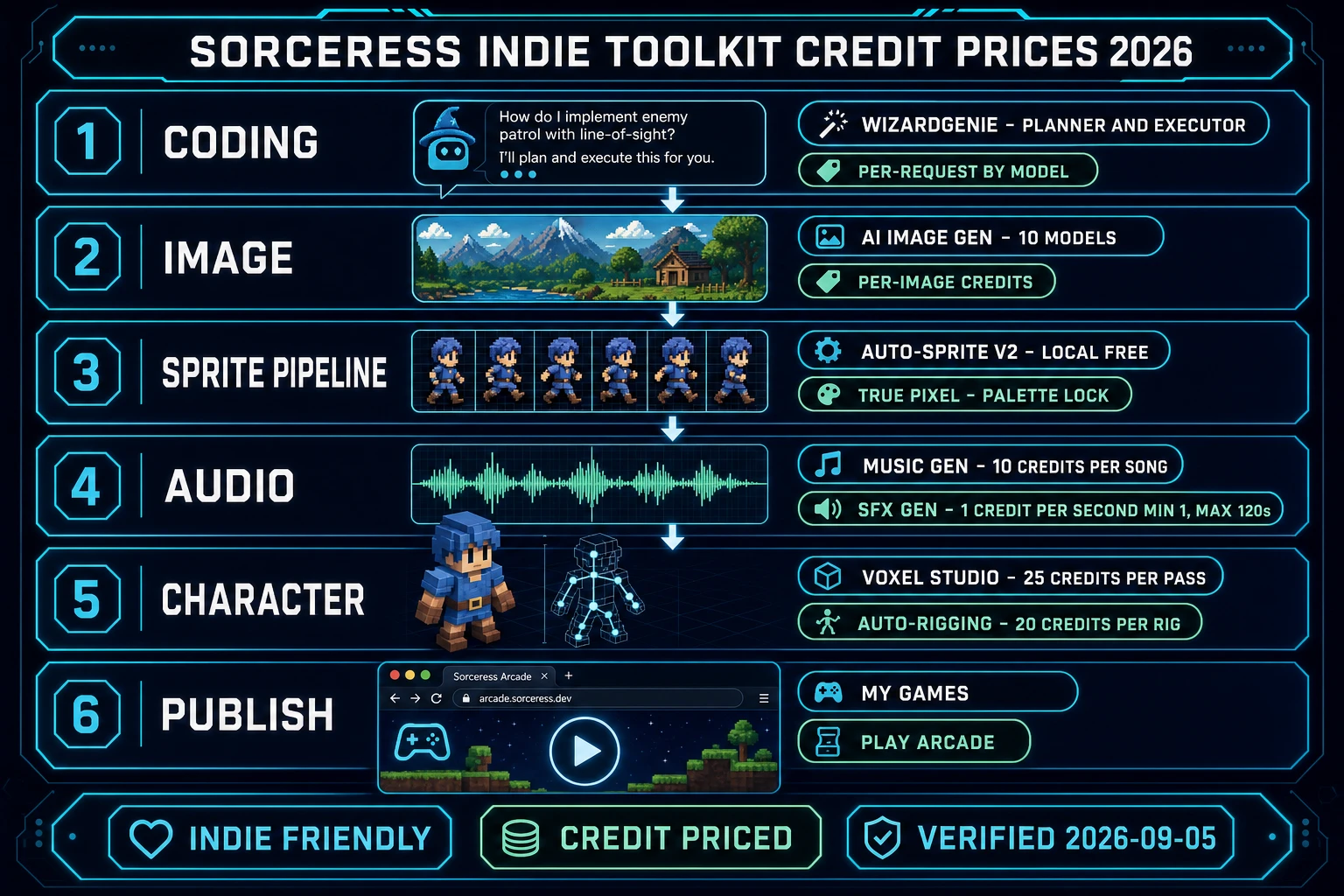
Step 1 - the coding pillar with WizardGenie and the eight coding models

The coding pillar is the one that took the longest to arrive. Writing a game loop is not the same as writing a REST API - the model has to reason about state that persists across frames, coordinate systems, input events, collision resolution, and the eventual save format. As of 2026-09-05, verified against CODING_MODELS in src/app/_home-v2/_data/tools.ts, the WizardGenie surface exposes eight frontier coding models: Claude Opus 4.7 and Claude Sonnet 4.6 from Anthropic, GPT-5.5 from OpenAI, Gemini 3.1 Pro from Google, DeepSeek V4 Pro, Kimi K2.5 from Moonshot, Grok 4.2 from xAI, and MiniMax M2.7. The lineup covers both frontier planners (Opus, GPT-5.5, Gemini Pro, Grok) and cheap fast executors (DeepSeek V4 Pro, Kimi K2.5, MiniMax, Sonnet as a middle option) so a dual-agent Planner+Executor pattern is a two-dropdown pick, not a plumbing project.

The agent itself is engine-agnostic. It writes Phaser code for browser games (Phaser v4.2.1 "Giedi" released 2026-07-09, verified 2026-09-05 via phaser.io/download/stable), plain Canvas or WebGL for engine-less projects, C# for Unity, GDScript for Godot, and Luau for the Roblox Studio path. The dev picks the engine, the agent writes the code, and the browser tab hot-reloads the build on every patch. For an indie deciding between engines, this matters more than any benchmark: the AI is not locked to one runtime, so the engine choice stays with the developer instead of being dictated by which model has better tokenizer coverage for the language.

Step 2 - the asset pillars: AI Image Gen, Auto-Sprite v2, 3D Studio, Tileset Forge

The art pillar has four panels because "game art" is not one job. Concept art is one job (character portraits, key art, hero banners). Sprite art is a second job (character frames, walk cycles, prop pixels). Tileset art is a third (grid-aligned floor tiles, wall tiles, autotile sets). 3D character art is a fourth (mesh, texture, rig). Trying to compress all four into one panel produces a Swiss army knife that does none of them well. Sorceress splits the work across four surfaces that each specialize in one output format and then wire together via a shared reference-image system so a character stays on-model as it moves from concept to sprite sheet to walk cycle to rigged mesh.

Concept art lives in AI Image Gen, which exposes ten image models (GPT Image 2, Nano Banana Pro, Seedream 5 Pro, Flux 2 Pro, Grok Imagine, and family variants) with per-model reference-image caps published in src/lib/models.ts. Frame batching for animation goes through Auto-Sprite v2, which extracts frames from a source video or renders synthetic frames and packages them as a sprite sheet or animated GIF - local backend mode is free, cloud mode uses a frame-count credit formula. Grid-aligned tiles come from Tileset Forge. 3D characters go through 3D Studio for image-to-mesh and then through Auto-Rigging for the skeleton - a full character pass is 20 credits for the rig (AUTO_RIG_CREDITS.meshy in src/lib/rigging/external-rig/autoRigPricing.ts, verified 2026-09-05) plus the image-to-mesh cost.

Sorceress indie toolkit credit-price panel diagram for ai for game developers in 2026: WizardGenie coding per-request by model, AI Image Gen with 10 models per-image credits, Auto-Sprite v2 local free, Music Gen 10 credits per song, SFX Gen 1 credit per second min 1 max 120s, Voxel Studio 25 credits per pass, Auto-Rigging 20 credits per rig, plus My Games and Play Arcade publishing
Every pillar of the Sorceress ai for game developers stack ships with a published, verified credit price.

Step 3 - the audio pillar: Music Gen, SFX Gen, Speech Gen

Audio is the pillar most jam devs cut when they run out of time, which is the wrong cut - a two-minute loop plus a handful of sound effects moves a build from "prototype" to "playable" faster than a second art pass. The Sorceress audio pillar is three panels, one per audio job. Music Gen composes a full song from a prompt at a fixed 10 credits per generation (MUSIC_CREDIT_COST in src/app/music-gen/page.tsx, verified 2026-09-05) with a 20-second default duration and support for creating, extending, mashing up, adding vocals, or replacing a section of an existing song at 5 credits per replace. Automatic lyrics generation runs at 2 credits (LYRICS_CREDIT_COST), and stem or MIDI exports have their own small credit lines.

Sound effects live in SFX Gen, which prices audio by the second: SEED_AUDIO_CREDITS_PER_SECOND = 1 in src/app/sfx-gen/page.tsx, minimum 1 credit, capped at 120 seconds per generation. That price shape matches the actual output the dev wants: a jump is a fifth of a second and costs 1 credit, an ambient rain bed is 30 seconds and costs 30 credits. Voice work lives on the Speech Gen panel, which handles NPC lines and narration through MiniMax Speech 2.8 HD with the same shared-credit balance. Together the three panels cover every audio slot in a small game without pushing the dev to leave the browser or open a DAW - which is the point of the pillar.

What ai for game developers actually costs on Sorceress in 2026

The credit prices are the reason the stack is defensible for an indie budget. A jam-length project ships for a small fraction of what the equivalent human labor would cost, and every price is published rather than negotiated. Coding runs through WizardGenie on a per-request price that varies by model, listed on the plans page - a session on DeepSeek V4 Pro or Kimi K2.5 as the executor is a fraction of the cost of the same session on Opus or GPT-5.5 as the executor, which is why Planner+Executor pairings matter for the bill.

Asset costs stack predictably. A full character starts from an image generation (per-model credit cost in the AI Image Gen panel), passes through 3D Studio for the image-to-mesh step, and picks up the 20-credit rig fee for the skeleton. Voxel characters use the Voxel Studio path at 25 credits per Hunyuan 3D 3.1 pass (VOXEL_HUNYUAN_CREDITS in src/lib/voxelgen-hunyuan.ts, verified 2026-09-05). Audio ships at 10 credits per song plus the SFX pack at 1 credit per second. Auto-Sprite v2 is free in local backend mode; cloud mode is the frame-count formula. The whole toolkit sits on the plans page as a single line-item bundle so the dev can plan a jam budget instead of guessing. For anyone shopping around, the indie-stack guide, the stack-rundown umbrella, and the coding-model bench are the three cross-reads that map ai for game developers onto the specific tools inside Sorceress.

The last thing worth saying is what the stack does not do. It does not remove the need for taste. It does not remove the need for playtesting. It does not remove the need for a real design document if the game is more than a two-scene jam. What it does do is hire out the labor that used to be four separate specialists and puts all four of them in a browser tab. The ai for game developers honest pitch in 2026 is that phrase, not "prompt to game" - and it is the version indie devs actually ship with.

Frequently Asked Questions

What is the ai for game developers stack in 2026?

The ai for game developers stack in 2026 is four specialized jobs, not one prompt-to-game button. Job one is code: an agent that types the game loop for you (Sorceress WizardGenie runs eight coding models including Claude Opus 4.7, Claude Sonnet 4.6, GPT-5.5, Gemini 3.1 Pro, DeepSeek V4 Pro, Kimi K2.5, Grok 4.2, and MiniMax M2.7, verified 2026-09-05 in src/app/_home-v2/_data/tools.ts CODING_MODELS). Job two is art: an image model for concept art, sprites, tilesets, and UI. Job three is audio: a music model for the bed and a sound-effects model for cues. Job four is character: an image-to-3D model plus an auto-rigger that gives you a game-ready GLB with a skeleton attached. Sorceress ships all four in a browser tab.

How much does the ai for game developers stack actually cost on Sorceress?

Verified 2026-09-05 against the source code: WizardGenie coding runs on a credit-per-request price that varies by model (published on /plans). Music Gen is 10 credits per song (MUSIC_CREDIT_COST in src/app/music-gen/page.tsx), lyrics generation is 2 credits, and the default song duration is 20 seconds. SFX Gen is 1 credit per second (SEED_AUDIO_CREDITS_PER_SECOND in src/app/sfx-gen/page.tsx), capped at 120 seconds, minimum 1 credit. Voxel Studio image-to-voxel runs on Tencent Hunyuan 3D 3.1 at 25 credits per pass (VOXEL_HUNYUAN_CREDITS in src/lib/voxelgen-hunyuan.ts). Auto-Rigging is 20 credits per rig (AUTO_RIG_CREDITS.meshy in src/lib/rigging/external-rig/autoRigPricing.ts). Auto-Sprite v2 in local mode is free (isLocal branch returns 0); cloud mode uses a frame-count credit formula published in-app.

Is ai for game developers actually good enough to ship a game with, or is it still a demo?

The published Sorceress blog is the receipt. As of 2026-09-05 the blog has shipped over two hundred game-dev tutorials that were drafted through the AI stack described here, with hundreds of code samples that were written or refined by WizardGenie's coding models. The stack is genuinely at ship-a-jam-game quality for 2D games, and it is at ship-a-vertical-slice quality for small 3D games with GLB characters. What it is not is a replacement for a large studio's asset pipeline - a shipped AAA console title still needs custom tooling. For an indie or a jam team, the honest answer in 2026 is: yes, ship with it.

Do I need to pick between an ai for game developers stack and a game engine like Phaser or Godot?

No. The AI stack sits on top of a real engine, not in place of one. WizardGenie writes Phaser code for browser games (Phaser v4.2.1 'Giedi' released 2026-07-09 per phaser.io/download/stable, verified 2026-09-05), Unity C# for the Unity path, Luau for the Roblox Studio path, and Godot GDScript when the reader picks Godot. The engine choice belongs to the developer; the AI writes the code for that engine and generates the assets that engine consumes. That is why the pillar model works: the engine is the game runtime, the AI is the labor that fills the runtime with playable content.

Why does ai for game developers still need a human in the loop?

Because 'agent, not autopilot' is not a slogan - it is how the current generation of models actually work. Frontier coding models get the loop mostly right on the first pass but miss edge cases that a human playtester catches in ten seconds. Image models produce beautiful frames that occasionally break silhouette consistency across a walk cycle. Audio models nail a mood but sometimes miss a tempo target. The developer's job in 2026 is to describe the game clearly, run the models, playtest, and patch - not to type every line and paint every pixel. The AI moves the tedium; the taste stays with the human.

Sources

  1. Video game development - Wikipedia
  2. Game engine - Wikipedia
  3. Phaser 4.2.1 stable release
  4. Games - MDN Web Docs
  5. Skeletal animation - Wikipedia
Written by Arron R.·2,126 words·9 min read

Related posts