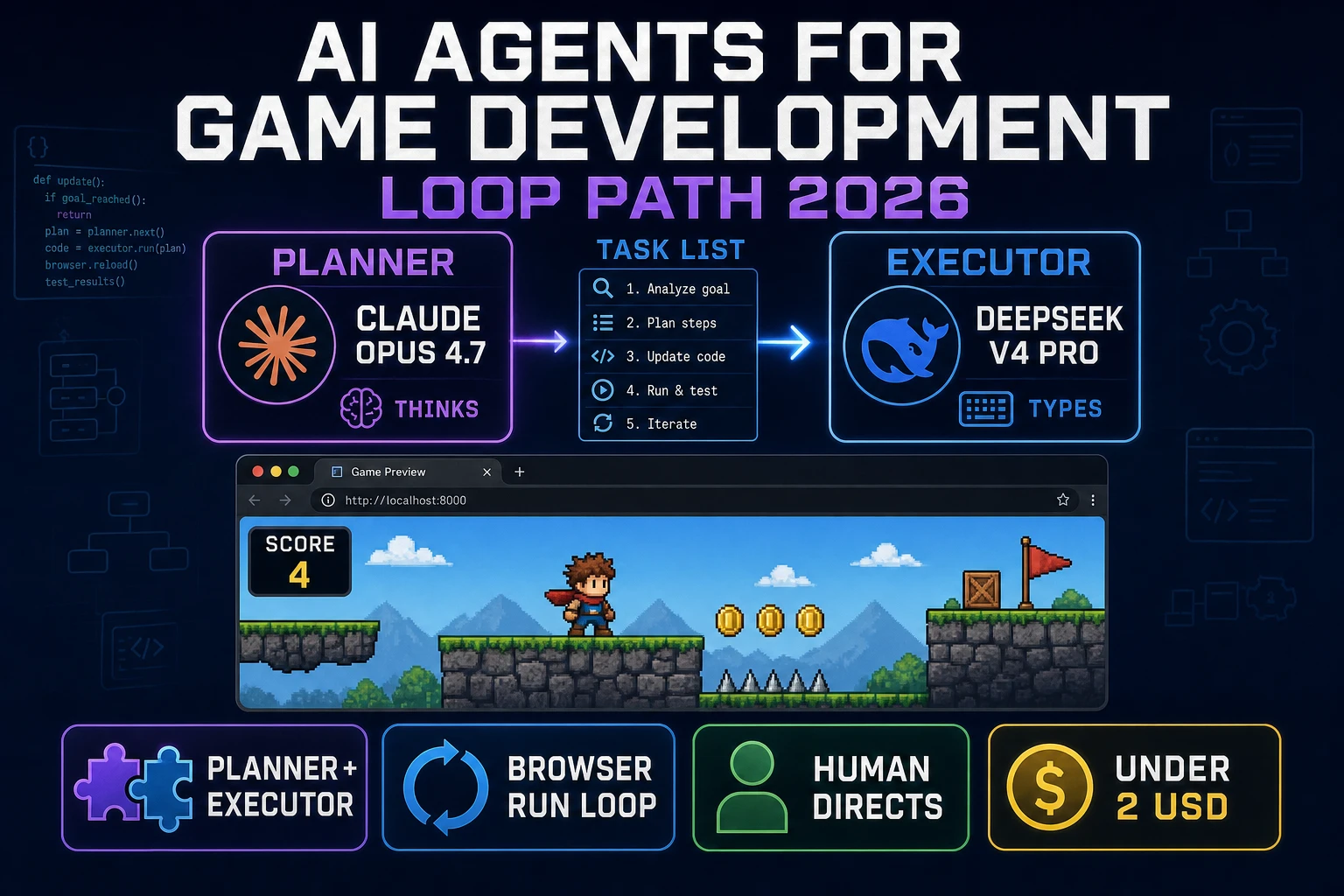
Deploy AI Agents for Game Development (Loop Path 2026)

By Arron R.11 min read
AI agents for game development in 2026 is a Planner+Executor pair, not a chatbot. Claude Opus 4.7 plans the task list, DeepSeek V4 Pro types the Phaser code, Wi

The 2026 stack has finally made the phrase "AI agents for game development" mean something you can point at instead of a vague marketing line from 2024. Two years ago the label covered a spread of chat-based coding assistants that would happily return ten lines of Phaser between apology paragraphs. Today it names a specific software pattern - a Planner model that reads a spec and writes a task list, plus an Executor model that types the actual game code, plus a browser-embedded run loop that catches runtime errors and feeds them back, plus a human developer directing every taste call. This piece is the 2026 rundown of that pattern against the shipping Sorceress agent stack: WizardGenie exposes eight coding models with a Planner+Executor split, Sorceress Code handles chat-based file-aware refactor, and the Sorceress tools guide lists every complementary agent that plugs into the loop. Verified 2026-09-08 against the source tree.
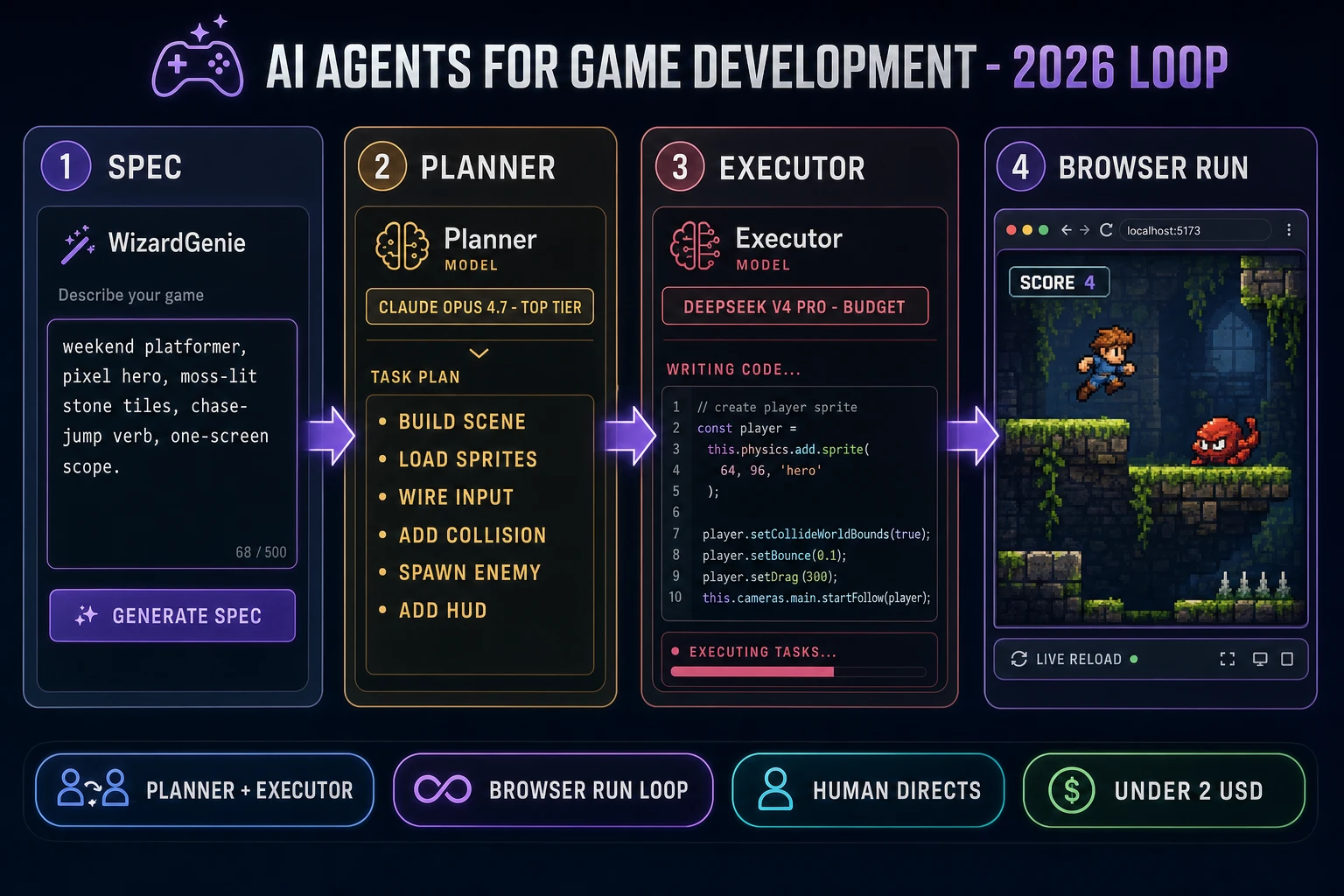
AI agents for game development in 2026 loop path: a 4-step pipeline showing SPEC (WizardGenie prompt), PLANNER (Claude Opus 4.7 top tier), EXECUTOR (DeepSeek V4 Pro budget), and BROWSER RUN (embedded Phaser platformer preview with a pixel hero mid-jump and SCORE 4 HUD)
The 2026 loop path for AI agents for game development: a Planner+Executor pair running a full Phaser build in a single browser tab, verified against the Sorceress source tree.

What "AI agents for game development" actually mean in 2026

The phrase "AI agents for game development" carries three years of accumulated meaning drift. In 2023 an "agent" was mostly a marketing prefix on top of a chat window - a single-model surface that could occasionally call a tool. By 2024 it started to mean an LLM that could actually run a loop against a codebase. In 2026 the honest working definition is tighter: an agent in the software-engineering sense (verified 2026-09-08 on Wikipedia) is a program that perceives an environment, chooses actions, and pursues a goal without step-by-step human instruction. Apply that definition to game dev and four ingredients drop out cleanly: (1) a bounded environment (the game project file tree, the browser preview, the console), (2) a task list the agent maintains on its own, (3) a model that reads runtime errors and picks a next action, and (4) a human who defines the goal and directs every taste call.

Everything else that gets marketed as "AI agents for game development" but skips one of those four ingredients is a chat. A chat window returns text; the developer runs the code and eats the errors. That is not an agent - that is a documentation query with better prose. The 2026 Sorceress stack is one of the few that ships all four ingredients as a single-tab surface, and the reason to draw the distinction sharply is that the cost math and the workflow feel completely different once the loop actually closes. The prior AI game development browser stack rundown covers the four-pillar shape (code, art, 3D, audio) that surrounds the agent; this piece drills into the coding-agent pillar because that is where the "AI agents for game development" query lands hardest in 2026 search intent, and where the difference between a real agent and a fancy chat is easiest to see.

The Planner+Executor pattern behind serious agents

Every serious 2026 AI coding agent in the game-dev lane runs a Planner+Executor split. The pattern is old (multi-agent robotics has used variants of it for decades, verified 2026-09-08 on the Wikipedia autonomous agent entry) but 2026 is the year the economics finally made it the default for LLM-backed coding. The Planner is an expensive top-tier reasoning model - Claude Opus 4.7, GPT-5.5, Gemini 3.1 Pro, or Grok 4.2, verified 2026-09-08 against CODING_MODELS in src/app/_home-v2/_data/tools.ts lines 766-775. The Planner reads the one-page game spec, emits a task list, decides which file to touch first, and writes each follow-up prompt for the Executor. The Executor is a cheap-fast large-context large language model (verified 2026-09-08 on Wikipedia) - DeepSeek V4 Pro, Kimi K2.5, MiniMax M2.7, Gemini 3.1 Flash, or GPT-5.5 Mini. The Executor receives each Planner prompt and returns actual Phaser code.

The economic logic is expensive reasoner thinks, cheap fast typer executes. A well-paired Planner+Executor session runs at roughly one-fifth the cost of a single-frontier-model session while producing better code, because the Planner spends its token budget on reasoning rather than typing, and the Executor spends its token budget on typing rather than deliberating. Never put Claude Sonnet, Claude Opus, GPT-5.5, or Gemini 3.1 Pro on the Executor side - those are frontier-priced models, and putting them on the typing lane erases roughly 80 percent of the cost advantage the pattern exists to capture. The practical default for a first Sorceress project is Claude Opus 4.7 as Planner, DeepSeek V4 Pro as Executor. That is the pairing WizardGenie surfaces by default when a new developer opens the panel, and the executor picks piece lands on the same pair after benchmarking all eight coding models against Phaser scene setup and Three.js loop wiring.
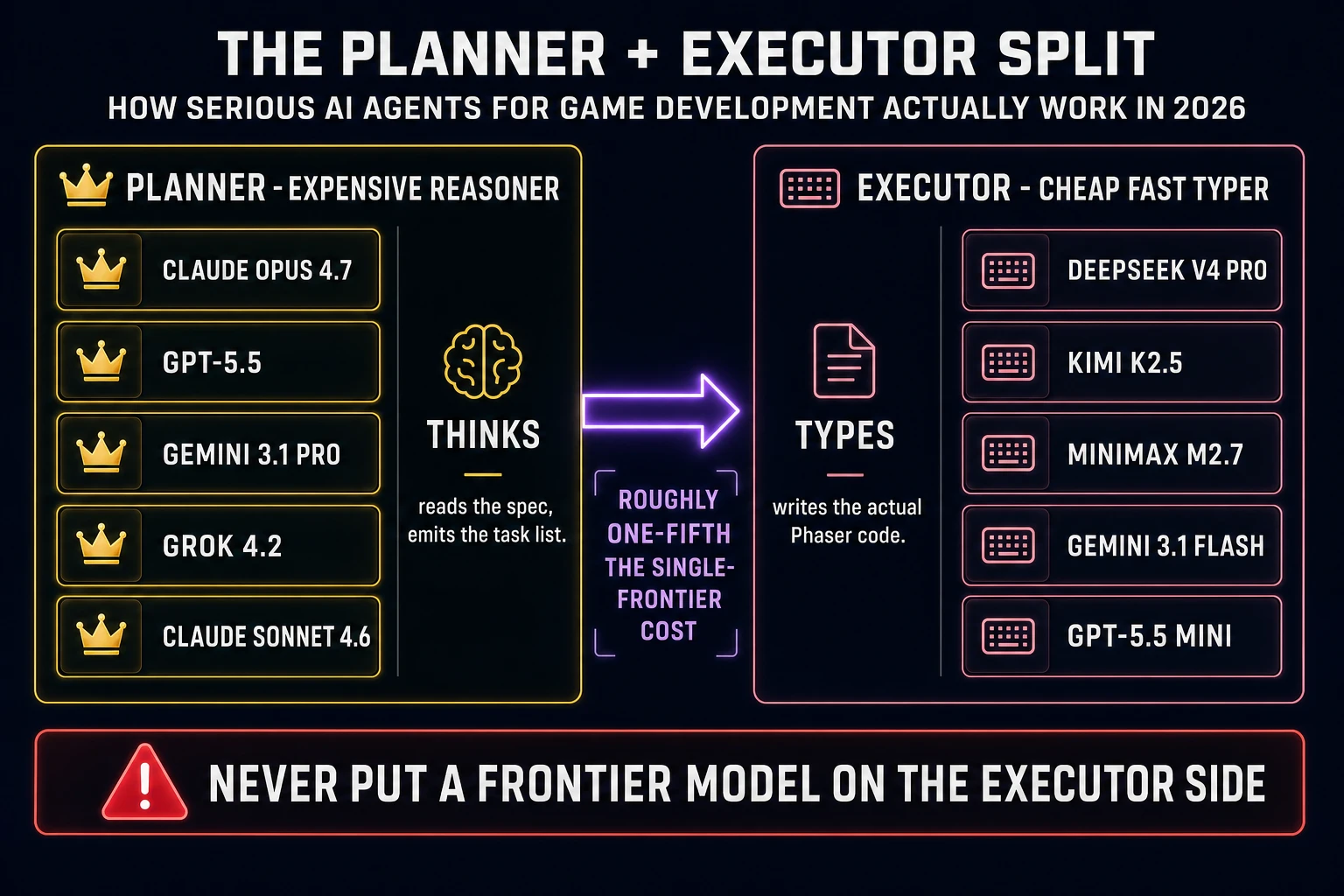
The Planner+Executor pattern for AI agents for game development: two columns showing five acceptable Planner models (Claude Opus 4.7, GPT-5.5, Gemini 3.1 Pro, Grok 4.2, Claude Sonnet 4.6) on the left and five acceptable Executor models (DeepSeek V4 Pro, Kimi K2.5, MiniMax M2.7, Gemini 3.1 Flash, GPT-5.5 Mini) on the right, with a callout that the split runs at roughly one-fifth the single-frontier cost
The Planner+Executor split that separates serious AI agents for game development from single-model chat windows. Expensive reasoner thinks; cheap fast typer executes; the developer keeps the taste calls.

WizardGenie as a dual-agent implementation

WizardGenie is the Sorceress implementation of the dual-agent pattern, tuned specifically for the game-dev vertical rather than generic code. The developer opens the WizardGenie tab (available on both web at /wizard-genie/app and on Windows desktop with auto-update, verified 2026-09-08 against the app surface), writes a one-page game spec into the prompt field, picks the Planner and Executor models from the eight-model panel, and starts the loop. WizardGenie takes it from there: it maintains the task list, hands each task to the Executor, catches the runtime error out of the embedded browser preview, and hands the error back to the Planner for a patched next prompt. The developer's job during that loop is to say "yes this jump feels right, no this enemy telegraph is too fast, add a coin pickup" - taste calls, not code.

The desktop build of WizardGenie is the strongest option for longer-running project work because it has native filesystem access (write directly to a real project folder), longer-session agent memory, and offline-capable project work after the initial download. The web build runs the same eight models in the browser tab and is the friction-free entry point for a first-time developer. Both surfaces expose the same Planner+Executor pattern and the same eight-model catalog. Neither auto-publishes anything to any arcade at the end of the run - the developer exports the build and hosts it wherever they want, and every "publish" step in a WizardGenie flow is a deliberate human action.
Sorceress Code and file-aware refactor

Sorceress Code is the second AI agent in the coding pillar, aimed at a slightly different job: chat-based file-aware refactor of an existing project. Where WizardGenie is the scaffold-and-iterate agent for a project you are starting from scratch, Sorceress Code is the "I have a working game and I want to add a level-select screen without breaking the existing scene chain" agent. It is a coding surface tuned for Phaser scene management, Three.js renderer plumbing, game-loop wiring, collision setup, and asset loading. The agent reads the file, understands the surface it is editing, and returns edits in the same style as the existing code rather than dropping in a stylistically foreign snippet.

The clean split between the two agents matters for a real project: WizardGenie owns the first Saturday (scaffold, iterate, ship a playable slice), Sorceress Code owns everything after week two (refactor, refactor, refactor as the design changes). Both agents inherit the same Planner+Executor economics if the developer pairs them with the right model on each side, and both link into the same asset and audio pillars covered next. The will AI take over game development verdict covers the "agent, not autopilot" framing that both tools ship - the developer stays in the driver seat at every decision point, and the AI is the assembly line.

Where art and audio agents plug into the coding loop

The coding agent is only one pillar of "AI agents for game development" in 2026. A playable Saturday build also needs art (hero sheet, enemy sheet, backdrop, HUD icons), audio (a music bed and a handful of SFX cues), and often a rigged 3D prop or two. Each of those pillars runs its own agent surface inside Sorceress, and each one plugs into the coding loop as a URL the WizardGenie tab can reference. AI Image Gen ships twelve top-tier image models (Nano Banana Pro, Nano Banana 2, GPT Image 2, Seedream 5 Lite, Flux 2 Pro, Z-Image Turbo, Grok Imagine, and more, verified 2026-09-08 in src/lib/models.ts) for backdrops, hero sheets, and UI icons. Quick Sprites handles animated pixel-art sprite sheets. 3D Studio handles image-to-rigged-3D lifting when the game needs a real 3D prop.

Music Gen bills a flat MUSIC_CREDIT_COST of 10 credits per generation via Suno V5.5 (verified 2026-09-08 in src/app/music-gen/page.tsx line 28). The developer writes a mood prompt - "chill 90 BPM lo-fi loop in A minor, no vocals, 20 seconds, loopable" - and picks a candidate from the returned variations. SFX Gen bills SEED_AUDIO_CREDITS_PER_SECOND = 1 credit per second (verified 2026-09-08 in src/app/sfx-gen/page.tsx line 23) via BytePlus Seed Audio 1.0. Every one of those agents follows the same human-directs-model-executes pattern the coding agent uses. Nothing about the art or audio pillar is autopilot - every asset is a directorial choice the developer makes, and every returned candidate gets approved or discarded before it enters the game.

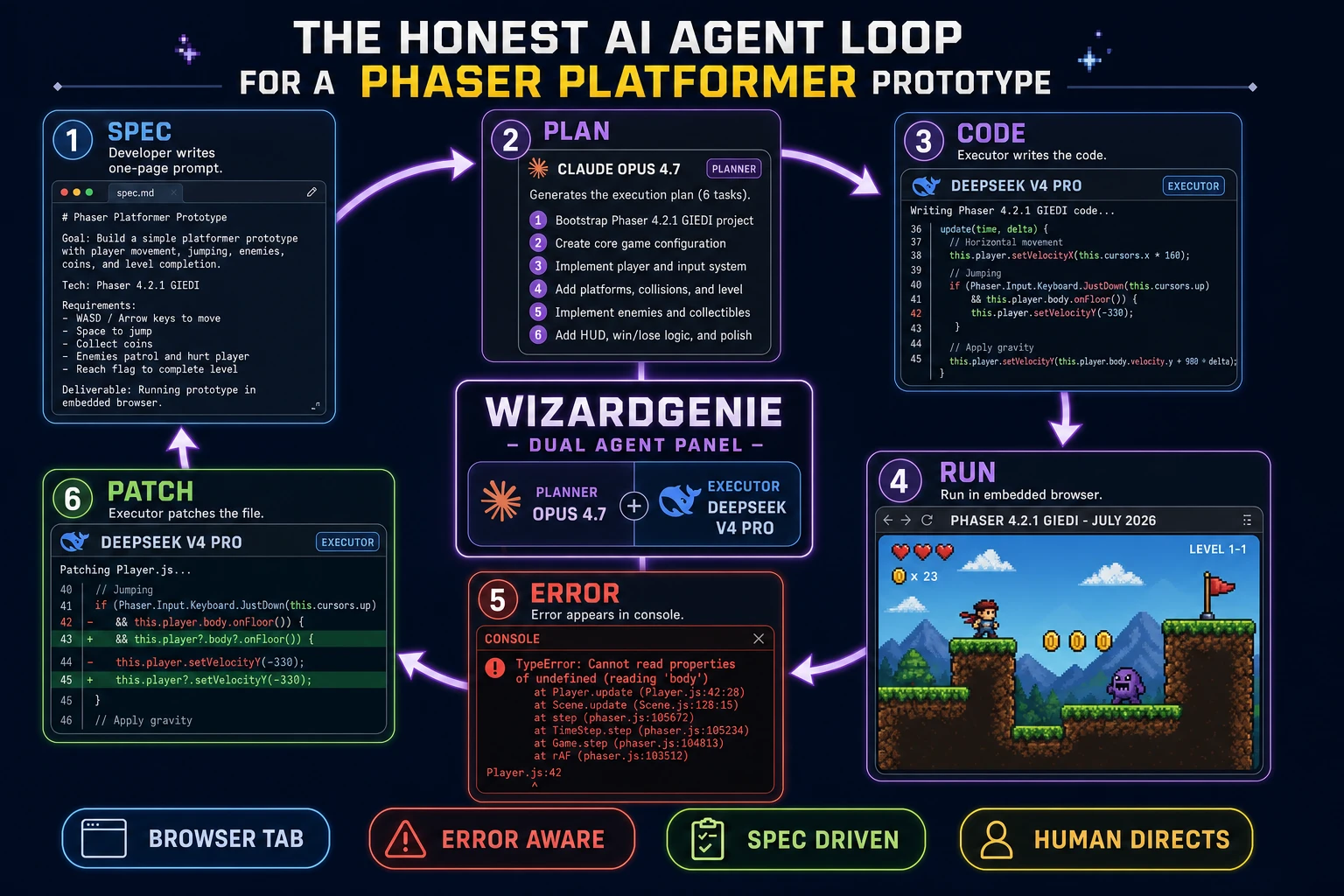
The full AI agent loop for a Phaser platformer prototype: a circular 6-step feedback cycle showing SPEC (developer prompt), PLAN (Claude Opus 4.7 task list), CODE (DeepSeek V4 Pro Phaser 4.2.1 output), RUN (embedded browser preview), ERROR (TypeError console callout), and PATCH (Executor diff), all orbiting a central WizardGenie dual-agent panel
The full loop AI agents for game development run in 2026: spec, plan, code, run, error, patch, repeat. WizardGenie owns the orchestration; the developer owns the taste.

The honest agent loop for a Phaser platformer prototype

The clearest way to describe how AI agents for game development actually run in 2026 is to walk one honest loop end to end. Start with a one-paragraph spec: "weekend platformer, pixel hero, moss-lit stone tiles, chase-jump verb, one-screen scope, coin pickup, one patrol enemy, three-heart HUD, win screen when all coins collected". Open a WizardGenie tab, paste the spec, pick Claude Opus 4.7 as Planner and DeepSeek V4 Pro as Executor, and hit run. The Planner emits a six-item task list (build scene, load sprites, wire input, add collision, spawn enemy, add HUD). The Executor writes the actual code against Phaser v4.2.1 "Giedi" (released 9 July 2026, verified 2026-09-08 on the official Phaser stable download page) - the same stable release the browser preview will run against.

The embedded preview boots and the hero appears mid-scene. The first runtime error surfaces on line 42 - a sprite is undefined because the loader promise resolved after the scene ran its create hook. WizardGenie catches the error, hands it back to the Planner, and the Executor patches the sprite loader to await properly. The scene refreshes and the hero moves. The developer says "the jump feels floaty - gravity should be 0.9, not 0.6". The Planner writes that as a follow-up task, the Executor patches the physics config, and the run refreshes. Loop through art (AI Image Gen produces a 4-frame hero sheet, one enemy sheet, and a stone-tile backdrop), audio (Music Gen returns a 20-second loop, SFX Gen returns four cues), and playtest passes for the next hour. At the end of the loop the game is playable in the tab, the developer has never left it, and the HTML Canvas API (verified 2026-09-08 on MDN) is what actually renders the pixels behind the scenes. That is not a "video game development" hypothetical - that is what a video game development loop (verified 2026-09-08 on Wikipedia) looks like in the browser tab with a real agent driving it.

The credit math for a full dual-agent session

The specific number that makes AI agents for game development a viable indie workflow in 2026 is the credit math. A full dual-agent WizardGenie session for the Saturday platformer described above runs under two US dollars in total generation. Credits convert at CREDITS_PER_DOLLAR = 100 (one credit is one US cent, verified 2026-09-08 in src/lib/models.ts line 69). A typical session on the Opus 4.7 + DeepSeek V4 Pro default burns roughly 60 to 120 credits for the initial scaffold pass, another 40 to 80 credits for two iteration rounds against runtime errors and design feedback, and a further 40 to 60 credits for the asset side (hero sheet + enemy sheet + backdrop from AI Image Gen at single-digit credits per generation, a Music Gen loop at 10 credits, four SFX cues at roughly 5 credits total).

Total: 140 to 260 credits for a playable weekend build, or 1.40 to 2.60 USD. The free 100-credit signup grant covers the entire asset side outright for a first project, so the effective cost bar is closer to one US dollar for a first-time dev who has never touched credits before. Lifetime Early Access sits at LIFETIME_PRICE = 49 USD (verified 2026-09-08 in src/app/plans/page.tsx line 51) and unlocks the desktop WizardGenie build with auto-update, longer session memory, and native filesystem access. The pricing page lists the full credit tiers if you want to top up beyond the signup grant. That whole math is the reason a solo dev can now attempt a scope that would have required a small team in 2022 - not because the AI made the developer less necessary, but because the assembly-line cost floor dropped by roughly two orders of magnitude.

The verdict on AI agents vs plain chat for game dev

The honest 2026 verdict is that AI agents for game development are worth deploying only when the agent actually runs the loop. If the "agent" in question is a chat window that returns snippets, it saves the developer some typing but does not change the shape of the work - the developer still runs the game, reads the errors, and manages the file surface by hand. If the agent runs the browser preview, catches the runtime error, and patches the file without a copy-paste cycle, the shape of the work changes: the developer becomes a director, the agent becomes the assembly line, and the Saturday build ships. WizardGenie is the browser-tab implementation of that split; Sorceress Code is the file-aware refactor companion for everything past week two. Both run the same Planner+Executor economics and both plug into the same asset-and-audio pillars around them.

Open a WizardGenie tab, write a one-page spec, pick Sorceress's default Opus 4.7 + DeepSeek V4 Pro pairing, direct the art and audio agents around the coding loop with the same taste you would have used in 2022, and ship the tab. That is what AI agents for game development actually look like in 2026, and the credit bill will land under two US dollars for a first playable slice - verified 2026-09-08 against the source tree.

Frequently Asked Questions

What are AI agents for game development in 2026?

AI agents for game development in 2026 name a specific software pattern, not a marketing phrase. An agent is a Planner model that reads a natural-language spec and writes a task list, plus an Executor model that types the actual game code, plus a browser-embedded run loop that catches errors and feeds them back, plus a human developer directing every taste call. Verified 2026-09-08 against the Sorceress source tree, WizardGenie exposes eight coding models (Claude Opus 4.7, Claude Sonnet 4.6, GPT-5.5, Gemini 3.1 Pro, DeepSeek V4 Pro, Kimi K2.5, Grok 4.2, MiniMax M2.7 in src/app/_home-v2/_data/tools.ts lines 766-775) and lets the developer pick the Planner+Executor pair. That is the difference between a real AI agent for game development and a chat window that returns code snippets - the agent has a plan, a loop, and a bounded task surface.

How does the Planner+Executor pattern work in AI agents for game development?

The Planner+Executor pattern splits an AI coding agent into two roles, verified 2026-09-08 against the Sorceress WizardGenie implementation. The Planner is an expensive top-tier reasoning model (Claude Opus 4.7, GPT-5.5, Gemini 3.1 Pro, or Grok 4.2 in the CODING_MODELS list) that reads the one-page game spec and emits a task list - what files to touch, what functions to write, what order to build in. The Executor is a cheap-fast large-context model (DeepSeek V4 Pro, Kimi K2.5, MiniMax M2.7, Gemini 3.1 Flash, or GPT-5.5 Mini) that receives each Planner prompt and writes actual Phaser code. The economic logic is expensive reasoner thinks, cheap fast typer executes - a full session runs at roughly one-fifth the single-frontier cost. Never put Claude Sonnet, Claude Opus, GPT-5.5, or Gemini 3.1 Pro on the Executor side; that erases roughly 80 percent of the cost advantage the pattern exists to capture.

Which AI coding models work best as executors for game development agents?

The five acceptable Executor models for AI agents for game development in 2026, verified 2026-09-08 against the Sorceress model catalog. First, DeepSeek V4 Pro - budget-tier, 256K context, best Executor default for Phaser and Three.js work. Second, Kimi K2.5 - 256K context tuned for coding, strong on iterative refactor. Third, MiniMax M2.7 - explicitly agent-ready, tuned for tool-calling loops. Fourth, Gemini 3.1 Flash - large context, cheap per-token, fast enough to keep the loop tight. Fifth, GPT-5.5 Mini - the cheapest OpenAI-family option that reliably clears the Executor bar. The forbidden Executors are Claude Sonnet (any version), Claude Opus, GPT-5.5, and Gemini 3.1 Pro - they are frontier-priced, and putting them on the typing side breaks the Planner+Executor cost model the pattern exists to deliver.

What does WizardGenie automate that a plain chat agent does not?

WizardGenie automates the loop around the code, verified 2026-09-08 against the tool surface. A plain chat coding agent (any browser tab with a single model behind it) returns text - the developer copies it, pastes it into an editor, runs the game, reads the console, and returns to chat with the error. That is a chat, not an agent. WizardGenie runs the game in an embedded browser preview, catches the runtime error, hands the error back to the Planner, and lets the Executor patch the file - all without the developer leaving the tab. The agent also owns the task list (what to build next), the file surface (which scene, which loader, which HUD component), and the model rotation (Planner vs Executor). WizardGenie ships on both web (at /wizard-genie/app) and Windows desktop with auto-update; the desktop build is the strongest option for longer-running project work with native filesystem access.

How much does a full dual-agent game development session cost in credits?

A full dual-agent WizardGenie session for a Saturday-scope Phaser platformer runs under two US dollars in generation, verified 2026-09-08 against the Sorceress credit model. Credits convert at CREDITS_PER_DOLLAR = 100 (one credit = one US cent, in src/lib/models.ts line 69). A typical session on the Planner+Executor default (Claude Opus 4.7 planning, DeepSeek V4 Pro executing) burns roughly 60-120 credits for the initial scaffold, another 40-80 credits for two iteration rounds, and the asset side (AI Image Gen for hero + enemy sheet, Music Gen at MUSIC_CREDIT_COST = 10 for a 20-second loop, SFX Gen at SEED_AUDIO_CREDITS_PER_SECOND = 1 for four cues) adds another 40-60 credits. Total: 140-260 credits, or 1.40-2.60 USD. The free 100-credit signup grant covers the entire asset side outright for a first project. Lifetime Early Access sits at LIFETIME_PRICE = 49 USD (src/app/plans/page.tsx line 51) if you want desktop WizardGenie with auto-update.

Sources

  1. Software agent - Wikipedia
  2. Video game development - Wikipedia
  3. Large language model - Wikipedia
  4. Autonomous agent - Wikipedia
  5. Phaser v4.2.1 Giedi stable download
  6. Canvas API - MDN Web Docs
Written by Arron R.·2,436 words·11 min read

Related posts