Batch an AI Pokemon Sprite Generator (Roster Sheet 2026)

By Arron R.15 min read
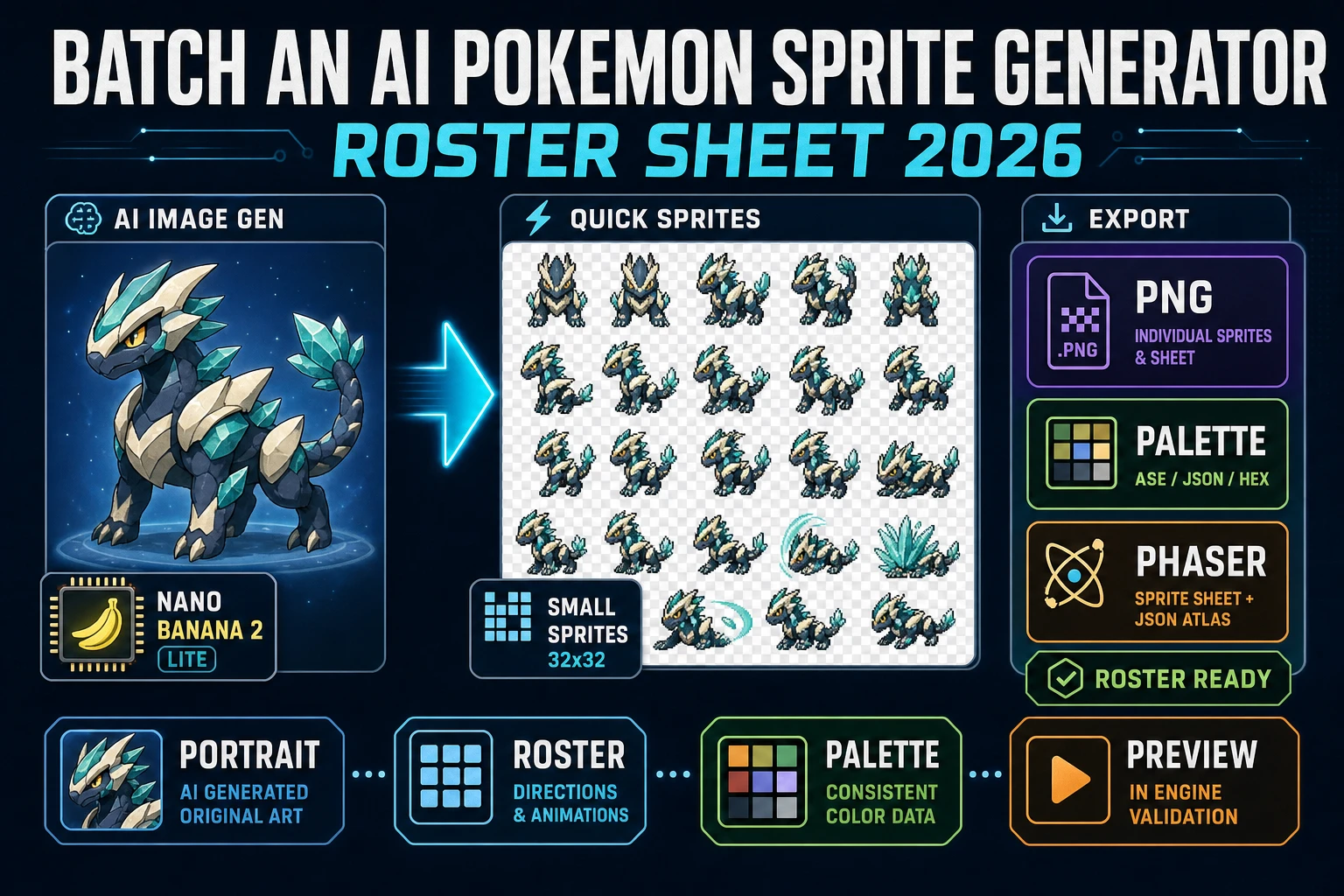
An ai pokemon sprite generator in 2026 is a five-panel Sorceress loop: AI Image Gen for the creature portrait, Quick Sprites for the transparent PNG roster grid

Type ai pokemon sprite generator into Google in 2026 and the SERP mixes three unrelated products under one query. The top of the fold is a fan-fusion web toy that returns one AI-painted creature portrait, useful for a Discord avatar and useless for a game engine. The middle is a general text-to-image app painting a hero-shot creature illustration — closer to a game asset, but a hero illustration is not a battle sprite and a creature-battler RPG cannot loop an idle bob on a single JPG. The bottom is the actual game-asset tool: a browser pipeline that returns a transparent-background PNG with the creature poses laid out in a uniform grid, sized for a 2D engine at 32x32 or 64x64. That third meaning is what a Pokemon-style fan project or an original creature-battler indie needs, and the 2026 Sorceress version of that pipeline lives inside five panels: AI Image Gen for the reference creature portrait, Quick Sprites for the transparent-background roster PNG, True Pixel for the retro palette lock, BG Remover for the alpha touchup, and Sprite Analyzer for the frame-by-frame preview. Every credit price, model id, and code constant below is verified against the Sorceress source on 2026-09-07.
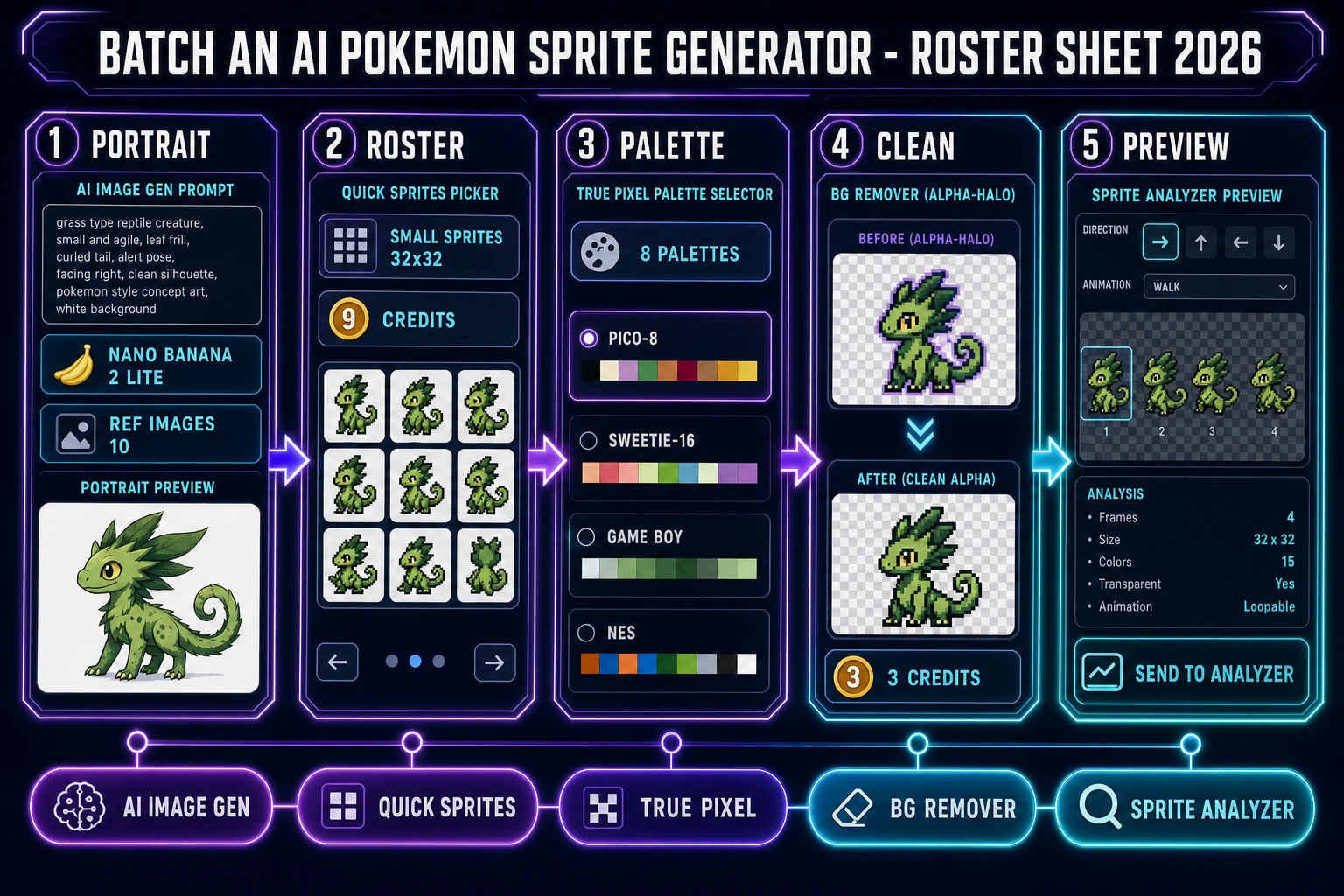
Batch an ai pokemon sprite generator roster sheet 2026: five-panel Sorceress pipeline showing an AI Image Gen creature portrait, a Quick Sprites style picker, a transparent-background PNG roster grid, a True Pixel palette selector, and a Sprite Analyzer preview
The Sorceress ai pokemon sprite generator workflow in five panels: portrait, roster, palette, clean, preview.

What an ai pokemon sprite generator actually returns for a 2026 creature roster

The phrase ai pokemon sprite generator covers three separate products in the same SERP, which is why the top of Google reads as noise. The first is a Pokemon-fusion toy that returns one AI-painted creature portrait — a single 512x512 JPG the engine cannot animate and cannot legally ship inside a real project because the source pixels are Nintendo IP. The second is a general text-to-image app (Nano Banana, GPT Image, Seedream) prompted with a "Pokemon-style creature" brief that returns a single hero illustration — closer to a real asset, cleanly original, but still one frame. The third is the honest game-asset tool: a browser pipeline that returns a transparent-background PNG with the creature poses arranged in a uniform grid, sized to 32x32 or 64x64 for the engine, paired with row labels the engine reads to pick an idle bob or a hit reaction. That third meaning is the one a creature-battler indie project ships, and it is the meaning worth building the pipeline around.

Three capabilities crossed the honest-good-enough-for-a-creature-roster line in the last year and made the third meaning real. Pixel-art diffusion models learned to hold a consistent creature silhouette across a small grid of poses (idle, hit, faint, cast) without repainting the color scheme or the horn shape between frames. Alpha-channel cleanup learned to run in one browser tap — drop a creature with a stray outline halo into BG Remover and re-import a hard-alpha PNG. Palette-lock quantizers learned to remap any 32-bit AI creature portrait onto a fixed 16-color SWEETIE-16 or PICO-8 palette while keeping the silhouette readable at 32x32. Chain the three together inside one dashboard and the exported roster sheet loads through Phaser’s this.load.spritesheet in one line. That is the honest baseline for what a 2026 ai pokemon sprite generator ships for a creature-battler project.

The Sorceress ai pokemon sprite generator loop in one minute

A creature-battler project rarely wants a single portrait — it wants a roster: a stack of transparent-background PNGs (or one atlas), a consistent silhouette across every frame of each creature, and dimensions the engine can slice with a single frameWidth and frameHeight. The one-minute mental model of the Sorceress pipeline is: draft each creature portrait in AI Image Gen, prompt Quick Sprites with that portrait as the visual anchor to lay down the pose grid, lock the palette in True Pixel so the whole roster shares one color scheme, clean stray alpha with BG Remover if a frame ships with a halo, and preview the animation frame-by-frame in Sprite Analyzer before wiring the sheet into the battle scene. Five tools, one dashboard tab, one game-ready roster.

The critical ordering is what keeps a Pokemon-style roster honest and legally clean. Draft the creature portrait first in AI Image Gen with an original creature brief (never a Pokemon character name in the prompt) — the reference-image workflow is what keeps every pose on-model afterward. Prompt Quick Sprites second with the portrait uploaded as the reference so the model paints the pose grid using your original silhouette, not a memorized Nintendo one. Lock the palette in True Pixel third so the whole roster reads as one visual world instead of a patchwork of AI-styled creatures. Run BG Remover only when a single frame has a halo, not as a default step (Quick Sprites output already ships with a transparent background). Preview through Sprite Analyzer last so the frame-by-frame check catches a drift before the engine does. Ordering matters because each step preserves the transparent-background PNG grid the engine expects and each skipped step is a saved credit.

Sorceress Quick Sprites as the ai pokemon sprite generator anchor (three roster styles, one call)

Quick Sprites is the anchor of the Sorceress ai pokemon sprite generator because it lands a game-ready creature sheet in a single API call. It sits inside the Sprites & 2D group next to Auto-Sprite v2 and True Pixel (verified 2026-09-07 in src/app/_home-v2/_data/tools.ts) and calls the Retro Diffusion rd-animation model under the hood (MODEL_ID = 'retro-diffusion/rd-animation', verified 2026-09-07 in src/app/quick-sprites/page.tsx). Pricing is flat: CREDITS_PER_GEN = 9 per generation, one generation returns one transparent-background spritesheet PNG in the selected style. The Spritesheet PNG toggle is on by default so the export ships as a single tileable atlas the engine loads with one image call rather than a folder of per-frame PNGs the engine has to load and reassemble.

Three animation styles cover the three roster shapes a Pokemon-style project actually ships. Small Sprites (id: 'small_sprites') is the workhorse for a creature-battler overworld: a 32x32 grid with six rows — right-walk, left-walk, arms (idle chatter), look (idle head-turn), surprise (dialogue reaction), and lay down (defeated) — which maps almost one-to-one to a top-down overworld creature (walking to you on the tall grass, reacting when engaged, going down at the end of a battle). Four Angle Walking (id: 'four_angle_walking') returns a 48x48 grid with the four cardinal directions on four rows and four walk frames per row — the shape a player-controlled creature companion follows the trainer with. VFX Effects (id: 'vfx') returns a square 1:1 sheet at any of six sizes (24, 32, 48, 64, 80, or 96 pixels) — the classic battle-move impact shape (fire blast, water gun, thunderbolt). Verified 2026-09-07 in src/app/quick-sprites/page.tsx: the ANIMATION_STYLES array carries all three definitions and the STYLE_ROW_LABELS map carries the six-row layout by name.
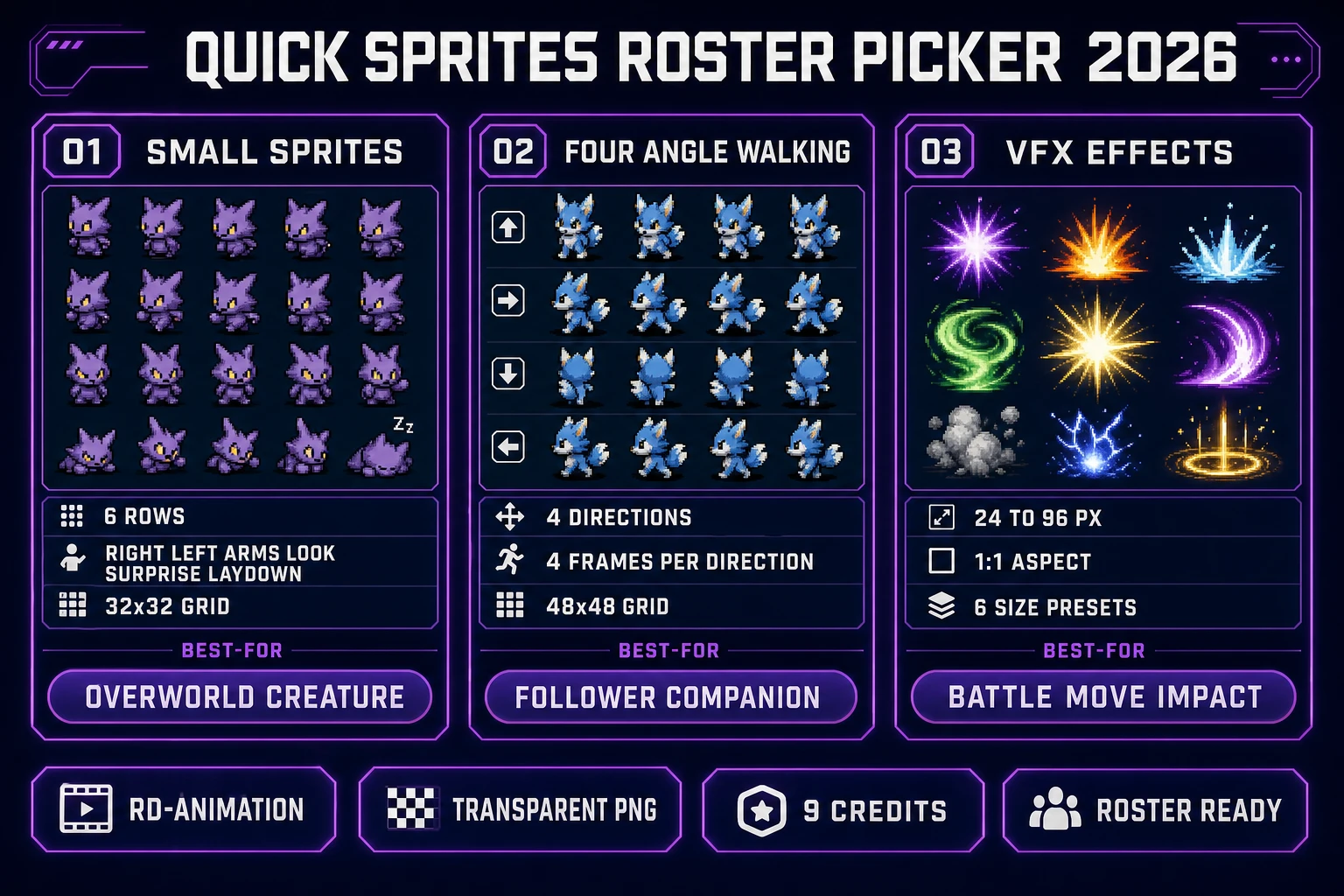
Quick Sprites roster style picker for the ai pokemon sprite generator 2026: Small Sprites 32x32 for the overworld creature, Four Angle Walking 48x48 for the follower companion, and VFX Effects 24 to 96 px for the battle-move impacts
Three Quick Sprites styles inside the ai pokemon sprite generator, each with a distinct creature-battler use case.

Step 1 — anchor the creature in AI Image Gen before the roster call

The prompt shape determines whether the roster reads as an on-model creature line or a bag of AI-styled monsters. The honest 2026 recipe starts with a reference portrait rather than a text-only brief for each roster slot. Draft the creature in AI Image Gen at /generate first, then send that portrait to Quick Sprites as the reference upload alongside the prompt. Verified 2026-09-07 in src/lib/models.ts: the current unified panel exposes Nano Banana Pro (18 credits at 1K or 2K, 33 at 4K, up to 8 reference images), Nano Banana 2 (9 credits at 1K, 12 at 2K, 17 at 4K, up to 14 refs), Nano Banana 2 Lite (4 credits, up to 10 refs), Nano Banana (6 credits, up to 3 refs), GPT Image 2 (5 credits base, up to 16 refs), GPT Image 1.5 (3 low / 4 medium / 15 high, up to 4 refs), Seedream 5 Lite (6 credits at 2K, 8 at 3K, up to 14 refs), Flux 2 Pro (6 credits base plus 3 per reference, up to 8 refs), plus Z-Image, Seedream 4.5, Seedream 5 Pro, and Grok Imagine. Every model in the panel accepts reference images, which is what enables the creature-consistency workflow: upload two to eight anchor shots of the same creature, generate the pose grid, and the model paints the same silhouette across every row.

Prompt shape stays four parts: creature typology, silhouette, palette or era, and a one-word attitude. "Grass-type reptile, quadruped, leaf tail, green with cream belly, curious" is a working brief for a Small Sprites overworld creature. "Water-type serpent, coiled long body, dorsal fin, deep blue with silver highlights, calm" is a working brief for a follower on Four Angle Walking. "Fire-type dragon breath attack, orange to yellow burst, wide arc, quick" is a working brief for a VFX battle move. Never put a Pokemon character name (Pikachu, Charmander, Bulbasaur, Mewtwo) in the prompt — the resulting sprite would be a direct derivative of Nintendo IP and cannot ship in a real project. The reference-image field in Quick Sprites (refImage in the source) is what turns those original creature briefs from stochastic re-rolls into consistent reproduction across the whole roster.
Step 2 — prompt Quick Sprites for the creature roster grid

The style pick is what saves credits and what fits the exported roster to the engine. A creature-battler overworld does not need a Four Angle Walking sheet for every roster slot — the four extra rows for a wild encounter creature are dead pixels the engine will never render. Pick Small Sprites for the overworld roster, Four Angle Walking for the trainer’s follower companion, and VFX for the battle-move library — the three styles map one-to-one to the three shapes a creature-battler project actually ships. On a full first-region roster the honest breakdown is twelve creatures on Small Sprites (12 x 9 = 108 credits), one follower on Four Angle Walking (9 credits), and eight elemental battle-move VFX (8 x 9 = 72 credits) — 189 credits for a complete twelve-creature starter region roster, under two dollars at the documented one-credit-equals-one-cent rate (CREDITS_PER_DOLLAR = 100 in src/lib/models.ts, verified 2026-09-07).

The Quick Sprites panel exposes seed control alongside the prompt so a re-roll on the same seed reproduces the same sheet exactly — useful when a jam team wants to iterate on a creature’s color palette without re-rolling the pose. Verified 2026-09-07 in src/app/quick-sprites/page.tsx: the GeneratedSprite type carries a seed field and the queue item carries the same seed forward so a second run reproduces the first with a modified prompt (change "green with cream belly" to "blue with cream belly" for a regional variant creature and keep the seed; the reptile walks the same way in a blue palette). That deterministic-with-seed behavior is what turns Quick Sprites from a lottery into a real roster pipeline — the same creature can ship shiny, regional, and mega variants from one base sheet without re-rolling the pose.

Step 3 — lock the retro palette in True Pixel for the roster look

True Pixel is the palette-lock stage of the roster loop. A raw AI creature portrait ships in a 32-bit color space with subtle gradients and anti-aliasing halos that read as fine art on a still image and read as noise on an in-engine 32x32 sprite. True Pixel at /pixel-art is the browser tool that remaps that portrait onto a fixed palette while keeping the silhouette readable at sprite scale. Verified 2026-09-07 in src/app/pixel-art/page.tsx: the tool exposes eight palette presets (PICO-8 at 16 colors, SWEETIE-16 at 16, Endesga 32 at 32, Game Boy at 4, CGA at 16, NES at 54, Grayscale at 8, and 1-Bit at 2), three dither modes (none, ordered Bayer, and Floyd-Steinberg), K-means color quantization for arbitrary palettes, chroma-key alpha removal, and a master-resolution longest-side cap of 256 pixels (MASTER_RES_LONGSIDE = 256).

The palette-lock pass is what makes a creature roster feel like a Pokemon-era game rather than an AI collage. For a Game Boy-style project, pick the 4-color Game Boy palette and every creature snaps to the classic olive-and-cream look. For a Gen 3 GBA-style project, pick SWEETIE-16 or a custom 16-color palette and every creature reads at 32x32 with legible type coloring. For a modern indie creature-battler with a retro-inspired look, pick Endesga 32 with Floyd-Steinberg dither and the roster gains a hand-shaded feel without a hand-shader. Generate every creature portrait with the same palette pass and the whole roster shares one visual world instead of twelve unrelated art styles. The image-to-pixel-art walkthrough covers the palette-quantization mechanics in more depth for the roster designer who wants control over the K-means output.

Step 4 — clean the alpha and preview with BG Remover and Sprite Analyzer

Quick Sprites output ships with a transparent background as the default. Occasionally a single frame lands with a soft alpha halo around the creature silhouette — a one-pixel bleed where the outline blurs into a soft edge. The honest fix is a single pass through BG Remover at /bg-remover. Verified 2026-09-07 in src/app/bg-remover/page.tsx: pricing is three credits per removal (BG_REMOVER_CREDITS = 3), max upload is five megabytes (MAX_FILE_SIZE_MB = 5). The tool returns a hard-alpha PNG the engine reads without an anti-aliased halo, ready to drop back into the roster in place of the halo-affected frame. BG Remover is a per-frame touchup rather than a full-sheet regeneration — upload the affected frame, receive the cleaned PNG, and paste it back into the grid at the same position using the free browser pixel editor at /canvas.

Sprite Analyzer at /spritesheet-analyzer is the downstream verifier for the whole roster. Drop the exported roster sheet into it and preview the animation frame-by-frame, extract frame data, and confirm the row layout matches what the battle engine expects. Quick Sprites exposes a one-click "send to Sprite Analyzer" button (verified 2026-09-07 in src/app/quick-sprites/page.tsx, the sorceress:navigate postMessage path) so a jam team can validate the roster without leaving the browser tab. The Sprite Analyzer preview is where a subtle idle-bob drift becomes visible (a creature that hovers a pixel too high on frame three, a tail that clips through the ground on frame two) — the same drift is invisible on the static roster PNG and painful once it is playing at 8 fps inside the actual battle scene.

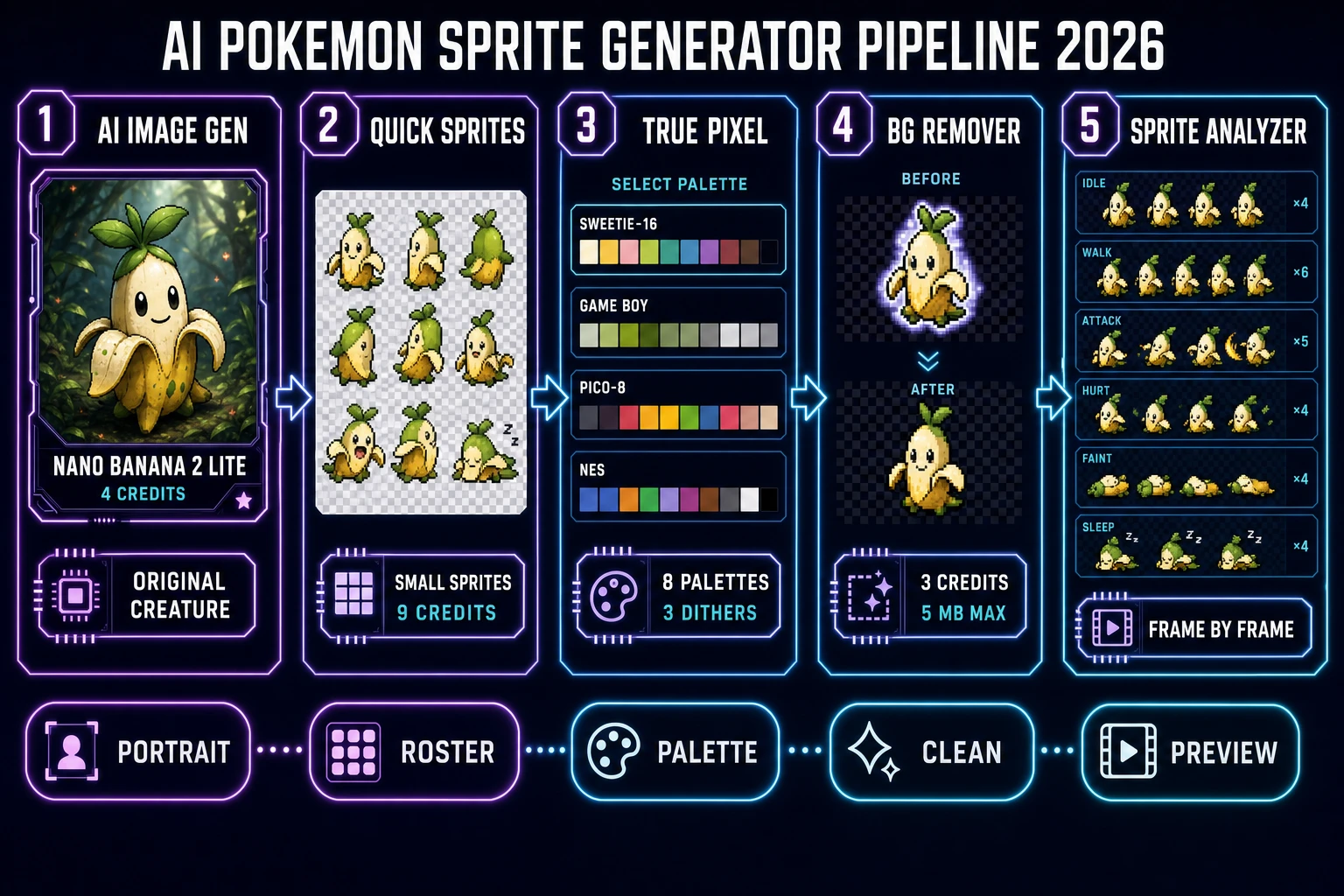
AI pokemon sprite generator pipeline 2026: Nano Banana 2 Lite creature portrait at 4 credits, Quick Sprites rd-animation roster at 9 credits per creature, True Pixel palette lock with SWEETIE-16 and Game Boy presets, BG Remover alpha touchup at 3 credits, and Sprite Analyzer frame-by-frame preview
Five Sorceress panels feed a single game-ready creature roster: portrait, roster, palette, clean, preview.

Where WizardGenie, Auto-Sprite v2, and Tileset Forge fit around the roster

The five-panel loop above ships the creature roster. The finishing panels around it ship the world the roster lives in. Auto-Sprite v2 at /autosprite-v2 is the tool for a custom battle animation Quick Sprites does not cover — a signature move that needs a ten-frame arc, a species-specific evolution animation, a mega-evolution transformation flash. Auto-Sprite v2 accepts a short AI Video Gen clip of the creature in motion, extracts frames with requestVideoFrameCallback, background-removes them, and packs them into a grid PNG the same way Quick Sprites does. Tileset Forge at /tileset-creator is the paired tool for the overworld tiles (tall grass, cave floor, gym flooring) the roster walks across — generate the tileset with the same palette that True Pixel locked the creature roster to, and the whole world shares one visual language.

WizardGenie is the paired coding agent that wires the exported roster sheet into a Phaser battle scene: describe the creature (base stats, type matchups, move list, faint animation trigger), and WG scaffolds the this.load.spritesheet, this.anims.create, and the battle state machine in the same session. The full Sorceress tools guide covers the wider Sprites & 2D group lineup, and the ai game sprite generator walkthrough covers the general-purpose ready-sheet framing that a creature roster inherits from. The ai 2D sprite generator pack guide and the AI character generator roster-lock walkthrough cover the human-character side of the same roster-batching workflow for the trainer, gym leader, and elite four cast.

What an ai pokemon sprite generator run actually costs on Sorceress in 2026

The credit math for a full ai pokemon sprite generator roster is transparent and stackable. Every constant is verified 2026-09-07 in the tool source. Quick Sprites is CREDITS_PER_GEN = 9 per generation. BG Remover for a stray-alpha touchup is BG_REMOVER_CREDITS = 3. True Pixel is Pro-tier and adds no per-run credit for the palette pass. Sprite Analyzer is included in the workflow at no per-run cost. AI Image Gen for the reference creature portrait varies by model as noted above: Nano Banana 2 Lite at 4 credits per creature (the honest pick for a twelve-creature starter roster), GPT Image 2 at 5 credits, Nano Banana at 6, GPT Image 1.5 at 3 low, Nano Banana 2 at 9, Nano Banana Pro at 18 for the 1K or 2K tier (the pick for the signature legendary or box art). The credit unit is CREDITS_PER_DOLLAR = 100, so one credit is one cent and every price above is legible in dollars rather than hidden in a per-model rate card.

Two real project totals ground the roster math. A twelve-creature first-region starter roster with a Nano Banana 2 Lite portrait for each (12 x 4 = 48 credits) plus a Small Sprites overworld sheet for each (12 x 9 = 108 credits) plus eight elemental battle-move VFX (8 x 9 = 72 credits) is 228 credits — about two dollars and thirty cents for a complete starting-region asset pack. A full 150-creature roster (the classic Gen 1 count) is roughly 12.5x that: 150 x 4 = 600 credits for portraits plus 150 x 9 = 1,350 for overworld sheets plus 20 x 9 = 180 for the full move VFX library — 2,130 credits, about twenty-one dollars for a full-region creature roster that would take a solo pixel artist months at any hand-drawn pace. Ship the roster, wire it into Phaser with the single this.load.spritesheet call per creature, and design the type chart in an afternoon. See the plans page for the tier-level credit bundles and the how-to-make-a-sprite-sheet walkthrough for the beginner path through the same loop.

How the ai pokemon sprite generator roster actually loads into a 2D battle engine

Quick Sprites exports a transparent-background PNG that packs each creature’s frames as a uniform grid, which is exactly what a 2D battle engine wants to slice with one call. Phaser v4.2.1 Giedi (released 2026-07-09, verified 2026-09-07 via phaser.io/download/stable) loads that grid with a single spritesheet call: this.load.spritesheet(creatureId, url, { frameWidth, frameHeight }) in preload, then this.anims.create({ key: `${creatureId}_idle`, frames: this.anims.generateFrameNumbers(creatureId, { start: 0, end: 3 }), frameRate: 8, repeat: -1 }) in create for the idle bob and additional anims.create calls for hit, faint, and cast. For a Small Sprites 32x32 overworld creature, frameWidth and frameHeight are both 32; for a Four Angle Walking 48x48 follower, both are 48. The engine picks the animation by naming the frame range that maps to the row four frames of the required pose.

For a raw browser creature-battler without Phaser, the same PNG loads through the Canvas API drawImage call with a source rectangle — pass sx, sy, sWidth, sHeight to pick the frame and the destination rectangle to place the creature on the battle background. The texture atlas pattern is the same across every mainstream browser engine (a single image plus a metadata map of frame rectangles), which is why the Sorceress export shape is engine-agnostic. Same PNG, two loaders, no per-frame folder to manage — the roster ships as 150 lightweight PNGs the engine loads on demand rather than 150 folders of frame PNGs the engine has to stitch. That is the shipping shape a creature-battler project actually wants, and it is what a 2026 ai pokemon sprite generator honestly delivers when the pipeline is built around Sorceress Quick Sprites.

Frequently Asked Questions

What does an ai pokemon sprite generator actually return for a creature roster in 2026?

An ai pokemon sprite generator in the 2026 sense returns a transparent-background PNG spritesheet a creature-battler engine can slice with one call, not a single creature portrait and not a hero illustration. Sorceress Quick Sprites at /quick-sprites is that pipeline. It calls Retro Diffusion rd-animation (MODEL_ID = 'retro-diffusion/rd-animation', verified 2026-09-07 in src/app/quick-sprites/page.tsx) at nine credits per generation (CREDITS_PER_GEN = 9) and returns a grid PNG in one of three shapes: Small Sprites (32x32, six rows covering right and left walk, arms, look, surprise, and lay down - the overworld creature shape), Four Angle Walking (48x48, four cardinal directions with four walk frames each - the trainer follower companion shape), or VFX Effects (24 to 96 px, 1:1 - the battle-move impact shape). The Spritesheet PNG toggle ships on by default so the output is one tileable atlas the engine loads with one image call rather than a folder of frame files.

Can you legally use ai pokemon sprite generator output in a real creature-battler project?

You can ship sprites that follow the creature-battler visual grammar (top-down 32x32 overworld pose grid, retro 16-color palette, 8 fps idle bob) as long as every creature in the output is an original design and no protected franchise character name appears in the prompt. Sorceress does not licence any third-party creature-battler IP and neither does any other AI sprite tool on the SERP; the fan-fusion toys that return recognizable franchise likenesses are training-data derivatives and cannot ship inside a commercial project. The honest workflow is: describe the creature typology and silhouette (grass-type reptile, quadruped, leaf tail, green with cream belly) rather than name-checking a franchise creature, upload the resulting original portrait to Quick Sprites as the reference image, and the exported roster sheet is a legally clean original creature roster in the retro creature-battler aesthetic. This is the same rule that governs every Palworld, Coromon, Nexomon, and Cassette Beasts asset - style is not protected, characters are.

Which Quick Sprites style fits an overworld creature versus a battle-move impact?

Small Sprites is the pick for the overworld creature. Verified 2026-09-07 in src/app/quick-sprites/page.tsx: the small_sprites style returns a 32x32 grid with six rows (STYLE_ROW_LABELS in the source) - right-walk, left-walk, arms (idle chatter), look (idle head-turn), surprise (dialogue reaction), and lay down (defeated) - which is exactly the shape a top-down creature-battler overworld reads to render a wild encounter creature. Four Angle Walking is the pick for the trainer follower companion that walks behind the player and needs the four cardinal directions. VFX Effects is the pick for the battle-move library - a fire blast, a water gun, a thunderbolt - at any of the six documented sizes (24, 32, 48, 64, 80, 96 px) in the VFX_SIZES array. Pick the style once per creature, prompt with the original creature portrait, ship the sheet. For a signature move that needs a longer arc than the Quick Sprites VFX row supports, the loop hands off to Auto-Sprite v2 at /autosprite-v2 for a video-driven custom frame extraction.

How does the ai pokemon sprite generator loop pull in AI Image Gen and True Pixel?

Quick Sprites is fastest when the creature prompt is anchored to a reference image. Generate each creature portrait first in AI Image Gen at /generate using Nano Banana 2 Lite (4 credits, up to 10 refs), GPT Image 2 (5 credits base, up to 16 refs), Nano Banana (6 credits, up to 3 refs), or Nano Banana Pro for the signature legendary (18 credits at 1K or 2K, up to 8 refs) - every credit price verified 2026-09-07 in src/lib/models.ts. Every model in the panel accepts reference images, which is what keeps the creature silhouette consistent across the whole roster. Send the portrait through Quick Sprites as the reference upload alongside the text prompt; the model latches onto the silhouette and paints the pose rows to match. Finish through True Pixel at /pixel-art with a locked palette (PICO-8, SWEETIE-16, Endesga 32, Game Boy at 4 colors, CGA, NES at 54, Grayscale, 1-Bit - eight palettes verified 2026-09-07 in src/app/pixel-art/page.tsx) so the whole roster shares one color scheme rather than reading as twelve unrelated AI-styled creatures.

What does the ai pokemon sprite generator actually cost for a full creature roster in 2026?

The credit math for a full ai pokemon sprite generator roster is transparent and stackable, verified 2026-09-07 in tool source. Quick Sprites is nine credits per generation (CREDITS_PER_GEN = 9). One generation returns one creature sheet. A twelve-creature first-region starter roster with a Nano Banana 2 Lite portrait for each creature (12 x 4 = 48 credits) plus a Small Sprites overworld sheet for each (12 x 9 = 108 credits) plus eight elemental battle-move VFX (8 x 9 = 72 credits) totals 228 credits - about two dollars and thirty cents at the documented one-credit-equals-one-cent rate (CREDITS_PER_DOLLAR = 100 in src/lib/models.ts). A full 150-creature roster is roughly 12.5x that: 150 x 4 = 600 credits for portraits plus 150 x 9 = 1,350 for overworld sheets plus 20 x 9 = 180 for the full move VFX library - 2,130 credits, about twenty-one dollars for a full-region roster that would take a solo pixel artist months at any hand-drawn pace. BG Remover for stray-alpha touchups is three credits per frame (BG_REMOVER_CREDITS = 3, verified 2026-09-07 in src/app/bg-remover/page.tsx). True Pixel and Sprite Analyzer are Pro-tier and add no per-run credits.

How does the exported roster sheet actually load into a Phaser or browser battle engine?

Quick Sprites exports a transparent-background PNG with each creature frames packed as a uniform grid. Phaser v4.2.1 Giedi (released 2026-07-09, verified 2026-09-07 via phaser.io/download/stable) loads that grid with a single spritesheet call: this.load.spritesheet(creatureId, url, { frameWidth, frameHeight }) in preload, then this.anims.create with generateFrameNumbers for the idle bob plus additional anims.create calls for hit, faint, and cast. For a Small Sprites 32x32 overworld creature, frameWidth and frameHeight are both 32; for a Four Angle Walking 48x48 follower, both are 48. The engine picks the animation by naming the frame range that maps to the row of the required pose. For a raw browser battler without Phaser, the same PNG loads through the Canvas API drawImage call with a source rectangle - pass sx, sy, sWidth, sHeight to pick the frame and the destination rectangle to place the creature on the battle background. Same PNG, two loaders, no per-frame folder to manage.

Sources

  1. Phaser v4.2.1 release notes - GitHub
  2. Phaser download - stable channel
  3. Canvas API - MDN
  4. Sprite (computer graphics) - Wikipedia
  5. Texture atlas - Wikipedia
  6. Color quantization - Wikipedia
Written by Arron R.·3,303 words·15 min read

Related posts