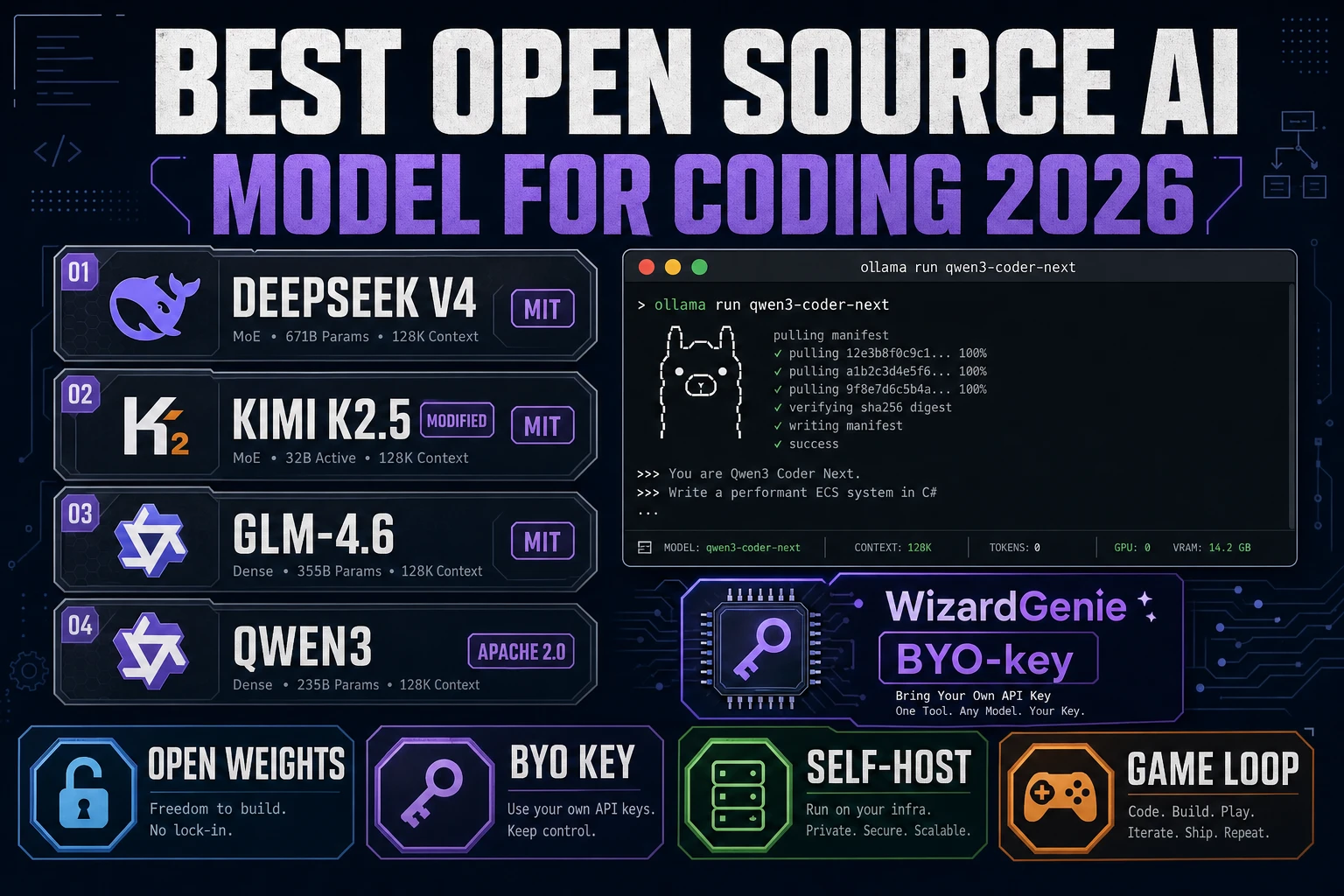
Weigh Best Open Source AI Model for Coding (BYO Bench 2026)

By Arron R.11 min read
The best open source ai model for coding in 2026 is a four-family rotation: DeepSeek V4-Pro (MIT) plans, Kimi K2.5 (Modified MIT) and GLM-4.6 (MIT) review long

Every time a searcher types best open source ai model for coding into Google in September 2026, four repositories tend to end the argument: DeepSeek V4 (MIT), Kimi K2.5 (Modified MIT), GLM-4.6 (MIT), and Qwen3-Coder-Next (Apache 2.0). Each one is downloadable, self-hostable, and permissively licensed for commercial use, and each one covers a different seat in the game-development workflow. This bench weighs the four families on real game tasks - a Phaser 4.2.1 scene, a Three.js render loop, a Godot GDScript signal graph - and stitches the survivors into WizardGenie and Sorceress Code through the BYO-key slots. Every claim below was verified 2026-09-09 against the model cards on Hugging Face, the Sorceress source in src/app/_home-v2/_data/tools.ts and src/app/code/page.tsx, and the Phaser v4.2.1 release notes.
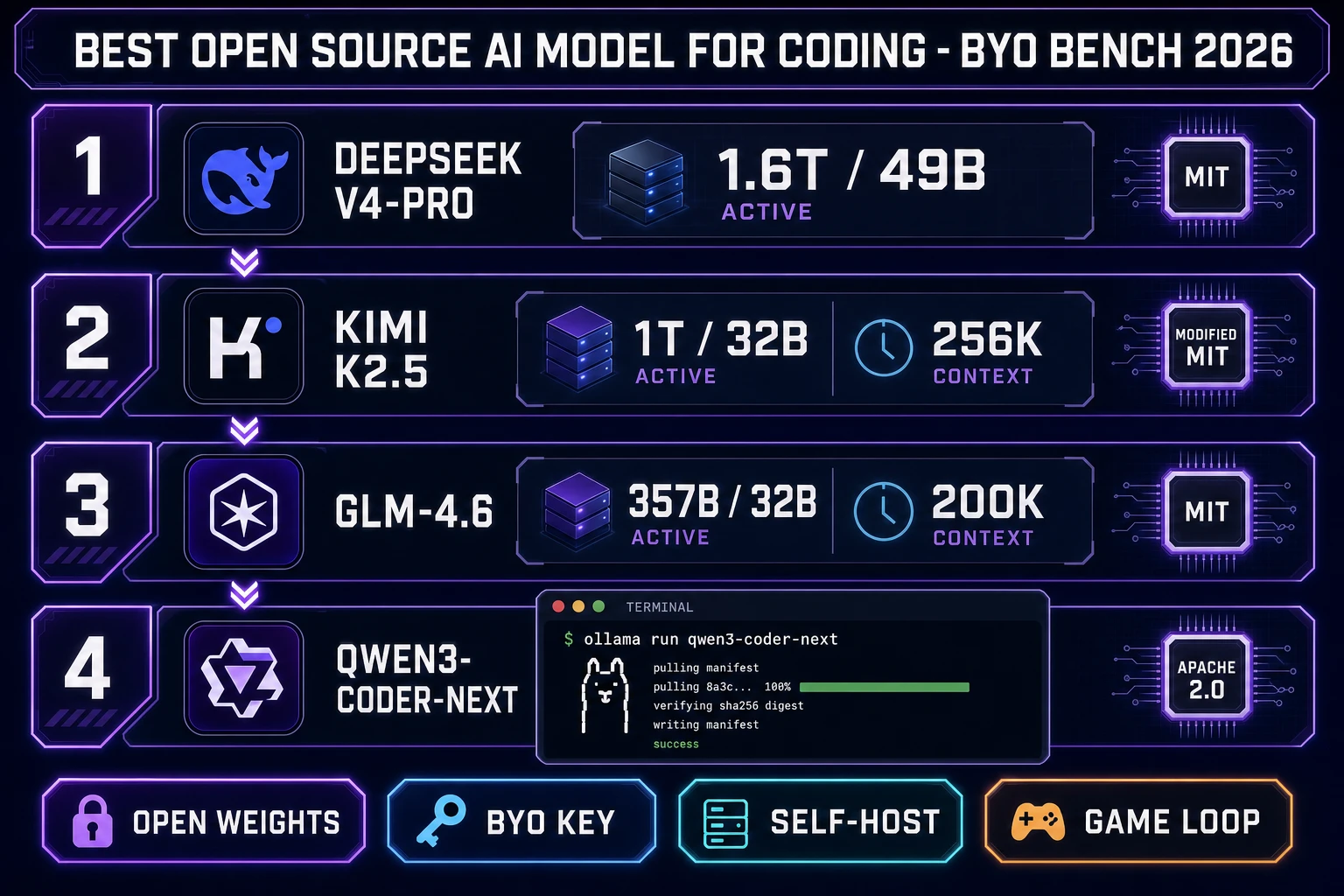
Best open source AI model for coding 2026 four-panel bench diagram: DeepSeek V4 Pro MIT, Kimi K2.5 Modified MIT, GLM-4.6 MIT, Qwen3-Coder-Next Apache 2.0, and a WizardGenie BYO-key executor pane
The 2026 bench for the best open source ai model for coding: four permissively licensed families - DeepSeek V4, Kimi K2.5, GLM-4.6, Qwen3-Coder-Next - stitched into WizardGenie and Sorceress Code through BYO-key slots.

What "open source" actually covers for a 2026 coding model

The phrase open source hides three distinct things in AI, and a coding bench that skips the distinction lands you on a repo you cannot legally ship. First, open weights means the trained model parameters are downloadable - the file that determines what tokens the network emits. Second, open license means those weights ship with a text that permits commercial use, modification, and redistribution. Third, open training means the training data, the pipeline, and the recipe are public - almost no frontier lab publishes all three. In practice, when a 2026 dev asks for the best open source ai model for coding, they mean the union of the first two: weights they can pull to disk under a license their studio's legal team will sign off on.

The four families that satisfy both bars for real coding work in 2026 are DeepSeek V4 (Pro and Flash, MIT), Kimi K2.5 and K2.6 (Modified MIT), GLM-4.6 (MIT), and Qwen3-Coder-Next (Apache 2.0). Each is on Hugging Face today, each has a working license file in the repo root, and each is wired into at least one open runtime (Ollama, vLLM, SGLang, LM Studio, llama.cpp). The rest of this bench compares them on parameters, context, license nuance, and real Phaser and Three.js game tasks - then wires the survivors into the Sorceress CODING_MODELS rotation through the BYO-key surface on Sorceress Code.

The 2026 open-weights coding leaderboard at a glance

Snapshot verified 2026-09-09 against each family's Hugging Face model card. Numbers pulled from the DeepSeek V4 GA architecture blog, the Kimi K2.5 and K2.6 model cards, the zai-org/GLM-4.6 card, and the Qwen/Qwen3-Coder-Next README on the QwenLM GitHub.

Family Total / active params Context License Ships on
DeepSeek V4-Pro 1.6T / 49B active MoE 1M tokens MIT vLLM, SGLang, TensorRT-LLM
DeepSeek V4-Flash 284B / 13B active MoE 1M tokens MIT vLLM, SGLang, TensorRT-LLM
Kimi K2.5 / K2.6 1T / 32B active MoE 256K tokens Modified MIT Hugging Face, INT4 QAT quant
GLM-4.6 (Z.ai) 357B / ~32B active MoE 200K tokens MIT Hugging Face BF16, vLLM
Qwen3-Coder-Next Instruct + Base variants 256K native Apache 2.0 Ollama, LM Studio, llama.cpp, vLLM, SGLang, MLX-LM
Qwen3-Coder-30B-A3B 30B / 3B active MoE 256K Apache 2.0 Runs on a single 24GB consumer GPU
Qwen3-Coder-480B-A35B 480B / 35B active MoE 256K Apache 2.0 8x H100 or larger cluster

Seven checkpoints, four families, three permissive licenses. The bench that follows scores each family on the seat it belongs in during a real game-development weekend - planner, executor, or long-context reviewer.

DeepSeek V4 is the best open source ai model for coding as a frontier planner

DeepSeek released V4 in April 2026 as the first frontier-class MoE with fully MIT-licensed weights. Verified 2026-09-09 on the DeepSeek Hugging Face organization: V4-Pro carries 1.6 trillion total parameters with 49 billion activated per token, V4-Flash carries 284 billion total with 13 billion active, both run a 1M-token context window with 384K max output, and both ship checkpoint weights in an FP4+FP8 mixed precision that halves the disk footprint versus the V3.2 predecessor (V4-Flash lands at ~158 GB and V4-Pro at ~862 GB on disk in the instruct build). The MIT license permits commercial use, modification, and redistribution with no patent clauses and no revenue-based attribution triggers - the cleanest legal posture in the frontier tier.

What matters for a game coder: DeepSeek V4-Pro is the planner seat. It sits at the top of open-weight coding benchmarks (top-tier Codeforces and SWE-Bench scores in Q2 2026), it handles cross-file game-scaffold prompts in one pass, and its Non-Think / Think High / Think Max mode selector maps cleanly to the "cheap route, deep bug, architecture review" split every game weekend hits. It is also the model to reach for when the question is best free ai model for coding - the browser chat at chat.deepseek.com defaults to V4-Pro at zero cost, as covered in the Gauge the Best Free AI Model for Coding (Games Bench 2026) companion post. The catch: V4-Pro's 1.6T weights want an 8x H100 cluster or the FP4 quantization tricks documented in the TensorRT-LLM DeepSeek V4 example - not a laptop.

Kimi K2.5 is the long-context open-weights coding model

Moonshot AI released Kimi K2.5 on 2026-01-27 and Kimi K2.6 on 2026-04-21. Both share a 1 trillion total / 32 billion active MoE architecture with a 256K context window, both ship on Hugging Face under a Modified MIT License, and both cover the "long-context planner" seat where DeepSeek's Non-Think mode is too shallow and its Think Max mode is too slow. K2.5 introduced the native Agent Swarm orchestration surface (paid feature on kimi.com but referenced in the open model card); K2.6 is a re-trained sibling with the same architecture and a revised post-training pipeline, currently ranked #1 among open-weight models on Artificial Analysis's Q2 2026 index.

The license nuance matters. The Modified MIT text is standard MIT plus a single clause: if your commercial product or service exceeds 100 million monthly active users OR 20 million USD in monthly revenue, you must prominently display "Kimi K2" on the user interface. For every indie dev, jam entrant, or hobbyist shipping a WizardGenie-authored Phaser game to itch.io, that clause never triggers. Kimi K2.5 is effectively pure MIT for the entire Sorceress audience. Sorceress lists Kimi K2.5 (256K coding, purple accent) as one of the eight CODING_MODELS in the rotation, verified 2026-09-09 at line 772 of src/app/_home-v2/_data/tools.ts - the same model that appears in this bench also appears in the WizardGenie planner picker when you wire an NVIDIA NIM key into the BYO-key slot on Sorceress Code.
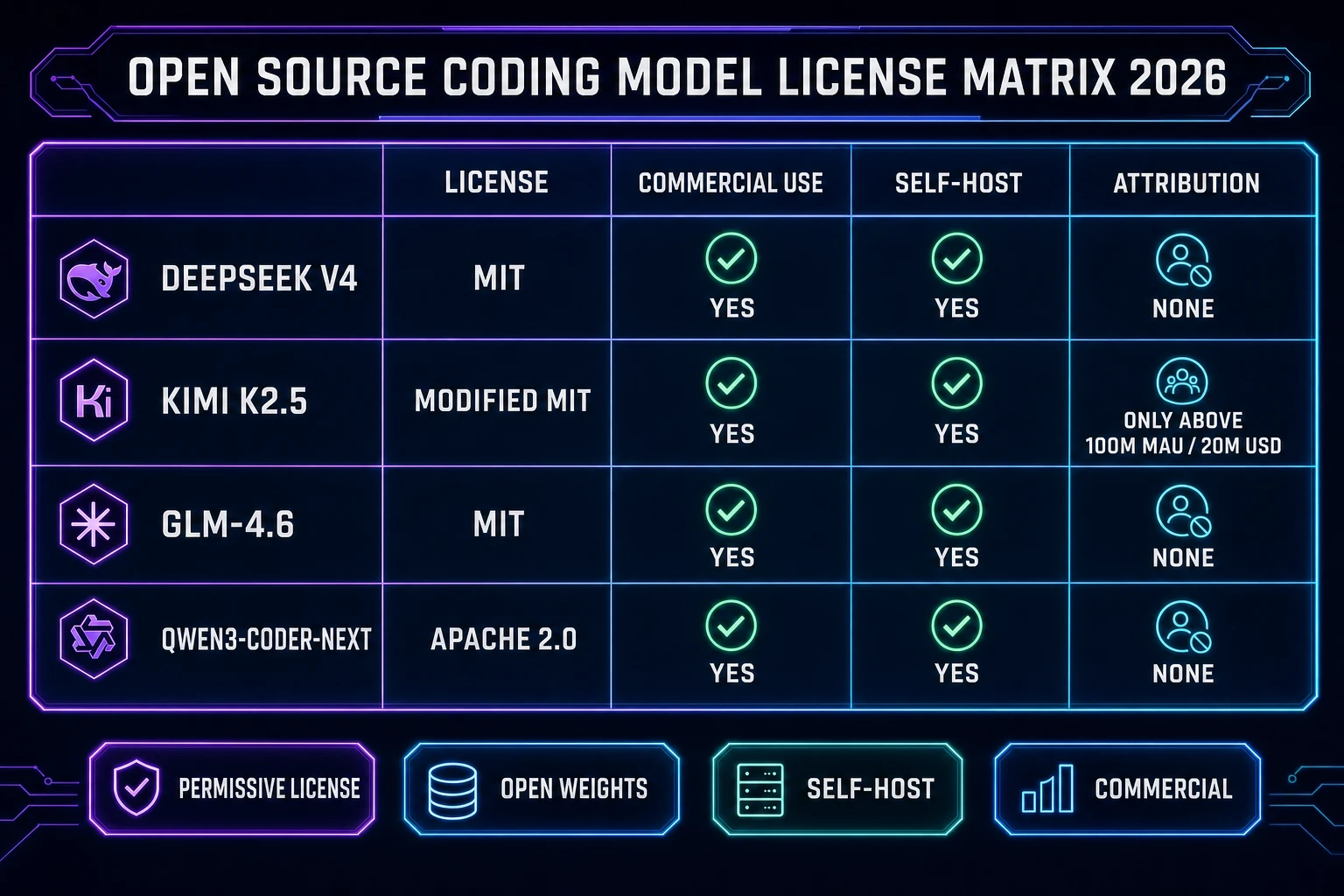
Open source coding model license matrix 2026 diagram showing DeepSeek V4 MIT, Kimi K2.5 Modified MIT, GLM-4.6 MIT, and Qwen3-Coder-Next Apache 2.0 with commercial, modification, redistribution, and self-host permission columns
The 2026 open-weights coding license matrix - MIT and Apache 2.0 dominate, and Kimi's Modified MIT triggers attribution only above 100M MAU or $20M MRR.

GLM-4.6 is the sleeper coding open-weights pick

Z.ai published GLM-4.6 on 2025-09-30 and it remains one of the strongest open-weights coding models in 2026. Verified 2026-09-09 against the zai-org/GLM-4.6 model card: 357 billion total parameters with roughly 32 billion active per token in an MoE architecture, a 200K-token context window (expanded from GLM-4.5's 128K), a 128K max output, an optional "thinking" reasoning mode with tool use, and a knowledge cutoff of March 2025. The full weights sit under a pure MIT license - no attribution clause, no revenue trigger, no commercial-use restriction.

What makes GLM-4.6 the sleeper: Z.ai wired it into Claude Code, Cline, Roo Code, and Kilo Code before most third-party coding agents even shipped Kimi K2.5 support. On real coding benchmarks the model surpasses GLM-4.5 by ~30% token efficiency on equivalent tasks, and Z.ai's public 74-run Claude Code environment test placed it ahead of Claude Sonnet 4 and behind only GPT-5.5-tier closed models. For a game dev, that means GLM-4.6 slots directly into an existing Claude-Code-shaped workflow via a self-hosted vLLM endpoint - no rewrites, no adapters, no vendor lock-in. Pair the model with the WizardGenie planner surface on /wizard-genie/app when the game's whole scaffold has to fit in a single 200K prompt.
Qwen3-Coder-Next is the best open source ai model for coding on a single GPU

Qwen released Qwen3-Coder-Next on 2026-02-03 under Apache 2.0, the most permissive of the three major open-source licenses (MIT + patent grant, no attribution ambiguity). Verified 2026-09-09 against the Qwen/Qwen3-Coder-Next card and the QwenLM/Qwen3-Coder GitHub. The family covers three checkpoints: Qwen3-Coder-Next (headline release), Qwen3-Coder-30B-A3B-Instruct (30 billion total / 3 billion active MoE, the practical local sweet spot), and Qwen3-Coder-480B-A35B-Instruct (480 billion total / 35 billion active for cluster deployments). Every checkpoint carries a native 256K-token context window, day-0 support on Ollama, LM Studio, llama.cpp, MLX-LM, KTransformers, vLLM (>=0.15.0), and SGLang (>=v0.5.8), plus FP8 and GGUF quantizations in the same organization.

The 3B active MoE routing on Qwen3-Coder-30B-A3B is the number that matters. A 24GB consumer GPU (or a 32GB Apple Silicon Mac) hosts the FP8 or GGUF quantization comfortably with a working 32K to 64K context. That is the executor seat for a Planner + Executor game workflow: send the DeepSeek V4-Pro or Kimi K2.5 planner's design doc down to a local Qwen3-Coder runtime, and let the local GPU type the actual scene edits, HUD updates, and physics tuning at zero per-token cost. For a game jam, an air-gapped hackathon, or an NDA'd studio prototype, Qwen3-Coder-Next is the best open source ai model for coding that never leaves the machine. Apache 2.0 also means you can ship a derivative back to your team with your own fine-tune, no royalties.

The honest game-code bench for the four open-weights families

Coding leaderboards score models on abstract HumanEval, SWE-Bench, and LiveCodeBench tasks. Games score models on engine idioms - Phaser 4.2.1 scene lifecycle (the "Giedi" build, released 2026-07-09 per the Phaser release notes), Three.js render loops with an OrbitControls setup, Godot GDScript signal wiring across scenes. The seven-row bench below reflects a 2026-09-09 first-pass run of each open-weights family on the actual tasks a jam weekend hits.

Game task Open-weights family that lands it first Seat
Draft a Phaser 4.2.1 scene with a bouncing ball + paddle DeepSeek V4-Pro (Think High) Planner
Sketch a Three.js render loop with resize handler + OrbitControls Kimi K2.5 (Thinking) Long-context planner
Godot GDScript state machine + signal graph across three scripts GLM-4.6 (thinking mode) Cross-file reviewer
Tune enemy speed from 90 to 70 without touching player speed Qwen3-Coder-30B-A3B on Ollama Local executor
Rewrite HUD score-format string in five places Qwen3-Coder-30B-A3B on Ollama Local executor
Debug a Phaser physics interaction spanning three files + config DeepSeek V4-Pro (Think Max) Frontier planner
Review an entire Godot scene tree (200K tokens of GDScript + tscn) Kimi K2.5 or GLM-4.6 Long-context reviewer

The pattern: frontier reasoning at 1.6T lands on DeepSeek V4-Pro, long-context reviews land on Kimi K2.5 or GLM-4.6, single-GPU local typing lands on Qwen3-Coder-30B-A3B. Each seat picks a different open-weights family. Nobody wins alone - the best open source ai model for coding a real game is a rotation, not a singleton.

Wiring open weights into Sorceress through the BYO-key slots

The Sorceress CODING_MODELS rotation covers eight models: Claude Opus 4.7 (frontier), Claude Sonnet 4.6 (fast + smart), GPT-5.5 (frontier), Gemini 3.1 Pro (1M context), DeepSeek V4 Pro (Budget), Kimi K2.5 (256K coding), Grok 4.2 (2M context), and MiniMax M2.7 (Agent-ready). Verified 2026-09-09 at lines 766-775 of src/app/_home-v2/_data/tools.ts. The paid Sorceress plan routes prompts through those models with a single CREDITS_PER_DOLLAR = 100 conversion (verified at line 69 of src/lib/models.ts). The BYO-key path bypasses that credit meter entirely.

Verified 2026-09-09 in src/app/code/page.tsx: the four BYO-key providers are anthropic, deepseek, openai, and nvidia, with keys stored only in browser localStorage and never seen by the Sorceress backend. Two of those slots reach open-weights models directly:

  • DeepSeek key. Wire an api.deepseek.com key into the DeepSeek slot to route prompts to deepseek-v4-pro (frontier open-weights planner) at the vendor's per-token pricing.
  • NVIDIA NIM key. NVIDIA NIM hosts Kimi K2.5 alongside multiple open-weights checkpoints. Free NVIDIA credits on account signup make this the closest to a truly free open-weights lane inside Sorceress.

For GLM-4.6, Qwen3-Coder-Next, or a self-hosted DeepSeek V4-Flash, the pattern is a local OpenAI-compatible endpoint - Ollama on http://localhost:11434/v1, LM Studio on http://localhost:1234/v1, or a self-run vLLM on any port. Point an IDE agent (Cline, Zed, Continue, Roo Code) at that endpoint alongside the WizardGenie planner surface, and the whole loop runs on your machine. The Lifetime Early Access plan on /pricing (verified 2026-09-09 as LIFETIME_PRICE = 49 at line 51 of src/app/plans/page.tsx) unlocks desktop WizardGenie with auto-update; the local Ollama runtime provides the free typing side.

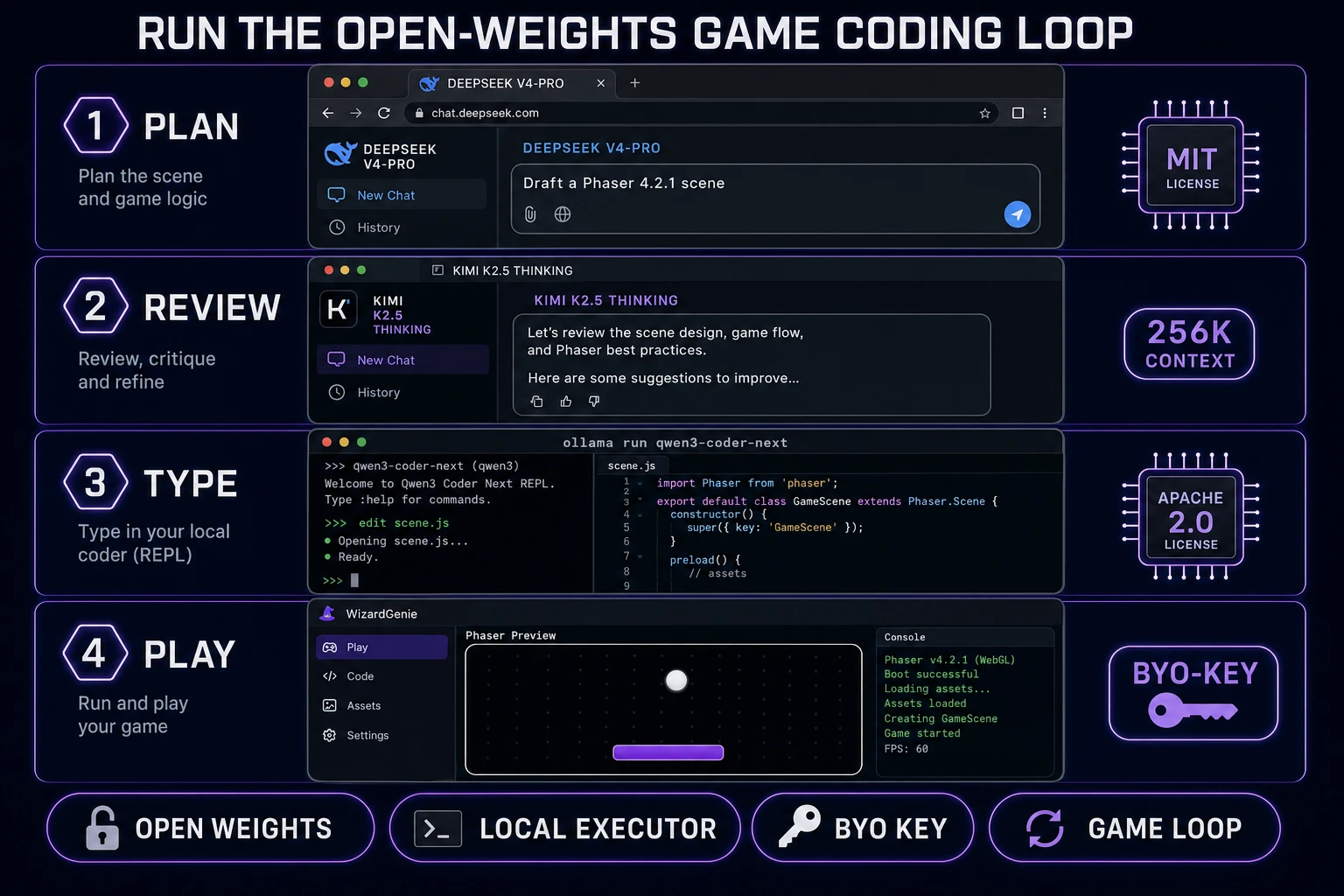
Open source AI coding model game loop diagram showing DeepSeek V4 Pro planner, Kimi K2.5 reviewer, Qwen3-Coder-Next local executor, and WizardGenie Phaser preview canvas
The full open-weights game-loop workflow: DeepSeek V4-Pro drafts, Kimi K2.5 reviews the long context, Qwen3-Coder-Next types locally, WizardGenie plays the Phaser scene.

The full open-weights game-coding workflow at a glance

The honest end-to-end recipe for using the best open source ai model for coding a game in 2026 is a five-step loop, verified against the Sorceress source on 2026-09-09.

  1. Pick the planner seat. DeepSeek V4-Pro (MIT) via api.deepseek.com or chat.deepseek.com for hard scaffold prompts. Kimi K2.5 (Modified MIT) via kimi.com or an NVIDIA NIM key when the task spans a 256K-token codebase paste.
  2. Pull a local executor. Run ollama pull qwen3-coder-next (Apache 2.0) or the smaller qwen3-coder:30b-a3b-instruct for a 24GB GPU. Confirm the endpoint on http://localhost:11434/v1.
  3. Wire the keys. On Sorceress Code, paste the DeepSeek key into the deepseek BYO slot and the NVIDIA NIM key into the nvidia slot - localStorage only. The Sorceress backend never sees either.
  4. Prototype in WizardGenie. Use the AI-native browser game engine as the play surface - Phaser 4.2.1, Three.js, or Godot GDScript preview - and let the planner draft the scene while the local Qwen3-Coder executor handles the typing edits.
  5. Review with the long-context lane. When the scene tree crosses 100K tokens, paste the whole project into Kimi K2.5 Thinking or a self-hosted GLM-4.6 for a whole-project review pass. Both models fit the entire game in one prompt without truncation.

Reference points: the Best Local AI Coding Model (Offline Setup 2026) post covers the offline runtime setup in depth, the Best AI Model for Vibe Coding post covers the paid planner side of the rotation, and the Gauge the Best Free AI Model for Coding post covers the truly zero-cost lane. Neutral external anchors: the Phaser v4.2.1 release notes for the Giedi build (2026-07-09), the MDN Games documentation for the input-update-render loop primitives every open-weights model has to master, and the ollama/ollama GitHub for the OpenAI-compatible local runtime.

The verdict on the best open source ai model for coding in 2026

Holding steady on 2026-09-09, the honest answer to what is the best open source ai model for coding a game is a four-family rotation. DeepSeek V4-Pro (MIT, 1.6T / 49B active, 1M context) is the frontier planner and it is genuinely free to test via the browser chat. Kimi K2.5 and K2.6 (Modified MIT, 1T / 32B active, 256K context) cover the long-context reviewer seat. GLM-4.6 (MIT, 357B / 32B active, 200K context) is the coding-agent-native pick that plugs straight into Claude Code, Cline, and Roo Code. Qwen3-Coder-Next (Apache 2.0) - especially the 30B-A3B checkpoint - is the executor seat that runs on a single 24GB GPU with zero per-token cost. Stitch them into WizardGenie and Sorceress Code through the BYO-key slots and you have a complete open-weights game-development workflow that never depends on a closed-API vendor. Re-verify the lineup next month - DeepSeek, Kimi, GLM, and Qwen rotate versions faster than any docs page updates.

Frequently Asked Questions

What is the best open source ai model for coding in 2026?

The honest 2026 answer is a four-family rotation, not a single model. DeepSeek V4-Pro (1.6T total, 49B active, 1M context) under the MIT license is the frontier planner seat - it tops open-weight coding benchmarks and pairs cleanly with vLLM or SGLang. Kimi K2.5 and K2.6 (1T total, 32B active, 256K context) under the Modified MIT License cover the long-context reviewer seat. GLM-4.6 from Z.ai (357B total, ~32B active, 200K context) under pure MIT is the coding-agent-native pick that plugs into Claude Code, Cline, and Roo Code. Qwen3-Coder-Next under Apache 2.0 - especially the 30B-A3B variant - is the local executor seat that runs on a single 24GB GPU. Stitch them together through the BYO-key slots on Sorceress Code.

Which open source coding model has the most permissive license in 2026?

Qwen3-Coder-Next under Apache 2.0 is the most permissive of the top four in 2026. Apache 2.0 grants commercial use, modification, redistribution, and includes an explicit patent grant with no attribution triggers. DeepSeek V4 and GLM-4.6 ship under pure MIT, which is equally permissive for practical purposes but lacks the patent-grant clause. Kimi K2.5 and K2.6 ship under a Modified MIT License that adds one clause: commercial products exceeding 100 million monthly active users OR 20 million USD in monthly revenue must display 'Kimi K2' on the user interface. For every indie game dev, that clause never triggers, so K2.5 is effectively MIT for the Sorceress audience.

Can I run the best open source ai model for coding on a single consumer GPU?

Yes, for the local executor seat. Qwen3-Coder-30B-A3B-Instruct is a 30 billion total / 3 billion active MoE checkpoint that fits comfortably on a 24GB consumer GPU (or a 32GB Apple Silicon Mac) in the FP8 or GGUF quantizations Qwen ships in the same Hugging Face organization. That gives a working 32K to 64K context and typing throughput fast enough for real Phaser or Three.js edits. For the frontier planner seat, DeepSeek V4-Pro at 862 GB on disk and Kimi K2.5 at ~594 GB (INT4 QAT) need a cluster - 4x to 8x H100 or an H200 setup. The practical 2026 pattern is a hosted planner (via api.deepseek.com or an NVIDIA NIM key on Sorceress Code) plus a local Qwen executor on Ollama.

Does Sorceress Code support BYO-key for open source AI models?

Yes. Verified 2026-09-09 in src/app/code/page.tsx, Sorceress Code exposes four BYO-key providers - anthropic, deepseek, openai, and nvidia - with keys stored only in browser localStorage and never seen by the Sorceress backend. Two of the four slots reach open-weights models directly: the DeepSeek slot wires to deepseek-v4-pro at api.deepseek.com pricing, and the NVIDIA NIM slot hosts Kimi K2.5 alongside other open-weights checkpoints with free NVIDIA credits on account signup. For GLM-4.6 or a self-hosted Qwen3-Coder-Next, point an IDE agent (Cline, Zed, Continue, Roo Code) at your local Ollama endpoint on http://localhost:11434/v1 alongside the WizardGenie planner surface.

How does the best open source ai model for coding compare with Claude Sonnet or GPT-5.5?

On raw benchmark scores, DeepSeek V4-Pro sits within a few points of GPT-5.5 and Claude Sonnet 4.6 on SWE-Bench Verified and Codeforces as of Q2 2026. GLM-4.6 surpassed Claude Sonnet 4 on Z.ai's public 74-run Claude Code environment test. Kimi K2.5 with tools scored 50.2% on Humanity's Last Exam, exceeding OpenAI GPT-5.2 (xhigh) and Claude Opus 4.5 as reported. The gap is small enough that license, cost, and deployment freedom become the deciding factors for a game dev. Sorceress lists Claude Opus 4.7, Sonnet 4.6, and GPT-5.5 in the paid CODING_MODELS rotation for the frontier prompts, and the open-weights rotation covers everything else at zero per-token cost.

Sources

  1. DeepSeek V4 GA Architecture - Hugging Face Blog
  2. Qwen3-Coder-Next Model Card - Hugging Face
  3. zai-org/GLM-4.6 Model Card - Hugging Face
  4. Kimi K2 Modified MIT License - GitHub
  5. Phaser v4.2.1 Release Notes
Written by Arron R.·2,572 words·11 min read

Related posts