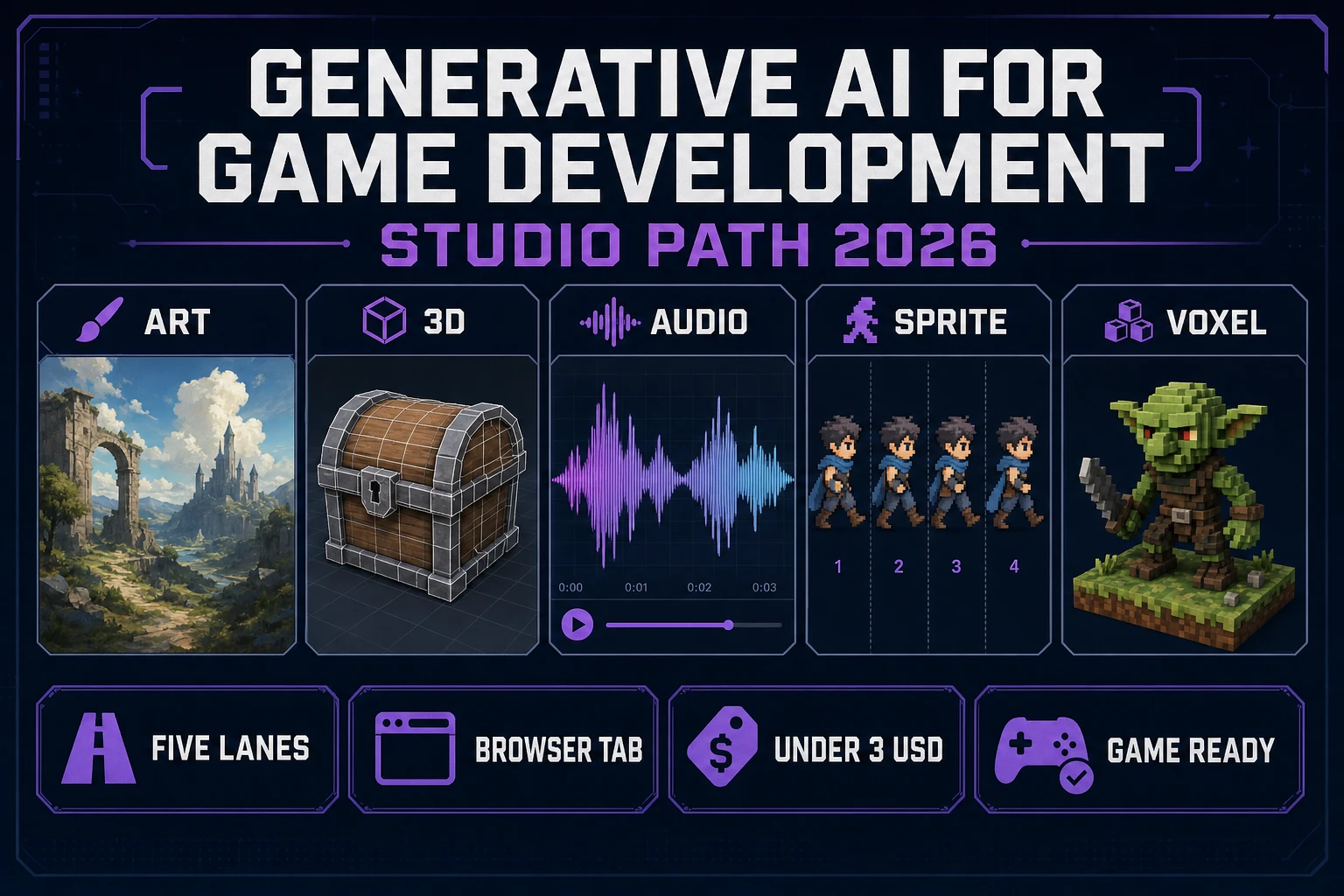
Vet Generative AI for Game Development (Studio Path 2026)

By Arron R.11 min read
Generative AI for game development in 2026 is five lanes, not one. AI Image Gen paints art, 3D Studio lifts meshes, Music Gen writes the bed, Quick Sprites anim

Generative AI for game development stopped being a demo reel in 2024 and started being a real studio pipeline in 2026. The phrase used to gesture at a Midjourney image dropped into a Godot project or a Suno bed under a jam trailer - one asset from one prompt, glued into a manual workflow. Today it names a five-lane pipeline that ships in a browser tab: an image lane for concept art and backdrops, a 3D lane for props and characters, an audio lane for music beds and SFX cues, a sprite lane for animated pixel-art rosters, and a voxel lane for blocky worlds. This piece walks each lane against the shipping Sorceress stack - AI Image Gen, 3D Studio, Music Gen, Quick Sprites, Voxel Studio, and the tools that support them in the Sorceress tools guide. Every fact below was verified 2026-09-08 against the source tree.
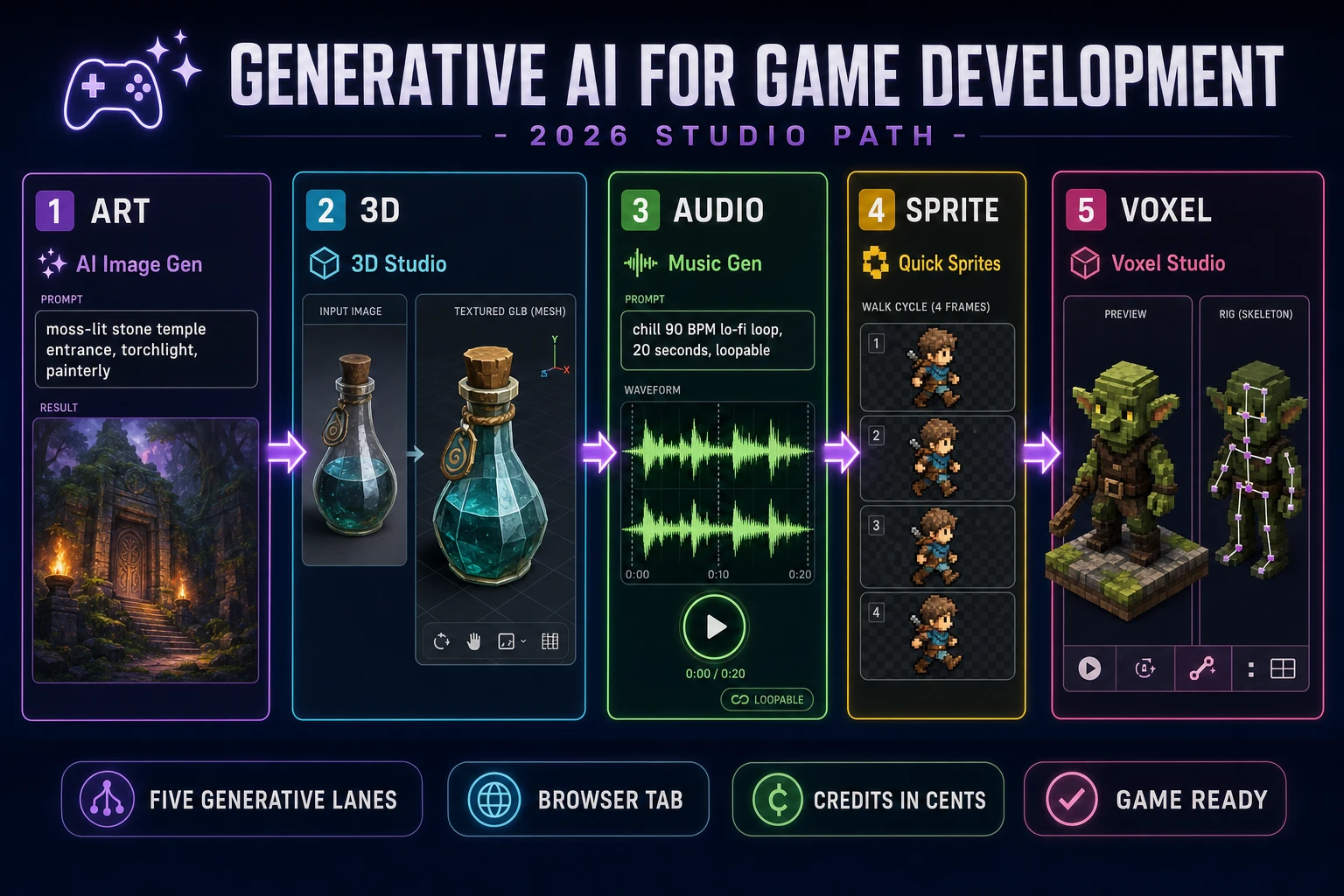
Generative AI for game development in 2026 studio path: a 5-step pipeline showing ART (AI Image Gen prompt returning a moss-lit temple backdrop), 3D (3D Studio image-to-mesh viewport with a potion bottle), AUDIO (Music Gen waveform with a 20-second loopable prompt), SPRITE (Quick Sprites 4-frame pixel walk cycle), and VOXEL (Voxel Studio blocky goblin with a rig skeleton)
The 2026 studio path for generative AI for game development: five lanes, one browser tab, every asset billed in cents. Verified against the Sorceress source tree.

What "generative ai for game development" actually covers in 2026

The general-purpose definition of generative artificial intelligence (verified 2026-09-08 on Wikipedia) is straightforward: models that learn the patterns of their training data and generate new data in response to natural-language prompts. Bolt that definition onto the game-dev vertical and a tighter reading falls out. Generative AI for game development is any model that turns a plain-English prompt into a specific game-runtime asset - an image the engine can load, a 3D mesh with UVs, a music loop with a compatible sample rate, a sprite sheet the animator can slice, a voxel block-out the level designer can drop into a scene, or a block of engine code that compiles. Every returned asset has to slot into a working runtime. That last constraint is what separates a real game-dev generator from a general-purpose image or audio model wearing a game-flavored prompt.

The 2026 stack breaks cleanly into six pillars, and five of them are pure generative surfaces (the sixth, coding, is generative-plus-agent and covered in the prior AI agents for game development loop-path piece). Every asset lane bills in credits at CREDITS_PER_DOLLAR = 100 (one credit equals one US cent, verified 2026-09-08 in src/lib/models.ts line 69), so the whole pipeline stays visibly cent-priced instead of hiding behind a monthly subscription with hidden per-generation caps. The rest of this piece walks each lane end-to-end, keeps the model catalog concrete, and lands on the honest verdict for a solo indie building a weekend prototype - which is where generative AI for game development has actually earned its keep in 2026.

The generative art lane: AI Image Gen and 12 text-to-image models

AI Image Gen is the surface that answers most of the search intent behind "generative AI for game development" queries in 2026. It hosts twelve text-to-image models with per-model credit costs, per-model reference-image support, and per-model output-resolution tiers - verified 2026-09-08 in src/lib/models.ts. The top-tier line-up covers Nano Banana Pro (18 credits at 1K/2K, 33 at 4K, up to 8 reference images), Nano Banana 2 (9 credits, up to 14 refs), GPT Image 2 (5-15 credits, up to 16 refs, the only model that reliably renders dense legible text inside the image), Seedream 5 Lite (6-8 credits, up to 14 refs), Seedream 5 Pro (VIP tier), Flux 2 Pro (6 base credits plus 3 per reference image, up to 8 refs), Grok Imagine, GPT Image 1.5, Nano Banana 2 Lite (4 credits), Nano Banana base (3 refs), Seedream 4.5, and Z-Image. Twelve real models, all priced in cents, all callable from the same tab.

The game-dev workflow through the art lane is straightforward and honest. The developer types a scene prompt in plain English ("moss-lit stone temple entrance, torchlight, painterly, top-down camera, ISO tile-ready"), picks a model that matches the desired aesthetic (Seedream 5 Lite for painterly, Nano Banana 2 for photoreal, GPT Image 2 when the image has to contain legible UI text like a sign or a HUD label), uploads 1-8 reference images if consistency matters (character portraits, style pins, existing screenshots), and hits generate. The returned image lands in the collection rail at a 3:2 or 16:9 aspect the engine can crop; a right-click sends it to Canvas for touch-ups, to True Pixel for palette snap, or to BG Remover for alpha matte. The consistent character generator piece covers the reference-image trick that keeps a hero's face stable across a whole set of scene shots - the entire trick is per-model reference-image support, and every model in the twelve-model catalog documents its own reference cap.
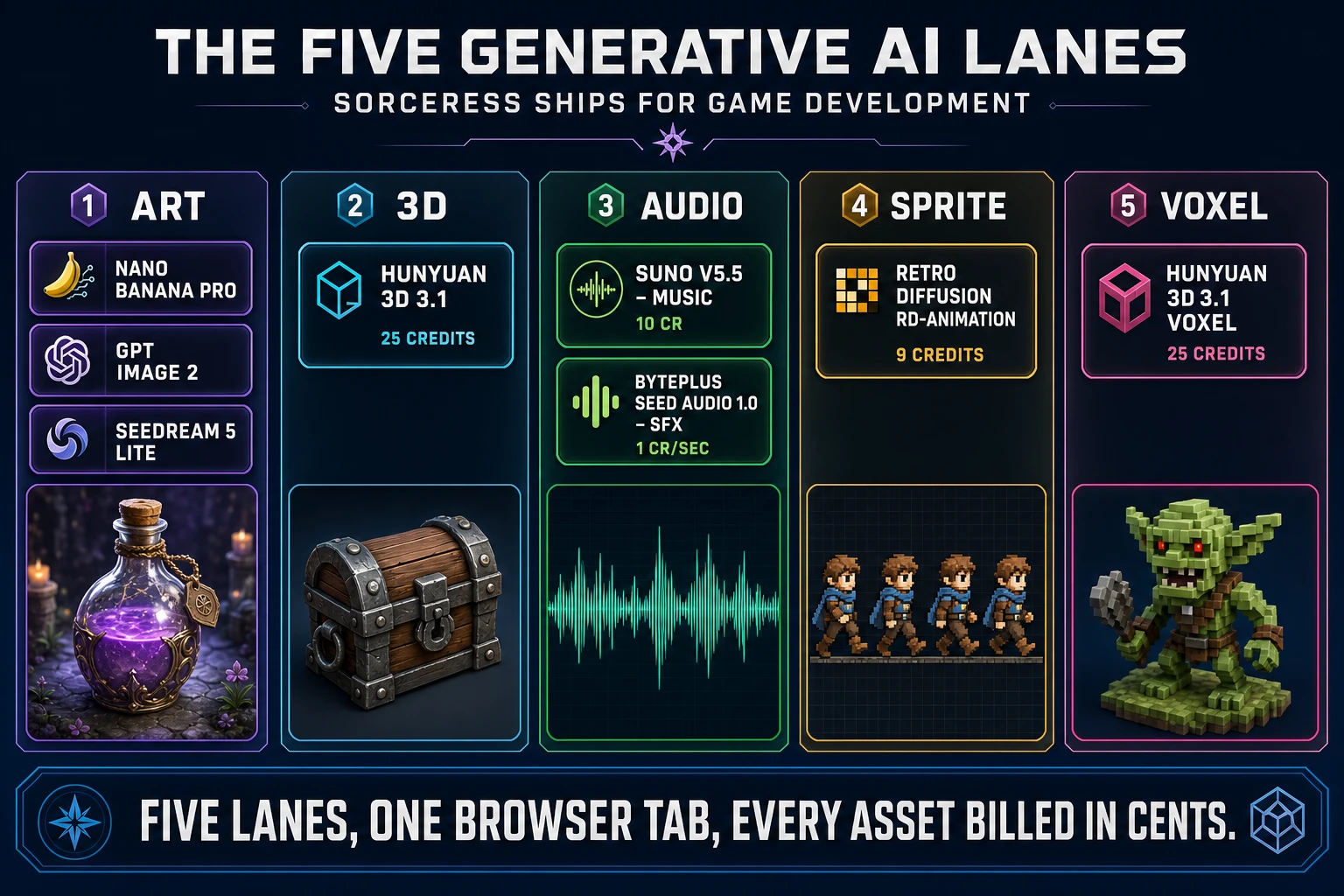
The five generative AI lanes Sorceress ships for game development: ART with Nano Banana Pro, GPT Image 2, and Seedream 5 Lite model cards; 3D with Hunyuan 3D 3.1 at 25 credits; AUDIO with Suno V5.5 at 10 credits and BytePlus Seed Audio at 1 credit per second; SPRITE with Retro Diffusion RD-Animation at 9 credits; VOXEL with Hunyuan 3D 3.1 Voxel at 25 credits
The five generative lanes of the Sorceress studio: art, 3D, audio, sprite, voxel. Every lane surfaces real models at documented credit costs, and every credit is one US cent.

The generative 3D lane: 3D Studio and Auto-Rigging

The 3D lane is where generative AI for game development goes from "a nice concept picture" to "a mesh the engine can render at runtime". 3D Studio takes an image (usually one produced by AI Image Gen on the art lane, but any real reference image works) and lifts it to a textured GLB via an image-to-mesh model. The mesh comes back with UVs, a diffuse texture, and (optionally) a PBR set. It is not a scan-quality replica of the input image - it is a stylized game-ready prop or character at whatever poly budget the model was tuned for. That distinction matters: the goal is a mesh a game engine can load and skin, not a museum-quality reconstruction.

The rig side runs through the Auto-Rigging tool. For humanoid meshes, the workflow accepts a GLB (either the one 3D Studio just produced or one from an external source) and returns the same mesh with a game-ready skeleton, verified 2026-09-08 against src/lib/rigging/external-rig/autoRigPricing.ts: the Meshy provider bills AUTO_RIG_CREDITS.meshy = 20 credits per rig. For non-humanoid creatures (multi-leg animals, insects, custom silhouettes), the Rigging Multi-Leg surface hands the mesh through a variant of the same pipeline. Both routes end in an FBX or a rigged GLB that drops directly into Unity URP/HDRP, Unreal, Godot, or a Three.js scene - the AI character rigging piece walks the marker-placement step in detail. The whole 3D lane runs in a browser tab; no Blender, no Maya, no C4D install anywhere in the loop.

The generative audio lane: Music Gen, SFX Gen, Speech Gen

The audio lane covers the three things a real game needs from sound: a music bed, sound effects for actions, and NPC voices for dialogue. Music Gen handles the first, billed at MUSIC_CREDIT_COST = 10 credits per generation via Suno V5.5 as the default model (verified 2026-09-08 in src/app/music-gen/page.tsx line 28 and the MODELS array). V5.5 accepts a custom duration slider from 10 to 360 seconds, which matters for game loops - a 20-second bed with a clean loop point is often what a scene actually needs, and V5.5 will target that exact length instead of returning a 90-second track the developer has to hand-trim. The prompt language is plain English ("chill 90 BPM lo-fi loop in A minor, no vocals, 20 seconds, loopable, hint of piano"), the returned track is a fully mixed audio file, and stems and MIDI cost more (STEM_CREDIT_COST = 8, MIDI_CREDIT_COST = 15).

SFX Gen handles the second job at SEED_AUDIO_CREDITS_PER_SECOND = 1 credit per second via BytePlus Seed Audio 1.0 (verified 2026-09-08 in src/app/sfx-gen/page.tsx line 23, DEFAULT_SFX_MODEL = 'byteplus-seed-audio'). A 3-second footstep-on-stone cue costs 3 credits; a 5-second sword-clang cue costs 5. That per-second billing is honest for a game workflow because most SFX assets are under 3 seconds anyway, so most cues land at 1-3 credits each. Speech Gen handles the third job with a full voice-cloning slot at VOICE_CLONE_CREDITS = 400 credits (verified 2026-09-08 in src/app/speech-gen/page.tsx line 31), so a solo dev can commit one voice per major NPC without breaking the budget. The prior AI game music generator loop-bed piece and the AI NPC voice piece cover the music and speech workflows end-to-end.
The generative sprite lane: Quick Sprites and Auto-Sprite v2

The sprite lane is a distinct generative surface even though its output is technically an image - a sprite (verified 2026-09-08 on Wikipedia) is a two-dimensional bitmap animated within a game, and the tooling around sprites has different requirements than a general concept-art model. Quick Sprites runs Retro Diffusion RD-Animation (verified 2026-09-08 in src/app/quick-sprites/page.tsx: MODEL_ID = 'retro-diffusion/rd-animation', CREDITS_PER_GEN = 9) with three animation styles: four-angle walking (48x48), small sprites (32x32, six-row NPC layout for right / left / arms / look / surprise / lay-down), and VFX (24-96 px). A single generation returns a spritesheet PNG (default on) ready to slice, and a one-click handoff sends it to Sprite Analyzer or the Slicer for frame parsing.

Auto-Sprite v2 is the companion for the higher-frame-count case - taking a source video (or a set of extracted frames) and running each frame through a chroma-key pipeline to produce a game-ready sprite with a transparent background. The credit formula is honest and small: getCreditCost = Math.max(1, Math.ceil(frameCount / 10) * (isHiRes ? 2 : 1)) where isHiRes = maxDim > 512, verified 2026-09-08 in src/app/autosprite-v2/page.tsx lines 3822-3826. A 40-frame SD walk cycle costs 4 credits; the same 40 frames at HD cost 8. Local backend mode (running the model on the developer's own machine) is free. The AI 2D sprite generator piece and the AI game sprite generator ready-sheet piece walk the two surfaces in more detail.

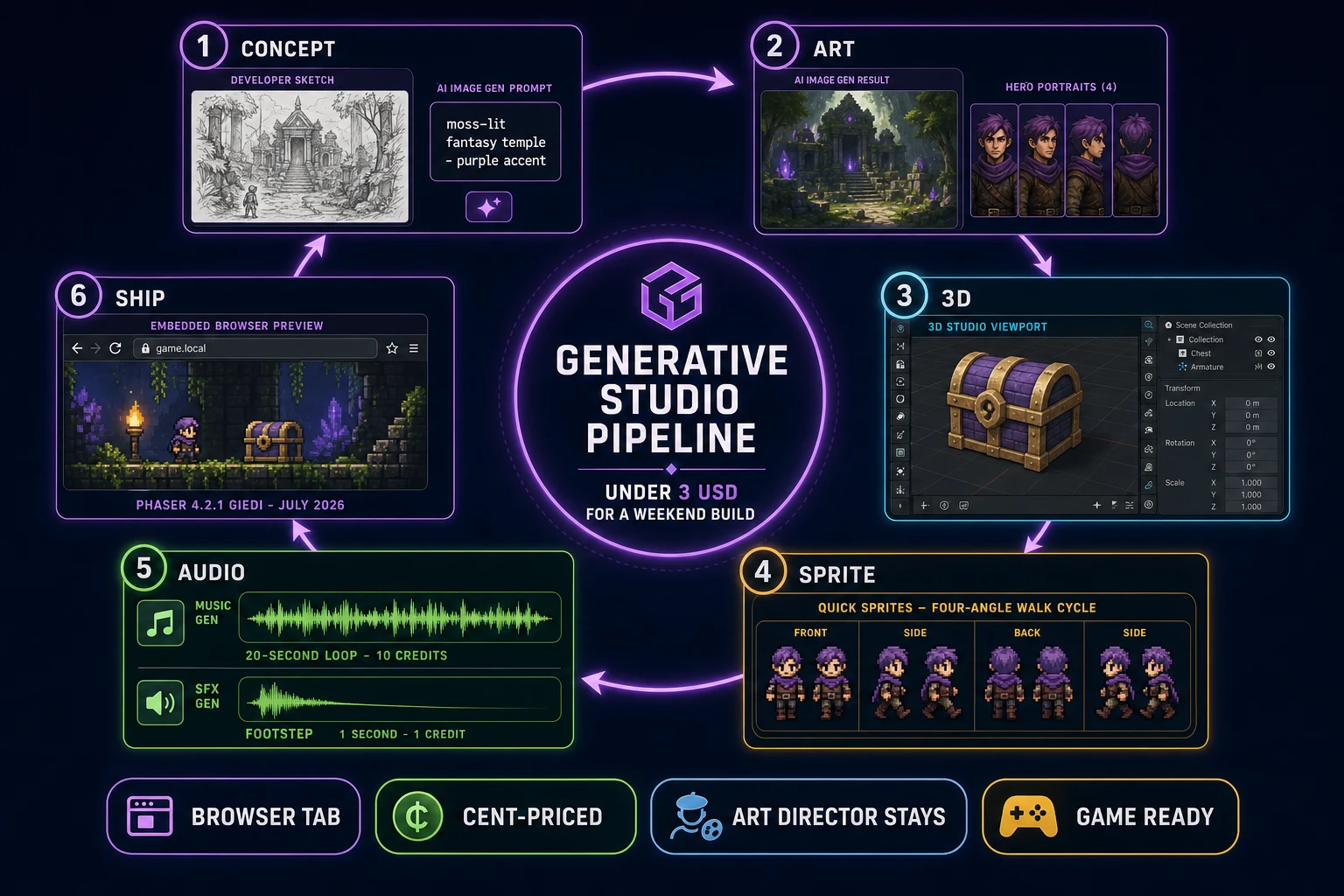
The honest generative studio pipeline for a weekend indie build: a circular 6-step workflow showing CONCEPT (developer sketch and AI Image Gen prompt), ART (returned painterly backdrop and hero portrait strip), 3D (rigged stylized chest mesh in 3D Studio viewport), SPRITE (Quick Sprites four-angle walk cycle), AUDIO (Music Gen 20-second loop and SFX Gen footstep envelope), and SHIP (embedded Phaser 4.2.1 Giedi browser preview with a pixel adventure scene)
The honest studio pipeline for a weekend indie build with generative AI for game development. Six steps, one browser tab, under three US dollars in generation - and the developer stays in the art-director seat at every one of them.

The generative voxel lane: Voxel Studio and Hunyuan 3D 3.1

The voxel lane is the youngest of the five and often the most overlooked. A voxel (verified 2026-09-08 on Wikipedia) is a value on a regular grid in three-dimensional space - the 3D analog of a pixel - and voxel games have a distinct aesthetic that lands somewhere between Minecraft-style blockiness and modern stylized crafts. Voxel Studio generates voxel characters and props from text or an image via Tencent Hunyuan 3D 3.1, verified 2026-09-08 in src/lib/voxelgen-hunyuan.ts: VOXEL_HUNYUAN_CREDITS = 25 credits per generation, with Synexa Hunyuan 3.1 as the default provider and Replicate Hunyuan 2.1 as the fallback. Exports cover the full MODEL_EXTENSIONS = ['.glb', '.gltf', '.fbx', '.obj', '.stl'] set (verified 2026-09-08 in src/app/voxelgen/page.tsx), so the resulting voxel mesh drops directly into a Three.js scene, a Godot MeshInstance3D, or a Unity URP GameObject with no format conversion.

The workflow is direct: the developer types a prompt ("chunky goblin warrior with a rusty sword, cel-shaded voxel style") or uploads an image reference, picks the humanoid or multi-leg rig type, and Voxel Studio returns a blocky mesh with a skinned skeleton. The output slots into the same Auto-Rigging pipeline the 3D lane uses if a different rig is needed, and it can be paired with Music Gen and SFX Gen for a full voxel game slice on a single Saturday. The AI voxel generator browser block-path piece covers the surface end-to-end. If the game is not a voxel game, this lane simply sits idle - but for the growing indie subset making blocky RPGs, roguelikes, or Minecraft-style sandboxes, it is the only generative voxel surface that ships in a browser tab in 2026.

The honest studio pipeline end-to-end

The five lanes only pay off if they compose. Here is a real Saturday-scope video game development loop (verified 2026-09-08 on Wikipedia) that uses every lane once, running against Phaser v4.2.1 "Giedi" (released 9 July 2026, verified 2026-09-08 on the official Phaser stable download page). Concept: a top-down pixel dungeon-crawler slice with a hero, a goblin patrol, three loot chests, and a stone-temple backdrop. Hour one runs the art lane - AI Image Gen produces a painterly backdrop plate (Seedream 5 Lite, 6 credits), a 4-frame hero portrait strip (GPT Image 2 with 4 reference images for consistency, 5-15 credits per pass), and a set of loot-chest icons (Nano Banana 2 Lite, 4 credits each). Hour two runs the sprite lane - Quick Sprites returns an animated hero walk cycle (9 credits) and Auto-Sprite v2 chroma-keys a set of goblin patrol frames from a reference video (a 30-frame SD sequence costs 3 credits).

Hour three runs the 3D lane - 3D Studio lifts the loot-chest icon into a textured GLB mesh, Auto-Rigging adds a chest-open animation rig (Meshy provider, 20 credits), and Voxel Studio blocks out a stylized voxel goblin prop for a boss cutscene (25 credits). Hour four runs the audio lane - Music Gen returns a 20-second loopable dungeon bed (Suno V5.5, 10 credits) and SFX Gen returns eight cues at 1-3 seconds each (roughly 15 credits total). Hour five wires the assets into a Phaser scene with the coding-lane agent (either WizardGenie for a scratch scaffold or Sorceress Code for a refactor of an existing template). The final asset bill: roughly 150-250 credits, or 1.50-2.50 USD, all generation-side. Every returned asset was directed by the developer's taste; none was picked or shipped without a human sign-off. The HTML Canvas API (verified 2026-09-08 on MDN) is what actually renders the pixel scene at runtime.

The verdict on generative ai for game development in 2026

The honest 2026 verdict on generative AI for game development is that the tech has finally cleared the "toy" bar and landed in "real studio pipeline" territory - but only when the five lanes are treated as a single composable surface instead of five separate demos. A dev who spins up a Midjourney account for concept art, a Suno account for music, a Meshy account for 3D, a chroma-key script for sprites, and a Minecraft-style voxel editor separately will spend most of the Saturday wrangling accounts, formats, and hand-offs. The same dev on a single-tab stack that puts all five lanes behind one credit meter can spend the Saturday making game-design decisions instead. That is the value delta the 2026 stack delivers - the generative models themselves are commodities now, but the plumbing that turns them into a shippable game asset is where the honest productivity lift lives.

Open a WizardGenie tab for the coding lane, an AI Image Gen tab for concept art, a 3D Studio tab for the props, a Music Gen tab for the bed, a Quick Sprites tab for the roster, and a Voxel Studio tab if the game needs blocks. Direct every lane with the same taste an experienced art director would apply, keep the human sign-off on every returned asset, and ship the tab. That is what generative AI for game development actually looks like in 2026 on a real indie stack, and the credit bill will land under three US dollars for a first playable slice - verified 2026-09-08 against the source tree. The pricing page lists the credit tiers, and the Sorceress home page walks the full stack in a couple of scrolls.

Frequently Asked Questions

What is generative AI for game development in 2026?

Generative AI for game development in 2026 is a family of models that turn a natural-language prompt into a specific game asset - an image, a sprite sheet, a rigged 3D mesh, a music loop, a sound effect, a voxel block-out, or lines of engine code. The 2026 working definition follows the same shape as the general-purpose Wikipedia definition of generative AI (models that learn the patterns of their training data and generate new data in response to input), but with a domain-specific tail: every returned asset has to slot into a working game runtime. Verified 2026-09-08 against the Sorceress source tree, the shipping stack covers five distinct generative lanes (art, 3D, audio, sprite, voxel) plus a coding lane, and every lane bills in credits at CREDITS_PER_DOLLAR = 100 (one credit = one US cent, src/lib/models.ts line 69).

How many models does Sorceress ship for generative AI game work?

Sorceress ships roughly thirty generative model surfaces across the six pillars, verified 2026-09-08 against src/lib/models.ts and src/app/_home-v2/_data/tools.ts. The image lane alone covers twelve top-tier text-to-image models including Nano Banana Pro (top-tier), GPT Image 2 (dense-text illustration), Seedream 5 Lite, Seedream 5 Pro, Flux 2 Pro, Nano Banana 2, Nano Banana 2 Lite, GPT Image 1.5, Grok Imagine, Z-Image, Seedream 4.5, and base Nano Banana. The coding lane covers eight frontier and executor models (Claude Opus 4.7, Claude Sonnet 4.6, GPT-5.5, Gemini 3.1 Pro, DeepSeek V4 Pro, Kimi K2.5, Grok 4.2, MiniMax M2.7 in tools.ts lines 766-775). The 3D lane runs Hunyuan 3D 3.1 at VOXEL_HUNYUAN_CREDITS = 25. The audio lane runs Suno V5.5 at MUSIC_CREDIT_COST = 10 for music and BytePlus Seed Audio 1.0 at SEED_AUDIO_CREDITS_PER_SECOND = 1 for SFX. The sprite lane runs Retro Diffusion RD-Animation at CREDITS_PER_GEN = 9. That is a real generative stack, not a marketing catalog.

Which generative AI lane covers 3D models for a game?

The generative 3D lane in Sorceress runs through 3D Studio and Voxel Studio, verified 2026-09-08 against src/app/voxelgen/page.tsx and src/lib/voxelgen-hunyuan.ts. 3D Studio accepts an image (from AI Image Gen or a real reference) and lifts it into a textured GLB, then hands the mesh to Auto-Rigging for a game skeleton (Meshy provider at AUTO_RIG_CREDITS.meshy = 20 credits per rig). Voxel Studio takes text or an image and generates a voxel character via Tencent Hunyuan 3D 3.1 at VOXEL_HUNYUAN_CREDITS = 25, exports to .glb / .gltf / .fbx / .obj / .stl (MODEL_EXTENSIONS constant), and can hand the result to the multi-leg rigger for creatures. Neither surface asks the developer to open Blender or Maya - the whole 3D lane lands in a browser tab and the mesh is game-ready on export.

Does generative AI for game development handle music and sound effects too?

Yes, the audio lane is one of the five generative pillars, verified 2026-09-08 against the Sorceress audio surfaces. Music Gen writes music loops via Suno V5.5 at MUSIC_CREDIT_COST = 10 credits per generation (src/app/music-gen/page.tsx line 28), with V5.5 supporting custom durations from 10 to 360 seconds and the developer typing a mood prompt in plain English (chill 90 BPM lo-fi loop in A minor, no vocals, 20 seconds, loopable). SFX Gen produces sound effects via BytePlus Seed Audio 1.0 at SEED_AUDIO_CREDITS_PER_SECOND = 1 (src/app/sfx-gen/page.tsx line 23), so a 3-second footstep cue costs 3 credits. Speech Gen handles NPC voice with a full voice-cloning slot at VOICE_CLONE_CREDITS = 400 for a persistent character voice. Every audio asset lands as a WAV or MP3 the developer can drop into the game with no extra pipeline.

How much does a full generative AI pipeline cost for a weekend game project?

A full generative AI pipeline for a Saturday-scope indie project runs between 1.50 and 3.00 US dollars in generation on Sorceress in 2026, verified 2026-09-08 against the credit costs in src/lib/models.ts and each tool page. A typical weekend build spends roughly 30-50 credits on the art side (hero portrait + enemy sheet + backdrop through AI Image Gen at Nano Banana 2 Lite = 4 credits, GPT Image 2 = 5 credits, or Nano Banana 2 = 9 credits per generation), 25 credits on a voxel prop via Voxel Studio, 20 credits on an auto-rigged 3D mesh, 10 credits on a music bed via Music Gen, 20-40 credits on assorted SFX cues, and 9 credits per pass on a Quick Sprites animated hero. Total: roughly 150-300 credits, or 1.50-3.00 USD. The 100-credit signup grant covers most of the asset side outright, and Lifetime Early Access sits at 49 USD for the full desktop stack with auto-update.

Sources

  1. Generative artificial intelligence - Wikipedia
  2. Video game development - Wikipedia
  3. Large language model - Wikipedia
  4. Sprite (computer graphics) - Wikipedia
  5. Voxel - Wikipedia
  6. Phaser v4.2.1 Giedi stable download
  7. Canvas API - MDN Web Docs
Written by Arron R.·2,516 words·11 min read

Related posts