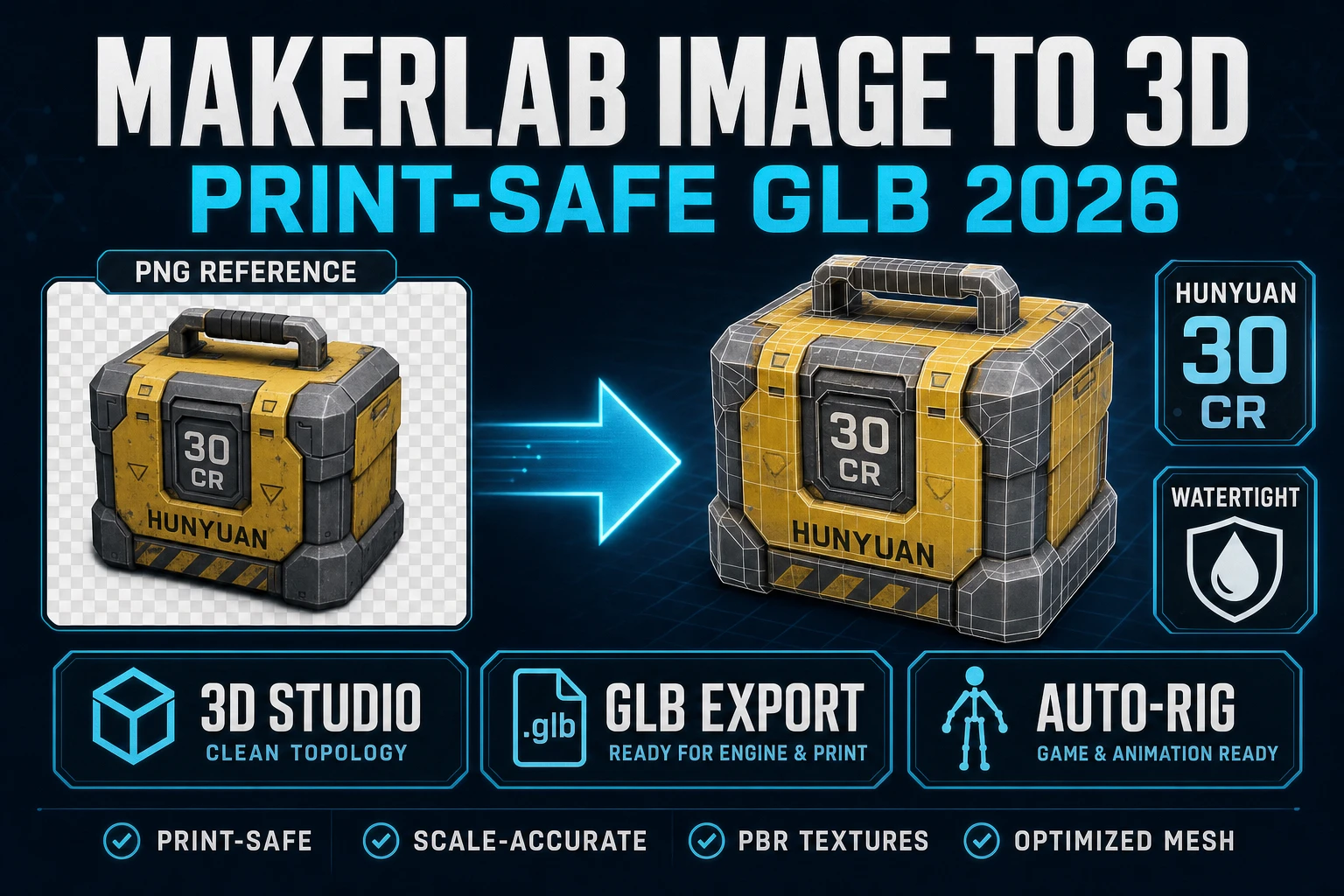
People who type makerlab image to 3D into Google are rarely hunting a mesh theory lecture. They saw a one-photo lift somewhere in the maker world and want the same outcome: a downloadable file they can open in a viewer, drop into a game engine, or hand to a slicer. This guide traces that intent onto Sorceress in 2026 — what the query actually wants, the 3D Studio route, cleanup that makes a GLB honest for print or play, when to fork into Voxel Studio, the auto-rig handoff, and credit math verified against source today. MakerLab itself stays plain text here; the destination is Sorceress.
What makerlab image to 3D searchers actually want
DataForSEO lists makerlab image to 3d at 590 searches a month with KD 1 (confirmed in tools/research-supplement.md, verified 2026-09-24 pull). Neighbors include makerlab 3d, image to 3d print, and generic image to 3d model phrasing. The long-tail is brand-shaped, but the job is format-shaped: one still image becomes a mesh with a file extension the next tool understands.
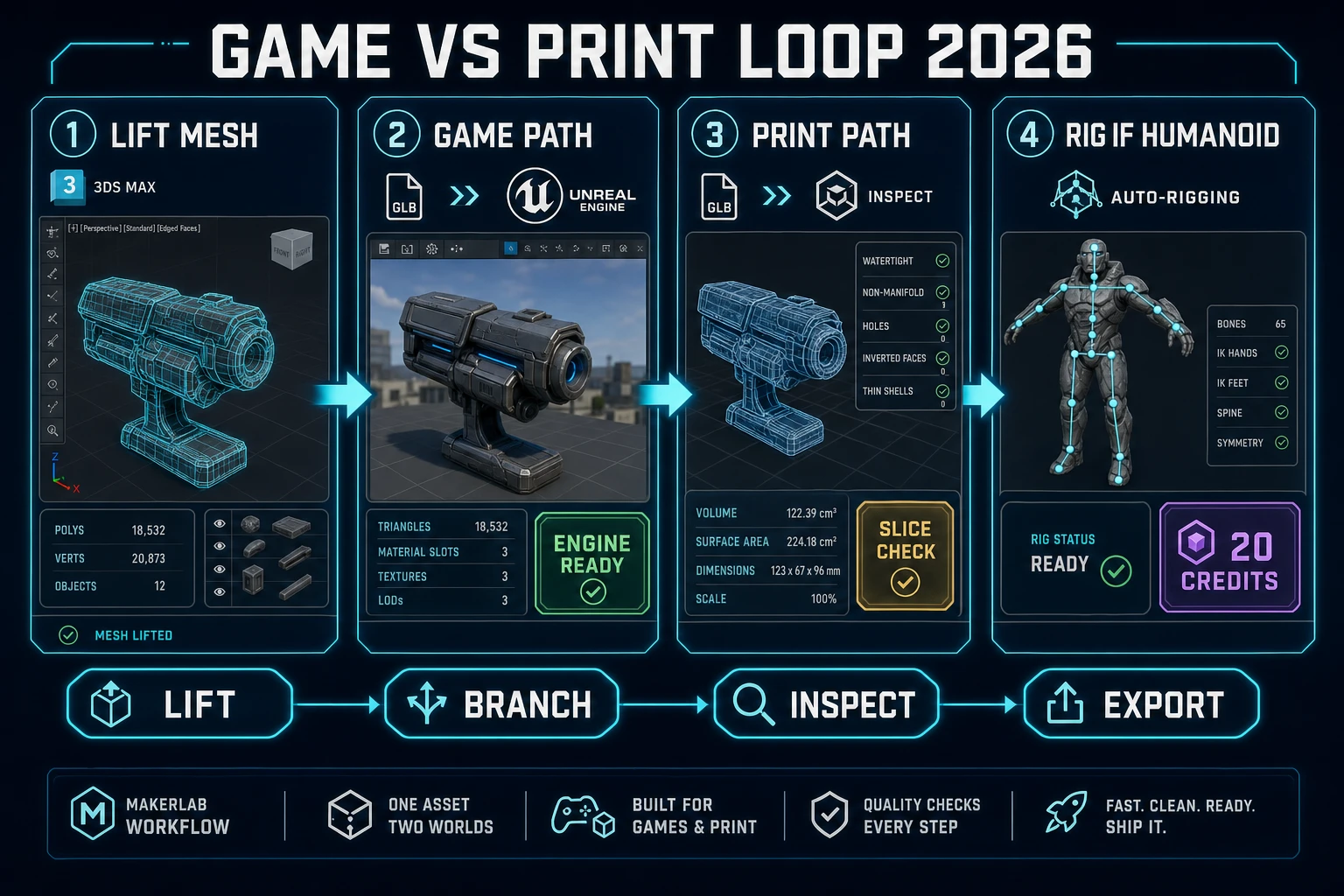
Three outcomes dominate that intent in September 2026. First, a textured preview they can orbit in the browser. Second, a binary download — usually GLB for web and game engines, sometimes STL or 3MF after a slicer conversion for filament. Third, enough geometry honesty that thin walls, floating debris, and open holes do not explode the next step. Miss the third and the “AI made my prop” story becomes an afternoon of remesh and hole-fill.
Two open-source lineages still anchor the reconstructors the pickers wrap. Microsoft Research’s TRELLIS paper, Structured 3D Latents for Scalable and Versatile 3D Generation, remains a CVPR’25 Spotlight (verified 2026-09-25 on github.com/microsoft/TRELLIS, 13,702 stars). Tencent’s Hunyuan3D-2.1 README still describes the line as From Images to High-Fidelity 3D Assets with Production-Ready PBR Material (verified 2026-09-25 on github.com/Tencent-Hunyuan/Hunyuan3D-2.1, 4,075 stars). Hosted studios productize those ideas behind a credit ledger — that is the makerlab image to 3D job on Sorceress.
The 3D Studio route for makerlab image to 3D
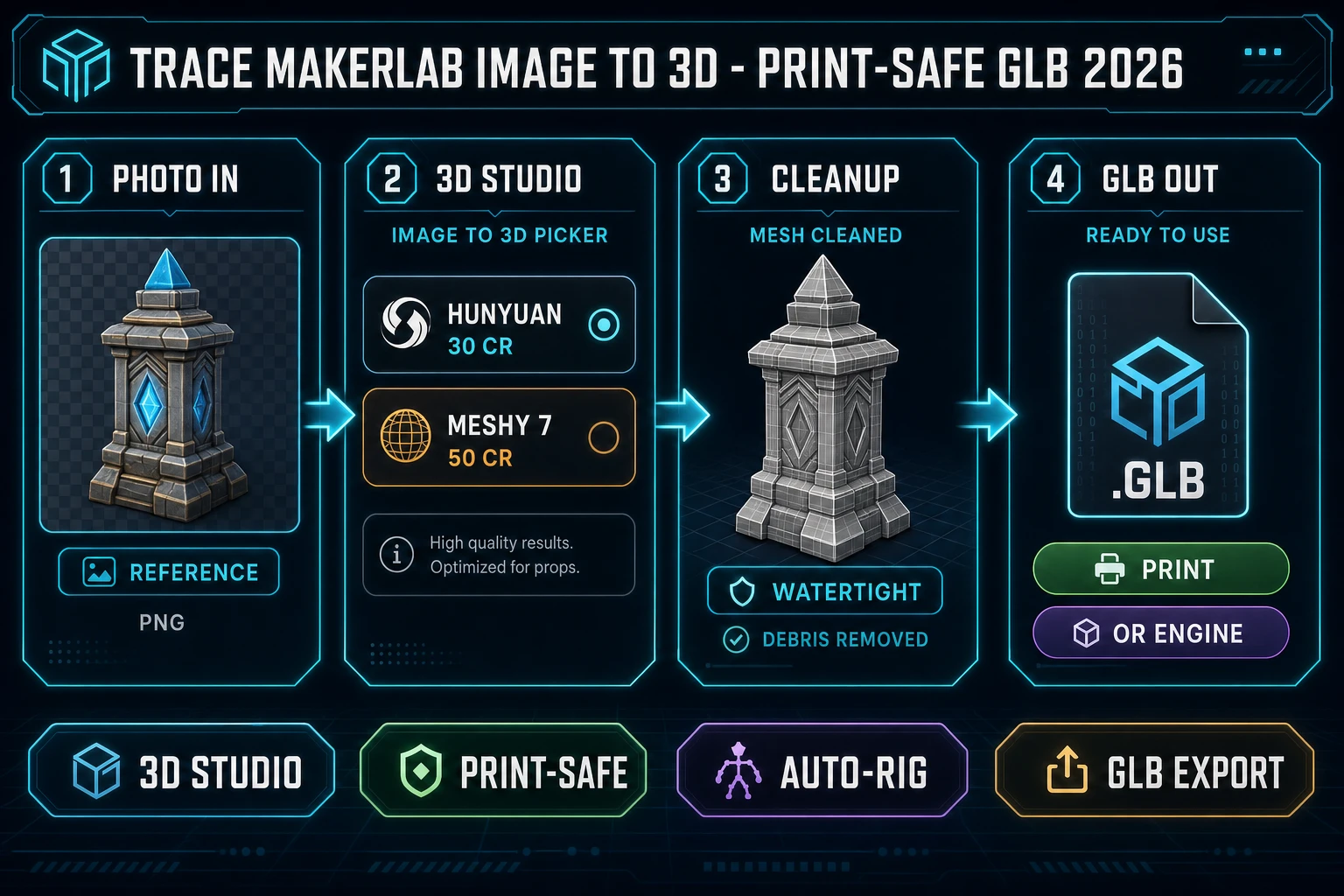
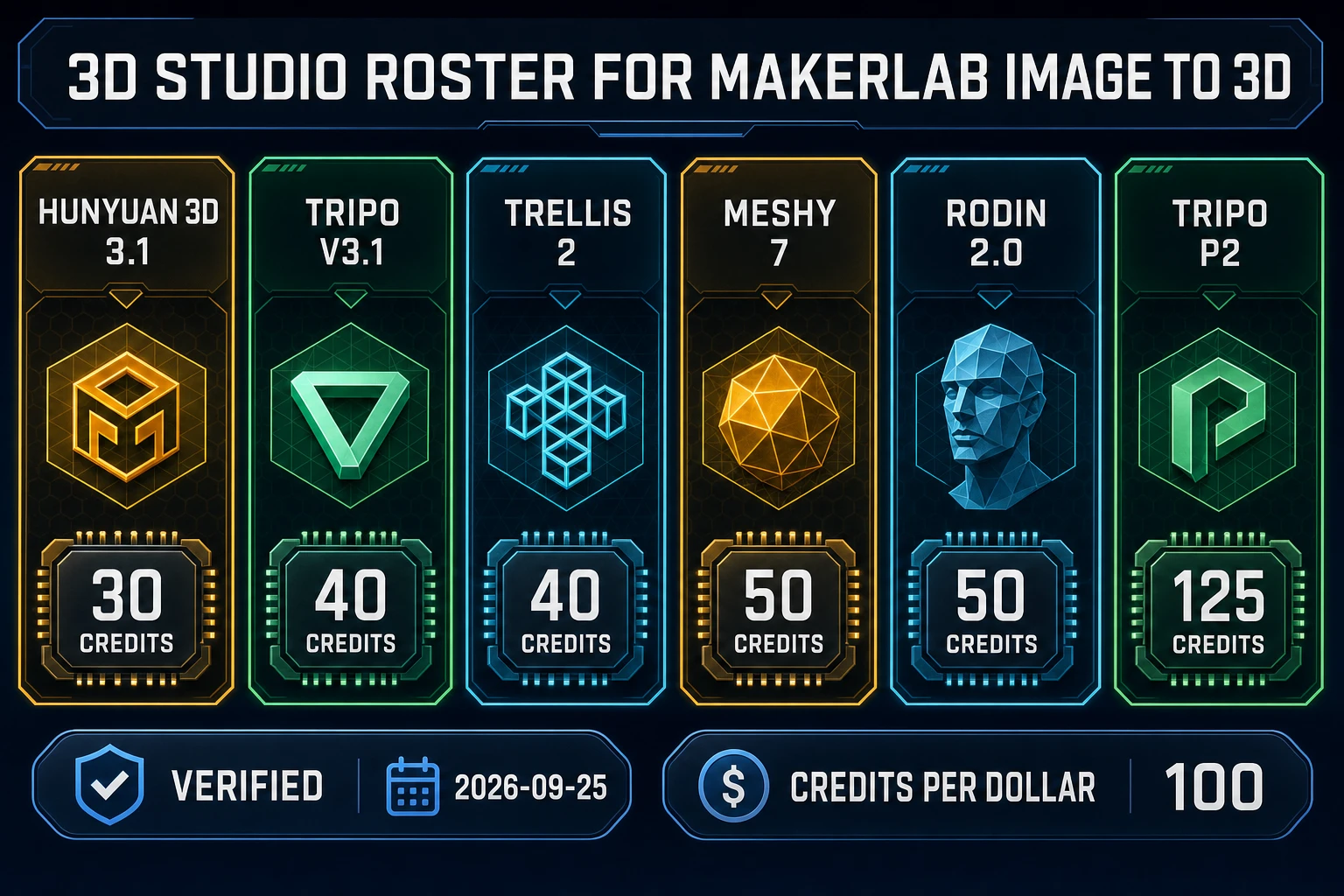
Sorceress 3D Studio is the featured panel. The home card description (verified 2026-09-25 in src/app/_home-v2/_data/tools.ts) chains AI image generation, single-image to textured 3D, automatic humanoid auto-rigging with weight-paint refinement, and AI text-to-animation, then exports FBX, GLB, or GLTF for any engine. The picker lives in src/lib/threed-models.ts. Base credits checked today:
| Model | Base credits | Best fit after a makerlab image to 3D search |
|---|---|---|
| Hunyuan 3D 3.1 | 30 | First bulk lifts on a wallet |
| Tripo v3.1 | 40 | Game-ready props with Face Limit control |
| TRELLIS 2 | 40 (1024 default) | Concept meshes and mood-board props |
| Meshy 7 | 50 (texture on) | Humanoids headed to auto-rig; Pose Mode A/T |
| Meshy 6 | 50 | Stylized characters; Low Poly mesh type |
| Rodin 2.0 | 50 | Stylized props with PBR material options |
| Tripo Smart Mesh P1 | 65 | Low-poly mobile/web budgets |
| Tripo P2 | 125 | Hero props when fidelity beats cost |
| Pixal3D | 0 (VIP free unlimited) | VIP-only image-to-3D lane |
Meshy 5 sits at 31 credits for older jobs. TRELLIS v1 stays registered at 8 credits but is hidden from the picker in favor of TRELLIS 2. Hunyuan 3D 2.1 is 15 credits and gated behind RunPod configuration. Seed3D 2.0 shows creditLabel Admin test and is admin-only — do not plan a public lift around it. Pixal3D is vipOnly: true with creditLabel Free unlimited (all verified 2026-09-25 in src/lib/threed-models.ts). The badge on the home card for 3D Studio is AI Credits, not Free.
For sibling angles already shipped on the blog, see image to 3D models for the plural prop-pack loop and image to 3D model free for the low-credit voxel path. This page stays on makerlab image to 3D as the brand-shaped query with a print-safe GLB finish.
Cleanup before you call the GLB print-safe
A textured orbit is not a printable solid. After the lift, inspect for four failure modes that show up constantly on makerlab image to 3D jobs: floating dust islands, paper-thin panels that will not survive a nozzle, fused floor geometry under the subject, and open holes where the reconstructor guessed the back side wrong. Crop the source PNG tighter before you spend a second pass. Prefer a plain background and one subject fully in frame. For bilaterally symmetric props, turn Symmetry on when the model exposes it; for rocks and asymmetric keys, leave it off.
Khronos calls glTF the JPEG of 3D: a royalty-free format for efficient transmission of scenes and models, with glTF 2.0 published as ISO/IEC 12113:2022 (verified 2026-09-25 on khronos.org/gltf). Wikipedia’s glTF page (verified 2026-09-25) distinguishes .gltf JSON from binary .glb. 3D Studio’s export line matches that reality: FBX for many desktop engine pipelines, GLB for single-file web delivery, GLTF when you want the unpacked form.
“Print-safe” in this article means: watertight enough to slice after a standard remesh or conversion step, scaled to real units you chose on purpose, and free of debris that becomes stray shell islands in the slicer. It does not mean the albedo texture is already a multicolor filament map. Textured GLB is great for engines and previews; filament regions are a separate paint-or-convert job in your slicer toolchain. For a browser sanity check before that handoff, MDN’s 3D games on the Web overview (checked 2026-09-25) points at Three.js, Babylon.js, and PlayCanvas loaders.