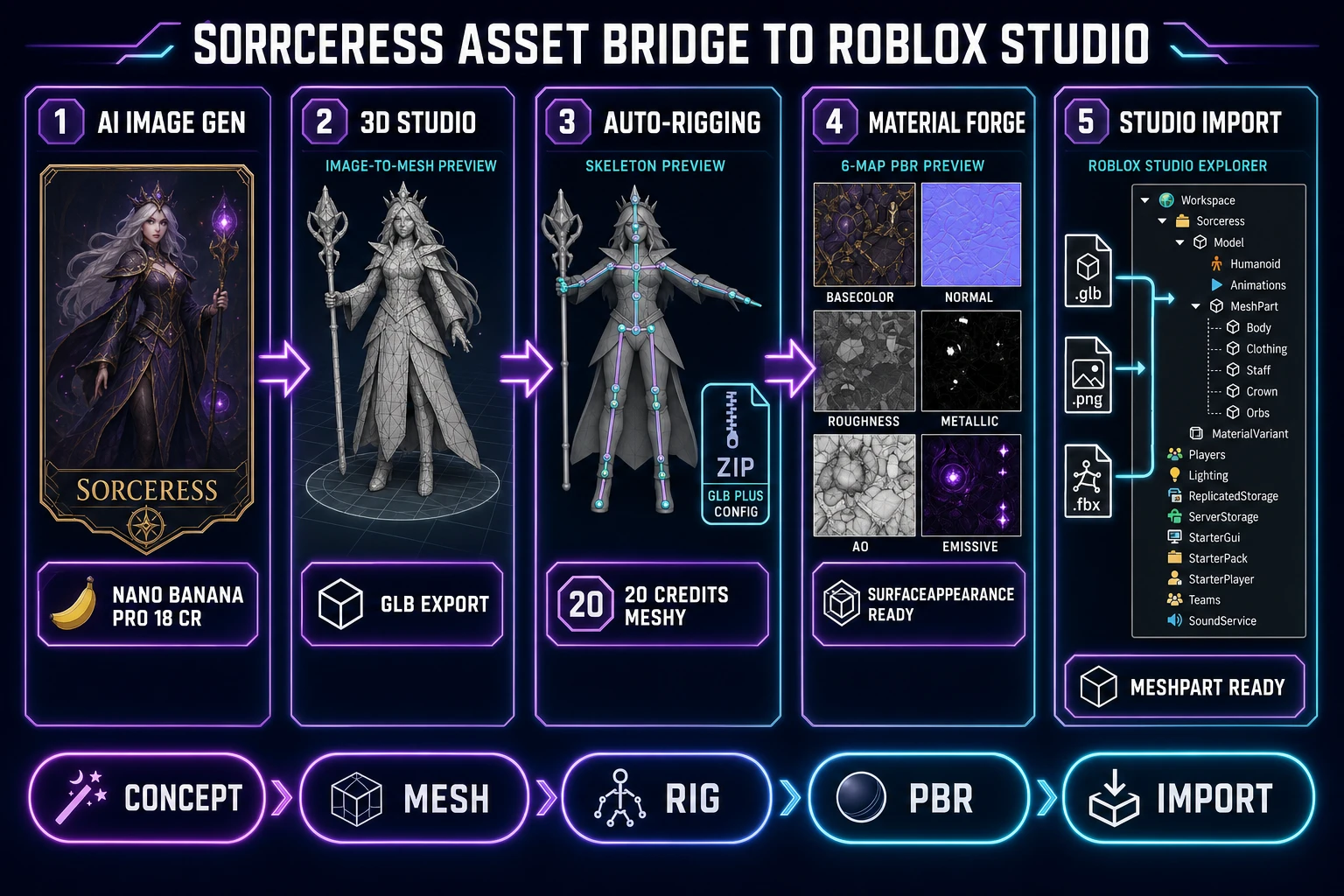
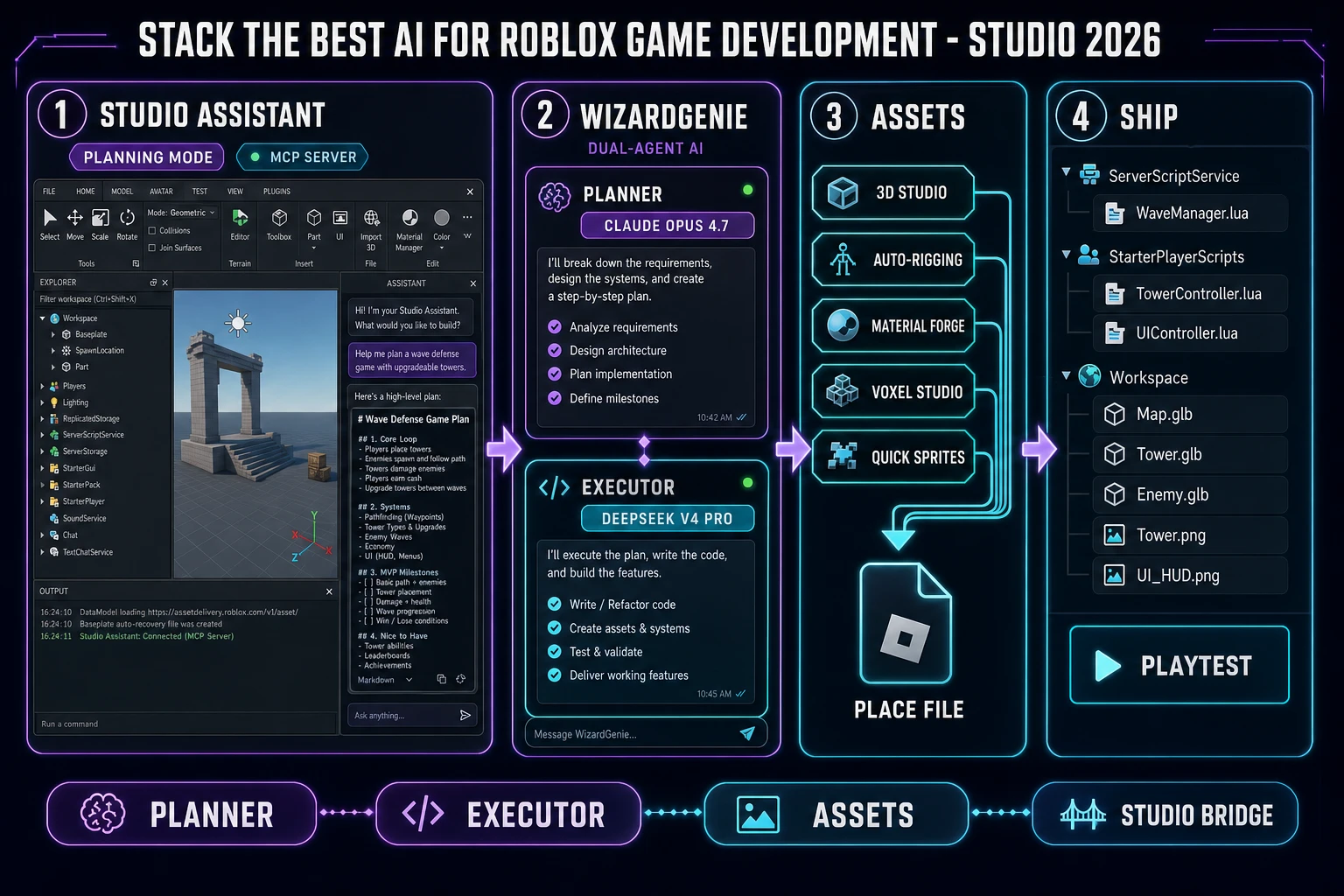
Searchers who type best ai for roblox game development in 2026 land on two very different answers, and the honest one takes both seriously. Path one is the Roblox Studio Assistant with Planning Mode, which launched 2026-04-17 and turns a prompt into an editable Markdown plan the developer approves before the Assistant executes it, plus the built-in Studio MCP server that exposes roughly two dozen editor tools (script_read, multi_edit, execute_luau, generate_procedural_model, generate_mesh, subagent, screen_capture, playtest input simulation) to any MCP-compatible client (verified 2026-09-07 via create.roblox.com/docs/studio/mcp). Path two is a browser-first Sorceress stack that drives the same Roblox place from outside Studio: WizardGenie planner-plus-executor for the Luau server and client modules, 3D Studio and Auto-Rigging for the character pipeline, Material Forge for PBR maps that land in Roblox as SurfaceAppearance textures. Same place, two different agents; below is the honest bench across both.
What best ai for roblox game development actually means in 2026
Roblox coding in 2026 is not "write a Script under Workspace, press Play, hope the RemoteEvent fires." It is an agentic loop: read the place spec, read the current Explorer tree and the open module, plan a task list, write the Luau into a ServerScriptService or StarterPlayerScripts container, press F5 to enter playtest, read the output log, patch the module, loop. The pattern is documented for browser games in the best ai coding model game bench and for the general vibe-coding shape in the executor picks writeup. It maps directly onto Roblox because Studio already carries a live place graph - a software agent that can read the world, the currently open script, and the last playtest log in real time is meaningfully different from a chatbot pasting local part = Instance.new("Part") above a stub.
The best ai for roblox game development in 2026 is therefore not a single model name - it is a decision about where the agent sits and which model drives it. In-editor sits closest to the world and the Explorer tree but binds the workflow to Studio's MCP host and to the developer's own vendor keys for frontier calls. Out-of-editor sits further from the world but lets you swap models freely across the eight-model Sorceress lineup, keeps the same agent driving your Unity, Unreal, and browser projects too, and never pins the workflow to one Studio window. Both are honest paths. The rest of this bench lays out what each one is good for and what it costs on a real 2026 project.
Two paths that both count as best ai for roblox game development
The two paths differ on four axes: where the agent runs, which models it drives, who bills the tokens, and what it can touch. Every honest bench for the phrase best ai for roblox game development has to hold both up side by side.
- Roblox Studio Assistant with Planning Mode plus the built-in MCP server (Planning Mode launched 2026-04-17, MCP quick connect list expanded July 2026, verified 2026-09-07 via create.roblox.com/docs/studio/mcp and devforum.roblox.com/t/announcing-planning-mode-for-roblox-assistant). Assistant Planning Mode translates a prompt into an editable Markdown plan (opened via
/planor the Assistant dropdown), the developer edits and approves the plan, and the Assistant executes it against the live place. The plan never auto-executes - the[Build]button is the explicit approval gate. The Studio MCP server ships built into Studio and speaks the Model Context Protocol over stdio. Its tool surface covers scripts (script_read, multi_edit, script_search, script_grep), asset generation (generate_mesh, generate_material, generate_procedural_model, search_asset, insert_asset), Luau execution (execute_luau), playtest (start_stop_play, get_console_output, screen_capture, character_navigation, user_keyboard_input, user_mouse_input), and data-model exploration (search_game_tree, inspect_instance, subagent for explore and playtest). Quick Connect works with Claude Code, Claude Desktop, Cursor, Visual Studio Code, Antigravity, Codex CLI, and Gemini CLI; a JSONmcp.jsonpluscmd.exe /c %LOCALAPPDATA%\Roblox\mcp.batcovers everything else with stdio transport. Assistant runs on a free Roblox-hosted default model quota; Bring Your Own Key routes the same session to Claude, GPT, Gemini, or a self-hosted Ollama model on the developer's own vendor key. - The Sorceress browser stack. Runs in a browser tab or on the desktop app. Drives the same eight
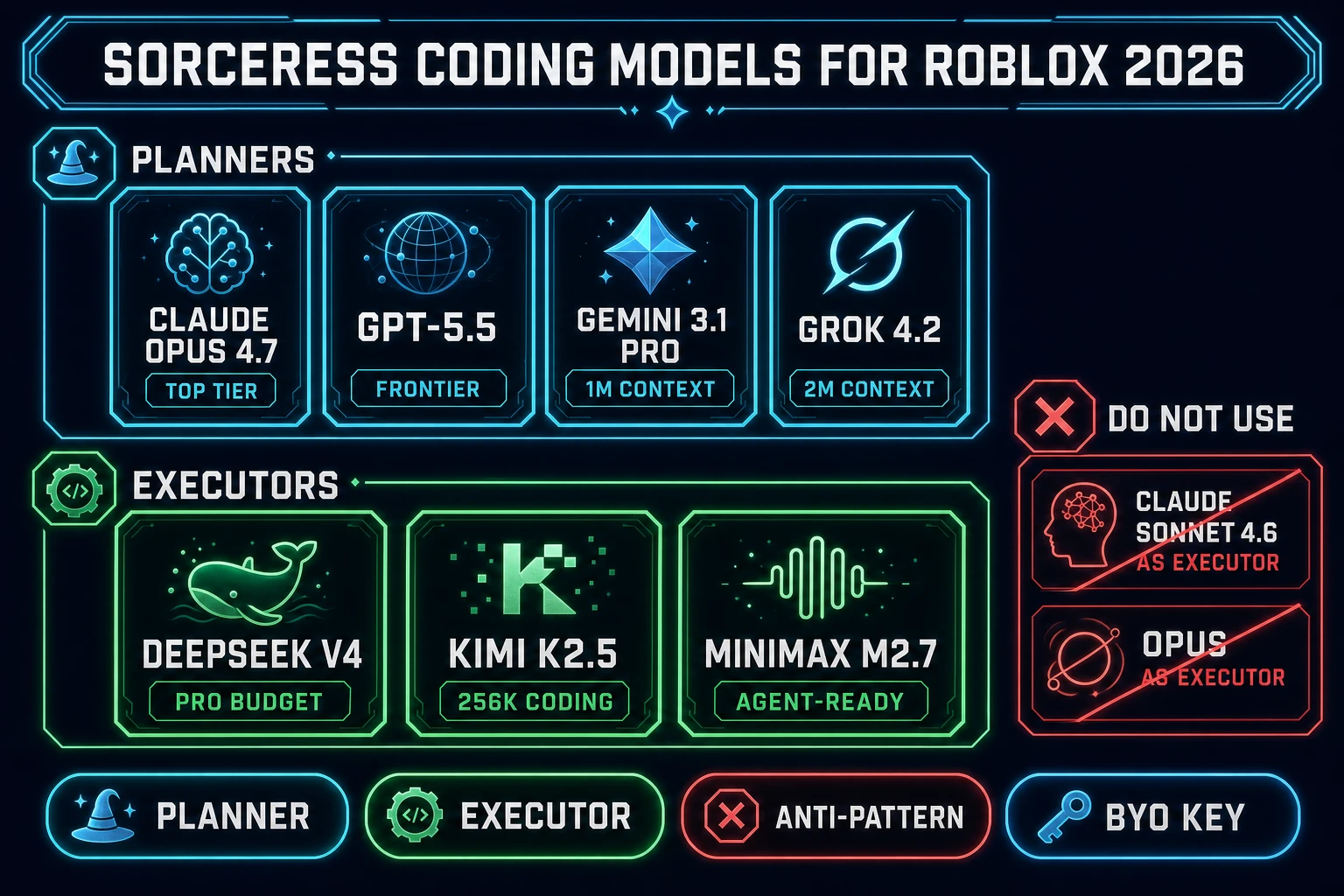
CODING_MODELSvisible in the Coding Studio card at tools-guide: Claude Opus 4.7 (Top tier), Claude Sonnet 4.6 (Fast + smart), GPT-5.5 (Frontier), Gemini 3.1 Pro (1M context), DeepSeek V4 Pro (Budget), Kimi K2.5 (256K coding), Grok 4.2 (2M context), MiniMax M2.7 (Agent-ready) - every name and tag verified 2026-09-07 insrc/app/_home-v2/_data/tools.tsat lines 766-774. Writes Luau server and client modules into a local folder or straight into a ServerScriptService paste target inside Studio. Billed against Sorceress credits at one credit per US cent (CREDITS_PER_DOLLAR = 100insrc/lib/models.ts, verified 2026-09-07), or against your own vendor keys through the Code page's BYO-API slots for Anthropic, DeepSeek, OpenAI, and NVIDIA NIM (verified 2026-09-07 insrc/app/code/page.tsx).
The two paths are not mutually exclusive. A serious 2026 workflow runs both: the Studio Assistant with MCP for world-aware nudges (insert this Model into Workspace, wire this RemoteEvent to that ServerScript, run the playtest subagent for 30 seconds and read the output, screenshot the current camera frame) and the Sorceress browser stack for the parts of the project that never need Studio loaded (cross-file Luau scaffolding, module design docs, batch generation of asset variants, the shared game-loop logic that has to survive when Studio crashes). The next three sections lay out the browser side because that is the side this blog can speak to directly - the exact Assistant seat charges and BYOK routing change with each Studio point release and are best read from the vendor page on the day you install. This piece mirrors the Unity coding bench and the Unreal Engine coding bench because the browser stack is intentionally the same across all three engines - Roblox, Unity, and Unreal are just three folders for the same coding models.
The Sorceress CODING_MODELS lineup for Roblox Luau and Studio
The eight-model lineup in the WizardGenie coding picker is the same lineup that drives Phaser and Three.js browser games, Unity C#, and Unreal C++; nothing in the panel is Roblox-specific. That is a feature, not a gap - Luau is a variant of Lua the language, and the frontier coding models were trained on public GitHub which is thick with Roblox open-source (Roact, Rodux, TestEZ, dozens of community frameworks). The models handle Roblox's Instance-and-service model as first-class output, and the tightly-scoped Roblox globals (game, workspace, Instance.new, DataStoreService, ReplicatedStorage, RemoteEvent, UserInputService) are stable enough that model output rarely drifts on syntax.
Split the eight names by role, the same split the executor picks bench uses for browser games. The Planner reasons over the Roblox place shape and produces a task list. The Executor writes the Luau, edits the module scripts, and patches the code after each playtest pass.
- Planner seat (reasoning-heavy, low call volume): Claude Opus 4.7 for dense server-client module graphs and complex Remote Event chains, GPT-5.5 for cross-file plans that touch ReplicatedStorage plus StarterPlayerScripts plus ServerScriptService plus a data-store schema, Gemini 3.1 Pro when the session has been running long enough that a 1M-token context matters, Grok 4.2 when the place has crossed into production week and even 1M is tight.
- Executor seat (typing-heavy, high call volume): DeepSeek V4 Pro as the default (Budget tag), Kimi K2.5 when the running context - Explorer tree plus current module dump plus five iterations - starts to feel constrained (256K coding tag), MiniMax M2.7 for tool-call heavy edit loops (Agent-ready tag). Never Sonnet or Opus on the typing side - the whole point of the split is the price asymmetry, and Sonnet 4.6 on the executor seat erases roughly 80 percent of the savings.
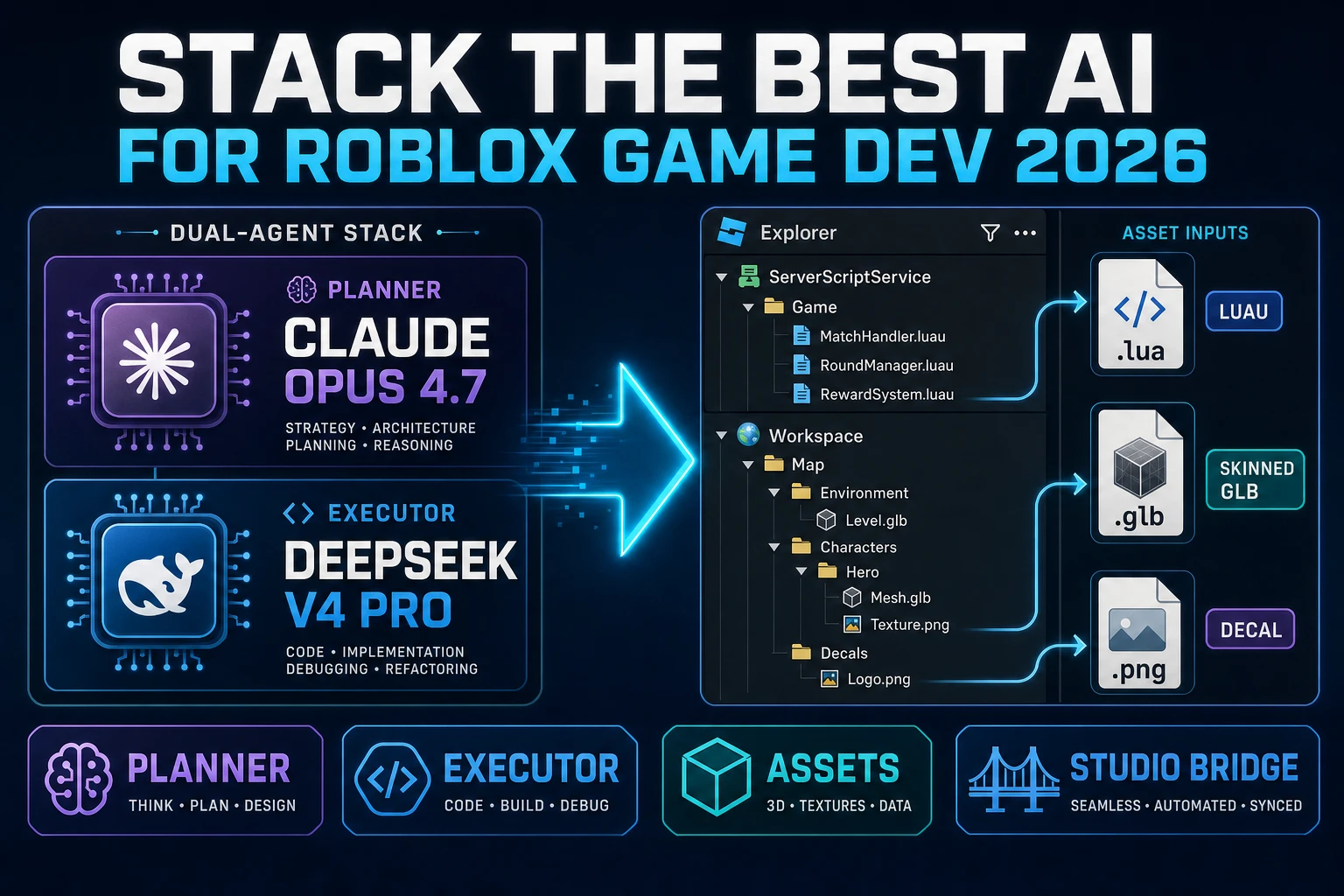
The pair that ships the most Roblox work in a weekend, without a strong opinion from the place shape: Claude Opus 4.7 planner, DeepSeek V4 Pro executor. Swap the planner to Gemini 3.1 Pro when the running conversation is the primary risk to sanity; swap the executor to Kimi K2.5 the moment the place graph plus the prior iterations blow past 100K tokens. The rest of the panel is available for one-off swaps mid-run.