Splice Best AI Tools for Game Development (Stack Path 2026)

By Arron R.10 min read
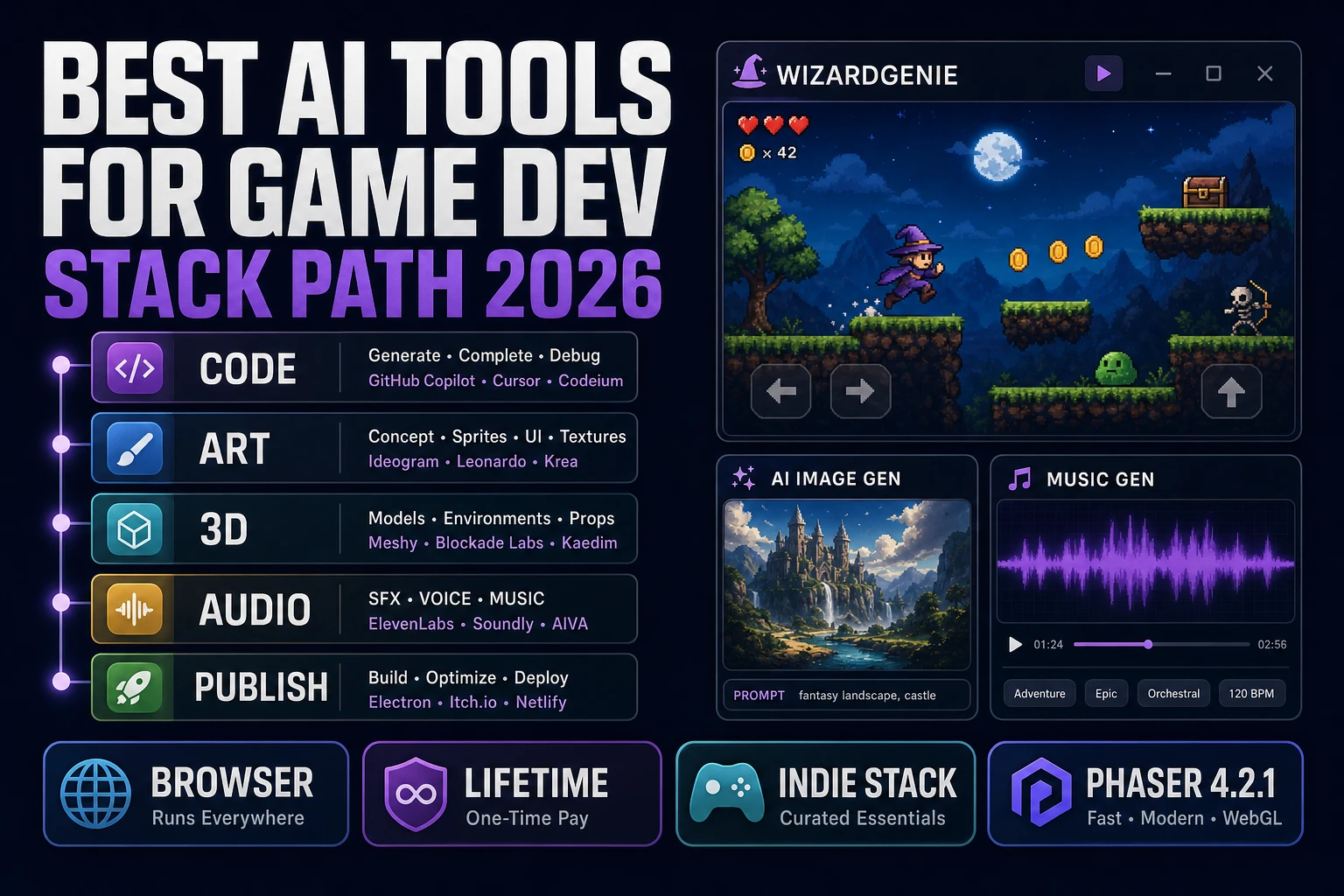
The best AI tools for game development in 2026 split across five categories: coding (WizardGenie + Sorceress Code with 8 CODING_MODELS), 2D art (Image Gen, Quic

Searchers who type best ai tools for game development in 2026 want a shortlist they can actually build on, not a directory of every marketing page on the internet. Real game development in 2026 splits across five distinct jobs - writing the game loop, drawing the art, sculpting the 3D, scoring the audio, and shipping the build - and no single AI tool does all five well. The honest answer is a stack: two coding tools that share eight frontier CODING_MODELS, four 2D art tools that share a browser-first pipeline, three 3D tools that pair image-to-3D with auto-rigging, four audio tools that split music from voice from sound effects, and three publish tools that turn a browser build into a playable URL. Every fact below is verified 2026-09-09 against Sorceress source-of-truth in src/app/_home-v2/_data/tools.ts, src/lib/models.ts, and src/app/plans/page.tsx, plus the current release of Phaser (v4.2.1 Giedi, 2026-07-09).
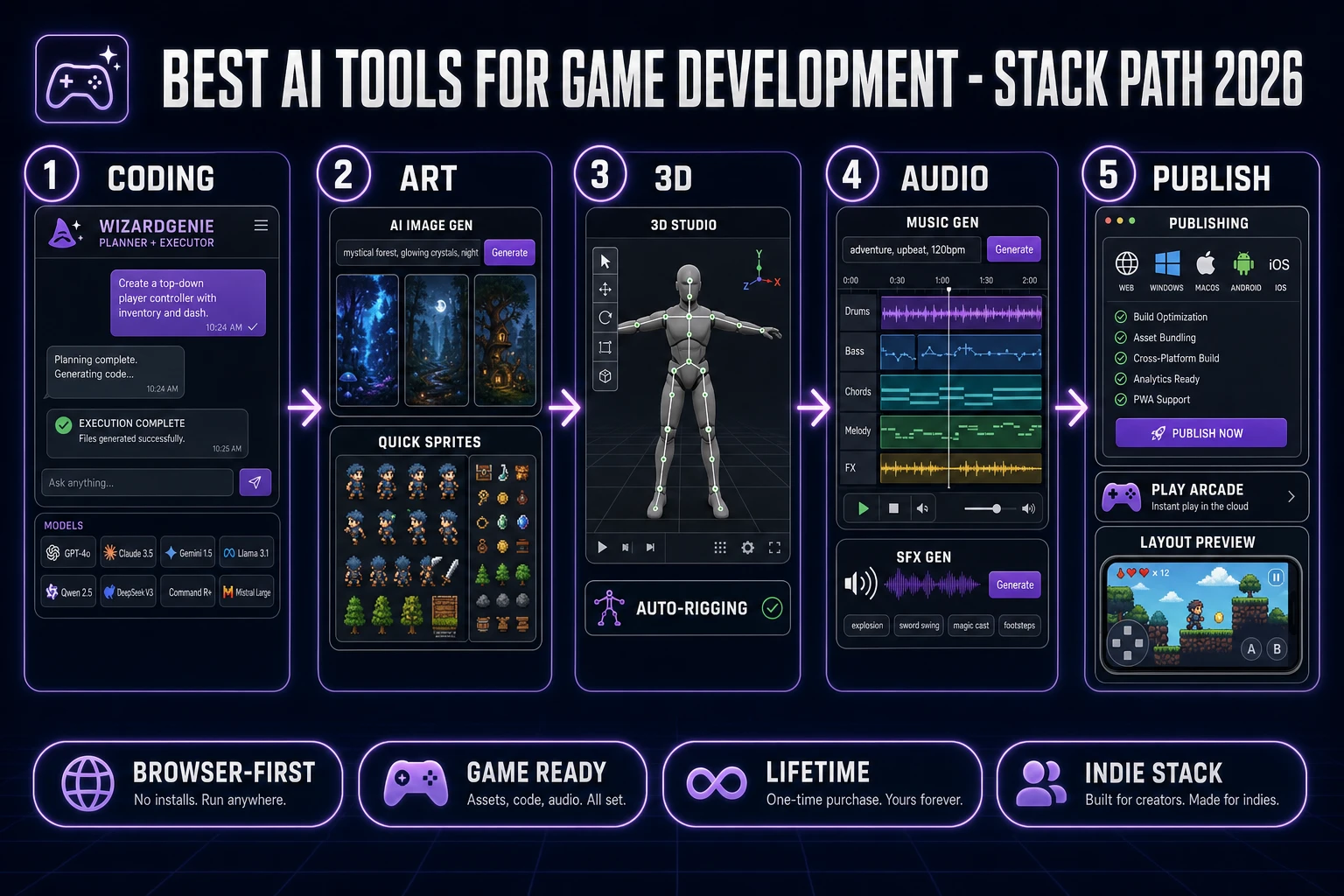
Best AI tools for game development 2026 five-panel stack diagram: WizardGenie coding, AI Image Gen and Quick Sprites art, 3D Studio and Auto-Rigging, Music Gen and SFX Gen, Publishing and Layout Preview
The 2026 best ai tools for game development stack: coding, 2D art, 3D, audio, and publish - five categories with a purpose-built Sorceress tool for each.

What best ai tools for game development actually means in 2026

Three overlapping ideas hide behind the phrase best ai tools for game development, and confusing them wastes a jam weekend. An AI coding agent writes and edits the game code - the scenes, the update loops, the collision logic, the state machines. An AI asset generator produces the raw art, 3D, and audio files that the game code loads. An AI publish tool takes the finished build and turns it into a URL that a stranger can actually play. All three are real tool categories in 2026, and a search for the best ai tool for game development that returns only one of the three is showing you a slice, not the shortlist.

The scope of video game development (per the Wikipedia definition: design, coding, art, audio, and QA) maps directly onto the five categories in this article. Where a general-purpose AI coding agent stops at code, a game-dev-native stack keeps going: it draws the sprite sheet, extracts the tileset, rigs the character, scores the level, and pushes the browser build to a shareable link. The rest of this article works through each of the five categories in the order most indie devs actually touch them, with concrete tool names and credit costs verified against the Sorceress source.

The five categories a real 2026 game-dev stack covers

Every shipping game requires code, art, 3D (or a deliberate decision to skip it), audio, and a way to publish. Not every project needs a bespoke tool in every category - a 2D pixel-art puzzle can ignore 3D entirely, a text-based game can skip pixel-art tools - but the categories themselves are non-negotiable. A stack that pretends game development is only about coding leaves the indie dev alone the moment the placeholder art needs to be replaced.

The rest of the article works one category at a time. Each section calls out the specific model or credit cost taken straight from the Sorceress source, so the shortlist is grounded, not a marketing paraphrase.
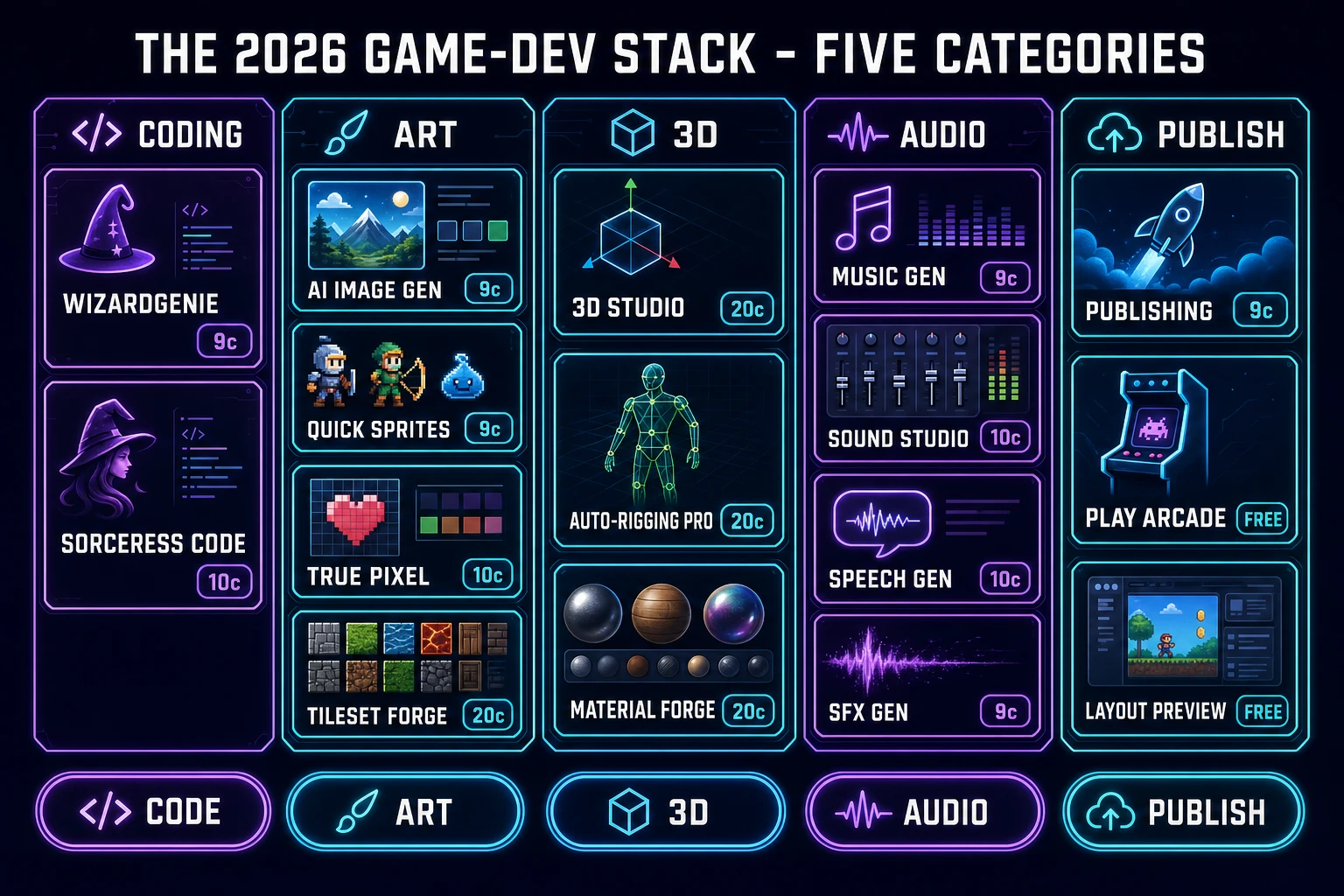
The 2026 game-dev stack five categories matrix diagram: coding column with WizardGenie and Sorceress Code, art column with AI Image Gen Quick Sprites True Pixel Tileset Forge, 3D column with 3D Studio Auto-Rigging Material Forge, audio column with Music Gen Sound Studio Speech Gen SFX Gen, publish column with Publishing Play Arcade Layout Preview
Fifteen tools across five categories - the actual footprint of the 2026 best ai game development tools stack, with credit costs on each card.

Coding tools: WizardGenie and Sorceress Code with 8 CODING_MODELS on rotation

WizardGenie is a browser-embedded AI game engine that pairs a Planner agent (the expensive reasoner) with an Executor agent (the fast typer). Describe a game in plain English and WizardGenie writes, runs, and iterates the code in real time - the preview canvas renders the running build inside the same tab as the chat. Verified 2026-09-09 in src/app/wizard-genie/page.tsx: the dual-agent Planner + Executor label is the shipping surface, and the game preview is a live Phaser or Three.js runtime, not a mockup. WizardGenie is available on both desktop (Windows installer with electron-updater auto-update, native filesystem access, offline project work) and web (no-install entry at /wizard-genie/app). The reader picks.

Sorceress Code is the file-aware companion agent. Where WizardGenie owns the scaffold-a-whole-game moment, Code owns the edit-this-scene moment. It knows Phaser (currently v4.2.1 Giedi, released 2026-07-09, verified on phaser.io) scene lifecycles, Three.js renderer setup, game loops, collision detection, and asset loading. Verified 2026-09-09 in src/app/code/page.tsx: Code accepts BYO API keys for the anthropic, deepseek, openai, and nvidia providers, storing them only in browser localStorage.

Both tools rotate the same eight models under the hood. Verified 2026-09-09 in src/app/_home-v2/_data/tools.ts lines 766-775, the CODING_MODELS lineup is: Claude Opus 4.7 (top tier), Claude Sonnet 4.6 (fast + smart), GPT-5.5 (frontier), Gemini 3.1 Pro (1M context), DeepSeek V4 Pro (budget), Kimi K2.5 (256K coding), Grok 4.2 (2M context), and MiniMax M2.7 (agent-ready). The right pairing for a Planner + Executor loop pairs an expensive reasoner (Opus 4.7 or GPT-5.5) with a cheap fast typer (DeepSeek V4 Pro or Kimi K2.5), and the honest cost story is roughly one-fifth of a single-frontier session when the executor is truly the cheap tier.
2D art tools: AI Image Gen, Quick Sprites, True Pixel, and Tileset Forge

The 2D art pipeline splits by intent. AI Image Gen is the unified panel that fronts every top image model - Nano Banana Pro, Nano Banana 2, GPT Image 2, Seedream 5 Lite (uncensored), Flux 2 Pro, Z-Image Turbo, and Grok Imagine. Reference images, aspect ratios, batch generation, and collections all live in one interface. This is where character concepts, background art, and prop illustrations start. GPT Image 2 is the specific pick for anything that needs legible text baked into the image - product diagrams, UI mockups, panelled explainer art.

Quick Sprites is the fastest path from a text description to a fully animated pixel-art sprite sheet. Grid-formatted PNG with transparent background, sized for Godot, Unity, Phaser, and RPG Maker. Verified 2026-09-09 in src/app/quick-sprites/page.tsx: the per-generation cost is 9 credits (9 cents at the standard 1-credit-per-cent rate). Walk cycles, idle animations, attack frames, death poses - one prompt gets the whole rig. For an NPC roster of shopkeepers, guards, and villagers, Quick Sprites is measured in minutes not days.

True Pixel converts any image or video into authentic pixel art with chroma key, palette quantization, edge cleanup, batch processing, and sprite-sheet export. Feed it AI Image Gen output and get a Game Boy, NES, or custom-palette portrait ready to drop into a scene. See the sprite (computer graphics) Wikipedia entry for the underlying concept - the modern pipeline is the same idea with an AI in the middle. Tileset Forge takes AI-generated dungeon or terrain art and outputs a clean, grid-perfect tileset ready for a 2D engine - alignment, extraction, preview, and export. Together, these four tools cover every stage from concept doodle to Godot-importable sprite atlas.

3D tools: 3D Studio, Auto-Rigging, and Material Forge

3D Studio is the end-to-end 3D pipeline: generate a character image, lift it to a textured mesh (Meshy 6, Meshy 5, Rodin 2.0, TRELLIS, TRELLIS 2, Tripo v3.1, or Hunyuan 3D 3.1), auto-rig the humanoid skeleton with weight-paint refinement, and animate through text-to-motion via HiMotion. Exports to FBX, GLB, and GLTF for any engine. Verified 2026-09-09 in src/lib/voxelgen-hunyuan.ts: the Hunyuan 3D 3.1 voxel generation costs 25 credits per model. The image-to-3D lift is what turns a single concept illustration into a rotatable, rigged asset without a modelling seat.

Auto-Rigging is a Pro-badge tool that drops any humanoid mesh into a fully rigged, skinned character with a clean Unreal-style skeleton. Verified 2026-09-09 in src/lib/rigging/external-rig/autoRigPricing.ts: the current provider charge is AUTO_RIG_CREDITS.meshy = 20 (20 credits, 20 cents) per rig. The credit price bakes in a small retry margin - a rig that returns technically successful but visually wrong still bills the provider, so the user-facing 20-credit charge covers real-world retry math. Auto-Rigging exposes a paint-style weight refinement tab for the joints the automated pipeline gets slightly wrong.

Material Forge converts any image into a full PBR material set (albedo, roughness, metallic, normal, and ambient occlusion maps) with a live 3D preview and one-click export to Unity, Unreal, or Godot. It also supports the native .wgmat format. For dungeon walls, terrain surfaces, prop textures, or stylized shaders, Material Forge collapses what used to be a three-tool Substance-plus-Photoshop workflow into a single browser panel. Together with 3D Studio and Auto-Rigging it forms a complete 3D pipeline that never touches Blender.

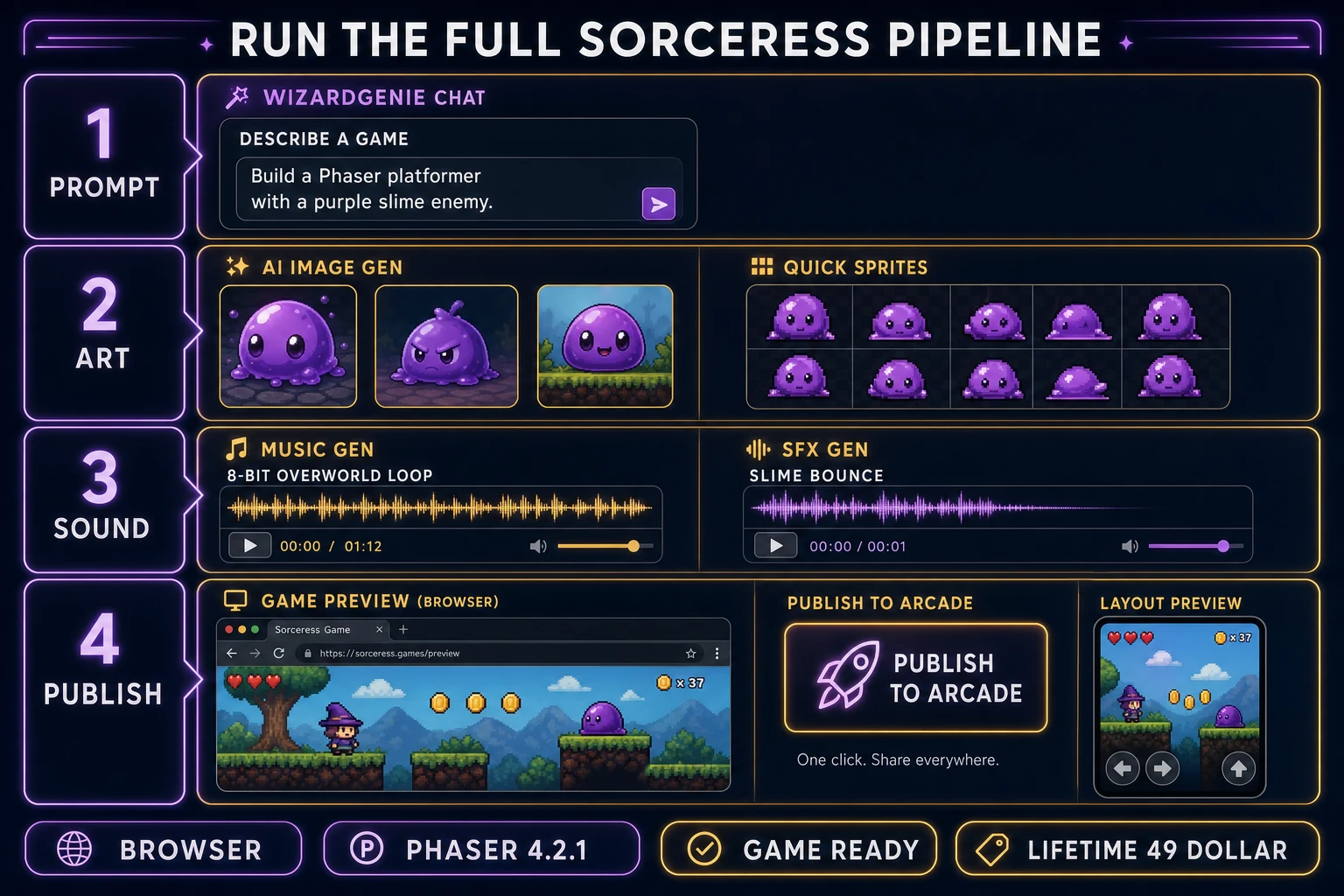
Full Sorceress pipeline diagram: WizardGenie prompt to platformer, AI Image Gen character concept plus Quick Sprites sheet, Music Gen 8-bit overworld loop plus SFX Gen slime bounce, Publishing to Sorceress Arcade with Layout Preview mobile chip
The full pipeline in one loop: prompt a game in WizardGenie, replace placeholder art with AI Image Gen and Quick Sprites, score with Music Gen and SFX Gen, then push the build through Publishing.

Audio tools: Music Gen, Sound Studio, Speech Gen, and SFX Gen

Music Gen generates full vocal or instrumental tracks from a prompt or custom lyrics, with two variations per generation. Verified 2026-09-09 in src/app/music-gen/page.tsx line 28: the per-track cost is MUSIC_CREDIT_COST = 10 (10 credits, 10 cents) with Suno V5.5 as the default model. Battle music, ambient overworld loops, cutscene themes - all one prompt each. For a full 10-track soundtrack the total is a dollar. Sound Studio is the all-in-one shell that groups Music Gen, SFX Gen, Speech Gen, and the SFX Editor into a single workflow surface - useful when the game has more than a handful of audio cues and needs a shared library.

Speech Gen handles voiceover, narration, and NPC dialogue with multiple voices, languages, and voice cloning. Verified 2026-09-09 in src/app/speech-gen/page.tsx line 31: a full voice clone costs VOICE_CLONE_CREDITS = 400 (400 credits, 4 dollars) - a one-time investment per character that unlocks unlimited generation with that voice thereafter. That is the tool for consistent NPC voices across a whole project. SFX Gen generates entire sound-effect packs from text with AI planning and auto-duration detection. Verified 2026-09-09 in src/app/sfx-gen/page.tsx line 23: the cost is SEED_AUDIO_CREDITS_PER_SECOND = 1 with BytePlus Seed Audio as the default model - a 3-second sword swing runs 3 credits (3 cents). See the MDN Games reference for how the Web Audio API consumes these files on the render side.

Publish tools: Publishing, Play Arcade, and Layout Preview

Shipping is not an afterthought - it is the reason all the earlier work matters. Publishing pushes browser games to either the Sorceress Arcade or auto-deploys to GitHub Pages. Two clicks between a Sorceress Code prototype and a URL a stranger can play. This is a Free-badge tool verified 2026-09-09 in src/app/_home-v2/_data/tools.ts - no credit cost. WizardGenie today does not auto-publish games to the arcade on its own (that flow lived in an older Sorceress product and does not exist in WG in 2026), so the honest ship path is either GitHub Pages via a git push or a manual export from the WizardGenie project surface.

Play Arcade is the curated arcade of community-built browser games at play.sorceress.games - a distribution surface that also functions as the largest live library of what indie devs are actually shipping with the stack. Reading a couple of arcade games is the fastest way to internalize what tone and scope a jam project can realistically hit. Layout Preview tests a game across phones, tablets, desktops, and orientations before publish, catching the aspect-ratio bugs that every browser game gets wrong at least once. Publishing, Play Arcade, and Layout Preview are all Free-badge tools - no credits, no per-publish charge.

The honest verdict on the 2026 stack

The best ai tools for game development in 2026 are not one product - they are a coordinated set of fifteen tools across five categories, engineered so the output of each feeds the input of the next. Coding tools (WizardGenie and Sorceress Code) share the same eight CODING_MODELS. 2D art tools (AI Image Gen, Quick Sprites, True Pixel, Tileset Forge) share the same browser-first sprite-sheet format. 3D tools (3D Studio, Auto-Rigging, Material Forge) share the same GLB/FBX export target. Audio tools (Music Gen, Sound Studio, Speech Gen, SFX Gen) share the same track library. Publish tools (Publishing, Play Arcade, Layout Preview) share the same browser build target. The stack is greater than the sum because the seams do not exist.

Pricing is unusually simple for a tool of this scope. Verified 2026-09-09 in src/app/plans/page.tsx line 51: the Sorceress lifetime tier is LIFETIME_PRICE = 49 - a single 49-dollar payment unlocks every tool listed in this article. Credit-metered generations run on top at a flat rate of 1 credit per cent (verified in src/lib/models.ts CREDITS_PER_DOLLAR = 100), which puts a full weekend-jam session in a realistic 5-20 dollar range. The Free-badge tools (Canvas, Publishing, Play Arcade, Layout Preview, Marketplace) sit under that structure at zero credit cost, so the publish surface itself never charges again. For a comprehensive tour of every tool in one place, the Tools Guide and the Sorceress home page are the canonical entry points - start there, then bookmark the specific tool for the specific category the current project needs first.

Frequently Asked Questions

What are the best AI tools for game development in 2026?

For indie game development in 2026 the honest shortlist splits across five categories. Coding: WizardGenie (dual-agent Planner + Executor game engine) and Sorceress Code (file-aware coding agent) with 8 CODING_MODELS on rotation - Claude Opus 4.7, Claude Sonnet 4.6, GPT-5.5, Gemini 3.1 Pro, DeepSeek V4 Pro, Kimi K2.5, Grok 4.2, and MiniMax M2.7. 2D art: AI Image Gen (Nano Banana Pro, GPT Image 2, Seedream 5 Lite, Flux 2 Pro), Quick Sprites (pixel-art sprite sheets), True Pixel (image-to-pixel-art), Tileset Forge (grid-aligned tilesets). 3D: 3D Studio (image-to-3D via Meshy 6, Rodin 2.0, TRELLIS, Tripo v3.1, Hunyuan 3D 3.1), Auto-Rigging (humanoid skeletons at 20 credits per rig), Material Forge (image-to-PBR). Audio: Music Gen (10 credits per generation, Suno V5.5 default), Sound Studio, Speech Gen (400 credits per voice clone), SFX Gen (BytePlus Seed Audio at 1 credit per second). Publish: Publishing (Arcade / GitHub Pages), Play Arcade, Layout Preview.

Is there one best AI tool for game development or do I need a stack?

A single best AI tool for game development does not exist because game development is not one job. Coding, art, 3D, audio, and publish each need a different model architecture and a different interaction surface. What does exist is a coordinated stack: Sorceress is engineered so every tool feeds the next - WizardGenie writes the game loop, Sorceress Code file-edits it, AI Image Gen drafts the character concept, Quick Sprites or 3D Studio turns that concept into an animated asset, Music Gen scores the level, and Publishing pushes the browser build to a playable URL. The five categories are the stack; the individual tool inside each category is the pick.

What do the best AI game development tools cost in 2026?

The Sorceress lifetime tier is 49 dollars one-time (verified 2026-09-09 in src/app/plans/page.tsx LIFETIME_PRICE constant) and unlocks the full catalog - every tool listed in this article. Credit costs are pay-as-you-go on top of the lifetime unlock: 1 credit equals 1 cent (verified in src/lib/models.ts CREDITS_PER_DOLLAR = 100). Concrete costs verified 2026-09-09: Quick Sprites at 9 credits per generation, Music Gen at 10 credits per track, SFX Gen at 1 credit per second of audio, Voice Clone at 400 credits, Voxel Hunyuan generation at 25 credits, Auto-Rig at 20 credits per rig. Free-badge tools (verified in src/app/_home-v2/_data/tools.ts) include Canvas, Publishing, Play Arcade, Layout Preview, and Marketplace - no credit cost at all.

Can these AI tools ship a real game or only prototypes?

They ship real browser games. WizardGenie targets Phaser (currently v4.2.1 Giedi, released 2026-07-09, verified on phaser.io) and Three.js, both of which are shipping web-game frameworks used by commercial studios. Sorceress Code file-edits an actual repository and can deploy to GitHub Pages or the Sorceress Arcade via the Publishing tool. Assets produced by AI Image Gen, Quick Sprites, True Pixel, Tileset Forge, 3D Studio, Music Gen, and SFX Gen export as engine-agnostic files (PNG, WebP, MP3, WAV, GLB, GLTF, FBX) that drop into any engine including Godot, Unity, Unreal, and RPG Maker. The stack is not simulation - it is a browser-first pipeline that skips the download-and-install step.

Which AI tool for game development should a solo indie start with?

Start at WizardGenie. The reason: it is the single tool that produces a running game on the first prompt and gives you a scaffold to iterate against. From there the natural expansion order is Sorceress Code (once the file structure grows past what WizardGenie surfaces), then AI Image Gen (to replace placeholder art), then Quick Sprites (once you know your art style), then Music Gen and SFX Gen (once the game loop is stable enough to score), then 3D Studio (if you outgrow 2D), and finally Publishing when the build is stable. That order matches the natural cost curve - the early tools carry the most creative decisions per credit and the later tools finish what the early tools started.

Sources

  1. Video game development - Wikipedia
  2. Phaser v4.2.1 Release
  3. Games - MDN Web Docs
  4. PBR (Physically Based Rendering) - Wikipedia
  5. Sprite (computer graphics) - Wikipedia
Written by Arron R.·2,244 words·10 min read

Related posts