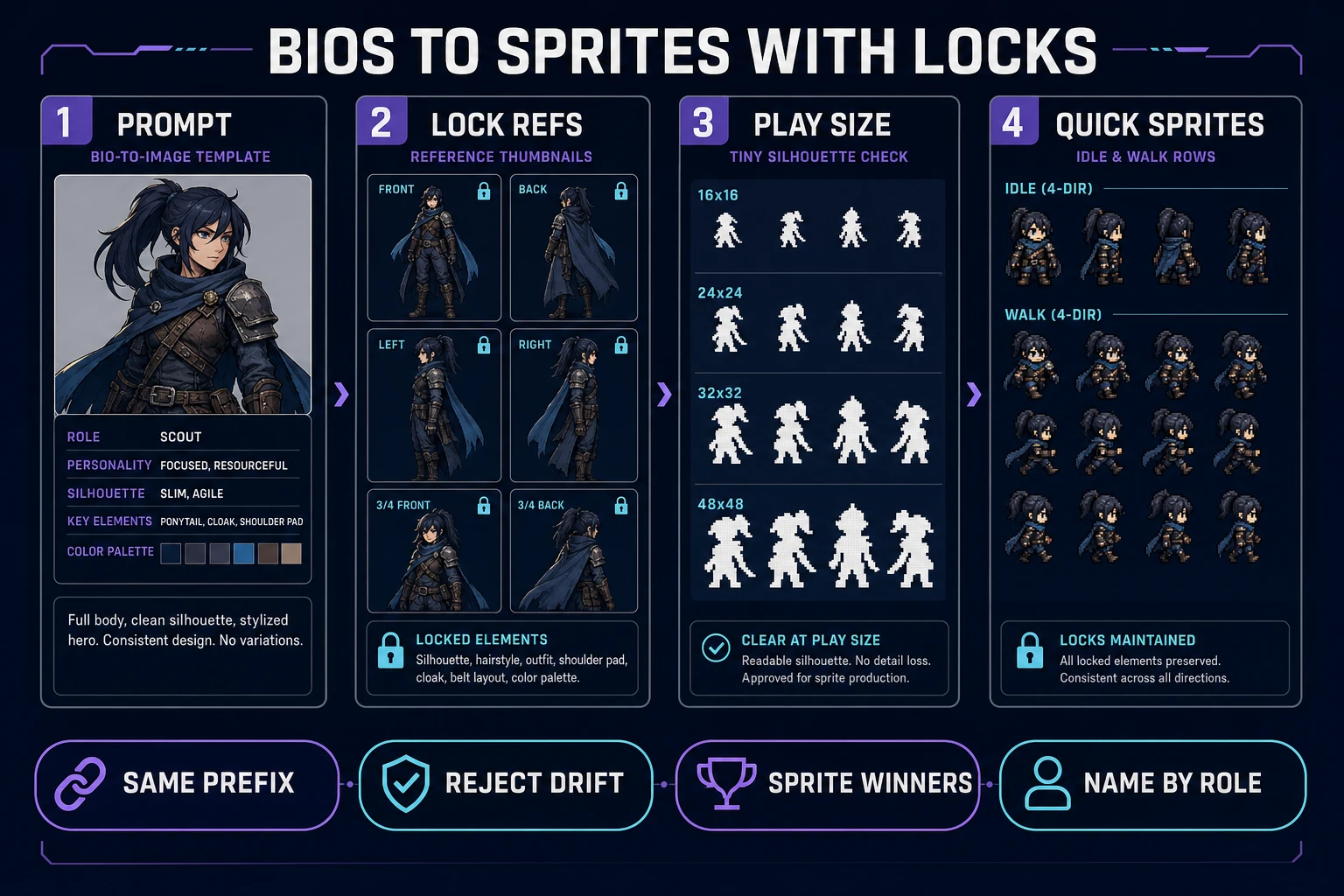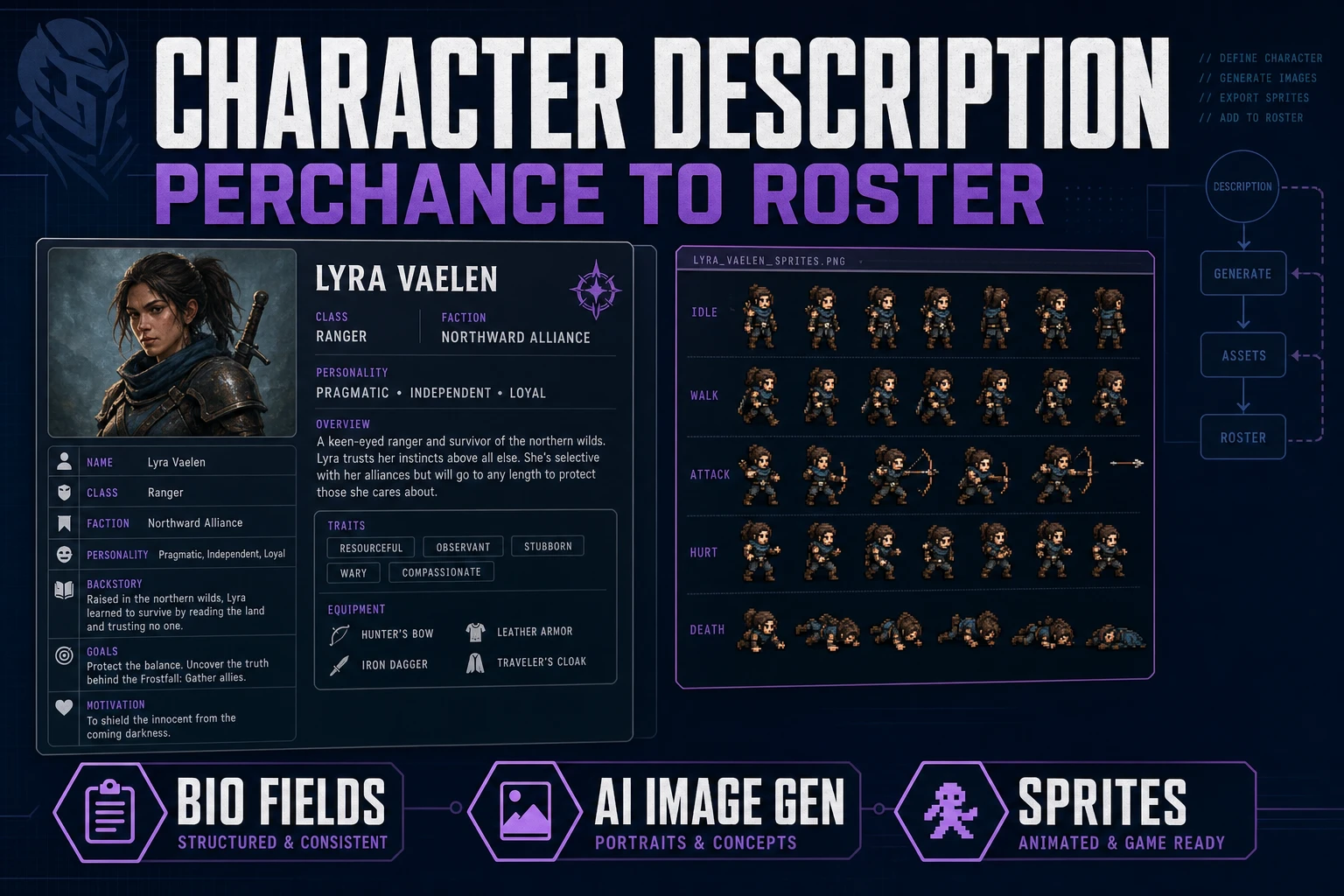
People searching a perchance ai character description generator usually want a cast they can ship, not a page of disposable lore. Randomizers are fine for sparks. Games need structured fields: role, silhouette, palette, prop, voice beat, and one hook an engine can reuse. This guide seeds those fields into roster cards, turns them into image prompts, then sprites only the winners.
Treat description output like a production character sheet, not a novella. If a bio cannot become a prompt prefix and a dialogue stub in under a minute, rewrite the fields before you spend credits on art.
What a perchance ai character description generator search wants
The phrase perchance ai character description generator clusters with people who already tried a free randomizer and bounced when the paragraphs would not map to sprites. They want browser-speed bios that stay on model across a hero, two NPCs, and one enemy family. Pretty adjectives without camera height or palette budget fail that test.
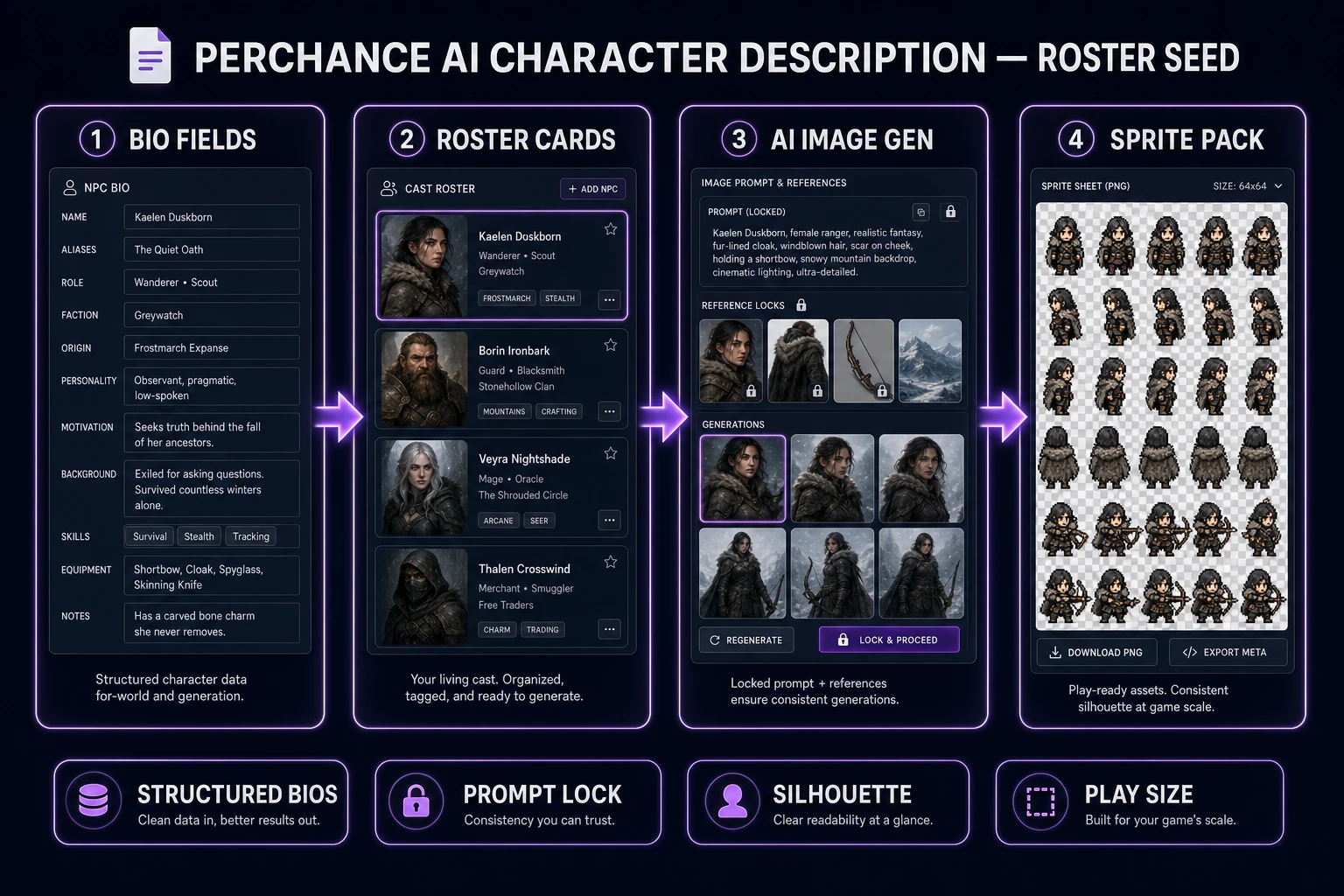
Perchance-style tools (named here in plain text only — no outbound competitor link) are useful for naming sparks and quirk rolls. They are not a production pipeline. On Sorceress, the honest handoff is: freeze six fields per role, paste them into AI Image Gen, then convert silhouette winners in Quick Sprites. A sibling stay-on-model portrait angle lives in Perchance AI Character Generator (Stay On-Model for Games); this article is the description-first edition.
If your jam folder is already full of orphaned paragraphs, stop generating. Extract the six fields below from the best three bios and delete the rest. Continuity recovers faster than another random roll.
Search intent here is informational but ship-shaped: the reader wants a description format that survives the jump from chat window to art panel to playable sprite. Anything that only lives as a story paragraph fails that chain. Keep the primary keyword honest in your notes — you are building a perchance ai character description generator workflow that ends in files, not another browser tab of unused text.
Write fields engines can reuse
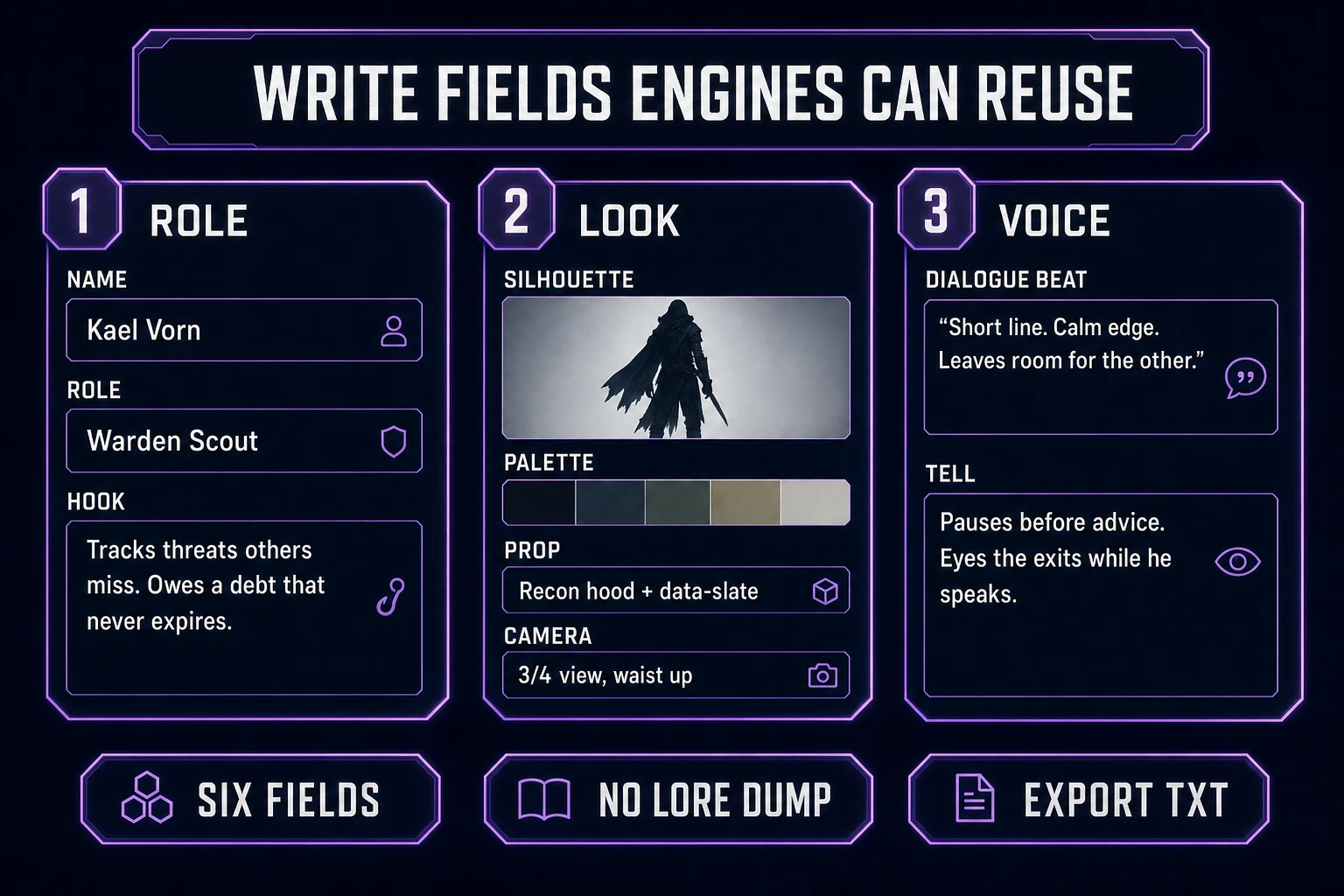
Open a blank text file named roster_cards_v1.txt. For every role, fill exactly these lines:
- Role — hero scout, village herbalist, hornless grunt.
- Silhouette family — tall lanky, squat soft, wide-shouldered block.
- Palette budget — three to five named colors the whole cast shares.
- Signature prop — scarf, satchel, cracked pauldron, or none.
- Voice beat — one sentence the NPC can say on first meet.
- Plot hook — one verb the player can act on (trade, warn, chase).
Those six lines mirror what a tabletop character sheet keeps on the front page: stable identity plus the data you glance at mid-session. Skip eye-color essays. Skip childhood timelines. Engines and artists both fail when the sheet is a wall of prose.
Keep sentences short enough to paste as a reusable prompt prefix. A jam cast that shares language ships faster than a gallery of unrelated “best takes.” For name flavor without derailing the sheet, pair this pass with Forge a Fantasy Name Generator and drop only the chosen name onto the Role line.
Write one card each for hero, support NPC, and enemy family before you open any image model. Three complete cards beat ten half-finished bios. If a field is blank, fill it with a deliberate “none” rather than inventing detail mid-prompt — empty prop language is a lock; improvised props mid-session are drift.
Turn bios into image prompts
Copy the shared silhouette, palette, prop language, and camera into a prefix. Change only the role clause between generates:
- “…front three-quarter, soft left key, indigo–amber palette, scarf motif — hero scout, confident stance”
- “…same lighting and palette — village herbalist, soft shoulders, satchel”
- “…same lighting and palette — hornless enemy grunt, wider shoulders, cracked armor”
Open AI Image Gen and draft on cheap models first. Credit costs below were verified July 25, 2026 against src/lib/models.ts (1 credit ≈ $0.01 via CREDITS_PER_DOLLAR = 100):
- Z-Image — 3 credits. Best first pass for silhouette and costume blocking.
- GPT Image 2 — 5 credits base. Stronger edges when a draft is almost right.
- Seedream 4.5 / Seedream 5 Lite / Nano Banana / Flux 2 Pro — 6 credits base. Flux adds +3 credits per reference image when you lock a winner.
- Nano Banana Pro — 18 credits at default 1K/2K. Hero finals only, not exploration.
A thrifty description-to-art session: eight Z-Image drafts (24 credits) across three roles, two GPT Image 2 refinements (10), one Flux 2 Pro lock with a single reference (6 base + 3 ref = 9). That is roughly 43 credits — under half of the 100 OAuth starter grant (SIGNUP_GRANT in src/app/api/admin/credits/route.ts, verified July 25, 2026) — with runway left for sprites.
For reference-locked continuity after the first winners land, see Create With a Consistent Character AI Image Generator. For a paid roster sprint that starts from cast language instead of free randomizers, use Spawn a Character Generator AI.