Scratch How to Make a Platformer in Scratch (AI Assets)

By Arron R.7 min read
How to make a platformer in Scratch: lock a hero look, ship AI sprite packs via Auto-Sprite or Quick Sprites (9 cr), import costumes, then iterate the jump loop

Searchers who type how to make a platformer in Scratch usually already have the stage open. What they lack is a coherent hero look, a walk and jump costume set that does not wobble, and a loop they can feel before they rebuild every block. This guide answers that query with an AI asset path on Sorceress: lock the sprite pack first, generate frames with Quick Sprites or Auto-Sprite v2, import costumes the Scratch way, then use WizardGenie as the iterate sandbox when the jump still feels wrong.
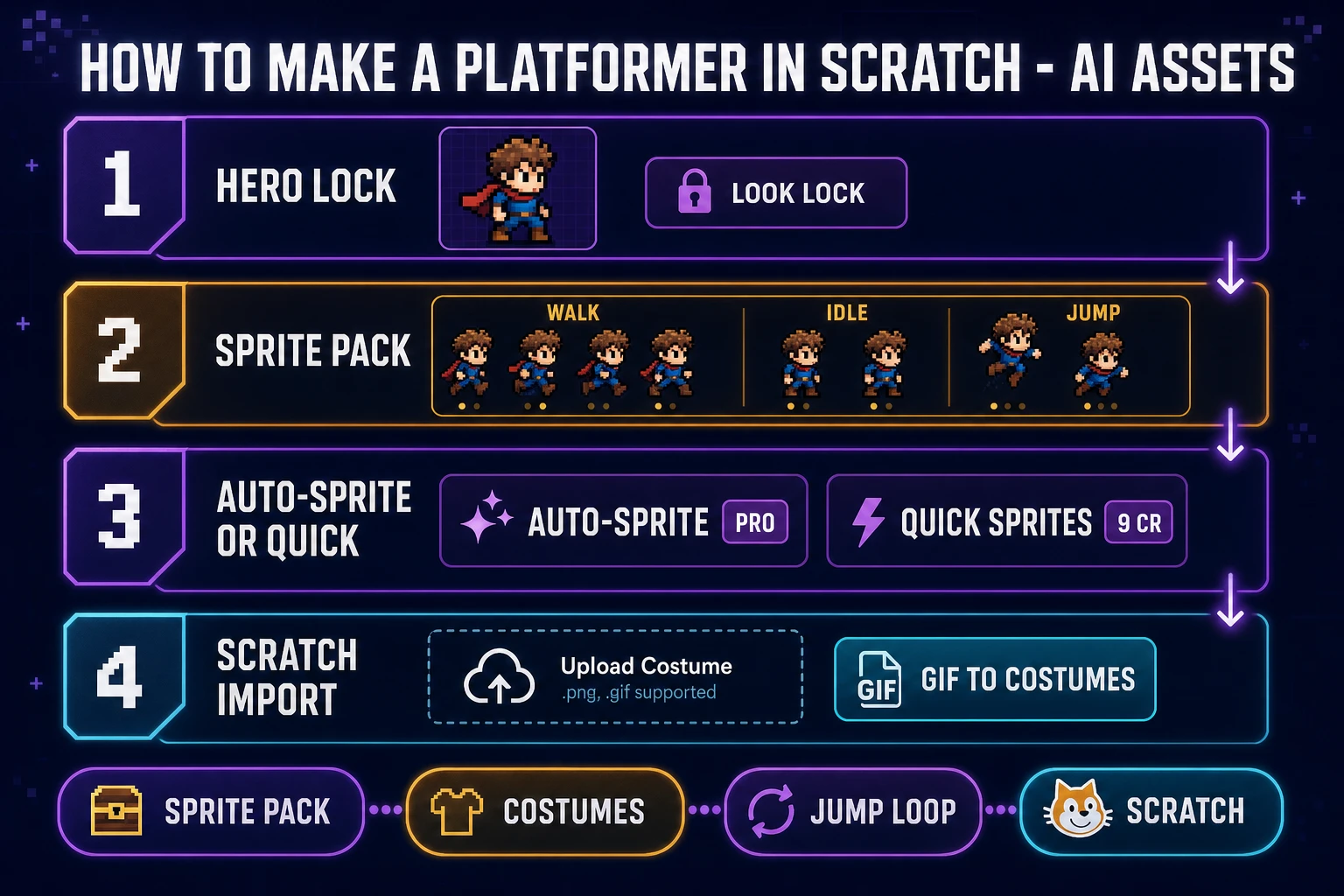
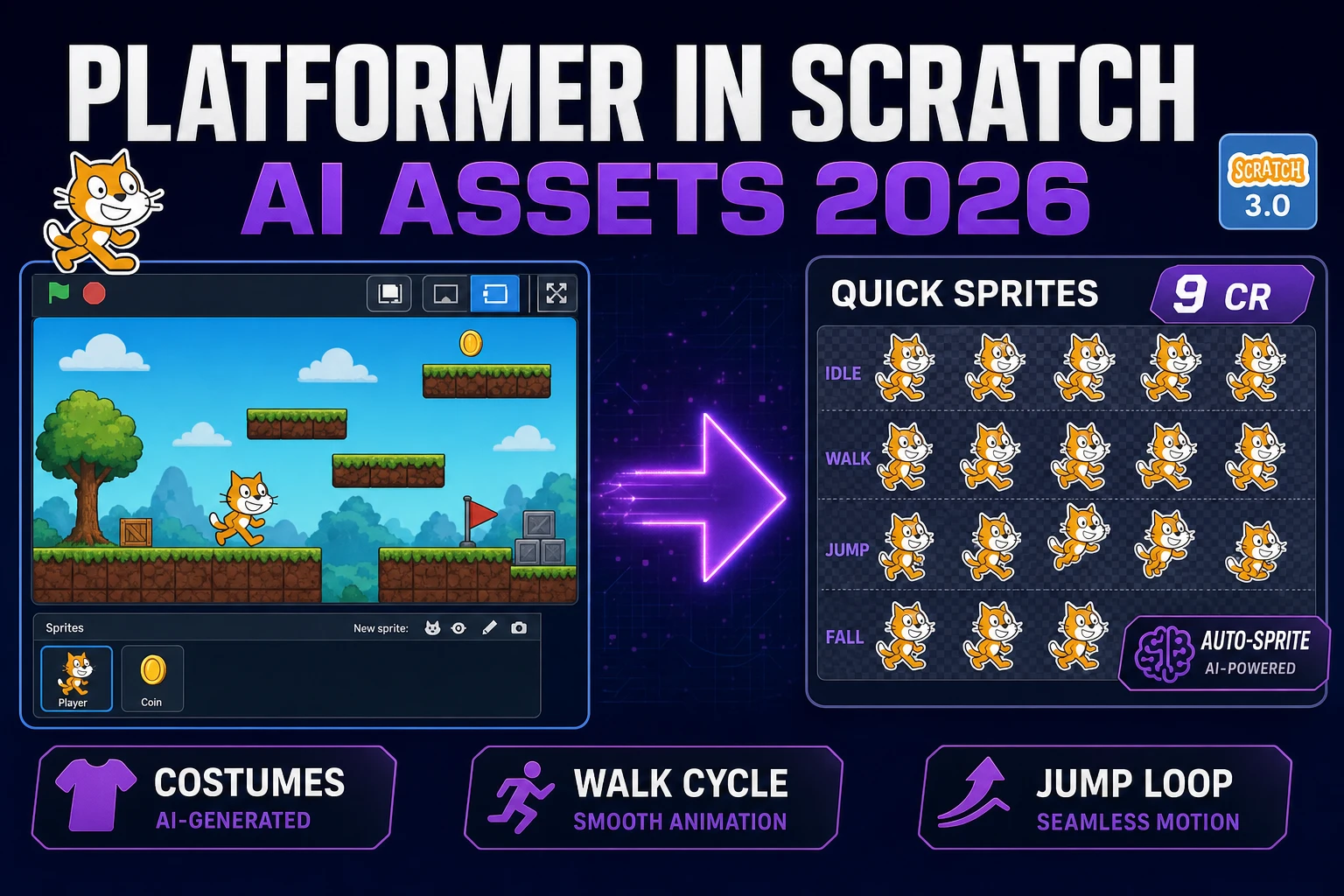
How to make a platformer in Scratch pipeline: hero lock, sprite pack, Auto-Sprite or Quick Sprites, costume import
How to make a platformer in Scratch as one loop: lock the look, ship costumes, then tune the jump.

What how to make a platformer in Scratch searchers want

DataForSEO lists how to make a platformer in scratch at 1,900 searches a month with KD 0 (confirmed in tools/research-supplement.md, verified 2026-09-28 pull). Neighbor phrases such as how to make a platformer on scratch and how to make a scratch platformer sit at the same volume band — this page stays on the “in Scratch” long-tail and the AI costume path, not a second generic controls tutorial.

Wikipedia’s platform game page (verified 2026-09-28) defines the genre by jumping between suspended platforms and over obstacles. The Scratch Wiki’s Platformer article (verified 2026-09-28) maps that idea onto Scratch: color-touch hazards, arrow or WASD control, wall-jump extras, plus scrolling, static, pen, and 360° layouts. Many Scratchers stall on “realistic” math — the Wiki notes trigonometry and complex sensing as common pain points — but the first visual failure is usually worse: a hero that changes size every costume, a jump that has no air pose, and platforms that do not read as ground.

For sibling angles already on the blog, see how to make a platformer game for a browser run-loop framing, and ai sprite generator for roster sheets outside Scratch. This page is specifically how to make a platformer in Scratch when the blocker is art, not another gravity script clone.

Lock a sprite pack before you code the jump

Before you touch sensing blocks, decide the costume jobs your Scratch platformer must ship. A minimum AI pack for how to make a platformer in Scratch looks like this:

  • Idle — one readable standing pose that matches the walk silhouette.
  • Walk — six to eight frames, same foot spacing, transparent background.
  • Jump / air — one or two frames with tucked or extended limbs you can hold while Y velocity is nonzero.
  • Land / recover — optional, but it sells weight when you hit a platform.
  • Hazard cue — spikes, lava, or enemy frames that stay on the Wiki’s color conventions (red for danger is still the classroom default).

Generate stills in AI Image Gen when you want a concept lock, then crop and clean in Canvas (home card badge Free, verified 2026-09-28 in src/app/_home-v2/_data/tools.ts). Keep the camera orthographic-friendly: one subject, plain backdrop, no baked ground shadow that becomes a second silhouette in Scratch.

Name files before you leave Sorceress — hero-idle.png, hero-walk-01.png, hero-jump.png. Scratch costume order is the animation order. A messy download folder becomes a messy Looks pane, and the “next costume” block will cycle through junk frames mid-run.
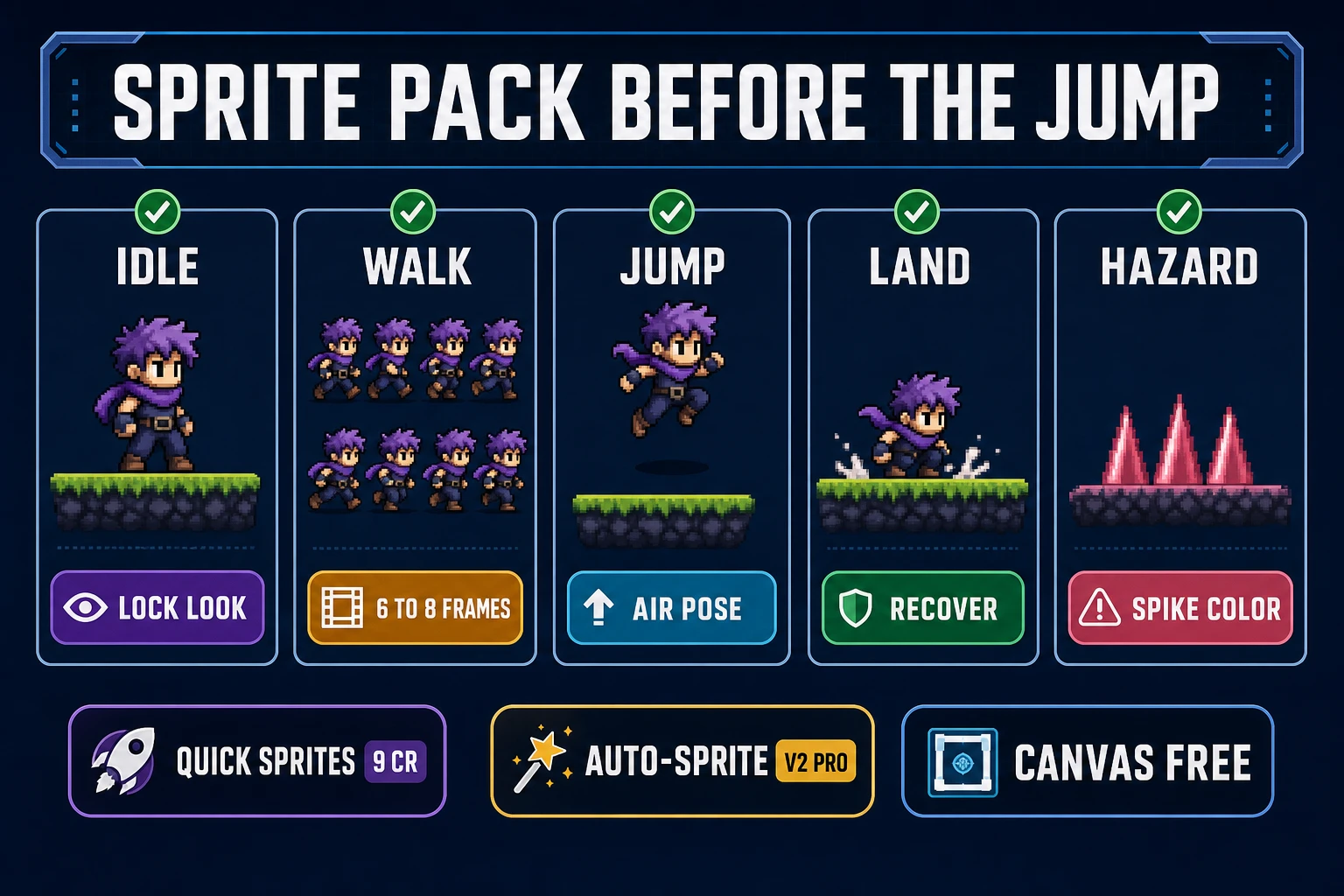
Sprite pack checklist for how to make a platformer in Scratch: idle, walk, jump, land, hazard
Lock idle, walk, jump, land, and hazard frames before you burn credits on a second hero redesign.

Auto-Sprite v2 and Quick Sprites for the costume set

Auto-Sprite v2 is the featured three-step path when you want motion that started as video. The home card (verified 2026-09-28 in src/app/_home-v2/_data/tools.ts) describes the pipeline in order: AI image generation creates the character, AI video brings it to life, then Auto-Sprite converts the clip into a clean, game-ready sprite sheet. The Sprites & 2D tile badge is Pro — plan for a Pro-capable account before you promise a classroom that every student can open the same lane.

When you need pixel-art sheets faster and on the credit ledger, open Quick Sprites. The home card badge is AI Credits. Source sets CREDITS_PER_GEN = 9 in src/app/quick-sprites/page.tsx (verified 2026-09-28), so one generation is nine credits — nine US cents at CREDITS_PER_DOLLAR = 100 in src/lib/models.ts. Prompt for walk, idle, and jump as separate jobs if one sheet tries to do too many actions and melts the silhouette.

Prompt habits that survive Scratch import: say the art style once (“chunky 16-bit side view”), demand a transparent background, forbid text in the image, and keep the character centered. If the sheet comes back with a soft gray matte, run a cleanup pass before upload — Scratch’s bitmap editor will not magically fix a dirty edge when you stamp costumes at 50% size.

For sheet-level engine habits outside Scratch, the atlas write-up at how to make a sprite sheet covers frame grids; this Scratch path cares more about individual costume uploads than a single Phaser atlas.
WizardGenie as the iterate sandbox

WizardGenie is Sorceress’s AI-native game engine: describe the game you want, and it writes, runs, and iterates in real time, switching across leading coding models with your own API key (verified 2026-09-28 in src/app/_home-v2/_data/tools.ts). It ships on web and desktop — pick the surface that matches the machine in front of you.

Why mention it in a how to make a platformer in Scratch article? Because Scratch blocks are slow to refactor when the feel is wrong. Prototype coyote time, variable jump height, camera follow, and enemy patrols in WizardGenie with the same hero art direction, watch the loop play, then translate the winning numbers into Scratch variables. You are not required to publish from WizardGenie — keep Scratch as the classroom share target and treat WG as the feel lab.

MDN’s game development hub (verified 2026-09-28) still frames the modern browser as a viable game platform with a clear main-loop anatomy. WizardGenie sits in that same “run it while you edit it” mindset; Scratch sits in the block-based classroom publish mindset. Use both without forcing one tool to pretend it is the other.

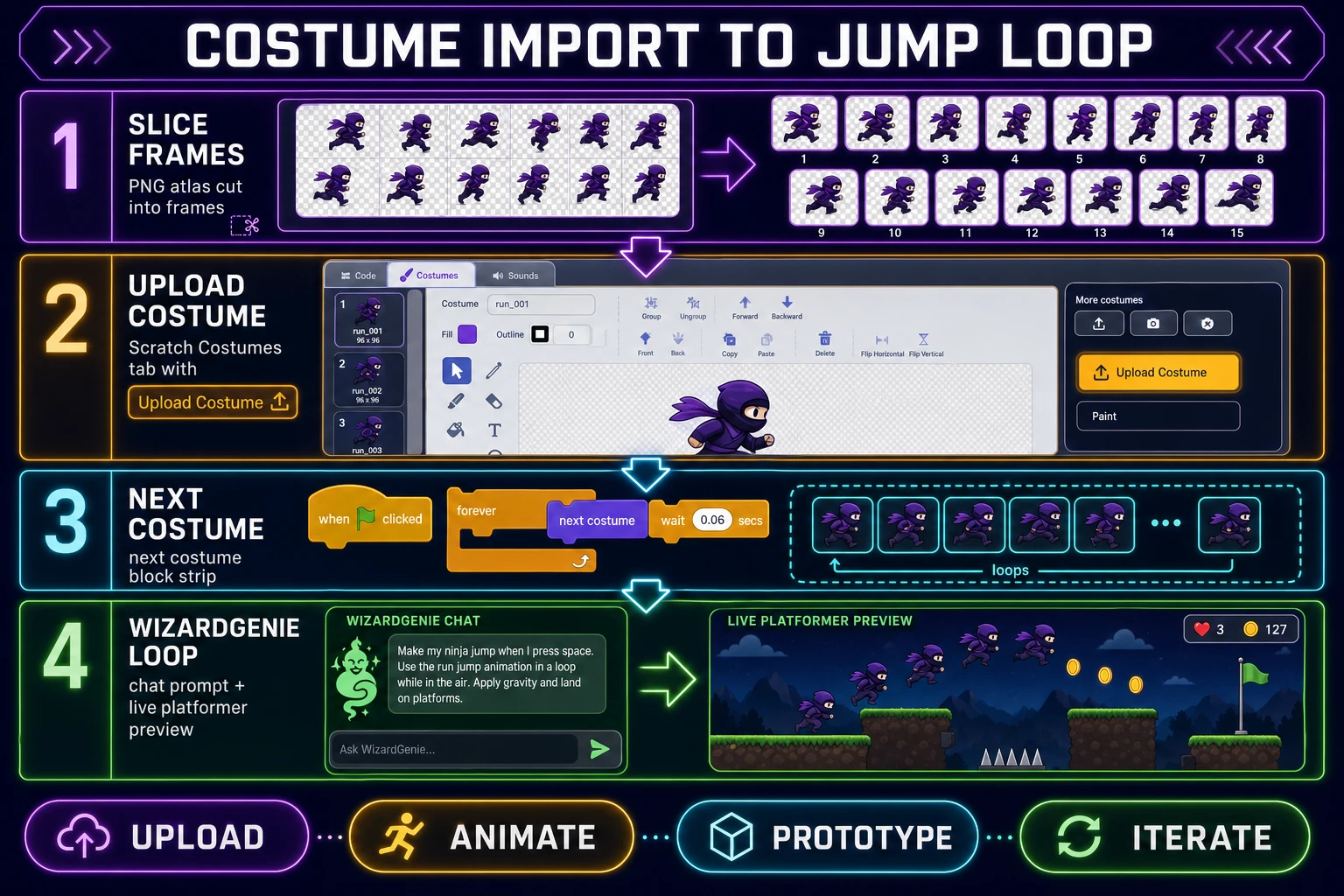
Costume import and WizardGenie iterate loop for how to make a platformer in Scratch
Slice frames, Upload Costume, wire next costume, then stress-test jump feel in WizardGenie before you rebuild every Scratch block.

Import habit: costumes into Scratch

Scratch costumes are the animation unit. The Scratch Wiki Costume page (verified 2026-09-28) lists three creation paths: draw in the Paint Editor, Choose a Costume from the library, or Upload Costume from disk. Uploading an animated GIF splits the file into many costumes so next costume can play the run. That GIF path is the cleanest bridge from an Auto-Sprite or Quick Sprites export when you can save a short looping GIF of the walk.

For PNG atlases, slice first. Export individual frames from the sheet (or regenerate single-action sheets in Quick Sprites), upload each frame as its own costume, and rename them in order. Then wire Looks blocks:

when green flag clicked
forever
  if <key (right arrow) pressed?> then
    change x by (4)
    next costume
  end
end

Hold a dedicated jump costume while the vertical motion flag is set, then switch back to walk or idle on landing. Size every costume to the same center point — mismatched pivots make the hero “teleport” one pixel left every frame, which players read as broken collision even when the sensing is fine.

Platforms and hazards stay on color sensing if that is your classroom standard: green or brown ground, red death zones, as the Platformer Wiki examples describe. Keep AI tiles visually flat enough that color-touch still works; busy noise textures create false positives.

Credit math for an AI-asset Scratch session

Quote wallet numbers from source. CREDITS_PER_DOLLAR = 100 in src/lib/models.ts. SIGNUP_GRANT = 100 in src/app/api/admin/credits/route.ts. Both checked 2026-09-28. One credit is one US cent on the top-up ledger.

Session plan Tool line Credits USD at 100 cr/$
1 Quick Sprites hero sheetQuick Sprites9$0.09
Hero + 2 enemy sheetsQuick Sprites × 327$0.27
Concept stills cleanupCanvas0 (Free badge)$0.00
Signup-only art stress test11 × Quick Sprites99 of 100 grant$0.99 of grant

Auto-Sprite v2 sits behind the Pro badge — do not tell readers it is a free credit burn. Budget AI image and AI video generations as separate line items when you use that pipeline, then treat the sprite-ify step as the Pro workflow that turns the clip into a sheet. Canvas remains the free cleanup bench between generations.

A practical checklist before you open Scratch: lock one hero silhouette, generate walk and jump as separate jobs if needed, export GIF or sliced PNGs, Upload Costume in order, then only then write gravity. Art-first is how to make a platformer in Scratch without redrawing the hero after every failed jump tweak.

The verdict

How to make a platformer in Scratch in 2026 is still jump, platforms, and costumes — the Wiki and Wikipedia definitions have not changed. What changed is the cost of a coherent sprite pack. Use Quick Sprites at 9 credits when you need pixel sheets on the ledger, Auto-Sprite v2 when you want the Pro video-to-sheet path, Canvas for free cleanup, and WizardGenie when the feel needs a fast prototype before you rebuild the Scratch stack. Import with Upload Costume (GIF split or sliced PNGs), keep pivots aligned, and ship the classroom project with art that already looks like a game.

Start with one hero pack today: nine credits, one walk sheet, one jump costume, then a five-minute WizardGenie feel test. That is the shortest honest path from the search query to a Scratch stage that moves.

Frequently Asked Questions

What does how to make a platformer in Scratch actually mean?

How to make a platformer in Scratch is the search phrasing for a jump-and-run game built in Scratch: a controllable sprite, solid platforms, gravity or jump timing, and costume animation. The Scratch Wiki’s Platformer page (verified 2026-09-28) covers scrolling, static, pen, and 360° variants plus color-touch hazards. This guide answers that query with an AI sprite-pack path on Sorceress, then costume import back into Scratch.

Should I draw costumes or use AI for a Scratch platformer?

Draw when you want vector polish in Scratch’s Paint Editor. Use AI when the bottleneck is a full walk/idle/jump set. On Sorceress, Quick Sprites costs CREDITS_PER_GEN = 9 credits per generation (verified 2026-09-28 in src/app/quick-sprites/page.tsx). Auto-Sprite v2 is the Pro three-step path: AI image → AI video → sprite sheet (verified 2026-09-28 in src/app/_home-v2/_data/tools.ts). Import frames with Upload Costume; animated GIFs split into costumes per Scratch Wiki.

How do I import an AI sprite sheet into Scratch costumes?

Scratch costumes are alternate appearances of a sprite. The Scratch Wiki Costume page (verified 2026-09-28) lists three creation paths: Paint, Choose a Costume from the library, and Upload Costume from disk. Uploading an animated GIF splits it into many costumes for next costume animation. For a PNG atlas, slice frames first, then upload each frame as its own costume and name them walk-1, jump-1, and so on.

Where does WizardGenie fit if I am shipping in Scratch?

WizardGenie is Sorceress’s AI-native game engine: describe a game and it writes, runs, and iterates in real time on web or desktop (verified 2026-09-28 in src/app/_home-v2/_data/tools.ts). Use it to prototype jump feel, camera scroll, and enemy patterns with the same art direction before you rebuild the logic in Scratch blocks — or keep the playable WG loop as a reference build. Scratch stays the classroom publish target; WizardGenie is the iterate sandbox.

How many credits do I need for an AI-asset Scratch platformer?

CREDITS_PER_DOLLAR = 100 in src/lib/models.ts and SIGNUP_GRANT = 100 in src/app/api/admin/credits/route.ts (verified 2026-09-28). One Quick Sprites hero set is 9 credits ($0.09). Three enemy variations are 27 credits. Canvas is Free for crop and cleanup. Auto-Sprite v2 sits behind the Pro badge on the home card — budget image and video generations separately when you use that pipeline.

Sources

  1. Platformer - Scratch Wiki
  2. Costume - Scratch Wiki
  3. Platform game - Wikipedia
  4. Game development - MDN
Written by Arron R.·1,576 words·7 min read

Related posts