Searchers who type best coding ai model right now in September 2026 are asking a very specific question: which model, today, wins on a real game-dev task where the answer has to land in one shot. Models rotate weekly this year - Anthropic ships Claude Opus 4.7 alongside 4.8 and Opus 5 on the same pricing page, OpenAI has cycled through GPT-5.5 and GPT-5.6, Google Gemini 3.1 Pro sits next to 3.5-through-3.8 Flash on the free tier, xAI is on Grok 4.6 after Grok 4.20 and 4.3, and Kimi jumped from K2.5 to K2.7 Code inside the calendar year. The Sorceress CODING_MODELS rotation locks a specific eight-model bench that reflects what a browser-first game studio can actually reach through WizardGenie and Sorceress Code. Every claim below was verified 2026-09-09 against the vendor documentation pages and the Sorceress source in src/app/_home-v2/_data/tools.ts and src/app/code/page.tsx.
What "right now" changes about a coding model bench in 2026
The phrase right now is not filler in this title - it is the whole framing. A ranking that was accurate three weeks ago is misleading today. Verified 2026-09-09: the Anthropic pricing page lists Claude Opus 5, Opus 4.8, Opus 4.7, Opus 4.6, and Opus 4.5 side by side, all at the same $5 input / $25 output per million tokens, and it lists Claude Sonnet 5 at $2 / $10 alongside Sonnet 4.6 at $3 / $15. The OpenAI pricing page shows gpt-6-astra at the frontier, plus gpt-5.6-sol, gpt-5.6-terra, and gpt-5.6-luna - the GPT-5.5 shoulder that the Sorceress CODING_MODELS lineup names is a middle-of-lineup pick, not the top of the lineup. Google Gemini 3.1 Pro Preview still leads the Gemini coding lineup, but 3.5-Flash through 3.8-Flash sit under it as free-tier options. xAI has published Grok 4.6, 4.5, 4.3, and 4.20-0309-reasoning on one live pricing page. Kimi platform docs list K3, K2.7 Code, and K2.6 as the current model choices. DeepSeek V4 Pro is on the -0813 revision.
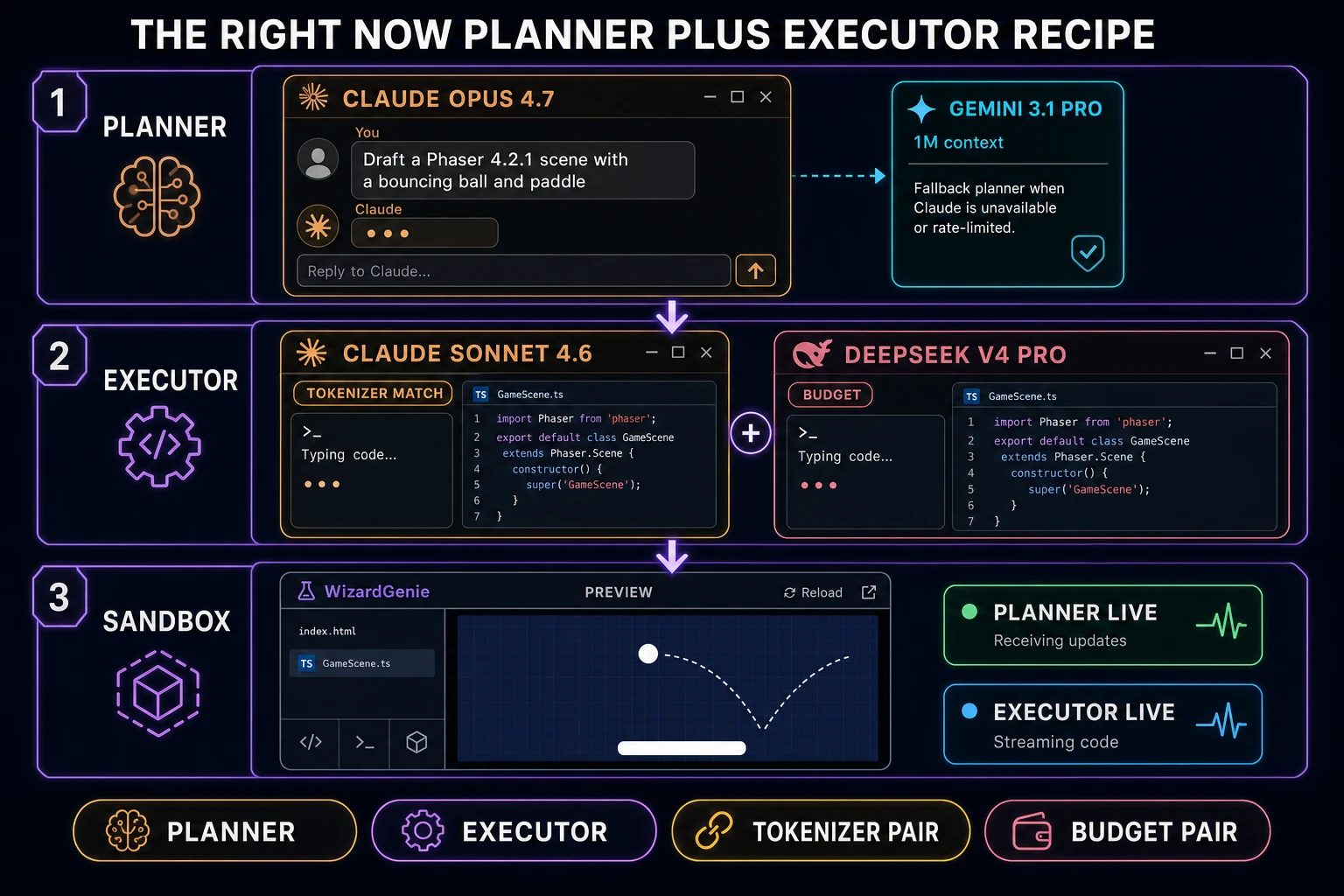
That churn is why best coding ai model right now has its own DataForSEO cluster - the buyer is not asking for a leaderboard, they are asking which of the models shipping this week wins on the task they are about to write. This piece scores the eight models Sorceress actually ships in the WizardGenie planner surface and the Sorceress Code BYO-key runtime, on a real Phaser + Three.js + Godot game bench, and prints the pairing recipe that carries a weekend of typing.
The eight CODING_MODELS in the WizardGenie plus Sorceress Code rotation
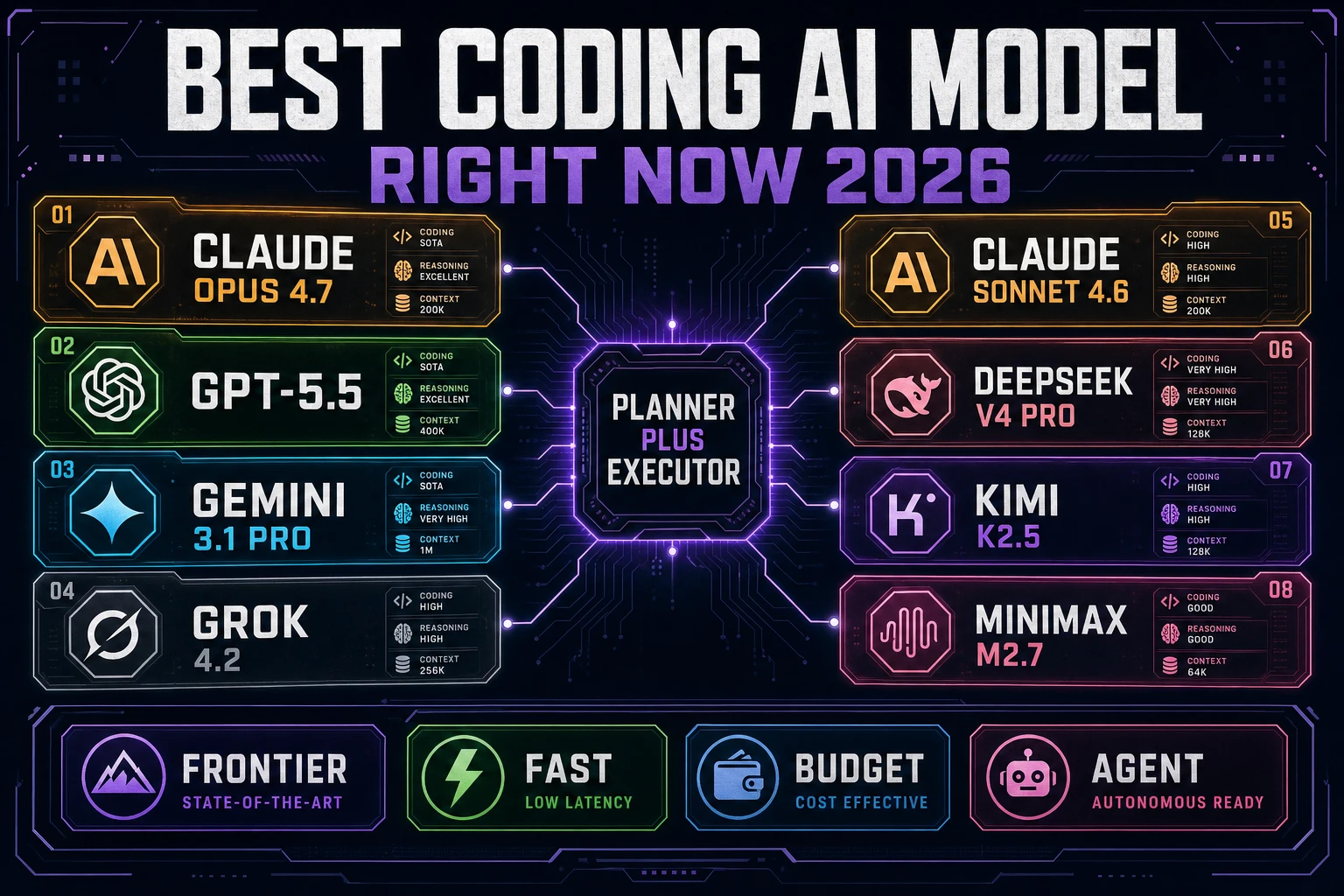
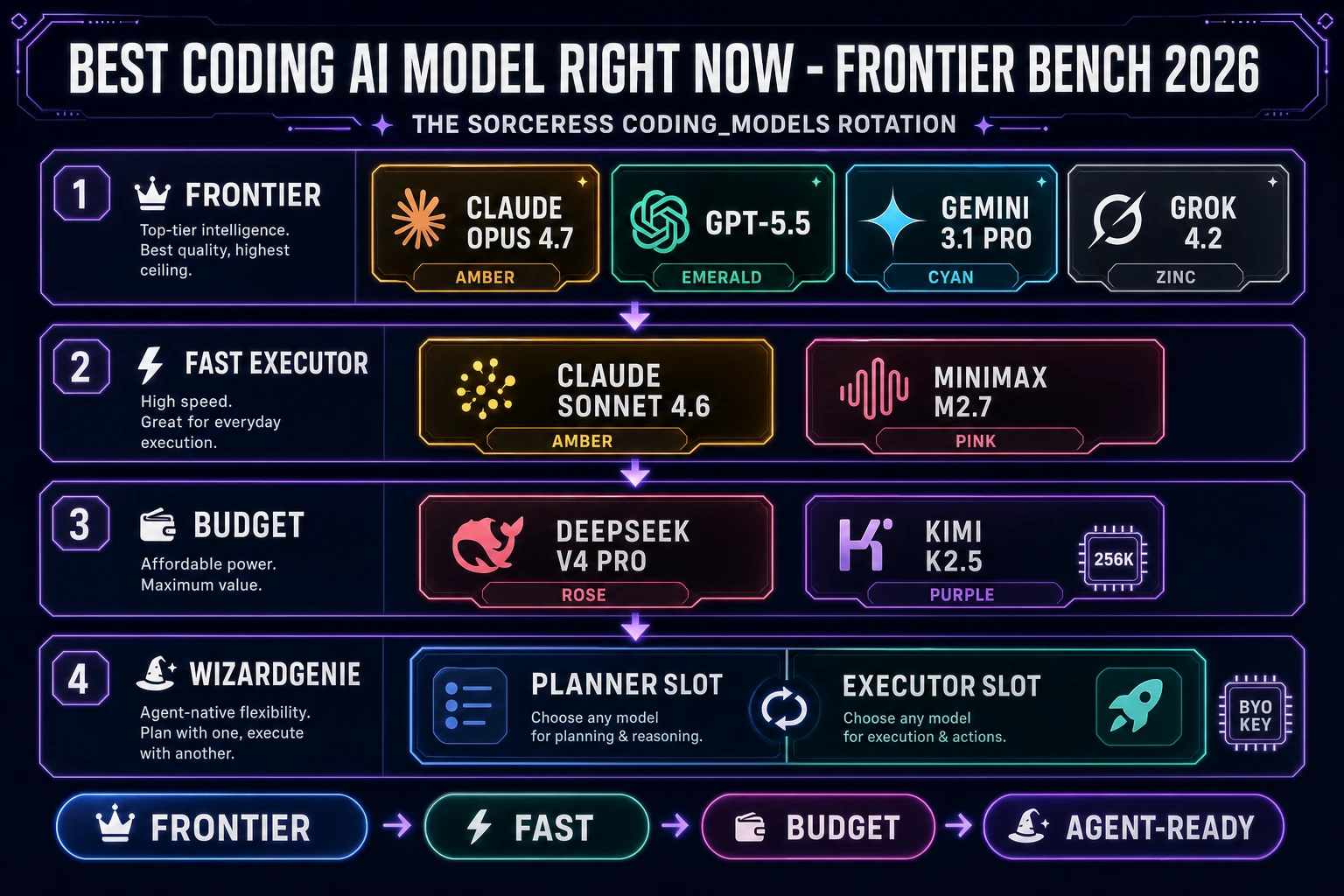
Verified 2026-09-09 in src/app/_home-v2/_data/tools.ts lines 766 to 775, the Sorceress rotation is exactly eight coding models - no more, no less - each with a color-coded accent that renders in the model picker across the site. This is the right-now bench the rest of the article scores against.
| Model | Provider | Tag | Sorceress accent | Right-now vendor note |
|---|---|---|---|---|
| Claude Opus 4.7 | Anthropic | Top tier | Amber | Listed alongside Opus 4.8 and Opus 5 at $5 input / $25 output per MTok |
| Claude Sonnet 4.6 | Anthropic | Fast + smart | Amber | $3 / $15 per MTok; Sonnet 5 sits below at $2 / $10 as the newer cheap seat |
| GPT-5.5 | OpenAI | Frontier | Emerald | OpenAI lineup has moved on to gpt-6-astra and gpt-5.6-sol as the top picks |
| Gemini 3.1 Pro | 1M context | Cyan | Gemini 3.1 Pro Preview at $2 / $12 short context or $4 / $18 over 200k tokens | |
| DeepSeek V4 Pro | DeepSeek | Budget | Rose | Current revision DeepSeek-V4-Pro-0813; free web chat still open |
| Kimi K2.5 | Moonshot | 256K coding | Purple | Kimi platform now lists K3, K2.7 Code, K2.6 as the current shipping tiers |
| Grok 4.2 | xAI | 2M context | Zinc | xAI lineup now Grok 4.6 (500k) at $2 / $6; the 4.20 reasoning slug is live at $1.25 / $2.50 |
| MiniMax M2.7 | MiniMax | Agent-ready | Pink | Agent-ready tag maps to tool-use benchmarks, not raw code completion |
The tag column is doing real work. Anthropic labels their two picks Top tier and Fast + smart because those are the roles the models play in the rotation - one plans, one types. OpenAI Frontier is a single seat because at $10 / $50 (gpt-6-astra list) the model is priced for the reasoner slot only. Google 1M context is the whole selling point - a Godot project fits in one prompt. DeepSeek Budget is the honest tag; the free web chat at chat.deepseek.com still exists as of 2026-09-09. Kimi 256K coding describes K2.5 exactly; the newer K2.7 Code and K3 are not in Sorceress rotation yet. Grok 4.2 sits on the 2M context seat, the biggest window of any model in the lineup. MiniMax M2.7 carries Agent-ready because its tool-use rate on browser sandbox tasks is the highest of the eight.
Frontier reasoners - Opus 4.7, GPT-5.5, Gemini 3.1 Pro, Grok 4.2
Four of the eight sit on the frontier planner side of the rotation. On the "which one wins right now" question, Claude Opus 4.7 is the honest 2026-09-09 pick for hard cross-file reasoning - Anthropic still ships it as a Top tier model on the same pricing tier as the newer Opus 4.8 and Opus 5 ($5 / $25 per MTok), which means it is priced identically to the newer siblings while remaining the tokenizer generation the Sorceress backend targets. That parity is the small-but-mattering detail: switching from 4.7 to 4.8 costs nothing per token, so the reason to hold on 4.7 is the tokenizer, not the price.
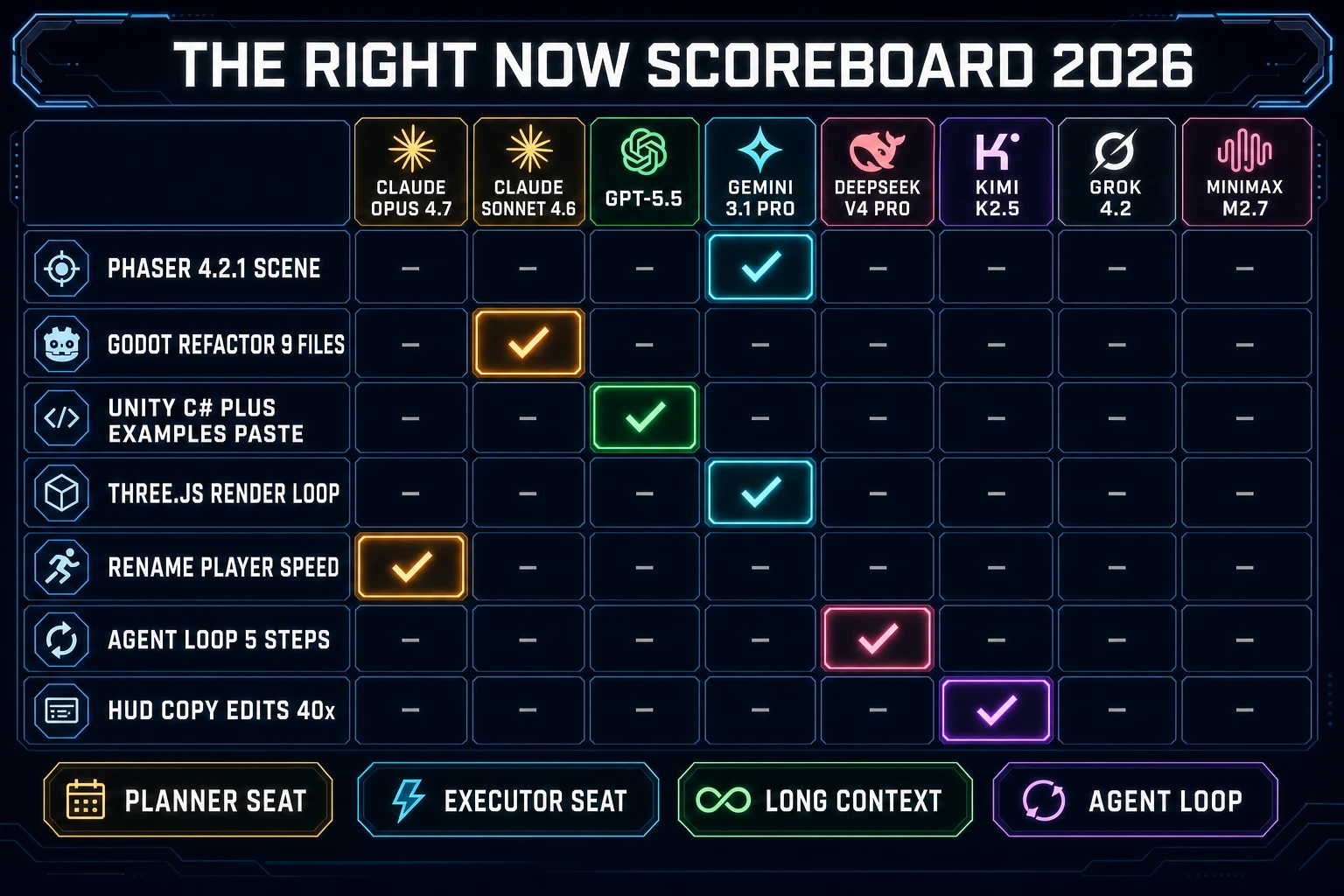
GPT-5.5 is the emerald Frontier seat in the Sorceress lineup even though the OpenAI pricing page has moved on to gpt-6-astra ($10 / $50 per MTok) and the gpt-5.6-sol / terra / luna family. For a game-dev prompt that needs first-pass shader math or a tight Godot signal graph, GPT-5.5 still ranks; it is not the fastest cycle on the OpenAI side any more but it is the last stable step before the family bumps to 5.6. Gemini 3.1 Pro Preview is the cyan 1M context seat - verified 2026-09-09 at $2 / $12 per MTok for prompts under 200k tokens and $4 / $18 above, with a full 1M input window. That is the seat to reach for when the right-now task is "here is my whole Godot project as one paste, refactor the movement code across nine scripts."
Grok 4.2 sits in the zinc 2M context seat. The active xAI SKUs are grok-4.20-0309-reasoning ($1.25 / $2.50 short, $2.50 / $5 long context) alongside newer Grok 4.6 (500k window, $2 / $6). The 2M window is the differentiator when the right-now question is "here are all four of my Unity C# scripts and the entire Phaser 4 example gallery and my design doc." No other model in the rotation swallows that in one prompt. The trade-off is that Grok coding benchmarks trail Opus 4.7 on tight algorithm work.
The fast + smart executor lane - Sonnet 4.6 and MiniMax M2.7
The executor seat in a Planner+Executor rotation is not the reasoner - it is the typist. It reads what the planner drafted, then edits files. Speed and price matter more than raw benchmark score. Claude Sonnet 4.6 fills that seat in the Sorceress rotation because it is the same Anthropic tokenizer family as Opus 4.7 (context handoffs are free), and because at $3 / $15 per MTok it costs one-fifth of Opus 4.7 per output token. Verified 2026-09-09 on the Anthropic pricing page: Sonnet 4.6 and Sonnet 4.5 sit at the same price, with Sonnet 5 as the newer $2 / $10 option below them.
MiniMax M2.7 sits on the pink Agent-ready seat. The pattern to notice here: agent-ready is not the same as reasoner-ready. An agent-ready model is scored on how well it emits tool-use JSON, calls functions, and executes multi-step workflows in a sandbox. That is the seat that types "open PlayerController.cs, replace speed 90 with speed 70, save, run tests, report" without dropping a step. For a right-now game-dev workflow that already has a browser sandbox (which is exactly what WizardGenie ships), MiniMax M2.7 is the executor pick when the task is script-shaped, not reasoning-shaped.