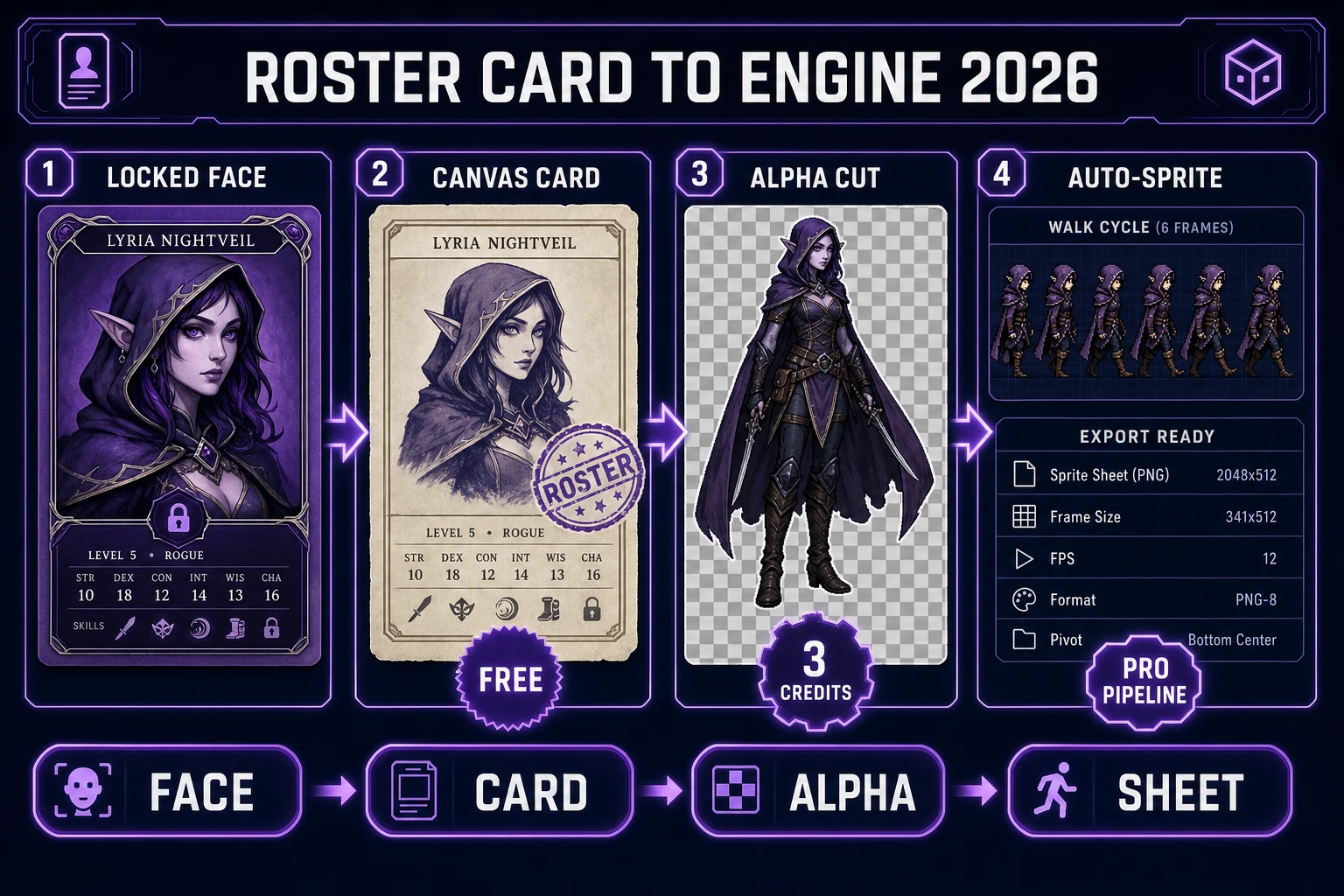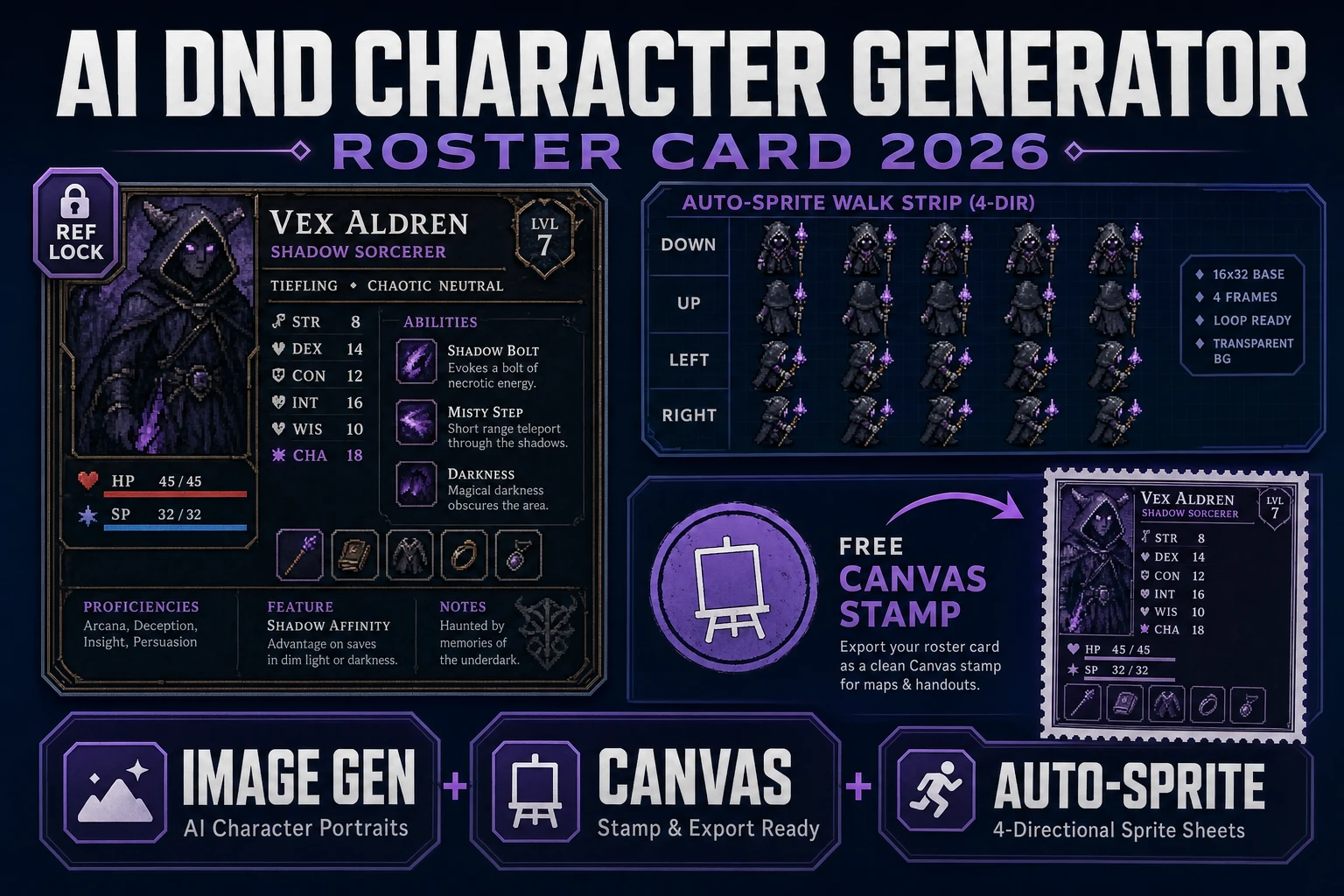
People who type AI DnD character generator into a search box are rarely shopping for another one-off fantasy selfie. They already sketched a class, a quirk, and a party slot — what they need is a roster card that stays on-model across poses, tokens, and maybe a walk sheet. This guide treats that long-tail as a shipping problem: what the query wants, how Sorceress AI Image Gen locks a face, how free Canvas turns keepers into clean cards, when Auto-Sprite v2 earns a Pro sheet, and the credit math verified against source today.
What an AI DnD character generator search actually wants
DataForSEO lists ai dnd character generator at 320 searches a month with KD 2 (confirmed in tools/research-supplement.md, verified 2026-09-28 pull). Neighbor phrases such as ai character generator sit much higher at 27,100/mo — that head term already has its own roster-lock post. This page stays on the DnD long-tail and on the job both phrasings share: a cast you can reuse at the table or in an engine.
Wikipedia’s character sheet page (verified 2026-09-28) still defines the tabletop record as name, physical characteristics, changing stats, and inventory. The art half of that record is what searchers mean when they ask an AI DnD character generator for a “card”: a readable face, class silhouette, and palette that survive a second prompt. Three outcomes dominate that intent in September 2026. First, a hero face that does not drift hair color between takes. Second, two or three party NPCs that share one art direction. Third, files the next surface understands — a stamped PNG token for the tabletop, or a transparent sprite when the same cast enters a jam build.
Wikipedia’s model sheet page (verified 2026-09-28) names the production problem: standardize appearance, poses, and gestures so collaborators stay on-model. Indie AI workflows do not skip that need; they relocate it into reference images and a shared prompt prefix. The text-to-image model overview (verified 2026-09-28) notes that modern systems condition on text embeddings and can latch onto a small set of concept images — that is the technical spine under roster lock.
For sibling character angles already on the blog, see AI character generator roster lock for the head query, AI character generator perchance for the brand-shaped long-tail, and AI sprite generator roster sheet for sheet-first framing. This page stays on AI DnD character generator as the party-card path.
Prompt lock the party face in AI Image Gen
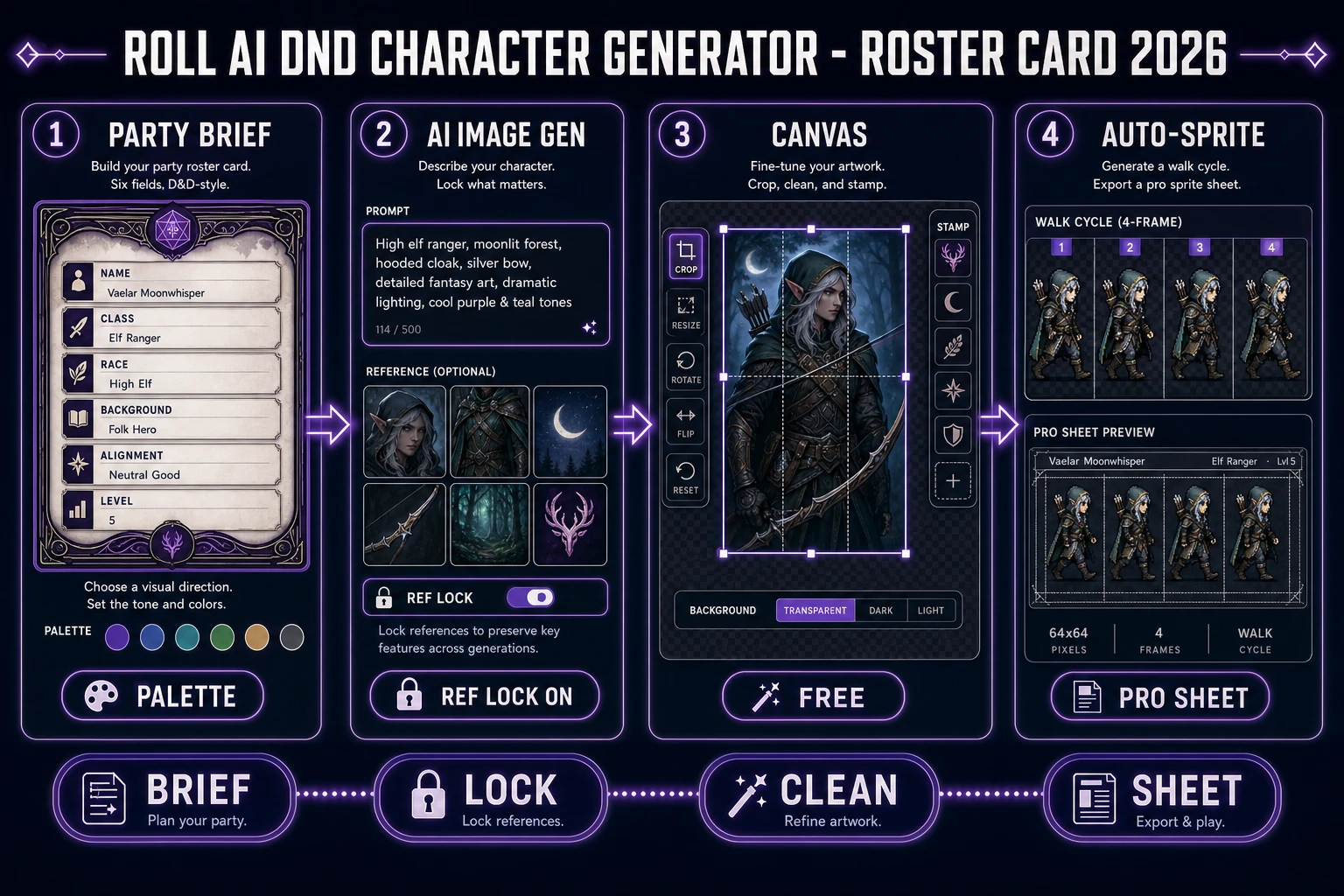
AI Image Gen is the featured panel. The home card (verified 2026-09-28 in src/app/_home-v2/_data/tools.ts) lists Nano Banana Pro, GPT Image 2, Grok Imagine, Seedream 5 (uncensored), Flux 2 Pro, Z-Image Turbo, and more behind one prompt field and one gallery. For an AI DnD character generator session, start with a deterministic seed prompt: class, silhouette, palette, one prop, one voice hook, plain background. Do not improvise cloak adjectives between takes.
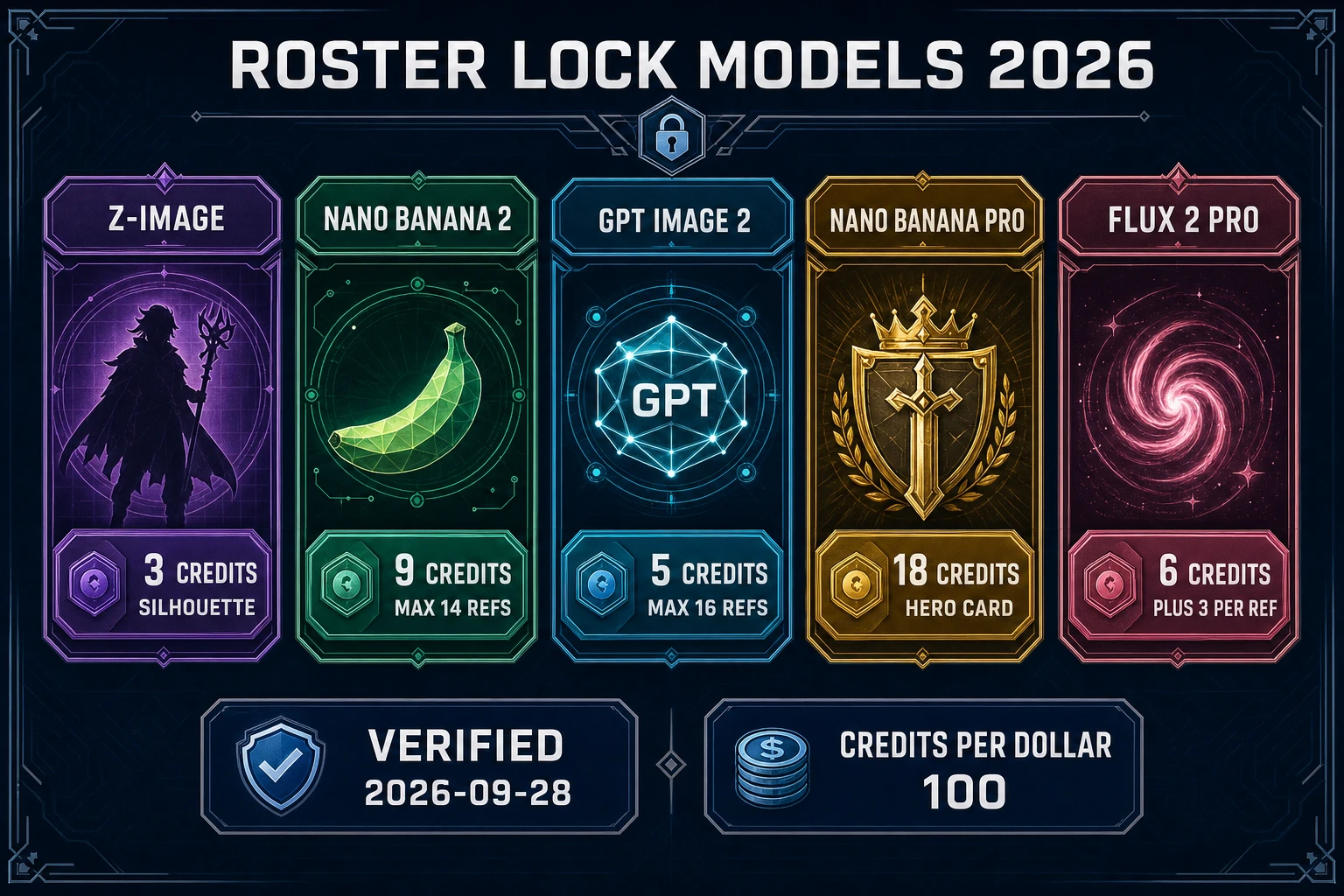
Base credits checked today in src/lib/models.ts (verified 2026-09-28):
| Model | Base credits | Best fit for an AI DnD character generator card |
|---|---|---|
| Z-Image | 3 | Silhouette drafts and cheap volume |
| GPT Image 2 | 5 | Dense in-image text and sharp card art |
| Flux 2 Pro | 6 (+3 per ref) | Painterly fantasy heroes |
| Nano Banana / Seedream 5 Lite | 6 | Mid-tier party variants |
| Nano Banana 2 | 9 | Default locked roster workhorse (up to 14 refs) |
| Nano Banana Pro | 18 | Hero card when fidelity beats cost |
Nano Banana 2 Lite sits at 4 credits when you want a lighter Nano Banana 2 lane. New accounts start with SIGNUP_GRANT = 100 free credits (src/app/api/admin/credits/route.ts). CREDITS_PER_DOLLAR = 100, so one credit is one US cent on the top-up ledger. Pick the seed model before you invent a second outfit — the cheap lane is for finding the face; the 9- and 18-credit lanes are for keepers.
After the first keeper lands, drop that PNG into the reference panel and generate every follow-up pose against it. Reference maxima from src/lib/models.ts today: Nano Banana max 3, Nano Banana Pro max 8, Nano Banana 2 max 14, GPT Image 2 max 16, Flux 2 Pro max 8 with refImageCredits: 3 per extra image. Keep the prompt prefix identical. Change only the pose line. If hair length or cloak color drifts, you loosened the prefix or swapped models mid-roster — reset to the seed reference and rerun.
Name files before the queue finishes: fighter_seed.png, fighter_attack_01.png, cleric_seed.png. A gallery full of untitled thumbnails is how an AI DnD character generator party dies between sessions.
Touch up roster cards in Canvas
A diffusion keeper is not yet a card. Open Canvas — the home more-tools card calls it a quick, easy in-browser image editor and badges it Free (verified 2026-09-28 in src/app/_home-v2/_data/tools.ts). Crop to a consistent frame, erase stray background crumbs, and stamp a simple name or class label if the portrait needs to read at token size. Do not ask Canvas to invent a new face; treat it as the production cleanup bench between Image Gen takes.
Useful card habits for an AI DnD character generator export: same canvas size for every party member, centered subject, no baked ground shadow that becomes a second silhouette when you stamp tokens, and a flat backdrop you can cut later. MDN’s image file type guide (verified 2026-09-28) still treats PNG as the browser-friendly format with optional transparency — keep keepers as PNG before you fork into tokens or sprites.
When you need true alpha for engine import or VTT tokens, open BG Remover at a flat BG_REMOVER_CREDITS = 3 per image (verified 2026-09-28 in src/app/bg-remover/page.tsx). Cut once on approved faces, then stop regenerating backgrounds inside the diffusion model. Canvas remains free touch-up; BG Remover is the paid alpha pass.