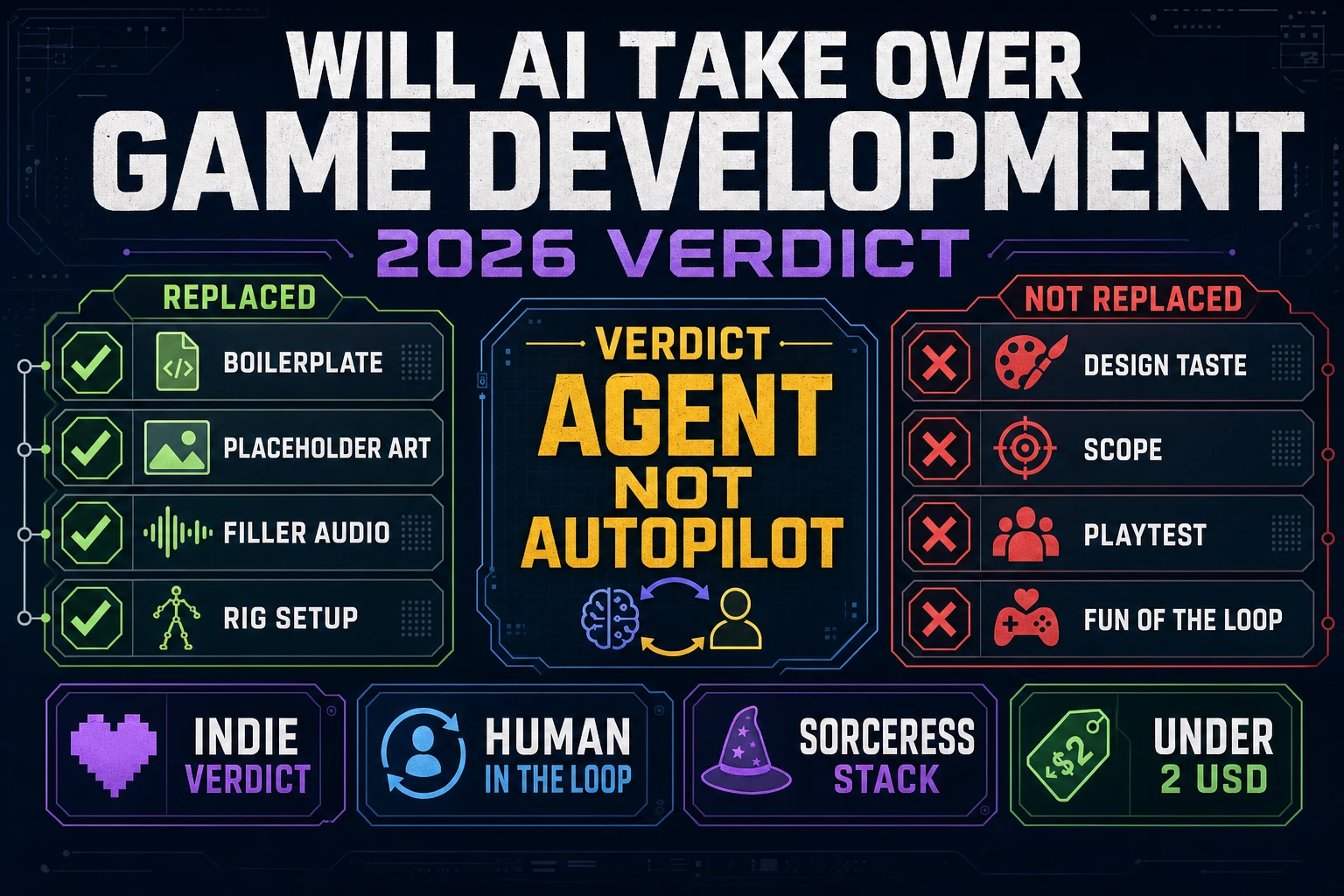
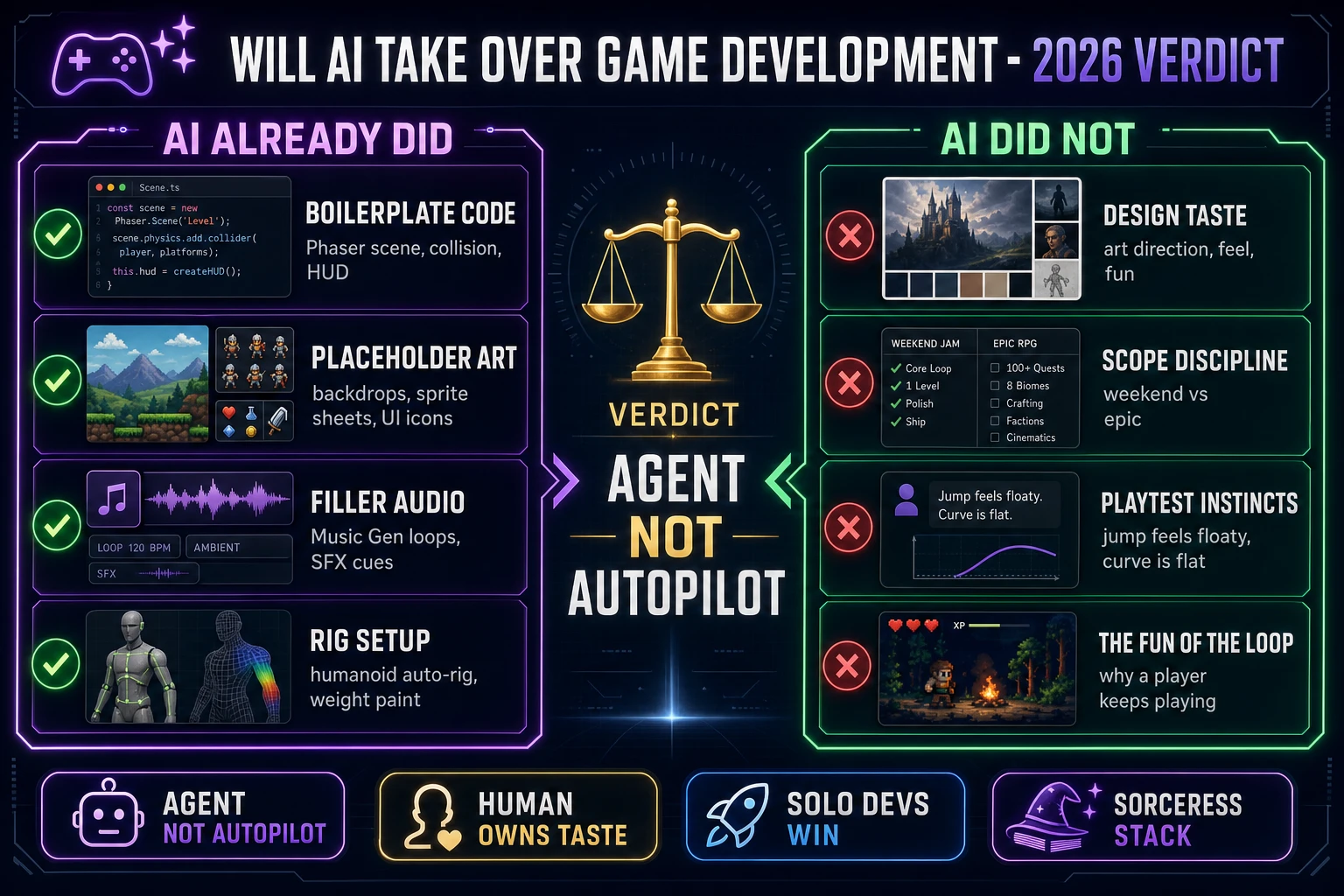
Every few months since 2022 the same question has cycled back through indie Discord servers, YouTube think-pieces, and X threads: will ai take over game development? In 2023 the honest answer was "unclear, come back in a year". In 2024 it was "maybe on the boilerplate, definitely not on the design". In 2026 the answer is stable enough that we can stop treating it as a live question and start writing down the verdict. AI has already replaced four concrete categories of game-development work (boilerplate code, placeholder art, filler audio, and rig setup) and it has not touched the four categories that actually determine whether a game is good (design taste, scope discipline, playtest instincts, the feel of the loop). This piece is the honest 2026 rundown against the shipping Sorceress agent stack: WizardGenie drives eight coding models with a Planner+Executor split, AI Image Gen ships twelve top-tier image models, Music Gen bills a flat 10 credits per generation via Suno V5.5, and Sorceress Code handles file-aware refactor - all of it agent, none of it autopilot, human in the driver seat at every taste call. Verified 2026-09-08 against the source tree.
The honest question behind "will ai take over game development"
The phrase "will ai take over game development" arrives in Google search with three different intents stacked on top of each other. Some searchers are indie developers asking whether their weekend project is about to be obsoleted by a prompt-driven engine. Some are hiring managers asking whether they can shrink the team next quarter. A few are students asking whether learning Unity is still worth it in 2026. Every one of those readers deserves the same answer because the underlying facts are the same, and the 2026 facts are settled enough to write down cleanly. The honest question is not "will an AI ship a AAA RPG from one sentence" - it obviously will not, and anyone selling that demo is showing a rendered trailer, not a workflow. The honest question is "which parts of the 2022 game-development job survive to 2026, and which parts got compressed into the AI stack". Split the question that way and the verdict follows without any hand-wringing.
The mental model that keeps the rest of this piece grounded is agent, not autopilot. An AI coding agent in 2026 is genuinely capable of a working video game development scaffold from a natural-language spec (verified 2026-09-08 on the Wikipedia video game development entry). A well-scoped prompt to WizardGenie produces a Phaser v4.2.1 "Giedi" game loop (released 9 July 2026, verified 2026-09-08 on the official Phaser stable download page) with a hero, an enemy, input, collision, and a scoreboard in under twenty minutes. What that agent does not do in 2026 is make design decisions or read playtest instincts - it cannot tell you that the jump feels floaty because gravity should be 0.9 instead of 0.6, or that the game is boring after ninety seconds because the difficulty curve is flat. That distinction is the entire ballgame on the will ai take over game development question. The prior AI game development browser stack rundown covered the four-pillar shape of the 2026 workflow; this piece answers the "so does it replace me" question that stack keeps raising in reader mail.
What AI has already replaced in 2026 game development
Four concrete categories of pre-2026 game-dev work now genuinely live inside the AI stack. Each category is a real thing that used to eat a week and now takes an afternoon. Verified 2026-09-08 against the Sorceress source in src/app/_home-v2/_data/tools.ts.
- Boilerplate code - Phaser scene setup, collision handlers, camera follow, HUD wiring, save/load scaffolding, event bus, sprite loader plumbing. A Planner+Executor pair (Claude Opus 4.7 planning, DeepSeek V4 Pro typing) writes a working game loop in under twenty minutes from a one-page spec, and follow-up prompts refine physics, spawner, HUD, and scoring without any manual code stitching.
- Placeholder art - backdrops, sprite sheets, enemy sheets, UI icons, item icons, particle textures. AI Image Gen ships twelve top-tier image models (Nano Banana Pro, Nano Banana 2, GPT Image 2, Seedream 5 Lite, Flux 2 Pro, Grok Imagine, Z-Image Turbo, and more, verified 2026-09-08 in
src/lib/models.ts) that produce a jam-quality asset in single-digit credits per generation. - Filler audio - a 20-second looping music bed and four short SFX cues cover the whole audio contract for a first weekend game. Music Gen bills
MUSIC_CREDIT_COST= 10 credits per generation via Suno V5.5 (verified 2026-09-08 insrc/app/music-gen/page.tsxline 28). SFX Gen billsSEED_AUDIO_CREDITS_PER_SECOND= 1 credit per second (verified 2026-09-08 insrc/app/sfx-gen/page.tsxline 23) via BytePlus Seed Audio 1.0. - Rig setup and weight paint - the humanoid skeleton, weight-paint refinement, and text-to-animation lift for 3D characters. 3D Studio and Auto-Rigging handle the auto-rig in one click, and the developer only touches weight paint when a specific bone reads wrong on a specific pose.
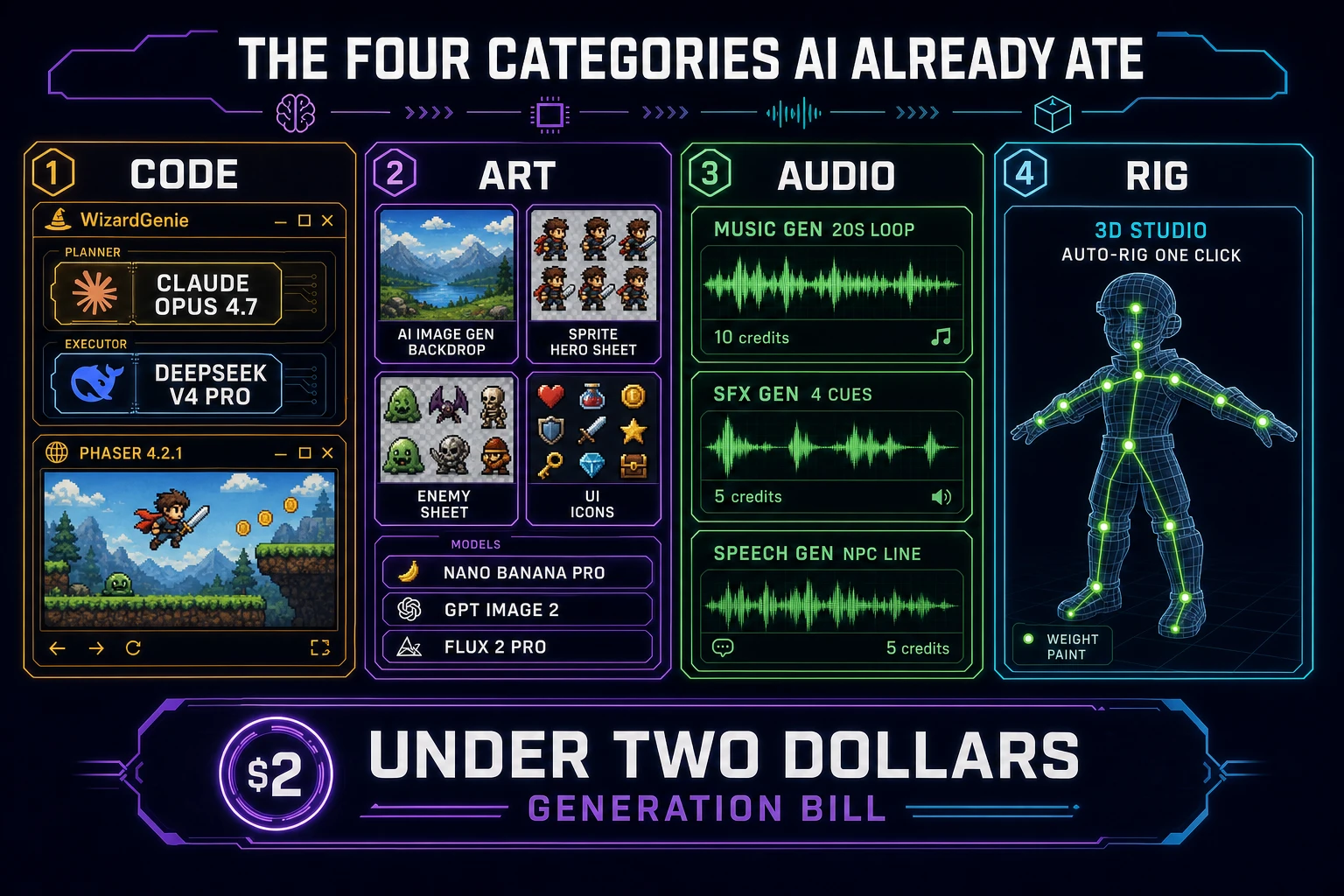
Those four categories add up to roughly 80 percent of the pre-2026 assembly-line grind. Credits convert at 100 per dollar via CREDITS_PER_DOLLAR in src/lib/models.ts line 69, and a first weekend-scope project runs under two US dollars in total generation. That number is the concrete signal on the will ai take over game development question - it is the reason a one-person indie can now attempt what a five-person team attempted in 2022. The prior AI for game developers indie toolkit walks the same replacements from the tool-picking angle, and the how to make a game with AI walkthrough shows the compressed workflow end to end.
What AI has NOT replaced (and won't in 2027)
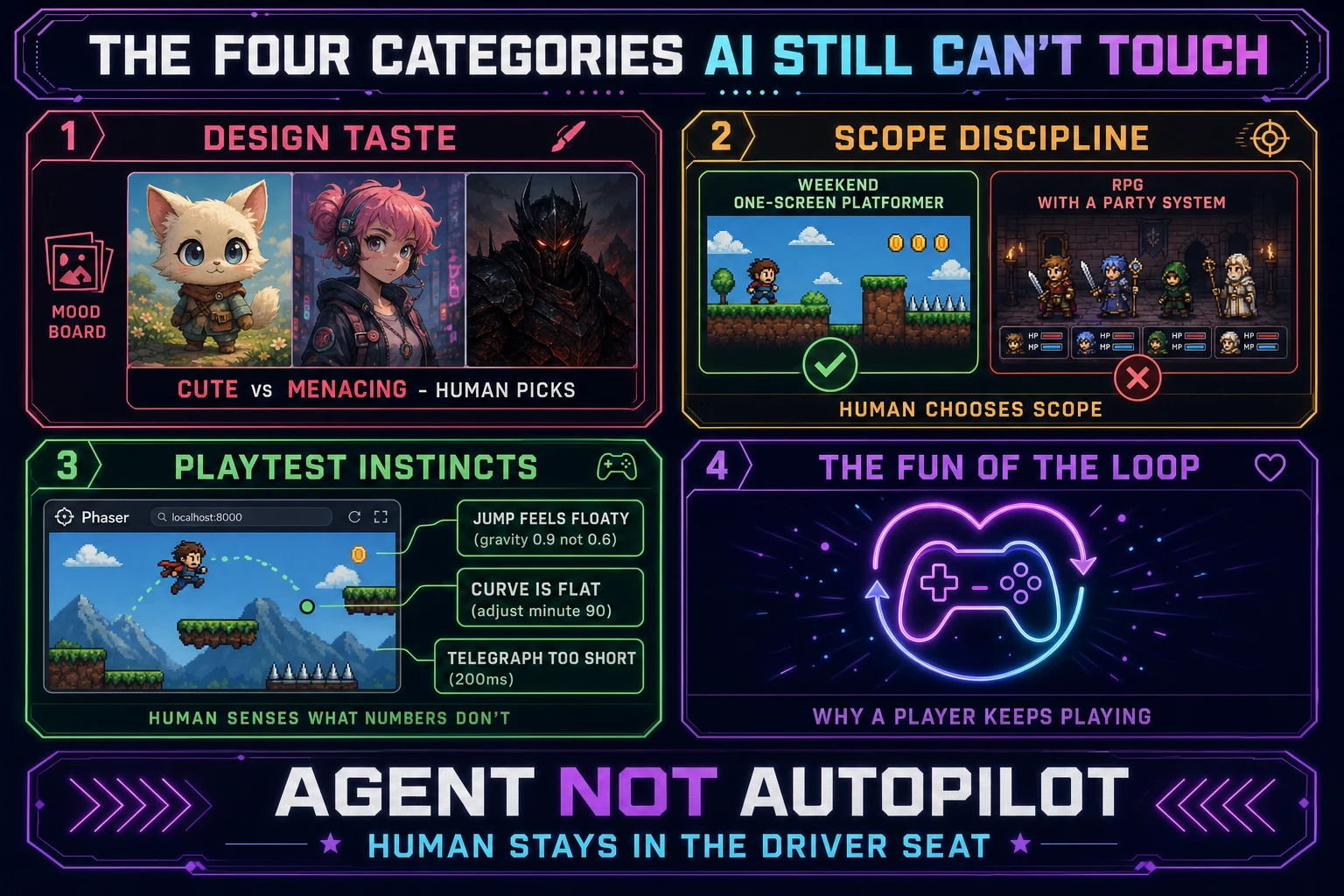
The parts of game development that actually determine whether a game is good are still entirely human. This is the answer to the will ai take over game development question that most 2023 forecasts got wrong. Four categories, each verified 2026-09-08 against the shipping Sorceress workflow.
- Design taste - the call about what the game is. Should the hero read as cute or menacing? Should the fail state be brutal or forgiving? Should the second-minute reveal land as a twist or a payoff? Game design as defined 2026-09-08 on Wikipedia is a taste discipline, not a token-prediction problem, and no 2026 model measurably narrows the gap.
- Scope discipline - the difference between "weekend one-screen platformer" and "RPG with a party system and crafting". A large language model (verified 2026-09-08 on Wikipedia) is happy to attempt whichever scope you type; it has no incentive to tell you the second one will not ship on a weekend. Scope discipline is a human judgment call, and it is the biggest predictor of whether a first Saturday ends in a playable tab.
- Playtest instincts - the eye that sees "the jump feels floaty because gravity is 0.6 instead of 0.9", "the enemy is unfair because the telegraph is 200 milliseconds too short", "the game gets boring at minute two because the difficulty curve is flat". Playtest as defined 2026-09-08 on Wikipedia is a human observation activity - the tester is a person, the fix decision is a person. No 2026 agent watches the browser tab and says "this level is bad".
- The fun of the loop - the reason a player keeps playing. Fun is not a specification; it is the emergent property of pace, feedback, feel, and stakes composing into something a player wants to sit with. That composition is the entire craft, and it is exactly the part no AI touches.