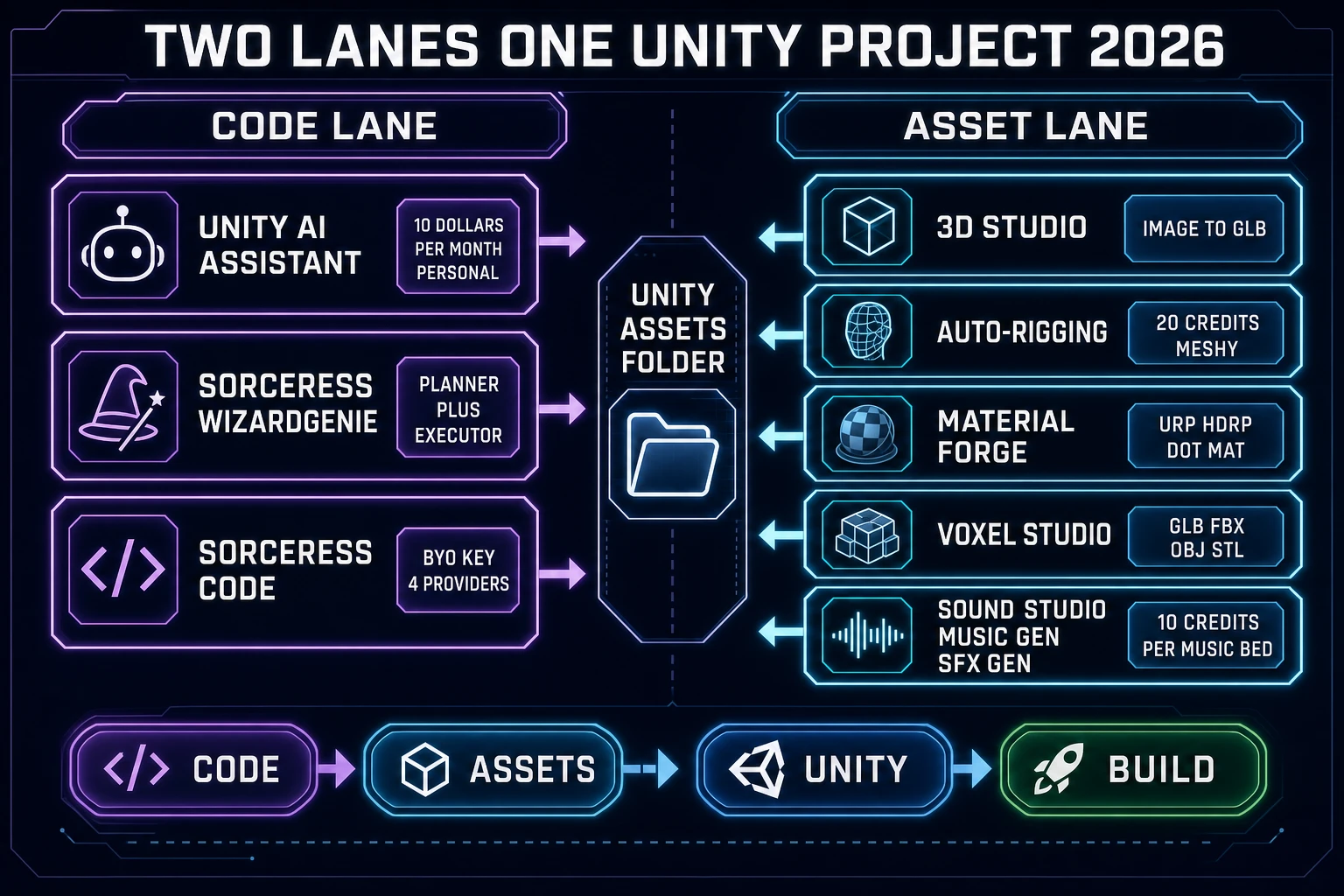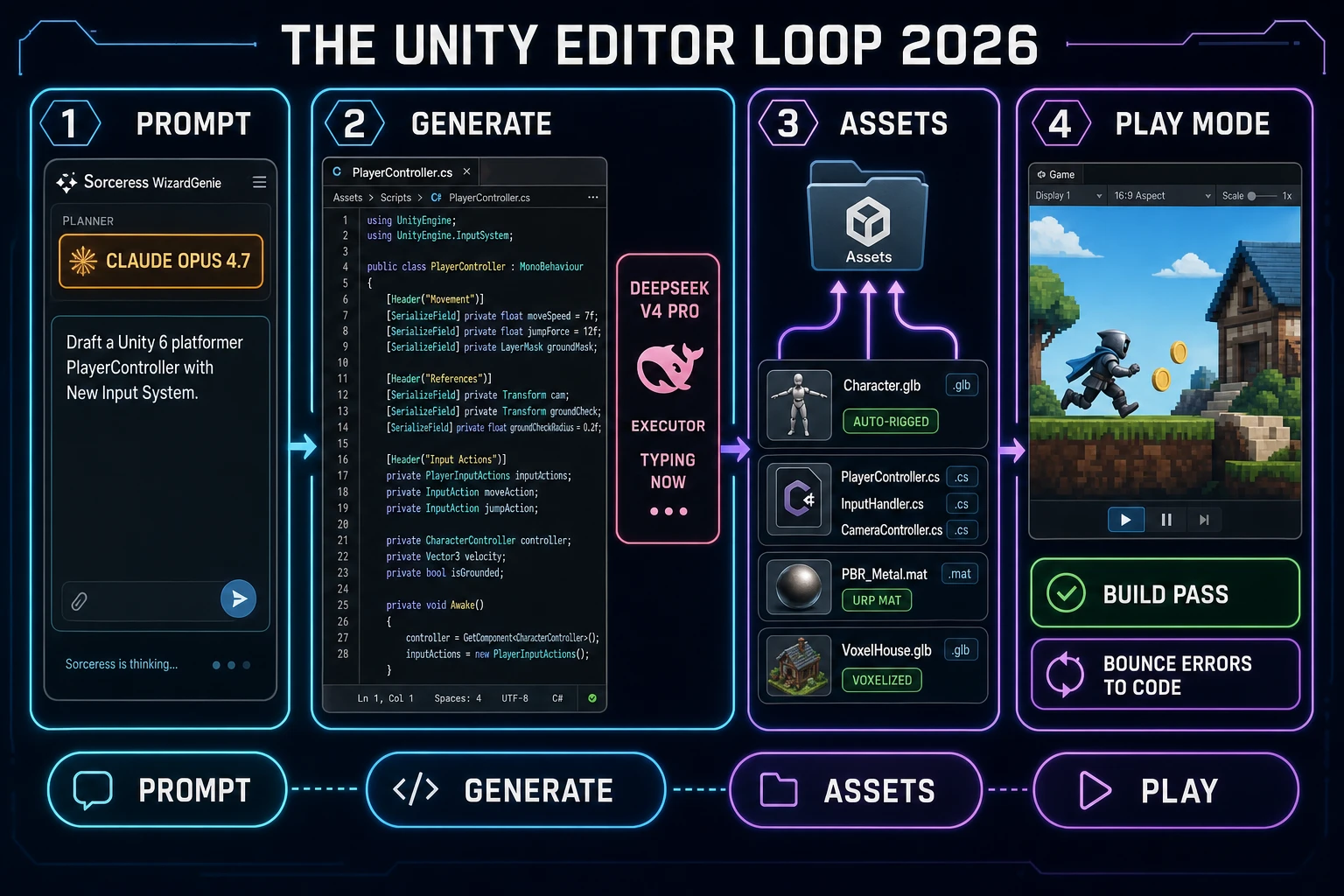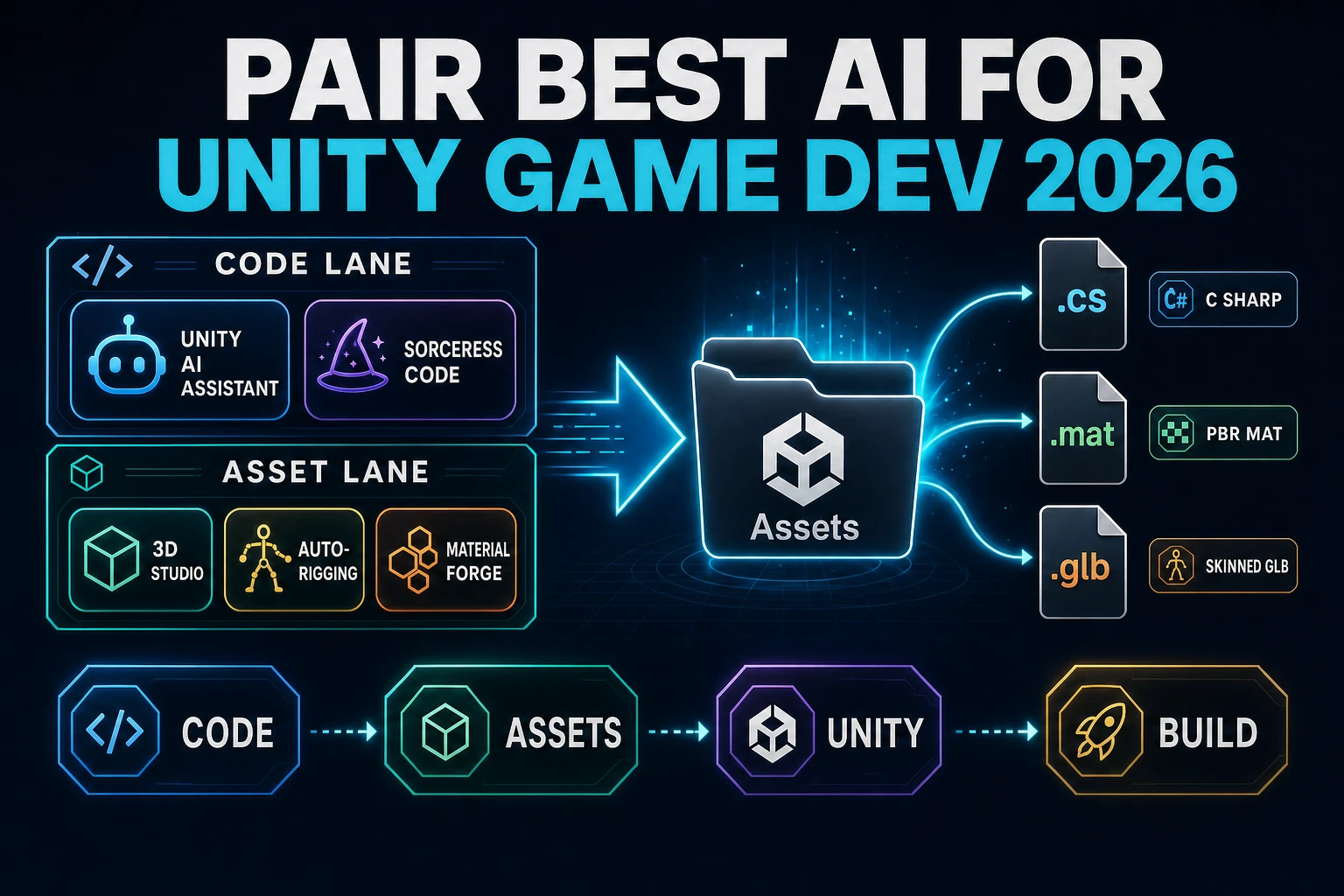
Searchers who type best ai for unity game development in September 2026 are asking a two-lane question and usually only get one lane back. Unity Personal is a real free tier, Unity 6.0 shipped its first in-editor AI Assistant into open beta this year, and the Anthropic + OpenAI + Google + DeepSeek + Moonshot + xAI + MiniMax coding-model roster has settled into a stable eight-seat rotation the Sorceress CODING_MODELS array locks. But the honest answer for a Unity project is that code alone is one-fifth of the surface - the other four-fifths are 3D character rigging, PBR materials, voxel props, sprite atlases, background music, SFX, and the .glb / .mat / .fbx / .wav / .cs files a Unity Assets/ folder actually receives. Every claim below was verified 2026-09-09 against vendor documentation and the Sorceress source in src/app/_home-v2/_data/tools.ts, src/app/code/page.tsx, src/lib/rigging/unity-export.ts, and src/lib/material-forge/exporters/unity.ts. The verdict resolves into two lanes and a shared Assets/ folder, not a single-tool leaderboard.
What "Unity game development" means separately from "Unity coding"
The phrase best ai for unity game development and the phrase best ai for unity coding look almost identical, and they resolve into different answers. Unity coding is the C# and shader lane: MonoBehaviour subclasses, Update loops, coroutines, ScriptableObjects, Job System, Burst compiler, and the New Input System versus the legacy Input Manager. Unity game development is the whole surface. That includes the C# lane, but it also includes 3D character rigging, PBR material authoring (physically based rendering maps and Unity URP/HDRP conversion), scene assembly, level design, animation state graphs and blend trees, VFX Graph, audio (music, ambient beds, SFX, voice), lighting, and the build pipeline that ships to PC, consoles, mobile, and WebGL.
An AI stack that only writes C# leaves eight of those ten lanes untouched. That is why the best ai for unity game development question resolves into a two-lane rig rather than a single-tool leaderboard: the code lane covers C# scaffolding and shader edits, and the asset lane covers everything a scripting agent cannot produce - rigged 3D characters, .mat files, .fbx voxel props, PNG sprite atlases, music beds, and .wav SFX. Sorceress ships both lanes under one credit meter through WizardGenie, Sorceress Code, and the asset tools on the tools guide. Unity 6.0+ ships the in-editor AI Assistant that covers the C# lane with project-aware context. Together they close the two-lane loop for a real Unity project.
The two AI lanes a Unity project actually needs
Split the AI stack for Unity into two lanes and every product on the market sorts cleanly. The code lane writes C#, edits shaders, refactors Prefab references, and drives the Unity Editor via the Model Context Protocol server. The asset lane generates 3D meshes, rigs skeletons, bakes PBR maps, voxelizes props, slices sprites, and produces .wav files for music and SFX.
| Lane | What it produces | Where it lands in Unity | Sorceress or Unity tool |
|---|---|---|---|
| Code lane | MonoBehaviour scripts, coroutines, scriptable objects, shader edits | Assets/Scripts/*.cs, Packages/ | Unity AI Assistant, WizardGenie, Sorceress Code |
| Asset lane - characters | Skinned .glb with humanoid or custom rig, walk config JSON, C# controllers | Assets/Characters/*.glb + SorceressRigBot/*.cs | Auto-Rigging |
| Asset lane - meshes | Image-to-mesh .glb, text-to-mesh .glb, base color textures | Assets/Props/*.glb | 3D Studio |
| Asset lane - materials | URP or HDRP .mat YAML files with PBR maps (BaseColor, Normal, Metallic, Roughness-to-Smoothness, AO, Emissive) | Assets/Materials/*.mat | Material Forge |
| Asset lane - voxels | .glb, .gltf, .fbx, .obj, .stl voxel props | Assets/VoxelProps/*.fbx | Voxel Studio |
| Asset lane - sprites | Transparent PNG sprite sheets, cell-sliced atlases | Assets/Sprites/*.png (Sprite Editor grid-by-cell-size) | Quick Sprites, True Pixel, Tileset Forge |
| Asset lane - audio | .wav music beds, SFX, NPC voice lines | Assets/Audio/*.wav | Sound Studio, Music Gen, SFX Gen, Speech Gen |
The row that changes the most in 2026 is the audio lane. Unity 6 shipped its own AI Generators for placeholder audio, but production audio still comes from a dedicated audio-AI pipeline. Sorceress Music Gen bills 10 credits per bed (MUSIC_CREDIT_COST in src/lib/sorceress-tools/audio/music.ts, verified 2026-09-09), SFX Gen bills a per-clip minimum of 1 credit, and Speech Gen produces NPC voice lines. That means one Sorceress credit ($0.01 at the CREDITS_PER_DOLLAR = 100 conversion in src/lib/models.ts) buys one SFX; ten credits ($0.10) buys one music bed. A whole Unity jam's audio track lands under a dollar.
Unity 6.0+ AI Assistant - the code lane inside the Editor
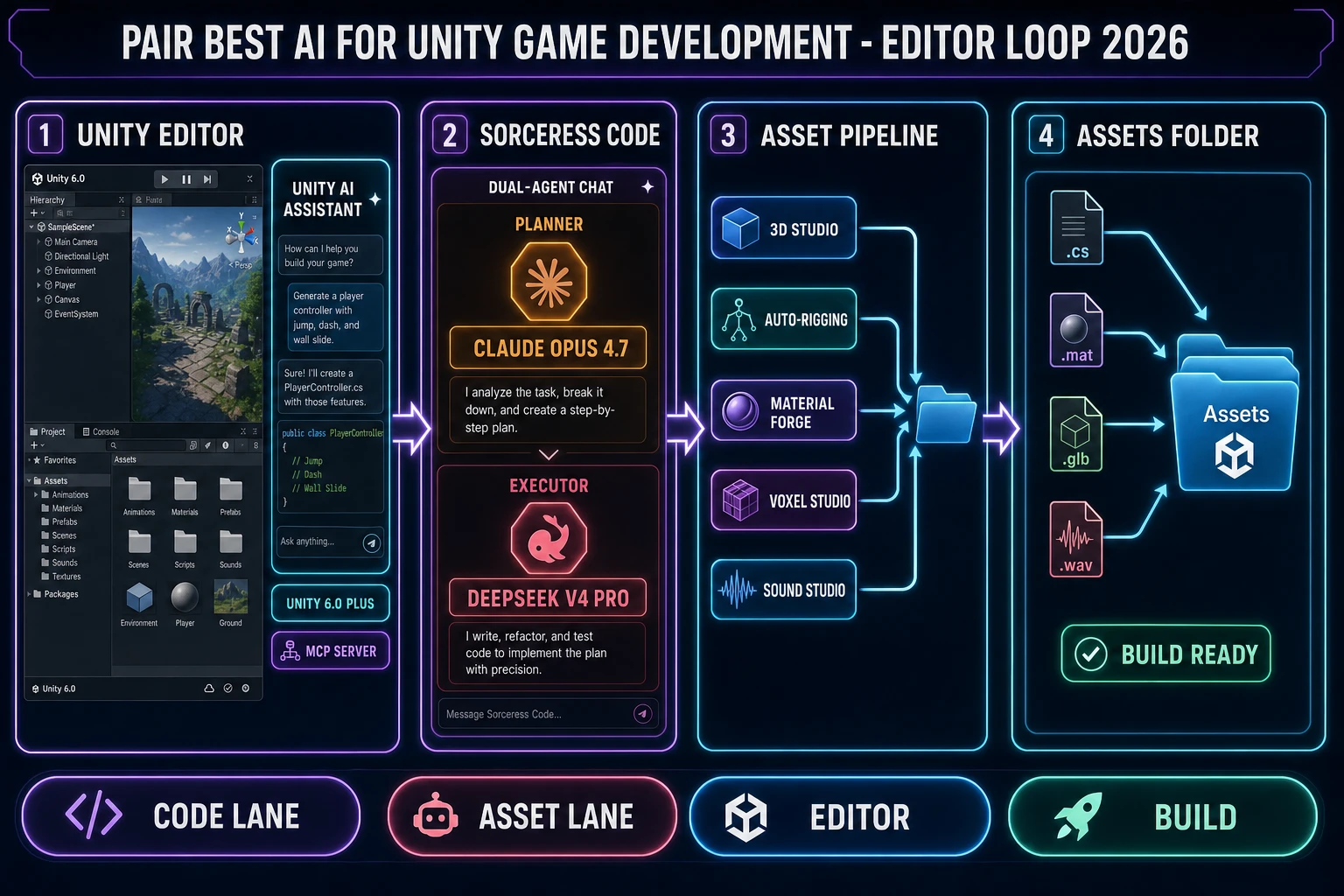
Unity's own in-editor AI Assistant went to open beta in 2026 on Unity 6.0 and later. It runs inside the Unity Editor rather than in a browser tab, which is what makes it the Editor half of the "Editor Loop" title. Verified 2026-09-09 on unity.com/features/ai and unity.com/blog/unity-ai-how-to-get-started, the Assistant reads the live scene graph, GameObjects, components, installed packages, and target platform in real time, and routes to third-party frontier models through the Unity Cloud AI Gateway. The three modes are Ask (Q&A), Plan (multi-step scaffolds), and Agent (write files, edit components, run the scene). The MCP Server sits behind it and lets external IDEs read Unity project state.
Pricing verified 2026-09-09: Personal Edition gets a 14-day 1,000-credit trial that converts to 10 USD per month for 1,000 credits. Pro, Enterprise, and Industry subscribers get the Assistant, AI Gateway, and MCP Server access included with their existing seats plus a monthly credit allotment. Overage credit bundles are purchasable. Third-party model calls routed through the AI Gateway with your own Anthropic, OpenAI, or Google API key do not consume Unity credits - the Unity subscription pays for the Editor integration, the AI Gateway hosting, and the MCP Server. Unity Muse (the earlier deprecated product line) has been fully replaced by the AI Assistant. It requires Unity 6.0 or newer; it is not backwards compatible.
The role Unity's Assistant plays in the two-lane rig is narrow and important: it is the Editor-native scripting seat. If you are debugging a physics collision in Play Mode, the Assistant reads the Rigidbody component values and the collision layer matrix and can propose a change without the developer copy-pasting anything into a browser tab. That is the Editor-integration advantage. What it does not do is generate a rigged 3D character, bake a PBR material, or produce a .wav music bed - those live in the asset lane.
The Sorceress code lane - WizardGenie planner plus Sorceress Code executor
The Sorceress code lane runs in a browser tab or the desktop WizardGenie Electron app. Its structural advantage over the in-Editor Assistant is the eight-model rotation and the planner-plus-executor split. Verified 2026-09-09 in src/app/_home-v2/_data/tools.ts lines 766-775, the CODING_MODELS array is exactly eight seats with color-coded accents that render in the Sorceress model picker across every page.
| Model | Provider | Sorceress tag | Right-now seat for Unity |
|---|---|---|---|
| Claude Opus 4.7 | Anthropic | Top tier | Planner default - dense component graphs, cross-file refactor plans |
| Claude Sonnet 4.6 | Anthropic | Fast + smart | Planner shoulder - same tokenizer as Opus 4.7, cheaper per token |
| GPT-5.5 | OpenAI | Frontier | Planner - Prefab + ScriptableObject + Job System cross-cuts |
| Gemini 3.1 Pro | 1M context | Planner - session-five refactor across nine Unity scripts | |
| DeepSeek V4 Pro | DeepSeek | Budget | Executor default - typing the C# the planner drafted |
| Kimi K2.5 | Moonshot | 256K coding | Executor - when scene graph plus code blows past 100K tokens |
| Grok 4.2 | xAI | 2M context | Planner - when the whole Unity project pastes in one prompt |
| MiniMax M2.7 | MiniMax | Agent-ready | Executor - open file, patch, save, run tests, report loops |
The right-now Unity pair on 2026-09-09 is Claude Opus 4.7 as planner plus DeepSeek V4 Pro as executor. Opus 4.7 sits at Anthropic Top tier pricing ($5 input / $25 output per MTok), verified 2026-09-09 on the Anthropic pricing page which lists Opus 4.7 alongside Opus 4.8 and Opus 5 on the same tier. DeepSeek V4 Pro sits at roughly $0.27 / $1.10 per MTok on the DeepSeek API, verified 2026-09-09 on the DeepSeek docs which resolve the API alias to DeepSeek-V4-Pro-0813 with Non-Think / Think High / Think Max modes and a 1M context window. The cost ratio between planner and executor lands at roughly one-fifth of a single-frontier session, which is exactly why the Planner + Executor pattern exists.
Sorceress Code is the BYO-key runtime that pairs with WizardGenie. Verified 2026-09-09 in src/app/code/page.tsx, the /code page exposes four provider slots - Anthropic, DeepSeek, OpenAI, NVIDIA - and stores keys only in browser localStorage so they never touch Sorceress servers. That is the path for a Unity indie team already paying Anthropic or DeepSeek directly on a company card.