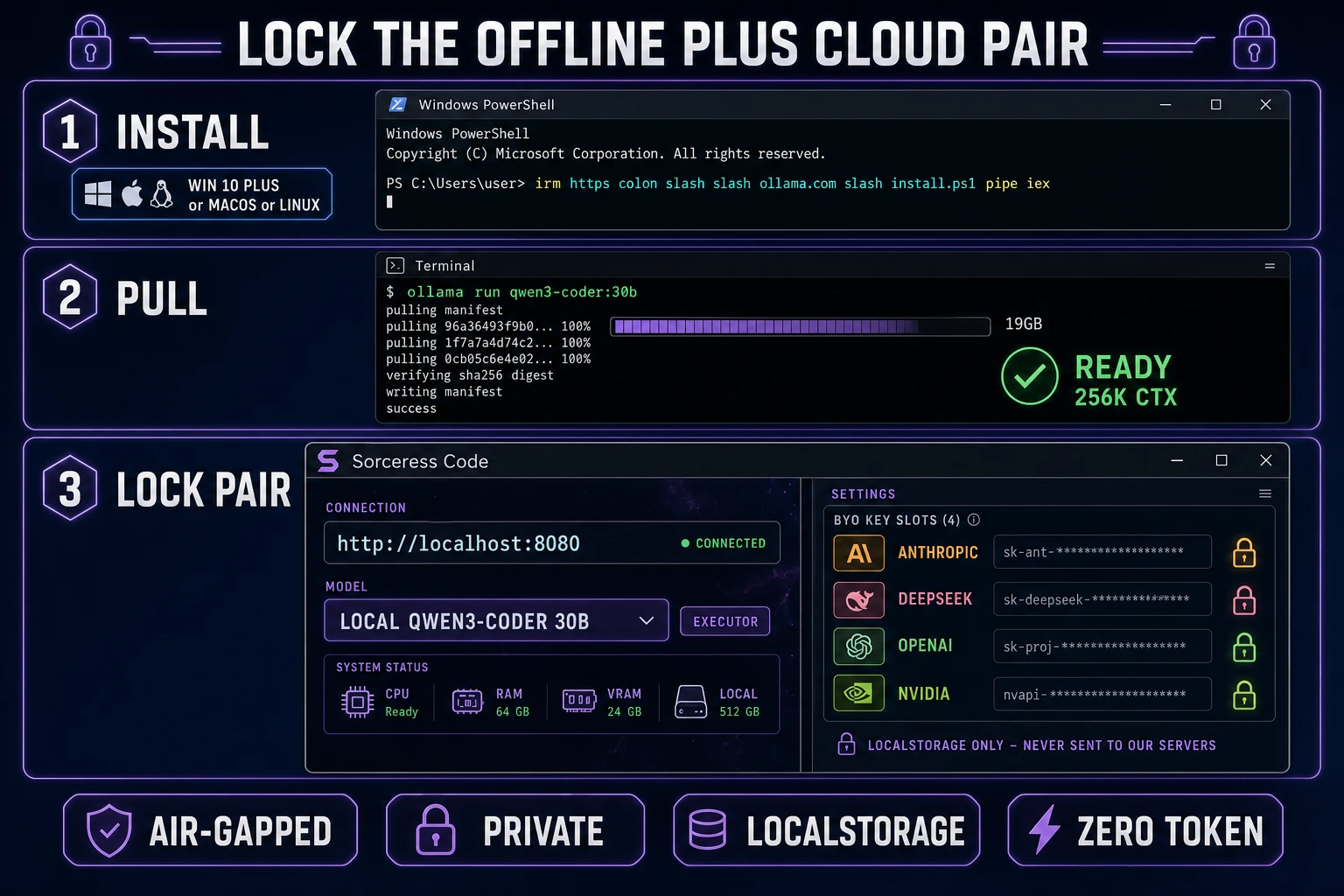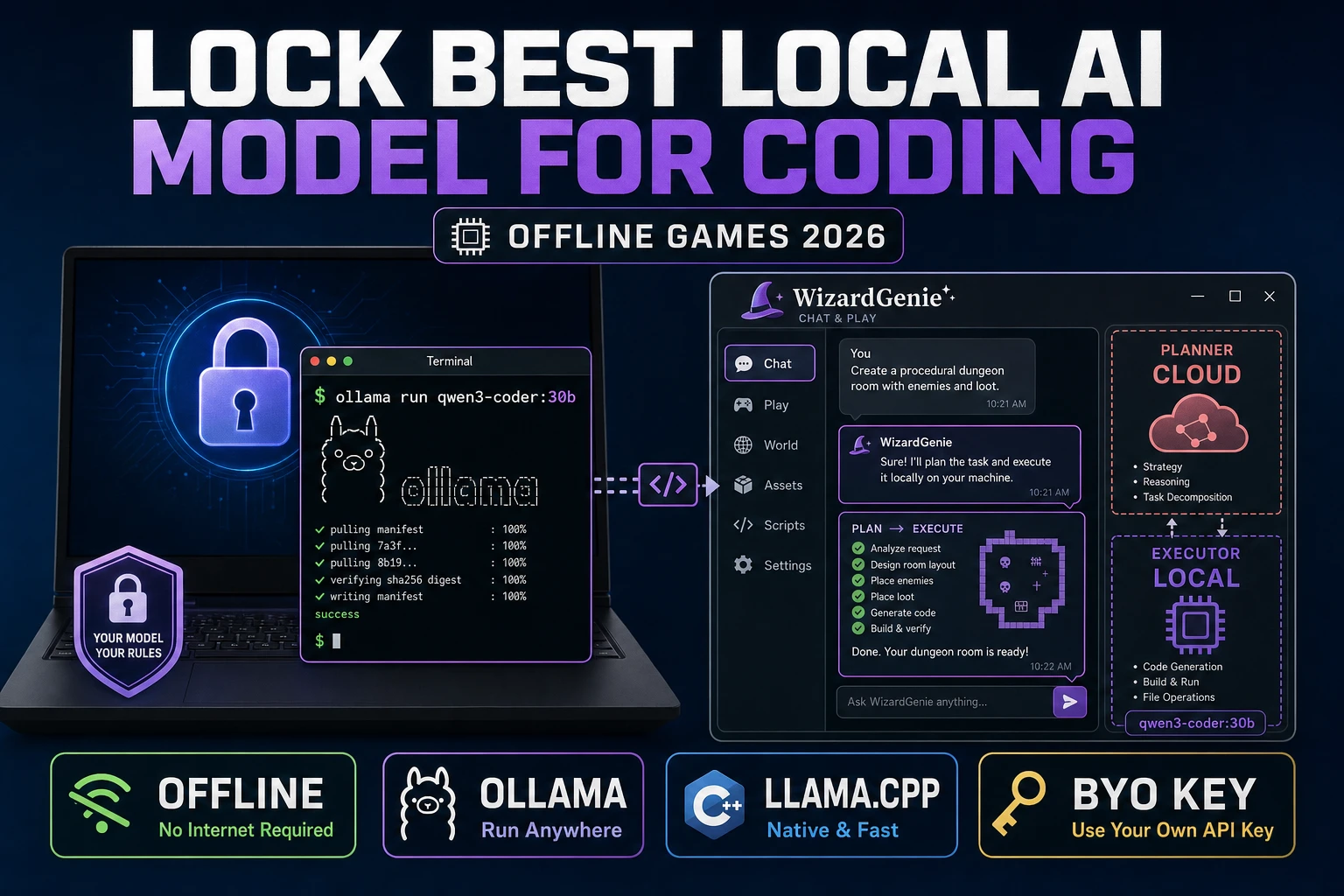
Every jam weekend a growing number of indie devs type best local ai model for coding into a search bar and get back a wall of leaderboards. The 2026 honest answer, verified 2026-09-10 against the Ollama model library and the Sorceress source code, is that the winner is not a single row. It is a locked pair - qwen3-coder:30b running offline through Ollama or llama.cpp on the executor seat for zero-token typing, plus a BYO-key cheap-cloud lane inside WizardGenie and Sorceress Code for the frontier reasoning a 24GB GPU cannot host. This post explains what to lock in each seat, on which rig, and how the pair pays off across a real game-dev day. Every number below was re-checked against a live vendor doc or the Sorceress source on 2026-09-10.
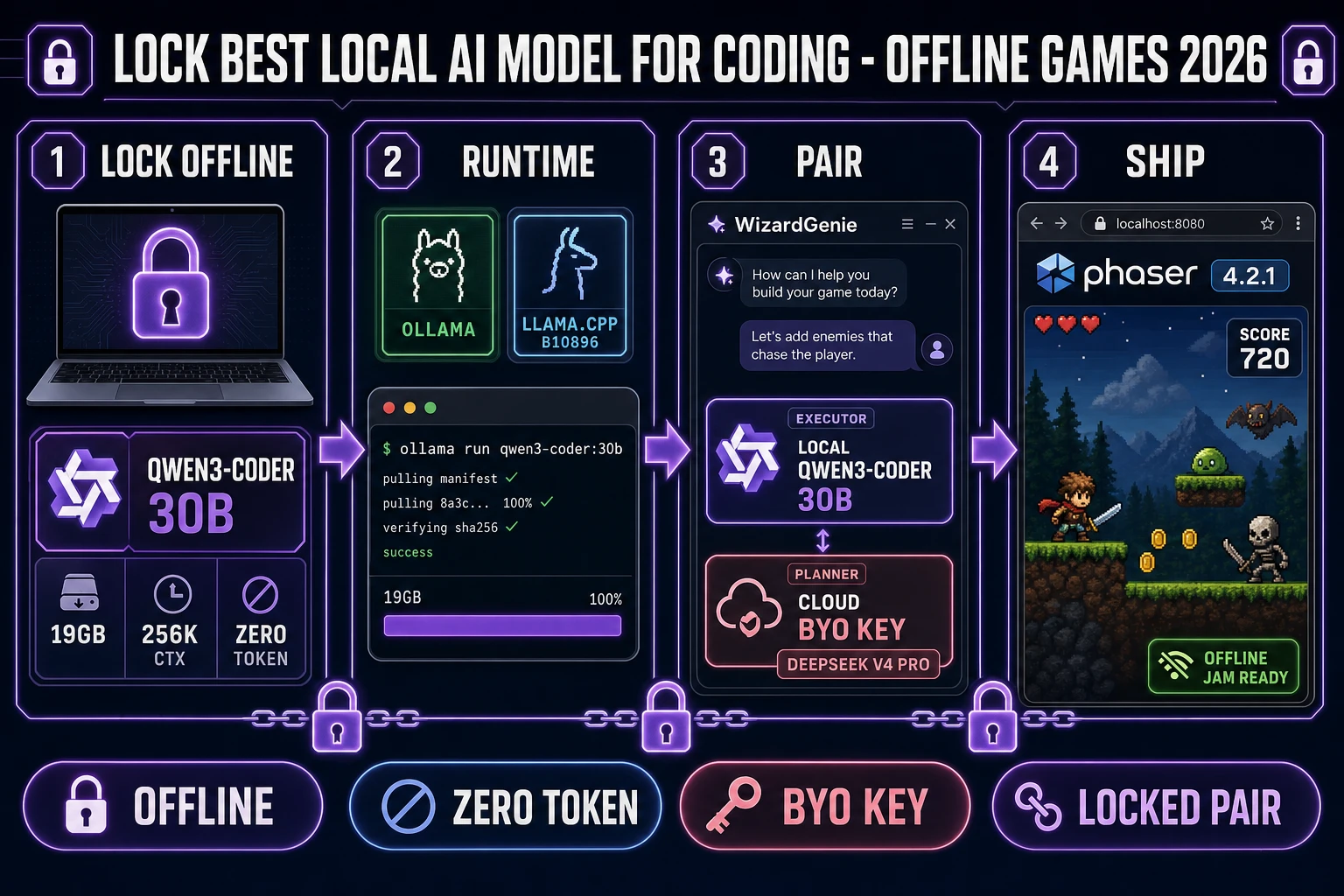
What "local" actually means when you type best local AI model for coding
The phrase best local ai model for coding hides three overlapping meanings, and mixing them up burns a weekend. Offline means the weights sit on your machine and the network can be off - the usual stack is Ollama or llama.cpp plus an open-weight model such as qwen3-coder or gpt-oss. Self-hosted means you run the inference server, but the model can still be a huge open-weight like deepseek-v3.1:671b that only fits on a workstation-class rig. Logically local means the code and keys stay inside your own account - the pattern that Sorceress Code uses, where anthropic, deepseek, openai, and nvidia keys live only in localStorage and never touch Sorceress servers.
All three answers are legitimate on 2026-09-10, and each one wins a different sub-query. The rest of this piece scores them against the four coding jobs a real jam has to grind through: single-variable feel fixes, HUD copy, cross-file scaffolds, and long-horizon agent runs. Every row of scoring cites either an Ollama model card, a llama.cpp release tag, a vendor pricing page, or the Sorceress source itself - no leaderboard screenshots.
The local-first best local AI model for coding families on Ollama in 2026
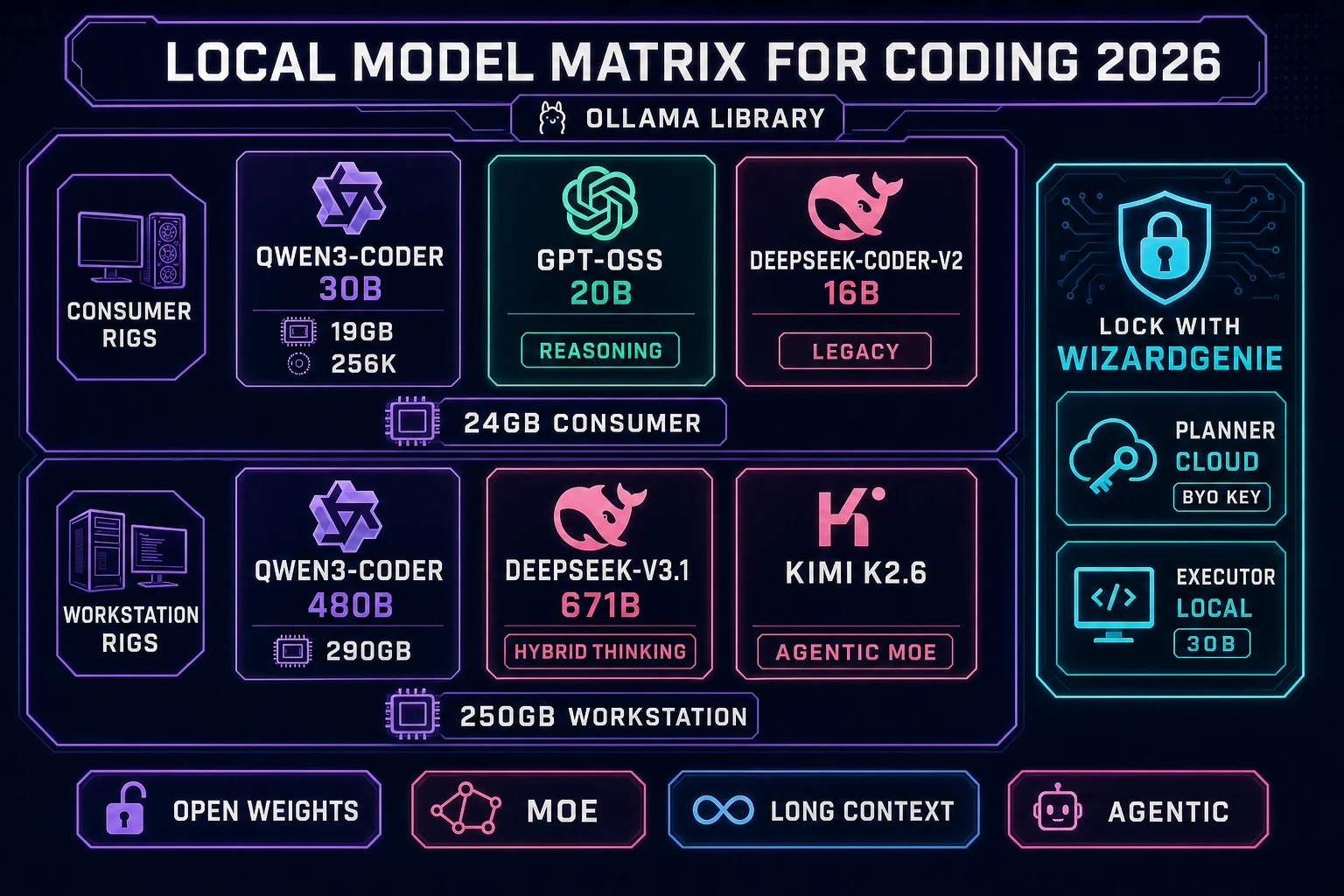
The names and sizes below come from the Ollama library entries verified 2026-09-10, not from memory. The parent library on GitHub sits at 180,572 stars on the same day and advertises support for Kimi-K2.6, GLM-5.2, MiniMax, DeepSeek, gpt-oss, Qwen, and Gemma. Pick the row that matches your rig, not the row that trended on Twitter last week.
| Model | Params (total / active) | Download size | Context | Best fit |
|---|---|---|---|---|
| qwen3-coder:30b | 30B / 3.3B MoE | 19GB | 256K native (1M with extrapolation) | Default offline executor for game code on a 24GB GPU or 32GB Apple Silicon |
| qwen3-coder:480b | 480B MoE | 290GB | 256K native | Workstations with 250GB or more of memory - long-horizon coding |
| gpt-oss:20b | 20B | Fits a 24GB GPU | Standard | Reasoning-heavy scaffolds when Qwen falters |
| gpt-oss:120b | 120B | Workstation-class | Standard | Larger open-weight reasoner for frontier passes without a cloud key |
| deepseek-v3.1:671b | 671B hybrid thinking / non-thinking | Workstation-class | Standard | Alternate offline reasoner when Qwen and gpt-oss disagree |
| kimi-k2.6 | Native multimodal agentic MoE | Workstation-class | Long | Long-horizon coding with vision inputs (screenshots as prompts) |
| kimi-k2.7-code | K2.6 base tuned for code | Workstation-class | Long | Roughly 30 percent fewer thinking tokens than K2.6 on identical tasks |
| deepseek-coder-v2:16b | 16B MoE | Consumer-class | Standard | Legacy fallback when a fresh qwen3-coder pull is not possible |
qwen3-coder:30b is the default lock because the 3.3B activated MoE routes cheaply enough to type single-variable feel fixes without stalling a 24GB card. The 480B sibling is the same architecture at workstation scale - the Ollama model card lists a 250GB memory minimum for local inference. gpt-oss:20b is the honest alternate when the task is reasoning-shaped instead of typing-shaped. For a plain-English primer on why 30B / 3.3B activated beats a dense 13B on the same VRAM budget, the Wikipedia entry on large language models is a good non-vendor reference to share with a teammate.
Local runtimes: Ollama and llama.cpp on 2026-09-10
Two runtimes matter for the best local AI model for coding lock in 2026. Ollama is the fast path - one installer, one ollama run command, an OpenAI-compatible REST endpoint at http://localhost:11434/v1. The GitHub repo lists 180,572 stars on 2026-09-10 and advertises out-of-the-box support for Kimi-K2.6, GLM-5.2, MiniMax, DeepSeek, gpt-oss, Qwen, and Gemma. That is the seat to lock when you want a zero-touch executor lane ready in five minutes.
llama.cpp is the deeper path - a raw C++ inference engine with per-quant control over KV cache, batch size, and offload strategy. Release b10896 tagged 2026-09-10 ships CPU builds for Ubuntu (x64, arm64, s390x), macOS Intel and Apple Silicon (arm64), Android arm64, and Windows (x64, arm64), plus GPU builds for CUDA 12 and 13, ROCm 10.0, Vulkan, OpenVINO, SYCL FP32 and FP16, Metal via xcframework, and OpenCL Adreno on Windows arm64 - plus the openEuler 310p and 910b targets. Locking llama.cpp instead of Ollama pays off when the workflow needs a specific quant, a specific KV-cache layout, or a genuinely air-gapped deployment where the Ollama daemon is not allowed to run.
Either runtime works for the executor seat. Retest whichever one you lock at the start of every jam - the release cadence on both is aggressive enough that a quant that ran clean last month can regress on the next tag.
Hardware brackets: which lock fits your rig
Sizing matters more than model choice on the local seat. The bracket below matches an Ollama tag to the honest minimum VRAM or unified memory for a working coding loop, not the marketing-page minimum for a single-shot demo.
| Bracket | Rig | Recommended lock | Working context ceiling |
|---|---|---|---|
| Laptop, 16GB unified memory | Apple Silicon M2 / M3 Pro, entry Windows arm64 | deepseek-coder-v2:16b or gpt-oss:20b (Q4) | ~16K tokens practical |
| Consumer GPU, 24GB VRAM | RTX 4090, RTX 5080 Ti, RX 8900 XTX | qwen3-coder:30b (Q4) | ~32K tokens practical |
| Apple Silicon workstation, 64GB unified | M3 Max / M4 Pro 64GB | qwen3-coder:30b (Q6) or gpt-oss:120b (Q4) | ~64K tokens practical |
| Dual-GPU workstation, 96GB total VRAM | 2x RTX 6000 Ada, 1x H100 | gpt-oss:120b (Q5) or deepseek-v3.1:671b (Q3) | 128K plus with tensor parallel |
| Workstation, 250GB unified memory | M3 Ultra / server-class | qwen3-coder:480b or kimi-k2.6 | 256K native |
Two honest reads. First, if the rig is not on this list, the local lock is probably wrong and the cheap-cloud BYO-key lane is the honest answer. Second, the "working context ceiling" column is the practical value with a system prompt, three source files, and a scratch buffer already loaded - not the theoretical 256K or 1M number in the model card. If a paste is bigger than the rig can hold, do not force the local seat to swap - flip to Gemini 3.1 Pro Preview inside Sorceress Code at $2 input / $12 output per MTok for prompts up to 200k tokens and $4 / $18 above that (verified 2026-09-10 on ai.google.dev/gemini-api/docs/pricing).