Leap How to Make a 2D Platformer in Godot (Jump Loop 2026)

By Arron R.10 min read
How to make a 2D platformer in Godot 4.7.2: wire CharacterBody2D with a 96-pixel apex and 0.35s time-to-apex, lay a TileMapLayer level, pack a hero frame set in

When an indie dev types how to make a 2d platformer in godot into Google, two problems sit behind the query. The first is engine mechanics: how do you wire a hero that runs, jumps, falls, and lands on tiles that actually collide? The second is the art pipeline: a platformer with an idle, a run, a jump, a fall, a hurt, a coin, and one enemy archetype is roughly twenty-five frames before the hero can leave the first screen. Most hobby projects stall on the frames, not the physics. This guide walks the Godot 4 node tree for a 2D platformer, pins down the jump math that actually feels right, and wires an AI sprite and audio path so the frame tax does not kill the project.
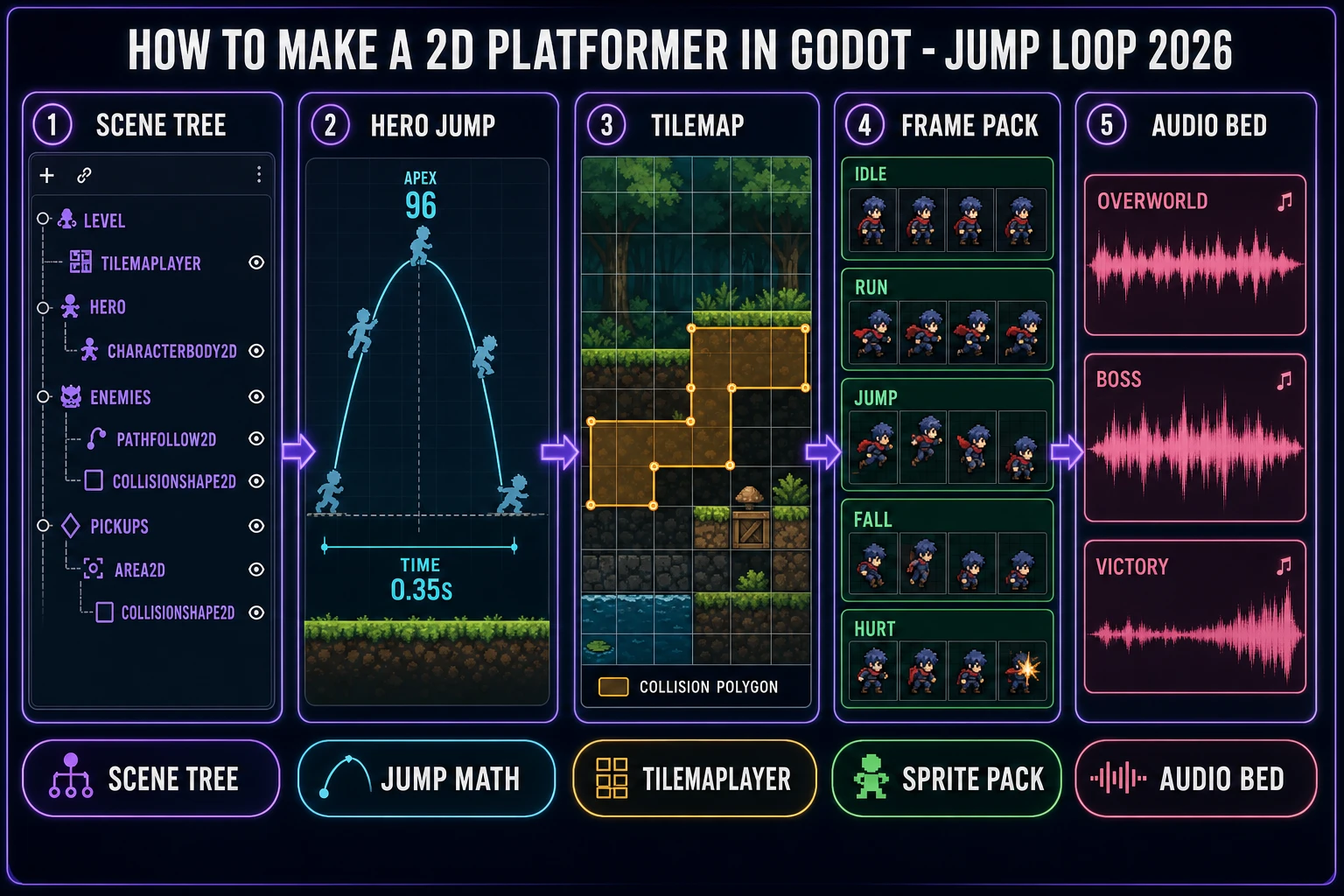
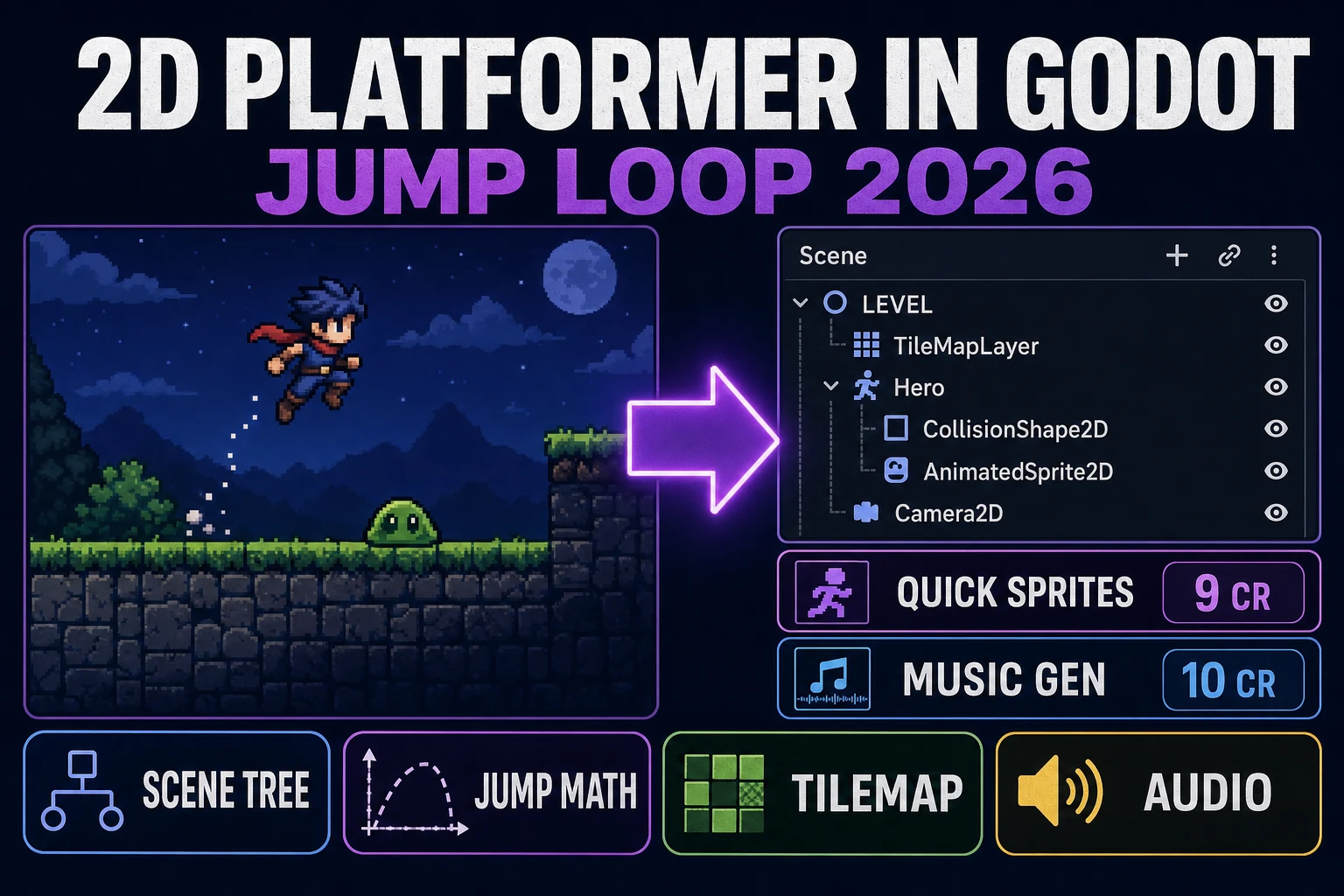
How to make a 2d platformer in godot pipeline: scene tree, hero jump, tilemap, sprite pack, audio bed
How to make a 2D platformer in Godot as one loop: scene tree, jump math, tilemap, frames, audio.

What how to make a 2d platformer in godot searchers actually want

DataForSEO lists how to make a 2d platformer in godot at 50 searches per month with a Keyword Difficulty of 0 (verified 2026-10-01 in tools/research-supplement.md). Neighbor phrases like godot 2d platformer tutorial, how to make a platformer in godot, and godot platformer jump sit in the same cluster, so one honest how-to on the “in Godot” path answers them all without a second cannibalizing post.

The audience is narrower than the Scratch or Unity equivalents. These are devs who already installed Godot — stable release 4.7.2, shipped August 18, 2026, per the Godot engine Wikipedia page (verified 2026-10-01) — and they already made the cat-moves-with-arrow-keys demo. They want the next step: a proper platformer loop with gravity, variable jump height, a tilemap, and the kind of coyote time that keeps the controls from feeling cheap. For a general-purpose Godot 2D intro, see the sibling post how to make a 2D game in Godot. This page is specifically how to make a 2d platformer in godot — the jump-loop angle.

The platformer loop in Godot 4's node tree

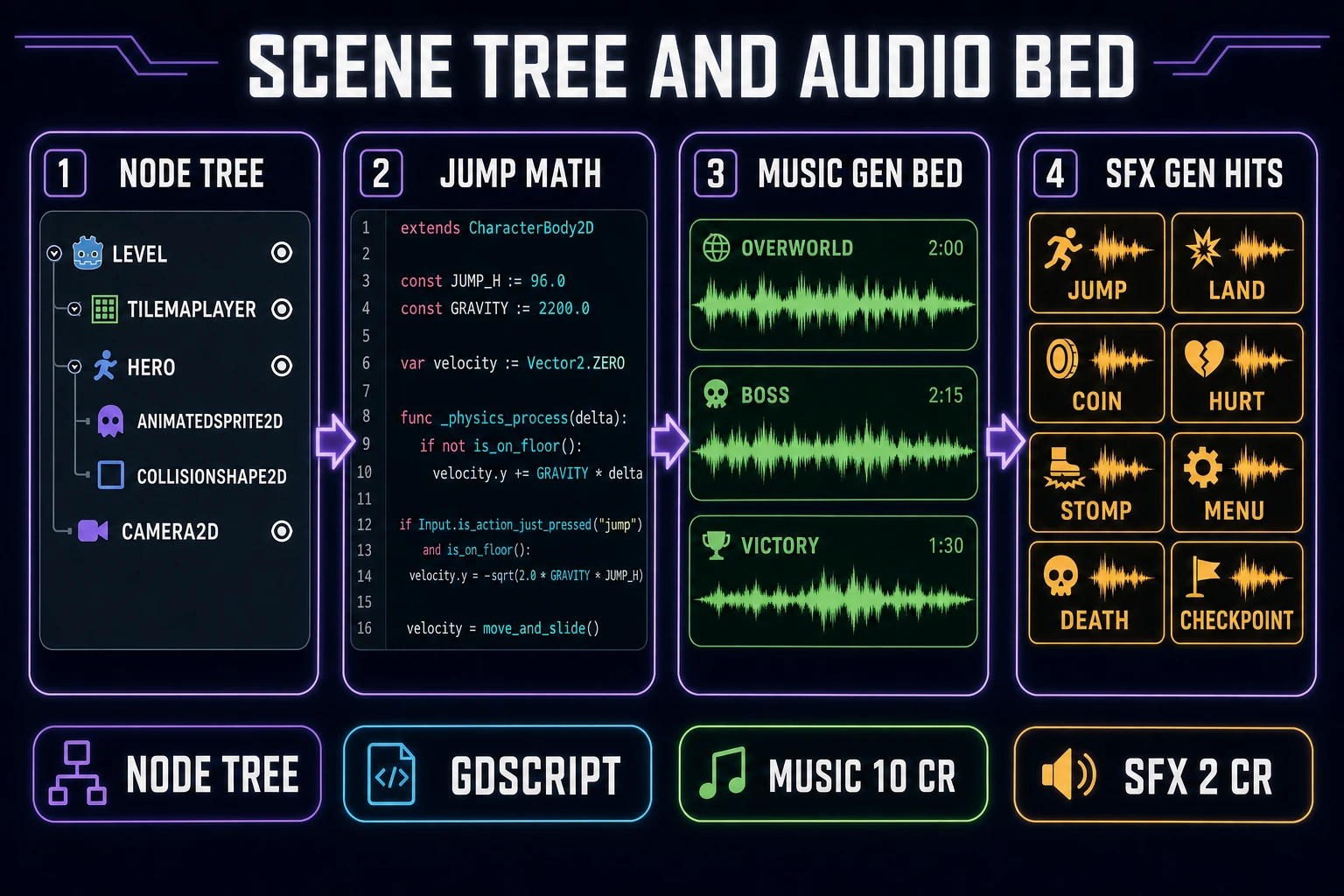
Godot organizes a game as a tree of nodes grouped into reusable scenes (confirmed on the Wikipedia Godot entry above). A minimum 2D platformer runs on a tight set of nodes. The scene tree looks like this:

  • Level (Node2D) — the root.
  • TileMapLayer — the dungeon or forest geometry; one layer per visual pass (background, collision, foreground).
  • Hero (CharacterBody2D) — a kinematic body with move_and_slide; the hero's physics live here.
    • AnimatedSprite2D — plays the idle, run, jump, fall, and hurt frame strips.
    • CollisionShape2D — a capsule or rectangle that defines the hero's physical bounds.
    • Camera2D — follows the hero with a soft-smoothing lerp.
  • Enemies (Node2D group) — a parent node holding each enemy as its own CharacterBody2D.
  • Pickups (Area2D) — coins, keys, and jump pads register as areas, not bodies, so the hero passes through them while triggering a signal.
  • UI (CanvasLayer) — HP hearts, coin count, and a pause overlay rendered above the world.

Godot 4 replaced the old KinematicBody2D with CharacterBody2D and promoted move_and_slide to a method that reads a built-in velocity property, so the input loop reads tighter in 4.x code than in 3.x tutorials. If a tutorial you are reading still passes a velocity argument into move_and_slide(velocity), it is 3.x code — stop and find a 4.x source, because the signatures diverged.

Lock a hero sprite sheet before you open the scene editor

The art pipeline is where platformer projects die. Before you drop a single node, decide the hero animation set. A minimum 2D platformer sheet that still reads as polished looks like this:

  • Idle — 4 frames, breathing loop.
  • Run — 6 frames, side-view cycle.
  • Jump — 3 frames: crouch, takeoff, airborne.
  • Fall — 2 frames, airborne descent.
  • Hurt — 2 frames, knockback flinch.
  • Attack — 3 frames if the hero has a melee, optional.
  • Coin or pickup — 4 frames, rotating.
  • Enemy archetype — 2 idle, 4 walk, 2 hit — 8 frames.

Count the frames and a minimum sheet lands around twenty-eight. That is a weekend of pixel art if you hand-draw every frame. The AI sprite path on Sorceress collapses it into a credit-costed afternoon. Name files before you leave the generator — hero-idle-01.png, hero-run-01.png, and so on — because Godot's AnimatedSprite2D imports frames in file-name order and messy naming becomes messy animation at play time.

For sibling framing on the sheet-before-code habit, see how to make a sprite sheet and the Godot-specific sprite sheet for Godot write-up. Both bake in the same discipline this section wants.
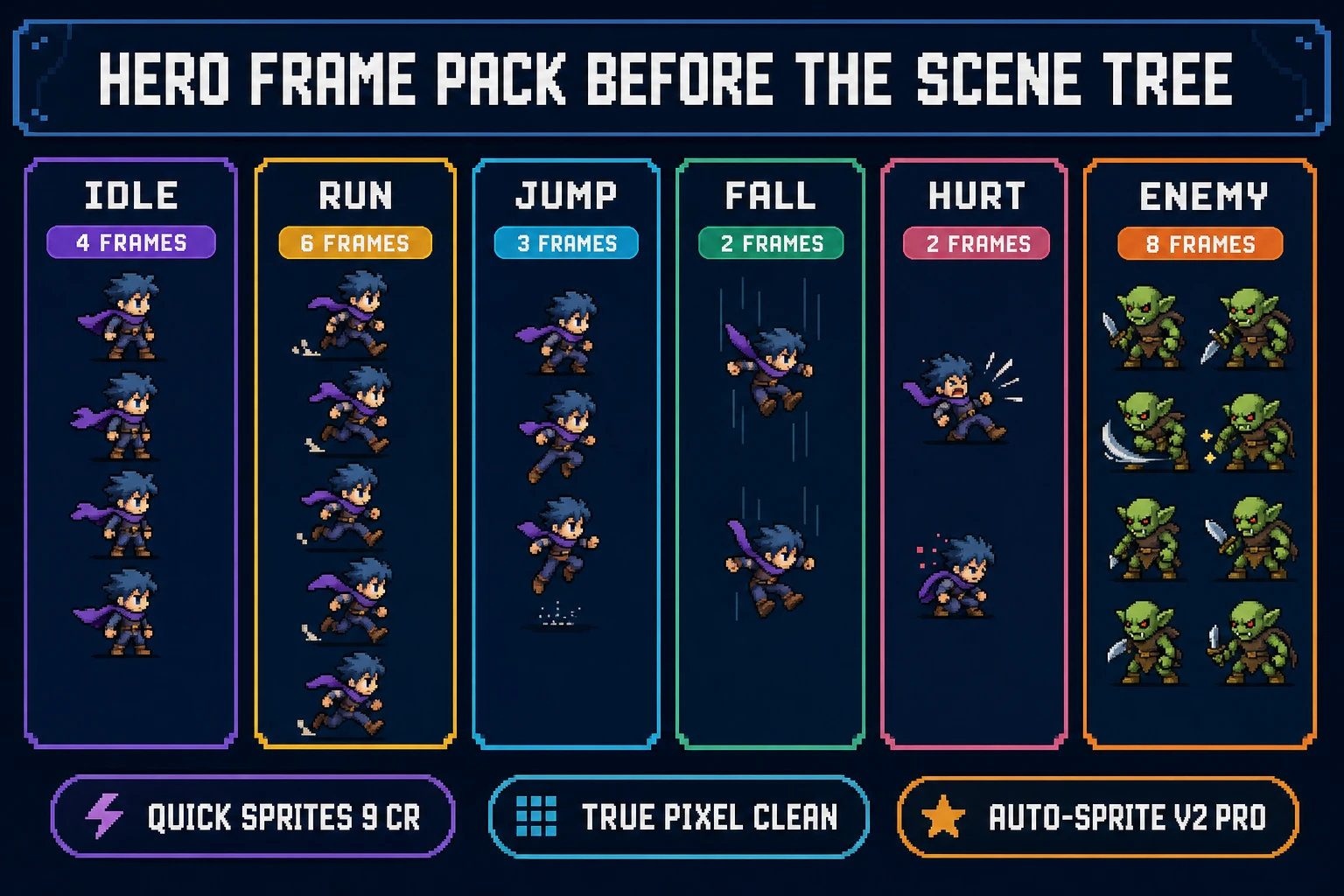
Hero sprite sheet checklist for how to make a 2d platformer in godot: idle, run, jump, fall, hurt, enemy
Lock the hero and enemy frame counts before you spend credits on a second redesign.

CharacterBody2D jump math that feels right

A platformer jump is not velocity.y = -400. It is a derived number from three design choices: how high you want the apex, how long you want the hero in the air, and how fast gravity should pull them back. Pick the apex in pixels and the time to apex in seconds, and gravity falls out of the equations.

The physics come from the platform game genre's standard model (verified 2026-10-01 on Wikipedia). The jump height is h, the time to apex is t_a, the gravity is g = 2h / t_a^2, and the initial jump velocity is v_0 = -2h / t_a. Pick h = 96 pixels (three tiles at a 32-pixel grid) and t_a = 0.35 seconds and gravity becomes roughly 1568 pixels per second squared and jump velocity becomes roughly minus 549 pixels per second. Those are game-feel numbers, not textbook numbers — tune them.

In GDScript on a CharacterBody2D node:

extends CharacterBody2D

const JUMP_H := 96.0
const JUMP_T := 0.35
const GRAVITY := 2.0 * JUMP_H / (JUMP_T * JUMP_T)
const JUMP_V := -2.0 * JUMP_H / JUMP_T
const RUN_SPEED := 180.0

var coyote := 0.0
var jump_buf := 0.0

func _physics_process(delta: float) -> void:
    velocity.x = Input.get_axis("left", "right") * RUN_SPEED
    velocity.y += GRAVITY * delta
    coyote = max(0.0, coyote - delta)
    jump_buf = max(0.0, jump_buf - delta)
    if is_on_floor():
        coyote = 0.1
    if Input.is_action_just_pressed("jump"):
        jump_buf = 0.1
    if jump_buf > 0.0 and coyote > 0.0:
        velocity.y = JUMP_V
        coyote = 0.0
        jump_buf = 0.0
    if Input.is_action_just_released("jump") and velocity.y < 0.0:
        velocity.y *= 0.4
    move_and_slide()

Coyote time (the 0.1-second window after walking off a ledge during which a jump still fires) and jump buffering (the 0.1-second window before landing during which an early jump press still fires on landing) are the two single most impactful quality-of-life tweaks a platformer can ship. Variable jump height — cutting velocity.y to 40% on button release — is the third. Without those three, the hero controls will feel cheap no matter how good the art is.
TileMapLayer and the collision shape habit

Godot 4.3 introduced TileMapLayer, which replaced the single monolithic TileMap node with one node per visual layer (confirmed on the Wikipedia Godot entry — the version lineage of Godot 4.x is tracked in the Features section). Each layer is its own node with its own tileset, its own z-index, and its own collision configuration. A platformer typically wants three layers: background decoration (no collision), level geometry (physics collision), and foreground props (no collision, draws above the hero).

Open the TileSet resource and define each tile as a cell. For every tile that should block the hero, enable the physics layer and draw a collision polygon that covers the solid area. Thin platforms get a single top-edge polygon; one-way platforms toggle the one_way_collision flag so the hero can jump up through them from below. The Camera2D on the hero should set limit_left, limit_right, limit_top, and limit_bottom to clamp the view to the TileMapLayer's extents — otherwise the camera scrolls past the level edge and shows unpainted void.

Paint the tiles with the TileMap paint tool. Save the TileSet as its own .tres resource — one tileset per biome, reused across every level scene in that biome. The import habit matches the one the sibling post how to make a 2D game in Godot baked in: never paint onto a tileset you have not yet named and saved to disk.

Quick Sprites and Auto-Sprite v2 for frames and enemies

Open Quick Sprites for the fast lane. The page sets CREDITS_PER_GEN = 9 in src/app/quick-sprites/page.tsx (verified 2026-10-01), so one generation is nine credits — nine US cents at CREDITS_PER_DOLLAR = 100 defined in src/lib/models.ts. Prompt the hero with the same style anchor every time (“chunky 16-bit side-view platformer hero, forest-tinted palette, no text in image”) and swap only the pose line between runs. Treat idle, run, jump, fall, and hurt as five separate jobs rather than one sheet that tries to carry all five.

Cost math on the frame set above: hero at 5 pose generations is 45 credits, one enemy archetype at 3 pose generations is 27 credits, pickup rotation at 1 generation is 9 credits — the whole platformer frame pack lands around 81 credits, or $0.81 at the public rate. The SIGNUP_GRANT = 100 credit new-account bonus covers the entire art tax before you spend a dollar.

When a Quick Sprites output comes back close but not quite game-ready, send it to True Pixel for the CorridorKey pixel-art backend (per src/app/pixel-art/page.tsx, verified 2026-10-01). You can also sketch the hero concept in AI Image Gen first with Nano Banana 2, GPT Image 2, or Seedream 5 Lite, then push the reference back into Quick Sprites to lock the look. For motion sheets that need to start from a short video clip rather than a static image, Auto-Sprite v2 is the Pro three-step pipeline: AI image, AI video, clean sprite sheet. The sibling write-up at AI sprite generator walks the atlas framing in detail.

Import habit for Godot: drop every PNG into the project's res://sprites/ folder. Create an AnimatedSprite2D node, open its sprite_frames resource, create animations named idle, run, jump, fall, and hurt, then drag the right PNGs into each. The hero's _physics_process switches $AnimatedSprite2D.animation based on velocity: zero horizontal and on floor becomes idle, nonzero horizontal and on floor becomes run, negative vertical becomes jump, positive vertical becomes fall.

Godot platformer scene tree and audio bed for how to make a 2d platformer in godot
Scene tree carries the hero, enemies, and level; Music Gen scores the biome, SFX Gen punches the jump.

Music Gen and SFX Gen for the jump-loop audio bed

A platformer audio bed is leaner than an RPG's. A minimum pack is three tracks and roughly ten sound effects:

  • Overworld theme — loopable, 60–90 seconds, bright and brave.
  • Boss or hazard theme — tempo spike, 60 seconds, loopable.
  • Victory stinger — 10-second one-shot that fires on level complete.
  • SFX — jump, double-jump (if used), land, coin, hurt, enemy stomp, menu move, menu select, death, checkpoint.

Open Music Gen for the three themes. The base generation cost is MUSIC_CREDIT_COST = 10 credits (verified 2026-10-01 in src/app/music-gen/page.tsx). WAV conversion is a separate 2-credit step, lyrics are 2 credits, and MIDI export is 15. The whole three-track music bed lands at 30 credits before conversions. Download as MP3 or convert to WAV and drop files into a res://music/ folder. Load each on an AudioStreamPlayer node with stream_loop_mode set to FORWARD for the loopable themes.

For the ten SFX, open SFX Gen. The Suno Sounds path costs SUNO_SOUNDS_CREDIT_COST = 2 credits per generation (verified 2026-10-01 in src/app/sfx-gen/page.tsx); the seed-audio path bills at one credit per second with a one-credit floor. Ten short effects at the Suno rate is twenty credits. Drop the WAVs into res://sfx/ and attach them to AudioStreamPlayer2D nodes on the hero, enemies, and pickups so the sound follows the source's position. Total audio spend for the whole platformer lands near 50 credits — half a dollar.

Ship, export, and the WizardGenie feel lab

Godot's export system is the one place the engine is still rough for first-time users. Open Project → Export, add a preset (Windows Desktop, HTML5, or Android), point it at the templates (download once, reuse forever), and press Export Project. The MIT license on Godot — confirmed on the Wikipedia Godot entry — means no royalty on the export regardless of revenue, which is a bigger deal than it sounds relative to engines with revenue thresholds.

For a browser build, the HTML5/WebAssembly export produces a folder with index.html, index.wasm, index.pck, and a loader. Upload the whole folder to any static host. The MDN Games reference (verified 2026-10-01) still frames the browser as the viable low-friction game platform in 2026, which is why the HTML5 export is the right first distribution target for a weekend platformer. Classical side-scrollers trace their lineage to the arcade era — the side-scrolling video game Wikipedia entry (verified 2026-10-01) covers the design evolution — so a browser-playable platformer slots directly into the format readers already recognize.

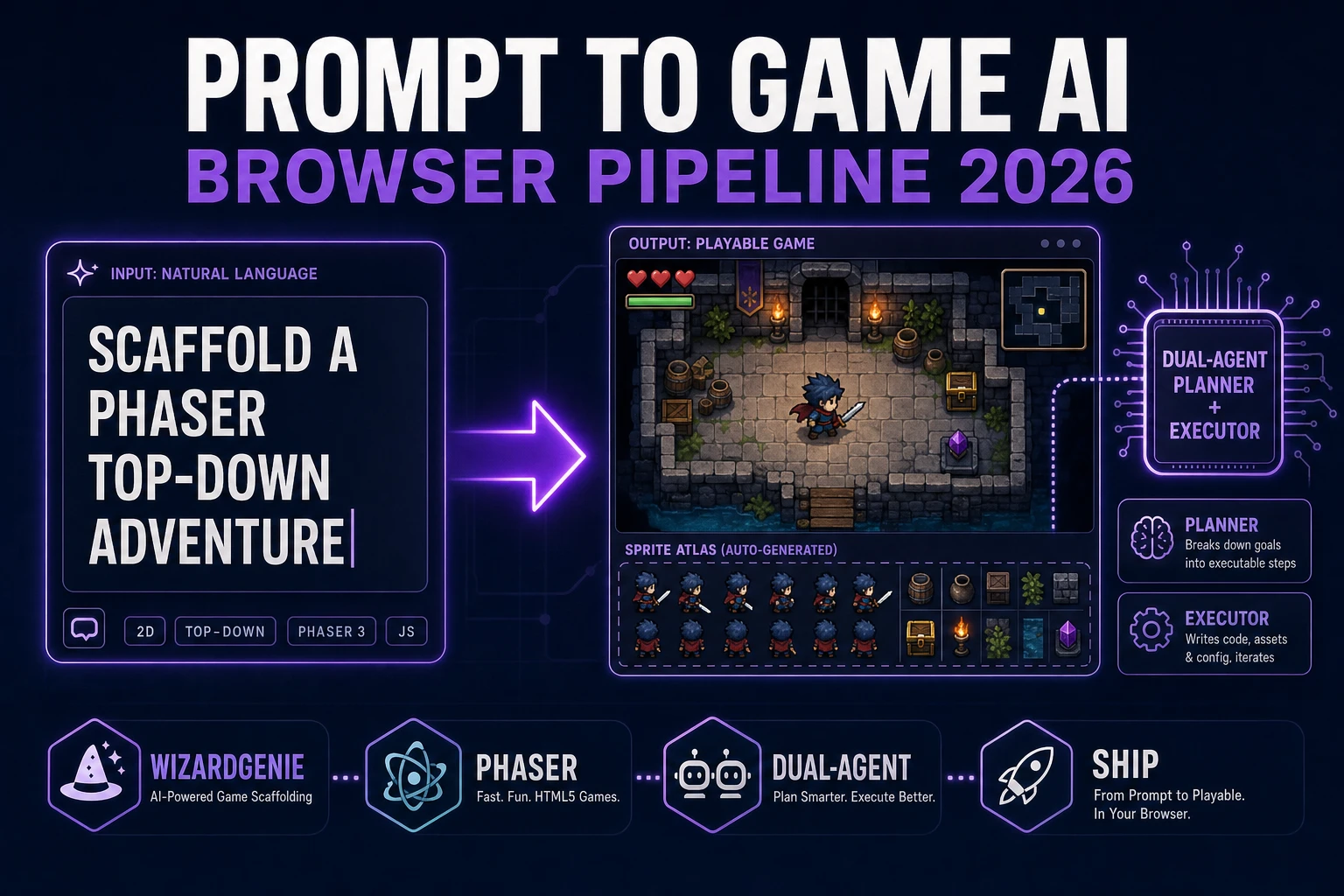
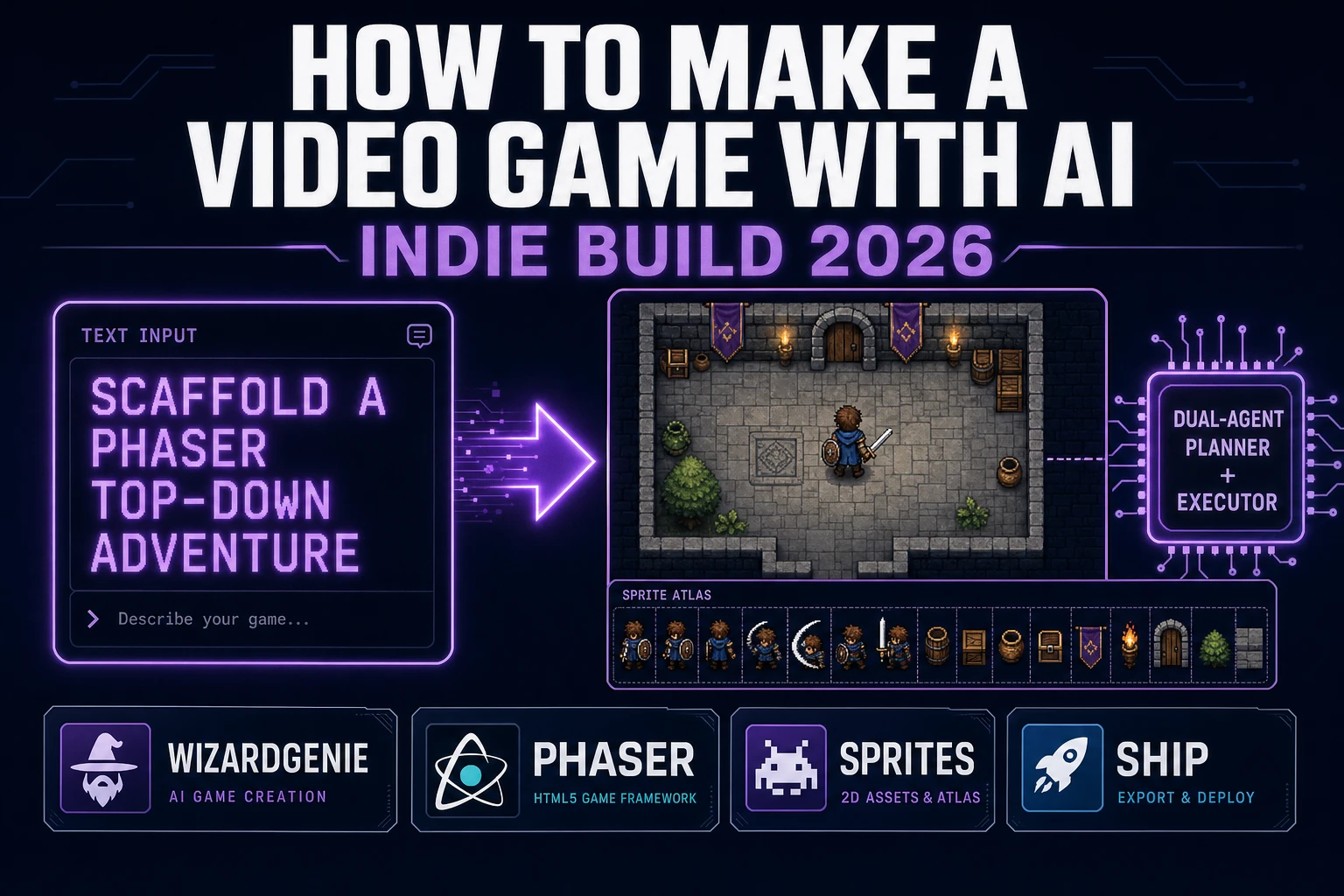
WizardGenie, Sorceress's AI-native game engine, is useful here as a feel lab. Describe the jump mechanic in plain English (“96-pixel apex, 0.35-second time to apex, variable height on release, 0.1-second coyote time, 0.1-second jump buffer”) and WizardGenie writes a browser-playable Phaser prototype that runs the numbers live. Tune the pacing with the actual controls in hand, then transplant the balanced numbers into Godot's GDScript. Godot stays the ship target. WizardGenie stays the feel sandbox.

For the wider Sorceress stack this guide pulled from, see the full tools overview. The AI sprite plus AI audio plus Godot ship path is the shortest route from “I want to make a 2D platformer” to a Godot export an actual player can finish in one sitting. For the Scratch-shaped sibling angle on the same genre, see how to make a platformer in Scratch; for the generic browser-engine take, see how to make a platformer game.

Frequently Asked Questions

What does how to make a 2d platformer in godot actually mean?

How to make a 2d platformer in godot is the search phrasing for a side-scrolling platformer built in Godot Engine, the MIT-licensed open-source engine whose current stable release is 4.7.2 as of August 18, 2026 (verified 2026-10-01 on the Godot game engine Wikipedia page). The minimum feature set is a hero that runs and jumps, a tile-based level with real collision, enemies the hero can touch or stomp, pickups that register on contact, and an export the player can actually run. This guide answers that query with a Godot 4 node tree plus a Sorceress AI sprite and audio path for the frame pack.

What is the current stable Godot version in 2026?

Godot 4.7.2 is the current stable release, published August 18, 2026 (verified 2026-10-01 on the Godot game engine Wikipedia page). The 4.x line replaced KinematicBody2D with CharacterBody2D, replaced the monolithic TileMap with per-layer TileMapLayer nodes starting in 4.3, and made move_and_slide read the built-in velocity property instead of taking it as an argument. If a tutorial you are reading still passes velocity into move_and_slide(velocity), it is 3.x code and will not compile against 4.x without edits.

Should I use GDScript or C# for a Godot platformer?

GDScript for a first platformer. The language is gradually typed, Python-like, and ships with the editor — no extra toolchain. The Wikipedia Godot page notes that statically typed GDScript has been observed to run more than 40 percent faster in release builds (verified 2026-10-01), which is more than enough headroom for a 2D platformer. Pick C# only if the rest of your toolchain is already C# or if you need a specific NuGet dependency. For the HTML5 web export, note the Wikipedia entry caveat that C# is not yet available for the web target.

How many credits does a full AI-asset Godot platformer cost?

A minimum hero and enemy frame pack in Quick Sprites lands around 81 credits (hero at 5 pose generations is 45; one enemy at 3 is 27; a rotating pickup at 1 is 9) at CREDITS_PER_GEN = 9 verified 2026-10-01 in src/app/quick-sprites/page.tsx. A three-track Music Gen bed at MUSIC_CREDIT_COST = 10 credits per track is 30 credits (verified 2026-10-01 in src/app/music-gen/page.tsx). Ten SFX at SUNO_SOUNDS_CREDIT_COST = 2 credits each is 20 credits. Total around 131 credits — $1.31 at the public rate — and new accounts start with SIGNUP_GRANT = 100 free credits that cover most of it.

Where does WizardGenie fit if I am shipping in Godot?

WizardGenie is Sorceress's AI-native game engine: describe the game and it writes, runs, and iterates in real time on web or desktop. Use it as a feel sandbox. Describe your platformer jump in plain English — 96-pixel apex, 0.35-second time to apex, variable height on release, 0.1-second coyote time, 0.1-second jump buffer — and WizardGenie writes a browser-playable Phaser prototype that runs the numbers live. Tune the pacing with actual controls in hand, then transplant the balanced numbers into Godot's GDScript. Godot stays the ship target. WizardGenie stays the feel lab.

Sources

  1. Godot (game engine) - Wikipedia
  2. Platform game - Wikipedia
  3. Side-scrolling video game - Wikipedia
  4. Game development - MDN
Written by Arron R.·2,289 words·10 min read

Related posts