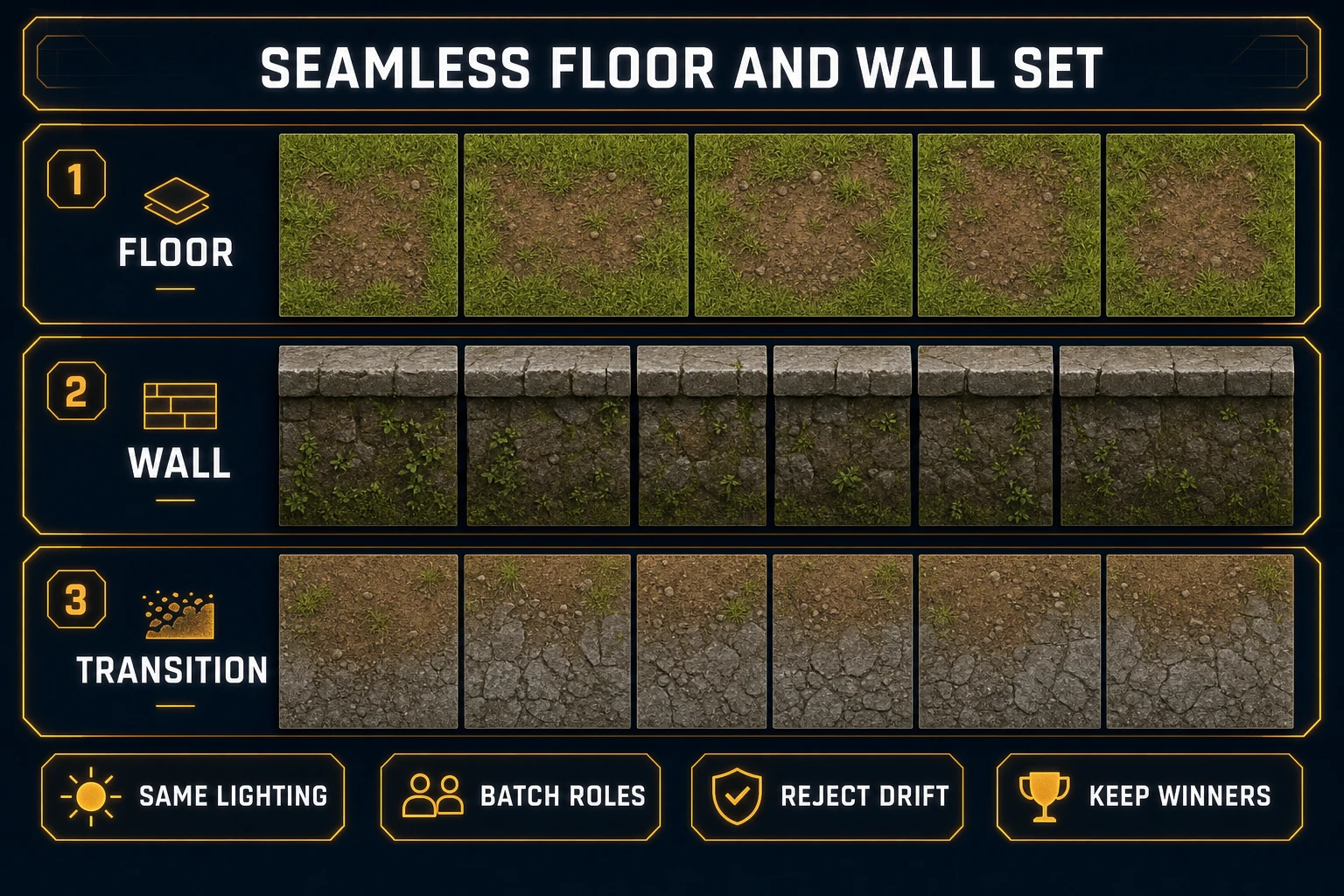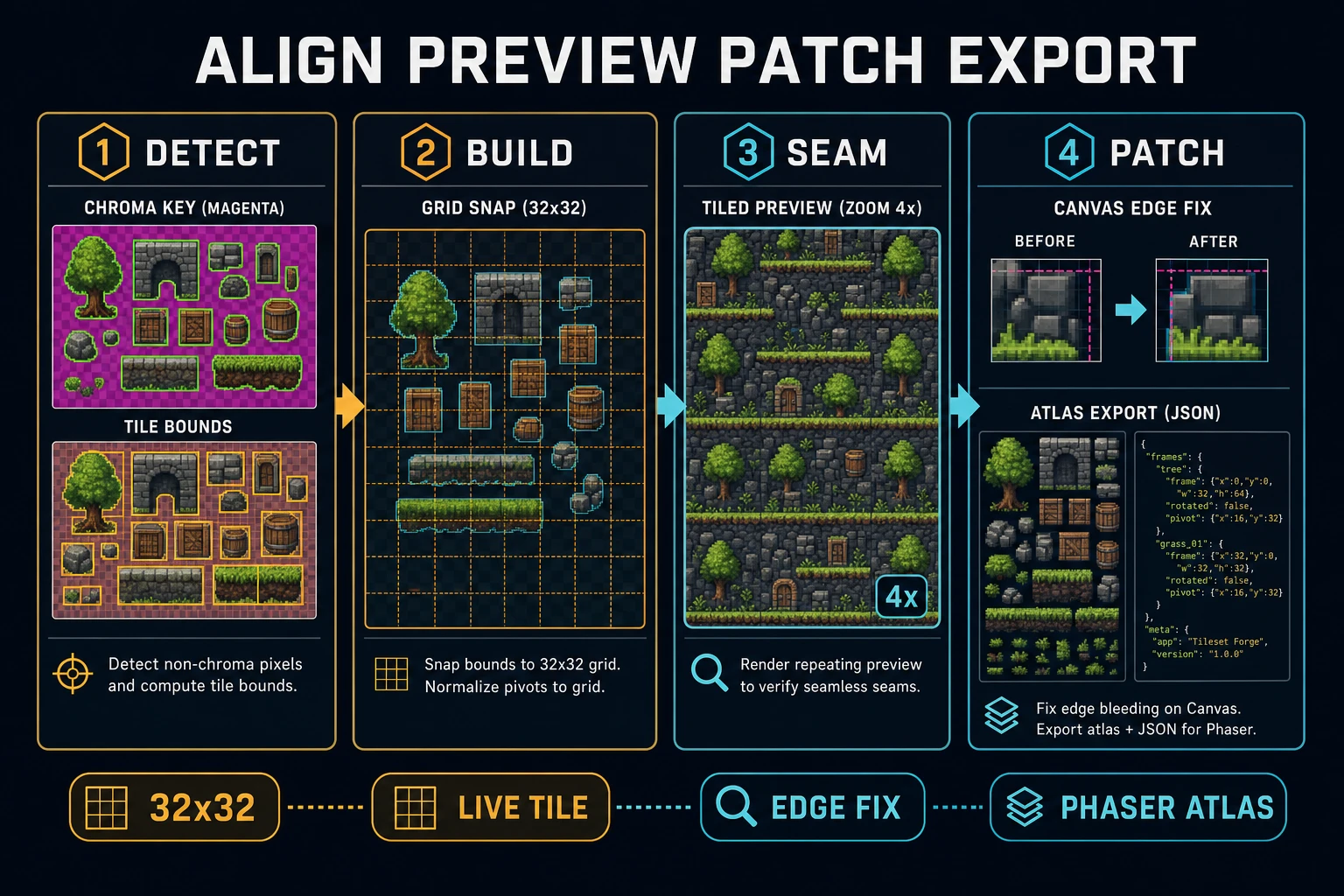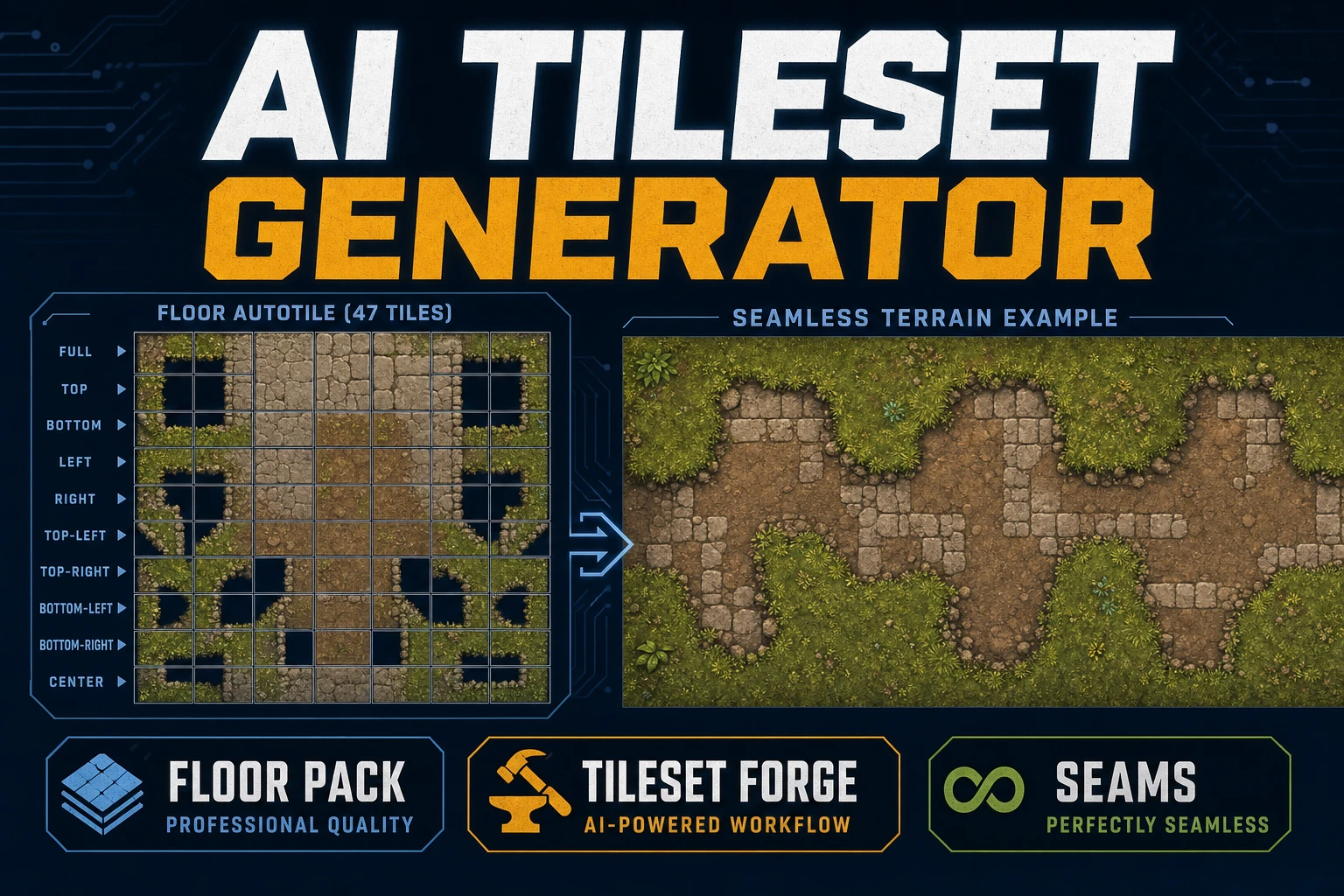
Pretty seamless squares do not ship a level. Games need floors, walls, corners, and transitions that share lighting, palette, and edge rules so a painter can autotile without visible seams. This guide turns an ai tileset generator search into a floor pack pipeline: label tile roles first, generate terrain in Seamless Tile Gen, align the grid in Tileset Forge, then patch only failing edges in Canvas. Model credit bases below were verified against src/lib/models.ts TILESET_MODELS on July 20, 2026.
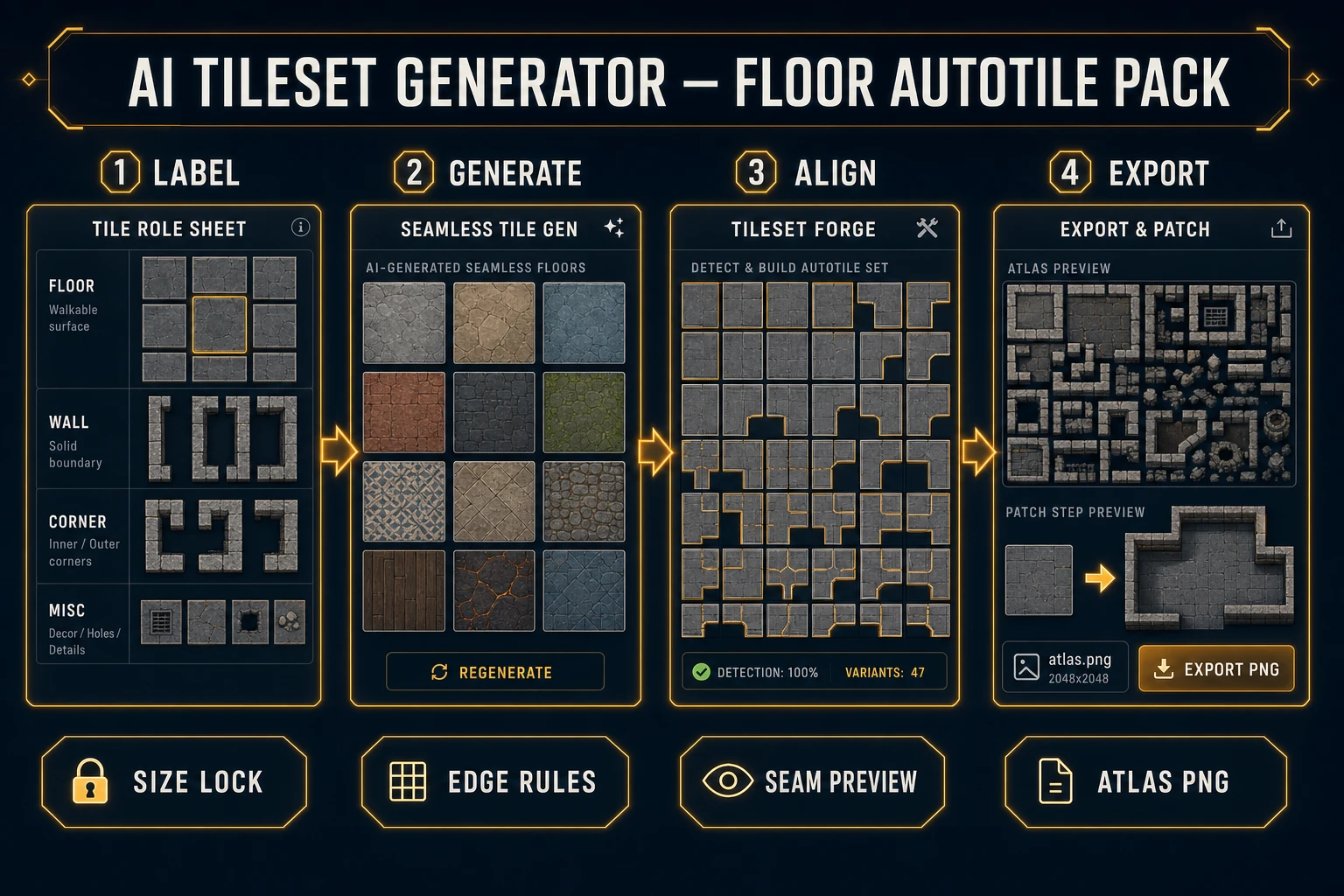
What an AI tileset generator must label
DataForSEO lists ai tileset generator at 50 monthly searches with KD 0 in research-output.md, verified July 20, 2026. It sits beside the sibling phrase tileset generator ai (covered earlier on the blog as a browser Phaser-ready overview). This article stays on the floor autotile pack: labeled cells you can paint, not a single marketing tile.
Four labels decide whether your ai tileset generator output survives the engine:
- Tile size: lock 16×16, 32×32, or 64×64 before any prompt. Tileset Forge defaults to 32×32 output cells.
- Role: floor fill, wall face, outer corner, inner corner, or material transition.
- Collision intent: walkable, solid, or hazard — write it on the sheet even if collision lives in a separate layer later.
- Edge rules: which edges must match which neighbors (N/E/S/W color and value). Autotile systems are edge-matching machines; Wang tiles are the classic formalization of that contract.
Tile-based games reuse small squares so levels stay editable and cheap to render. Your label sheet is the production document that keeps AI batches on that contract. Without it, every regenerate invents a new grass language and the wall line collapses.
Choose tile size and edge rules first
Open a plain text note and lock size before you touch a prompt field. A minimal jam floor pack is enough:
- Floor fill: one walkable material that repeats cleanly.
- Wall faces: north-facing caps that share the floor’s lighting direction.
- Corners: outer and inner pieces that continue the wall edge colors.
- Transitions: one dirt-to-stone or grass-to-path blend if the map needs two materials.
For each row write the export name (floor_grass, wall_n, corner_ne, trans_dirt_stone), the four edge codes, and one forbidden trait (“no directional footprints,” “no centered logos,” “no perspective vanishing”). Forbidden traits matter: models love to stamp hero props into “seamless” floors, which break tiling the moment you repeat them.
Keep the sheet short enough to paste as a reusable prompt prefix. Lore about the dungeon can live elsewhere; the ai tileset generator pass only needs visual and edge constraints. Pin the sheet beside the session so every batch starts with identical locks. When a teammate joins mid-week, they inherit the same size and edge codes instead of reinventing grass from a Discord screenshot. That handoff is the difference between a pack and a folder of near-misses.
If you already painted a stub map with placeholder colored squares, keep those placeholder ids and map your final atlas indices to the same numbers. Changing tile size after a map exists forces a full remesh of collision and spawn data. Size lock is not optional bureaucracy — it is the contract between art and level JSON.
Generate the base floor and wall set
Open Seamless Tile Gen (TileMaker) and treat each role as a family, not a single lucky image. The default prompt scaffold already nudges tileability — the page seeds seamless repeating forest terrain tile with consistent lighting and pixel art cues. Replace the material, keep the seamless and lighting language, and append your role delta: “top-down floor fill,” “north wall face flat lighting,” “NE outer corner.”
Credit bases verified July 20, 2026 in src/lib/models.ts TILESET_MODELS (order: GPT Image 2, Nano Banana 2, GPT Image 1.5, Seedream 5 Lite, Imagen 4 Ultra):
- Seedream 5 Lite: 6 credits at 2K, 8 at 3K — cheapest terrain iteration while edge rules settle.
- GPT Image 2 / GPT Image 1.5: 7 credits at medium quality, 17 at high — stronger readable edges for later Forge alignment.
- Nano Banana 2: 9 / 12 / 17 credits at 1K / 2K / 4K.
- Imagen 4 Ultra: 8 credits flat.
Start cheap on Seedream until the floor wrap test passes. Spend higher-quality credits on the keeper wall and corner set, not on ten unrelated biomes. Aspect ratio should stay 1:1 for square cells. New accounts still receive starter credits; pay-as-you-go packs and the $49 lifetime unlock (verified July 20, 2026 in src/app/plans/page.tsx LIFETIME_PRICE) are listed on the plans page. Seamless Tile Gen burns AI credits; Tileset Forge is a Pro lifetime tool. The Sorceress tools guide maps adjacent 2D tools if you later add sprites on the same palette.
Batch three variants per role with the identical prefix. Keep only the ones that share value range, light direction, and edge color. Reject “cooler” outliers that change hue mid-edge — they will fail the tiled preview later no matter how pretty they look alone.