How to Make an RPG Game in Scratch (Block Loot 2026)

By Arron R.10 min read
How to make an RPG game in Scratch: lock a four-sprite party in Quick Sprites (9 credits/gen), wire turn-based combat with Variables and My Blocks, score the du

When a kid or a hobbyist types how to make an rpg game in scratch into Google, two problems sit behind the query. The first is coding: how do turn-based attacks, inventory, hit points, and save data fit inside Scratch 3.0’s drag-and-snap block set? The second is art: a Scratch RPG with four party members, three enemy archetypes, and a loot table is roughly twenty costumes before the first battle, and most hobby devs stall right there. This guide walks the Scratch-native RPG loop, then wires an AI sprite and audio path so the twenty-costume art tax does not kill the project.
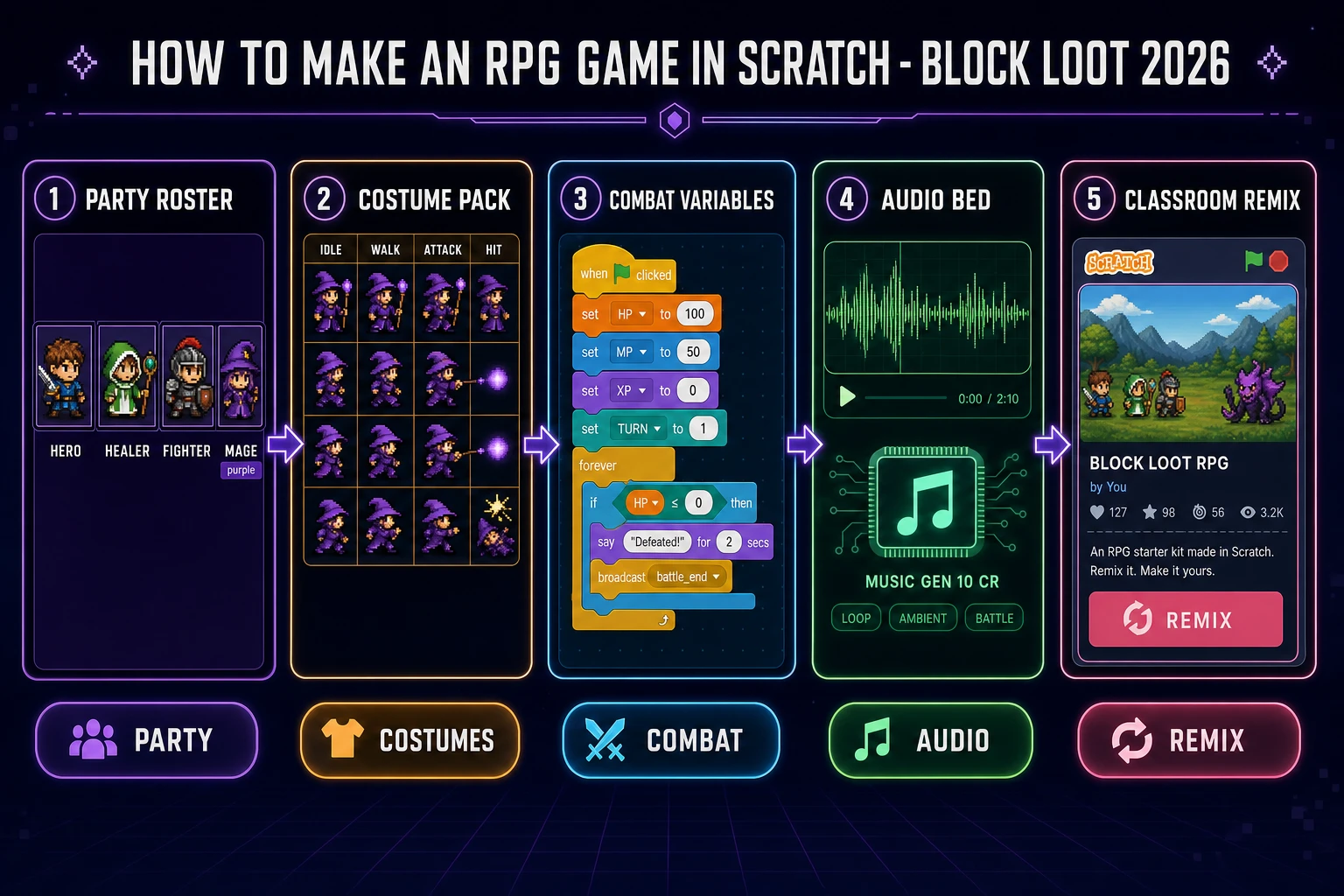
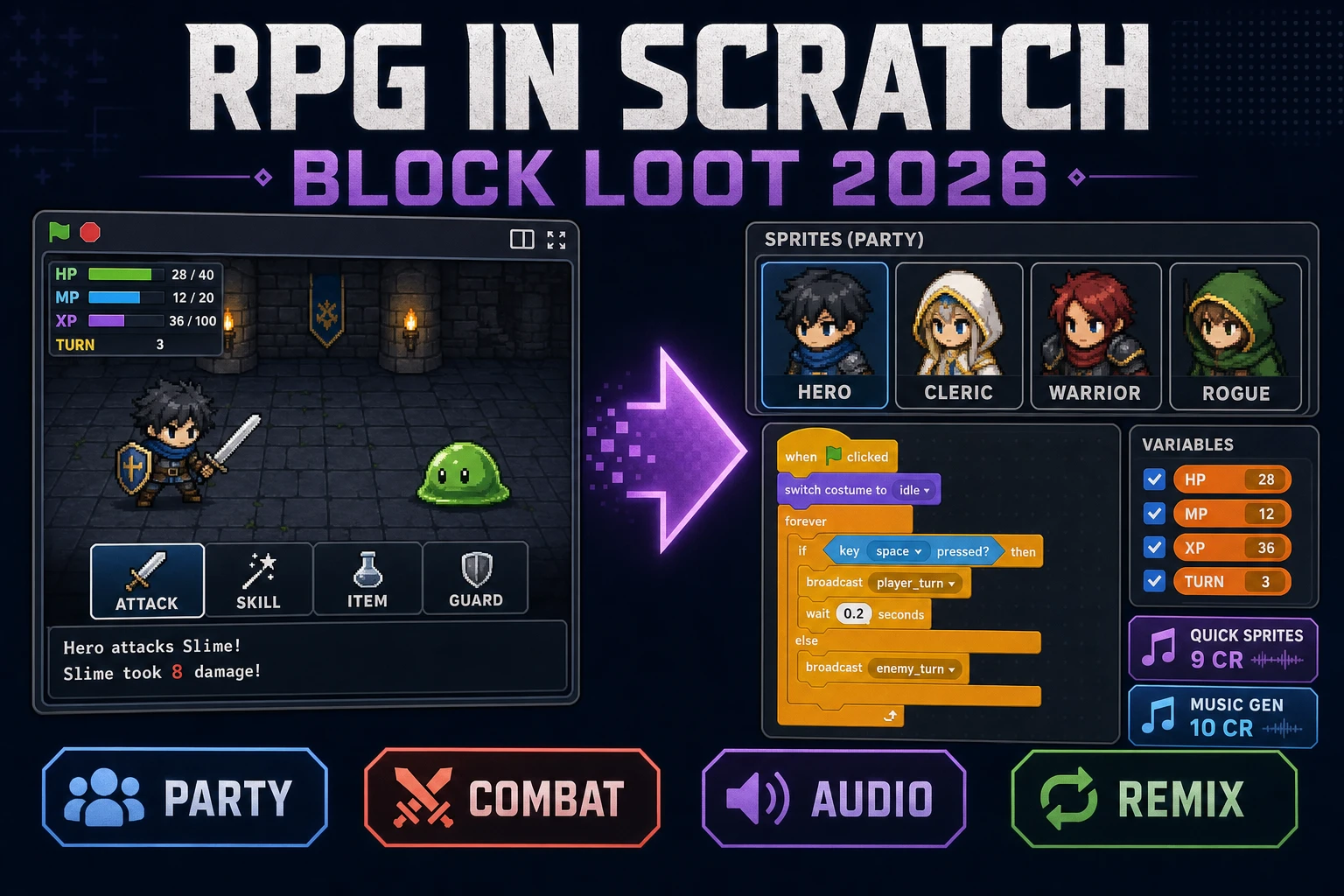
How to make an rpg game in scratch pipeline: party roster, costume pack, combat variables, audio bed, classroom share
How to make an RPG game in Scratch as one loop: roster, costumes, variables, audio, remix.

What how to make an rpg game in scratch searchers want

DataForSEO lists how to make an rpg game in scratch at 110 searches per month with a Keyword Difficulty of 1 (verified 2026-10-01 in tools/research-supplement.md, seed how to make an rpg). Neighbor phrases such as how to make an rpg in scratch, scratch rpg tutorial, and how to make a scratch rpg sit in the same cluster, so one honest how-to on the “in Scratch” path answers them all without a second cannibalizing post.

The audience is split in a way that matters for the article. Half of searchers are students: they already have a Scratch account, they have published a cat-chases-mouse project, and they want the shortest route to a battle screen that reads as an RPG. The other half are first-time indie devs who heard that Scratch is a legitimate game-making platform and want to know if the block set can carry turn-based combat and a saveable inventory. Both groups get the same answer: yes, Scratch 3.0 can carry a real RPG, and the hard part is not the blocks — it is the art pipeline.

For sibling angles already on this blog, see how to make a platformer in Scratch for a jump-loop take on the same editor, and how to make an RPG game for a browser-engine framing of the same genre. This page is specifically how to make an RPG game in Scratch when the blocker is a party roster, not a browser code loop.

The core RPG loop in Scratch 3.0 blocks

Scratch 3.0 is the current major version — released on January 2, 2019 and built on HTML5 and JavaScript (verified 2026-10-01 on the Scratch Wiki Scratch 3.0 page). The editor organizes code into nine block categories: Motion, Looks, Sound, Events, Control, Sensing, Operators, Variables, and My Blocks. An RPG loop uses every one of them.

Think of the loop as five states that each sprite enters by broadcasting an event:

  • Overworld — the party hero sprite moves with arrow keys using Motion blocks. Backdrops change by room via a when backdrop switches to hat.
  • Encounter trigger — a Sensing block checks for touching an enemy sprite or hitting a random tile; it broadcasts start battle.
  • Turn-based combat — a battle backdrop appears, party and enemy sprites show their combat costumes, and a Variables-driven state machine cycles through player turn, enemy turn, and resolve.
  • Loot and leveling — a list variable tracks inventory; an XP variable crosses a threshold and a My Blocks custom block applies the level-up.
  • Save — on request, the game writes a compact save string into a hidden sprite’s costume name using a Variables → join operator, then the player can paste it back next session.

The Scratch Wiki’s block set is wide enough to carry every one of those states without any extension. The online? Sensing block (added January 29, 2026 per the same Wiki page) and the Face Sensing extension (added October 7, 2025) are available if you want party expressions tied to a webcam, but they are optional. Nothing above requires an extension.

Lock a party sprite roster before you touch sensing blocks

Before you drag a single when green flag clicked hat, decide the sprite roster. A minimum RPG roster that still feels like an RPG looks like this:

  • Hero — four costumes: overworld idle, overworld walk, combat idle, combat attack.
  • Two allies — same four-costume shape each. One is the healer, one is the fighter. Visual silhouette must differ at a glance.
  • Three enemy archetypes — slime, skeleton, boss. Two costumes each: idle and hit-reaction.
  • UI sprites — HP bar, menu cursor, item icon strip. Four to six costumes total.
  • Tilemap sprite — one sprite with backdrops swapped as rooms, or several sprites arranged in a grid for a hand-placed dungeon.

Count the frames and the roster lands around twenty-four costumes plus five backdrops. That is why so many Scratch RPG projects stall — not because the blocks fail, but because twenty-four hand-pixeled costumes is a weekend of pixel art before gameplay testing even starts. The AI sprite path on Sorceress collapses that into a credit-costed afternoon.

Name files before you leave the generator: hero-overworld-idle.png, hero-overworld-walk-1.png, and so on. Scratch imports in the order you select, and the next costume block cycles through costumes by position. Messy naming becomes messy animation at play time.
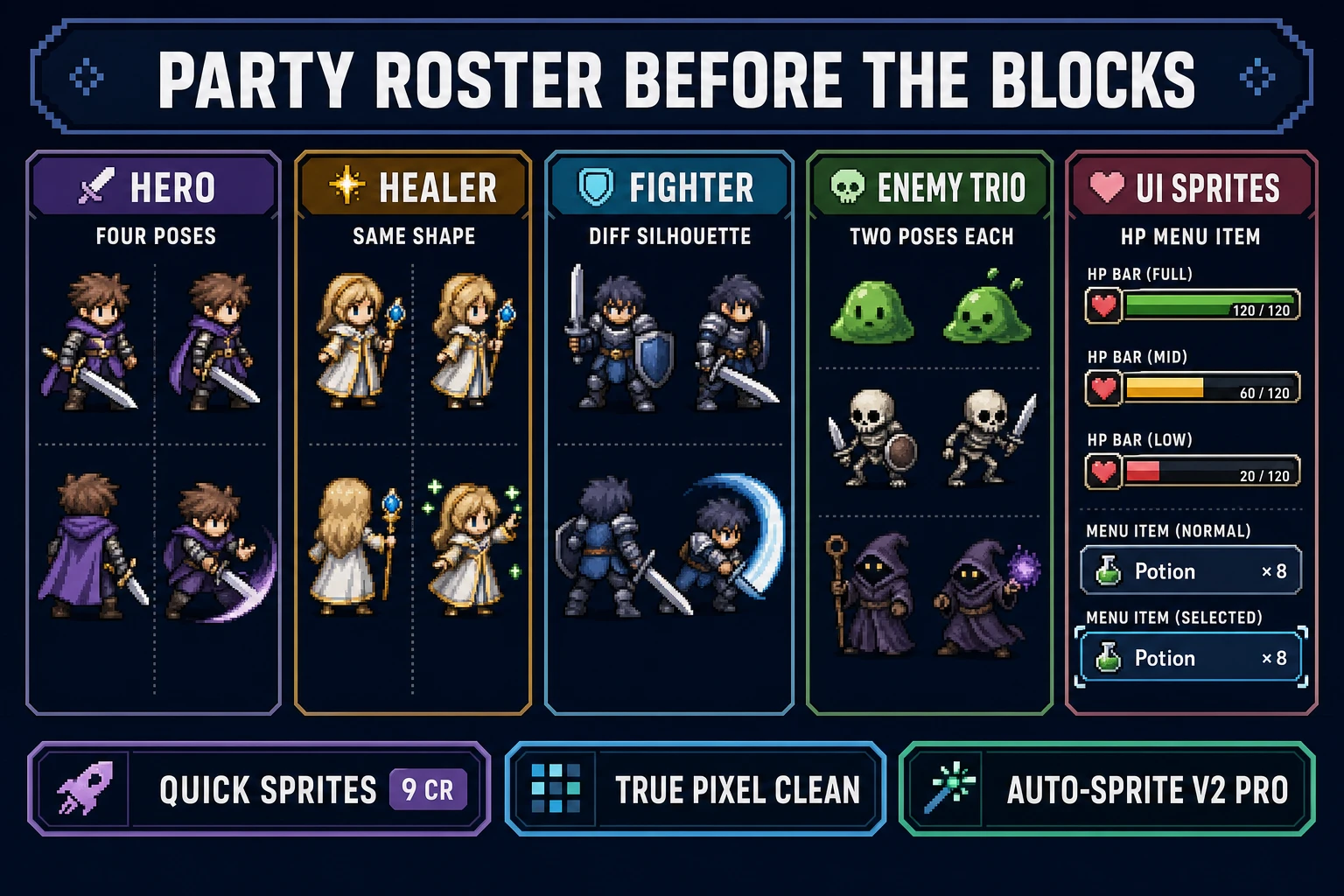
Party sprite roster checklist for how to make an rpg game in scratch: hero, allies, enemies, UI, tilemap
Lock the party, enemy, UI, and tilemap sprite counts before you spend credits on a second hero redesign.

Quick Sprites and True Pixel for the party sheet

Open Quick Sprites for the fast lane. The home card badge is AI Credits. The page sets CREDITS_PER_GEN = 9 in src/app/quick-sprites/page.tsx (verified 2026-10-01), so one generation is nine credits — nine US cents at CREDITS_PER_DOLLAR = 100 defined in src/lib/models.ts. Prompt the hero four times with the same style anchor (“chunky 16-bit top-down RPG, torch-lit interior, no text in image”) and swap only the pose line between runs. Treat idle, walk, combat idle, and attack as four separate jobs rather than one sheet that tries to do all four.

For the three enemy archetypes, cost math is six generations (two costumes × three enemies) at 54 credits total. For the hero and two allies at four costumes each, that is twelve generations at 108 credits. A full party-and-enemy pack lands around 180 credits — $1.80 at the public rate. That is cheaper than one coffee and faster than one weekend of hand-pixeling.

When a Quick Sprites output comes back close but not quite game-ready, send it to True Pixel — the CorridorKey backend converts and cleans frames at a per-frame credit rate (see src/app/pixel-art/page.tsx, verified 2026-10-01). You can also sketch the hero concept in AI Image Gen first (Nano Banana 2, GPT Image 2, or Seedream 5 Lite), then push the reference into Quick Sprites to lock the look. For motion sheets that started from a short video clip rather than a static image, Auto-Sprite v2 is the three-step pipeline: AI image → AI video → clean sprite sheet.

Import habit for Scratch: open the Costumes tab for the target sprite, click Upload Costume, and pick frames in order. The Scratch Wiki Costume page (verified 2026-10-01) confirms three creation paths — Paint, Choose a Costume from the library, and Upload Costume from disk. Uploading an animated GIF splits it into one costume per frame, which is useful if Auto-Sprite v2 produced a GIF rather than discrete PNGs. For the roster sheet pattern used outside Scratch, the write-up at AI sprite generator covers the atlas framing.
Combat, inventory, and save variables in Scratch blocks

Scratch Variables carry an RPG’s state. A minimum RPG save state fits in roughly fifteen variables plus three lists:

  • hp, max_hp, mp, max_mp, xp, level, gold — numeric variables for the hero.
  • ally1_hp, ally2_hp, and matching MP values — party-member state.
  • enemy_hp, enemy_type, turn, battle_state — scene-local variables used only during combat.
  • inventory (list), equipped (list), defeated_bosses (list) — persistent progression lists.

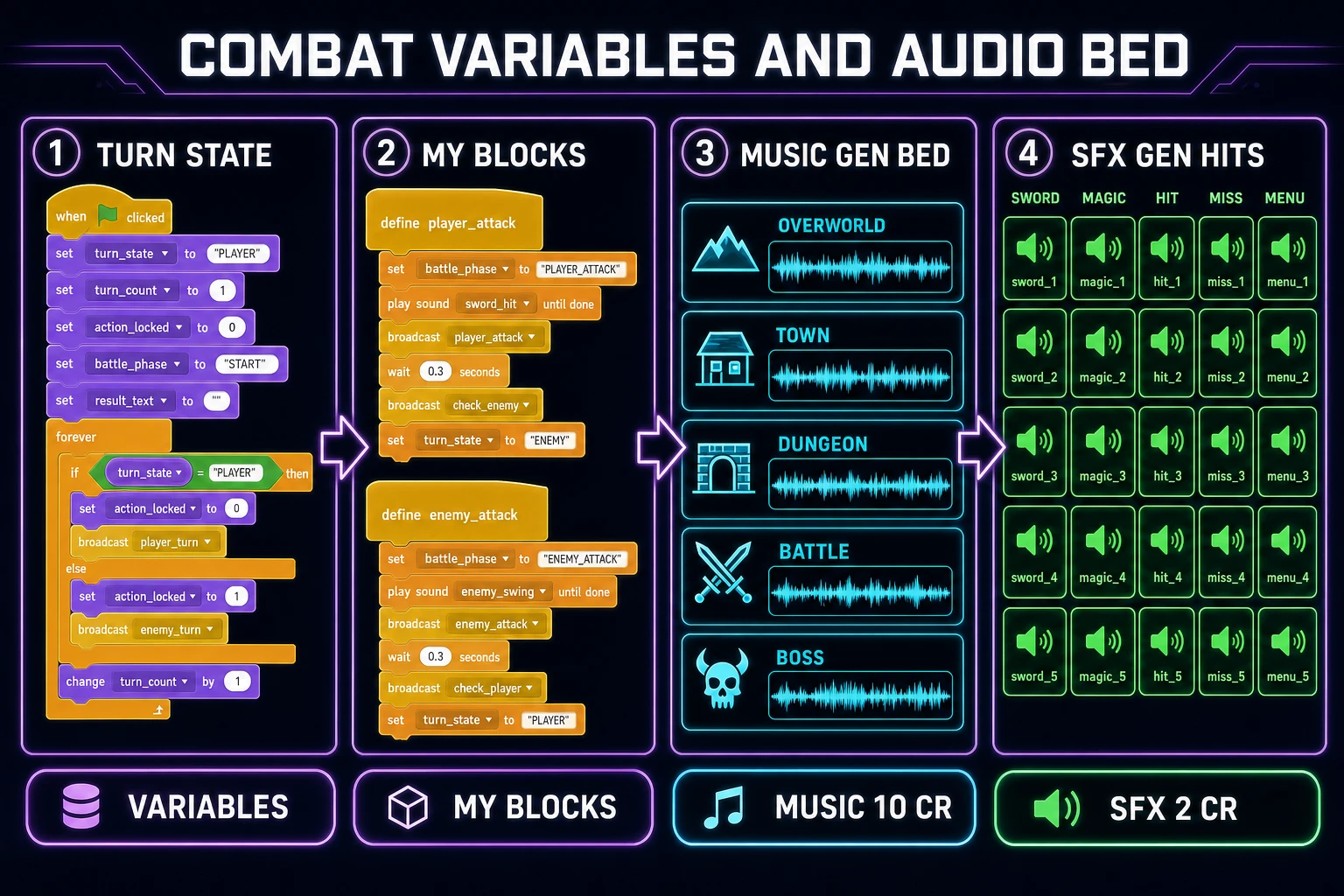
Build a player attack My Block that takes a damage number as input, subtracts it from enemy_hp, broadcasts enemy hit, then checks whether enemy_hp < 1 and broadcasts enemy defeated. The enemy sprite responds to enemy hit by swapping to its hit-reaction costume for 0.2 seconds, then back to idle. The enemy sprite listens for player turn ends and runs its own enemy attack My Block that reduces hp on the hero sprite.

For a save string, join every variable with a delimiter: join [hp:] (hp), chained into a single long string. Set a hidden sprite’s costume name to that string. On load, parse the string with letter N of and the contains Operator block. The Scratch Wiki covers trigonometry and complex sensing as common pain points for ambitious projects (per the Scratch 3.0 Wiki page), but a text-save pattern avoids both and runs anywhere.

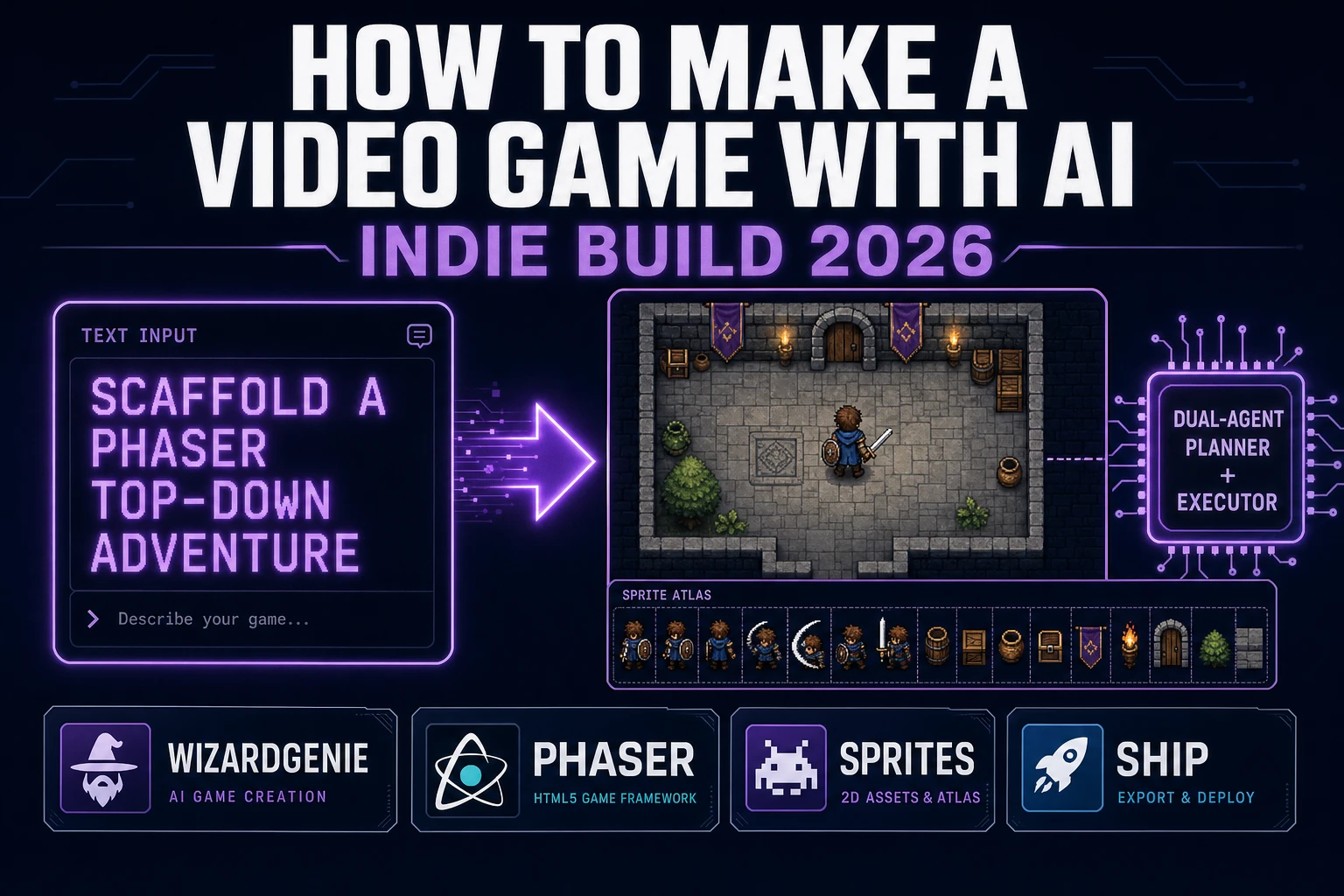
WizardGenie, Sorceress’s AI-native game engine, is useful here as a feel lab. Describe the combat math in plain English (“attack damage is strength minus half of defense, minimum 1”) and WizardGenie writes a browser-playable Phaser prototype that runs the numbers live. Tune until the pacing feels right, then transplant the balanced numbers into Scratch variables. Scratch stays the classroom publish target. WizardGenie stays the feel sandbox.

Scratch combat variables and audio bed loop for how to make an rpg game in scratch
Variables carry state, My Blocks encode moves, Music Gen fills the dungeon, SFX Gen punches the hits.

Music Gen and SFX Gen for the RPG audio bed

Scratch’s built-in Sound Editor can trim and loop audio, but it does not compose. A minimum RPG audio bed is five tracks and roughly fifteen sound effects:

  • Overworld theme — loopable, 60–90 seconds, bright and brave.
  • Town theme — mellow, 60 seconds, loopable.
  • Dungeon theme — minor key, tense, 60 seconds.
  • Battle theme — tempo spike, 60 seconds, loopable.
  • Boss theme — one unique track for the final fight.
  • SFX — sword slash, magic cast, hit, block, miss, menu move, menu select, level-up fanfare, item pickup, chest open, door open, step, stairs, defeat, victory.

Open Music Gen for the five themes. The base generation cost is MUSIC_CREDIT_COST = 10 credits (verified 2026-10-01 in src/app/music-gen/page.tsx). WAV conversion is a separate 2-credit step, lyrics are 2 credits, and MIDI export is 15. A clean five-track RPG score lands around 60 credits before conversions. Download as MP3 or convert to WAV, then import each track into Scratch via the sprite’s Sounds tab (the Scratch Wiki Costume page confirms the sound-upload path next to the costume-upload path).

For the fifteen SFX, open SFX Gen. The Suno Sounds path costs SUNO_SOUNDS_CREDIT_COST = 2 credits per generation (verified 2026-10-01 in src/app/sfx-gen/page.tsx); the seed-audio-driven path bills at one credit per second of output with a one-credit floor. Fifteen short effects at the Suno rate is thirty credits. Total audio spend for the whole RPG lands near 90 credits — under a dollar.

Ship, remix, and classroom distribution

Scratch’s publish model is unusual and useful. Once a project is shared, every other Scratcher can click the See Inside button to view the blocks, then click Remix to fork the project under their own account. The Scratch Foundation runs the platform as a nonprofit (verified 2026-10-01 on scratch.mit.edu/about — Scratch was developed at the MIT Media Lab in 2007 under Professor Mitchel Resnick and transferred to the Scratch Foundation in 2019). The remix lineage is first-class metadata on every project page.

For classroom distribution, create a Studio from your account page and invite students by username. Studios are the Scratch equivalent of a shared folder: anyone in the studio can submit a project. A classroom RPG unit works nicely as “publish your remix of the base RPG to the class studio by Friday” — the base game ships the loop, students bring the content.

If you want to extend beyond Scratch’s website, the Scratch Wiki’s Scratch 3.0 page confirms that projects can be downloaded as .sb3 files and reopened later. The HTML5/JavaScript runtime also powers forks like TurboWarp (not a Sorceress competitor — it is an open-source Scratch mod runtime). For a modern-browser lens on where game dev lives in 2026, MDN Games (verified 2026-10-01) still frames the browser as a viable game platform with a clear main-loop anatomy, which is exactly the mental model a Scratch RPG runs on under the hood.

For a wider lens on the genre, Wikipedia’s role-playing video game entry (verified 2026-10-01) traces the RPG’s descent from tabletop systems through NES-era console RPGs into the modern party-based structure most Scratch RPGs borrow. Reading one paragraph of the entry before you lock the roster is the cheapest research your project will ever do — it tells you which conventions readers expect even in a blocks-based build.

For a sibling Sorceress stack guide outside Scratch, see the full tools overview. The AI sprite + AI audio + classroom publish path is the shortest route from “I want to make an RPG” to a Scratch project that an actual player can finish in one sitting.

Frequently Asked Questions

What does how to make an rpg game in scratch actually mean?

How to make an RPG game in Scratch is the search phrasing for a role-playing game built in Scratch 3.0, Scratch Foundation's block-based editor (verified 2026-10-01 on scratch.mit.edu/about). The minimum feature set is an overworld with movement, random or triggered encounters, turn-based combat, inventory, and a save path. Scratch 3.0's nine block categories can carry every one of those states without an extension, confirmed on the Scratch Wiki Scratch 3.0 page (verified 2026-10-01). This guide answers that query with a Scratch-native loop plus an AI sprite and audio path on Sorceress for the costume art.

Should I draw costumes or use AI for a Scratch RPG?

Draw when you want handcrafted student art in Scratch's Paint Editor and the lesson plan requires it. Use AI when the roster is wide and the costume count would otherwise block gameplay. On Sorceress, Quick Sprites costs CREDITS_PER_GEN = 9 credits per generation (verified 2026-10-01 in src/app/quick-sprites/page.tsx), so a full hero sheet of four poses runs 36 credits ($0.36 at CREDITS_PER_DOLLAR = 100 from src/lib/models.ts). For video-driven sheets, Auto-Sprite v2 is the Pro three-step pipeline (AI image, AI video, sprite sheet). Scratch imports each frame via Upload Costume.

Can Scratch 3.0 actually handle turn-based combat?

Yes. Variables carry hit points, mana, and turn state. My Blocks encode moves such as player attack and enemy attack with input parameters. Broadcasts switch between the overworld backdrop and the battle backdrop. Lists store inventory. The Scratch Wiki Scratch 3.0 page (verified 2026-10-01) confirms the nine block categories cover state, flow, event, and operator logic. The hard part is not the blocks; it is the twenty-plus costume art pack. The AI sprite path collapses the art work from a weekend into a credit-costed afternoon.

How many credits does a full AI-asset Scratch RPG cost?

A full party and enemy sheet in Quick Sprites lands around 180 credits (hero plus two allies at four costumes each is 108 credits; three enemies at two costumes each is 54; UI sprites are the remaining 18). A five-track RPG score in Music Gen at MUSIC_CREDIT_COST = 10 credits per track is 50 credits (verified 2026-10-01 in src/app/music-gen/page.tsx). Fifteen SFX in SFX Gen's Suno Sounds path at 2 credits each is 30 credits. Total around 260 credits — $2.60 at the public rate, counting the SIGNUP_GRANT = 100 credits new accounts receive.

Where does WizardGenie fit if I am shipping in Scratch?

WizardGenie is Sorceress's AI-native game engine: describe the game and it writes, runs, and iterates in real time on web or desktop. Use it as a combat-math sandbox. Describe your damage formula in English, watch WizardGenie build a browser-playable Phaser prototype that runs the numbers, tune pacing live, then transplant the balanced numbers into Scratch variables. Scratch stays the classroom publish target with the See Inside and Remix flow. WizardGenie stays the feel-tuning lab.

Sources

  1. Scratch 3.0 - Scratch Wiki
  2. Costume - Scratch Wiki
  3. About - Scratch Foundation
  4. Role-playing video game - Wikipedia
  5. Game development - MDN
Written by Arron R.·2,140 words·10 min read

Related posts