Godot How to Make a 2D Game in Godot (Import Loop 2026)

By Arron R.8 min read
How to make a 2D game in Godot without redrawing every frame: lock a hero look, generate walk sheets in Quick Sprites (9 cr) or Auto-Sprite v2, import as Sprite

Searchers who type how to make a 2D game in Godot usually already have the editor open on an empty scene. What they lack is a coherent hero look, a walk-and-jump atlas that AnimatedSprite2D can slice without teleport frames, and a feel loop they can prototype before they refactor every GDScript signal. This guide answers that query with an AI asset path on Sorceress: lock the sprite pack first, generate frames with Quick Sprites or Auto-Sprite v2, import the PNG as SpriteFrames on an AnimatedSprite2D node, and use WizardGenie as the fast feel lab when the jump still reads wrong.
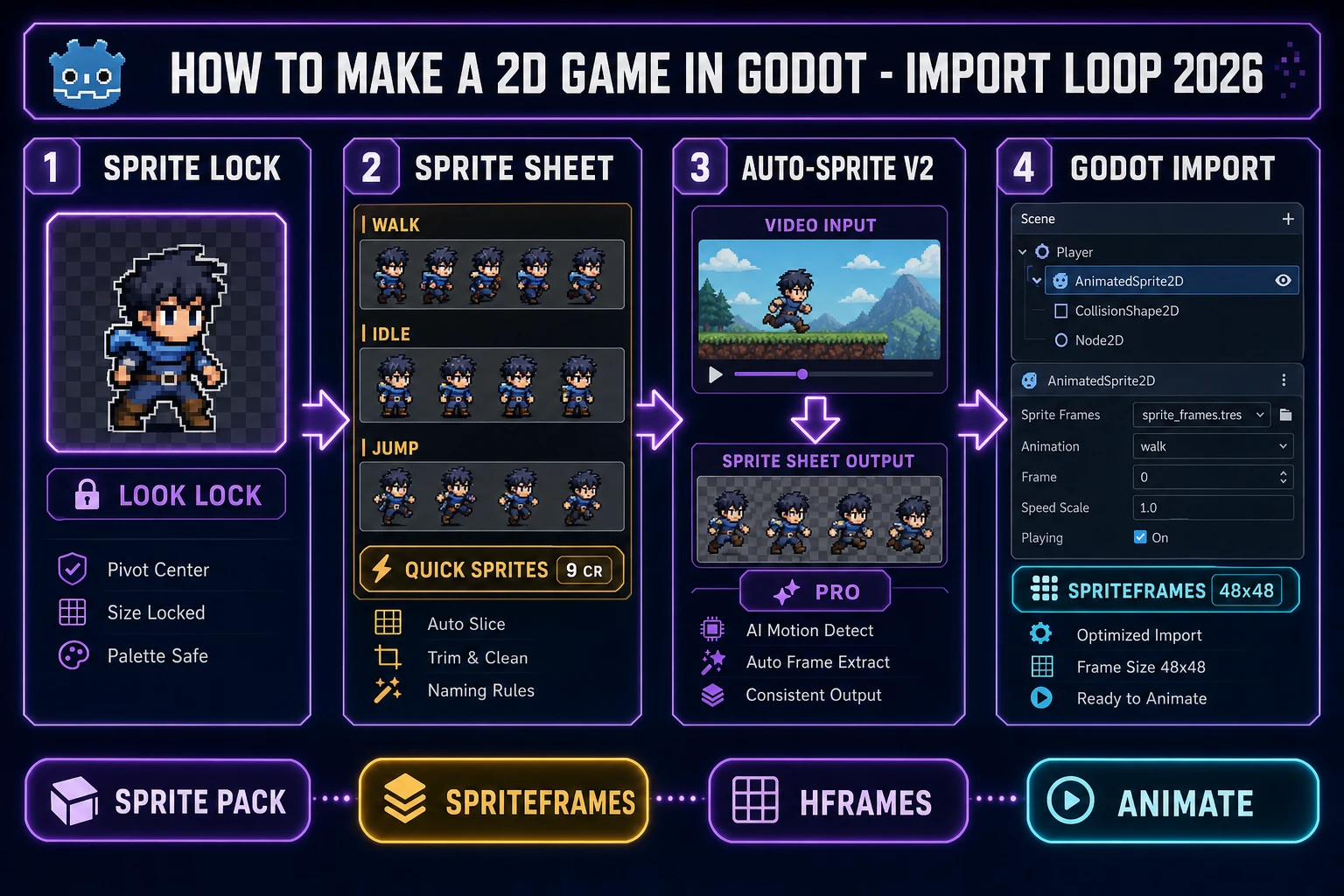
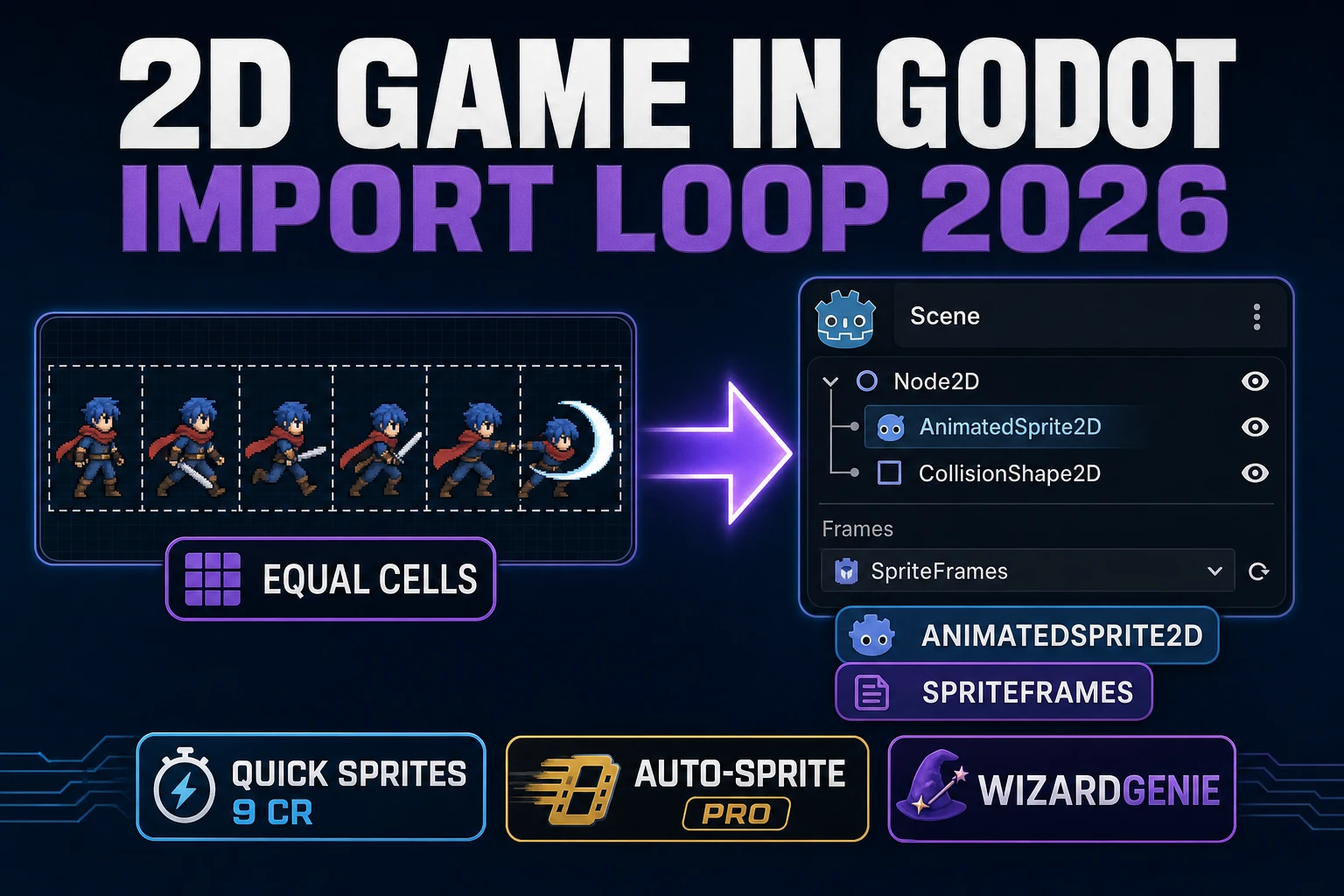
How to make a 2D game in Godot pipeline: sprite lock, sprite sheet, Auto-Sprite v2, AnimatedSprite2D import
How to make a 2D game in Godot as one loop: lock the look, ship the atlas, then slice it into SpriteFrames.

What how to make a 2D game in Godot searchers want

DataForSEO lists how to make a 2d game in godot at 110 searches a month, KD 0, competition 0.01 (confirmed in tools/research-supplement.md, verified 2026-09-29 pull). Neighbor phrases such as godot 2d game tutorial and godot animatedsprite2d sit in the same low-competition band. This page stays on the “in Godot” long-tail with an AI atlas path, not a rewrite of the official gravity script.

The Wikipedia Godot (game engine) article (verified 2026-09-30) records the current stable release as Godot 4.7.2, dated 18 August 2026, MIT-licensed, written in C++, with editor builds for Windows, macOS, Linux, Web, and Android. The same article notes GDScript as the built-in gradually-typed language, plus C# and C++ via GDExtension. Wikipedia’s Sprite (computer graphics) entry (verified 2026-09-30) defines a sprite as a 2D bitmap composited into a larger scene, and the Texture atlas entry (verified 2026-09-30) is the neutral name for packing many of those bitmaps into one image. Godot’s AnimatedSprite2D and SpriteFrames resources are that atlas idea with editor-specific names.

For sibling angles already on the blog, see how to make a sprite sheet for godot for the atlas hygiene deep-dive, and how to make a platformer in scratch for the beginner classroom angle. This page is specifically how to make a 2D game in Godot when the blocker is art, not another Dodge-the-Creeps clone.

Lock a sprite pack before you build the scene tree

Before you add a CharacterBody2D root and a CollisionShape2D child, decide what the hero must be able to do. A minimum AI pack for how to make a 2D game in Godot looks like this:

  • Idle — one readable standing pose that matches the walk silhouette.
  • Walk — six to eight frames, same foot spacing, transparent background.
  • Jump / air — one or two frames with tucked or extended limbs you can hold while the vertical velocity is non-zero.
  • Hit — a single flash frame that plays for a few tenths of a second on damage.
  • Death or knockdown — optional, but sells stakes when the game-over trigger fires.

Generate concept stills in AI Image Gen when you want a look lock, then crop and clean in Canvas (home card badge Free, verified 2026-09-30 in src/app/_home-v2/_data/tools.ts). Keep the camera orthographic-friendly: one subject, plain backdrop, no baked ground shadow that becomes a second silhouette after import.

Name files before you leave Sorceress — hero-idle.png, hero-walk-01.png, hero-jump.png. Godot’s SpriteFrames resource lists animations by their frame order, and a messy download folder becomes a messy SpriteFrames panel every time you re-import.
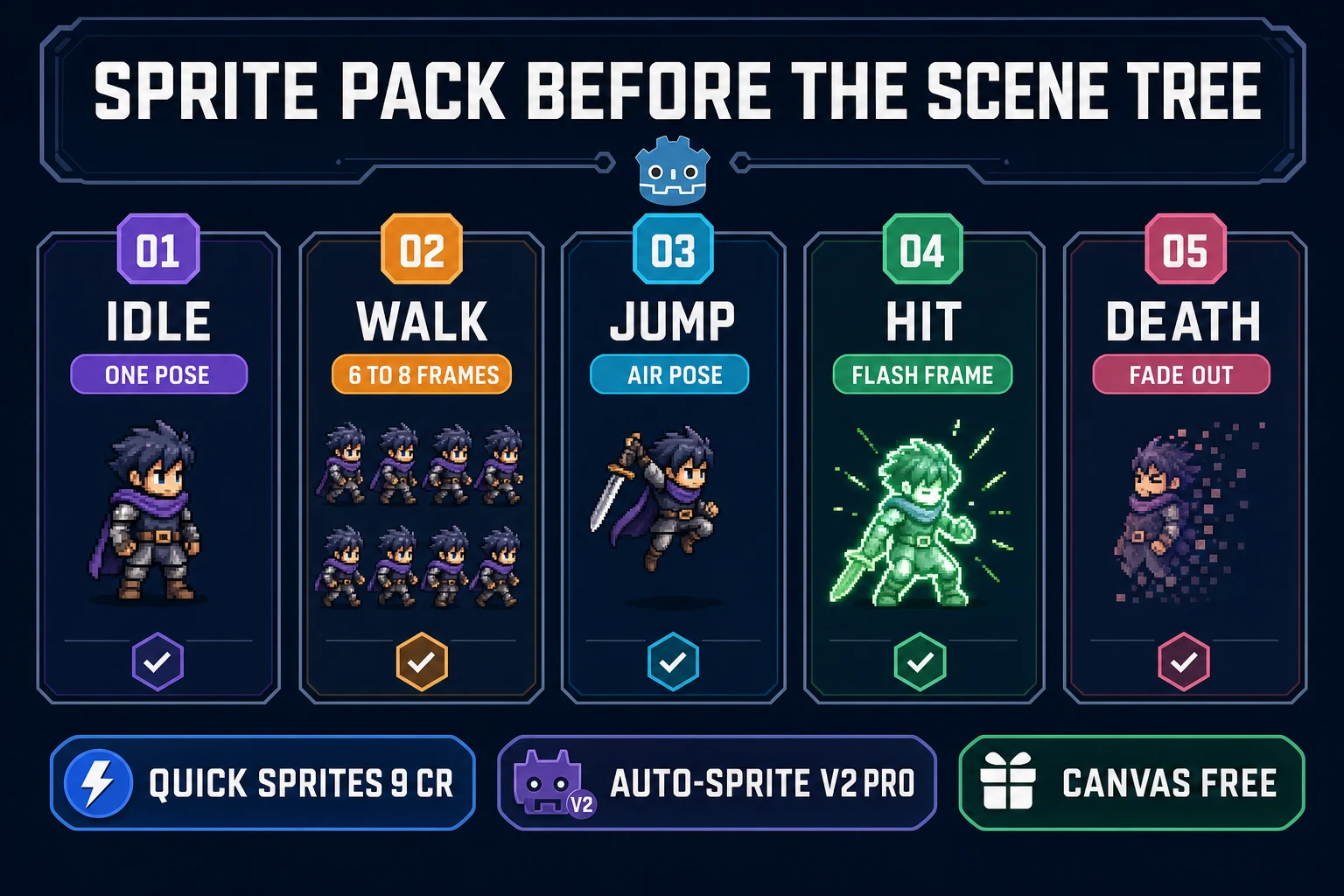
Sprite pack checklist for how to make a 2D game in Godot: idle, walk, jump, hit, death
Lock idle, walk, jump, hit, and death frames before you burn credits on a second hero redesign.

Auto-Sprite v2 and Quick Sprites for the atlas itself

Auto-Sprite v2 is the featured three-step path when you want motion that started as video. The home card (verified 2026-09-30 in src/app/_home-v2/_data/tools.ts) describes the pipeline in order: AI image generation creates the character, AI video brings it to life, then Auto-Sprite converts the clip into a clean, game-ready sprite sheet. The Sprites & 2D tile badge is Pro — plan for a Pro-capable account before you promise a team that every seat can open the same lane.

When you need pixel-art sheets faster and on the credit ledger, open Quick Sprites. The home card badge is AI Credits. Source sets CREDITS_PER_GEN = 9 in src/app/quick-sprites/page.tsx (verified 2026-09-30), so one generation costs nine credits — nine US cents at CREDITS_PER_DOLLAR = 100 in src/lib/models.ts. Three built-in styles matter here: Four Angle Walking outputs at 48×48 (rows Up, Right, Down, Left), Small Sprites outputs at 32×32 with six rows for townsfolk poses, and VFX Effects defaults to 64×64 for hits and explosions. Prompt for walk, idle, and jump as separate jobs if one sheet tries to do too many actions and melts the silhouette.

Prompt habits that survive AnimatedSprite2D import: say the art style once (“chunky 16-bit side view”), demand a transparent background, forbid text in the image, keep the character centered on every cell. If the sheet comes back with a soft gray matte, run a cleanup pass in Canvas before you touch the SpriteFrames panel — a dirty alpha edge becomes a visible halo when Godot applies texture filtering.

For deeper atlas hygiene (equal cells, nearest-neighbor filtering, palette lock in True Pixel), the write-up at how to make a sprite sheet for godot covers the SpriteFrames slicer step by step. This page keeps the focus on the whole 2D-game loop.
Import: AnimatedSprite2D and SpriteFrames

Godot 4.7’s 2D sprite animation workflow gives you two paths (verified 2026-09-30 against the Godot 4.7 documentation): AnimatedSprite2D with a SpriteFrames resource for straight sprite playback, or a plain Sprite2D driven by an AnimationPlayer with Hframes and Vframes when you want to key texture changes alongside position or rotation. For how to make a 2D game in Godot with a pre-baked AI atlas, AnimatedSprite2D is the shorter road.

The full import checklist:

  1. Drop the transparent PNG into the Godot project folder. The editor auto-imports it as a Texture2D.
  2. In the Import dock, set Filter to Off (nearest-neighbor) so pixel art stays crisp.
  3. Add an AnimatedSprite2D node to the scene tree, parented under a CharacterBody2D root when you want movement and collision.
  4. In the Inspector, click the SpriteFrames property and choose New SpriteFrames.
  5. Open the SpriteFrames panel at the bottom of the editor. Choose “Add frames from a Sprite Sheet” and pick your PNG.
  6. Set the horizontal and vertical cell counts. For a Quick Sprites Four Angle Walking sheet that is 4 across and 4 down; for Small Sprites it is 4 across and 6 down. Match the numbers to the actual atlas.
  7. Rename the default animation to walk_right, add more animations for walk_down, walk_left, walk_up, idle, and jump. Assign the correct cell range to each.
  8. Add a CollisionShape2D child and give it a RectangleShape2D sized to the character’s feet, not the full sprite.

A minimum movement script that plays the right animation by input direction:

extends CharacterBody2D

@export var speed: float = 120.0
@onready var anim: AnimatedSprite2D = $AnimatedSprite2D

func _physics_process(_delta: float) -> void:
	var input_dir := Input.get_vector("ui_left", "ui_right", "ui_up", "ui_down")
	velocity = input_dir * speed
	move_and_slide()
	if input_dir == Vector2.ZERO:
		anim.play("idle")
	elif absf(input_dir.x) > absf(input_dir.y):
		anim.play("walk_right" if input_dir.x > 0 else "walk_left")
	else:
		anim.play("walk_down" if input_dir.y > 0 else "walk_up")

Play the scene. If a sprite “teleports” one pixel every frame, the atlas cells are not equal — regenerate the offending row in Quick Sprites at the same cell size rather than resizing frames by hand.

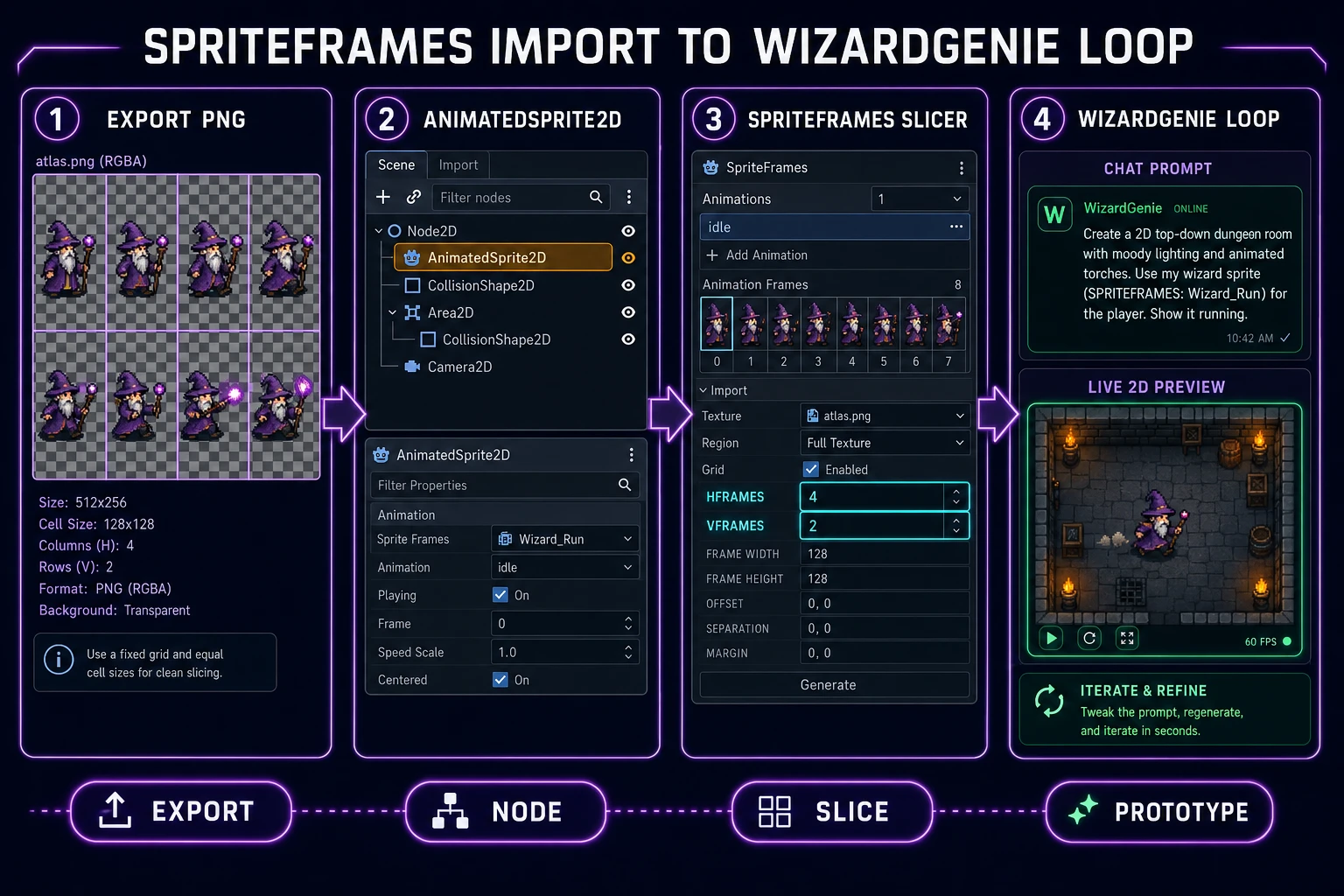
SpriteFrames import to WizardGenie iterate loop for how to make a 2D game in Godot
Export equal-cell PNG, add AnimatedSprite2D, slice with SpriteFrames, then stress-test feel in WizardGenie before you rebuild every signal.

WizardGenie as the feel-prototype loop

WizardGenie is Sorceress’s AI-native game engine: describe the game you want, and it writes, runs, and iterates in real time, switching across leading coding models with your own API key (verified 2026-09-30 in src/app/_home-v2/_data/tools.ts). It ships on web and desktop — pick the surface that matches the machine in front of you.

Why mention it in a how to make a 2D game in Godot article? Because Godot signals and scene refactors are slow to iterate when the feel is wrong. Prototype coyote time, variable jump height, camera follow, and enemy patrols in WizardGenie with the same hero art direction, watch the loop play, then translate the winning numbers into GDScript @export variables. You are not required to publish from WizardGenie — keep Godot as the ship target and treat WG as the fast feel lab. Cost per WG session is your own model key; on Sorceress plans a trial fallback key is available so a new user can play with the loop before wiring an account.

MDN’s game development hub (verified 2026-09-30) still frames the browser as a viable game platform with a clear main-loop anatomy: process input, update state, render. WizardGenie sits in that “run it while you edit it” mindset; Godot sits in the compiled scene-tree editor mindset. Use both without forcing one tool to pretend it is the other.

Credit math for an AI-asset Godot 2D session

Quote wallet numbers from source. CREDITS_PER_DOLLAR = 100 in src/lib/models.ts. SIGNUP_GRANT = 100 in src/app/api/admin/credits/route.ts. Both checked 2026-09-30. One credit equals one US cent on the top-up ledger.

Session plan Tool line Credits USD at 100 cr/$
1 Quick Sprites hero sheetQuick Sprites9$0.09
Hero + 3 enemy sheetsQuick Sprites × 436$0.36
Concept stills cleanupCanvas0 (Free badge)$0.00
Signup grant stress test11 × Quick Sprites99 of 100 grant$0.99 of grant

Auto-Sprite v2 sits behind the Pro badge — do not tell readers it is a free credit burn. Budget AI image and AI video generations as separate line items when you use that pipeline, then treat the sprite-ify step as the Pro workflow that turns the clip into a sheet. Canvas remains the free cleanup bench between generations, and True Pixel is the Pro palette-lock pass when the Godot tileset bed fights the character sheet.

A practical checklist before you touch move_and_slide: lock one hero silhouette, generate walk and jump as separate jobs if needed, export a transparent PNG at 48×48 or 32×32, add AnimatedSprite2D under CharacterBody2D, slice with SpriteFrames, name the animations by direction, then only then wire input. Art-first is how to make a 2D game in Godot without redrawing the hero after every failed jump tweak.

The verdict

How to make a 2D game in Godot in 2026 is still scene tree, sprite, movement, collision — the Wikipedia and Godot 4.7 documentation definitions have not changed. What changed is the cost of a coherent atlas. Use Quick Sprites at 9 credits when you need pixel sheets on the ledger, Auto-Sprite v2 when you want the Pro video-to-sheet path, Canvas for free cleanup, and WizardGenie when the feel needs a fast prototype before you rebuild the Godot scene. Import with AnimatedSprite2D and SpriteFrames, keep cells equal, and ship the project with art that already looks like a game.

Start with one hero pack today: nine credits, one walk sheet, one jump frame, then a five-minute WizardGenie feel test. That is the shortest honest path from the search query to a Godot scene that moves.

Frequently Asked Questions

What does how to make a 2D game in Godot actually mean in 2026?

How to make a 2D game in Godot is the search phrasing for building a playable 2D project in the Godot editor: a scene tree with a CharacterBody2D or Area2D root, a sprite, movement input, and collision. Godot 4.7.2 shipped on 18 August 2026 (per the Wikipedia Godot article, verified 2026-09-30) and its First 2D Game tutorial (“Dodge the Creeps!”) is still the canonical entry point. This guide answers the query by locking the art path first with Sorceress AI sprite tools, then handing a clean atlas to AnimatedSprite2D.

Should I draw sprites in Godot or generate them with AI?

Draw when you want vector polish inside Godot’s built-in editor. Use AI when the bottleneck is a full idle/walk/jump set that has to stay on-model across frames. On Sorceress, Quick Sprites bills CREDITS_PER_GEN = 9 credits per generation (verified 2026-09-30 in src/app/quick-sprites/page.tsx). Auto-Sprite v2 is the Pro three-step path: AI image, AI video, then Auto-Sprite converts the clip into a game-ready sprite sheet (verified 2026-09-30 in src/app/_home-v2/_data/tools.ts). Both output transparent PNGs that AnimatedSprite2D can slice by Hframes and Vframes.

How do I import an AI sprite sheet into Godot AnimatedSprite2D?

Godot 4.7’s 2D Sprite Animation docs describe the workflow: add an AnimatedSprite2D node, create a new SpriteFrames resource, then in the bottom panel choose Add frames from a Sprite Sheet, load the PNG, set the horizontal and vertical cell counts, and pick the frames for each named animation. On the Sorceress side, Quick Sprites Four Angle Walking outputs at 48×48 and Small Sprites at 32×32 (verified 2026-09-30 in src/app/quick-sprites/page.tsx) — hand those exact dimensions to the SpriteFrames slicer and every cell lines up.

Where does WizardGenie fit if the final game is shipping in Godot?

WizardGenie is Sorceress’s AI-native game engine: describe a game and it writes, runs, and iterates in real time on web or desktop (verified 2026-09-30 in src/app/_home-v2/_data/tools.ts). Use it to prototype jump feel, camera scroll, and enemy patterns with the same art direction before you rebuild the systems in GDScript. WizardGenie is not a Godot replacement in this workflow — it is the fast feel lab that saves credits and hours before the Godot editor sees the atlas.

How many credits do I need to make a 2D game in Godot with AI assets?

Quote wallet numbers from source. CREDITS_PER_DOLLAR = 100 in src/lib/models.ts, and SIGNUP_GRANT = 100 in src/app/api/admin/credits/route.ts (both verified 2026-09-30). A single Quick Sprites hero sheet is 9 credits ($0.09). A hero plus three enemy variations is 36 credits ($0.36). Canvas cleanup is 0 credits on the Free badge. Auto-Sprite v2 sits behind the Pro badge — budget AI image and AI video generations as separate line items when you use that pipeline, then treat the sprite-ify step as the Pro workflow. The 100-credit signup grant covers roughly eleven Quick Sprites sheets before any top-up.

Sources

  1. Godot (game engine) - Wikipedia
  2. Sprite (computer graphics) - Wikipedia
  3. Texture atlas - Wikipedia
  4. Game development - MDN
Written by Arron R.·1,837 words·8 min read

Related posts