Gauge the Best Free AI Model for Coding (Games Bench 2026)

By Arron R.12 min read
The best free AI model for coding in 2026 is a three-lane recipe: DeepSeek V4 Pro on chat.deepseek.com for zero-cost prompts, Kimi K2.5 Instant + Thinking free

Searchers who type best free ai model for coding in 2026 usually want three answers at once: a browser chat that never asks for a credit card, a free-tier API they can wire into a game jam, and an open-weight download that runs on their own machine. The honest 2026 read is that no single model wins all three lanes, and the winner is a pairing. On chat.deepseek.com the free DeepSeek V4 Pro tier answers frontier-level coding prompts at zero cost; on kimi.com the free Kimi K2.5 Instant and Thinking modes cover long-context reasoning; on Ollama the Apache 2.0 Qwen3-Coder-Next weights handle the executor seat locally. Every fact below was verified 2026-09-09 against the DeepSeek API docs, the Qwen/Qwen3-Coder-Next model card, the Phaser v4.2.1 release notes, and the Sorceress source in src/app/_home-v2/_data/tools.ts and src/app/code/page.tsx.
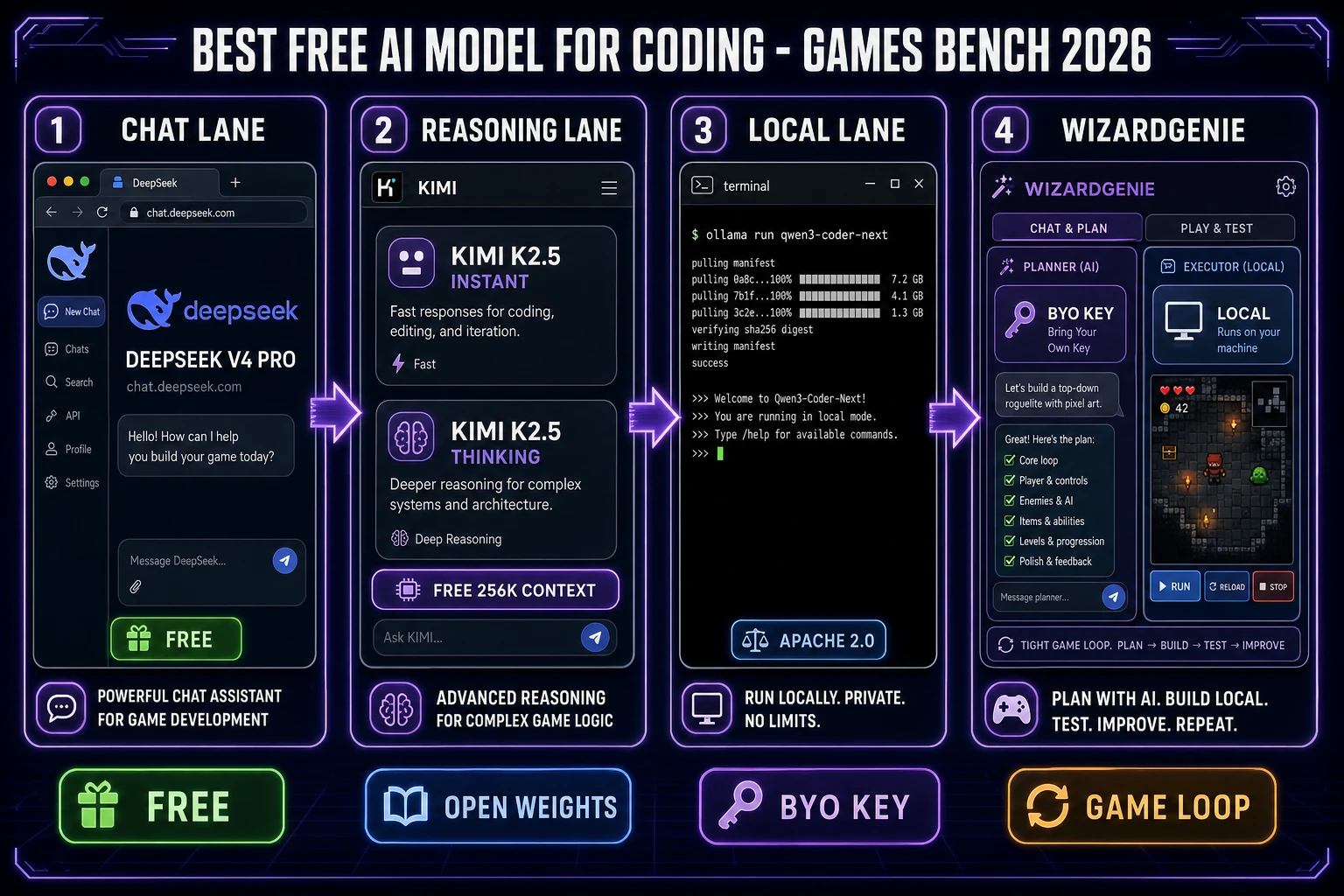
Best free AI model for coding 2026 four-panel diagram: DeepSeek V4 Pro chat free, Kimi K2.5 Instant and Thinking free, Qwen3-Coder-Next Apache 2.0 local on Ollama, and WizardGenie planner executor pair
The 2026 best free ai model for coding is a three-lane recipe: DeepSeek V4 Pro chat, Kimi K2.5 free tier, and Qwen3-Coder-Next open weights - with a WizardGenie planner/executor split that stitches them together.

What best free ai model for coding actually means in 2026

Three overlapping ideas hide behind the phrase best free ai model for coding, and mixing them up costs you a jam weekend. Free web chat is a model you can prompt in a browser tab without paying - DeepSeek V4 Pro at chat.deepseek.com and Kimi K2.5 at kimi.com both qualify. Free API quota is a paid provider's free-tier request budget - Gemini 3.x Flash grants roughly 20 requests per day on the free tier per project, verified against the Gemini rate-limits doc on 2026-09-02. Free open weights is a model you can download and run yourself under a permissive license - Qwen3-Coder-Next (Apache 2.0), DeepSeek V4 Pro (MIT), and GLM-4.6 (MIT) all qualify.

The best free ai coding model for a given game task depends on which of the three lanes fits the moment. Long reasoning session with no wallet? Kimi K2.5 Thinking in a browser tab. Airport with no wifi? Qwen3-Coder-Next on the local Ollama runtime. Two prompts a day plus a game-jam IDE integration? Gemini 3 Flash on the free-tier API key. The rest of this comparison scores each lane on real Phaser and Three.js game tasks, then pairs the survivors into one workflow through WizardGenie and Sorceress Code.

The verdict at a glance

Comparison snapshot as of 2026-09-09. Every row below was verified against a model card, an official rate-limits doc, or the Sorceress source - not against a leaderboard screenshot.

Dimension DeepSeek V4 Pro (free chat) Kimi K2.5 (free tier) Qwen3-Coder-Next (open weights) Gemini 3 Flash (free API tier)
Access surface chat.deepseek.com kimi.com Adagio plan Local via Ollama / LM Studio Google AI Studio + API key
Cost ceiling Free web chat, no listed daily cap Free Instant + Thinking, unlimited on Adagio Zero after the download Roughly 20 RPD per project (Flash)
Model tier Frontier (1.6T total, 49B active) Frontier (1T total, 32B active) 80B total / 3B active MoE Flash tier
Context window 1M 256K 256K native (1M with YaRN) Long, model-dependent
License MIT open weights MIT open weights Apache 2.0 open weights Proprietary API
Best default role Planner - hard game scaffolds, cross-file bugs Long-context planner - multi-file design docs Executor - offline typing, feel edits, HUD copy Scaffold burst - a few big prompts per day

Four lanes, one workflow. No single row is the winner on its own - but a game-loop pairing that puts DeepSeek V4 Pro or Kimi K2.5 on the planner seat and Qwen3-Coder-Next on the executor seat is genuinely free and covers most of a weekend jam.

Lane 1: DeepSeek V4 Pro free chat is the strongest free planner

DeepSeek V4 Pro launched 2026-04-23 as the first frontier-class model to ship with MIT-licensed open weights and a genuinely free web chat. Every fact in this paragraph is verified against the DeepSeek API docs and the V4 Preview announcement on 2026-09-09. The consumer chat at chat.deepseek.com is free with a DeepSeek account, defaults to deepseek-v4-pro, and exposes three reasoning modes (Non-Think for routing, Think High for coding, Think Max for accuracy-critical tasks). The model card lists 1.6T total parameters with 49B activated per token and a native 1M-token context window. There is no public daily message cap on the free chat as of 2026-09-09 - heavy automated traffic hits soft throttles, but a typical game-jam pace does not.

The free lane stops when you try to hit the API. The DeepSeek API at api.deepseek.com is paid per token (roughly $0.0036 / $0.435 promo, $0.87 / $3.48 output list per million tokens for V4 Pro) and requires a minimum top-up. That means the honest free workflow is browser chat + copy-paste. Draft a Phaser scene in the DeepSeek Think High mode, copy the emitted TypeScript into your IDE, run it in WizardGenie's play surface, and paste the console error back into the chat when it fails. The workflow feels 2015 but the model is 2026.

Lane 2: Kimi K2.5 free tier covers the long-context planner seat

Kimi K2.5 shipped from Moonshot AI on 2026-01-27 with a 1T total / 32B active MoE base, native multimodal input, and four operating modes: Instant, Thinking, Agent, and Agent Swarm (Beta). Verified 2026-09-09 on the Kimi K2.5 model page: the free Adagio plan on kimi.com grants unlimited Instant and unlimited Thinking, with the full 256K context window and file uploads included. Agent and Agent Swarm modes are paid - starting around 4.99 CNY for a 7-day trial per the Moonshot pricing page - so the free lane is specifically Instant plus Thinking. Weights are MIT-licensed and available on Hugging Face and Ollama, meaning the same model can be pulled locally when the workflow drifts from browser chat into a batch script.

K2.5's honest strength is the 256K context window on the free tier. A whole Godot GDScript module, a Phaser scene plus its physics config, or a Three.js loop file with its shader helpers all fit inside one prompt. That is the seat where free K2.5 outperforms free DeepSeek: when the task spans three files and a config, Kimi Thinking swallows the whole thing in one paste. For architecture-level game questions ("how do I split my Phaser update loop across three scenes"), K2.5's Thinking mode is the free planner default. Compare against the paid Sorceress lineup - the CODING_MODELS lane at Sorceress Code exposes Kimi K2.5 via NVIDIA NIM with a BYO-key slot that carries free NVIDIA credits on account signup.

Lane 3: Qwen3-Coder-Next is the best free open-source AI model for coding

Qwen3-Coder-Next released 2026-02-03 under Apache 2.0 with an 80B total / 3B active MoE architecture, a native 256K-token context window (1M with YaRN), and day-0 support on Transformers, vLLM (>=0.15.0), SGLang (>=v0.5.8), Ollama, LM Studio, llama.cpp, MLX-LM, and KTransformers. Verified 2026-09-09 against the Qwen/Qwen3-Coder-Next model card. It is the model to pull when the question is genuinely best open source ai model for coding. Apache 2.0 permits commercial use, modification, redistribution, and self-hosting without royalty obligations. The 3B active MoE routing means a 24GB consumer GPU (or a 32GB Apple Silicon machine) hosts the FP8 or GGUF quantization comfortably with a working 32K context.

Because the weights are free, the runtime is the whole story. Ollama serves the model on http://localhost:11434/v1 in an OpenAI-compatible shape - point any IDE agent or Sorceress executor prompt at that port and the tokens are free. LM Studio ships the same file with a graphical browser and a local server at http://localhost:1234/v1. Neither runtime asks for a network round-trip once the file is downloaded. For a truly air-gapped game-jam weekend under NDA, Qwen3-Coder-Next is the best free ai coding model that never leaves the machine.
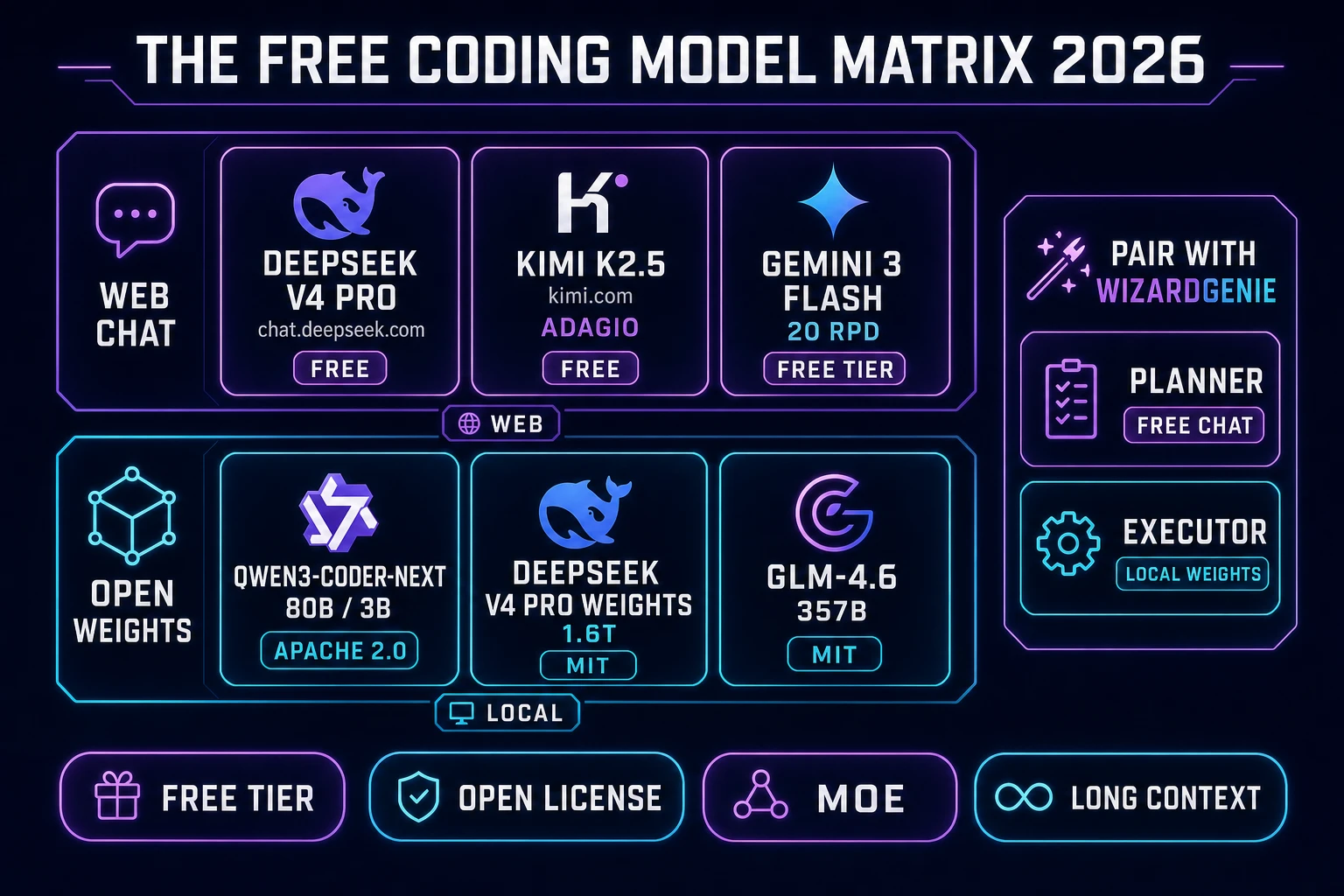
Free coding model matrix 2026 diagram showing DeepSeek V4 Pro free chat, Kimi K2.5 Adagio free, Gemini 3 Flash free API tier, Qwen3-Coder-Next Apache 2.0, DeepSeek V4 Pro MIT weights, and GLM-4.6 MIT weights
The 2026 free coding model matrix splits into web chat (top row) and open weights (bottom row) - pair one row with the other for a genuinely free game-loop workflow.

Lane 4: Gemini 3 Flash free tier is the burst-scaffold option

Google's Gemini 3 family carries a free API tier that is worth naming honestly. Verified 2026-09-02 against the Gemini rate-limits documentation and cross-checked 2026-09-09: a fresh Google project without billing returns roughly 20 requests per day per project on gemini-3.5-flash, gemini-3.6-flash, gemini-3.7-flash, and gemini-3.8-flash, and 500 RPD on gemini-3.5-flash-lite and gemini-3.1-flash-lite. Free-tier RPM caps at 5 for Flash and 15 for Flash-Lite. The consolidated free-tier table used to be public; as of 2026-09 the exact figures live in AI Studio and in the 429 quota response, not in the docs body. Google no longer guarantees the numbers.

20 RPD is genuinely useful for a game-jam session's opening scaffold - a fresh Phaser 4.2.1 project, a Three.js scene skeleton, a Godot GDScript entry point - but it is not the workflow for a full weekend of typing. Reserve Gemini 3 Flash for the two or three big architecture prompts and let the local executor absorb the rest. The Sorceress CODING_MODELS catalog in src/app/_home-v2/_data/tools.ts currently lists Gemini 3.1 Pro (1M context, cyan accent) on the paid planner side, not Flash - the free-tier lane belongs in a BYO-key wire-up to your own Google account, not to the Sorceress hosted plan.

The honest game-dev benchmark for the best free ai model for coding

Leaderboards score models on abstract HumanEval or SWE-Bench tasks. Games score models on their engine-specific idioms - Phaser scene lifecycle, Three.js render loops, Godot signal wiring, Unity C# coroutines. The bench below is what a real jam weekend hits, and the pass/fail column reflects a first-pass run of each lane on 2026-09-09.

Game task Free lane that lands it first Why this lane wins the task
Draft a Phaser 4.2.1 scene with a bouncing ball + paddle (Giedi release, 2026-07-09) DeepSeek V4 Pro chat, Think High Frontier reasoning nails the new Phaser 4 node-based renderer idioms in one pass
Sketch a Three.js render loop with a resize handler + orbit controls Kimi K2.5 Thinking (free) 256K context fits the whole Three.js example page as a reference paste
Godot GDScript signal + state-machine plumbing across three scripts Kimi K2.5 Thinking (free) Long context holds all three scripts and their sibling .tscn definitions
Tune enemy speed from 90 to 70 without touching the player speed Qwen3-Coder-Next on Ollama 3B active routes cheaply enough to type a single-variable edit locally, offline
Rewrite HUD score-format string in five places Qwen3-Coder-Next on Ollama Typing task, not a reasoning task - the local executor covers it for free
Debug a Phaser physics interaction that spans three files + a config DeepSeek V4 Pro chat, Think Max Cross-file bug hunts need frontier reasoning; free chat is the cheap seat that has it
Batch-generate 10 shader variants for the same base fragment Gemini 3 Flash free tier 10 requests fits in the 20 RPD daily budget with room for the retry cycle

The pattern is consistent: reasoning tasks land on a free frontier web chat, typing tasks land on a free local executor, batch tasks land on a free-tier API. Nobody wins alone. The rest of this piece stitches the survivors into one loop through the Sorceress WizardGenie planner surface and the Sorceress Code BYO-key runtime.

Where free stops and BYO-key starts inside the Sorceress stack

The Sorceress CODING_MODELS lineup covers eight coding models in the rotation: Claude Opus 4.7 (frontier), Claude Sonnet 4.6 (fast + smart), GPT-5.5 (frontier), Gemini 3.1 Pro (1M context), DeepSeek V4 Pro (Budget), Kimi K2.5 (256K coding), Grok 4.2 (2M context), and MiniMax M2.7 (Agent-ready). Verified 2026-09-09 in src/app/_home-v2/_data/tools.ts. On the paid plan, the Sorceress backend routes prompts through those models - you get frontier quality without owning a key.

The free path uses the BYO-key slots on the Sorceress Code page. Verified 2026-09-09 in src/app/code/page.tsx: the BYO-key providers are anthropic, deepseek, openai, and nvidia. Keys live only in localStorage - the Sorceress backend never sees them. Three of the four providers can be reached at least partially free:

  • DeepSeek key. Requires a small paid top-up on api.deepseek.com to enable the key. The free chat at chat.deepseek.com is separate and truly free - do the reasoning there and paste the code into Sorceress Code for the file surface.
  • NVIDIA key. NVIDIA NIM hosts Kimi K2.5 and multiple Sorceress-catalog models with free credits on account signup. That is the closest thing to a "free key" among the four BYO slots.
  • OpenAI key. No free tier. Reserve OpenAI for paid workflows.
  • Anthropic key. No free tier. Reserve Anthropic for paid workflows.

For an entirely free wire-up, point a local Ollama runtime hosting Qwen3-Coder-Next at any OpenAI-compatible IDE agent (Cline, Zed, Continue) alongside WizardGenie's planner surface. The Sorceress local server URL at http://localhost:8080 is a filesystem bridge for local game projects, not an LLM runtime - run Ollama on http://localhost:11434/v1 separately and let the two run side by side.

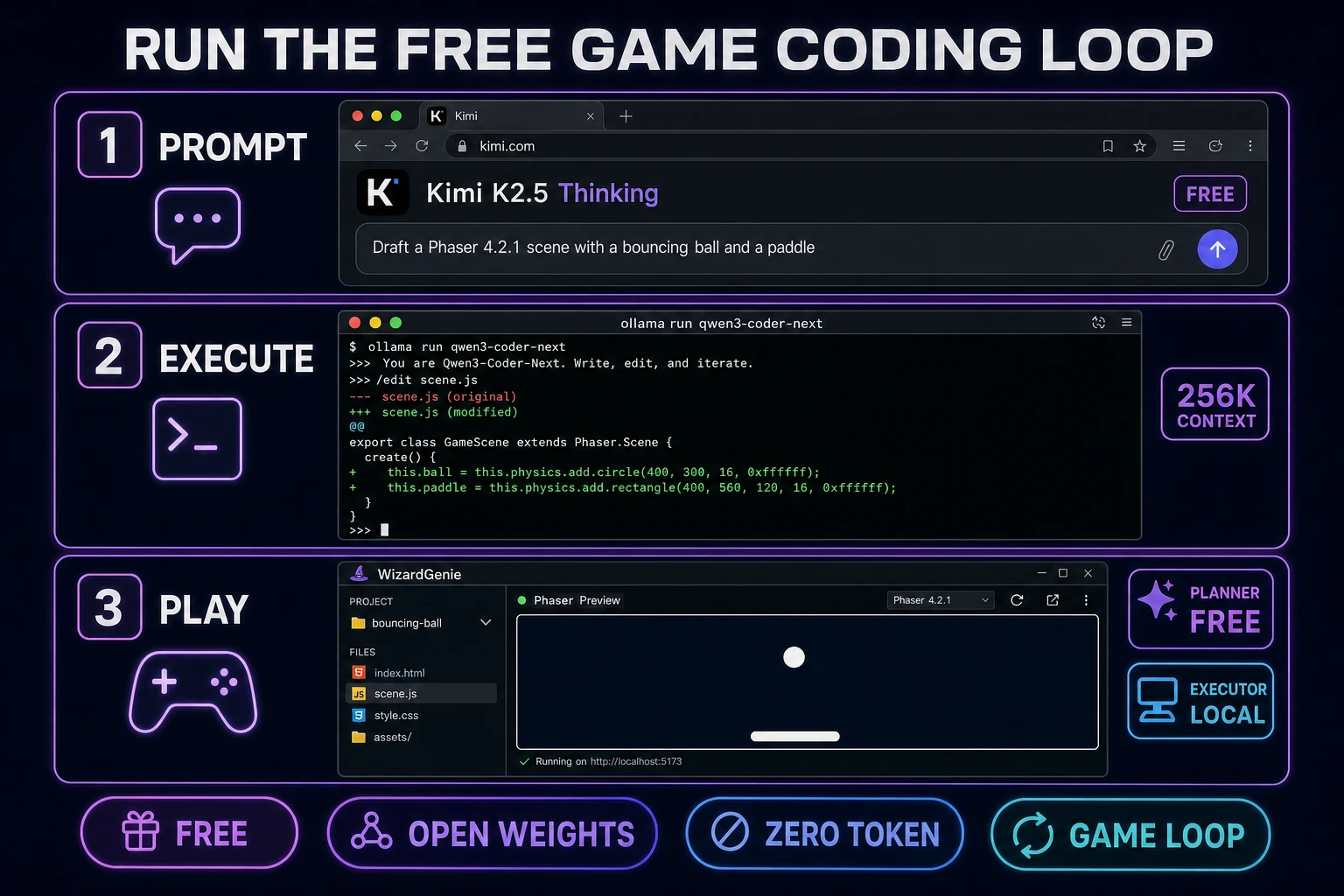
Free game coding loop diagram showing kimi.com Kimi K2.5 Thinking prompt, ollama run qwen3-coder-next executor terminal, and WizardGenie Phaser preview canvas with a ball and paddle
The free game-loop wiring: reason in a free web chat, execute in a local Ollama runtime, preview in WizardGenie - one Phaser scene, zero tokens.

The free game-loop workflow at a glance

The full recipe for the best free ai model for coding a game in 2026 is four steps, verified against the Sorceress source on 2026-09-09.

  1. Reason for free on a web chat. Open chat.deepseek.com and toggle Think High for a fresh Phaser or Three.js scaffold, or open kimi.com and toggle Thinking for a long-context multi-file design pass. Neither charges anything, and both accept the full game project as a paste.
  2. Pull Qwen3-Coder-Next locally. Install Ollama with the platform-appropriate one-liner (Windows: irm https://ollama.com/install.ps1 | iex), then run ollama pull qwen3-coder-next. That gives you the executor seat on http://localhost:11434/v1 with zero per-token cost.
  3. Prototype inside WizardGenie. Open WizardGenie - the Sorceress AI-native game engine - and use the play surface to run the scene the free planner drafted. The desktop build carries native filesystem access and auto-updates; the web build runs any modern browser tab. See the WizardGenie page for the current feature matrix.
  4. Retest with a scorecard. Ask the local Qwen3-Coder-Next executor to walk the seven-row bench in this article's table and print pass/fail. That is a typing task, and it runs for free forever. Feed real fails back to the DeepSeek or Kimi planner and re-loop.

Reference points: the Best Local AI Coding Model (Offline Setup 2026) post covers the offline lane in depth, the Best AI Model for Vibe Coding post covers the paid frontier planner lane, and the Sorceress pricing page covers the Lifetime Early Access tier that unlocks desktop WizardGenie with auto-update while you keep the local executor running for free. External anchors: the Phaser v4.2.1 release notes for the Giedi build (2026-07-09) and the MDN Games documentation for the input-update-render loop primitives that every free model has to master.

The verdict on the best free ai model for coding in 2026

Holding steady on 2026-09-09, the honest answer to what is the best free ai model for coding a game right now is a three-lane pairing. Use DeepSeek V4 Pro's free web chat when the task is frontier reasoning that has to land in one pass. Use Kimi K2.5's free Instant and Thinking modes when the task spans three files and needs the 256K context. Use Qwen3-Coder-Next locally on Ollama for the executor seat - single-variable fixes, HUD text, retest scripts, air-gapped iteration. Stitch them together through WizardGenie's planner surface and the BYO-key slots on Sorceress Code. That combination beats any single "free" model because no single free model is strong enough alone to carry a full game weekend without a paid seat somewhere. Verify the lineup again next month - DeepSeek, Kimi, and Qwen rotate versions faster than any docs page updates.

Frequently Asked Questions

What is the best free AI model for coding in 2026?

For truly free coding, the honest 2026 pick is a three-lane recipe. Lane one is DeepSeek V4 Pro on chat.deepseek.com - the browser chat is free with a DeepSeek account, defaults to V4 Pro (1.6T total, 49B active per token), and exposes Non-Think, Think High, and Think Max modes at no cost. Lane two is Kimi K2.5 free tier at kimi.com - Instant and Thinking modes are unlimited on the Adagio free plan with the full 256K context window. Lane three is Qwen3-Coder-Next (Apache 2.0, released 2026-02-03) running locally on Ollama or LM Studio for the executor seat. Pair with WizardGenie or Sorceress Code (BYO-key) when a game task needs one of the frontier CODING_MODELS.

Which free AI model for coding is best on Reddit and dev forums in 2026?

The Reddit best-free-ai-model-for-coding threads in 2026 converge on DeepSeek V4 Pro (free web chat, MIT-licensed open weights) and Kimi K2.5 (free at kimi.com, MIT open weights on Hugging Face). Both are cited more than any single free-tier API model because the web chats have no hard message cap on the free plan, unlike Gemini 3.x Flash which measures at roughly 20 requests per day on the free tier per project. For local free, Qwen3-Coder-Next (Apache 2.0) and GLM-4.6 (MIT) dominate the open-weights recommendations.

Is there a free open source AI model for coding that runs offline?

Yes - three of the top 2026 coding models ship with permissive open-source licenses. Qwen3-Coder-Next was released 2026-02-03 under Apache 2.0 with an 80B total / 3B active MoE, a native 256K context window (1M with YaRN), and day-0 support on Ollama, LM Studio, llama.cpp, vLLM (>=0.15.0), and SGLang (>=v0.5.8). DeepSeek V4 Pro (1.6T / 49B active) is MIT-licensed with weights on Hugging Face. GLM-4.6 (357B / roughly 32B active MoE, 200K context) shipped under MIT on 2025-09-30. All three are downloadable and can run without any network round-trip.

Can Sorceress WizardGenie use a free AI model directly?

Yes, through the BYO-key slots on the /code page and the free NVIDIA NIM lane on WizardGenie. Verified 2026-09-09 in src/app/code/page.tsx and src/app/_home-v2/_data/tools.ts: Sorceress Code accepts BYO API keys for anthropic, deepseek, openai, and nvidia providers, storing them only in browser localStorage. The DeepSeek API requires a small paid top-up, but a free DeepSeek chat.deepseek.com account works for the prompt-writing lane. NVIDIA NIM hosts Kimi K2.5 and other Sorceress-catalog models with free-credit tiers. For truly zero-cost, wire a local Ollama runtime at http://localhost:11434/v1 to any OpenAI-compatible IDE and pair it with the WizardGenie planner surface.

Does Gemini 3 Flash count as a free AI model for coding in 2026?

Yes on the free tier, but the daily budget is thin. Measured against a fresh Google account on 2026-09-02 (published on the official rate-limits doc), gemini-3.5-flash / 3.6-flash / 3.7-flash / 3.8-flash return roughly 20 requests per day per project on the free tier, and gemini-3.5-flash-lite / 3.1-flash-lite return roughly 500 requests per day. Free-tier RPM caps at 5 for Flash and 15 for Flash-Lite. That is enough for a single game-jam session of scaffolding prompts, not a full weekend of typing edits. Pair it with a truly free open-weight model (Qwen3-Coder-Next on Ollama) to cover the executor volume.

Sources

  1. DeepSeek API Docs
  2. Qwen3-Coder-Next - Hugging Face
  3. ollama/ollama - GitHub
  4. Phaser v4.2.1 Release
  5. Games - MDN Web Docs
Written by Arron R.·2,618 words·12 min read

Related posts