Forge Makerworld Image to 3D (Game GLB 2026)

By Arron R.8 min read
Makerworld image to 3D searchers want a photo-to-mesh path with a downloadable game file. On Sorceress, open 3D Studio, lift with Hunyuan 3D 3.1 (30 cr) or Mesh

People who type makerworld image to 3D into Google are rarely hunting a mesh theory lecture. They saw a one-photo lift somewhere in the MakerWorld ecosystem and want the same outcome with a game finish: a downloadable GLB they can orbit in a viewer, drop into an engine, or hand to a rigging pass. This guide forges that intent onto Sorceress in 2026 — what the query actually wants, the 3D Studio route, cleanup that makes a GLB honest for print or play, when to fork into Voxel Studio, the auto-rig handoff, and credit math verified against source today. MakerWorld itself stays plain text here; the destination is Sorceress.
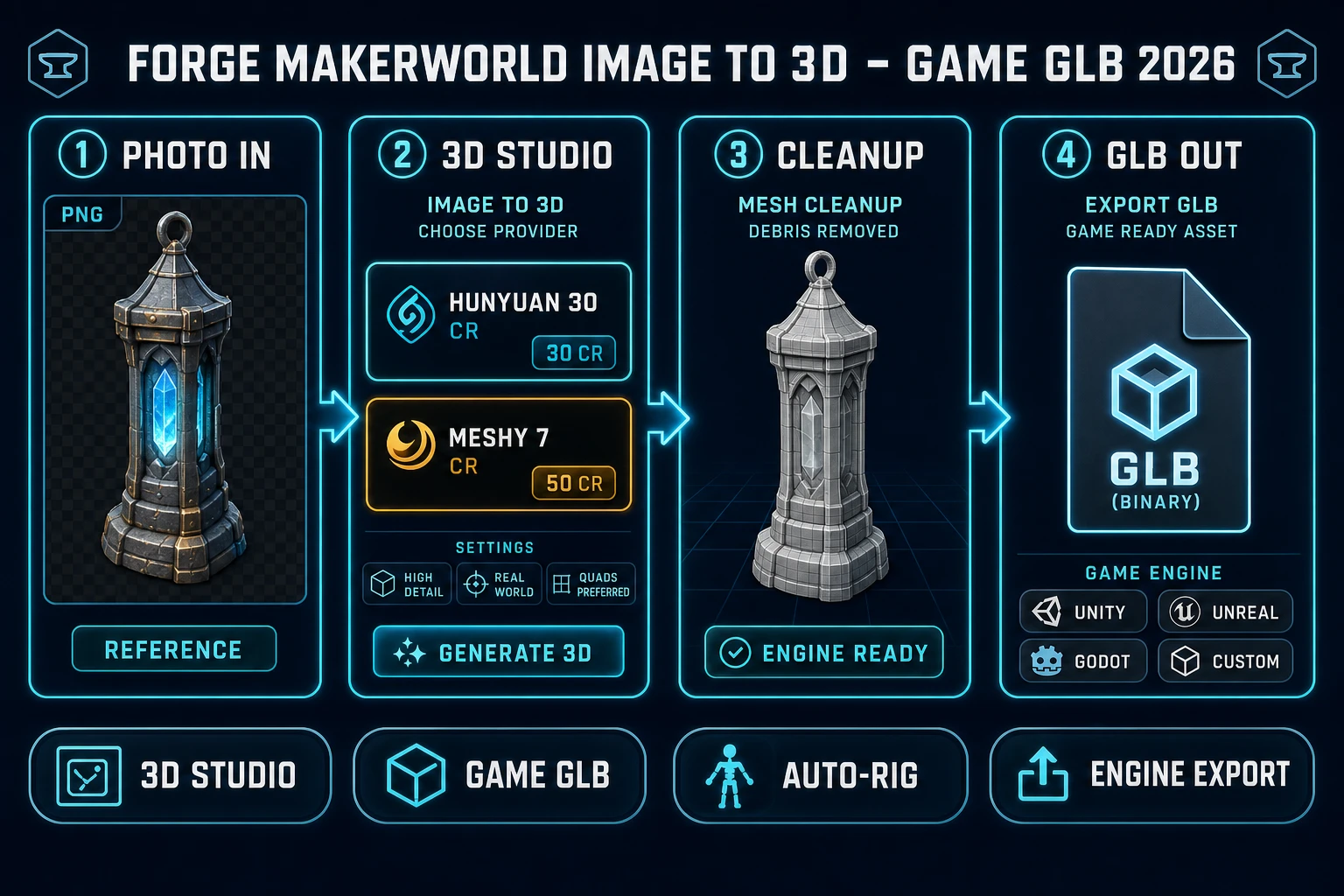
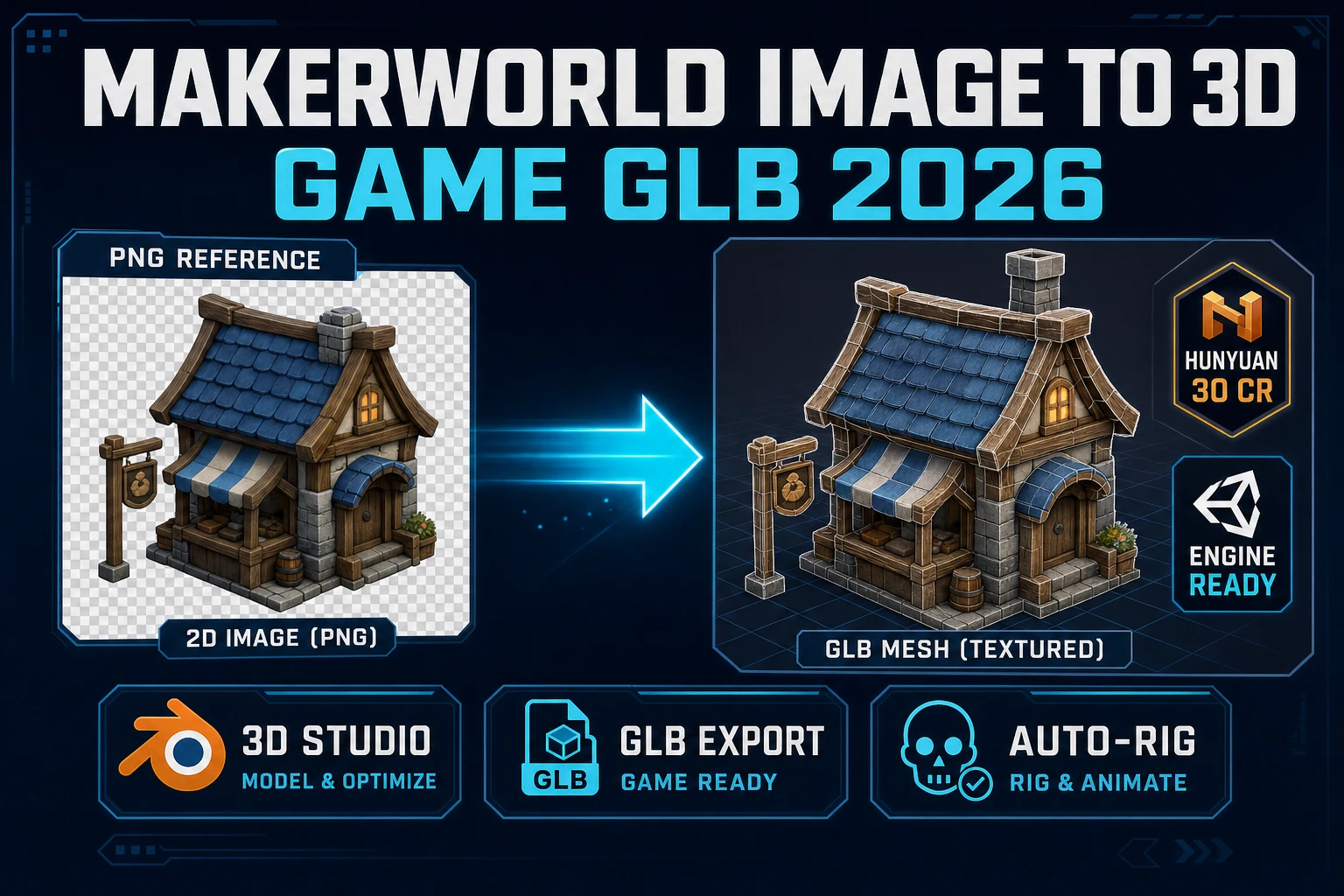
Makerworld image to 3D pipeline: photo reference, 3D Studio lift, cleanup, game GLB export
Makerworld image to 3D as a single loop: PNG in, textured mesh out, then a GLB you can drop into an engine.

What makerworld image to 3D searchers actually want

DataForSEO lists makerworld image to 3d at 1,300 searches a month with KD 11 (confirmed in tools/research-supplement.md, verified 2026-09-26 pull). The longer neighbor \makerworld image to 3d model\ sits at 210/mo, KD 10. The long-tail is brand-shaped, but the job is format-shaped: one still image becomes a mesh with a file extension the next tool understands.

Three outcomes dominate that intent in September 2026. First, a textured preview they can orbit in the browser. Second, a binary download — usually GLB for web and game engines, sometimes STL or 3MF after a slicer conversion for filament. Third, enough geometry honesty that thin walls, floating debris, and open holes do not explode the next step. Miss the third and the “AI made my prop” story becomes an afternoon of remesh and hole-fill.

Two open-source lineages still anchor the reconstructors the pickers wrap. Microsoft Research’s TRELLIS paper, Structured 3D Latents for Scalable and Versatile 3D Generation, remains a CVPR’25 Spotlight (verified 2026-09-27 on github.com/microsoft/TRELLIS, 13,708 stars). Tencent’s Hunyuan3D-2.1 README still describes the line as From Images to High-Fidelity 3D Assets with Production-Ready PBR Material (verified 2026-09-27 on github.com/Tencent-Hunyuan/Hunyuan3D-2.1, 4,085 stars). Hosted studios productize those ideas behind a credit ledger — that is the makerworld image to 3D job on Sorceress.

The 3D Studio route for makerworld image to 3D

Sorceress 3D Studio is the featured panel. The home card description (verified 2026-09-27 in src/app/_home-v2/_data/tools.ts) chains AI image generation, single-image to textured 3D, automatic humanoid auto-rigging with weight-paint refinement, and AI text-to-animation, then exports FBX, GLB, or GLTF for any engine. The picker lives in src/lib/threed-models.ts. Base credits checked today:

Model Base credits Best fit after a makerworld image to 3D search
Hunyuan 3D 3.130First bulk lifts on a wallet
Tripo v3.140Game-ready props with Face Limit control
TRELLIS 240 (1024 default)Concept meshes and mood-board props
Meshy 750 (texture on)Humanoids headed to auto-rig; Pose Mode A/T
Meshy 650Stylized characters; Low Poly mesh type
Rodin 2.050Stylized props with PBR material options
Tripo Smart Mesh P165Low-poly mobile/web budgets
Tripo P2125Hero props when fidelity beats cost
Pixal3D0 (VIP free unlimited)VIP-only image-to-3D lane

Meshy 5 sits at 31 credits for older jobs. TRELLIS v1 stays registered at 8 credits but is hidden from the picker in favor of TRELLIS 2. Hunyuan 3D 2.1 is 15 credits and gated behind RunPod configuration. Seed3D 2.0 shows creditLabel Admin test and is admin-only — do not plan a public lift around it. Pixal3D is vipOnly: true with creditLabel Free unlimited (all verified 2026-09-27 in src/lib/threed-models.ts). The badge on the home card for 3D Studio is AI Credits, not Free.

For sibling angles already shipped on the blog, see makerlab image to 3D for the print-safe finish, image to 3D models for the plural prop-pack loop and image to 3D model free for the low-credit voxel path. This page stays on makerworld image to 3D as the brand-shaped query with a game GLB finish.
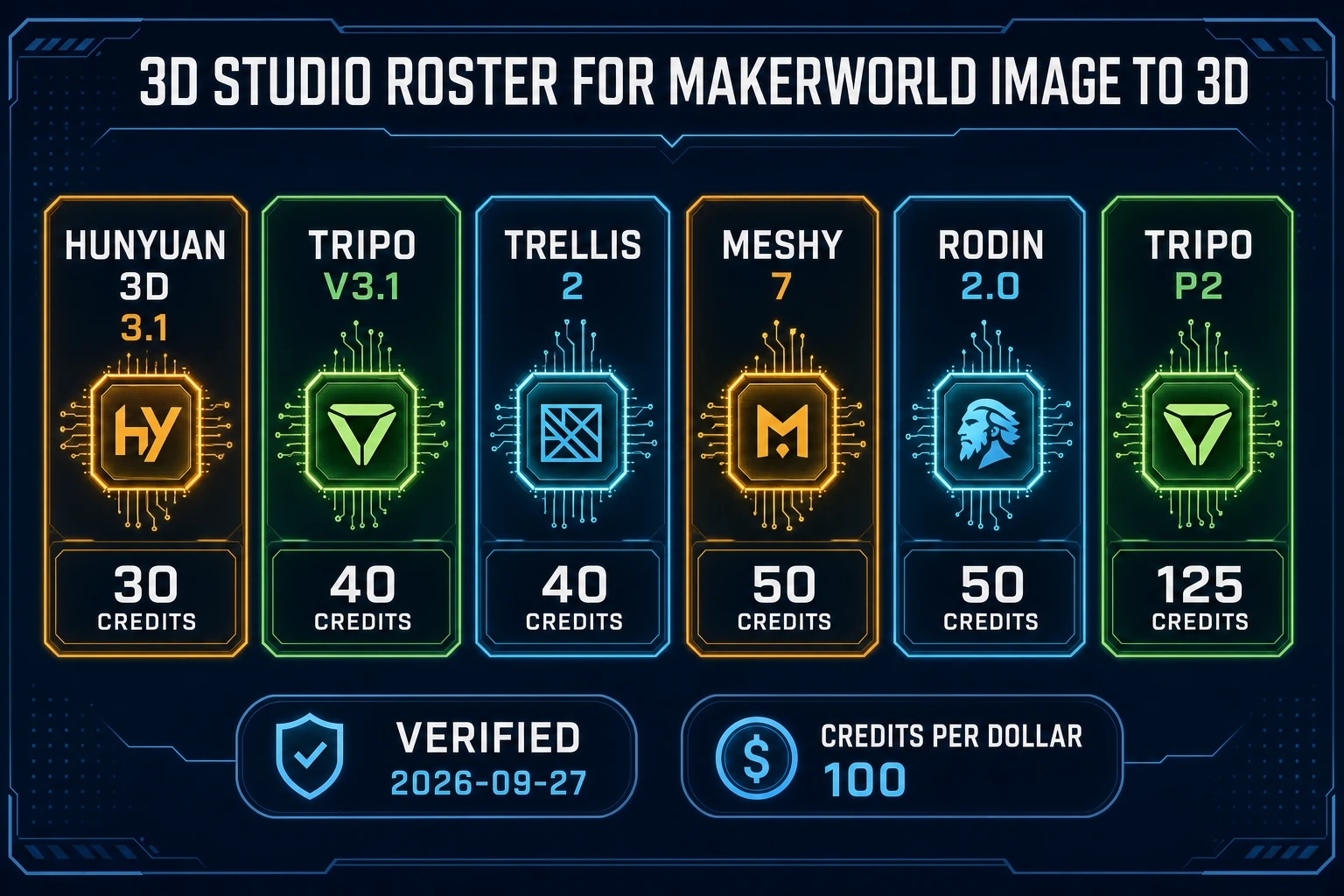
3D Studio model roster for makerworld image to 3D with credit chips from 30 to 125
Makerworld image to 3D roster inside 3D Studio: budget Hunyuan at 30 credits up to Tripo P2 at 125, verified 2026-09-27.

Cleanup before you call the GLB game-ready

A textured orbit is not an engine asset. After the lift, inspect for four failure modes that show up constantly on makerworld image to 3D jobs: floating dust islands, paper-thin panels that flicker under a directional light, fused floor geometry under the subject, and open holes where the reconstructor guessed the back side wrong. Crop the source PNG tighter before you spend a second pass. Prefer a plain background and one subject fully in frame. For bilaterally symmetric props, turn Symmetry on when the model exposes it; for rocks and asymmetric keys, leave it off.

Khronos calls glTF the JPEG of 3D: a royalty-free format for efficient transmission of scenes and models, with glTF 2.0 published as ISO/IEC 12113:2022 (verified 2026-09-27 on khronos.org/gltf). Wikipedia’s glTF page (verified 2026-09-27) distinguishes .gltf JSON from binary .glb. 3D Studio’s export line matches that reality: FBX for many desktop engine pipelines, GLB for single-file web delivery, GLTF when you want the unpacked form.

“Game-ready” in this article means: textured enough to read under a real light, free of debris that becomes stray draw calls, scaled to units you chose on purpose, and exported as a single binary file loaders accept. It does not mean every polycount is already mobile-safe. Cap Face Limit on Tripo v3.1 when the scene budget is tight, or turn Remesh on for Meshy when Target Polycount matters. For a browser sanity check before the engine handoff, MDN’s 3D games on the Web overview (checked 2026-09-27) points at Three.js, Babylon.js, and PlayCanvas loaders.
Game path after makerworld image to 3D

Once the mesh lands, stay on the playable branch.

Static props. Keep the textured GLB. Name the file with a project prefix (crate_loot_01.glb). Drop it into your engine or a Three.js viewer. Match scale against one hero prop already in the scene so a sword grip fits a humanoid hand later. Soft silhouettes and melted handles are predictable failure modes — crop tighter or switch from Hunyuan 3D 3.1 to Tripo v3.1 before you burn a second Meshy 7 pass.

Humanoid characters. Generate with Pose Mode set to a-pose or t-pose in Meshy 7 before you bind. Continue to the rig section below. A natural standing pose wastes the 20-credit auto-rig attempt.

Blocky art direction. Props that must look like cubes belong in Voxel Studio rather than a second 3D Studio pass. Image-to-voxel on Hunyuan 3.1 costs 25 credits (VOXEL_HUNYUAN_CREDITS in src/lib/voxelgen-hunyuan.ts, verified 2026-09-27). Keep that fork honest instead of forcing every silhouette through the same reconstructor.

If you need a separate PBR stack for ground planes or walls after the mesh is solid, open Material Forge. That is a material job, not a second image-to-3D spend. For a related prop-pack workflow see Lift Image to 3D Models.

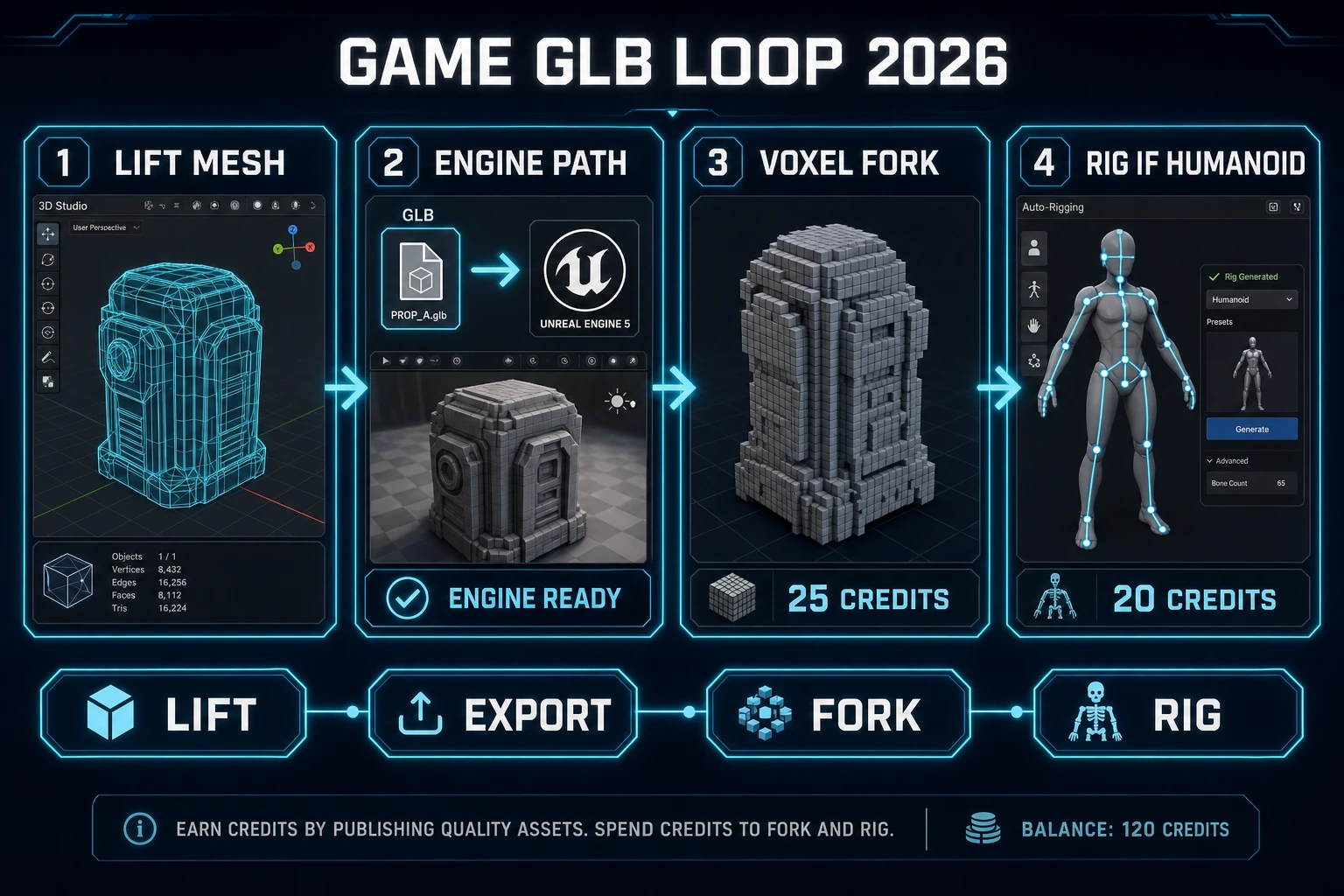
Makerworld image to 3D game GLB loop with optional voxel fork and auto-rig
Honest branch after makerworld image to 3D: game GLB, voxel fork at 25 credits, or 20-credit auto-rig for humanoids.

The rig path when the lift is a character

Many makerworld image to 3D searches start as a prop thumbnail and end as a mini that needs a walk cycle. After the lift, open Auto-Rigging (Pro on the home card, verified 2026-09-27). Two paths share the panel:

  • Free marker path. Load OBJ, FBX, or GLB. Place the thirteen required markers (pelvis, neck, chin, shoulders, elbows, wrists, knees, ankles). Build the skeleton, then compute weights. No AI auto-rig credits burn.
  • AI auto-rig button. Flat cost AUTO_RIG_CREDITS.meshy = 20 (verified 2026-09-27 in src/lib/rigging/external-rig/autoRigPricing.ts). Returns a Mixamo-named humanoid with weights baked into the GLB.

Generate the humanoid mesh with Pose Mode set to a-pose or t-pose in Meshy 7 before you bind — a natural standing pose wastes the 20-credit attempt. Stress-pose elbows and knees after the bind. Multi-legged bosses are not this tool; use Procedural Walk instead. For a deeper bind walkthrough see auto-rig character skin.

Credit math for a makerworld image to 3D session

Quote wallet numbers from source, not marketing memory. CREDITS_PER_DOLLAR = 100 in src/lib/models.ts (verified 2026-09-27). SIGNUP_GRANT = 100 in src/app/api/admin/credits/route.ts. One credit is one US cent on the top-up ledger.

Session plan Mesh line Rig line Total USD at 100 cr/$
1 Hunyuan 3.1 prop30030$0.30
1 Meshy 7 hero50050$0.50
1 Meshy 7 + AI auto-rig502070$0.70
1 Voxel Studio Hunyuan lift25025$0.25
Signup-only stress test3 × Hunyuan = 90090 of 100 grant$0.90 of grant

Optional add-ons: an AI Image Gen reference pass before the lift if you do not already have a clean PNG, Material Forge maps if you need a separate PBR stack, and text-to-animation clips after a successful bind. VIP accounts can burn Pixal3D for free unlimited image-to-3D on that lane only — everyone else should treat Hunyuan 3D 3.1 as the first makerworld image to 3D workhorse.

A practical checklist before you click Generate: crop to the silhouette, plain background, one subject, decide static prop versus riggable hero before you pick Meshy Ultra or 8K texture surcharges, and name the export before the queue finishes so the file lands in the right folder. Soft silhouettes and melted handles are predictable failure modes — crop tighter or switch from Hunyuan 3D 3.1 to Tripo v3.1 before you burn a second Meshy 7 pass. The cheap lane is for iteration; the 50-credit lane is for keepers.

Scale discipline matters as much as topology. Measure one hero prop in meters inside the 3D Studio viewport, then match follow-up lifts to that ground plane. A crate that exports at twice the intended scene height is not a style problem; it is a scale problem that wastes the next level-block hour. Same rule for game props: if the sword’s grip must fit a humanoid hand after auto-rig, generate the hero first, note the hand size, then lift the sword against that reference silhouette.

When a makerworld image to 3D lift comes back soft, do not immediately jump to Tripo P2 at 125 credits. Re-crop, raise contrast on the silhouette, and retry Hunyuan 3D 3.1 or Tripo v3.1 first. Reserve the expensive lanes for hero props that already survived a cheap pass. That habit keeps the signup grant useful and keeps the credit ledger honest across a whole prop pack.

Verdict: finish makerworld image to 3D with a game GLB

A clean makerworld image to 3D session on Sorceress in 2026 looks like this:

  1. Gather or generate a clean reference in AI Image Gen (plain background, one subject, full silhouette).
  2. Open 3D Studio, pick Hunyuan 3D 3.1 at 30 credits for the first lift or Meshy 7 at 50 credits for a riggable hero.
  3. Inspect for debris and thin walls, then export GLB for engine import.
  4. If the subject is a humanoid, bind with free markers or the 20-credit AI auto-rig on Auto-Rigging. If the art direction is cubes, fork to Voxel Studio at 25 credits instead.

That is the whole job makerworld image to 3D searchers are buying: not a vendor tour, but a PNG that becomes a GLB you trust enough to drop into a scene. Open 3D Studio, lift once, inspect hard, and move on to the part that actually needs the mesh.

Frequently Asked Questions

What does makerworld image to 3D mean in 2026?

Makerworld image to 3D is the search phrasing people type when they want a single photo turned into a downloadable mesh — often after seeing MakerWorld-style image-to-3D demos aimed at makers and model libraries. The job on Sorceress is the same destination with a game finish: drop a PNG into 3D Studio at /3d-studio, pick an image-to-3D model, and export GLB, FBX, or GLTF (verified 2026-09-27 in src/app/_home-v2/_data/tools.ts). This guide keeps MakerWorld as plain-text context only and ships the mesh through Sorceress.

Which model should I pick first for makerworld image to 3D?

For a wallet-friendly lift, start with Hunyuan 3D 3.1 at 30 credits per mesh (src/lib/threed-models.ts, verified 2026-09-27). For humanoids you plan to auto-rig, use Meshy 7 at 50 credits with Pose Mode set to a-pose or t-pose. Tripo v3.1 at 40 credits is a strong middle lane for Face Limit control. Pixal3D is credits 0 with creditLabel Free unlimited but vipOnly true. CREDITS_PER_DOLLAR = 100 in src/lib/models.ts, so 30 credits is $0.30 of wallet.

Is a GLB from makerworld image to 3D game-ready?

GLB is a binary glTF container — Khronos calls glTF the JPEG of 3D and notes glTF 2.0 is ISO/IEC 12113:2022 (verified 2026-09-27 on khronos.org/gltf). Wikipedia’s glTF page covers .gltf vs .glb. Game-ready means the mesh is textured, free of floating debris, scaled to your scene units, and exported as a single binary file engines and Three.js loaders accept. It does not mean every polycount is already mobile-safe — use Face Limit on Tripo or Remesh on Meshy when the engine budget is tight.

Can I auto-rig a makerworld image to 3D humanoid?

Yes. Lift the humanoid in 3D Studio with Pose Mode a-pose or t-pose, then open Auto-Rigging at /rigging. The free path places thirteen markers and computes weights. The AI auto-rig button costs AUTO_RIG_CREDITS.meshy = 20 credits and returns a Mixamo-named skeleton with baked weights (verified 2026-09-27 in src/lib/rigging/external-rig/autoRigPricing.ts). Export a skinned GLB for engine import.

When should makerworld image to 3D go through Voxel Studio instead?

When you want blocky Minecraft-style silhouettes rather than continuous mesh. Voxel Studio at /voxelgen runs image-to-voxel on Hunyuan 3.1 at 25 credits (verified 2026-09-27 in src/lib/voxelgen-hunyuan.ts). Use 3D Studio for smooth props and characters; use Voxel Studio when the art direction is cubes.

Sources

  1. glTF - Khronos Group
  2. glTF - Wikipedia
  3. Tencent-Hunyuan/Hunyuan3D-2.1
  4. microsoft/TRELLIS - CVPR'25 Spotlight
  5. 3D games on the Web - MDN
Written by Arron R.·1,876 words·8 min read

Related posts