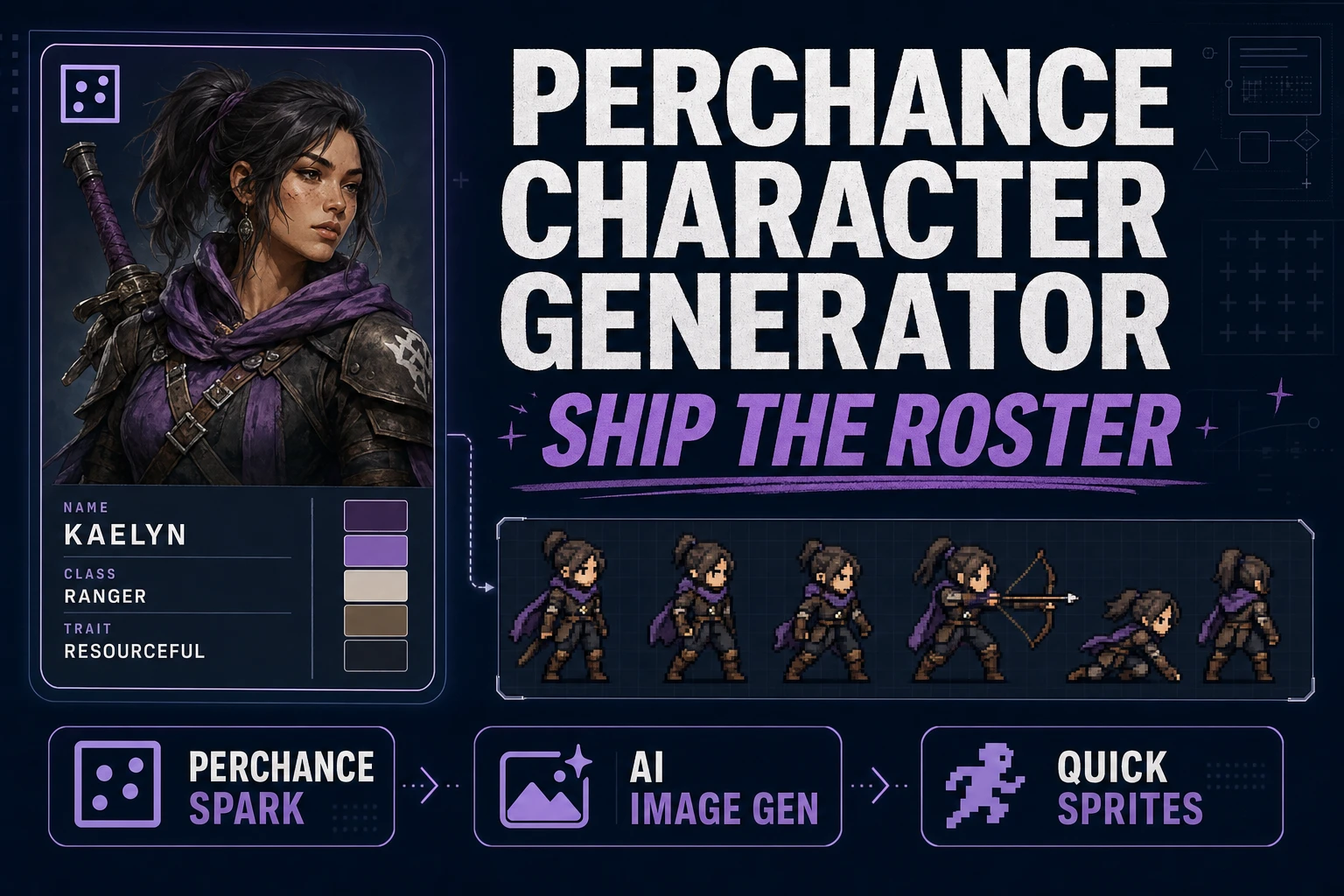
Craft Perchance AI Character Generator (Game Roster 2026)

By Arron R.10 min read
Perchance is free, no-login, and Llama-backed in 2026 - great for sparks, weak for engine-ready rosters. Hand off to Sorceress AI Image Gen with reference lock

A search for a perchance ai character generator in 2026 is almost always the same shape: an indie dev wants a free, no-login browser tool that spits out an image plus a bio, then wonders whether the same output can survive a jump into a game engine. Perchance answers half the question. The other half - engine-ready sprites, alpha cutouts, stable identity across a walk cycle - needs a pipeline that starts where Perchance stops.

This guide is that pipeline. It names Perchance in plain text only (no competitor store links), walks the honest strengths and gaps of its 2026 character surface, then shows a Sorceress AI Image Gen handoff that keeps every face on model and every sprite alpha-clean. Prices, credits, and Perchance feature flags below were live-verified on 2026-08-01.
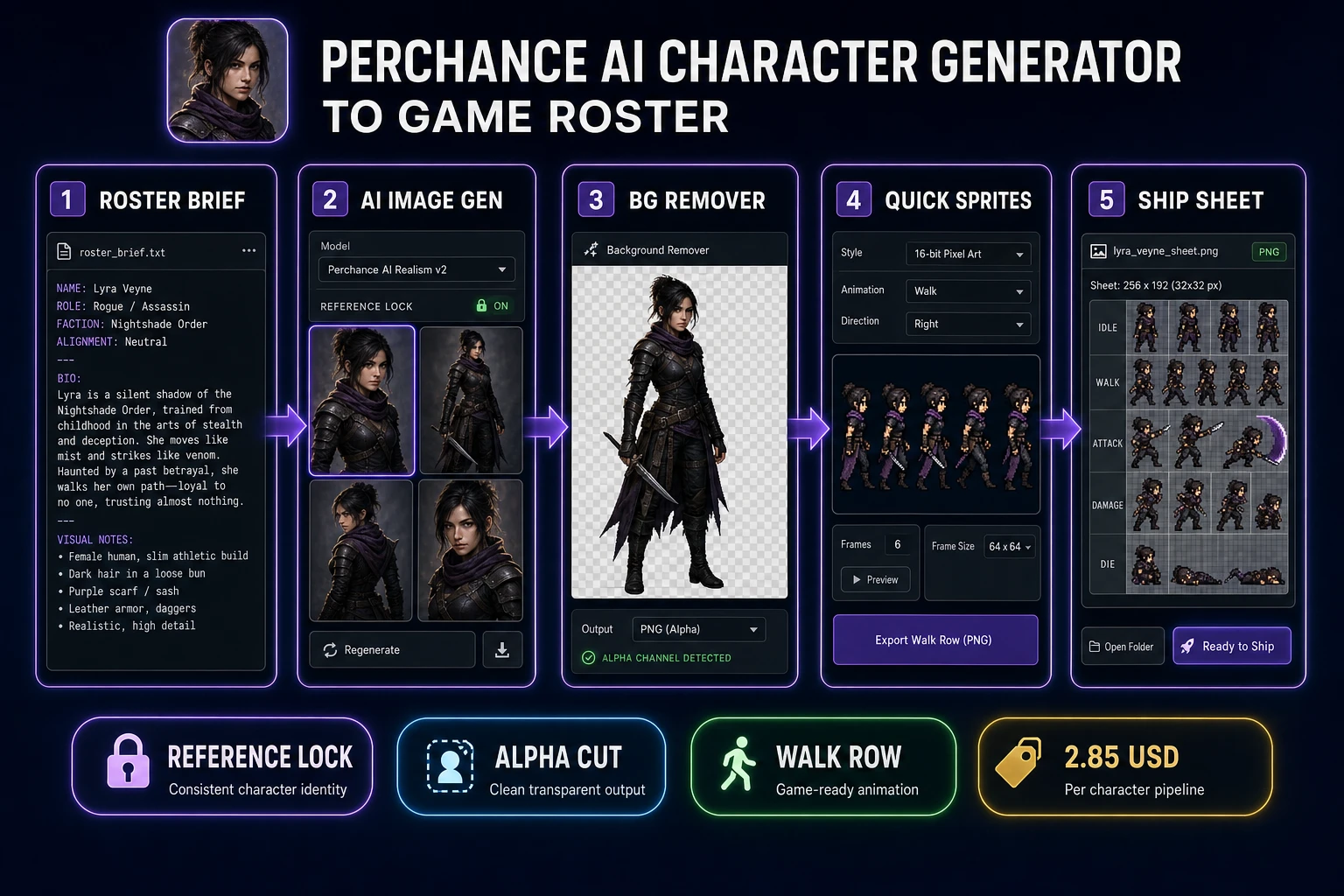
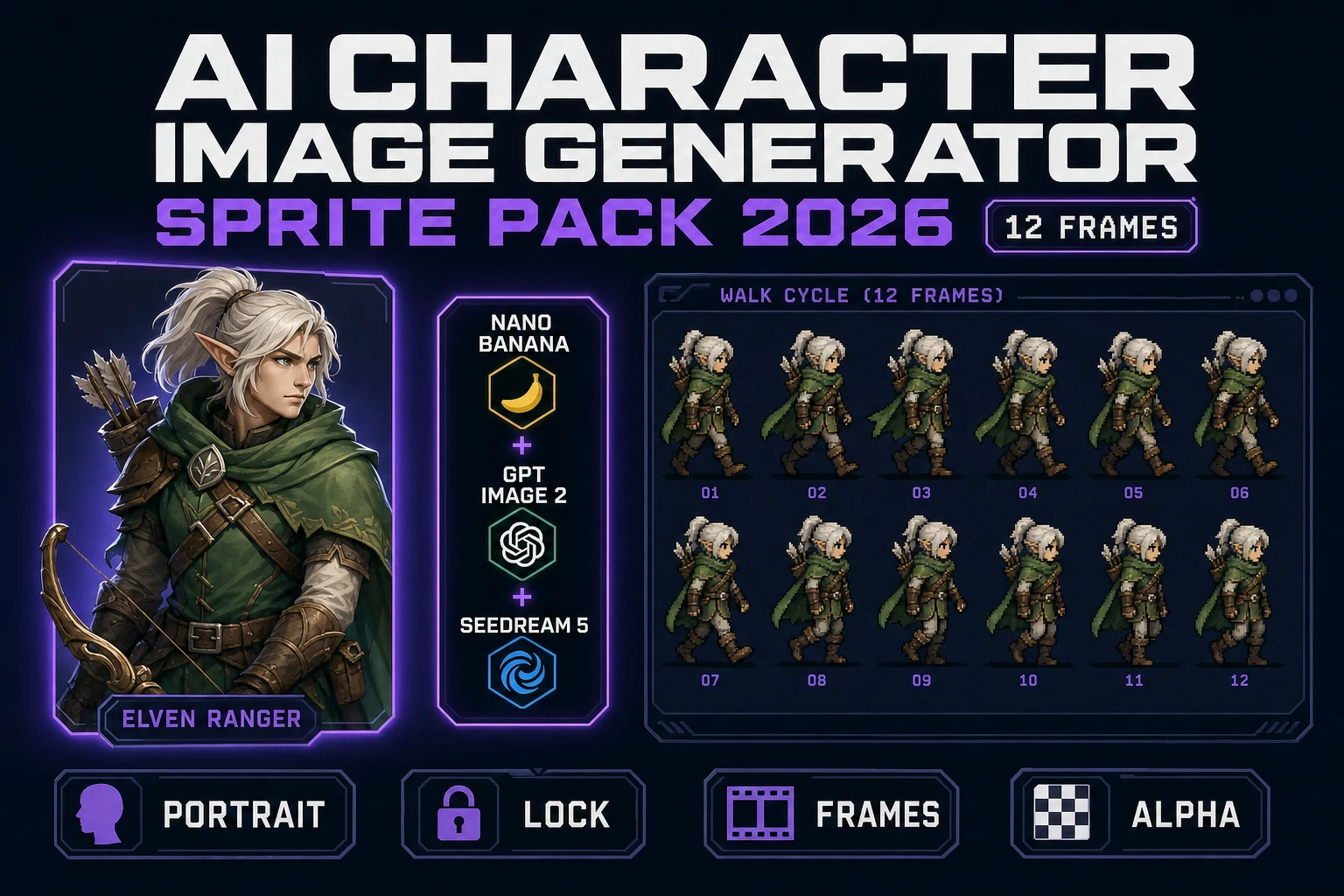
perchance ai character generator to sprite pack pipeline for indie game rosters
Perchance sparks the roster; AI Image Gen locks the identity; BG Remover and Quick Sprites ship the sheet.

What a perchance ai character generator search actually wants for a game roster

Type perchance ai character generator into Google and you land on perchance.org/ai-character-generator - a free, browser-based tool that pulls community-authored generator templates through a lightweight client-side JavaScript engine, then (since a 2026 update, verified 2026-08-01 via multiple AI-tool review outlets) layers a Llama-based inference model on top for freeform descriptions and dialogue. No login, no watermark, no daily cap, no credit system. That combination is genuinely rare in 2026, and it is why the query keeps ranking with 4,400 monthly searches at a soft KD 14.

But the query intent behind those searches is not "give me a random paragraph and a portrait I close five minutes later." The intent is roster-shaped: the user wants a hero, two or three NPCs, and one enemy family, each with a stable face, a shared palette, and a bio they can paste into dialogue trees. Perchance ships item #1 (a portrait) but leaves items #2 through #5 on the reader to solve. That is the gap this article closes.

A quick honest-search-intent map: someone typing a perchance ai character generator query today either wants a randomizer that stops the blank-page problem, or wants a browser tool cheaper than a subscription character-art service. Both intents share the same next step - you need the faces to stay on model when you generate the second one, the third one, and the villain - and that is a job for reference locks, not random rolls. Roster-ready character work is well-documented in tabletop model sheet practice: fix the silhouette, palette, and prop language before you touch color; every downstream frame inherits those locks.

Where Perchance's free tier is genuinely good and where it stalls a game jam

The honest strengths first. Perchance in 2026 added four structured input fields - Lore, World, NPC, and Instruction - that let a user pin persistent context (world setting, character rules, backstory constants) into the Llama inference call so the freeform description output stops drifting after twenty messages. Combined with the "no login ever" architecture and the fact that generation runs partly client-side with ad-supported GPU inference on the server, Perchance is one of the last truly zero-friction character tools on the open web. For side-quest NPC sparks, throwaway campaign one-shots, and jam brainstorm sessions, that friction floor is a real feature.

Now the gaps that stall a shipped game. First, Perchance has no native save system. The site is explicit about this in its own documentation: everything lives in your browser tab until you copy it out. Refresh the page and the roster is gone. For a solo dev on a 48-hour game jam, that is manageable; for a two-week jam or a longer indie project, it is a workflow trap. Second, the portrait output is a single JPEG per generation. There is no batch mode, no reference lock across generations, and no alpha channel - the background comes attached to the character, so the sprite pipeline needs a separate BG Remover pass anyway. Third, the Llama inference layer is tuned for freeform description rather than the tight prompt prefixes a game needs. Two consecutive generations of "elf scout with a leather cloak" will produce two different-looking elves. That is fine for a novel; it kills a walk cycle.

The move is to keep Perchance in the workflow for what it does well (spark a name, roll a quirk, seed a bio) and hand off to a Sorceress pipeline the moment the roster needs to stay on model. For a fuller side-by-side of every free character-generator surface the query cluster touches, the sibling posts Probe Canva AI Character Generator, Vet OpenArt AI Character Generator, and Dial an AI Character Generator map the same intent from three other angles.

The Sorceress perchance ai character generator alternative pipeline in five steps

The Sorceress path replaces the parts of a perchance ai character generator loop that stall a jam and keeps the parts that spark. Every step below runs in the same browser tab you already have open, and the whole pipeline is priced against credits rather than a subscription, so a five-face roster is a bounded number rather than an open-ended monthly bill. The five steps are:

  1. Lock a roster brief - six fields per role, written in a plain text file before any tool opens.
  2. Generate reference-locked faces on AI Image Gen using Nano Banana Pro, Nano Banana 2, or GPT Image 1.5 with the reference-image lock on.
  3. Cut transparent alpha on BG Remover - three credits per image, five-megabyte cap per upload.
  4. Cast a walk row on Quick Sprites using the retro-diffusion animation model - nine credits per generation.
  5. Ship a bio sheet alongside the sprite pack, mirroring the tabletop character sheet convention so the writer, the coder, and the animator all read from the same page.

Every step is undoable, every step happens in the browser, and none of them require a Blender install, a subscription upgrade, or a login-gated portal. The next three sections cover steps one, two, and three in detail; steps four and five slot in on top of the alpha cutouts once the faces are locked.
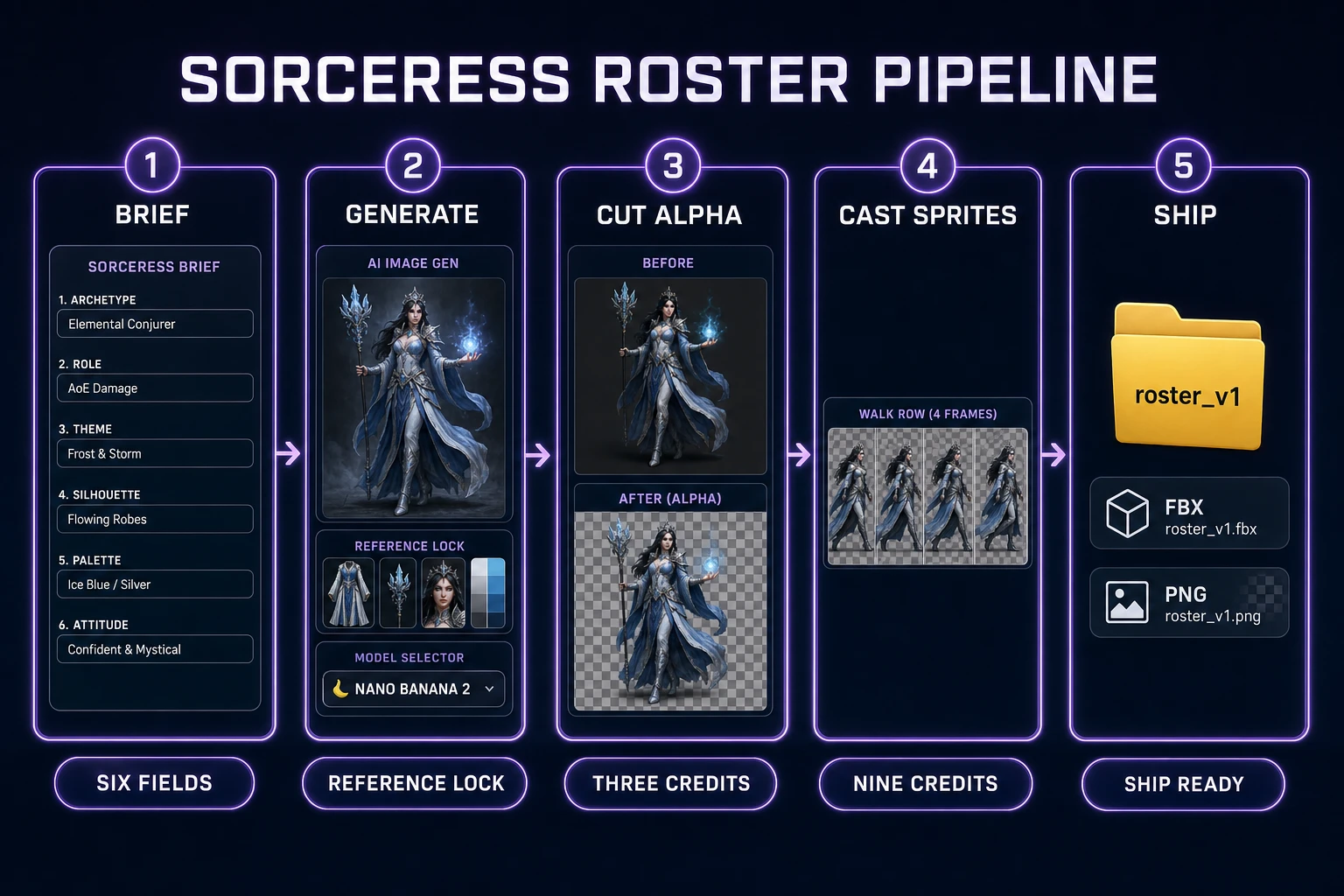
Five-step Sorceress pipeline replacing a perchance ai character generator workflow
Roster brief to reference-locked faces to alpha cutouts to walk rows to ship sheet. Five bounded credit steps.

Step 1 - lock the roster brief before touching either tool

Open a text file named roster_v1.txt. For every role you plan to ship, write exactly six lines: role, silhouette family, palette budget, signature prop, voice beat, and plot hook. That is the whole brief. A single hero card takes about ninety seconds to write, three cards take about five minutes, and the six-line format was chosen deliberately because it survives every downstream tool - a prompt prefix in AI Image Gen, a dialogue stub in a game engine, a personality note in a tabletop write-up.

Palette budget is the field almost every jam skips. Pick three to five named colors that the entire roster shares (a common indie choice is one warm skin range, one cloth accent, one metal accent, one outline color, and one glow color). The palette lock is what keeps the villain and the hero looking like they exist in the same game rather than in two different generator sessions. When Perchance generates a bio, the color language will usually be missing - add the palette line yourself before you paste anything into an image tool.

Voice beat and plot hook are the two lines Perchance actually does well. If you keep the tool open in a second tab, drop its output into the "voice beat" and "plot hook" fields on your card, then discard everything else it generated. The Llama inference under the hood is fine for a one-sentence tell; it is not fine for the six lines that survive into production.

Step 2 - generate reference-locked faces on AI Image Gen

Open AI Image Gen in a new tab. The tool exposes the full IMAGE_MODELS lineup, each with its own credit cost verified in src/lib/models.ts on 2026-08-01: Z-Image at 3 credits per image for silhouette drafts, Nano Banana at 6 credits, Nano Banana 2 at 9 credits, GPT Image 1.5 at 7 credits, Flux 2 Pro at 6 credits base plus 3 credits per reference image, Seedream 5 Lite at 6 credits, Seedream 5 Pro at 6 credits, and Nano Banana Pro (the model labeled Gemini 3 Pro Image on Replicate) at 18 credits by default. The two most useful models for reference-locked character work in a perchance ai character generator replacement flow are Nano Banana Pro for the hero card and Nano Banana 2 for supporting cast.

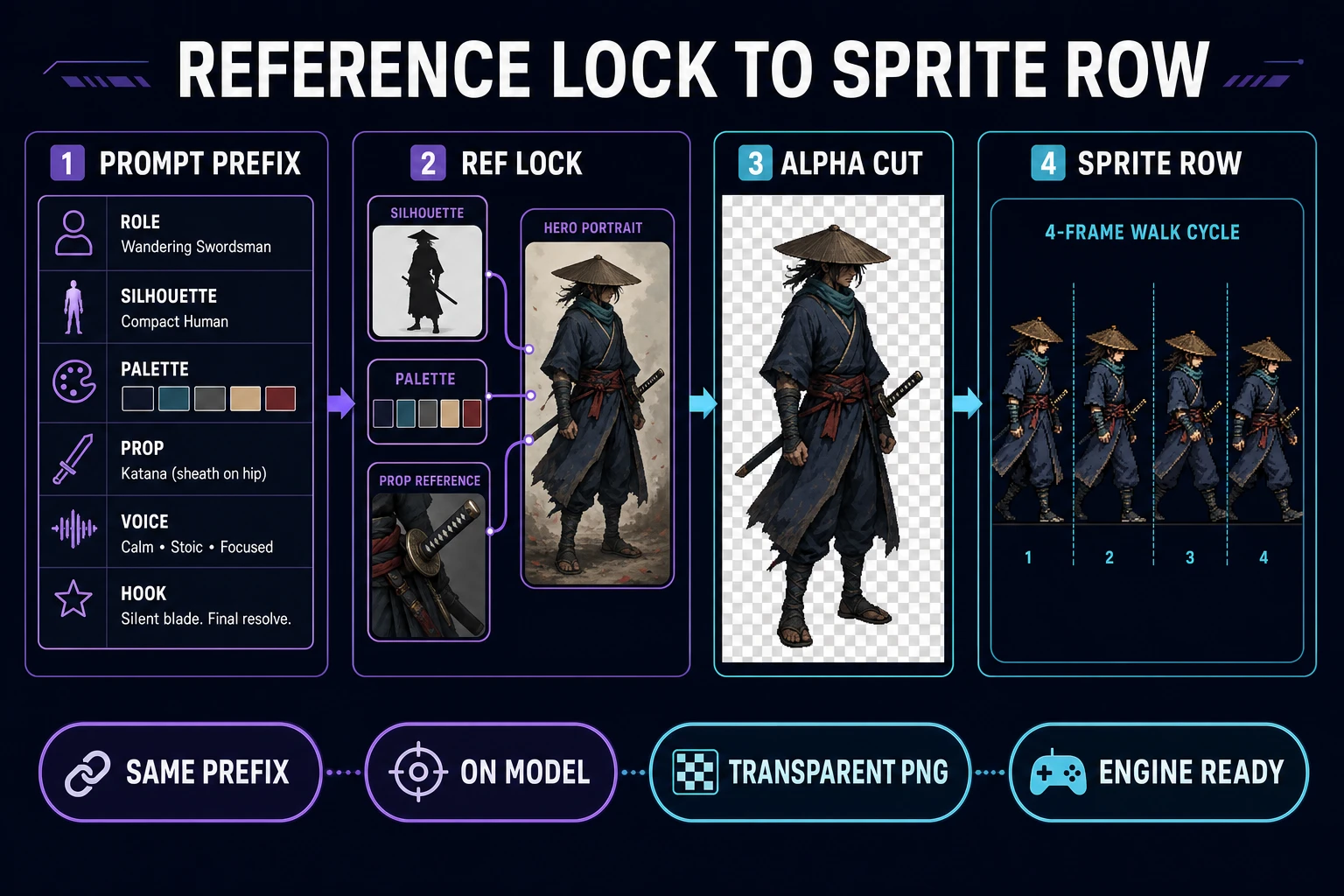
Paste the six-line roster card as the prompt prefix, then add one shot-specific line at the end (a T-pose plate for the sheet, a three-quarter torso portrait for the dialogue window, or a full-body silhouette for the sprite pass). Turn the reference-image lock on and re-use the first hero output as the reference for every follow-up generation in the same role. That is the mechanic Perchance's random-roll approach cannot reproduce: the second generation is anchored to the pixels of the first one, not to a re-interpretation of the text prompt.

Generate three variants of each face, pick the one whose silhouette reads cleanest at 128x128 pixels, and delete the others. Do not save every generation. A jam-scope five-face roster with three variants per face is fifteen images total; at Nano Banana 2's 9 credits each, that is 135 credits - about $1.35 at the Sorceress rate of 100 credits per dollar. That is the entire art budget for the roster, and it is a bounded number a solo dev can commit to in advance.

Reference-locked AI Image Gen faces handing off to BG Remover and Quick Sprites for a game roster
Reference lock on, three variants, keep the cleanest silhouette, alpha cut, sprite row.

Step 3 - cut alpha with BG Remover and cast sprites in Quick Sprites

Every face that survives the silhouette check goes through BG Remover next. The tool costs 3 credits per image, caps uploads at 5 megabytes, and runs a non-binary alpha matte so the edge of a cloak or a strand of hair is not clipped to a hard line. Upload the face, wait about six seconds, download the transparent PNG. Repeat for every kept variant. A five-face roster with one kept variant per face is 15 credits total on this step - about $0.15.

Then hand off to Quick Sprites. The tool wraps a retro-diffusion animation model (verified as retro-diffusion/rd-animation in src/app/quick-sprites/page.tsx on 2026-08-01) that consumes a locked face plus a motion description and returns a walk row, an idle row, or a hit-reaction row at a native pixel resolution. Cost is 9 credits per generation. Feed each transparent face into Quick Sprites, request "idle two-frame loop, walk four-frame loop, hit one-frame flinch," and export the resulting PNG sheet. A five-face roster with three motion rows per face is 15 sprite generations - 135 credits, or another $1.35.

Running total for a five-face jam roster: 135 credits on AI Image Gen for the reference-locked portraits, 15 credits on BG Remover for the alpha cutouts, and 135 credits on Quick Sprites for the motion rows. That is 285 credits, or $2.85 at the pay-as-you-go rate. Compared to a subscription character-art service or a per-hour freelance illustrator, it is a rounding error, and every asset is engine-ready the moment it downloads. For the tabletop side of the same query cluster, Roll an NPC Generator (Roster Bio Pack 2026) covers a WizardGenie-first path that pairs cleanly with this art pipeline; for the dnd-specific angle, Cast a DnD NPC Generator is the sibling that layers 5e stat blocks on top of the same bio cards.

What a perchance ai character generator run costs in Sorceress in 2026

Two honest cost paths. Path one is the pay-as-you-go rate: 100 credits per dollar, no minimum spend, so the five-face jam roster described above lands at $2.85 total. Path two is the Sorceress Lifetime Access plan at $49 (verified against src/app/plans/page.tsx LIFETIME_PRICE on 2026-08-01), which unlocks the paid tools required to upload custom 3D meshes and removes the credit-metering on unlimited daily generations for the tools that support it. For a hobbyist shipping one jam roster per weekend, pay-as-you-go is the right call; for anyone building a recurring cast library, Lifetime Access is the break-even point somewhere around the fourth full roster.

Every price above was live-verified on 2026-08-01 against the running Sorceress source: src/lib/models.ts for the IMAGE_MODELS credit table (Nano Banana Pro 18cr, Nano Banana 2 9cr, GPT Image 1.5 7cr, Seedream 5 Lite/Pro 6cr, Flux 2 Pro 6cr, Z-Image 3cr), src/app/bg-remover/page.tsx for BG_REMOVER_CREDITS (3cr) and MAX_FILE_SIZE_MB (5), src/app/quick-sprites/page.tsx for CREDITS_PER_GEN (9) and MODEL_ID (retro-diffusion/rd-animation), and src/app/plans/page.tsx for LIFETIME_PRICE ($49) and CREDITS_PER_DOLLAR (100). Perchance features were verified against the perchance.org public documentation and multiple independent 2026 reviews on the same date.

The upshot for a perchance ai character generator search that ends in a shipped roster: keep Perchance for the sparks it does well, hand off to the Sorceress pipeline the moment the game needs identity locks, and budget under three dollars for the whole art pass. The full tools guide maps every step to the exact page and credit cost; the plans page shows the Lifetime Access math when the third or fourth roster starts to feel like a workflow rather than a one-off.

Frequently Asked Questions

What does a perchance ai character generator search actually want?

A roster it can ship, not a single portrait. The intent behind the 4,400/mo perchance ai character generator query in 2026 is: a hero, two or three NPCs, and one enemy family with stable faces, a shared palette, and bios the writer can paste into dialogue trees. Perchance ships the first portrait cleanly but leaves reference locking, alpha cutouts, and sprite handoff to the reader. The Sorceress path fills those four downstream steps.

Is Perchance actually free in 2026?

Yes. Verified 2026-08-01 against perchance.org and multiple independent 2026 reviews: perchance.org/ai-character-generator has no login, no subscription, no watermark, and no daily cap. The site is supported by ad-funded GPU inference on the server plus donations, and the character surface added structured Lore/World/NPC/Instruction input boxes on top of a Llama-based inference layer in 2026. The trade-off is no native save system: everything lives in the browser tab until you copy it out, so a refresh loses the roster.

Which Sorceress image models are cheapest for a perchance ai character generator replacement flow?

Verified 2026-08-01 in src/lib/models.ts: Z-Image at 3 credits per image is the cheapest silhouette draft path, Nano Banana at 6 credits and Seedream 5 Lite at 6 credits handle mid-tier variations, Nano Banana 2 at 9 credits and GPT Image 1.5 at 7 credits carry supporting cast, and Nano Banana Pro (the Gemini 3 Pro Image model on Replicate) at 18 credits is the hero-card option. A five-face jam roster with three variants per face on Nano Banana 2 lands at 135 credits, or 1.35 dollars at 100 credits per dollar.

How much does a full five-face roster cost through Sorceress?

About 2.85 dollars, verified 2026-08-01. Five faces with three variants on Nano Banana 2 = 135 credits on AI Image Gen. Five kept variants through BG Remover at 3 credits each = 15 credits. Fifteen sprite generations on Quick Sprites at 9 credits each (retro-diffusion/rd-animation model, verified in src/app/quick-sprites/page.tsx) = 135 credits. Total 285 credits, priced at 100 credits per dollar. The Sorceress Lifetime Access plan at 49 dollars pays for itself somewhere around the fourth full roster.

How does this article differ from the Perchance description sibling on the Sorceress blog?

The July 25, 2026 Seed post targets perchance ai character description generator - Perchance's Llama-driven text bio surface. This article targets perchance ai character generator - Perchance's image character surface. Different Perchance tools, different search intent, different downstream Sorceress handoff. Both articles keep Perchance in the sparks role and hand off to Sorceress for reference locks, alpha, and sprite work.

Sources

  1. Character sheet - Wikipedia
  2. Model sheet - Wikipedia
  3. JavaScript - Wikipedia
  4. Sprite (computer graphics) - Wikipedia
Written by Arron R.·2,210 words·10 min read

Related posts