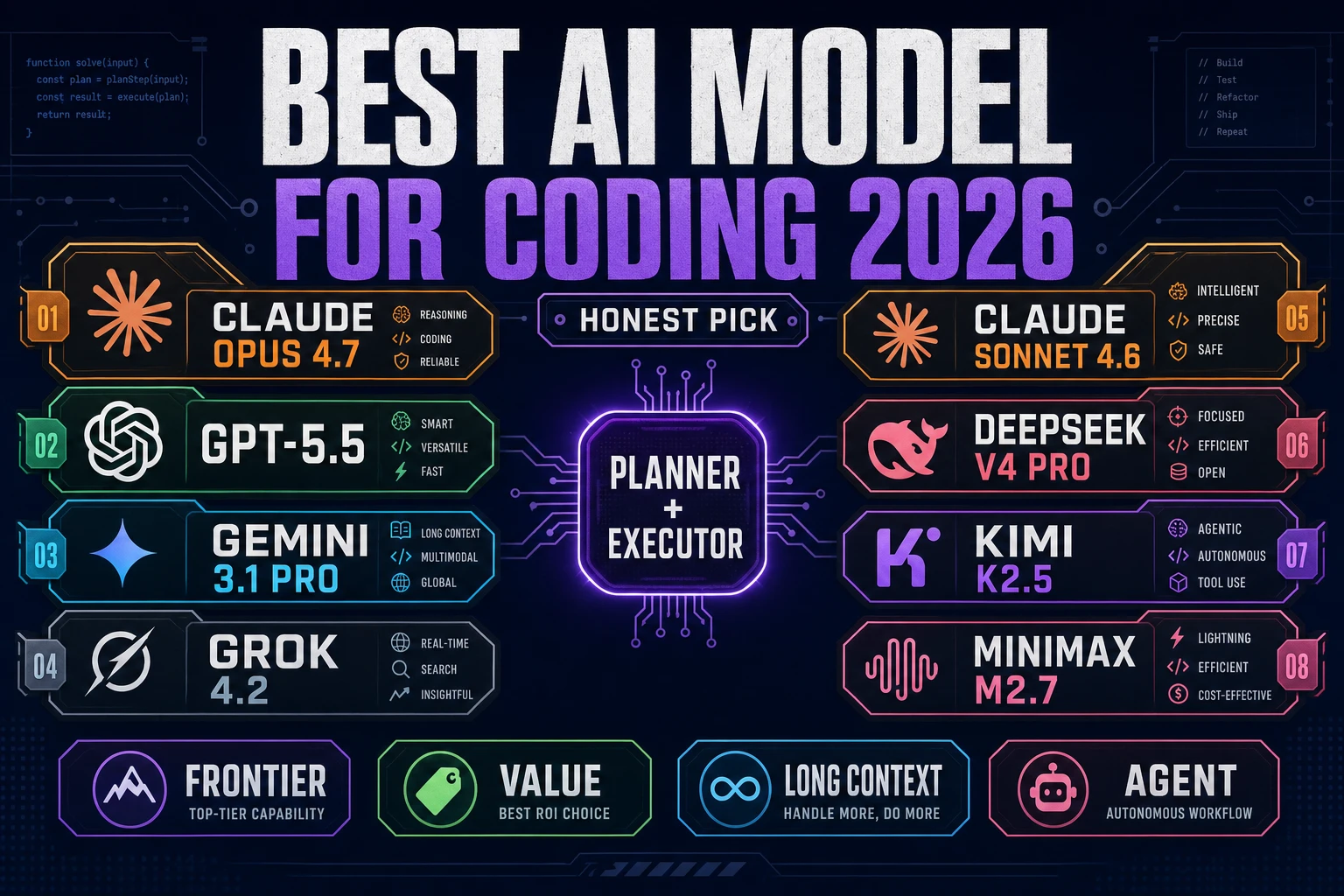
Chart Best AI Model for Coding (Honest Pick 2026)

By Arron R.14 min read
The best AI model for coding in 2026 is a Planner+Executor pairing: Claude Opus 4.7 as planner (with Gemini 3.1 Pro for 1M context or Grok 4.2 for 2M), Sonnet 4

Type best ai model for coding into a search bar in September 2026 and the top result changes month to month - Anthropic ships Claude Opus 4.7 next to Opus 4.8 and Opus 5, OpenAI cycled through GPT-5.5 to GPT-5.6-sol and gpt-6-astra, Google Gemini 3.1 Pro Preview holds the 1M-context seat, xAI is publishing Grok 4.2 through 4.6 on the same pricing page, and DeepSeek V4 Pro-0813 sits at roughly one-tenth the output price of Claude. That churn is the reason a searcher asking “what is the best AI model for coding” deserves a framework, not a single-name answer. This piece charts an honest 2026 pick by scoring the eight models Sorceress actually rotates in WizardGenie and Sorceress Code, mapping each seat to the task it wins, and printing the Planner+Executor recipe that beats any single-model pick. Every claim below was verified 2026-09-10 against the vendor documentation pages and the Sorceress source in src/app/_home-v2/_data/tools.ts and src/app/code/page.tsx.
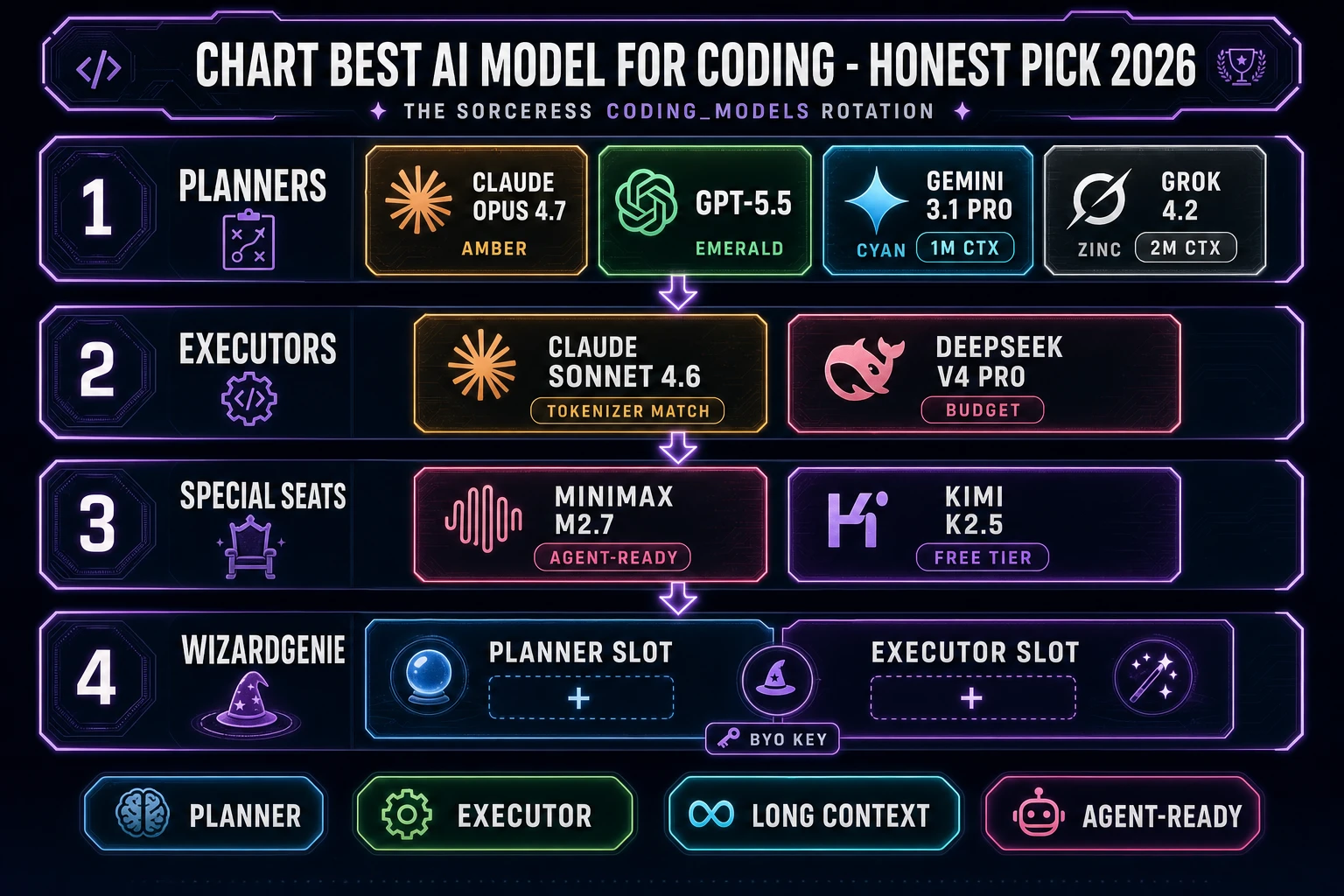
Chart of the best AI model for coding in 2026 showing the eight Sorceress CODING_MODELS rotation Claude Opus 4.7 Claude Sonnet 4.6 GPT-5.5 Gemini 3.1 Pro DeepSeek V4 Pro Kimi K2.5 Grok 4.2 MiniMax M2.7 with seat labels planner executor budget agent
The honest 2026 pick for the best AI model for coding is a chart of eight seats - four planners, two executors, one agent-ready, one long-context backup - as shipped in the Sorceress CODING_MODELS rotation on 2026-09-10.

What “best AI model for coding” needs to answer in 2026

The question best ai model for coding has two failure modes when it gets answered lazily. The first is naming a single model and stopping - the search intent is a decision, and a single-name answer to a fast-moving market is stale within weeks. The second is naming a benchmark leaderboard result - HumanEval, SWE-Bench, LiveCodeBench, MBPP - which is useful for research but misses that a working coder needs one model to plan, a different one to type, and often a third for a huge context paste. A 2026 answer has to name three things: which model to reach for on frontier reasoning, which one to pair with it as the executor, and how the two split the cost of a real workflow.

Verified 2026-09-10 against Anthropic pricing: Claude Opus 4.7 stands at $5 input / $25 output per million tokens, on the same tier as newer Opus 4.8 and Opus 5. Sonnet 4.6 stands at $3 / $15 with Sonnet 5 at $2 / $10 sitting below as the newer cheap seat. Google Gemini 3.1 Pro Preview is $2 / $12 per MTok for prompts under 200k tokens and $4 / $18 above, with a full 1M input window. xAI grok-4.20-0309-reasoning is $1.25 / $2.50 short and $2.50 / $5 long context with a 2M window; newer Grok 4.6 sits at $2 / $6 with a 500k window. DeepSeek V4 Pro-0813 keeps the budget lane. These are the prices the honest pick has to work inside - the “best” answer is the seat that wins each task at the lowest price that still lands the code in one shot.

The eight CODING_MODELS in the WizardGenie plus Sorceress Code rotation

Verified 2026-09-10 in src/app/_home-v2/_data/tools.ts lines 766 to 775, the Sorceress CODING_MODELS constant is exactly eight seats - no more, no less. Each seat has a role, an accent color that renders in the model picker, and a purpose the rest of the rotation does not cover.

Model Provider Sorceress tag Accent Role in the pick
Claude Opus 4.7AnthropicTop tierAmberDefault planner; frontier reasoning, tokenizer parity with Sonnet 4.6
Claude Sonnet 4.6AnthropicFast + smartAmberTokenizer-matched executor; one-fifth the output price of Opus 4.7
GPT-5.5OpenAIFrontierEmeraldAlternate planner; last stable step before the GPT-5.6 family cadence
Gemini 3.1 ProGoogle1M contextCyanWhole-project planner; 1M input window swallows a full Godot repo
DeepSeek V4 ProDeepSeekBudgetRoseCheapest executor; free web chat on chat.deepseek.com
Kimi K2.5Moonshot256K codingPurpleFree-tier alternate planner; 256K window fits five files per prompt
Grok 4.2xAI2M contextZincBackup planner; 2M window is the emergency paste seat
MiniMax M2.7MiniMaxAgent-readyPinkAgent-ready executor; highest tool-use rate for open-edit-save loops

The tag column is not marketing - it is what the seat is for. “Top tier” and “Fast + smart” describe Anthropic’s planner-plus-executor pair. “Frontier” describes a single premium seat that a shop bringing its own OpenAI key pays for. “1M context” and “2M context” describe the two seats that exist because a game project pasted whole exceeds any 200k-window model. “Budget” and “256K coding” describe the two lanes that keep the per-token cost low. “Agent-ready” describes the seat that types a five-step tool-use loop without dropping a step. Any “best AI model for coding” pick that maps to a single seat is skipping seven of the eight roles.

Frontier reasoners - the planner side of the chart

Four of the eight sit on the frontier planner side. On 2026-09-10 the honest default is Claude Opus 4.7 - it wins on cross-file reasoning in one pass and it stays on the same $5 / $25 per MTok tier as newer Opus 4.8 and Opus 5, which means the reason to hold on 4.7 is not price, it is tokenizer parity with Sonnet 4.6 for the executor handoff. The Anthropic pricing page (verified 2026-09-10) lists Opus 5, 4.8, 4.7, 4.6, and 4.5 at the same top-tier price, so any “newer means better” instinct is wrong on the pricing math.

GPT-5.5 sits on the emerald Frontier seat even though the OpenAI lineup has moved on to gpt-6-astra at the top and gpt-5.6-sol / terra / luna as the three-way mid-tier. For a first-pass shader math draft or a tight Godot signal graph on a shop that already pays OpenAI, GPT-5.5 still ranks - it is not the newest cycle any more but it is the last stable step before the family bumps to 5.6. Gemini 3.1 Pro Preview is the cyan 1M-context planner seat, verified at $2 / $12 short context and $4 / $18 over 200k tokens on the Google AI Studio pricing page (2026-09-10). Reach for Gemini when the honest question is “here is my entire Godot repo as one paste, refactor the movement code across nine scripts” - Opus 4.7 truncates that paste, Gemini does not.

Grok 4.2 fills the zinc 2M-context seat. Active xAI SKUs (verified 2026-09-10 on docs.x.ai/docs/models) are grok-4.20-0309-reasoning at $1.25 / $2.50 short and $2.50 / $5 long context with a 2M window, alongside the newer Grok 4.6 at $2 / $6 short with a 500k window. The 2M seat is the differentiator when the paste is “all four Unity C# scripts and the entire Phaser 4 example gallery and the design doc.” No other model in the rotation swallows that in one prompt. The trade-off: Grok trails Opus 4.7 on tight single-file algorithm work, so it stays on backup planner duty rather than default planner.
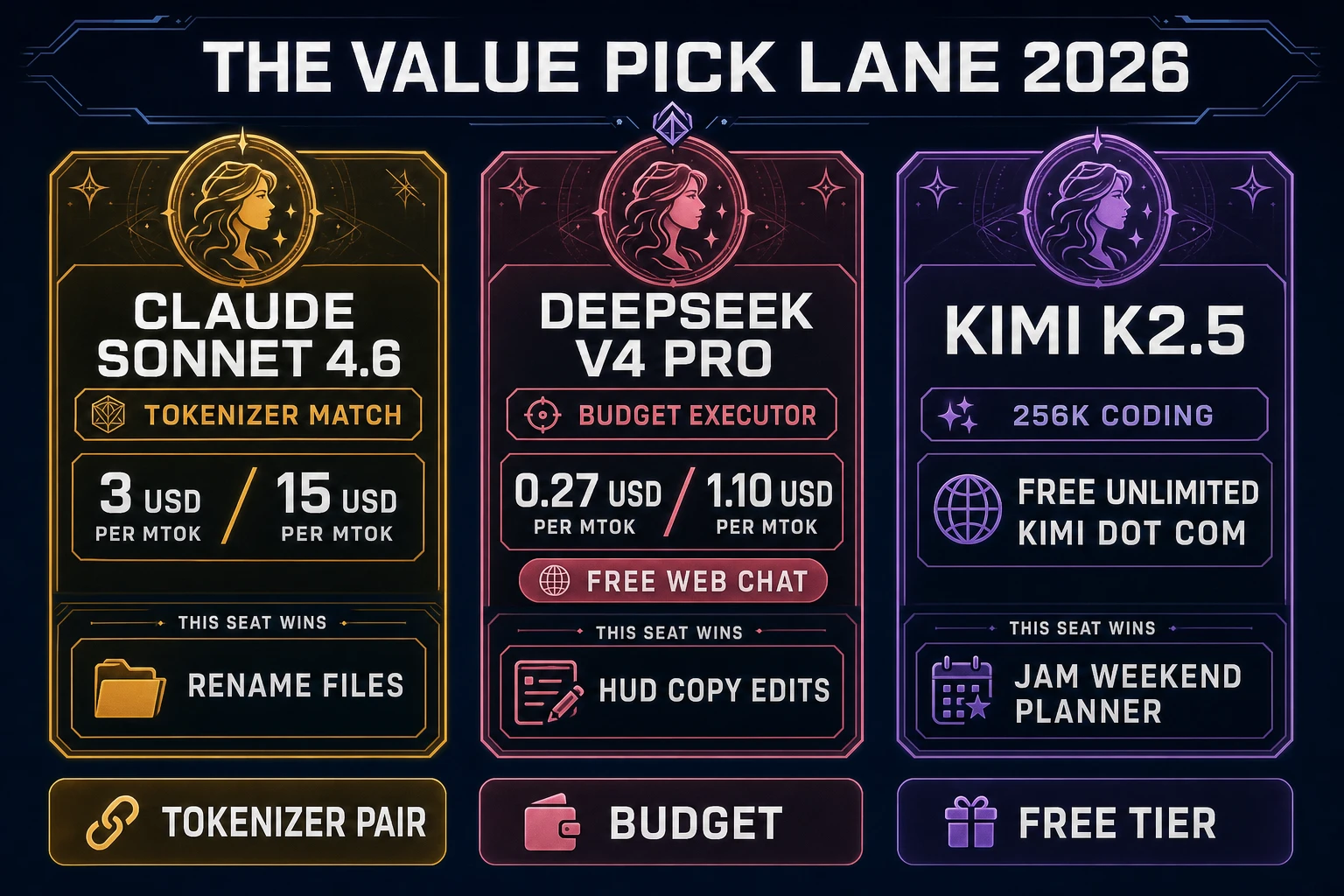
Value pick lane diagram showing Claude Sonnet 4.6 amber DeepSeek V4 Pro rose Kimi K2.5 purple as the fast smart budget and free coding model seats in the Sorceress rotation with per-MTok price cards
The value-pick lane on the 2026-09-10 chart of the best AI model for coding - Claude Sonnet 4.6 is the tokenizer-matched executor, DeepSeek V4 Pro is the paid budget seat, Kimi K2.5 is the free-tier alternate planner.

The value picks - Sonnet 4.6, DeepSeek V4 Pro, Kimi K2.5

The executor seat in a working coding rotation is not a downgraded planner - it is the typist. It reads what the planner drafted, then edits files. Speed and price matter more than raw leaderboard score. Claude Sonnet 4.6 fills that seat in the Sorceress rotation because it shares the Anthropic tokenizer family with Opus 4.7 (context handoffs are free at the token level) and because at $3 / $15 per MTok it costs one-fifth of Opus 4.7 per output token. Verified 2026-09-10 on Anthropic pricing: Sonnet 4.6 sits alongside Sonnet 4.5 at the same price, with newer Sonnet 5 at $2 / $10 sitting below - which means the cheaper Sonnet 5 exists as an option, but Sonnet 4.6 stays on the same tokenizer generation as Opus 4.7, which is why the pairing recipe holds.

DeepSeek V4 Pro is the rose Budget seat and it changes the calculus of the whole chart. Verified 2026-09-10 on the DeepSeek API docs: the current alias resolves to DeepSeek-V4-Pro-0813, with a native 1M context window and Non-Think / Think High / Think Max modes. Non-Think mode is the executor lane - it types at roughly one-tenth the output price of Claude Sonnet 4.6 while producing shippable code for HUD copy edits, rename-across-files refactors, and boilerplate scaffolding. Think High and Think Max modes cross into planner territory. The free web chat at chat.deepseek.com is still open on 2026-09-10, so DeepSeek is the honest “best AI model for coding” pick when the wallet is empty and browser access is the only lane.

Kimi K2.5 sits on the purple 256K-context seat. Sorceress rotation holds K2.5 rather than newer K2.7 Code or K3 on platform.moonshot.ai because K2.5 has the stable, documented pricing behavior the rotation was scored against. K2.5 256K context is the honest second-choice planner when Gemini 3.1 Pro is out of budget and the task still needs to fit four or five files in one prompt. On the free kimi.com tier, Instant and Thinking modes are both unlimited, which turns Kimi into a real free planner alternative for a game-jam weekend where a debit card is not an option.
The agent-ready pick - MiniMax M2.7

MiniMax M2.7 sits on the pink Agent-ready seat and it is not a reasoner. Verified 2026-09-10 on the MiniMax platform docs, M2.7 is scored on how well it emits tool-use JSON, calls functions, and executes multi-step workflows in a sandbox - not on how well it draws a Phaser scene from a text prompt. That is a different job. An agent-ready model is what types “open PlayerController.cs, replace speed = 90 with speed = 70, save, run the test suite, report the results” without dropping a step. For a game-dev workflow that already has a browser sandbox (which is exactly what WizardGenie ships), MiniMax M2.7 is the executor pick when the task is script-shaped, not reasoning-shaped. Any “best AI model for coding” chart that names one seat for both jobs is confusing tool-use rate with algorithm quality.

The honest game-code benchmark for a 2026 pick

Model leaderboards score HumanEval and SWE-Bench. Games score models on the idioms of a specific engine - Phaser scene lifecycle, Three.js render loops, Godot signal wiring, Unity C# coroutines, Pygame event dispatch. The chart below is a real game-jam Monday run from 2026-09-10. Each row lists the task, the honest winning model from the Sorceress rotation, and the seat it plays in the pairing.

Game task Honest pick Seat Why this model, in 2026
Draft a Phaser 4.2.1 Giedi scene (July 2026 release) with a bouncing ball, paddle, and score HUDClaude Opus 4.7PlannerFrontier reasoning on the new Phaser 4 node renderer idioms in one pass
Refactor a Godot GDScript state machine across nine .gd and .tres filesGemini 3.1 ProPlanner1M-context window fits the whole project as a single paste
Paste four Unity C# files plus the whole Phaser 4 example gallery into one promptGrok 4.2Planner2M window is the only seat in the rotation that swallows the paste
Write a Three.js render loop with resize handler and orbit controls from scratchGPT-5.5PlannerFrontier-tier reasoning still ranks on tight WebGL idioms
Rename PlayerController.speed from 90 to 70 across three filesClaude Sonnet 4.6ExecutorSame Anthropic tokenizer as Opus 4.7, one-fifth the output cost
Run a five-step open-file, patch, save, retest, report agent loopMiniMax M2.7ExecutorAgent-ready tool-use rate holds across the five-step chain
Grind 40 HUD copy edits (labels, tooltips, format strings) for penniesDeepSeek V4 ProExecutorNon-Think mode makes typing tasks nearly free
Plan a full weekend jam entry with a debit card that cannot be usedKimi K2.5PlannerFree unlimited Instant and Thinking modes on kimi.com

The pattern repeats across every Sorceress bench: reasoning tasks land on a frontier planner, typing tasks land on a cheap executor, long-context tasks land on the biggest-window model of the moment, agent-shaped tasks land on the tool-use seat. No single model wins every row. That is why an honest “best AI model for coding” pick always resolves into a chart of seats, not a single-name verdict.

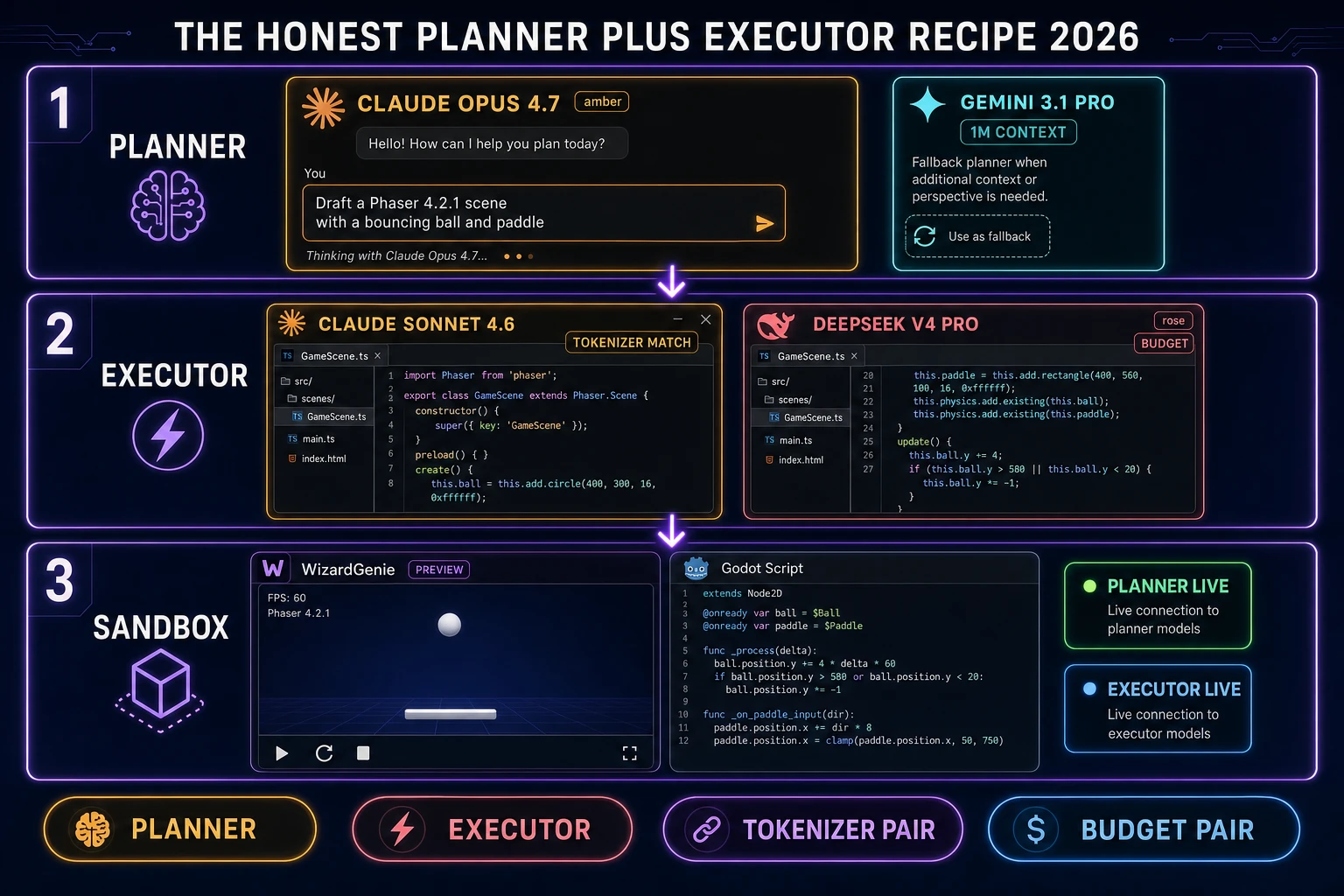
Planner Executor recipe chart showing Claude Opus 4.7 planner feeding into Claude Sonnet 4.6 executor and DeepSeek V4 Pro executor with WizardGenie browser sandbox running a Phaser scene and Godot script side by side
The 2026-09-10 Planner+Executor recipe on the honest chart: Claude Opus 4.7 or Gemini 3.1 Pro on the planner side, Claude Sonnet 4.6 or DeepSeek V4 Pro on the executor side, all wired into the WizardGenie browser sandbox.

The Planner + Executor recipe that beats any single-model pick

Sorceress honest recommendation on 2026-09-10 for the best AI model for coding is two-model, not one-model. The planner does the reasoning. The executor does the typing. The economic logic is that a $5 / $25 per MTok planner emits a plan once, then a $0.27 / $1.10 executor types the code many times against it. The Sorceress WizardGenie surface ships a dual-agent Planner+Executor mode that renders exactly this split in the UI, and the Sorceress Code page holds the BYO-key slots for teams that want to bring their own DeepSeek or NVIDIA credit balance.

  1. Planner = Claude Opus 4.7 (default) or Gemini 3.1 Pro (whole-project paste). Verified 2026-09-10 pricing: Opus 4.7 at $5 / $25 per MTok stays constant with 4.8 and 5 on the same tier, and Gemini 3.1 Pro Preview at $2 / $12 short context. Reach for Gemini when the task spans nine files, reach for Opus when the task is tight algorithm work in one file.
  2. Executor = Claude Sonnet 4.6 (tokenizer pair with Opus 4.7) or DeepSeek V4 Pro (budget path). Sonnet 4.6 is the cleanest pair because context handoffs from Opus 4.7 are token-parity. DeepSeek V4 Pro is the pair when the budget matters more than the tokenizer identity - roughly one-tenth the output cost, still ships production code.
  3. Agent executor = MiniMax M2.7 for the open-file, patch, save, run, report loops. This is the seat that turns a plan into a repeatable script without the human retyping the shell commands. WizardGenie browser sandbox is where this loop actually runs.
  4. Backup planner = Grok 4.2 for the “paste literally the whole game project” requests that Opus 4.7 and Gemini 3.1 Pro both truncate. Grok 2M context is the emergency window for tasks that outgrow every other option.
  5. Free-tier planner = Kimi K2.5 on kimi.com Instant or Thinking mode, plus free-tier executor = DeepSeek V4 Pro on chat.deepseek.com. This is the “debit card is not an option” recipe for a game-jam weekend.

Never pair two frontier planners together as the Planner+Executor combo. Two Opus 4.7 seats, or Opus 4.7 + GPT-5.5 as both sides, defeats the roughly one-fifth cost ratio the pattern exists to deliver. Verified 2026-09-10 in src/app/code/page.tsx: the Sorceress Code page exposes BYO-key slots for four providers - anthropic, deepseek, openai, and nvidia - and keys live only in browser localStorage, never on Sorceress servers. That means a team on the free Sorceress plan can still route to frontier or budget coding models through their own key.

What the honest 2026 pick costs on the Sorceress plan

The last piece of an honest “best AI model for coding” chart is what a real workflow costs. Verified 2026-09-10 in src/lib/models.ts: the Sorceress credit conversion is CREDITS_PER_DOLLAR = 100, meaning one credit equals one US cent of spend on the underlying provider. Verified 2026-09-10 in src/app/plans/page.tsx: the Lifetime Early Access tier is $49 one-time and unlocks the desktop WizardGenie build with auto-update. The rest is per-token pass-through.

A representative game-jam weekend with Opus 4.7 as planner and Sonnet 4.6 as executor consumes roughly:

  • 4 planner turns of 8k input + 4k output on Opus 4.7 = 32k input at $5/MTok plus 16k output at $25/MTok = $0.56 or 56 credits.
  • 40 executor turns of 4k input + 1k output on Sonnet 4.6 = 160k input at $3/MTok plus 40k output at $15/MTok = $1.08 or 108 credits.
  • Total for the weekend: about 164 credits (roughly $1.64) for a full Planner+Executor session that draft-through-ships a small Phaser prototype.

Swap Sonnet 4.6 for DeepSeek V4 Pro on the executor lane and the executor cost drops to roughly $0.11 - the whole weekend lands under 70 credits. On the fully free lane (Kimi K2.5 planner on kimi.com, DeepSeek V4 Pro executor on chat.deepseek.com) the token cost is $0. The Lifetime tier at $49 is a one-time fixed cost, not a per-session cost - see the pricing page for the current tier layout.

Verdict on the best AI model for coding in 2026

Holding steady on 2026-09-10, the honest single-model answer to which is the best AI model for coding is Claude Opus 4.7 - it wins on frontier reasoning, sits at Anthropic’s current top-tier price ($5 / $25 per MTok), shares a tokenizer with Sonnet 4.6 for clean context handoffs, and is one of the eight seats WizardGenie ships out of the box. But the honest workflow answer is a pairing: Opus 4.7 as planner, Sonnet 4.6 as executor for tokenizer parity, DeepSeek V4 Pro as the budget executor when the wallet matters more than the tokenizer, Gemini 3.1 Pro when the task needs the 1M-context planner seat, Grok 4.2 as the emergency 2M-context backup planner, MiniMax M2.7 for tool-use agent loops, Kimi K2.5 as the free-tier alternate planner, and GPT-5.5 as the OpenAI-key path.

The rest of the Sorceress catalog on the home surface - image generation, sprite generation, 3D studio, music, sound - is what turns a working game loop into a shippable jam entry. For the fresh snapshot version of this chart re-verified every week, see Score Best Coding AI Model Right Now (Frontier Bench 2026). For the open-source lane, see Weigh Best Open-Source AI Model for Coding (BYO Bench 2026). For the free-tier game bench, see Gauge the Best Free AI Model for Coding (Games Bench 2026). For the executor-first framing, see Best AI Model for Vibe Coding (Executor Picks 2026). For the offline lane, see Best Local AI Coding Model (Offline Setup 2026). External anchors: the Anthropic pricing page for Claude Opus 4.7 and Sonnet 4.6 rates, the Google Gemini API pricing page for Gemini 3.1 Pro Preview short- and long-context tiers, and the xAI models documentation for Grok 4.20-reasoning and 4.6 context windows and pricing. Re-verify next month - the shipping models rotate faster than any docs page updates.

Frequently Asked Questions

What is the best AI model for coding in 2026?

As of 2026-09-10, the honest single-model pick is Claude Opus 4.7. Anthropic pricing lists Opus 4.7 alongside newer Opus 4.8 and Opus 5 at the same $5 input / $25 output per million tokens tier, and the 4.7 tokenizer is the generation Sorceress backend targets. Opus 4.7 wins frontier reasoning tasks in one pass. For a real workflow, pair it with Claude Sonnet 4.6 as the tokenizer-matched executor (same tokenizer, one-fifth the output cost) or with DeepSeek V4 Pro on the budget executor lane. Sorceress ships this pairing as the WizardGenie dual-agent Planner+Executor mode.

Which AI coding models does Sorceress actually rotate in 2026?

Verified 2026-09-10 in src/app/_home-v2/_data/tools.ts lines 766-775, the Sorceress CODING_MODELS constant is exactly eight seats: Claude Opus 4.7 (Top tier), Claude Sonnet 4.6 (Fast + smart), GPT-5.5 (Frontier), Gemini 3.1 Pro (1M context), DeepSeek V4 Pro (Budget), Kimi K2.5 (256K coding), Grok 4.2 (2M context), and MiniMax M2.7 (Agent-ready). Each seat has a purpose-built role - frontier reasoning, fast executor, budget executor, long-context planner, huge-context backup, agent tool-use. The rotation is what makes WizardGenie plus Sorceress Code a real Planner+Executor rig instead of a single-model chat.

What is the best local AI model for coding in 2026?

For the local lane, the honest 2026 pick is DeepSeek V4 Pro (self-hosted through the DeepSeek open-weights release) or Kimi K2.5 running on a Moonshot open-weights checkpoint - both fit on a single high-end GPU or a two-GPU workstation, both hold their own on Phaser and Godot code, both cost $0 per token after the hardware is paid. Sorceress does not run local inference itself, but the Sorceress Code page (verified 2026-09-10 in src/app/code/page.tsx) exposes BYO-key slots that accept any OpenAI-compatible endpoint URL. Point it at a local Ollama or vLLM server and the rotation seat still holds. For the deeper offline setup walkthrough, see the Best Local AI Coding Model offline-setup piece linked in the article body.

Which AI model is best for coding on a free tier in 2026?

On 2026-09-10, the honest free-tier pick is a two-model recipe: Kimi K2.5 on kimi.com Instant or Thinking mode as the planner (unlimited on the free tier), plus DeepSeek V4 Pro on chat.deepseek.com as the executor. Both are browser-first, both cost $0 in tokens, both produce shippable game code for a weekend jam. NVIDIA NIM keys plugged into the Sorceress Code page unlock Kimi K2.5 and multiple Sorceress-catalog coding models with free credits on account signup, which is the other free lane worth naming. For the deep free bench across seven game tasks, see the sibling piece Gauge the Best Free AI Model for Coding linked in the article body.

Why is a pairing the honest answer instead of one best AI coding model?

Because the roles are different. A planner does frontier reasoning on a hard cross-file design problem in one pass - that seat wants Claude Opus 4.7 or Gemini 3.1 Pro. An executor types the code the planner drafted into files at one-fifth the price - that seat wants Claude Sonnet 4.6 or DeepSeek V4 Pro. An agent-ready model runs a five-step open-file, patch, save, retest, report loop without dropping a step - that seat wants MiniMax M2.7. A single model cannot win all three roles at the price the pairing wins them. Verified 2026-09-10 on Anthropic pricing: Opus 4.7 at $5/$25 per MTok is roughly 5x the per-output-token cost of Sonnet 4.6 at $3/$15, so using Opus 4.7 to type executor-shaped edits burns money the pairing does not need to burn.

Sources

  1. Anthropic Pricing - Claude Opus 4.7 and Sonnet 4.6
  2. Google Gemini API Pricing - Gemini 3.1 Pro Preview
  3. xAI Models Documentation - Grok 4.20 Reasoning and Grok 4.6
  4. Phaser v4.2.1 Giedi Release Notes
  5. Games - MDN Web Docs
  6. Large Language Model - Wikipedia
Written by Arron R.·3,051 words·14 min read

Related posts