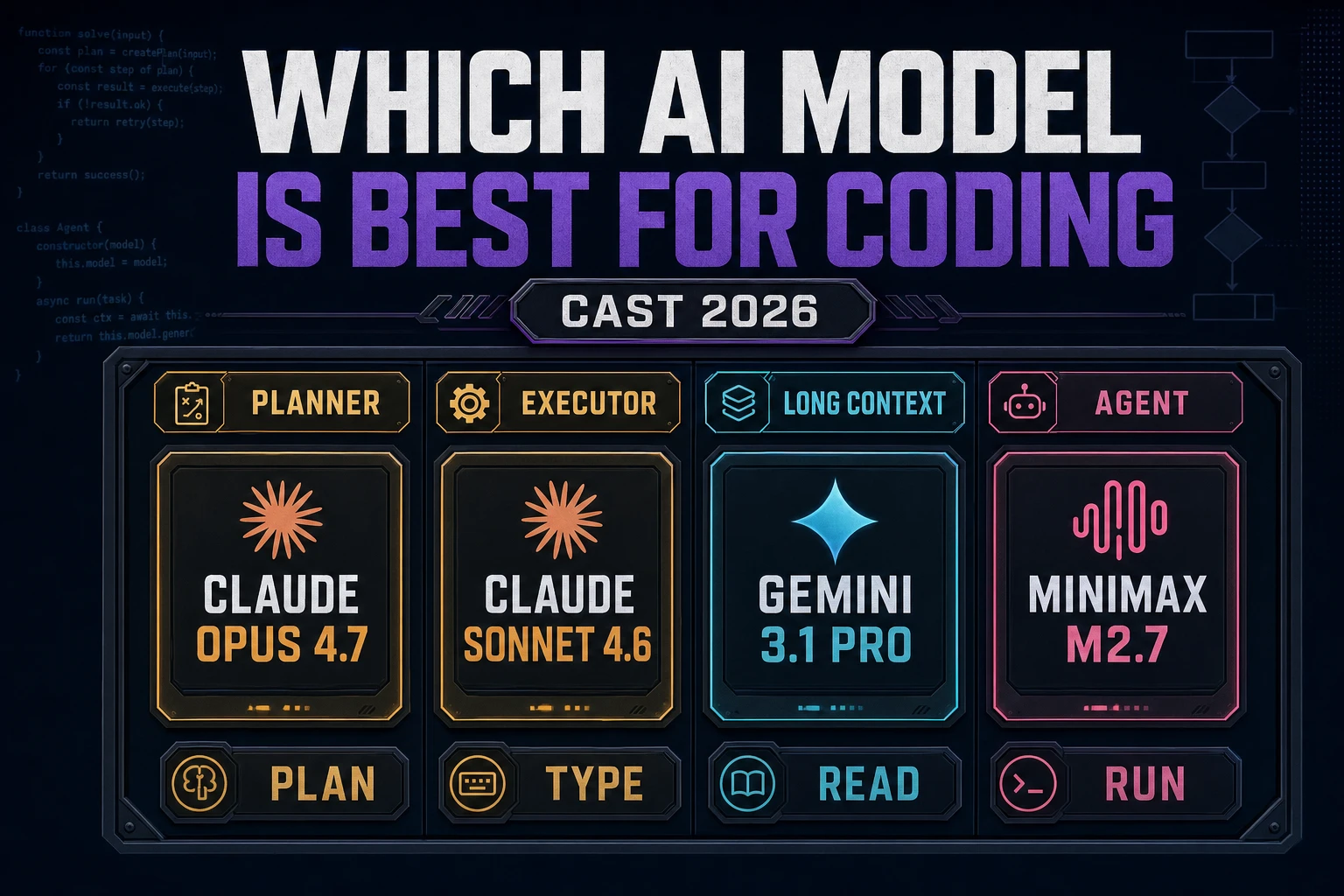
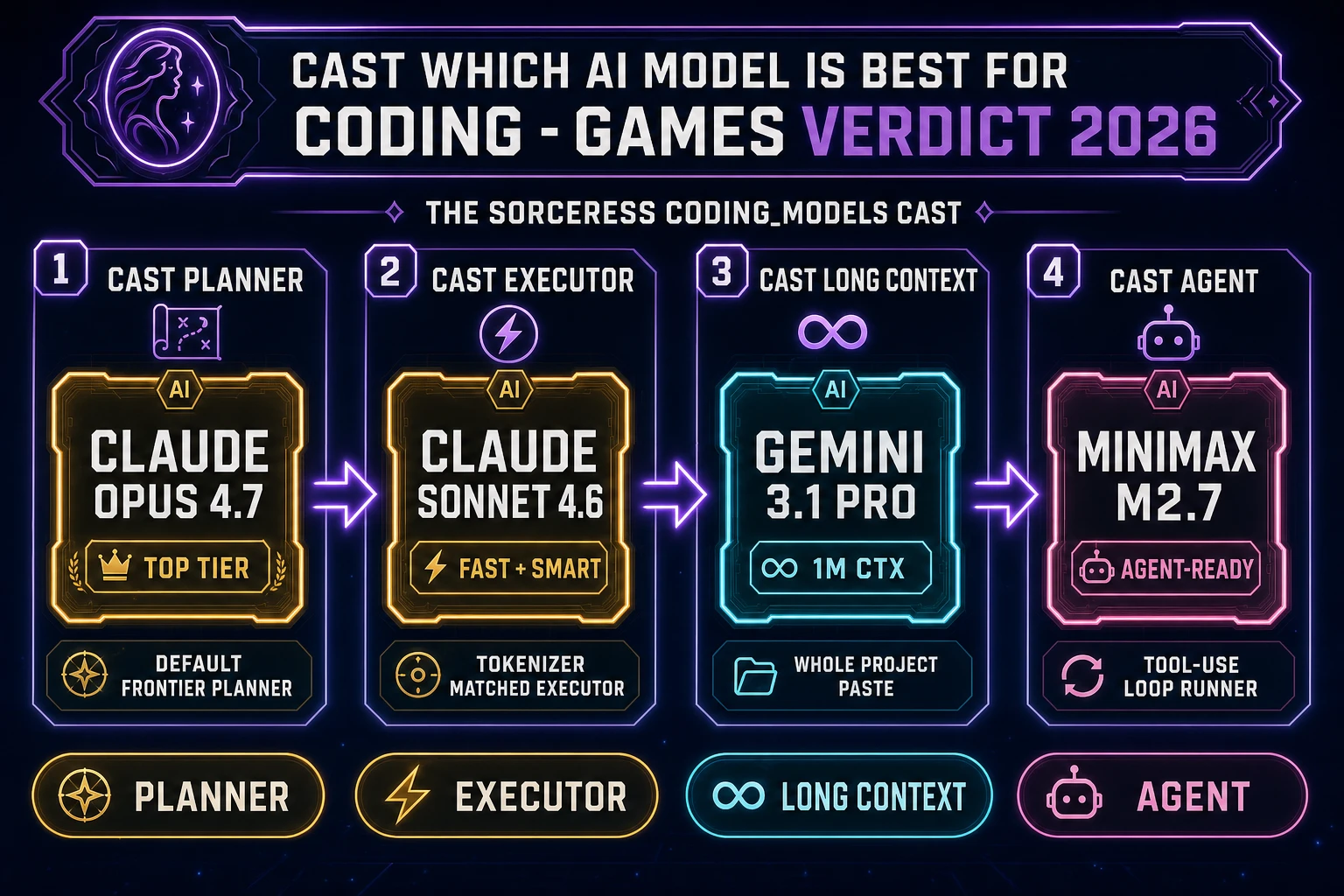
Every week, some indie dev types which ai model is best for coding into a search bar and gets back a list of blog posts each naming one winner as if that were a real answer. The honest verdict on 2026-09-10 is that the question is the wrong shape. A working game-dev day breaks into four different coding jobs - plan a hard cross-file problem, type many small edits, read a huge project paste, run a sandboxed agent loop - and the eight models Sorceress rotates through WizardGenie and Sorceress Code each fill a different role. This post casts every seat in that rotation against the job it wins, so the answer to which ai model is best for coding in 2026 stops being one name and becomes a per-job casting sheet. Every claim is verified 2026-09-10 against the vendor pricing pages and the Sorceress source in src/app/_home-v2/_data/tools.ts lines 766 to 775.
Which AI model is best for coding depends on which job you cast
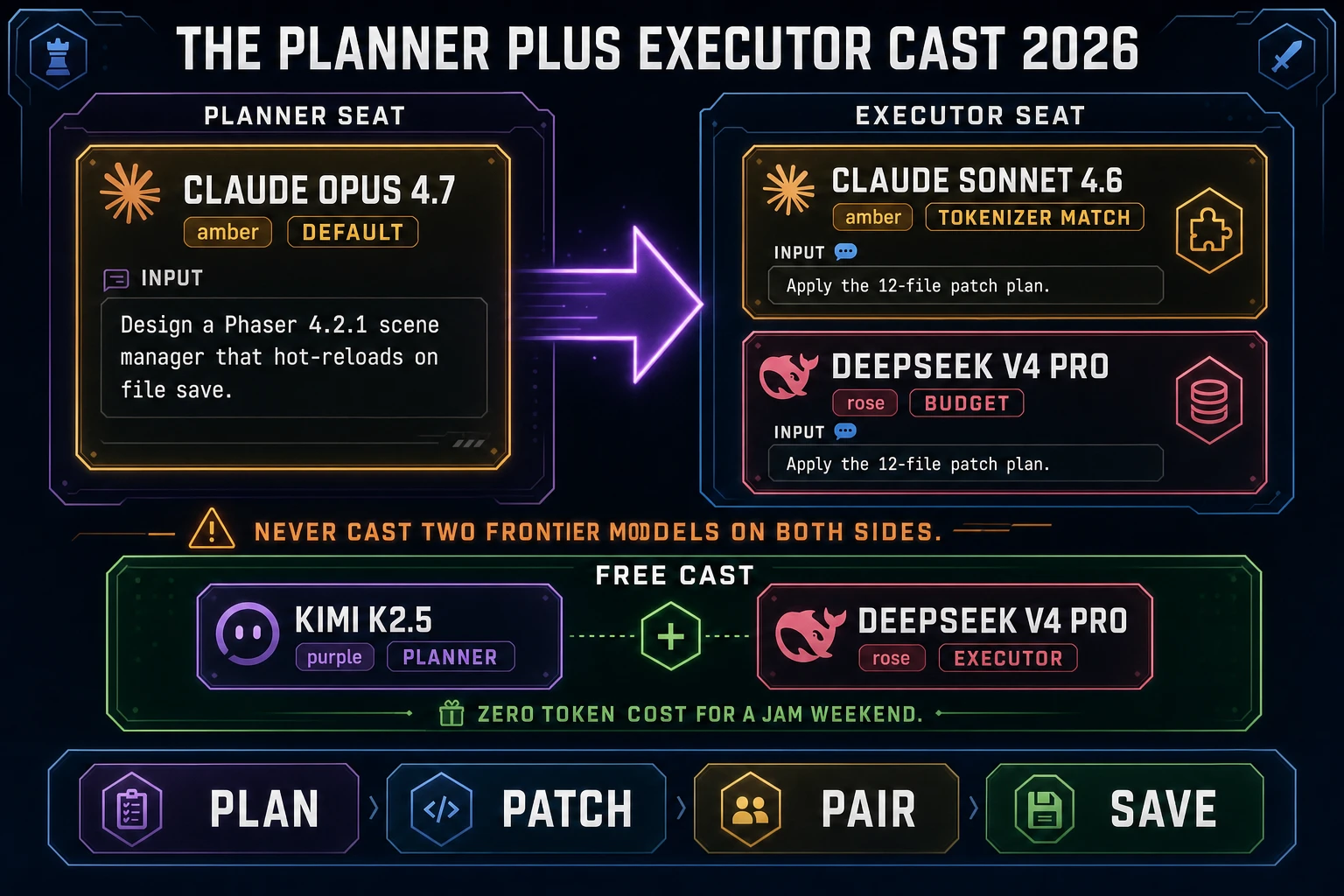
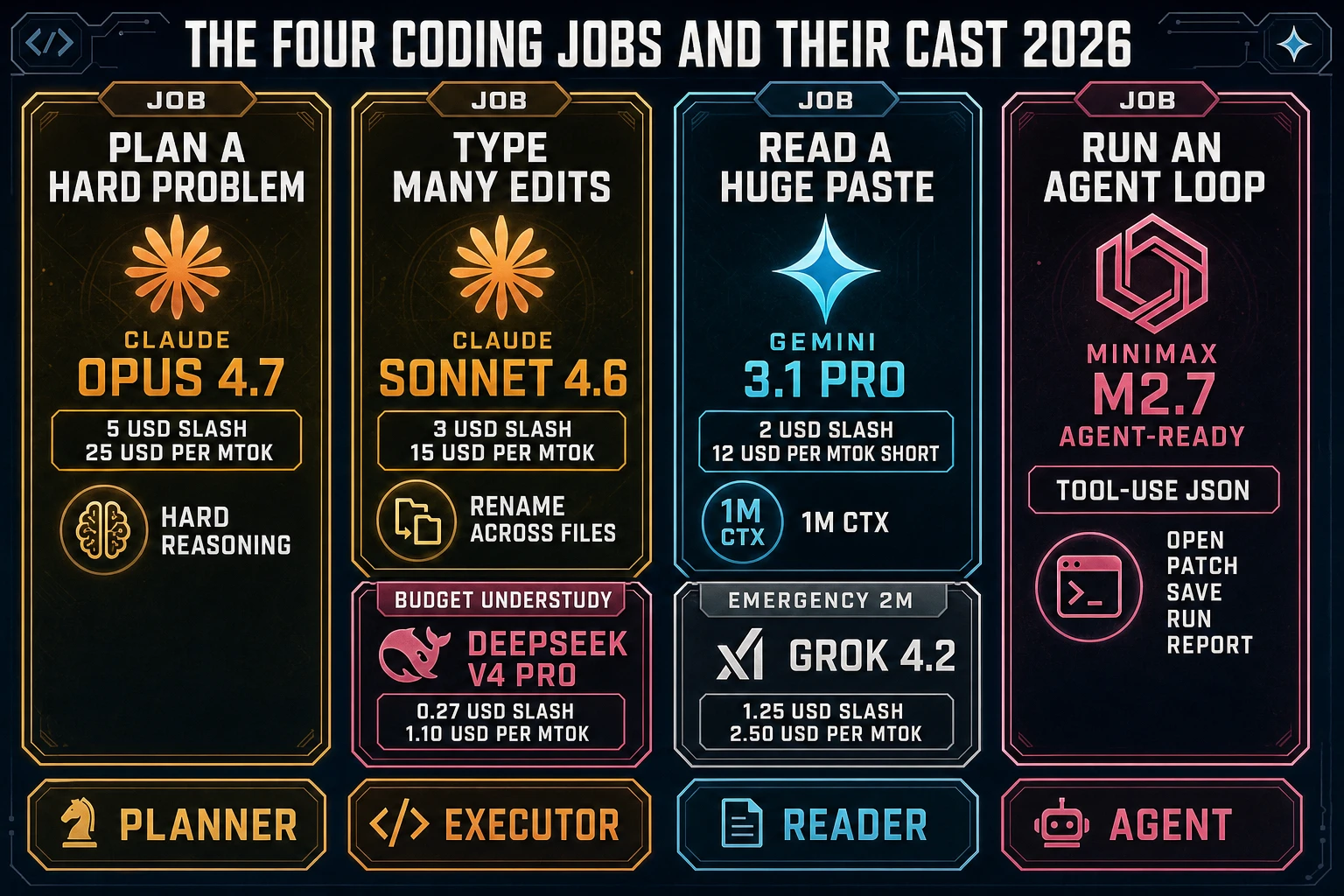
The first honest thing to say about the which ai model is best for coding question is that it hides four different jobs. Job one is planning: solve a cross-file design problem in one pass, then hand off a plan. Job two is typing: apply that plan across many files at the lowest per-token cost. Job three is reading: hold a whole-project paste in context and answer questions about it. Job four is running an agent loop: open a file, patch a value, save, run the test suite, report the result, and loop. A single “best” model would have to win all four rows every week - and no seat on the Sorceress rotation does. Verified 2026-09-10 against Anthropic pricing, Claude Opus 4.7 stands at $5 input / $25 output per million tokens on the same top tier as newer Opus 4.8 and Opus 5, while Sonnet 4.6 at $3 / $15 is roughly one-fifth the output cost. That five-times gap is why the sort names two different seats for the plan job and the type job. Trying to cast Opus 4.7 on both sides burns money the workflow does not need to burn.
Casting matters more than ranking because a rank-first framing hides role fit. Kimi K2.5 ranks last on the paid coding bench and first on the free-tier planner bench - the same seat, two different roles. MiniMax M2.7 ranks middle on raw code generation and first on tool-use loops - one seat, two very different scores. Any post that answers which ai model is best for coding with a single name is confusing rank with fit. The rest of this piece walks each of the four jobs and names the model to cast, then closes with the pairing recipe that makes the whole cast work together.
The eight seats in the Sorceress WizardGenie plus Sorceress Code rotation
Verified 2026-09-10 in src/app/_home-v2/_data/tools.ts lines 766 to 775, the Sorceress CODING_MODELS constant is exactly eight seats. Each seat carries a provider, a tag that names its role, and an accent color that renders in the model picker. The table below is the casting sheet: what the seat is called, what tier it sits on, and which of the four jobs above it wins.
| Seat | Provider | Tag | Accent | Cast role |
|---|---|---|---|---|
| Claude Opus 4.7 | Anthropic | Top tier | Amber | Planner (default frontier) |
| Claude Sonnet 4.6 | Anthropic | Fast + smart | Amber | Executor (tokenizer-matched typing) |
| GPT-5.5 | OpenAI | Frontier | Emerald | Planner (alternate; OpenAI-key path) |
| Gemini 3.1 Pro | 1M context | Cyan | Reader (1M-token whole-project paste) | |
| DeepSeek V4 Pro | DeepSeek | Budget | Rose | Executor (budget; ~1/10 cost) |
| Kimi K2.5 | Moonshot | 256K coding | Purple | Planner (free-tier alternate on kimi.com) |
| Grok 4.2 | xAI | 2M context | Zinc | Reader (emergency 2M-window paste) |
| MiniMax M2.7 | MiniMax | Agent-ready | Pink | Agent runner (tool-use loops) |
Two rows on this sheet want the same job - Opus 4.7 and GPT-5.5 both cast as planners, Sonnet 4.6 and DeepSeek V4 Pro both cast as executors, Gemini 3.1 Pro and Grok 4.2 both cast as readers. That is intentional. The primary cast is the honest default; the secondary cast is the alternate for a specific constraint (BYO OpenAI key, a wallet-first week, or a paste that outgrows 1M tokens). Kimi K2.5 is a special case: on the paid bench it ranks last, but on the free-tier planner bench (unlimited kimi.com Instant and Thinking modes) it ranks first. That flip is exactly why casting beats ranking on the which ai model is best for coding question.
Best for planning: cast Claude Opus 4.7
For the plan job, cast Claude Opus 4.7 as the default. Verified 2026-09-10 on docs.anthropic.com/en/docs/about-claude/pricing, Opus 5, Opus 4.8, Opus 4.7, Opus 4.6, and Opus 4.5 all sit side by side at the same $5 input / $25 output per million tokens on the top tier. That means the reason Sorceress holds on 4.7 rather than the newer Opus versions is not price - it is tokenizer parity with the executor cast. Claude 4.7 and later use a newer tokenizer that produces roughly 30% more tokens for the same text, and Opus 4.7 sits at the boundary of that tokenizer generation with Sonnet 4.6 on the previous generation - the exact pair that hands off a plan without a re-tokenization step in the middle.
The job Opus 4.7 wins is the one-pass cross-file algorithm. Design a Phaser 4.2.1 Giedi (released 2026-07-09) scene manager that hot-reloads on file save. Refactor a Godot GDScript state machine so the enemy AI takes damage the same way the player does. Redesign a Three.js orbit-controls loop to work with a resize handler. All three of those tasks want a single frontier draft, not five cheap drafts. The alternate cast on the plan job is GPT-5.5, held on the emerald Frontier seat as the OpenAI-key path. Sorceress holds on 5.5 rather than the newer gpt-6 family because 5.5 was the last generation where a full internal bench ran against real Phaser and Godot code. Reach for GPT-5.5 when the shop already pays OpenAI and the task is a tight WebGL shader math draft or a fresh Three.js render loop.
Best for typing: cast Claude Sonnet 4.6 with a DeepSeek V4 Pro understudy
For the type job, cast Claude Sonnet 4.6 as the default and DeepSeek V4 Pro as the budget understudy. Verified 2026-09-10 against Anthropic pricing, Sonnet 4.6 at $3 / $15 per MTok is roughly one-fifth the output cost of Opus 4.7 and shares the newer tokenizer generation for clean handoffs from the planner. Verified 2026-09-10 on the DeepSeek API docs, the current DeepSeek-V4-Pro-0813 revision ships with a native 1M-token context window and three inference modes: Non-Think, Think High, Think Max. Non-Think mode is the executor lane, and it runs at roughly one-tenth the output cost of Sonnet 4.6 - which changes the shape of any task that involves grinding forty HUD copy edits or scaffolding a new Phaser scene from a template. The free chat.deepseek.com web tier is still open on 2026-09-10, which is a real zero-token executor lane for weekend jam workflows that cannot expense an API budget.
In a real Sorceress week, the executor cast types more code than every other seat combined. Rename PlayerController.speed from 90 to 70 across three files. Rewire a Godot signal to a different handler in six scenes. Bump the enemy spawn interval in twelve Phaser scenes at once. Type the twelve-file patch plan the Opus 4.7 planner just drafted. Every one of those tasks is executor-shaped, not frontier-shaped, and the sort names Sonnet 4.6 first because tokenizer parity with the Opus 4.7 planner is worth the extra $2 output difference against Sonnet 5 ($2 / $10 on the older tokenizer generation, which breaks the pair). The newer Sonnet 5 is real and cheaper, but the tokenizer boundary is why the cast keeps 4.6 in the default seat.